light AUDI R8 SPYDER 2012 Repair Manual
[x] Cancel search | Manufacturer: AUDI, Model Year: 2012, Model line: R8 SPYDER, Model: AUDI R8 SPYDER 2012Pages: 236, PDF Size: 59.24 MB
Page 121 of 236
electronic control unit (the PA SS ENGE R AIR
BAG OFF
light comes on and stays on).
A WARNING
Sitting in the wrong position can increase
the risk of serious injury in crashes.
- To reduce the risk of injury when the air
bags inflate, the driver and passengers
must always sit in an upright posit ion,
must not lean against or place any part
of the ir body too close to the area where
the a irbags are located .
- Occupants who are unbelted, out of posi
t ion or too close to the airbag can be se
riously injured by an airbag as it unfolds
with great force in the blin k of an eye
¢page 111.
A WARNING
A child in a rearward-facing child sa fety
sea t insta lled on the front passenger seat
wi ll be seriously injured and can be k illed if
the front ai rbag inflates -even with an Ad
vanced Airbag System.
-
-The inflating airbag will hit the child
safety seat or infant carrier w ith great
force and w ill smash the ch ild safety seat
and child against the backrest, center
armrest , door or roof.
- Never install a rearward facing child
safety seat on the front passenger seat
unless the
PASSENGER A IR BAG OFF
light comes on and stays on . If the PAS
SENGER AIR BAG OFF
light does not
c ome o n and stay on, the inflating airbag
will hit the child safety seat o r infant car
rier wi th great force and will smash the
child safety seat and child against the
backrest, door or roof . Have the airbag
system inspected immediately by your
authorized Audi dealer .
A WARNING
Objects between you and the a irbag will
increase the risk of in jury in a c rash by in
terfering with the way the airbag unfolds
A irbag system 119
or by be ing p ushed into you as the airbag
inflates.
- Never hold things in you r hands o r on
your lap when the veh icle is in use.
- Never transport items on or in the area
of the front passenger seat . Objects
could move into the a rea of the front air
bags during braking or other sudden ma
neuvers and become dangerous projec
tiles that can cause ser ious personal in
jury if t he a irbags inflate .
- Never p lace or attach accessories or oth
er objects (such as cup holders, te le
phone b rac kets, large, heavy or bulky ob
jects) on the doors, ove r o r near the area
marked "AIRBAG " on the s teering wheel,
instrument panel, seat bac krests or be
tween those areas and yo urself. These
objects could cause inju ry in a c rash, es
pecially when the airbags inflate.
- Never recline the front passenger's seat
to transport objects . Items can a lso
move into the area of the s ide a irbag or
the front a irbag during braking or in a
sudden maneuver. Objects near the air bags can become projec tiles a nd cause
in ju ry, partic ula rly when the seat is re
clined.
A WARNING
T he fine dus t created when airbags deploy
can cause breathing prob lems fo r people
wi th a history of as thma or other breath
ing cond itions.
- T o reduce t he risk of bre ath ing problems,
those wi th asthma o r other respiratory
conditions s hou ld get fresh air r ight
away by getting o ut of the veh icle or
open ing windows or doors.
- If you are in a collision in which airbags
deploy, wash your hands and face with
mild soap and water before eating .
- Be ca reful not to get the dust into your
eyes, or into any c uts or scratches.
- If the resi due should get into your eyes,
f lush them w ith wate r.
•
•
Page 122 of 236
120 Airbag system
Monitoring the
Advanced Airbag
System
I Airbag monitoring indicator light
Two separate indicators monitor the function
of the Advanced Airbag System: the airbag
monitoring indicator light and the
PASSEN
GER AIR BAG OFF
light.
The Advanced Airbag System (includ ing the
e lectronic control un it, sensor circuits and sys
tem wiring) is monit ored cont inuous ly to
make sure that it is functioni ng properly
wheneve r the ignit io n is on. Each t ime yo u
turn on the igni tion, the airbag mon itoring in
d icator light
I will come on for a few se co n ds
(sel f di agnos tic s) .
The system must be inspected when the
indicator light
I :
- does not come on when t he ignit io n is
swi tched o n,
- does not go ou t a few seconds afte r yo u
h ave swi tched on the ign ition, o r
- comes on wh ile d riving .
If an airbag system malfunct ion is detected,
the ind icator light will first start flash ing to
catch the driver's attention and then stay on
continuously to se rve as a constant reminde r
to have the system inspected immediately.
If a malfunction occurs that turns the front
a ir bag on the passenger side off, the
PASSEN
GER AIR BAG OFF
li ght w ill come on and stay
on w henever the ign ition is on.
_& WARNING
An air bag system tha t is no t funct ionin g
prope rly ca nno t pro vide supplemen tal p ro
t ection in a fron tal crash .
-If the air bag indic ator li ght co mes on, it
means that there may be somet hing
wron g wit h the Adva nce d Airbag System.
It is possible t hat the air bag will inflate
when it is not s upposed to, or w ill not in
flate when it should.
-
- Have the airbag system inspected imme
diate ly by yo ur autho rized Au di dea le r.
PASSENGER AIR BAG OFF light
Fi g. 1 23 Sect ion from the instr um en t pa nel: PASSEN
GER AIR BAG O FF lig ht
The PASSENGER AIR BAG OFF light is located
i n t he center of the inst rument pa ne l
<=> fig . 123.
The
PASSENGER AIR BAG OFF light wi ll come
o n and stay on to tell you w hen the front Ad
vanced Airbag on the passenge r side has been
turned off by the electro nic contro l unit. Each
t ime you turn on the igni tion, the
PASSEN
GER AIR BAG
OFF light will flas h for a few
se co nds a nd:
- w ill stay on if the fro nt passenge r seat is not
occu pied,
- will stay on if the re is a small ch ild or child
restrai nt on the front passenge r seat,
- will go out if the front passenge r seat is oc
cupied by an adult as registered by the
weight-sens ing mat.
The
PASSENGER AIR BAG OFF light must
come on and stay on
if the ignition is on and
- a car bed has been installed on the front
seat, or
- a rearward-facing child rest raint has been
installed on the front passenger seat, o r
- a forwar d-fac ing ch ild restra int has been in
stalled on the front passenger seat, or
- t he weight reg iste red on the fron t passen
ge r seat is equal to or less t han the com
bined weig ht of a typical 1 year -o ld restra in
ed in one of the rear-facing or forward-fac-
ing infant restra ints listed in Federal Motor ..,.
Page 123 of 236
Vehicle Safety Standard 208 with which the
Advanced Airbag System in your vehicle was
certified.
I f the front passenger seat is not occ upied,
the front airbag will not deploy, and the
PA S
SENGER A IR BAG OF F
light will stay on. Nev
er insta ll a rearward-fac ing ch ild restra int on
the front passenger seat
c:> page 111, Child
restraints on the front seat -some important
things to know
and c:> page 130, Child Safety .
If the PASSENGER AIR BAG O FF light c omes
on
when one of the conditions listed above is
met, be sure to check the light regularly to
make certa in that the
PA SS ENG ER AIR BA G
OFF
light stays on cont inuously whenever the
i gn it ion is on. If the
PASSENGER AIR BAG
OFF
l ight does not appear on and stay on a ll
the t ime, stop as soon as it is safe to do so
and
- r eact ivate the system by turning the ignition
off and then turning it on again;
- remove and re install the child restraint .
Make sure that the child restraint is properly
installed and that the safety be lt fo r the
front passenger seat has been correct ly
ro uted through the child restraint as descri
bed in the chi ld restraint man ufacturer's in
structions;
- make su re that the convertible locking fea
ture on the safety be lt for the front passen
ger seat has been activated and that the
safety belt has been pulled tight. The belt must not be loose or have loops of slack so
that the sensor below the safety belt latch on the seat can do its job
c:> page 138;
- make sure that th ings that may increase the
weight of the ch ild and child safety seat are
not being transported on the front passen
ger seat;
- make sure that the safety belt tension sen
sor is not b locked. Shake the safety belt
latch on t he front passenge r seatbac k and
forth;
- If a st rap or tether is being used to tie the
c hild safety seat to the front passenger
seat, make s ure t hat i t is no t so tight tha t it
A irbag system 12 1
causes the weight -sensing mat to measure
more weight than is act ually on the seat.
If th e PASSENGER AIR BAG OFF light still
d oes not come on
and does not stay on con
tin uous ly (when the ignition is switched on),
- take the child rest ra int off the front passen-
ge r seat and have the a irb ag sys tem inspect
ed by yo ur authori zed Aud i dealer . Do not
transport children witho ut a c hil d safety
seat.
T he
PASSENGER AIR BAG OFF lig ht sho uld
NOT come on when the ignit ion is on and an
adult is s itting in a proper seating position on
the front passenger seat . If the
PASSENGER
AIR BAG OFF
light comes on and stays on or
flashes for about 5 seconds wh ile driving, un
der these c ircumstances, make sure that:
- the adult on the front passenger seat is
properly seated on the center of the seat
cushion with his or her back up aga inst the
backrest and the backrest is not recl ined
c:> page 92, Proper occupant seating posi
tions,
- the adult is not tak ing weight off the seat by
holding on to the passenger assist handle
above the front passenger door or support
ing their weight on the armrest,
- the safety belt is be ing properly worn and
that the re is not a lot of s lack in the safety
be lt webbing,
- accesso ry seat covers or cushions or other
things that may cause an inco rrect reading
or impression on the weight-sensing m at
under t he upho ls tery of the seat have been
removed from the front passenger sea t,
- a safety belt extender h as not been left in
t he sa fe ty belt latch for the fron t passenger
seat.
In add ition to the
PASSENGER AIR BAG OFF
l igh t in the center of the instrument panel,
t h e message
PASSENGER AIR BAG OFF or
PASSENGER AIR BAG ON wi ll briefly appear
i n the instrument cluster disp lay. This is to in
form the dr iver of the current front passenger
airbag status.
•
•
Page 124 of 236
122 Airbag sys te m
Important safety instructions on
monitoring the Advanced Airbag System
A WARNING
An airbag system that is not functioning
properly cannot provide supplemental pro
tect ion in a frontal crash.
- If the airbag indicator light comes on, it
means that there may be someth ing
wrong with the Advanced A irbag System .
It is possible that the airbag will inflate
when it is not supposed to, or w ill not in
flate when it should.
- Have the airbag system i nspected imme
diately by your author ized Audi dealer.
A WARNING
If the front air bag inflates, a ch ild witho ut
a child restra int, or in a rearwa rd-fac ing
child safety seat, or in a forward- facing
child restraint that has not been prope rly
installed will be serious ly injured and can
be killed.
- Even though your ve hicle is equipped
with an Advanced Airbag System, make certain that all children, especially 12
years and younger, a lways ride proper ly
restrained for their age and s ize.
- Never install a rearward facing child
safety seat on the front passenge r seat
unless the
PASSENGER AIR BAG OFF
light comes on and stays on. If the PAS ·
S ENGER AIR BAG OFF
light does not
come on and stay, on the inflating airbag
wi ll hit the child safety seat or infant car
rier with great fo rce and will smash the
child safety seat and child against the
backrest, door or roof. Have the airbag
system inspected immediately by your
authorized Audi dealer.
-A tight tether or other strap on a rear ward-facing child restra int attached to
the front passenger seat can put too much pressure on t he weight-sens ing
mat in the seat and register mo re weight
than is actually on the seat. The heavier
we ight registe red can make the system
-
wo rk as though an adult we re on the seat
and deploy the Advanced Airbag when it
must be suppressed, causing serious or
even fata l injury to the ch ild.
- If, i n exceptiona l circumstances, you
must install a forward-fac ing c hild re·
straint on the front passenger seat, al
ways move the seat i nto its rearmost po
sition in the seat's fore and aft adjust
ment range, as fa r away from the a irbag
a s poss ible. The b ackrest mus t be ad just
ed to an upright pos ition . Make s ure that
the
PASSENGER AIR BAG OFF light
comes on and stays on all the time when
ever the ignit ion is switched on.
A WARNING
=
- If the PASSENGER AIR BAG OFF light
does not go out when an adult is sitt ing
on the front passenger seat after taking
the steps described above, have the ai r
bag system inspected by yo ur autho rized
Aud i deale r before t ransporti ng anyone
on the front passenger se at.
(D Tips
If the weight-sensing mat in t he front pas
senger seat de tects an empty seat, the
front ai rbag on the passe nger side wi ll be
t urned off, and the
PASSENGER AIR BAG
OFF
w ill stay on.
-
Care, service and disposal of the airbags
Parts of the airbag system are installed at
many different places o n your Audi . Insta lling,
removing, servicing or repa iring a part in an
area of the veh icle can damage a part of an
airbag system a nd prevent that system from
working properly in a coll is ion.
There are some important things you have to
know to make sure that th e effectiveness of
the system w ill not be impaired and that dis
carded components do not cause injury or pol -
l u te the environment. ..,.
Page 126 of 236
124 Airbag system
Other things that can affect Advanced
Airbag performance
Changing the vehicle's suspension system can
change the way that the Advanced Airbag Sys
tem performs in a crash. For example, using
tire-r im combinations not approved by Audi,
lowering the vehicle, changing the stiffness of
the suspension, including the springs, suspen
sion strut s, shock absorbers etc. can change
the forces that are measured by the airbag sensors and sent to the electronic control
unit. Some suspension changes can, for example, increase the force levels measured by the
sensors and make the airbag system deploy in
crashes in which it would not deploy if the
changes had not been made. Other kinds of
changes may reduce the force levels meas
ured by the sensors and prevent the airbag
from deploying when it should .
The sensors in the safety belt buckle for the
driver and front passenger seat tell the elec
tronic control module if the safety belt is
latched or not .
If the safety belt is being used,
the front airbag will deploy at a slightly high er rate of vehicle deceleration than if the safe
ty belt is not being used. Therefore, in a par
ticular collision, it is possible that an airbag
will not deploy at a seating position where the
safety belt is being used but will inflate at the
position where the safety belt is not being
used.
It is important that nothing interfere
with the safety belt buckles so that the sen
sors can send the correct information about
safety belt use to the electronic control unit .
A WARNING
Changing the vehicle's suspension includ
ing use of unapproved tire-rim combina
tions can change Advanced Airbag per
formance and increase the risk of serious
personal injury in a crash.
- Never install suspension components
that do not have the same performance
characteristics as the components origi
nally installed on your vehicle.
- Never use tire-rim combinations that
have not been approved by Audi.
A WARNING
-Items stored between the safety belt
buckle and the center console can cause
the sensors in the buckle to send the
wrong information to the electronic con
trol module and prevent the Advanced Air
bag System from working properly.
- Always make sure that nothing can inter
fere with the safety belt buckles and that
they are not obstructed.
Knee airbags
· Description of knee airbags
The knee airbag system con provide supple
mental protection to properly restrained
front seat occupants.
Fig. 124 Drive r's airbag
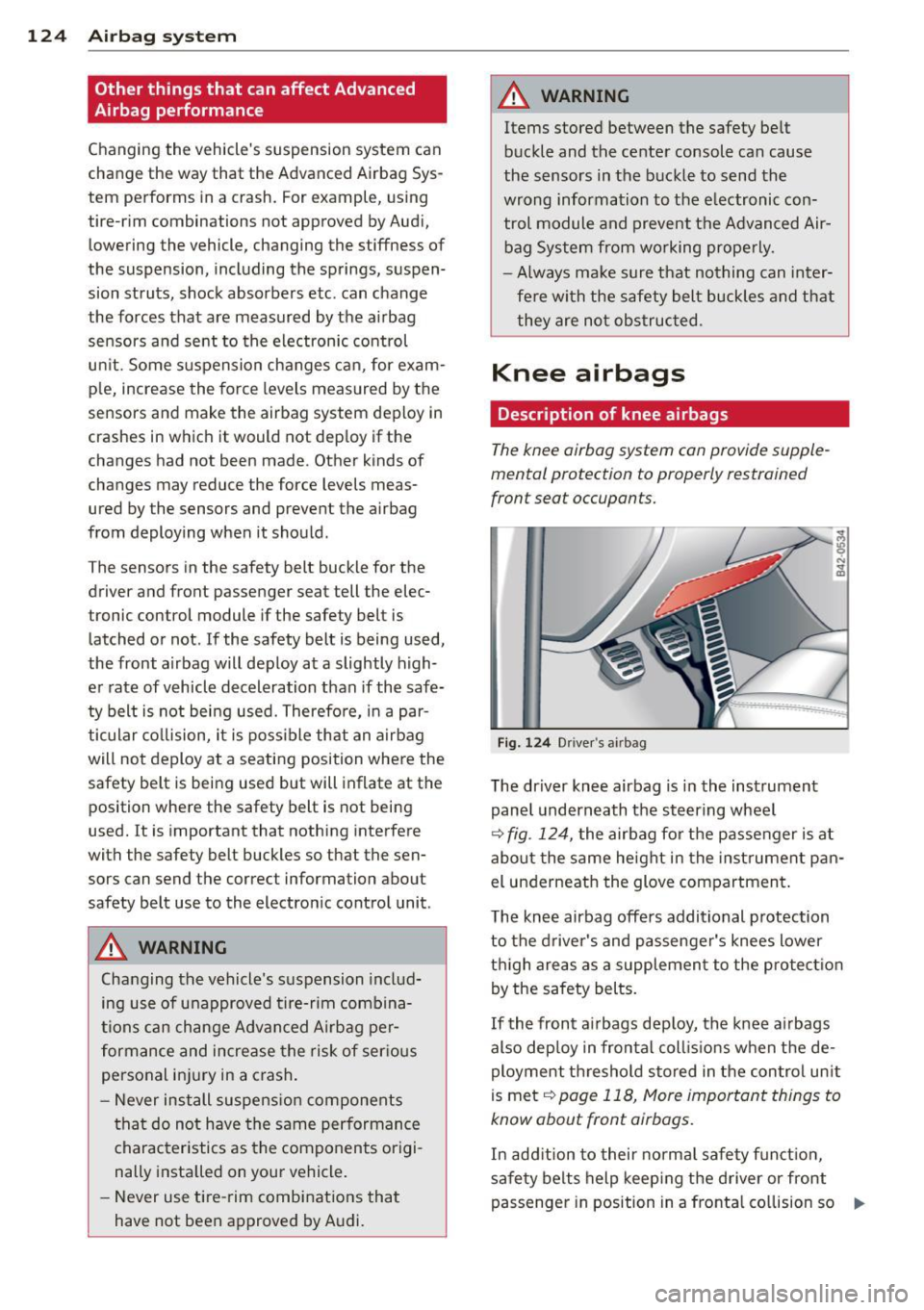
The driver knee airbag is in the instrument
panel underneath the steering wheel
~ fig . 124, the airbag for the passenger is at
about the same height in the instrument pan
el underneath the glove compartment.
The knee airbag offers additional protection
to the driver's and passenger's knees lower
thigh areas as a supplement to the protection
by the safety belts.
If the front airbags deploy, the knee airbags
also deploy in frontal collisions when the de
ployment threshold stored in the control unit
is met
~ page 118, More important things to
know about front airbags.
In addition to their normal safety function,
safety belts help keeping the driver or front
passenger in position in a frontal collision so ..,.
Page 127 of 236
that the airbags can provide s upplemental
protection.
The airbag system is not a s ubst itute for yo ur
safety be lt. Rathe r, it is part of the overall oc
cupant restraint system in your veh icle . Al
ways remember that the airbag system ca n
only help to protect you if you are wearing
your safety belt and wearing it properly . This
is why you shou ld always wear your safety
be lt, not just because the law requires you to
do soc::>
page 102, Why safety belts?.
The safety belt buck le for the driver and front
seat passenger have switches that tell the air bag control module if the safety belt is being
used or not . If the safety belt is being used,
the knee airbag will deploy at a slightly higher
r ate of decelera tion than if the belt is not be
in g used. Therefore, in a par ticular collision , it
is poss ible th at an airbag will not deploy at a
seating position where the safety belt is being
used but will inflate at the position where the
safety belt is not be ing used.
Remembe r too, airbags will deploy only once
and only in certain kinds of accidents -your
safety belts are a lways there to offer protec
tion in those acc idents in which airbags are
not supposed to deploy or when they have al
ready deployed, for example when your vehi
cle strikes o r is struck by another after the
fi rst coll is io n.
This is just one of t he reasons why an a irbag is
not a substitute for the safety belt. The airbag
system works most effective ly when used with
the safety belts. Therefore, always wea r your
safety belts correctly .
It is important to remember that while the
supp lemental knee airbag system is designed
to reduce the like lihood of serious injur ies,
o ther injuries, fo r example, swel ling, b rui sing,
minor abrasions and friction burn s can also
oc cur when an airbag infl ates.
The knee airbag system basically cons ists
of :
-The elect roni c con trol mod ule
A irba g sy stem 125
- Two in flatable ai rbags (a irbag and gas gen
erator), one for the driver and o ne for the
front passenger
- The a irbag i ndicator light in the instr ument
panel
The knee airbag system will not deploy:
- when the ignit ion is tu rned off
- in frontal collisions when the deceleration
meas ured by the cont ro l unit is too low
- in side collisions
- in rear-end collisions
- in rollovers
- in the event of a system malfunction (warn-
ing/ind icator light is on)
c::> page 14.
A WARNING
- Safety belts and the airbag system can
only provide protection w hen occupa nts
are in the proper seating position
<::>page 118.
- If the airbag ind icator light comes on
when the vehicle is being used, have the sys tem inspected immediately by your
author ized Audi dealer.
How knee airbags work
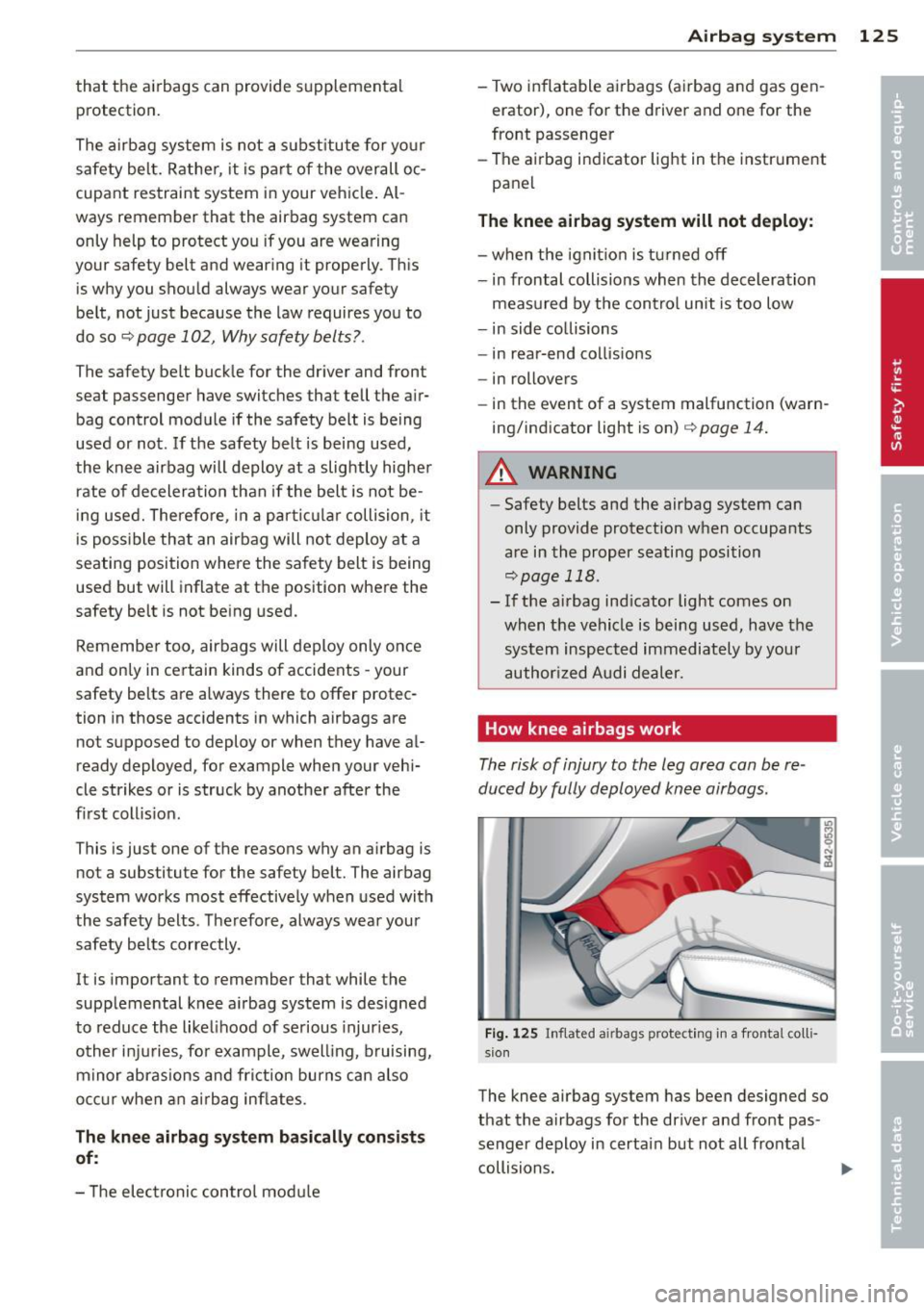
The risk of injury to the leg area can be re
duced by fully deployed knee airbags.
F ig. 12 5 Inflated a irbags prot ecting in a frontal coll i
s io n
-
The knee airbag system has been designed so
that the airbags for the dr iver and fro nt pas
senger deploy in certain but not all frontal
collisions .
II>-
Page 129 of 236
Side airbags
Description of side airbags
The airbag system can provide supplemental
protection to properly restrained front seat occupants .
Fig. 12 6 Side a irbag locat ion in t he d river 's seat
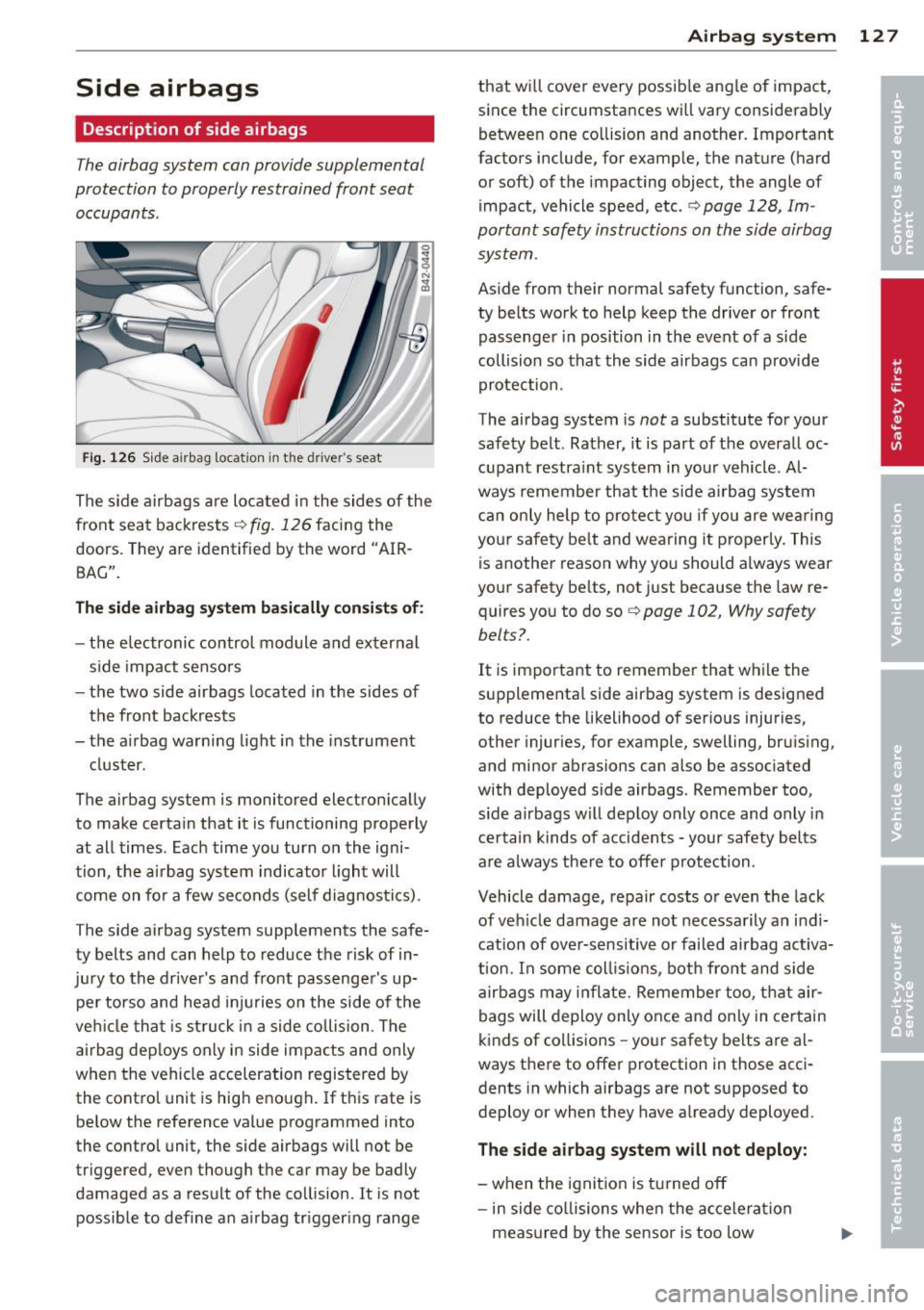
The s ide a irbags are located in the sides of the
front sea t backrests ¢
fig. 126 facing the
doors. They are identified by the word "AIR
BAG".
The side airbag sy stem ba sic ally con sis ts of:
- th e e lectronic control module and exter nal
s ide impact senso rs
- the two side airbags located in the sides of
the front backrests
- the a irbag warning light in the instrument
cluster .
The airbag system is monitored electron ically
to make certain that it is functioning properly
at all times . Each time you turn on the igni
tion, the airbag system indicato r light will
come on fo r a few seconds (self diagnosti cs) .
The s ide airbag system supplements the safe
ty belts and can help to reduce the risk of in
jury to the dr iver's and front passenger's up
pe r torso and head inj uries on the side of the
veh icle tha t is s truck i n a side collision . The
ai rbag dep loys only in side impacts and only
when the vehicle acceleration registered by
the cont rol unit is high e nough . If t his rate is
be low the reference va lue programmed into
the control unit, the side airbags will not be
tr iggered, even though the car may be badly
damaged as a result of the co llision .
It is not
possible to def ine an a irbag tr igger ing range
A irba g sy stem 12 7
that will cove r every possib le ang le of impact,
since the circumstances wi ll vary cons iderably
between one co llision and another. Important
factors include, for examp le, the nature (hard
or soft) of the impacting object, the angle of i mpact, vehicle speed, etc. ¢
page 128, Im
portant safety instructions on the side airbag system .
Aside from their normal safety function, safe
ty belts work to help keep the drive r or front
passenger in position in t he event of a side
collision so that the side airbags ca n provide
protection .
The airbag system is
not a substitute for your
safety belt . Rather, it is part of the overall oc
cupant restra int system in your vehicle . A l
ways remember that the side airbag system
c an on ly help to pro te ct yo u if you are wearing
your safe ty be lt and wea ring i t properly. This
is another reason why you should always wear
your safety be lts, not just because the law re
quires you to do so¢
page 102, Why safety
belts? .
It is important to remember that wh ile the
supplementa l side airbag system is designed
to reduce the likelihood of ser ious injuries,
other injur ies, for example, swelling, bru ising,
and minor abrasions can also be associated
with deployed side airbags . Remember too ,
s ide a irbags will deploy only once and only in
ce rtain kinds of accidents -your safety belts
a re a lways the re to offer p rotection .
Vehicle damage, repair costs o r even t he lack
of ve hicle damage are not necessa rily a n in d i
cation of ove r-s ensitive o r failed airbag activa
t ion. In some col lisio ns, both front and side
airbags may in flate. Remember too, that air
bags will deploy only once and on ly in ce rtain
k inds of co llisions -yo ur safety belts are a l
ways the re to offer protection in those acci
dents in which airbags are not supposed to
deploy or when they have a lready deployed .
The side airbag sy ste m will not deploy:
- when the ignit ion is turned off
- in side co llisions whe n the a ccelera tion
meas ured by t he sensor is too low
Page 130 of 236
128 Airbag system
-in front -end collisions
- in rear-end co llisions
- in ro llovers.
In some types of accidents the front airbags
and side a irbags may be triggered together .
A WARNING
-Safety belts and the a irbag system wi ll
only p rov ide protection when occupants
are in the proper sea ting posit ion
¢page 128.
- If the airbag indicato r light comes on
when the vehicle is being used, have the
system inspected immediately by your
authorized Audi dealer. The airbag may
not work properly when the vehicle ac
celeration in a side co llision is high
enough to activate the airbag.
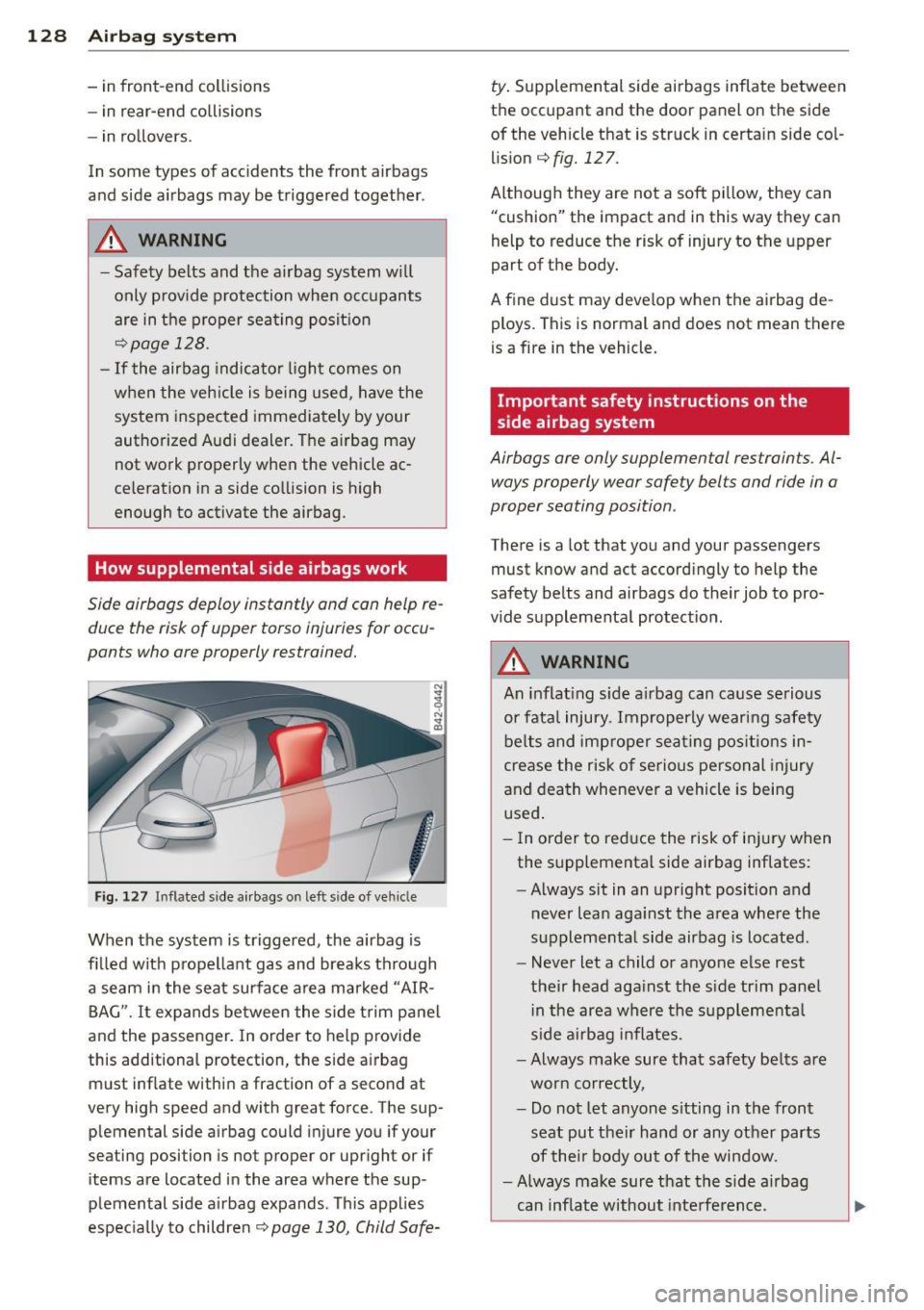
How supplemental side airbags work
-
Side airbags deploy instantly and can help re
duce the risk of upper torso injuries for occu
pants who are properly restrained.
Fig. 127 Inflated side air bags on left side of vehicle
When the system is triggered , the airbag is
fi lled with propellant gas and breaks through
a seam in the seat surface area marked "AIR
B AG".
It expands between the side t rim panel
and the passenger. In order to help provide
this additiona l protection, the side airbag
must inflate with in a fraction of a second at
very high speed and with great force. The sup
plemental side airbag could injure you if your
seating position is not proper or upright or if
items are located in the area where the sup
p lemental side a irbag expands . This appl ies
especia lly to childre n ¢ page 130, Child Safe- ty
. Supplemental side airbags inflate between
the occupant and the door panel on the side
of the vehicle that is struck in certain side col
li sion
¢ fig. 12 7.
Although they are not a soft pillow, they can
"cushion" the impact and in this way they can
help to reduce the risk of injury to the upper
part of the body.
A fine dust may deve lop when the airbag de
ploys . This is normal and does not mean there
is a fire in the vehicle.
Important safety instructions on the
side airbag system
Airbags are only supplemental restraints. Al
ways properly wear safety belts and ride in a
proper seating position .
There is a lot that you and your passengers
must know and act accord ingly to help the
safety belts and airbags do their job to pro
vide supplemental protection .
A WARNING
-
An inflat ing s ide a irbag can cause se rious
or fata l injury. Improperly wearing safety
bel ts and imp roper sea ting positions in
crease the r isk of se rious personal injury
and dea th whenever a vehicle is being
used .
- In order to reduce the risk of in jury w hen
the supplemental side airbag inflates:
- Always sit in an upright position and
never lean aga inst the area whe re the
supplementa l side airbag is located .
- Never let a child or anyone e lse rest
their head aga inst the s ide trim pane l
i n the area where the s upplementa l
s ide airbag inflates .
- Always make sure that safety be lts are
worn correctly,
- Do not let anyone s itting in the front
seat put their hand or any other parts
of the ir body out of the window.
- Always make sure that the s ide airbag
can inf late without inte rfe rence.
Page 132 of 236
130 Child Saf ety
Child Safety
Important things to
know
Introduction
The physical princip les of what happens when
your vehicle is in a crash app ly also to children
¢ page 104. But unlike adu lts and teenagers,
their muscles and bones are not fully devel
oped. In many respects children are at greater risk of serious injury in crashes than adults .
Because children's bodies are not fully deve l
oped, they require restraint systems especial ly designed for their size, weight, and body
structure. Many countries and all states of the United States and provinces of Canada have
l aws requiring the use of approved ch ild re
straint systems fo r infants and small child ren.
In a frontal crash at a speed of 20-35 mph
(30-56 km/h) the forces acting on a 13-pound
(6 kg) infant w ill be more than 20 times the
weight of the child. T his means the weight of
the child would s uddenly be more than
260 pounds (120 kg) . Under these conditions,
only an appropriate chi ld restraint properly
used can reduce the risk of serious injury.
Child restraints, like adult safety belts, must
be used properly to be effective. Used improp
erly, they can increase the risk of serious in
jury in an acc ident.
Consult the child safety seat manufacturer's instructions in order to be sure the seat is
right for your child's size¢
page 133, Impor
tant safety instructions for using child safety
seats .
Please be sure to read and heed all of
the important informat ion and WARN INGS
about child safety, Advanced A irbags, and the
installation of child restraints in this chapter.
There is a lot you need to know about the Ad
vanced A irbags in your vehicle and how they
work when infants and children in chi ld re
straints are on the front passenger seat. Be
cause o f the large amount of important info r
mation, we cannot repeat it all here. We urge
you to read the detailed information in this owner
's manual about airbags and the Ad
vanced Airbag System in your vehicle and the
very important information about transport
ing children on the front passenger seat.
Please be sure to heed the WARNINGS - they
are extremely important for your safety and
the safety of your passengers, especially in
fants and small children.
.&, WARNING
-
All vehicle occupants and especially chi l
dren must be restra ined properly whenev
er riding in a vehicle. An unrestrained or
improperly restrained child could be in
jured by strik ing the interior or by being
ejected from the vehicle during a sudden maneuver or impact. An unrestra ined or
i mproperly restra ined child is also at great
er risk of injury or death through contact
with an inflat ing airbag.
.&, WARNING
--Children on the front seat of any car even
with Advanced Airbags can be ser iously in
jured or even killed when an airbag in
flates. A child in a rearward-fac ing ch ild
safety seat installed on the front passen
ger seat will be seriously injured and can
be killed if the front airbag inflates.
- The inflating airbag will hit the child
safety seat or infant carrier with great
force and will smash the child safety seat
and child against the backrest, door or roof.
- Never install a rearward facing child safety seat on the front passenger seat
unless the
PASSENGER AIR BAG OFF
light comes on and stays on . If the PAS
SENGER AIR BAG OFF
l ight does not
come on and stay on, the inflating airbag
will hit the child safety seat or infant car
rier w ith great force and will smash the
child safety seat and child against the backrest, door or roof. Have the airbag
system inspected immediately by your
authorized Audi dealer.
Page 133 of 236
A WARNING
-=
If, in exceptional circumstances, you must
install a forward-facing child restraint on
the front passenger's seat:
- Always make sure the forward-facing
seat has been designed and certified by
its manufacturer for use on a front seat
with a passenger front and side airbag.
-Always follow the manufacturer's in
structions provided with the child safety
seat or carrier.
- Always move the passenger seat into its
rearmost position in the seat's fore and
aft adjustment range, as far away from
the airbag as possible before installing
the child restraint. The backrest must be
adjusted to an upright position.
- Always make sure that the
PASSENGER
AIR BAG OFF light comes on and stays
on all the time whenever the ignition is
switched on.
(D Tips
Always replace child restraints that were
installed in a vehicle during a crash. Dam
age to a child restraint that is not visible
could cause it to fail in another collision
situation.
Advanced front airbag system and children
Your vehicle is equipped with an "Advanced
Airbag System" in compliance with United
States Federal Motor Vehicle Safety Standard
(FMVSS) 208 as applicable at the time your
vehicle was manufactured.
The Advanced Airbag system in your vehicle
has been certified to meet the "low-risk " re
quirements for 3- and 6- year-old children on
the passenger side and small adults on the
driver side. The low risk deployment criteria
are intended to reduce the risk of injury
through interaction with the airbag that can
occur, for example, by being too close to the
steering wheel and instrument panel when
the airbag inflates. In addition, the system
Child Safety 131
has been certified to comply with the "sup
pression" requirements of the Safety Stand
ard, to turn off the front airbag for infants up
to 12 months who are restrained on the front passenger seat in child restraints that are list
ed in the Standard .
Even though your vehicle is equipped with an
Advanced Airbag system, a child should al
ways ride in the seat properly restrained for
its age and size . The airbag on the passenger
side makes the front seat a potentially dan
gerous place for a child to ride. The front seat
is not the safest place for a child in a forward
facing child safety seat .
It can be a very dan
gerous place for an infant or a larger child in a
rearward-facing seat.
Advanced Airbags and the weight
sensing mat in the front seat
The Advanced Airbag System in your vehicle
detects the presence of an infant or child in a
child restraint on the front passenger seat us
ing the weight-sensing mat in the seat cush
ion and the sensor below the safety belt latch
on the front passenger seat that measures the
tension on the safety belt.
The weight-sensing mat measures total
weight of the child and the child safety seat
and a child blanket on the front passenger
seat. The weight on the front passenger seat
is related to the design of the child restraint
and its "footprint", the size and shape of the
bottom of the child restraint as it sits on the
seat. The weight of a child restraint and its
"footprint" vary for different kinds of child re
straints and for the different models of the
same kind of child restraint offered by child restraint manufacturers.
The weight ranges for the individual types,
makes and models of child restraints that the
NHTSA has specified in the Safety Standard
together with the weight ranges of typical in
fants and typical 1 year-old child have been
stored in the control unit of the Advanced Air
bag System. When a child restraint is being
used on the front passenger seat with a
ll-
•
•