warning AUDI R8 SPYDER 2014 Owners Manual
[x] Cancel search | Manufacturer: AUDI, Model Year: 2014, Model line: R8 SPYDER, Model: AUDI R8 SPYDER 2014Pages: 244, PDF Size: 61.06 MB
Page 168 of 244
166 Cleaning and protection
- Do not wash, wax or dry the engine with
the engine running. Moving or hot parts
could injure you.
- Do not clean the underside of the chas
sis, fenders, wheel covers, or other hard
to reach parts w ithout protecting your
hands and arms. You may cut yourself on
sharp-edged metal parts.
- Always read and heed all WARNINGS and
other information
~ page 156.
Page 170 of 244

168 Fuel supply and filling your fuel tank
-Blend must contain not more than 15%
MTBE.
Seasonally adjusted gasoline
Many gasoline grades are blended to perform
especially well for winter or summer driving .
During seasonal change-over, we suggest that
you fill up at busy gas stat ions where the sea
sonal adjustment is more likely to be made in
time.
(CT) Note
- Methanol fuels which do not meet these
requirements may cause corrosion and
damage to plastic and rubber compo
nents in the fuel system.
- Do not use fuels that fail to meet the
specified criteria in this chapter.
- If you are unable to determine whether
or not a particular fuel blend meets the
specifications, ask your service station or
its fuel supplier.
- Do not use fuel for which the contents cannot be identified.
- Fuel system damage and performance
problems resulting from the use of fuels
different from those specified are not
the responsibility of Audi and are not
covered under the New Vehicle or the Emission Control System Warranties.
- If you experience a loss of fuel economy
or driveability and performance prob lems due to the use of one of these fuel
blends, we recommend that you switch
to unblended fuel.
Gasoline additives
A major concern among many auto manufac
turers is carbon deposit build-up caused by
the type of gasoline you use.
A lthough gasoline grades differ from one
manufacturer to another, they have certain
things in common. All gasoline grades contain
substances that can cause deposits to collect
on vital engine parts, such as fuel injectors
and intake valves. Although most gasoline
brands include additives to keep engine and fuel
systems clean, they are not equally effec
tive .
A udi recommends using TOP TIER Detergent
Gasoline. For more information on TOP TIER
Detergent Gasoline, please go to the official
website (www.toptiergas.com).
After an extended period of using inadequate
fuels, built-up carbon deposits can rob your
engine of peak performance.
(D Note
'
Damage or malfunction due to poor fuel
quality is not covered by the Audi New Ve
hicle Limited Warranty.
Fuel tank
Fuel filler neck
The fuel filler neck is located on the right rear
side panel behind the fuel filler flap.
If the unlocking system should fail, you can
still open the flap manually -for detailed in
structions see¢
page 170.
You can find the fuel tank capacity of your ve
hicle in
Technical Data <=>page 225.
The label on the inside of the fuel filler flap
tells you the correct fuel for your vehicle. For
more information about fuel specifications,
see ¢
page 167.
Your vehicle fuel tank has an on-board refuel
ing vapor recovery system. This feature helps
to prevent fuel vapors from escaping from the
tank and polluting the environment while you refuel your vehicle . In order to fill the tank
properly while protecting the environment,
please follow this refueling procedure careful
ly.
.8, WARNING
Under normal operating cond itions, never
carry additional fuel containers in your car.
Gas canisters and other containers used to
transport fuel can be dangerous. Such con
tainers, full or empty, may leak and could
cause a fire in a collision. If you must
Page 171 of 244
transport fuel to use for your lawn mower,
snow blower, etc., be very careful and al
ways observe local and state laws regard
ing the use, transportation and storage of
such fuel containers. Make certain the con
tainer meets industry standards (ANSI/
ASTM F8S2 -86) .
@ Note
Never drive your vehicle until the fuel tank
is completely dry. The irregular supply of
fue l can cause misfiring. Gasoline cou ld
enter into the exhaust system and damage
the catalytic converter .
Refueling
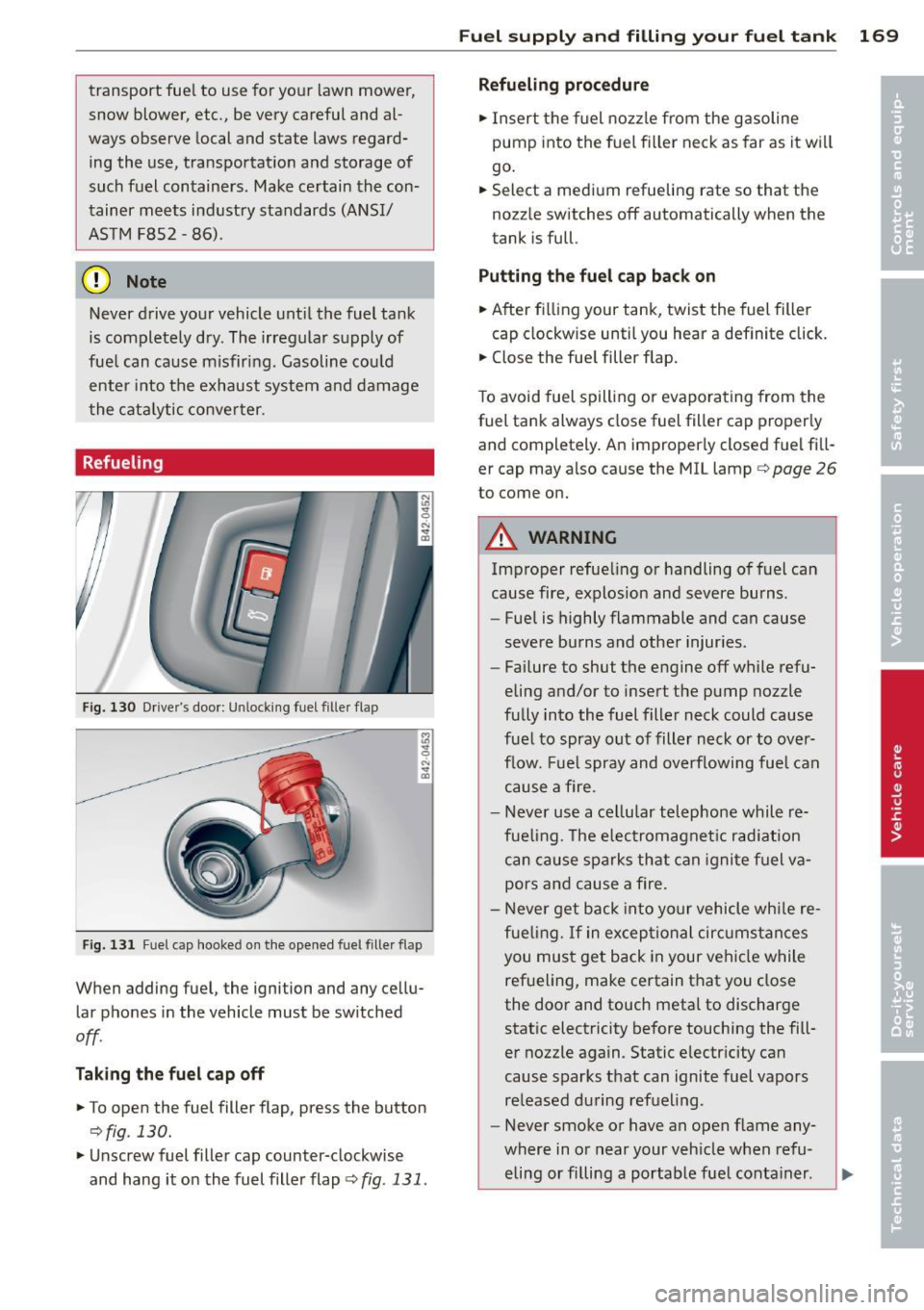
Fig. 130 Drive r's doo r: Unlock ing fuel filler flap
Fig. 131 Fu el cap hooked on the opened fuel filler flap
When adding fuel, the ignition and any cellu
lar phones in the vehicle must be switched
off .
Tak ing the fuel cap off
.. To open the fuel filler flap, press the button
9 fig . 130.
.. Unscrew fuel filler cap counter-clockwise
and hang it on the fuel filler flap ¢
fig. 131.
Fuel supply and filling your fuel tank 169
Refueling procedure
.. Insert the fuel nozzle from the gasoline
pump into the fuel filler neck as far as it will
go.
.. Select a medium refueling rate so that the
nozzle switches off automatically when the
tank is full.
Putting the fuel cap back on
.. After filling your tank, twist the fuel filler
cap clockwise until you hear a definite click.
.. Close the fuel filler flap.
To avoid fuel spilling or evaporating from the
fuel tank always close fuel filler cap proper ly
and completely. An improperly closed fuel fill
er cap may also cause the MIL lamp ¢
page 26
to come on.
A WARNING
Improper refueling or handling of fuel can
cause fire, explosion and severe burns.
- Fuel is highly flammable and can cause
severe burns and other injuries.
- Failure to shut the engine off while refu
eling and/or to insert the pump nozzle
fully into the fuel filler neck could cause
fuel to spray out of filler neck or to over
flow. Fuel spray and overflowing fuel can
cause a fire.
- Never use a cellular telephone while re
fueling. The electromagnetic radiation
can cause sparks that can ignite fuel va
pors and cause a fire.
- Never get back into your vehicle while re
fueling.
If in exceptional circumstances
you must get back in your vehicle while
refueling, make certain that you close
the door and touch metal to discharge static electricity before touching the fill
er nozzle again. Static electricity can
cause sparks that can ignite fuel vapors
released during refueling .
- Never smoke or have an open flame any
where in or near your vehicle when refu-
eling or filling a portable fuel container. ..,.
Page 174 of 244
17 2 Che cking and filling
Checking and filling
Engine compartment
Lid
Releasing the engine compartment lid
The engine compartment lid is released from
in side the vehicle.
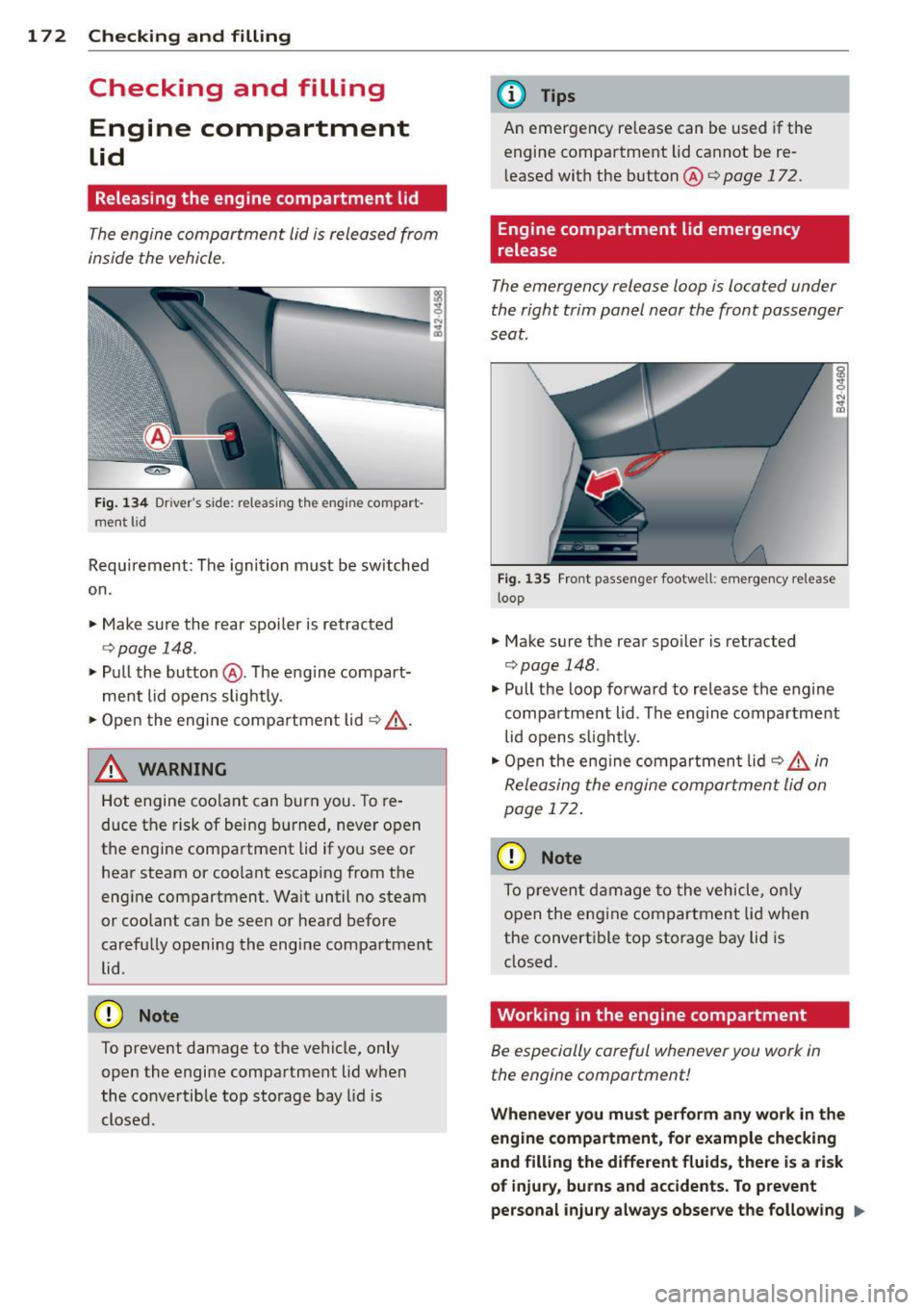
Fi g. 1 34 Drive r's s id e: re le asi ng th e eng ine co mpart
ment lid
R equ irement : The ignition must be sw itched
on.
.,. Make sure the rear spoiler is retracted
<=> page 148 .
.,. Pull the button @. The e ngine compart
ment lid opens slightly .
.,. Ope n the engi ne compa rtme nt lid
c:> .&, .
.&_ WARNING
Hot engine coo lant can burn you. To re
duce the risk of bei ng bur ned,
neve r open
the engine compartment lid if yo u see or
hear steam or coolant escaping from the
eng ine compartment. Wa it until no steam
or coolant can be seen or heard before
carefu lly opening the engine compartment
lid .
CD Note
To prevent damage to the vehicle, only
ope n the engi ne compartment lid when
t he convertib le top storage bay lid is
closed .
(D Tips
An emergency re lease can be used i f th e
engine compartment lid cannot be re
l eased with the
button @r::::>page 172.
Engine compartment lid emergency
release
The emergency release loop is located under
the right trim panel near the front passenger
seat.
F ig . 1 35 Fro nt passenger footwe ll: em erge ncy release
l oop
.,. Make sure the rear spo iler is retracted
<=> page 148 .
.,. Pull the loop forwa rd to release the engine
compa rtme nt lid . The engine compar tment
lid o pens s lig htly .
.,. Open the eng ine comp artmen t lid
c:> .&, in
Releasing the engine compartment lid on
page 172 .
CD Note
To preven t dam age to the vehicle, only
open the en gine compartment lid when
the convert ible top stora ge bay lid is
closed.
Working in the engine compartment
Be especially careful whenever you work in
the engine compartment!
Whenever you mu st perform any work in the
engine compartment, for example checking and filling the different fluids, there is a risk
of injury, burn s and accidents. To prevent
personal injury always observe the following
Ill-
Page 175 of 244
WARNINGS. The engine compartment of any
vehicle is a hazardous area!
c::> &.
A WARNING
To help avoid injury, before you check any
thing under the engine compartment lid:
- Switch off the engine.
- Remove the ignition key.
- Apply the parking brake.
- Move selector lever of S tronic to "N"
(Neutral); put manual transmission in
Neutral.
- Always let the engine cool down. Hot
components will burn skin on contact.
- To reduce the risk of being burned, never
open the engine compartment lid if you
see or hear steam or coolant escaping
from the engine compartment. Wait un
til no steam or coolant can be seen or heard before carefully opening the en
gine compartment lid .
- Keep children away from the engine com
partment .
-Never spill fluids on hot engine compo
nents. They can cause a fire.
- Never open the coolant reservoir cap when the engine is still warm. The coolant system is pressurized and hot cool
ant could spray out.
- Protect your face, hands and arm from
steam or hot engine coolant by placing a
thick rag over the cap when you open the
coolant reservoir .
- Do not remove the engine cover under
any circumstances. This increases the
risk of burns.
- If work on the fuel system or the electri
cal system is necessary:
- Always disconnect the battery.
- Never smoke or work near heaters or
open flames. Fluids in the engine com
partment could start a fire.
- Keep an approved fire extinguisher im
mediately available.
- To avoid electrical shock and personal in
jury while the engine is running or being
started, never touch:
Checking and filling 173
- Ignition cables
- Other components of the high voltage electronic ignition system.
- If you must perform a check or repair
with the engine running:
- First, fully apply the parking brake,
move selector lever of S tronic to "N"
(Neutral); put manual transmission in
Neutral.
- Always use extreme caution to prevent
clothing, jewelry, or long hair from get
ting caught in the radiator fan, V-belts
or other moving parts, or from contact ing hot parts. Tie back hair before
starting, and wear no clothing that will hang or droop into the engine.
- Minimize exposure to emission and chemical hazards
c::> .&. .
A WARNING
California Proposition 65 Warning:
- Engine exhaust, some of its constituents,
and certain vehicle components contain
or emit chemicals known to the State of
California to cause cancer and birth de
fects and reproductive harm. In addition, certain fluids contained in vehicles and
certain products of component wear con
tain or emit chemicals known to the
State of California to cause cancer and birth defects or other reproductive harm.
- Battery posts, terminals and related ac
cessories contain lead and lead com
pounds, chemicals known to the State of
California to cause cancer and reproduc
tive harms. Wash hands after handling.
@ Note
When adding fluids, always make sure that
they are poured into the proper container
or filler opening, otherwise serious dam
age to vehicle systems will occur.
@ For the sake of the environment
To detect leaks in time, inspect the vehicle
floor pan from underneath regularly. If
you see spots from oil or other vehicle
IJI>
•
•
Page 176 of 244
17 4 Che cking and filling
fluids, have your vehicle inspected by an
authorized Audi dealer.
Closing the engine compartment lid
.. Make sure that the rear spo iler is retracted
¢ page 148.
.. Pull the engine compa rtment lid dow n until
the p ress ure from the struts is reduced .
.. Pr ess the eng ine compartment lid closed
¢ &_ .
Eng ine compartment
A WARNING
-- W hen you close the engine compartment
lid, chec k it to make su re the safety catch
has prope rly engaged . The engine com
pa rtment lid s ho ul d be flush w ith the
sur ro un ding vehicle body parts .
- If you notice while driv ing t hat the en
g in e compartmen t lid is not secu red
p roperly, sto p at once and cl ose it .
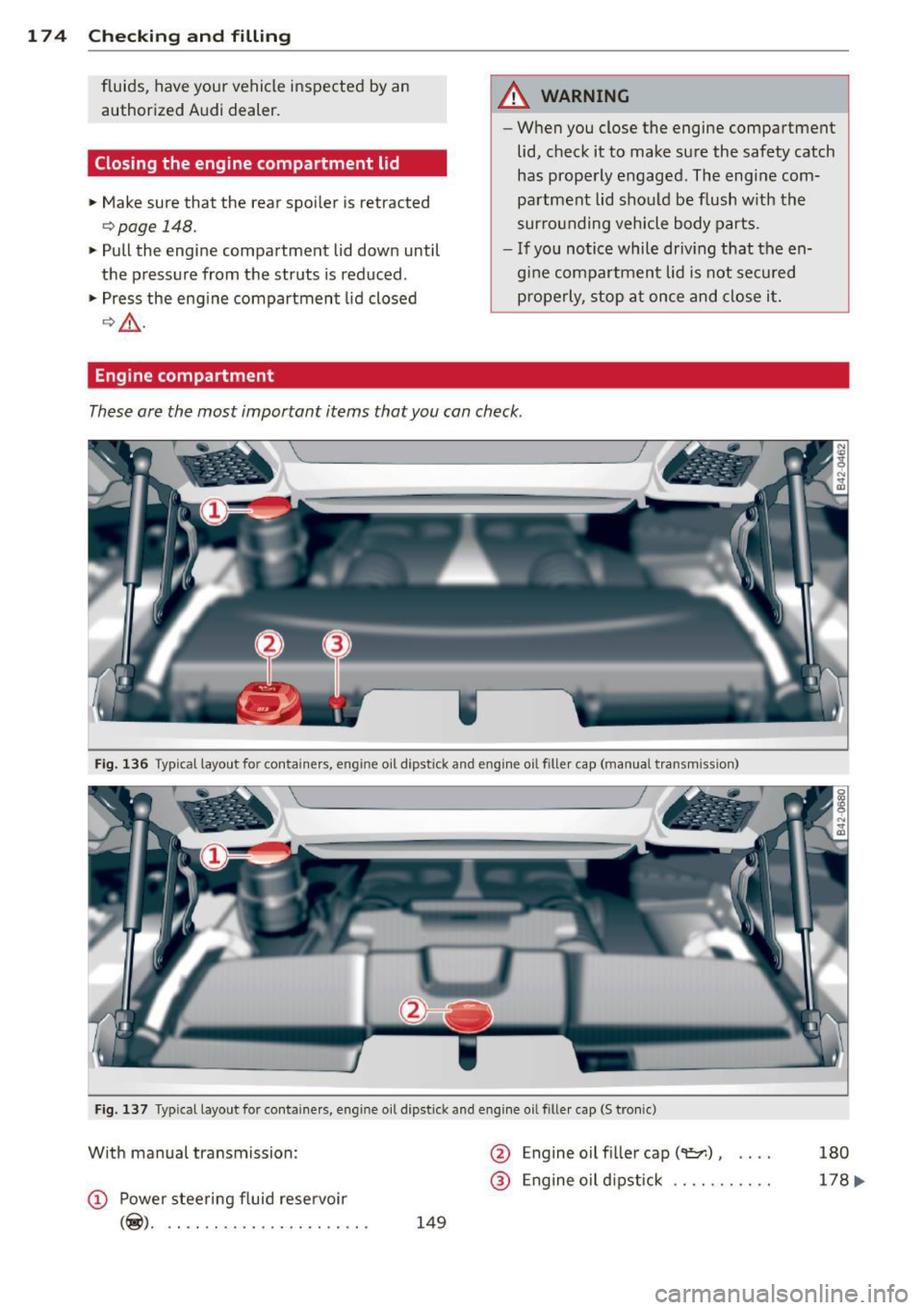
These ore the most important items that you con check .
Fig . 136 Ty pica l layout fo r co ntai ners , e ngin e o il dipst ick and engin e o il fille r cap (man ual t ra n sm iss io n)
F ig . 1 37 Typ ica l layout fo r co ntain ers, e ngin e o il d ipstic k and e ng in e o il fill er cap (S t ro nic )
W ith manual transmission: @ Engine oil f iller cap(~) ,
(D Power steering f luid rese rvoir
@ E ngine o il d ipst ick ...... .... .
(@) ... .... .... ....... .. .. . 14 9
180
178 ....
Page 177 of 244
With S tronic transmission:
(!) Powe r steeri ng fluid rese rvoir
(~ ) ... .. ................ . . 149
@ Engine oi l filler cap ("1::r.) with
engine oil dipstick, ........ .. 180, 179
A WARNING
Before you ch eck a nything in the engine
compartment, always read and heed all
WARNINGS
~ A in Working in the engine
compartment on page 173.
@ Tips
The coolant expansion tank is located un
der the convert ible top storage bay lid
~page 183.
Engine oil
Engine oil specifications (8-cyl.-engine )
The engine in your Audi needs the right kind
of oil.
-
The engine in your Audi is a soph istica ted
powerp lant tha t was b uilt to exacting specifi
cations . This engine needs the r ight kind of
engine oi l that meets specifications regarding
qua lity and viscosity so that it can run
smoothly and reliably. Choos ing the right oi l
and changing oil within the time and mileage intervals printed in your veh icle's Warranty
&
Ma intenance book let matters a lot more to
day than it d id yea rs ago. A udi has developed
a special quality standa rd for engine oil that
will he lp assure tha t your veh icle's eng ine will
get the lubrica tion it needs for prope r opera
tion.
M odern eng ine lub rication has taken a quan
t um leap in the last few yea rs. Ma ny synthetic
oils availa ble today provide be tter eng ine lu
b rica tion that can outlast traditional pe trole
um-based o ils, making them a smart choice
for use throughout the life of your A udi.
Whether yo u use syn thetic or petroleum
based engine oil, the oil that yo u use must
conform to Audi's oil qua lity standard VW S02
00 to help keep your vehicle's engine running
Checkin g and fillin g 175
smooth ly and he lp prevent the format ion of
harmful deposits, sometimes ca lled "s ludge,"
that over time can lead to expensive repairs.
At the time of prin ting, engine oils ava ilab le in
t h e U.S . and Canada that meet the exacting
specifications of Audi oi l standard VW 502 00
are synt het ic eng ine oi ls . Th is does not mean,
however, that every synthetic engine oil will
meet Audi o il standard VW 502 00. So always
be sure that you use an approved oil.
To he lp prevent the formation of harmfu l de
pos its use on ly oil with the following specifi
cations pr inted on the o il conta iner:
Audi oil standard VW 502 00
Oil containe r labels m ay car ry the s peci fica
t ion sing ly or in combina tion wi th othe r desig
na tions and oil quality s tanda rds .
Viscosity
Engine o ils are graded accord ing to thei r vis
cosity. The p roper viscos ity grade oil fo r yo ur
engine depends o n climactic or seasona l con
ditions where yo u drive. You must use oil w it h
a v isco sity g rade of SA E 5W-30 all temper a
tu re ranges fo r norma l d riving condi tions.
Because eng ine o il that meets the Audi oil
sta ndard may not be availab le everyw here
whe n you need i t, we strong ly reco mmend
t h at you a lways carry wit h you an ex tra quart
( li ter) of oil that exp ress ly con forms to the
VW 502 00, in case you have to top
off the oil
whi le on the road.
Only if the level of the o il is at or be low the
minimum ma rk on the oi l dipstick -and no oil
that expressly conforms to Audi oi l VW 502
00 is ava ilab le -may you top
off with a h igh
quality eng ine o il, preferab ly synthetic-based,
that meets ACEA A3 or API SM specifications. However, duri ng the entire time between oi l
c h ange in tervals, neve r top
off w ith more tha n
a total of 1 qt/lite r engine oil that does not
confo rm to Aud i oil spec ifi cat ion VW 50 2 00.
For more information abo ut eng ine oi l that
has been approved for your veh icle, please
contact e ither you r autho rized Aud i dea le r o r ..,.
•
•
Page 180 of 244
1 78 Che cking and filling
authorized Audi dealer will have to deny war
ranty cov erage un less you present to the dea l
er proof in the form of Serv ice o r Repair Or
ders tha t all sched uled maintena nce was per
f ormed in a t imely manner .
Engine oil consumption
T he engine in your vehicle depends on an ade
quate amoun t of oil to lubricate and cool all
of its moving par ts.
In order to provide effective l ubrication and
cooling of internal engine components, a ll in
ternal comb ustion eng ines consume a certa in
amount of o il. O il consumption var ies from
engine to eng ine and may c hange significa ntly
over the life of the eng ine . T ypically, eng ines
with a specifie d break-in per iod (see
c::> p oge 153) consume more oil during the
b reak-in per io d t han they co nsume after oil
consumption has sta bilized.
Unde r no rma l conditions, the rate of oil con
sum ption depends on the qu ality and vi scosity
of the oi l, the R PM ( revo lutions per m inute) at
which t he engine is ope rated, the ambient
temperature and road cond itio ns. Furthe r fac
tors are the amount of o il d ilution from water
condensation or fuel residue and the ox ida
ti on level of the oi l. As any engine is subject to
wear as mileage bu ilds up , the oil consump
tion may increase over t ime until replacement
of worn componen ts may become necessary.
W ith all these variables com ing into play, no
standa rd rate of o il consumption can be es
tablished or specif ied . T he re is no alternative
to regular and frequent checking of the oil lev
e l, see
Note .
If the ye llow eng ine o il level warning symbol
i n t he inst rument cluster
1\1 lights up, you
should check the o il l evel as soon as possibl e
c::> page 178. Top off the oil at you r earliest
conven ie nc e
c::>page 180.
_& WARNING
Before yo u check any thin g in t he engine
compartment , always read and hee d all
-
WAR NIN GS c::> & in Working in the engine
compartment on page 173.
(D Note
D riving wit h an insufficient o il level is like
l y to cause severe dama ge to the e ngine.
(D Tips
- The oil pressure warning display. is
not an indicator of the oil level. Do not
rely on it. Instead, check the oil level in
your engine at regular intervals , pref
erably each time you refuel, and always
before going on a long trip .
- If
you have t he impression yo ur engine
cons umes excessive amounts of o il, we
recommend that you consu lt your Aud i
deale r to have the cause of your concer n
prope rly diagnosed . K eep in m ind that
th e accu rat e meas urement of o il con
s u m ptio n re quires grea t care and may
t a ke some time. Y our Audi de aler h as i n
st ru ctio ns abou t how to measure oil con
sumption acc urately .
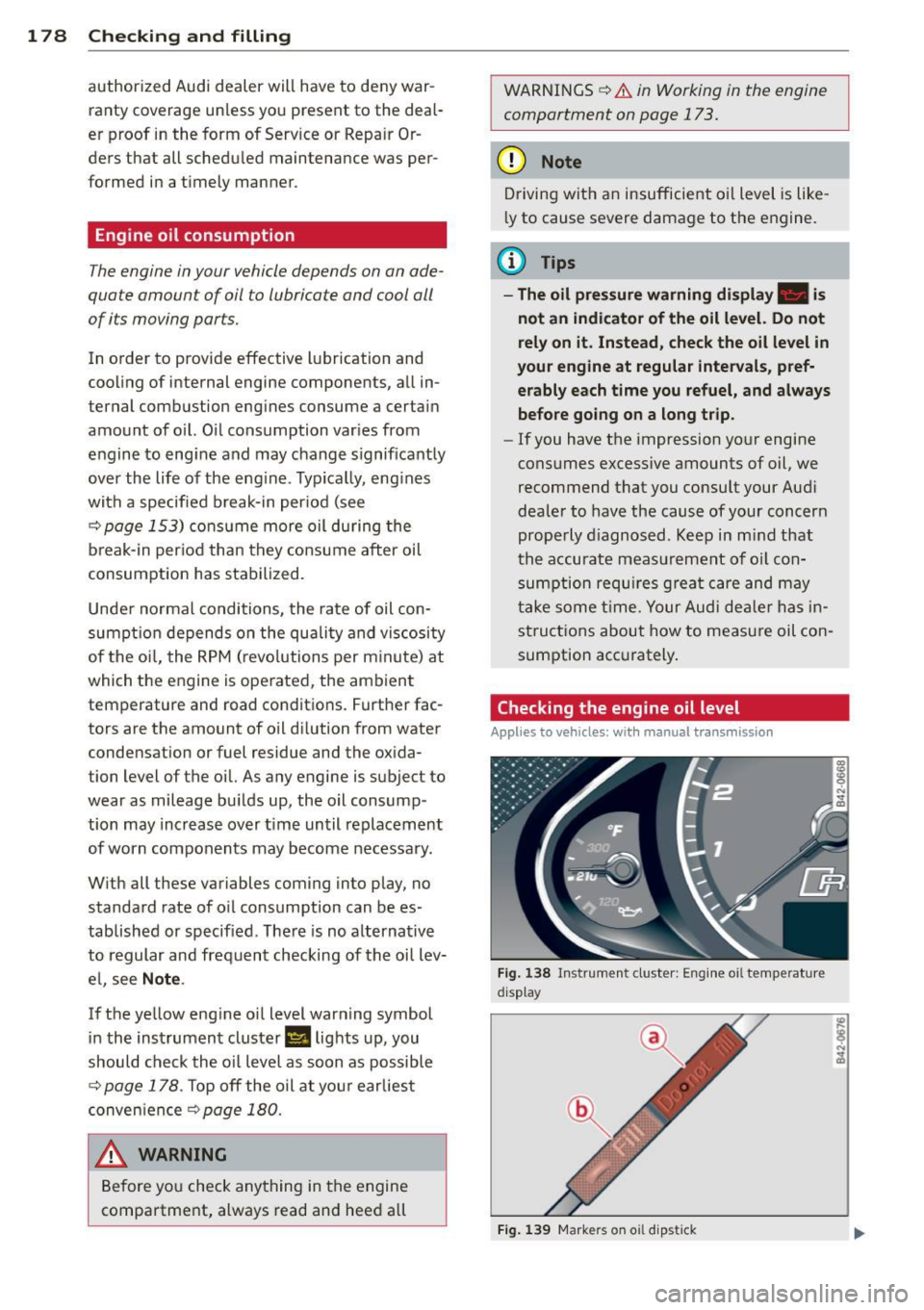
Checking the engine oil level
Applies to vehicles: with manual transmiss ion
Fig . 1 38 In st ru men t cl uste r: E ng in e oi l te m pe ratu re
d isp lay
Fig. 139 M arkers on o il dip stick
Page 182 of 244
180 Checking and filling
Adding engine oil "1::::1:
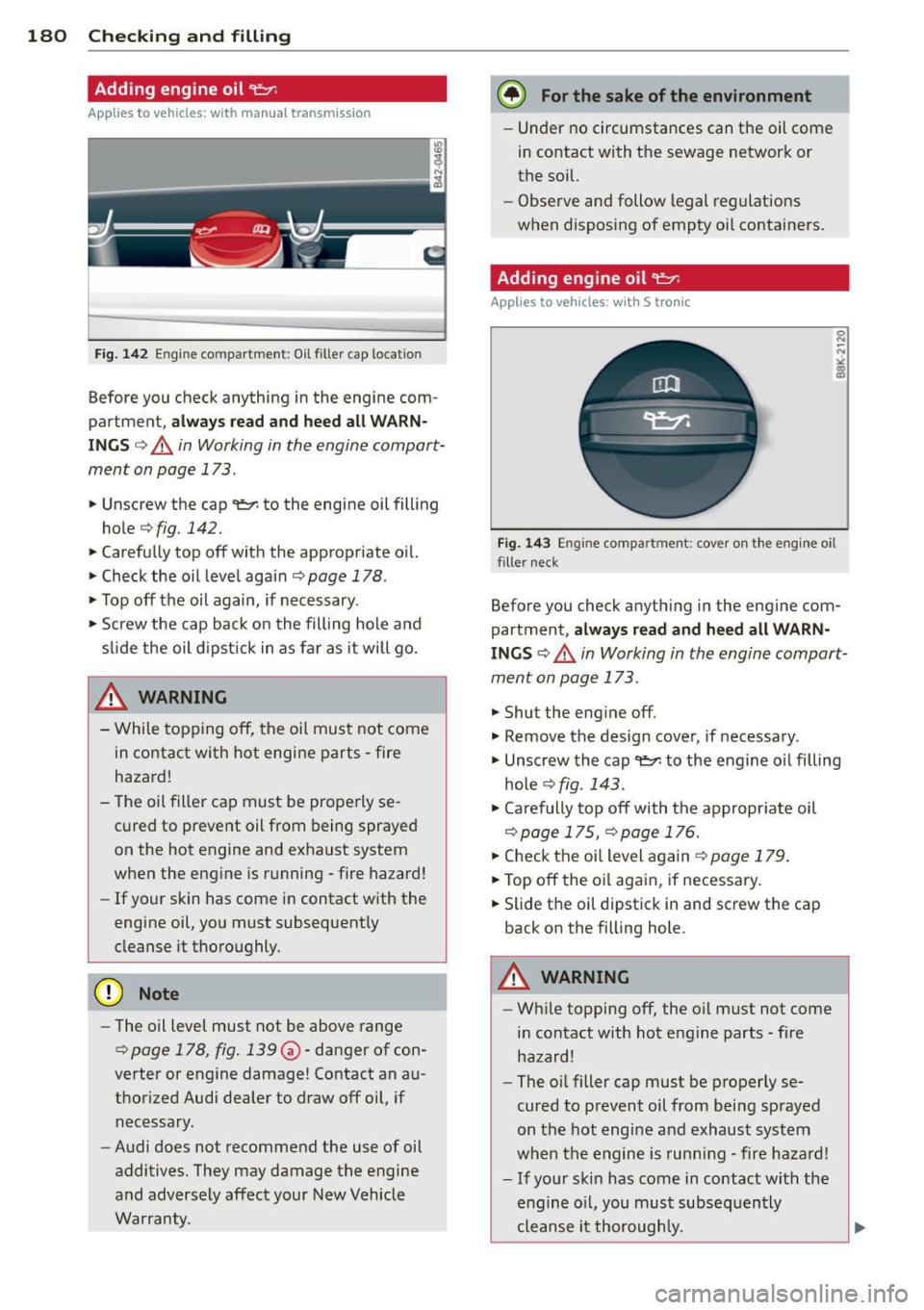
Appl ies to vehicles: with manual transmission
Fig. 142 Engine compartment : Oil filler cap locat io n
Before you check anything in the engine com
partment,
al ways r ead and h eed all WARN
INGS ¢ A in Working in the engine compart
ment on page 173 .
.. Unscrew the cap~ to the engine oil filling
hole¢
fig. 142 .
,. Carefully top off with the appropriate oil.
.. Check the oil level aga in ¢
page 178 .
,. Top off t he oil again, if necessary .
,. Screw the cap back on the filling hole and
s li de the oil d ipst ick in as far as it will go .
& WARNING
-While topping off, the oil mus t not come
in contact with hot engine parts -fire
hazard!
- The oil fil ler cap must be prope rly se
c u red to prevent oil from being sprayed
on the hot engine and exhaust system
when the eng ine is running - fire hazard!
- If your skin has come in contact w ith the
engine oil, you must subsequent ly
cleanse it thoro ughly.
(D Note
- The oil level must not be above range
c:> page 178, fig. 139 0 -danger of con
verter or engine damage ! Contact an au
thorized Audi dealer to draw off oil, if
necessa ry.
- Audi does not recommend the use of oil
additives. They may damage the engine
and adversely affect your New Vehicle
Warranty .
@) For the sake of the environment
-Under no circumstances can the oil come
in contact with the sewage network or
the soil.
- Observe and follow legal regulat ions
when disposing of empty oil containers.
Adding engin e oil "1::::1:
Applies to vehicles: with S tronic
Fig . 14 3 En gi ne compartment : cover on t he eng ine oi l
filler neck
Before you check anything in the engine com
partment,
always r ead and heed all WARN
INGS c:> A in Working in the engine compart
ment on page 173 .
,. Shut the eng ine off.
,. Remove the design cover, if necessary .
,. Unscrew the cap
't=7: to the engine o il filling
hole
c:> fig . 143.
,. Carefully top off with the appropr iate oil
c:> page 175, c:> page 176.
,. Check the oi l level aga in c:> page 1 79 .
.. Top off the oil again, if necessary.
.. Slide the oil dipstick in and screw the cap
back on the filling hole.
& WARNING
'-
- W hile topping off, the o il must not come
in contact with hot engine parts - f ire
hazard!
- The oi l filler cap must be p roperly se
cured to prevent oil from bei ng sprayed
on the hot engi ne and exhaust system
when the engine is runn ing - fire haza rd !
- If you r skin has com e in contact with the
engine o il, you must subsequently
cleanse i t thoroughly. ..,.
Page 183 of 244
CD Note
-The oil leve l mus t not be ab ove range
¢ page 179 , fig. 141 G) -danger of con
verter or engine damage! Contact an au
thorized Audi dealer to draw off oil, if necessary .
- Audi does not recommend the use of oil
additives. They may damage the engine
and adversely affect your New Vehicle
Warranty .
@ For the sake of the environment
-Under no circumstances can the o il come
i n contact with the sewage network or
the soil.
- Observe and follow lega l regu lations
when d isposing of empty oil containers.
Engine cooling system
Coolant
The engine coolant performs two functions: it
keeps the engine from overheating and it pro tects the engine from freezing in the winter.
The cooling system is sea led and generally re
q ui res lit tle at ten tion.
The cooling system has been filled at the fac
tory with a pe rma nent coolant which does not
need to be changed. The coolant consists of a
mix ture o f wa ter and the m anu fa ctu rer 's g ly
col -based coolant addit ive Gl3 antifreeze
with anticorrosion additives (50% for USA mod els; 60% for Canadian models) . This mix
ture both assures the necessary frost protec
tion and protects metal components i n the
engine's cooling system from corrosion and
scaling .
It also raises the bo iling po int of the
coolant.
Do not reduce the concentration of the coo l
ant in the summer by adding plain water.
The
proportion of coolant addit ive must b e at
lea st 50% but not more than 60 %
to main
tain antifree ze protection and cooling efficie n
cy.
If t he cool ant frost pro tect io n is too low,
the coo lant cou ld freeze and damage the veh i
cle heating and engine cooling system.
Checkin g and fillin g 181
For year -round driving, antifreeze is added at
the factory for temperatures down to:
- -31°F(-35°C)USA
- -40 °F ( -40 °C) Canada.
.8, WARNING
Before you check anythi ng i n the engi ne
com partmen t, a lways re ad and heed al l
WA RNIN GS
q .&. in Working in the engine
compartment on page 173 .
-
CD Note
- Before wi nte r sets in, have the coo lant
checke d to see if the cool ant a ddi tive in
yo ur vehicle is sufficient to meet the cli
mate conditions . This is especia lly impor
tant if you live in a region where the win
ter is extreme ly cold. I f necessary, in
crease the proportion of coo lant add itive
to 60% .
- When adding coolant additive to your cooling system, remember :
- We re commend using o nly coola nt ad
di tive G l2++ or Gl3 (check the l abe l)
for your vehi cle. This coolan t additive is
ava ila ble at autho rize d Aud i dea le rs .
Othe r ty pes of antifreeze can sig nifi
cantly reduce corros ion protection. The
resu lting corrosion can cause a loss of
coolant and serio us engine damage.
- Do not add any type of rad iator leak seal
ant to yo ur vehicle 's engine coolant.
Add ing radiator repair flu id may adverse
ly affect the f unction and performance of
your cooling system and co uld resu lt in
damage not covered by you r New Vehicl e
Li mited War ran ty.
•
•