warning AUDI R8 SPYDER 2014 Owners Manual
[x] Cancel search | Manufacturer: AUDI, Model Year: 2014, Model line: R8 SPYDER, Model: AUDI R8 SPYDER 2014Pages: 244, PDF Size: 61.06 MB
Page 184 of 244

182 Checking and filling
Checking the engine coolant level
Proceed carefully when checking the coolant.
Fig. 144 Convertible top: se rvice position
Fig. 145 Convert ible top sto rage bay: coo lant expan
sion tank
Before you check anything in the engine com
partment,
always read and heed all WARN
INGS c:::> &_ in Working in the engine compart
ment on page 173
and park your vehicle on a
level surface.
The coolant expansion tank is located in the
right side of the convertible top storage bay
under the round metal cover
c:::> fig. 145. The
convertible top must be in the service position
to check the coolant leve l
c:::> fig. 144.
Bringing the closed convertible top into
the service position
.. Switch the ignition on .
.. Pull and hold the convertible top switch .
.. Press and hold the rear window switch too
until the convertib le top moves into the
service position
c:::> fig. 144.
Bringing the open convertible to into the
service position
.. Switch the ignition on.
.. Press and hold the convertible top switch. ..
Press and hold the rear window switch too
until the convertible top moves into the
service position
c:::> fig. 144.
Opening the coolant expansion tank cover
.. Stop the engine and allow it to cool.
.. Switch the ignition off .
.. Care fully remove the bolts in the cover@
using a screwdriver and remove the cover.
The coolant reservoir is located below
¢fig. 145.
Checking the engine coolant level
.. Place a rag or cloth on the cap of the coolant
expansion tank and turn the cap
carefully to
the left (counter-clockwise)
c:::> .&, .
.. Read the coolant leve l inside the coolant ex
pansion tank¢
fig. 145. With a cold engine,
it must be above the "min" mark. With a hot
eng ine, it can be a little above the indicated
range.
To obtain an accurate reading, the engine must be switched off.
The expansion tank in your vehicle is equipped
with an electric coo lant level sensor
c:::> page 15. We still recommend you check the
coolant level from time to time .
Coolant loss
Coolant loss may indicate a leak in the cooling
system. In the event of coolant loss, the cool
ing system should be inspected immediately
by your authorized Audi dealer. It is not
enough merely to add coolant.
In a
sealed system, losses can occur on ly if
the boiling point of the coo lant is exceeded as
a result of overheating .
A WARNING
-- The cooling system is under pressure. Do
notopenthecapofthecoolantexpan
sion tank when the engine is hot. You
ris k be ing sca lded.
- The coolant additive, and therefore the
coo lant itself, is haza rdous to hea lth .
Keep the coolant additive in the original
Page 185 of 244
container out of the reach of children. It
is a poison hazard.
@ Note
Do not add any type of radiator leak seal
ant to your vehicle's engine coolant. Add
ing radiator repair fluid may adversely af
fect the function and performance of your
cooling system and could result in damage
not covered by your New Vehicle Lim ited
Warranty.
Adding coolant
Before you check anything in the engine com
partment,
always read and heed all WARN
INGS q A in Working in the engine compart
ment on pag e 173.
"'Add coolant .
"'Twist the cap on again
tightly.
"'Tighten the cap (D q page 182, fig. 145
again.
Replacement engine coolant must conform to
exact specifications
q page 181, Coolant .
We recommend using only coolant additive
G12++, G13 or in an emergency G12 +. Do
not
use a different additive. In an emergency use
plain water until you can get the correct addi
tive and can restore the correct ratio. This
should be done as soon as possible.
If you have lost a considerable amount of
coolant, then you should add cold antifreeze
and cold water only when the engine is cold.
Always use
new engine coolant when refilling .
Do not fill coolant above the "max" mark. Ex
cess coolant will be forced out through the
pressure relief valve in the cap when the en
gine becomes hot.
A WARNING
- The cooling system is under pressure and
can get very hot. Reduce the risk of
scalding from hot coolant by following
these steps.
Checking and filling 183
- Turn off the engine and allow it to cool
down.
- Protect your face, hands and arms from
escaping fluid and steam by covering
the cap with a large, thick rag.
- Turn the cap slowly and very carefully
in a counter-clockwise direction while
applying light, downward pressure on
the top of the cap.
- To avoid being burned, do not spill an
tifreeze or coolant on the exhaust sys
tem or hot engine parts. Under certain
conditions, the ethylene glycol in en
gine coolant can catch fire .
- Antifreeze is poisonous. Always store an
tifreeze in its original container and well
out of the reach of children.
- If you drain the coolant, it must be
caught and safely stored in a proper con
tainer clearly marked "poison" .
Q) Note
- Coolant pollutes the environment and
could cause an engine fire . Ex cess cool
ant will be forced out through the pres
sure relief valve in the cap when the en
gine becomes hot.
- If, in an emergency, only water can be
added, the correct ratio between water
and antifreeze
q page 181 must be re
stored as soon as possible.
@ For the sake of the environment
Drained coolant should not be reused . Al
ways dispose of used coolant while observ
ing all environmental regulations.
Brake fluid
Have the brake fluid changed by an experi
enced t echnician.
Brake fluid absorbs moisture from the air. If
the water content in the brake fluid is too
high, corrosion in the brake system may result
afte r a period of time. The boiling point of the
brake fluid will also decrease considerably and
decrease braking performance. .,.. •
•
Page 186 of 244
184 Checking and filling
Therefore, the brake fluid must be changed
ev ery two yea rs. A lways use new brake fluid
which conforms to Federal Motor Vehicle Standard "FMVSS 116 DOT 4".
Brake fl uid is rep laced according to the Audi
maintenance service schedule . Your author
ized Audi dealer is equipped with the necessa
ry special tools and rep lacement parts, has
the necessary expertise, and can d ispose of
the used fluid .
A WARNING
-Brake fluid is po isonous . It must be stor
ed only in the closed orig inal container
out of the reac h of children!
- Brake fa ilure can result from old o r inap
propriate b rake fluid. Observe these pre
c aut ions:
- Use on ly brake fluid that meets SAE
specif icat ion
J 1703 and conforms to
Federal Motor Vehicle Standard 116 .
Always check with your authorized Audi
dealer to make su re you are using the
correct brake flu id. The correct type of
b rake fluid is a lso indicated on the
b rake fluid reservoir.
- The brake fluid must be new. Heavy use
of the brakes can cause a vapor loc k if
t he brake fl uid is left in the system too
long. This can ser ious ly affect the effi
ciency of the brakes as well as yo ur
safety . This could result in an accident.
CJ) Note
Br ake fl uid will damage the paint of your
veh icle.
@.l For the sake of the environment
Because of the problem of prope r d isposa l
of brake fl uid as we ll as the speci al tools
req uired and the necessary expert ise, we
recommend that you have the brake fluid
changed by your authorized Audi dealer .
Battery
General information
Your vehicle is equipped with a specia l bat
te ry, an
ACM battery. This ba tte ry is located
i n the luggage compartmen t an d must be re
placed with an origina l equipment battery .
U nder normal operating conditions, the bat
tery is
maintenance -free.
Have the batte ry checked when yo u take your
vehicle in for service. You are well advised to
replace a battery that is o lde r than 5 years.
Disconnecting the battery te rminals
Some vehicle fu nctions (power window reg u
lators, for ex ample) are lost if the batte ry te r
mina ls are disconnected. These f unctions have
to be relearned after the battery termina ls are
connected again. To prevent this, the battery
sho uld only be disconnected from the veh icle
electrical system when abso lutely necessary
for repairs.
Vehicles not driven for long periods
If you do not drive your vehicle over a period
of seve ral days or weeks , e lectrica l compo
nents are gradually cut back or switched off.
This reduces energy consumption and ma in
ta ins start ing capability over a longer period
r:> page 150. Some of the convenience func
t ions may not operate, such as the inter ior
li ghts or powe r seat ad justment. The conven
ience funct io ns w ill be available again when
you sw itch on the ign it io n and s tart the en
gine.
Winter operation
D uring the winte r months, battery capac ity
tends to dec rease as temperatures drop. This
is because mo re power is a lso co nsumed wh ile
sta rting, and the headlig hts, rear win dow de
f ogger, e tc., are used more often .
Avoid unnecessa ry powe r consumpt ion, pa r
t icu lar ly i n city traffic o r when traveling only
sho rt dist ances. Let yo ur au thori zed Au di
dealer check the capacity of the vehicle bat -
tery before winter sets in
r:> page 187. A well ll>
Page 187 of 244
charg ed batte ry wi ll not only prevent starting
prob lems when the weather is cold, but will
a lso last longer.
Replacing battery
The new battery mu st h ave the same capac i
ty, vo ltage ( 12 volts), amperage, construction
a nd p lug sealing, as the origina l battery . Spec
ifications are listed on the battery housing.
Batteries specially developed by Audi fulfill
the maintenance, output, and safety require
ments.
When insta lling the battery, make sure the ig
nition and all electrica l consumers are switch
ed
off c:> (D .
We recommend that you use maintenance
free or
c y cle- re sis tant /leak-proof batteries
according to the standards TL 82S 06 (from
April 2008) and VW 7 50 73 (from Apr il
2010).
Replacing the battery should be carried by a
qua lified workshop. P lease follow the instruc
tions on the battery cover.
(D Note
-All work on the battery requires techni
ca l knowledge. Please contact an A udi
dealersh ip or another a uthorized facility
fo r quest ions about the battery - danger
of acid burns and explosion hazard!
- The battery must not be opened ! Do not
try to change the battery's liquid leve l,
othe rwise detonating gas w ill escape
from the battery - explos ion ha zard!
- The AGM batte ry in the luggage com
partment ca nnot leak, because the elec
trolyte fo r th is battery is absorbed into a
spec ial glass ma t. T his leak-proof battery
mus t not be repla ce wi th a convention al
batte ry .
- M ake sure the ven tilat ion hose on the
s id e of the b attery is con ne cte d, o ther
wise fumes or ba ttery acid can leak ou t.
- Ba ttery ho lder and term inals always
have to be secured cor rectly.
Checkin g and fillin g 185
-Be fore all wo rk on the batte ry follow the
warnings below co.&. in Working on the
battery on page 186 .
@ For the sake of the environment
Because o f the p rob lem of prope r disposal
of a battery, we recommen d your author
i zed Audi dealer change the battery for
you. Batteries contain sulfur ic acid and
l ead and must always be disposed of prop
e rly in comp liance with a ll environmental
regulat ions. Disposing of veh icle batter ies
i mprope rly is very dange rous to th e envi
r o nment. Make sure that the removed bat
te ry canno t overb alance, othe rwi se su lfu
r ic acid might escape!
(D Tips
If your vehicle is left s tanding for seve ral
weeks at ext remely low temperatures, the
vehicle battery sho uld be removed and
stored where it w ill not freeze . This will
prevent it from be ing damaged and having
to be replaced.
Working on the battery
Be especially careful when working on or near
the battery!
T he bat tery is located in the luggage compar t
ment behind a cover. Befo re you work on or
near the battery,
read and heed all WARN
INGS
co .&, .
A lways heed the
safety warnings , when work
ing on the vehicle battery or the vehicle e lec
trical system to prevent in jury.
The following WARNINGS are very
important wh en working on the battery :
Alway s heed the following WARNING SYM
BOLS and safety pre caution s when working
on the battery .
® Always wear eye protection . !
I). Battery acid contains sulfuric acid_-Al
~ ways wear gloves and eye protection. ..,.
•
•
Page 188 of 244
186 Checking and filling
No
- sparks
@
-flames
-smoking.
--· W hen a b att ery is ch arg ed , it produc es
A hydrogen ga s whi ch i s ex plosive and
could cause p ers onal injury.
®
Alway s keep the battery well out of
reach of children.
A WARNING
Whenever working on the battery or on the electrical system, there is the r isk of
inju ry, acc ident and
even fire. Read and
heed the following WARNINGS:
- Always wear eye protection . Do not let
battery acid or any lead part icles get on
yo ur sk in or cloth ing . Sh ield your eyes .
Explosive gases can cause blindness or
other injury.
- Battery acid contains sulfur ic acid. Sulfu
ric acid can cause blindness and
severe
burns.
- Always wear gloves and eye protection .
Do not tilt the battery because ac id
could lea k out of the vent ilation open
ings.
- If you get battery acid in yo ur eyes or
on your sk in, immediately rinse with
cold water for severa l m inutes and get
medical attention.
- I f you should ingest any battery acid,
see k medical attention immediately.
- Do not expose the battery to an open
flame, electric sparks o r an open ligh t.
- Do not smoke .
- Do not interchange the positive and neg-
ative cables .
- When working on the battery, be sure
not to short-circuit the terminals with
tools or other metal objects. This would
cause the battery to heat up
very quickly,
wh ich could lead to damage or e xplosion
and personal injury.
- When a battery is charged, it produces
hydrogen gas which is explosive and
cou ld cause persona l injury. -
Always keep the battery well out of the
reach of children.
- Before work is done on the elect rical sys
tem, disconnect the negative ground ca
ble.
- Before performing any work on the e lec
tr ica l system, switch off the engine and
ignit ion as well as any electrical equip
ment. The negative cable on the battery
must be disconnected .
If you are just go
i n g to replace a light bulb, then it is
enough to switch off the lights.
- Before disconnecting the battery, switch
off the anti-theft alarm system! Other
wise you wi ll set off the alarm.
- When disconnecting the battery, first
d isconnect the negat ive cab le and then
the posit ive cab le.
- Before reconnecting the batte ry, ma ke
sure all e lectr ica l consumers are sw itch
ed off. Reconne ct the pos it ive cable first
an d then the negative cable. Never inter
change the cables -this could start a fi re!
- Never ch arge a fro zen or a thawed-out
battery. I t could exp lode! I f a battery has
frozen, then it must be replaced . A dis
charged batte ry can freeze
over at 32 °F
(0 oc).
- Make sure the vent hose is always attach
ed to the opening on the s ide of the bat
tery .
- Never use batteries which a re damaged .
Danger of explosion! Always replace a
damaged battery .
A WARNING
California Proposition 65 Warning:
- Battery posts, terminals and related ac
cessories conta in lead and lead com
pounds, chemicals known to the State of
California to cause cancer and reproduc
tive problems . Wash hands after han
dling.
Page 189 of 244
(D Note
-Do not disconnect the vehicle battery
when the ignition is switched on or when
the engine is running, otherwise, you will
damage electronic components in the
electrical system .
- If your vehicle is going to stand for a
long period of time without being driven,
protect the battery from "freezing", oth
erwise it will be damaged and will then have to be replaced.
Charging the battery
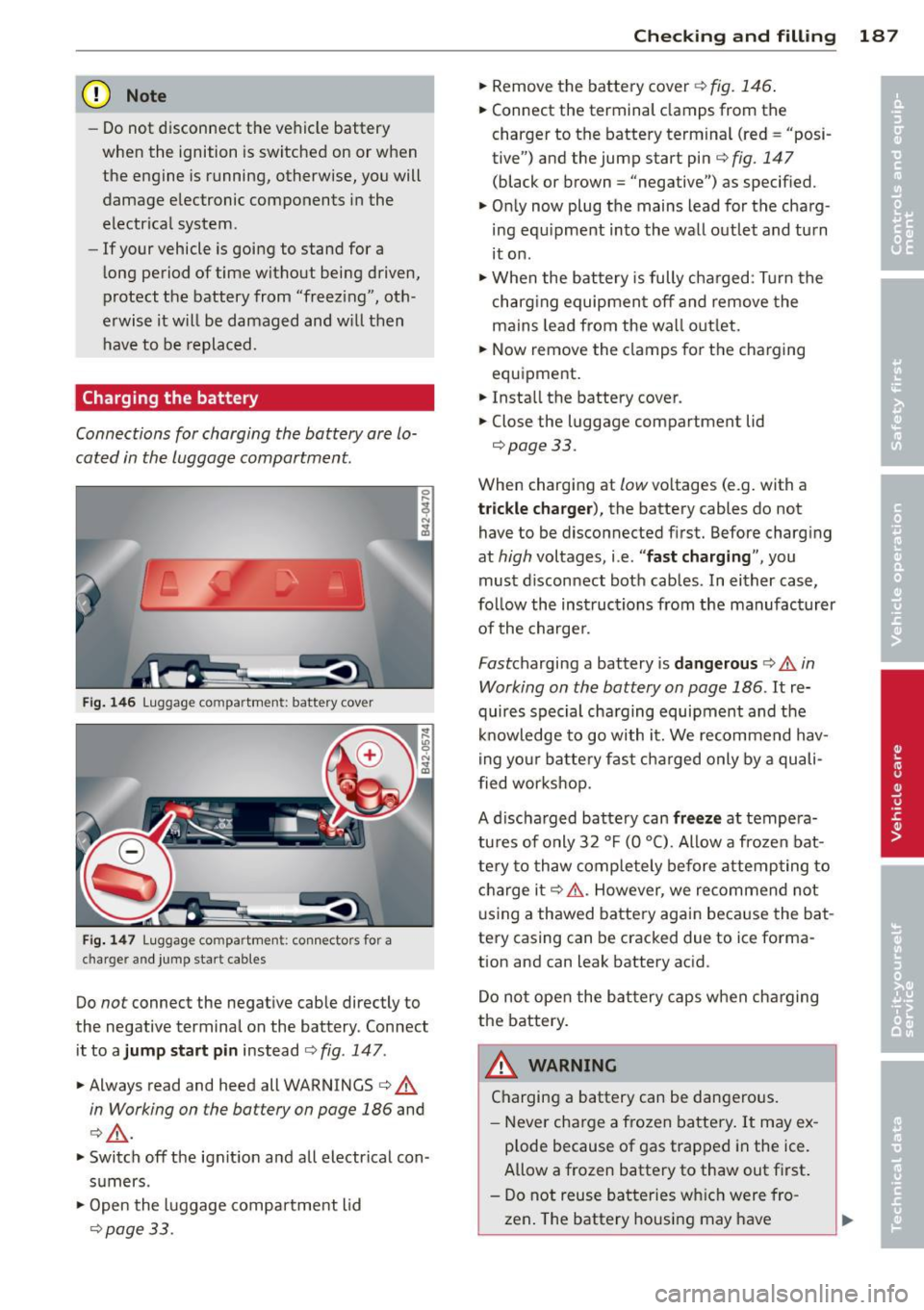
Connections for charging the battery are lo
cated in the Luggage compartment.
Fig. 146 Luggage com pa rtm ent: batt ery cov er
Fig. 147 Luggag e com partm ent: connec tor s for a
c harge r and jump start cables
Do not connect the negative cable direc tly to
the negative terminal on the battery . Connect
it to a
jump start pin instead c::.> fig . 147 .
.. Always read and heed all WARNINGS c::.> .&.
in Working on the ba ttery on page 186 and
Q ,&. .
.. Switch off the ignition and all electrical con
sumers .
.. Open the luggage compartment lid
c::.> page 3 3.
Checking and filling 187
.. Remove the battery cover c::.> fig. 146.
.. Connect the terminal clamps from the
charger to the battery terminal (red = "posi
tive") and the jump start pin
c::.> fig. 147
(black or brown= "negative") as specified.
.. Only now plug the mains lead for the charg
ing equipment into the wall outlet and turn
it on .
.. When the battery is fully charged: Turn the
charging equipment off and
remove the
mains lead from the wall outlet .
.. Now
remove the clamps for the charging
equipment .
.. Install the battery
cover.
.. Close the luggage compartment lid
c::.> page 3 3.
When charging at low voltages (e.g. with a
trickle charger), the battery cables do not
have to be disconnected first. Before charging
at
high voltages, i.e . "fast charging", you
must disconnect both cables. In either case,
follow the instructions from the manufacturer
of the charger.
Fastcharging a battery is
dangerous c::.> .&. in
Working on the battery on page 186 .
It re
quires special charging equipment and the
knowledge to go with it. We recommend hav
ing your battery fast charged only by a quali
fied workshop .
A discharged battery can
freeze at tempera
tures of only 32 °F (0 °C). Allow a frozen bat
tery to thaw completely before attempting to
charge it
c::.> & . However, we recommend not
using a thawed battery again because the bat
tery casing can be cracked due to ice forma
tion and can leak battery acid .
Do not open the battery caps when charging
the battery.
WARNING
Charging a battery can be dangerous.
- Never charge a frozen battery. It may ex
plode because of gas trapped in the ice .
Allow a frozen battery to thaw out first.
- Do not reuse batteries which were fro-
zen. The battery housing may have
Page 191 of 244
Tires and wheels
Tires
General notes
Tires may be the least appreciated and most
abused parts of a motor vehicle .
Tires may be the least appreciated and most
abused parts of a motor vehicle . Tires are,
however, one of the most important parts of a
vehicle, particularly considering the compara
tively small patch of rubber on each tire that
assures that a ll- important contact between
you, your vehicle and the road.
Maintaining the correct tire pressure, mak ing
sure that your vehicle and its tires do not have
to carry mo re weight than they can safely han
d le, avoiding damage from road hazards and
r eg ularly inspect ing t ires for damage i nclud
ing cuts, slashes irregu la r wear and ove rall
condition are the most important things that
you can do to he lp avoid sudden tire failure in
cluding tread separat ion and blowouts.
A voidin g damage
If you have to d rive over a curb or similar ob
stacle, drive very slow ly and as close as possi
b le at a right angle to the curb.
A lways keep chemicals includ ing grease, o il ,
gasoline and brake fluid off the t ires .
I nspect the t ires regularly for damage (cuts,
cracks or b listers, etc.). Remove any fo reign
bod ies embedde d in the treads.
Storing tires Mark tires when you remove them to indicate
the direction of rotation . T his ensures you to
be ab le to mount them correctly when you re
i nstall them .
When removed, the wheels or t ires should be
sto red in a cool, d ry and preferably dark place .
Store tires in a vertical pos ition if they are not
mounted on rims, in a horizontal pos it ion if
they are mounted on rims .
Tires an d wheel s 189
New tires
New ti res have to be broken in¢& .
The tread depth of new t ires may vary, accord
ing to the type a nd make of t ire and the tread
patte rn.
H idden damage
Damage to tires and r ims is ofte n not readily
visible . If you notice unusual v ib rat ion or the
vehicle pulls to one s ide, th is may ind icate
that one of the t ires has been damaged . T he
ti res m ust be chec ked immed iate ly by an au
thorized Audi dea le r or q ua lified wor kshop .
Unidirectional tires
A un idirectional tire can be identified by ar
rows on the sidewa ll, that po int in the direc
tion the t ire is designed to rotate. You mus t
f ol low the specified di rection o f rotation . T his
is necessary so that these tires can develop
their optimum characteristics regarding grip, road noise, wear and hydrop laning resistance.
For more information
¢ page 214.
A WARNING
New tires or t ires that are o ld, worn or
damaged cannot provide maximum con
trol and braking ability .
-
-New tires tend to be slippery and must
be broken in. To reduce the r isk of losing
control, a co llision and ser ious personal
in ju ries, d rive with special ca re for the
fi rst 350 m iles ( 560 km).
- Driving with worn or damaged tires can
lead to loss of control, sudden tire fail
ure, including a blowout and sudden de
fl ation, cras hes and se riou s personal in
juries . Have worn or damaged t ires re
placed immediate ly.
- Ti res age even if they are not being used
and can fai l sudden ly, especially at hig h
speeds. Tires that are more than 6 years
old can only be used in an emergency
and then w ith special care and at low
speed.
•
•
Page 196 of 244
194 Tire s and wheel s
that are stored . The system does not recog
nize the load cond ition of your vehicle.
See the il lustration ~
fig. 149 for the location
of the label on dr iver's side 8-pillar (color of
the actua l labe l and exact location on the ve
hicle wi LL vary slightly).
Note that the followi ng tab le is accurate at
the time o f go ing to press and is subject to
change. In the event of discrepancies, the tire pressure label on driver's s
ide 8 -pillar always
takes precedence .
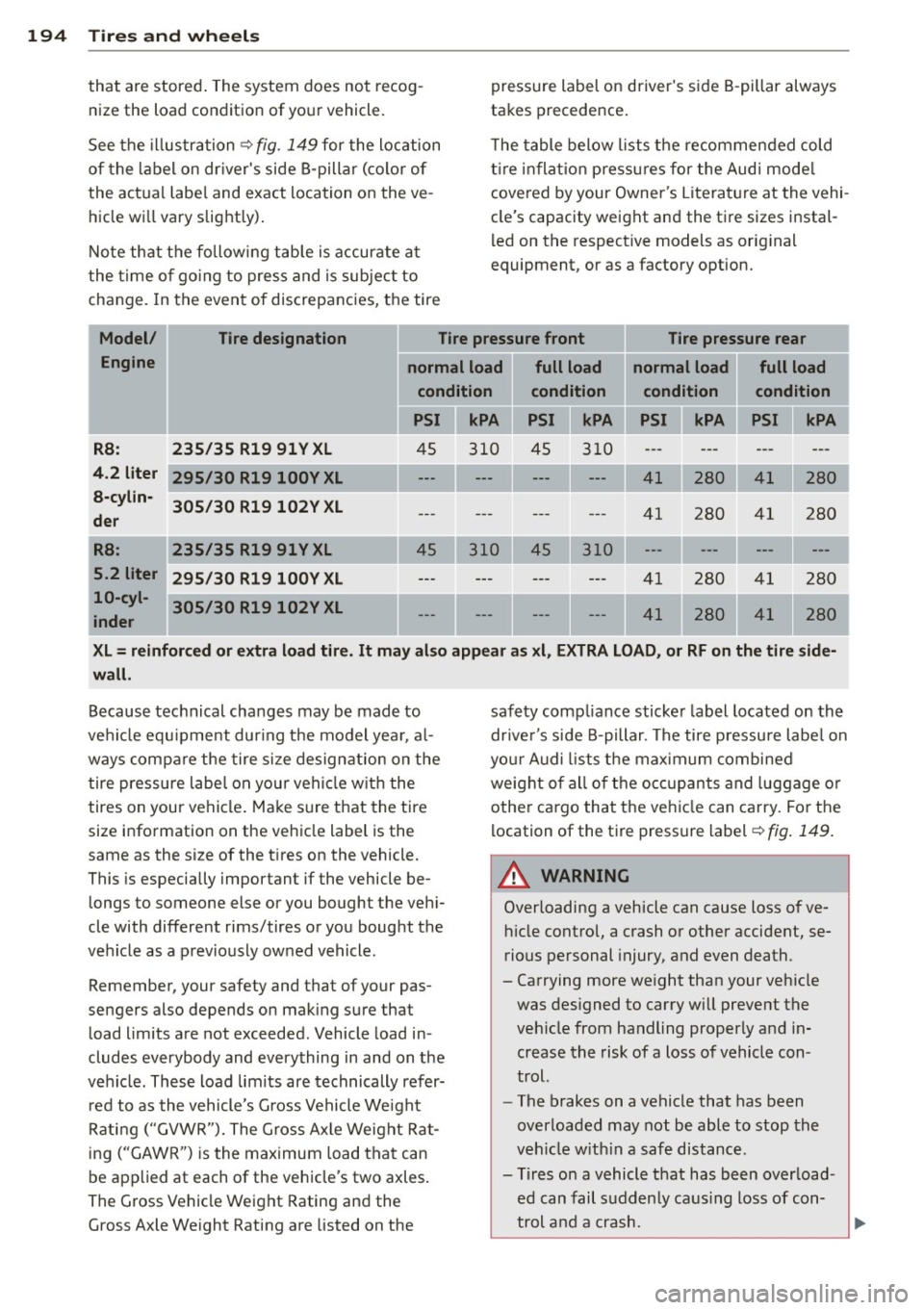
T he table below l ists t he recommended cold
t ire inflat ion pressu res for the Aud i mode l
covered by your Owner's Literat ure at the vehi
cle's capacity weight and the tir e sizes i nstal
l ed on the respective models as orig inal
equipment, or as a facto ry option.
I Model / \I Tire designation
Tire pressure front Tire pressure rear I
Engine
normal load full load normal load full load
condition condition condition condition
PSI II kPA PSI II kPA PSI ]I kPA
PSI II kPA
RS: 235/35 R19 91 Y XL 45
310 45 310
4 .2 liter
295 /30 R19 lOOY X L 280
8-c ylin-
305/30 R1 9 102V
XL
der 41
280 41
280
RS: 235/35 R19 91 Y XL 45
5.2 liter 295 /30 R19 l00Y XL 41 280 41
280
10-cyl-
305 /30 R19 102V XL
inder 41 280 41 280
--XL= reinforc ed or extra load tire. It may also a ppear as xl , EXTRA LOAD, or RF on the tire side·
wall.
Because tec hnical changes may be made to
ve hicle equ ipment dur ing the model yea r, a l
ways compare the tire size designation on the
tire pressure labe l on your vehicle w ith the
tires on your vehicle . Make s ure that the t ire
size information on the ve hicle label is the
same as the size of the tires on the vehicle.
This is especially important if the vehicle be
longs to someone else or you bough t the veh i
cle with different rims/tires or you bought the
ve hicle as a previously owned vehicle .
Remember, your safety and that of your pas
sengers also depends on mak ing sure that
load limits are not exceeded . Vehicle load in
cludes everybody and everything in and on the
vehicle. These load lim its are technically refer
r ed to as the vehicle 's Gross Vehicle We ight
Rating ("GVWR"). The G ross Ax le Weight Rat
ing ("GAWR") is the maximum load that can
be applied at each of the vehicle's two axles .
The Gross Vehicle Weight Rating and the
G ross Axle Weight Rating are listed on the safety compl
iance sticker label located on the
driver's side 8-pillar. The tire p ressure labe l on
yo ur Audi lists the max im um combined
weight of all o f the occ upants and luggage or
othe r ca rgo that the vehicle can carry. Fo r the
location of the tire pressure label
~ fig . 149.
A WARNING
Overloading a vehicle can cause loss of ve
h icle contro l, a crash or other accident, se
rious personal injury, and even death.
- Carrying more we ight than your veh icle
was designed to carry will prevent the
veh icle from handling properly a nd i n
crease the risk of a loss of vehicle con
trol.
- The brakes on a vehicle that has been
overloaded may not be able to stop the
veh icle w ith in a safe distance.
- Tires on a vehicle that has been overload
ed can fail suddenly ca using loss of con
trol and a crash.
Page 197 of 244
A WARNING
-Incorrect tire pressures and/or underin
flation can lead to a serious or fatal acci
dent .
- Incorrect tire pressures and/or underin
flation cause increased tire wear and can
affect the handling of the vehicle.
- Incorrect tire pressures and/or underin
flation can also lead to sudden tire fa il
ure, including a blowout and sudden de
flation, causing loss of vehicle control.
Checking tire pressure
The correct tire pressure for the tires original
ly installed on your vehicle is listed on the tire
pressure label located on driver's side 8-pil lar.
The recommended t ire pressures are on the
tire pressure labe l and in the tab le
¢ page 193, Cold tire inflation pressure . This
means that the pressure must be checked and
ad justed when the tire has not been driven for
more than a couple of m iles (kilometers) at
low speeds during the previous three hours.
Air in the tires expands when the tire heats up
as a result of internal fr iction as it flexes in
use. The tire pressure is higher when the tire
has warmed up than when it is "cold".
It is the inflation pressure in a "cold" tire that
counts. Therefore, you should never let air out
of a warm t ire to match "Cold tire inflation
pressure" recommendations
¢ page 193. The
tires would then be under inflated and could
fa il suddenly.
The tire pressure label on your Audi lists the recommended cold t ire inflat ion pressures for
the new, or iginal equipment tires that were
on you r vehicle at the t ime it was manufac
tured. For the location of the label
¢page 193, fig. 149.
Most tires lose a ir naturally over time. They
can also lose some a ir if you dr ive over a pot
h ole o r hi t a curb while pa rking. It is usua lly
not possib le to see whether the radia l tires
Tire s an d wheel s 195
used today are underinflated just by looking
at them .
T he refore, be su re to check t ire p ress ures at
least once a month and a lways befo re going
on a long trip . Make s ure to take the number
of peop le and the amount of luggage into ac
count when adjusting tire pressure for a trip -
even one that yo u wou ld not consider to be
"long". See
¢ page 196, Tires and vehicle
load limits
for more important information .
A lways use an accurate tire pressure gauge
when checking and adjusting inflation pres
sures. Check all of the tires. If the pressure in
any tire is too high when the tire is "cold", let
a ir out of the tire slowly with the edge of the
tire gauge and keep checking the pressure un
ti l you reach the pressure that is co rrect fo r
the load (passenge rs and luggage) and kind of
driv ing you plan to do .
If the pressure in any tire is too low, note the
difference between the p ressure in the cold
t ir e and the pressure you need and add the air
that you need to reach the correct pressure for
the vehicle load (passengers and luggage) for
the tires on your vehicle as listed on the on
your vehicle and in this man ua l and the kind
of driving you plan to do .
Never e xceed the m ax imum infl ation pre s
sure listed on the tire side wall f or an y re a
s on .
Remember that the vehicle manufacturer, not
the tire manufact urer, determines the cor rect
tire p ress ure for the tires on your ve hicle .
I t i s important to check the t ire press ure when
the tires are co ld .
- Read the required tire pressure from the t ire
p ressure labe l located on drive r's side B-pil
lar.
- Tu rn the va lve stem cap counter-clockw ise
to remove it from the t ire va lve.
- Place the a ir p ressure gauge on the va lve .
- The tire pressures should only be checked and ad justed when the tires are cold . The
slightly raised pressures of warm tires must
no t be reduced. .,. •
•
Page 198 of 244
196 Tire s and wheel s
-Adjust the tire pressure to the load you are
carrying.
- Reinsta ll the va lve stem cap on the valve .
When should I check the tire pres sur e?
The correct tire pressure is especially impor
tant at high speeds. The pressure should
therefore be checked at least once a month
and a lways before starting a journey.
When should I adjust th e tir e pre ss ures ?
Adjust the tire pressure to the load you are
carry ing . After changing a wheel
o r replacing
wheels you have to adjust the tire pressures
on all wheels. In addition , you must then init i
alize the new tire pressures in the tire p res
sure mon itoring system ¢
page 206.
& WARNING
Incorrect tire pressures and/or underinf la
tion can lead sudden tire failure, loss of
contro l, collision, serious personal injury
or even death.
- When the warning symbo l
(11 appears in
the instrument cluster, stop and inspect
the tires .
- Incorrect tire pressure and/or underinfla
tion can cause increased tire wear and
can affect the handling of the veh icle and
stopp ing ability .
- Incorrect tire pressures and/or underin
flation can also lead to sudden tire fa il
ure, including a blowout and sudden de
flation, causing loss of vehicle control.
- The driver is responsible for the cor rect
t ire pressures for all tires on the vehicle .
T he applicable p ressu re values are locat
ed on a stic ker on the d rive r's side 8 -pil
lar .
- Only when all t ires on the vehicle a re fi l
led to the correct pressure, the tire p res
sure monitoring system can work cor
rect ly .
- The use of incorrect tire pressure values
can lead to accidents or other damage.
T herefore it is essential that the driver
observe the specified tire pressure va lues
for the tires and the correct press ures for the function of the ti re p
ress ure monitor
ing system.
- Always inflate tires to the recommended
and correct t ire pressure before dr iv ing
off.
- Driving with underinflated tires bend
more, letting them get too hot resulting
in tread separation, sudden tire failure
and loss of control.
- Excessive speed and/overloading can
cause heat build-up, sudden tire failure
and loss of control.
- If the tire pressure is too low or too high,
the t ires will wear prematurely and the
veh icle w ill not handle well.
- If the tire is not flat and you do not have
to change a wheel immediately, drive at
reduced speed to the nearest service sta
tion to check the t ire p ressure and add
ai r as req uired .
@ Note
Driving w ithout valve stem caps can cause
damage to the tire valves. To prevent this ,
always make sure that factory insta lled
valve stem caps o n all whee ls are se curely
moun ted on the valve.
@ For the sake of the environment
Underinflated tires w ill also increase the
fuel consumption.
Tires and vehicle load limits
T he re a re limits to the amount of load or
weight that any vehicle and any tire can carry.
A vehicle that is overloaded will not handle
well and is more d ifficu lt to stop . Overloading
can not only lead to lo ss of vehicle control,
but can also damage impor tant parts of the
vehicle and ca n lead to sudden tire fa ilure, in
clud ing a blowout and sudden deflation that
can cause the vehicle to cras h.
Your safety and that of your passengers also depends on making sure that load limits a re
not exceeded . Vehicle load i ncludes eve rybody
and everything in and on the veh icle . These .,..