ECU AUDI R8 SPYDER 2014 User Guide
[x] Cancel search | Manufacturer: AUDI, Model Year: 2014, Model line: R8 SPYDER, Model: AUDI R8 SPYDER 2014Pages: 244, PDF Size: 61.06 MB
Page 84 of 244
![AUDI R8 SPYDER 2014 User Guide 82 Transmission [O] Risk of rolling! P not possible. Plea se set
the parking brake
- T he pa rking lock was released using the
eme rgency release
r=;, page 82. Or
- T he pa rking](/img/6/57641/w960_57641-83.png "AUDI R8 SPYDER 2014 User Guide 82 Transmission [O] Risk of rolling! P not possible. Plea se set
the parking brake
- T he pa rking lock was released using the
eme rgency release
r=;, page 82. Or
- T he pa rking")
82 Transmission [O] Risk of rolling! P not possible. Plea se set
the parking brake
- T he pa rking lock was released using the
eme rgency release
r=;, page 82. Or
- T he pa rking lock can no longer be engaged.
Drive to your authorized Audi dealer or
qualified repair facility immediately to have
the malfunction corrected.
• Transmission: System malfunction ! Stop
the vehicle
Do not cont inue driving. Turn off the ignition
and contact your nearest authorized Audi
dealer for assistance.
There is a serious system malfunction . Con
tinuing to drive could result in subsequent
damage.
0 Note
If S tronic has switched to emergency op
eration mode, you should have the mal
function corrected as soon as possible.
Parking lock emergency release
Appl ies to vehicles: with S tronic
The parking lock must be released using the
emergency release before towing the vehicle .
Fig. 86 Engine compartment: emergency release
Fig. 87 Engine compa rtment: pa rking lock emergency
r e lease
The emergency release is located in the en
gine compartment.
Releasing the parking lock using the
emergency release
.,. Turn the engine off.
.,. Set the parking brake to prevent the vehicle
from rolling unintentionally.
.,. Remove the removable plastic key from the
luggage compartment and extend the key to
its full length .
.,. Remove the cover over the emergency re
lease mechanism .
.,. Insert the plastic key into the emergency re
lease mechanism and turn it all the way to
the right
r=;, fig. 87.
Resetting the parking lock
.,. Tu rn the key all the way to the left .
.,. Install the cover.
The
[O] indicator light appears in the instru
ment cluster if the park ing lock was released
from P using the emergency release. The mes
sage
Risk of rolling! P not possible. Please
set the parking brake
also appears .
.&_ WARNING
- Only activate the emergency release
while on a level surface or a slight slope.
-If you release the parking lock using the
emergency release, secure you r vehicle
wit h the parking brake. The vehicle can
roll away if it is not secured and cause a
crash.
Page 94 of 244
92 Homelin k®
may not be sufficient for the Homelink ® sys
tem to learn the radio frequency signal. Per
form all other steps as described above .
Operating the Homelink ® transmitter
The HomeLink ® transmitter works in the
some manner as the original hondheld re
mote control that come with the system.
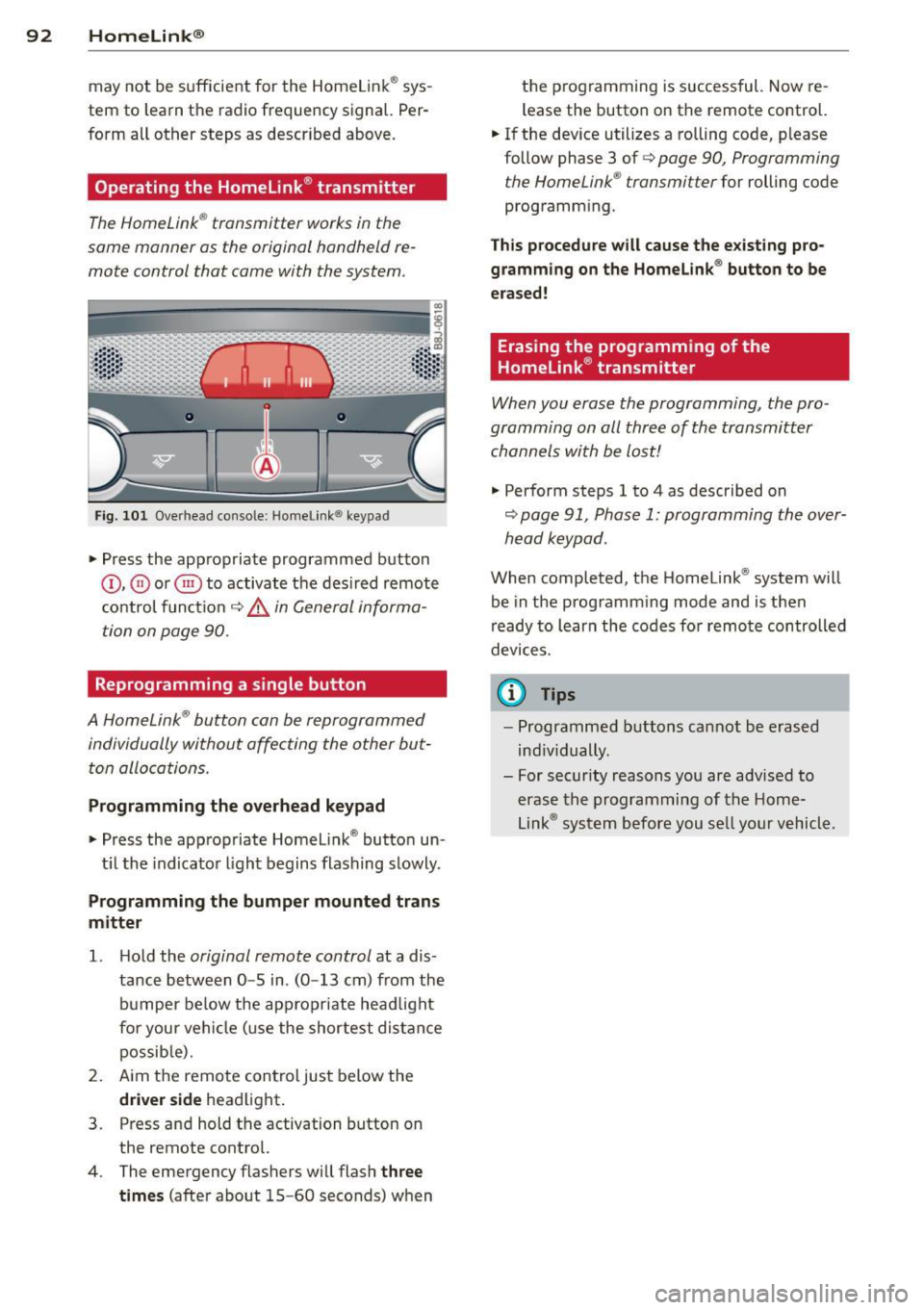
Fig. 101 Ove rhead conso le: Home link ® keypad
.,. Press the appropriate programmed button
(D , ® or @) to activate the des ired remote
control funct ion
c::> &, in General informa
tion on page 90.
Reprogramming a single button
A Homelink ® button can be reprogrammed
individually without affecting the other but ton allocations.
Programming the o verhead k eypad
.,. Press the appropriate Homelink ® button un -
t il the indicator light begins flashing slowly .
Programmin g the bumper mounted tran s
m itter
1. H old the original remote control at a dis
tance between
0 -5 in . (0 -13 cm) from the
bumper below the appropriate head light
for your vehicle (use the shortest distance possib le).
2. Aim the remote control just below the
d riv er side headlight .
3 . Press and hold the activation button on
the remote control.
4 . The emergency flashers will flash
th ree
time s
(after about 15-60 seconds) when the p
rogramming is successful. Now re
l ease the button on the remote control.
.,. If the device utilizes a rolling code, please
follow phase 3 of
c::> page 90 , Programming
t he HomeLink ® transmi tter
for rolling code
programm ing .
Th is p ro cedu re will c ause the e xisting pro
gr amm in g on the Homelink ® button to be
era sed!
Erasing the programming of the
Homelink ® transmitter
When you erase the programming , the pro
gramming on all three of the transmitter
channels with be lost!
.,. Perform steps 1 to 4 as described on
c:::;, page 91, Phase 1: programming the over
head keypad .
When completed , the Homelink ® system will
be in the programming mode and is then
r eady to learn the codes fo r remote controlled
devices.
© Tips
- Programmed buttons cannot be erased
ind iv idually .
- For security reasons you are advised to erase the programming of the Home
Link ® system before you se ll your vehicl e .
Page 95 of 244
Driving Safely
General notes
Safe driving habits
Please remember -safety first!
This chapter contains important information,
tips, instructions and warnings that you need
to read and observe for your own safety, the
safety of your passengers and others . We have
summarized here what you need to know
about safety belts, airbags, child restraints as
well as child safety. Your safety is for us
priori
ty number 1.
Always observe the information
and warnings in this section - for your own
safety as well as for that of your passengers.
The information in this section applies to all
model versions of your vehicle . Some of the
features described in this section may be
standard equipment on some models, or may
be optional equipment on others. If you are
not sure, ask your authorized Audi dealer.
A WARNING
- Make certain that you follow the instruc
tions and heed the WARNINGS in this
Manual. It is in your interest and in the
interest of your passengers.
- Always keep the complete owner's litera
ture in your Audi when you lend or sell
your vehicle so that this important infor
mation will always be available to the
driver and passengers.
- Always keep the owner's literature handy
so that you can find it easily if you have
questions.
Safety equipment
The safety features are part of the occupant
restraint system and work together to help
reduce the risk of injury in a wide variety of
accident situations .
Your safety and the safety of your passengers
should not be left to chance. Advances in
technology have made a variety of features
available to help reduce the risk of injury in an
Driving Safely 93
accident. The following is a listing of just a
few of the safety features in your Audi:
- sophisticated safety belts for driver and all
passenger seating positions,
- safety belt pretensioners ,
- front airbags,
- knee airbags,
- side airbags in the seats
- adjustable head restraints,
- adjustable steering column.
These individual safety features can work to
gether as a system to help protect you and
your passengers in a wide range of accidents.
These features cannot work as a system if
they are not always properly adjusted and
properly used!
Safety is everybody's responsibility!
Important things to do before driving
Safety is everybody's job! Vehicle and occu
pant safety always depends on the informed and careful driver.
For your safety and the safety of your passen
gers,
before driving always:
~ Make sure that all lights and signals are op
erating correctly .
~ Make sure that the tire pressure is correct.
~ Make sure that all windows are clean and af
ford good visibility to the outside.
~ Secure all luggage and other items carefully
r=:> page 60.
~ Make sure that nothing can interfere with
the pedals.
~ Adjust front seat, head restraint and mirrors
correctly for your height .
~ Instruct passengers to adjust the head re
straints according to their height .
~ Make sure to use the right child restraint
correctly to protect children¢
page 132,
Child Safety.
~ Sit properly in your seat and make sure that
your passengers do the same¢
page 57,
General recommendations. .,..
•
•
Page 100 of 244
98 Driving Safely
Pedal area
Pedals
The pedals must always be free to move and
must never be interfered with by a floor mat
or any other object.
Make sure that all pedals move freely without
interference and that nothing prevents them
from returning to their original positions .
Only use floor mats that leave the peda l area
free and can be secured with floor mat fasten
ers.
If a brake circuit fails, increased brake peda l
travel is required to bring the vehicle to a full
stop.
A WARNING
Pedals that cannot move freely can cause
loss of vehicle control and increase the r isk
of serious injury.
- Never place any objects in the driver 's
footwell. An object could get into the
peda l area and interfere w ith pedal func
tion. In case of sudden braking or an ac
cident, you would not be ab le to bra ke or
accelerate!
- Always make su re that nothing can fall
or move into the driver's footwell.
Floor mats on the driver side
Always use floor mats that can be securely
attached to the floor mat fasteners and do
not interfere with the free movement of the
pedals.
... Make su re that the floor mats are properly
secured and cannot move and interfere with
the pedals~ .&_.
Use only floor mats that leave the pedal a rea
unobstructed and that are firmly secured so
that they cannot s lip out of position. You can
obtain suitable floor mats from your author
ized Audi Dealer.
Floor mat fasteners are installed in your Audi . Floor mats used in your vehicle must be at
tached to these fasteners . Properly securing
the floor mats will prevent them from sliding
into positions that could interfere with the
pedals or impair safe operat ion of your vehicle
in other ways.
A WARNING ,-
Pedals that cannot move freely can result
i n a loss of vehicle control and increase the
r isk of ser ious persona l injury.
- Always make sure that floor mats are
p roperly secured.
- Never place or install floor mats or other
f loor coverings in the vehicle that cannot
be prope rly secured in place to prevent
them from slipping and interfer ing wi th
the peda ls or the ability to contro l the
vehicle.
- Never pla ce or install floor mats or other
floor coverings on top of already instal
led floor mats . Additiona l floor mats and
other coverings will reduce the size of
the pedal area and interfere with the
pedals.
- Always properly reinsta ll and secure floor
mats that have been taken out for clean
ing.
- Always make sure that objects cannot
fall into the dr iver footwell while the ve
hicle is moving . Objects can become
trapped under the brake pedal and accel
erator pedal causing a loss of vehicle
control.
Stowing luggage
Loading the luggage compartment
All luggage and other objects must be prop erly stowed and secured in the luggage com
partment.
Loose items in the luggage compartment can
shift s udden ly, changing vehicle handling
characteristics. Loose items can a lso increase
the risk of serious persona l injury in a sudden
vehicle maneuver or in a co llision.
Page 101 of 244
In a collision, the laws of physics mean that
even smaller items that are loose in the ve hi
cle will become heavy missiles that can cause
serious injury. Items in the vehicle possess en
ergy which vary with vehicle speed and the
weight of the item . Vehicle speed is the most
sig nificant factor.
For examp le, in a frontal coll is ion at a speed
of 30 mph (48 km/h), the forces acting on a
10 -lb (4 .5 kg) object are about 20 times the
norma l we ight of the item. Th is means that
the we ight of the item would suddenly be
about 200 lbs. (90 kg). You can imag ine the
in ju ries that a 200 lbs. (90 kg) item flyi ng
freely th roug h the passenge r compartment
could cause in a collision like this.
~ WARNING
Improperly stored luggage or other items
can fly through the vehicle ca us ing serious
personal in jury in the event of hard brak
ing or an acc ident. To help reduce the risk
of serious personal injury :
-Always put objects, for examp le, luggage
or other heavy items in the luggage com
partment .
A WARNING
Heavy loads will influence the way your ve
hicle handles . T o help reduce the r is k of a
loss of control leading to ser ious personal
injury:
- Always keep i n m ind whe n transporting
heavy objects, that a c hange in t he cen
t er of g ravity c an also cause c hanges in
vehicle handling .
- Never exceed the G ross Ax le Weight R at
ing or the Gross Veh icle Weight R ating
specified on t he safety compliance s tic k
er on the left door jamb. Exceeding pe r
missib le we ight standa rds can cause the
vehicle to s lide and handle differently.
- Please obse rve info rmation on safe driv
ing
c:;, page 93 .
Dr iving S afel y 99
A WARNING
Always make sure that the doors, all win
dows a nd the front lid are secure ly closed
and locked to reduce the r is k of injury
when the vehicle is not be ing used .
- After closing the front lid, always make sure that it is p rope rly closed and locked .
- Never leave your veh icle unattended es
pecially with the front lid left open . A
child co uld craw l into the luggage com
pa rtment and close the front lid becom
ing tr apped and unable to ge t out. Being
trapped in a veh icle can lead to se rious
pe rsonal injury .
- Never let c hild ren play i n or aroun d the
veh icle .
- Never let p assenger s ride in the luggage
comp artment. Vehicle oc cupants mus t
always be prope rly restrained in one of
the vehicle's seating pos it ions .
(D Tips
The t ire press ure mu st cor respond to t he
l oad. The t ire p ress ure is shown on the tire
pressure label. The tire pressure labe l is lo
cated on the d river's side B-pi llar . The t ire
pressure label lists the recommended cold
tire inflation pressures for the vehicle at i ts maximum capac ity we ight and the tires
that we re on your vehicle at the t ime it
was manufactured. For recommended tire
p ressures fo r no rma l load cond it ions,
please see chapter
c:;, page 193.
Reporting Safety
Defects
Applicable to U.S.A.
If you belie ve that your vehi cle
has a d efe ct which could cau se
a crash or could caus e injur y or
d eath, you should immediat ely
inform th e National High way
Tr affi c Safet y Administration
•
•
Page 104 of 244
102 Driving Safel y
Retracting rollover protection
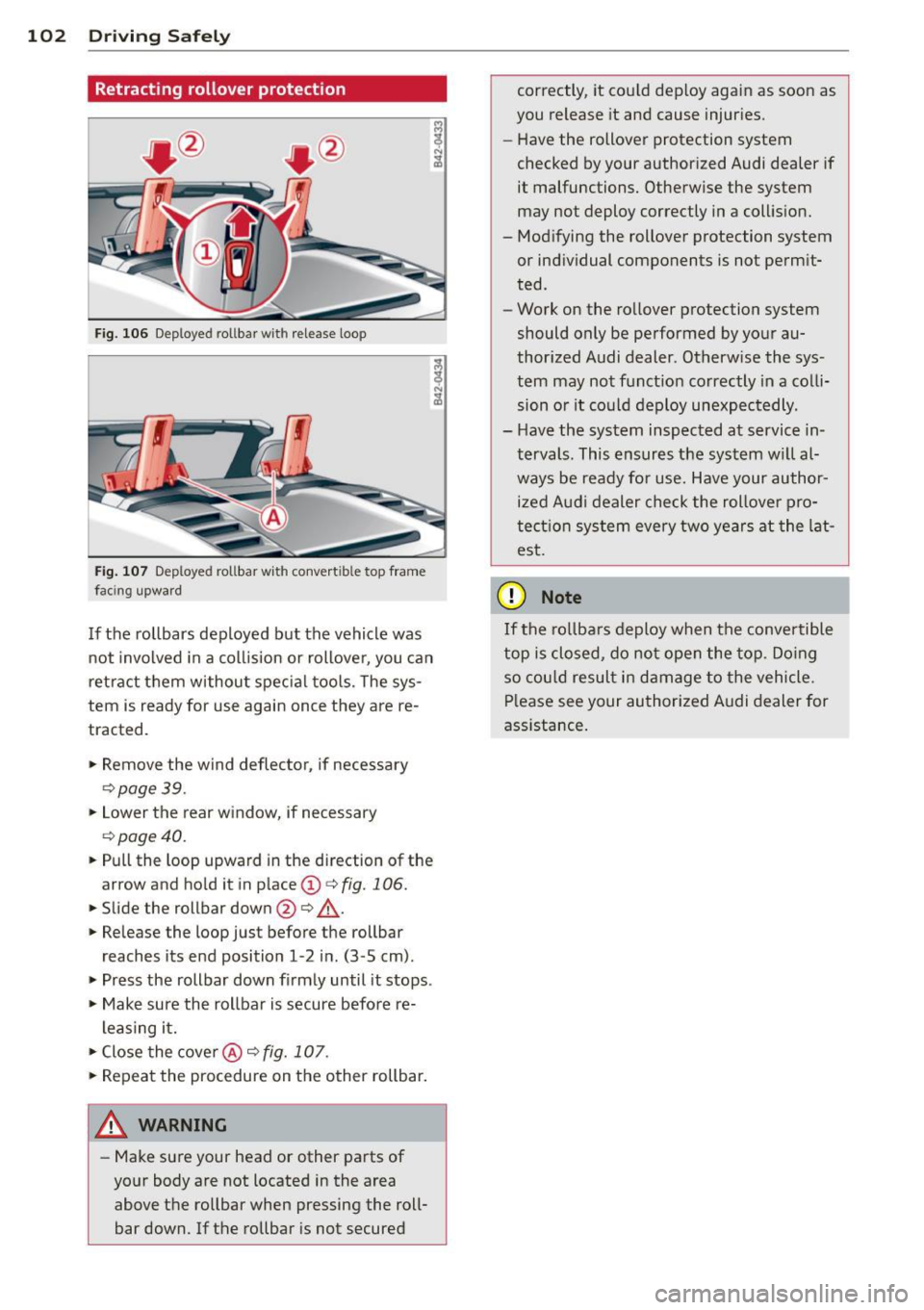
Fig. 106 Deployed roll bar w it h release loop
Fig . 107 Dep loye d rollbar w it h convert ible top frame
fac in g upwa rd
If the rollbars deployed but the vehicle was
not involved in a collision or rollover, you can
retract them without spec ia l tools. The sys
tem is ready for use again once they are re
tracted .
.,. Remove the w ind deflec to r, if necessary
c> page39 .
.,. Lower the rear window, if necessary
c> page40 .
.,. Pull the loop upward in the direction of the
arrow and ho ld it in p lace
(I) <=> fig. 106 .
.,. Slide the rollbar down@ c> /1. .
.,. Re lease the loop just before the rollbar
reaches its end position 1-2 i n. (3-5 cm) .
.,. Press the rollbar down firmly until it stops .
.,. Make sure the rollbar is secure before re
leas ing it .
.,. Close the cove r@ c>
fig. 107 .
.,. Repeat the procedure on t he other rollbar.
A WARNING
- Make su re your head or other parts of
yo ur body are not located in the area
above the rollbar when pressing the roll
bar down. If the rollbar is not secured -
correctly, it cou ld dep loy again as soon as
you release it and cause injur ies.
- Have the rollover protection system
checked by your author ized Audi dealer if
it malfunctions. Otherwise the system
may not deploy correctly in a collis ion.
- Mod ifying the rollover protection system
or individual components is not pe rm it
ted .
- Work on the ro llover protection system
should only be performed by your au
thor ized Audi dealer. Otherw ise the sys
tem may not f unct ion co rrectly in a colli
sion o r it co uld deploy unexpectedly.
- Have the system inspected at service in
tervals . This ensures the system w ill al
ways be ready for use. Have your author
i z ed Aud i dealer check the rollover pro
tec tion sys tem every two years at the lat
est.
(D Note
If the ro llba rs deploy when the convertible
top is clo sed, do no t open the top. Do ing
so cou ld resul t in damage to the vehicle.
P lease see your authorized A udi dealer for
ass istance.
Page 108 of 244
106 Safety belts
-For maximum protection, safety belts
must always be positioned correctly on
the body.
- Never strap more than one person, in
cluding small children, into any single
safety belt.
- Never place a safety belt over a child sit
ting on your lap.
- Always keep feet in the footwell in front
of the seat while the vehicle is being driv
en .
- Never let any person ride with feet on
the instrument panel or sticking out the
window or on the seat.
- Never remove a safety belt while the ve
hicle is moving. Doing so will increase
your risk of be ing injured or killed.
- Never wear belts twisted.
- Never wear belts over rigid or breakable
objects in or on your clothing, such as
eye glasses, pens, keys, etc., as these
may cause injury.
- Never wear the shoulder part of the belt
under your arm or otherwise out of posi
t ion .
- Several layers of heavy clothing may in
terfere with correct positioning of belts and reduce their effectiveness .
- Always keep belt buckles free of anything
that may prevent the buckle from latch
ing securely .
- Never use comfort clips or devices that
create slack in the shoulder belt. Howev
er, special clips may be required for the
correct use of some child restraint sys
tems.
- Never allow safety belts to become dam
aged by being caught in door or seat hardware.
- Torn or frayed safety bel ts can tear and
damaged belt hardware can break in an
accident. Inspect belts regularly. If web
bing, bindings, buckles, or retractors are
damaged, have belts replaced by an au
thorized Audi dealer or qualified work shop.
- Safety belts that have been worn and
loaded in an accident must be replaced with the correct replacement safety belt
by an authorized Audi dealer or qualified
workshop. Replacement may be necessa
ry even if damage cannot be clearly seen .
Anchorages that were loaded must also
be inspected .
- Never remove, modify, disassemble, or
try to repair the safety belts yourself.
- Always keep the belts clean. Dirty belts
may not work properly and can impair
the function of the inertia reel
¢ page 165, Safety belts.
Safety belts
· Fastening safety belts
Seat first -everybody buckle up!
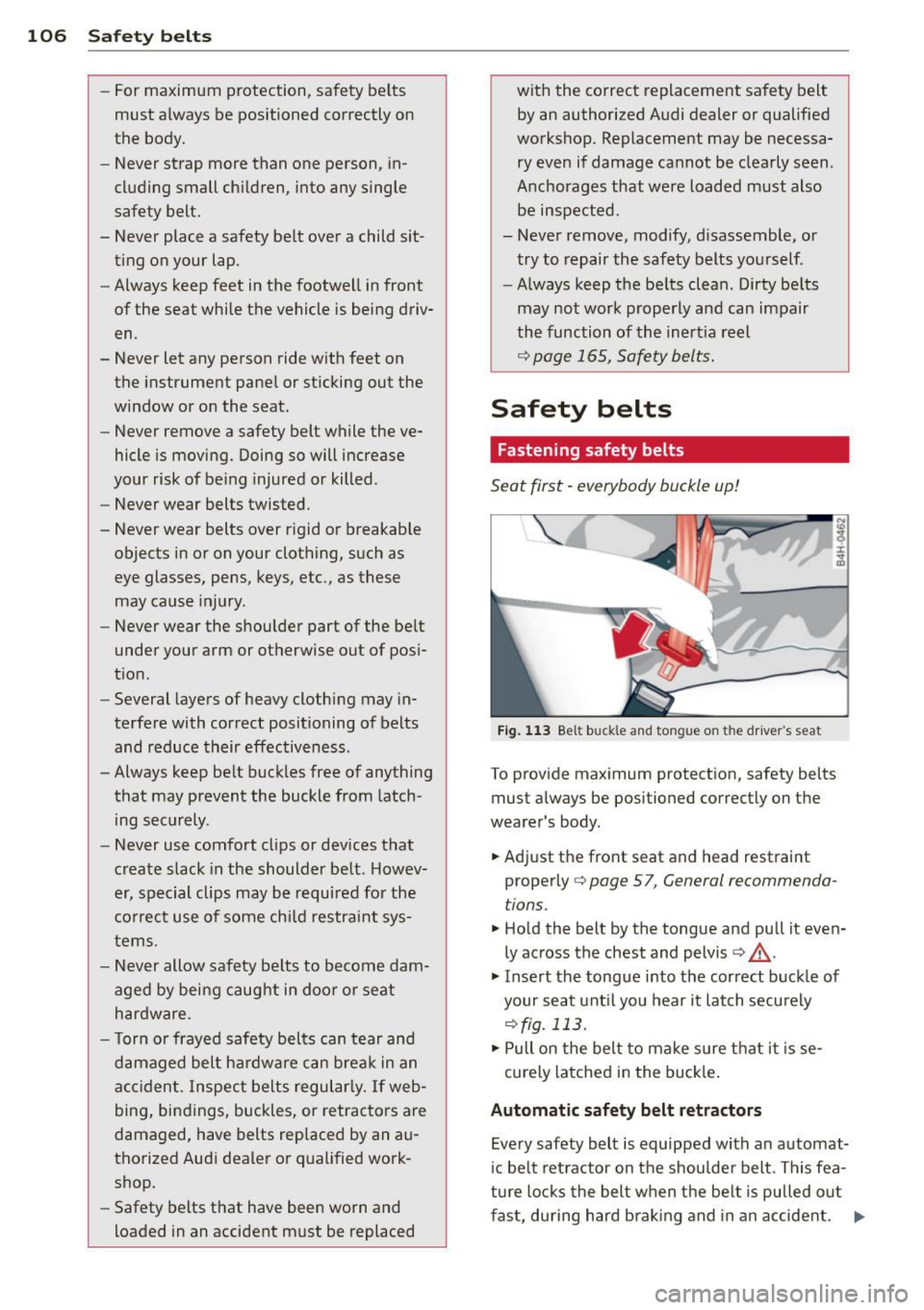
Fig. 113 Be lt buck le and to ngue o n th e drive r's se at
To provide maximum protection, safety belts
must always be positioned correctly on the
wearer 's body.
.. Adjust the front seat and head restraint
properly ¢
page 5 7, General recommenda
t ions .
.. Hold the belt by the tongue and pull it even
ly across the chest and pelvis ¢
_&..
.. Insert the tongue into the correct buckle of
your seat until you hear it latch securely
¢fig. 113 .
.. Pull on the belt to make sure that it is se-
curely latched in the buckle.
Automatic safety belt retractors
Every safety belt is equipped with an automat-
ic belt retractor on the shoulder belt. This fea
ture locks the belt when the belt is pulled out
fast, during hard braking and in an accident. ..,.
Page 109 of 244
The belt may also lock when you drive up or
down a steep hill or through a sharp curve.
During normal driving the belt lets you move
freely .
Safety be lt pretensioners
The safety belts are equipped with a belt pre
tensioner that helps to tighten the safety belt
and remove slack when the pretensioner is ac
tivated . The function of the pretensione r is
monitored by a warning light ¢
page 14.
Switchable locking feature
Every safety belt except the one on the driver
seat is equipped with a switchable locking fea
ture that
must be used when the safety belt is
used to attach a child seat. Be sure to read the important information about this feature
¢page 140.
A WARNING
Improperly positioned safety belts can
cause serious injury in an accident
¢ page 107, Safety belt position .
-Safety belts offer optimum protection
only when the seatback is upright and
belts are properly positioned on the
body.
-
- Never attach the safety belt to the buck
le for another seat. Attaching the belt to
the wrong buckle will reduce safety belt
effect iveness and can cause serious per
sonal injury.
- A passenger who is not properly restrain
ed can be seriously injured by the safety
belt itself when it moves from the stron
ger parts of the body into critical areas
like the abdomen.
- Always lock the convertible locking re
tractor when you are securing a child
seat in the vehicle
r:::> page 142.
Safety belts 107
Safety belt position
Correct belt position is the key to getting
maximum protection from safety belts .
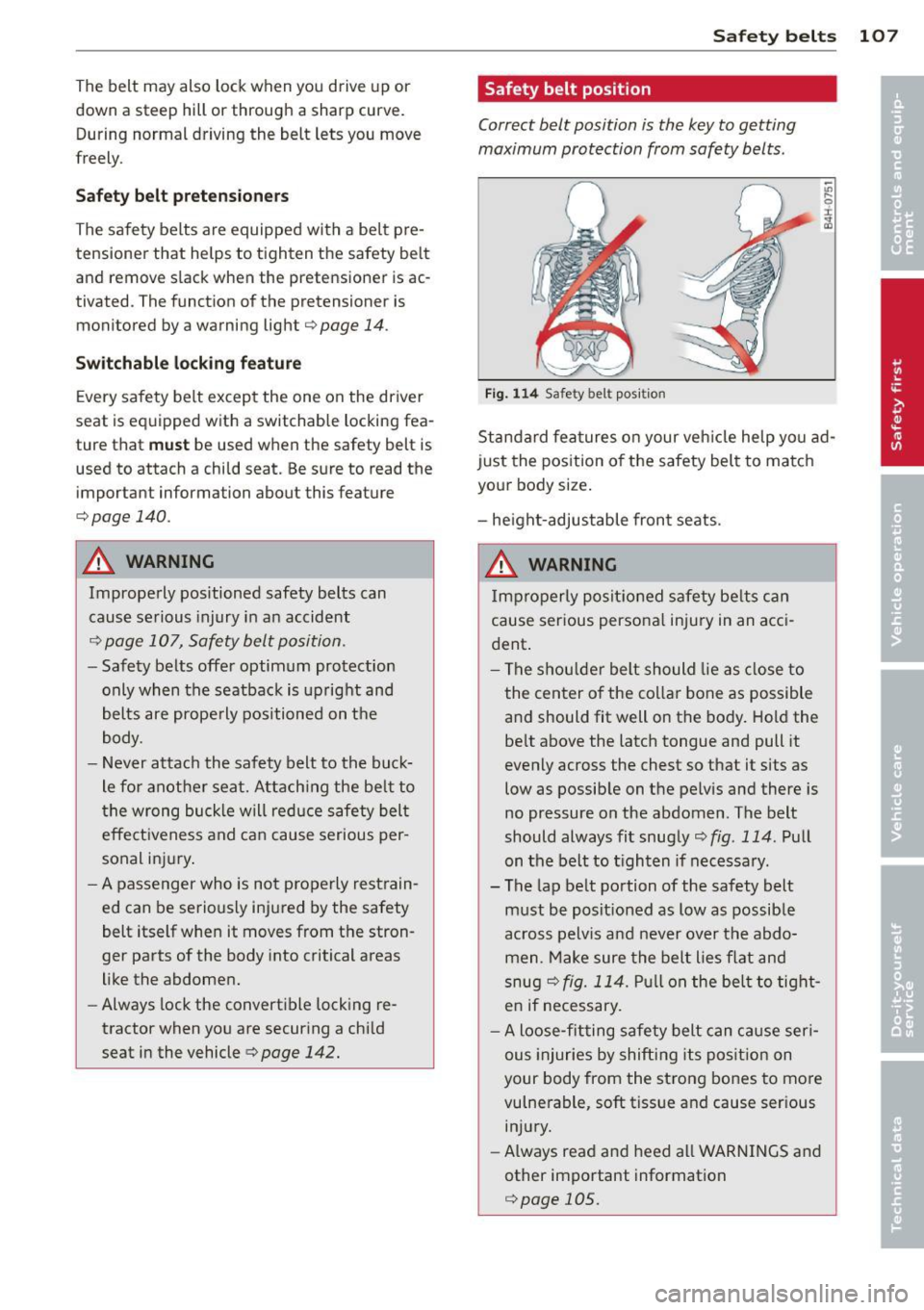
Fig. 114 Safety belt position
;;;
9 r ., a,
Standard features on your vehicle help you ad
just the position of the safety belt to match
your body size.
- height-adjustable front seats.
A WARNING
Improperly positioned safety belts can
cause serious personal injury in an acci
dent.
-
- The shoulder belt should lie as close to
the center of the collar bone as possible
and should fit well on the body. Hold the
belt above the latch tongue and pull it
evenly across the chest so that it sits as
low as possible on the pelvis and there is
no pressure on the abdomen . The belt
should always fit snugly
r:::> fig . 114. Pull
on the belt to tighten if necessary.
- The lap belt portion of the safety belt
must be positioned as low as possible
across pelvis and never over the abdo
men . Make sure the belt lies flat and
snug ¢
fig. 114. Pull on the belt to tight
en if necessary.
- A loose-fitting safety belt can cause seri
ous injuries by shifting its position on
your body from the strong bones to more
vulnerable, soft tissue and cause serious injury.
- Always read and heed all WARNINGS and
other important information
r:::> page 105.
Page 110 of 244
108 Safet y belt s
Pregnant women must also be properly
restrained
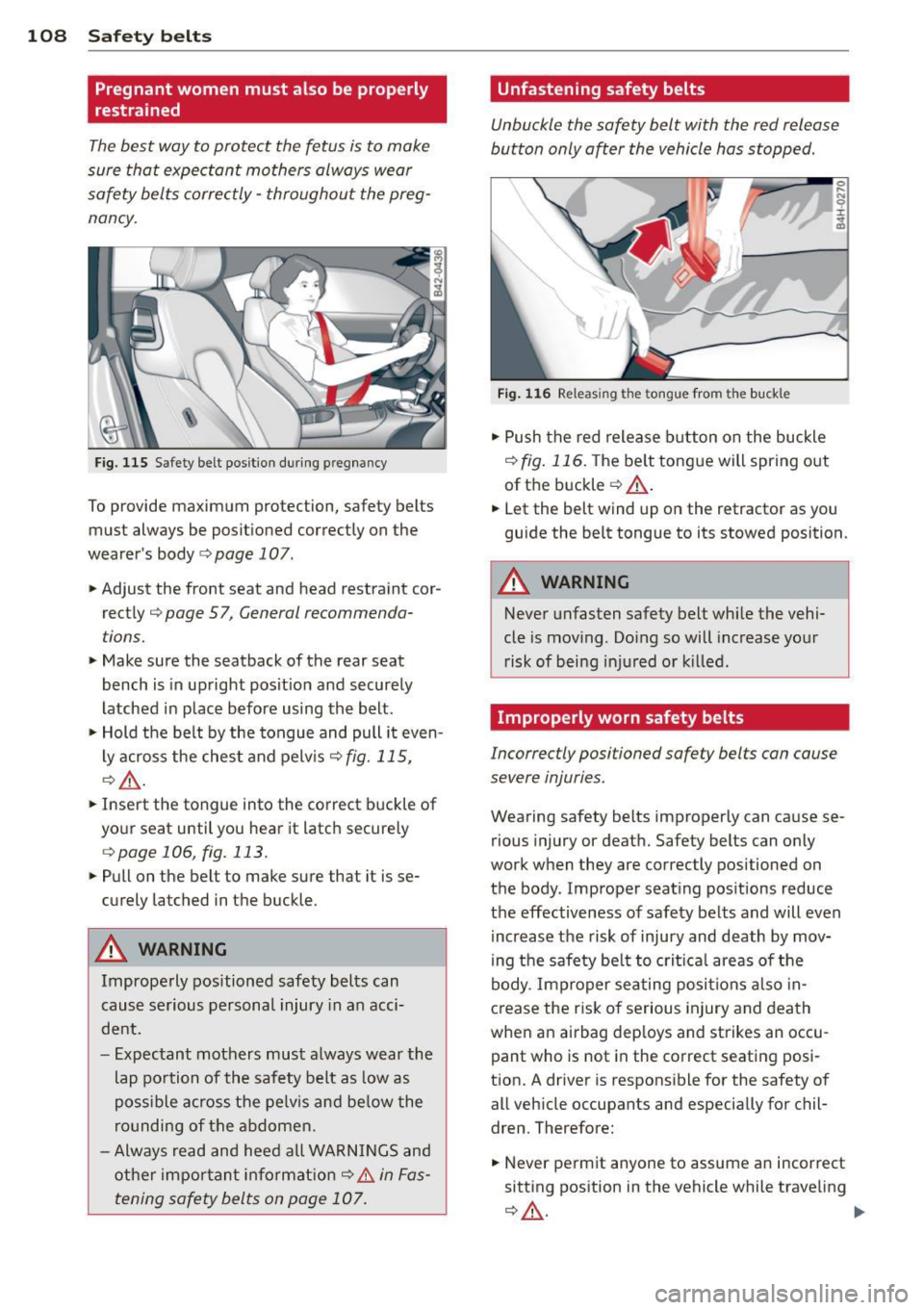
The best way to protect the fetus is to make
sure that expectant mothers always wear
safety belts correctly -throughout the preg
nancy.
Fig . 115 Safety be lt pos it io n dur ing p regnancy
To provide maximum prote ction , safety belts
must always be po sitioned correctly on the
wearer's body
c> page 107 .
• Adjust the front seat and head restraint cor
rect ly
c> page 5 7 , General recommenda
tions.
• Make sure the seatback of the rear seat
bench is in up right posit io n and securely
latched in p lace before using the b elt .
• Hold the be lt by the tongue and pull it even
l y across the ches t and pelvis
c> fig. 115,
c>,& .
• Inse rt the tongue into the correct buckle of
yo ur seat until you hear it latc h securely
c> page 106 , fig . 113.
• Pullon the belt to make sure that it is se
curely latched in t he buckle .
A WARNING
Imprope rly positioned safety belts can
cause se rious personal injury in an acci
dent.
-
- E xpec tant mothers must a lways wear the
lap po rtion of the safety b elt as low as
poss ible ac ross the pe lv is and be low the
ro unding of the abdome n.
- Always read and heed all WARN INGS and
ot her impo rtan t info rma tion
c> .&. in Fas
tening safety belts on page 107.
Unfastening safety belts
Unbuckle the safety belt with the red release
button only a~er the vehicle has stopped .
,,
}_
Fig . 11 6 Releas ing the ton gu e from the buc kle
• Push the red release b utton on the buckle
c> fig . 116. T he be lt tongue will spring out
of t he b uckle
c> ,& .
N 0 ;c
a1i
• Let the belt wind up on the retractor as you
guide the belt tongue to its stowed position .
A WARNING
-
Never unfasten safety belt whi le the vehi-
cle is mov ing . Do ing so will increase yo ur
r isk of being i njured o r kill ed .
Improperly worn safety belts
Incorrectly positioned safety belts can cause
severe injuries.
Wearing safety belts improper ly can ca use se
rious injury or deat h. Safety belts can only
work when they are correc tly positioned on
the body . Improper seat ing positions reduce
the effectiveness of safety be lts and will even
increase the risk of inju ry and death by mov
ing the safety be lt to crit ical areas o f the
body . Imp roper seati ng po siti ons also in
crease the risk of serious injury and death
whe n an a irbag dep loys and strikes an occu
pant who is not in the co rrect seating posi
t ion. A driver is respons ible for the safety of
all veh icle occupants and especially for chil
dren . There fore:
• Never pe rm it anyone to assume an incorrect
sitt ing position in the vehicle while trave ling
c> ,& . ~
Page 142 of 244
140 Child Safety
In order for the airbag to offer protection, it is
important that all vehicle occupants, especial
ly any children, who must be in the front seat
because of exceptional circumstances, be
properly restrained and as far away from the
airbag as possible. By keeping room between
the child's body and the front of the passen
ger compartment, the airbag can inflate com
pletely and provide supplemental protection
in certain frontal collisions .
& WARNING
Not using a booster seat, using the boos
ter seat improperly , incorrectly installing a
booster seat or using the vehicle safety
belt improperly increases the risk of seri
ous personal injury and death in a collision
or other emergency situation. To help re
duce the risk of serious personal injury
and/or death:
- The shoulder belt must lie as close to the
center of the child's collar bone as possi
ble and must lie and snug on the upper
body .
It must never lie across the throat
or neck. The lap belt must lie across the
pelvis and never across the stomach or
abdomen. Make sure the belt lies flat
and snug. Pull on the belt to tighten if
necessary.
- Failure to properly route safety belts
over a child's body will cause severe inju
ries in an accident or other emergency
situation
c::;,poge 103.
-Children on the front seat of any car,
even with Advanced Airbags, can be seri
ously injured or even killed when an air
bag inflates.
- Never let a child stand or kneel on the
seat.
- Never let a child ride in the cargo area of
your vehicle.
- Always remember that a child leaning
forward, sitting sideways or out of posi
tion in any way during an accident can be
struck by a deploying airbag. This will re
sult in serious personal injury or death.
- If you must install a booster seat on the
front passenger seat because of excep -
-
tional circumstances the PASSENGER
AIR BAG OFF
light must come on and
stay on, whenever the ignition is switch
ed on.
- If the
PASSENGER AIR BAG OFF light
does not come on and stay on, perform
the checks described .
- If the
PASSENGER AIR BAG OFF light
does not come on and stay on whenever
the ignition is switched on the inflating
airbag will hit the child safety seat or in
fant carrier with great force and will
smash the child safety seat and child
against the backrest, door or roof. Have
the airbag system inspected immediately
by your Audi dealer.
- Always read and heed all WARNINGS
whenever using a child restrained in ave
hicle is being used
¢page 103, Safety
belts,
c::;, page 111 , Airbag system and
c::;, page 132, Important things to know.
Installing a child safety
seat
Securing a child safety seat using a
safety belt
Safety belts for the front passenger con be
locked with the convertible locking retractor
to properly secure child safety sea ts.
The safety belts emergency locking retractors
for the front passenger's seat safety belt have
a convertible locking retractor for child re
straints . The safety belt must be locked so
that belt webbing cannot unreel. The retrac
tor can be activated to lock the safety belt and
prevent the safety belt webbing from loosen
ing up during normal driving. A child safety
seat can only be properly installed when the
safety belt is locked so that the child and child
safety seat will stay in place.
Always remember: Even though your vehicle is
equipped with an Advanced Airbag system, a
child should always ride in the seat properly
restrained for its age and size.
II>-