ECU AUDI R8 SPYDER 2014 Owner's Manual
[x] Cancel search | Manufacturer: AUDI, Model Year: 2014, Model line: R8 SPYDER, Model: AUDI R8 SPYDER 2014Pages: 244, PDF Size: 61.06 MB
Page 173 of 244
~ Pull the red loop in the direct io n of the ar
row unti l the fuel filler flap opens
¢ fig.
133 .
~ Once the fuel fi ller flap is open, secure the
cable on the crossmember again.
~ Close the engine compa rtment lid
¢ page
174 .
Fuel supply and filling your fuel tank 171
•
•
Page 176 of 244
17 4 Che cking and filling
fluids, have your vehicle inspected by an
authorized Audi dealer.
Closing the engine compartment lid
.. Make sure that the rear spo iler is retracted
¢ page 148.
.. Pull the engine compa rtment lid dow n until
the p ress ure from the struts is reduced .
.. Pr ess the eng ine compartment lid closed
¢ &_ .
Eng ine compartment
A WARNING
-- W hen you close the engine compartment
lid, chec k it to make su re the safety catch
has prope rly engaged . The engine com
pa rtment lid s ho ul d be flush w ith the
sur ro un ding vehicle body parts .
- If you notice while driv ing t hat the en
g in e compartmen t lid is not secu red
p roperly, sto p at once and cl ose it .
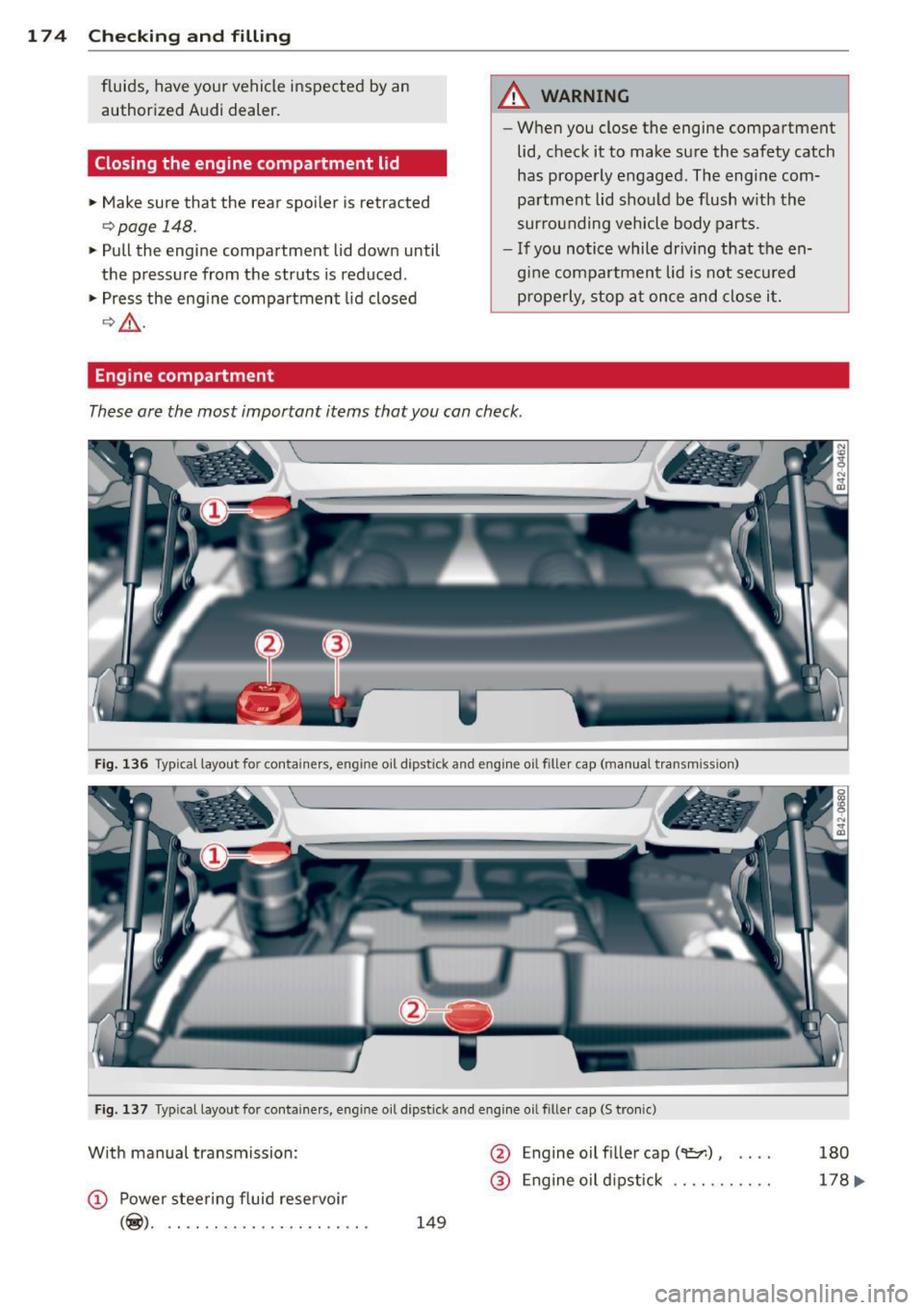
These ore the most important items that you con check .
Fig . 136 Ty pica l layout fo r co ntai ners , e ngin e o il dipst ick and engin e o il fille r cap (man ual t ra n sm iss io n)
F ig . 1 37 Typ ica l layout fo r co ntain ers, e ngin e o il d ipstic k and e ng in e o il fill er cap (S t ro nic )
W ith manual transmission: @ Engine oil f iller cap(~) ,
(D Power steering f luid rese rvoir
@ E ngine o il d ipst ick ...... .... .
(@) ... .... .... ....... .. .. . 14 9
180
178 ....
Page 187 of 244
charg ed batte ry wi ll not only prevent starting
prob lems when the weather is cold, but will
a lso last longer.
Replacing battery
The new battery mu st h ave the same capac i
ty, vo ltage ( 12 volts), amperage, construction
a nd p lug sealing, as the origina l battery . Spec
ifications are listed on the battery housing.
Batteries specially developed by Audi fulfill
the maintenance, output, and safety require
ments.
When insta lling the battery, make sure the ig
nition and all electrica l consumers are switch
ed
off c:> (D .
We recommend that you use maintenance
free or
c y cle- re sis tant /leak-proof batteries
according to the standards TL 82S 06 (from
April 2008) and VW 7 50 73 (from Apr il
2010).
Replacing the battery should be carried by a
qua lified workshop. P lease follow the instruc
tions on the battery cover.
(D Note
-All work on the battery requires techni
ca l knowledge. Please contact an A udi
dealersh ip or another a uthorized facility
fo r quest ions about the battery - danger
of acid burns and explosion hazard!
- The battery must not be opened ! Do not
try to change the battery's liquid leve l,
othe rwise detonating gas w ill escape
from the battery - explos ion ha zard!
- The AGM batte ry in the luggage com
partment ca nnot leak, because the elec
trolyte fo r th is battery is absorbed into a
spec ial glass ma t. T his leak-proof battery
mus t not be repla ce wi th a convention al
batte ry .
- M ake sure the ven tilat ion hose on the
s id e of the b attery is con ne cte d, o ther
wise fumes or ba ttery acid can leak ou t.
- Ba ttery ho lder and term inals always
have to be secured cor rectly.
Checkin g and fillin g 185
-Be fore all wo rk on the batte ry follow the
warnings below co.&. in Working on the
battery on page 186 .
@ For the sake of the environment
Because o f the p rob lem of prope r disposal
of a battery, we recommen d your author
i zed Audi dealer change the battery for
you. Batteries contain sulfur ic acid and
l ead and must always be disposed of prop
e rly in comp liance with a ll environmental
regulat ions. Disposing of veh icle batter ies
i mprope rly is very dange rous to th e envi
r o nment. Make sure that the removed bat
te ry canno t overb alance, othe rwi se su lfu
r ic acid might escape!
(D Tips
If your vehicle is left s tanding for seve ral
weeks at ext remely low temperatures, the
vehicle battery sho uld be removed and
stored where it w ill not freeze . This will
prevent it from be ing damaged and having
to be replaced.
Working on the battery
Be especially careful when working on or near
the battery!
T he bat tery is located in the luggage compar t
ment behind a cover. Befo re you work on or
near the battery,
read and heed all WARN
INGS
co .&, .
A lways heed the
safety warnings , when work
ing on the vehicle battery or the vehicle e lec
trical system to prevent in jury.
The following WARNINGS are very
important wh en working on the battery :
Alway s heed the following WARNING SYM
BOLS and safety pre caution s when working
on the battery .
® Always wear eye protection . !
I). Battery acid contains sulfuric acid_-Al
~ ways wear gloves and eye protection. ..,.
•
•
Page 207 of 244
A WARNING ,~
Using the wrong snow chains for your vehi
cle or installing them incorrectly can in
crease the risk of loss of control leading to
serious personal injury.
- Snow chains are available in different sizes. Always make sure to follow the instructions provided by the snow chain
manufacturer .
- When driving with snow chains, never
drive faster than the speed permitted for
your specific snow chains.
- Always observe local regulations .
(D Note
-Remove snow chains before driving on
roads not covered with snow to avoid
damaging tires and wearing the snow
chains down unnecessarily.
- Snow chains, which come into direct con
tact with the wheel rim, can scratch or
damage it . Therefore, make sure that the
snow chains are suitably covered. Check
the position of the snow chains after
driving a few yards and correct if neces
sary. Follow the instructions from the
snow chain manufacturer when doing so.
@ Tips
Where snow chains are mandatory oncer
tain roads, this normally also applies to
vehicles with all-wheel drive.
Wheel bolts
Wheel bolts must always be tightened to the
correct torque.
The design of wheel bolts is matched to the
factory installed rims. If different rims are fit
ted, the correct wheel bolts with the right length and correctly shaped bolt heads must
be used. This ensures that wheels are fitted
securely and that the brake system functions
correctly .
Tires and wheels 205
In certain circumstances, you may not use
wheel bolts from a different vehicle -even if it
is the same model
r:!> page 229.
A WARNING
Improperly tightened or maintained wheel
bolts can become loose causing loss of
control, a collision and serious personal in
jury.
- Always keep the wheel bolts and the
threads in the wheel hubs clean so the
wheel bolts can turn easily and be prop erly tightened.
- Never grease or oil the wheel bolts and
the threads in the wheel hubs . They can
become loose while driving if greased or
oiled, even if tightened to the specified
torque.
- Only use wheel bolts that belong to the
rim being installed.
- Never use different wheels bolts on your
vehicle.
-Always maintain the correct tightening
torque for the wheel bolts to reduce the
risk of a wheel loss. If the tightening tor
que of the wheel bolts is too low, they
can loosen and come out when the vehi
cle is moving. If the tightening torque is
too high, the wheel bolts and threads can be damaged and the wheel can be
come loose.
(D Note
The specified torque for the wheel bolts is
90 ft lb (120 Nm) with a tolerance of ± 7 .4
ft lb(± 10 Nm). Torque wheel bolts diago
nally. After changing a wheel, the torque
must be checked as soon as possible with a
torque wrench -preferably by an author
ized Audi dealer or qualified workshop.
Low aspect ratio tires
Your Audi is factory-equipped with low aspect
ratio tires. These tires have been thoroughly
tested and been selected specifically for your model for their superb performance, road feel .,.
•
•
Page 212 of 244
210 What do I do now?
What do I do now?
Trunk escape handle
Appl ies to vehicles: wit h tru nk escape hand le
In case of an emergency, the front lid can be
opened from the inside using the trunk es
cape handle .
.,. To
open the front lid pu ll the handle.
The trunk escape handle inside the luggage
compartment is made of fluorescent material
to g low in the dark.
A WARNING
The trunk escape handle is to be used only
in an emergency.
Vehicle tool kit
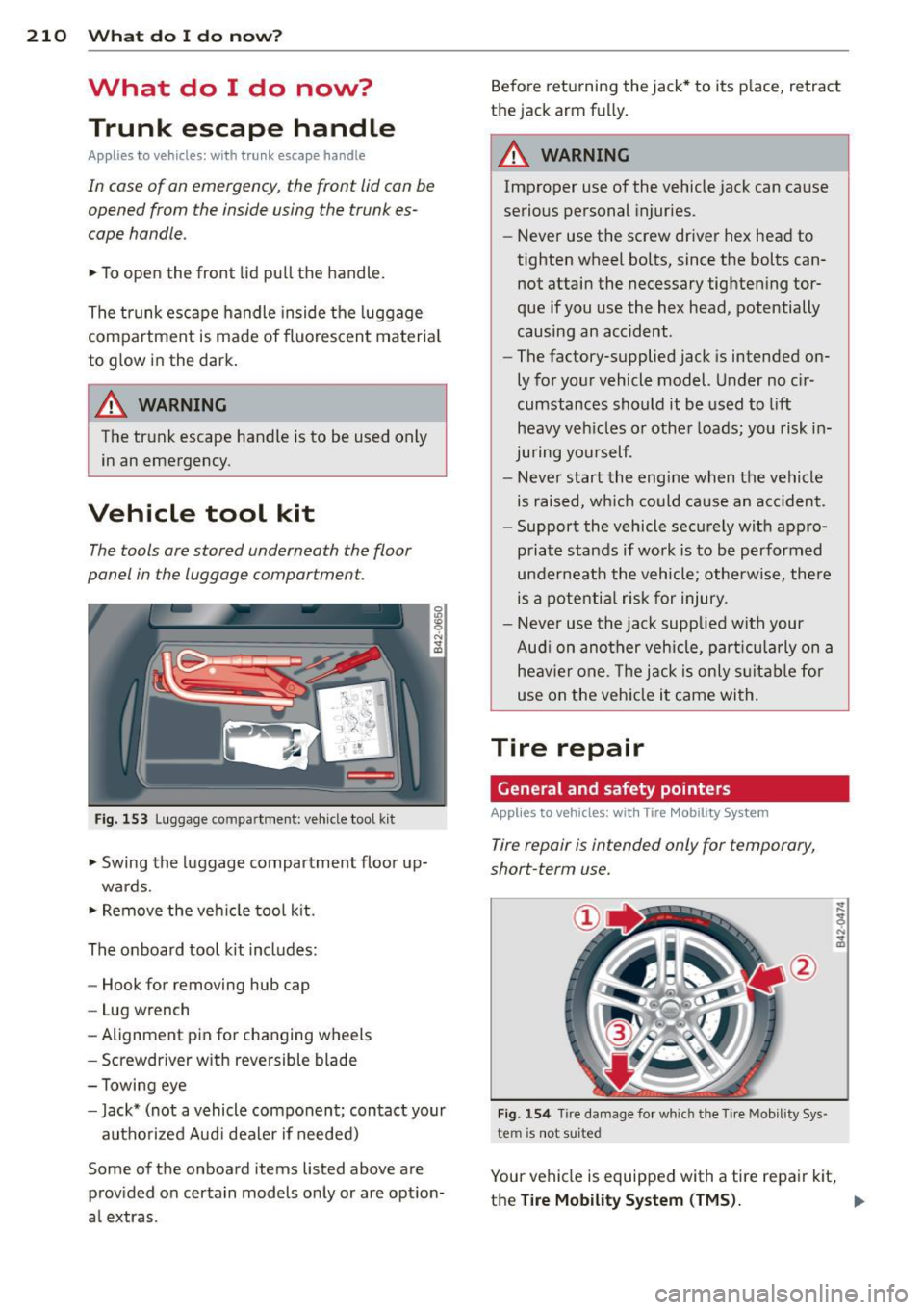
The tools are stored underneath the floor
panel in the luggage comportment.
Fig. 153 Luggage compartment: ve hicle tool k it
.,. Swing the luggage compartment floor up-
wards .
.,. Remove the vehicle tool kit.
The onboard tool kit includes:
- Hook for removing hub cap
- Lug wrench
- Alignment pin for changing wheels
- Screwdriver with reversible blade
- T owing eye
- Jack* (not a vehicle component; contact your
authorized Aud i dealer if needed)
Some of the on board items listed above are provided on certain models only or are option
a l extras. Before
returning the jack* to its place, retract
t h e jack arm fully.
A WARNING
-
Improper use of the vehicle jack can cause
serious personal injuries.
- Never use the screw driver hex head to
tighten wheel bolts, since the bolts can
not attain the necessary tightening tor
que if you use the hex head, potentially
causing an accident.
- The factory-supplied jack is intended on
ly for your vehicle model. Under no cir
cumstances should it be used to
lift
heavy veh icles or other loads; you risk in
juring yourself.
- Never start the engine when the vehicle
is raised, which could cause an acc ident.
- Support the vehicle securely with appro
priate stands if work is to be performed
underneath the vehicle; otherwise, there
is a potential risk for injury.
- Never use the jack supplied with your
Aud i on another vehicle, part icularly on a
heav ier one. The jack is only suitable for
use on the vehicle it came with.
Tire repair
General and safety pointers
Applies to veh icles: w it h Tire Mob ility System
Tire repair is intended only for temporary,
short-term use.
Fig . 154 Tire damage for wh ich the Tir e Mob ility Sys
te m is no t suited
Your vehicle is equipped with a tire repair kit,
the
Tire Mobility System (TMS). .,,.
Page 217 of 244
.. Find the lifting p oint in the sill on the side
with the affected wheel¢
fig. 159.
.. Extend the ja ck under the lifting point on
the doo r sill unti l its arm is positioned di
rectly under the lifting point¢ &_ .
.. Align the jack so that its arm @¢
fig. 160
engages in the designated lifting point in
the door sill and the movable base @ lies
flat on the ground. The base @ must be
ver
tical
under the lift ing po int @ .
.. Wind the jack up further until the flat tire
comes off the ground¢&_ .
Position the vehicle jack
onl y under the desig
nated lift ing po ints on the sill¢
fig. 159.
There is exactly one location for each side of
the vehicle. The jack must not be pos itioned
at any other location ¢ fri. ¢0 .
An
un sta bl e s urfa ce u nder the jack can cause
the vehicle to s lip off the jack . Always provide
a firm base for the jack on the ground . If nec
essary plac e a sturdy board or similar support
under the jack. On
ha rd, slippe ry surface s
(such as tiles) use a rubber mat or sim ilar to
prevent the jack from slipping¢&. .
A WARNING
-You or your passengers could be injured
wh ile chang ing a wheel if you do not fol
low safety p re ca utions:
- Position the vehicle jack only at the
designated lifting points and align the
jack . Otherwise, the vehicle jack could
slip and cause an injury if it does not
have sufficient ho ld on the vehicle.
- A soft or unstable surface under the
jack may cause the vehicle to slip off the jack. Always provide a firm base for
the jack on the ground . If necessary,
use a sturdy boa rd under the jack.
- On ha rd, slippery surface (such as tiles)
use a rubber mat o r similar to prevent
the jack from slipping .
- To help prevent injury to yourself and
your passenge rs:
- Do not raise the vehicle unti l yo u are
sure the jack is securely engaged .
What do I do now ? 215
-Passengers must not remain in the ve
hicle when it is jacked up .
- Make sure that passengers wait in a
safe place away from the veh icle and
well away from the road and traffic .
- Make sure jack position is correct, ad
just as necessary and then cont inue to
raise the jack .
(D Note
A floor jack or the pads on the hoist arms
must
not be positioned at the points
shown
-arrow -.
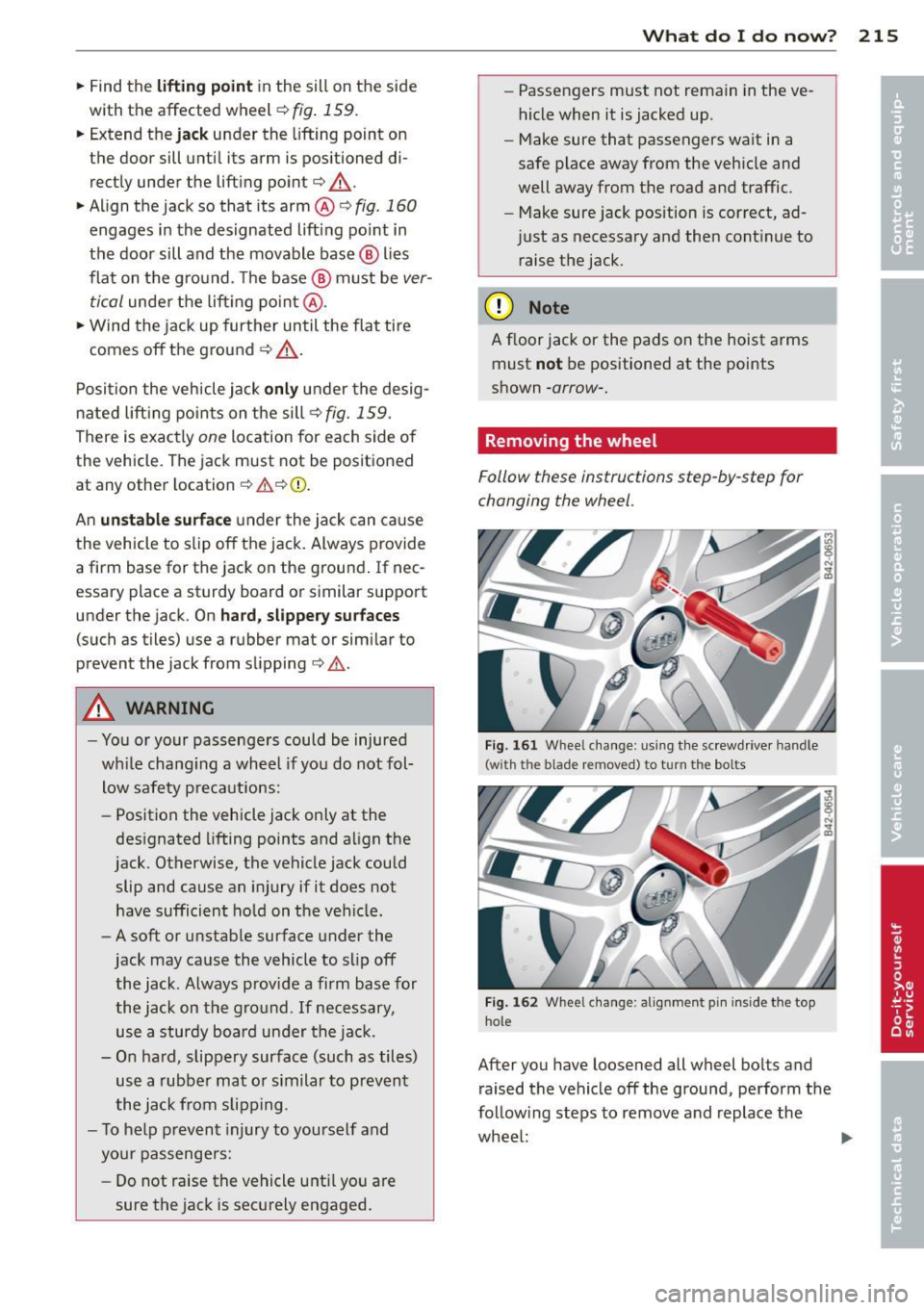
Removing the wheel
Follow these instructions step -by-step for
changing the wheel .
Fig . 1 61 W hee l change: us ing the sc rewdr iver hand le
(w it h th e blade r emov ed) to t urn th e bolts
F ig . 1 62 Whee l change: alignmen t pin inside the top
h ol e
After you have loosened all wheel bo lts and
raised the vehicle off the grou nd, perform the
follow ing steps to remove and replace the
whee l: ..,.
Page 219 of 244

-Che ck the tire p re ss ure on the spare imme
diatel y afte r mounting.
- Hav e the wheel b olt tightening torque
checked with a torque wrench a s soon a s
possib le by you r auth orized Audi dealer or
a qu alified ser vice sta tio n.
- With steel and allo y w heel rim s, the wheel
bolts are correctl y tight ened at a to rq ue of
90 ft lb (1 20 Nm ).
- If yo u notice while changin g a ti re th at the
wheel bolts are co rrod ed and diff icult to
turn , then they should be repl aced before
y ou check the t ighten ing to rqu e.
- Replace the flat t ire with a new one and
ha ve it installed on your vehicle as soon as
possib le . R emount th e wh eel co ver .
Until then, driv e with extra care and at re
d uced speeds.
A WARNING
- If you are going to equip your vehicle
with t ires or rims wh ich differ from those
w hich were factory installed, then be
sure to read the informat ion
~page 199,
New tires and replacing tires and
wheels.
- Always store the tools securely in lug
gage compa rtment. Otherw ise, in an ac
c ident o r sudden mane uver they could fly
f orward, causing inju ry to passengers in
the vehicle .
(D Note
Do not use commerc ia lly available t ire
sealants. Othe rwise, the elec trical compo
nents of the tire pressure monitoring sys
tem* will no longer work properly and the
sensor for the tire pressure monitoring
system wi ll have to be replaced by a qua li
fied workshop.
What do I do now? 217
Jump-starting
General
If necessary, the engine can be started by
connecting it to the battery of another vehi
cle.
If the engine should fail to start because of a
discharged or weak battery, the battery can be
connected to the battery of
another vehicle,
us ing a
pair of jump er cabl es to start the en
gine.
Both batteries must be rated at 12 volts . The
capacity (Ah) of the booster battery must not
be substantia lly less than the capac ity of the
discharged battery .
Jumper cables
Use only jumper cables of suff ic ient ly large
cro ss se ction to safely car ry the starter cur
rent . Refer to the manufacturer's specifica
tions .
Use only jumper cab les which have
insulated
term inal clamps and are properly marked for
dist inction:
plu s(+) cable : in most cases colored r ed
m inu s(-) cable :
in most cases colored black
A WARNING ~
Batteries contain e lectric ity, acid, and gas .
Any of these can cause very serious or fata l
injury. Follow the instructions below for
safe handling of your vehicle's battery.
-Always shield your eyes and avo id lean-
ing over the battery whenever poss ible.
- A discharged battery can a lready freeze
at temperatures just below 32 °F (0 °(). Before connect ing a jumper cable , the
frozen battery must be thawed com
pletely, othe rwise it could explode .
- Do not allow battery acid to contact eyes
or skin . Flush any contacted area with
wate r immediately .
- Improper use of a booster battery to
start a vehicle may cause an explosion. •
•
Page 221 of 244
4. Secure the other end to the jump start pin
© for the discharged battery@.
Starting the engine
.,. Start the eng ine of the vehicle providing as
s istance and allow it to run at id le.
.,. Now start the engine of the vehicle with the
discharged battery .
.,. If the engine does not start: Stop trying af
ter 10 seconds and then try again after
about 30 seconds .
.,. Disconnect the cable while the engine is
running in exactly
reverse order to that de
scribed.
The battery is vented to the outside to prevent
gases from entering the vehicle interior. Make
sure that the jumper clamps are well connect
ed with their
metal ports in full contact with
the battery termina ls.
A WARNING
To avoid serious personal i njury and dam
age to the vehicle, heed all warnings and
instructions of the jumper cable manufac
turer.
If in doubt, ca ll for road service .
- Jumper cables must be long enough so
that the vehicles do not touch.
- When connecting jumper cables, make
sure that they cannot get caught in any
moving parts in the engine compart
ment.
- Before you check anything in the engine
compartment, always read and heed all
WARNINGS
c:> page 172, Working in the
engine comportment.
Improper hook-up of jumper cables can ru
in the generator.
- Always connect POSITIVE( +) to POSI
TIVE(+), and NEGATIVE(-) to NEGATIVE
( - ) ground post of the battery manager
control unit.
- Check that all screw plugs on the battery
ce lls are screwed in firmly. If not, tighten
plugs prior to connecting clamp on nega
tive battery terminal.
-
What do I do now? 219
- Please note that the procedure for con
necting a jumper cable as described
above applies specifically to the case of
your vehicle being jump started. When
you are giving a jump start to another ve
hicle, do
not connect the negative(-) ca
ble to the negative(-) terminal on the
discharged battery@. Instead, securely
connect the negative(-) cable to eithe r a
solid metal component that is firmly
bolted to the engine block or to the en
gine block itself. If the battery that is be
ing charged does not vent to the outside,
escaping battery gas could ignite and ex
plode!
Emergency towing
with commercial tow
truck
' General hints
Your Audi requires special handling for tow
ing.
The following information is to be used by commercial tow truck operators who know
how to operate their equipment safely.
- Never tow your Audi, towing will cause dam
age to the engine and transmission.
- Never wrap the safety chains or winch cables around the brake lines.
- To prevent unnecessary damage, your Audi
must be transported w ith a car carrier (flat
bed truck) .
- To load the vehicle on to the flat bed, use
the towing loop found in the vehicle tools
and attach to the front anchorage
c:> page 220 .
A WARNING
A vehicle being towed is not safe for pas
sengers . Never allow anyone to ride in a
vehicle be ing towed, for any reason.
•
•
Page 222 of 244
220 What do I do now?
(D Note
The vehicle has very low ground clearance.
Make sure that no damage is caused to the
underside of the vehicle when it is being
loaded onto a flat bed truck .
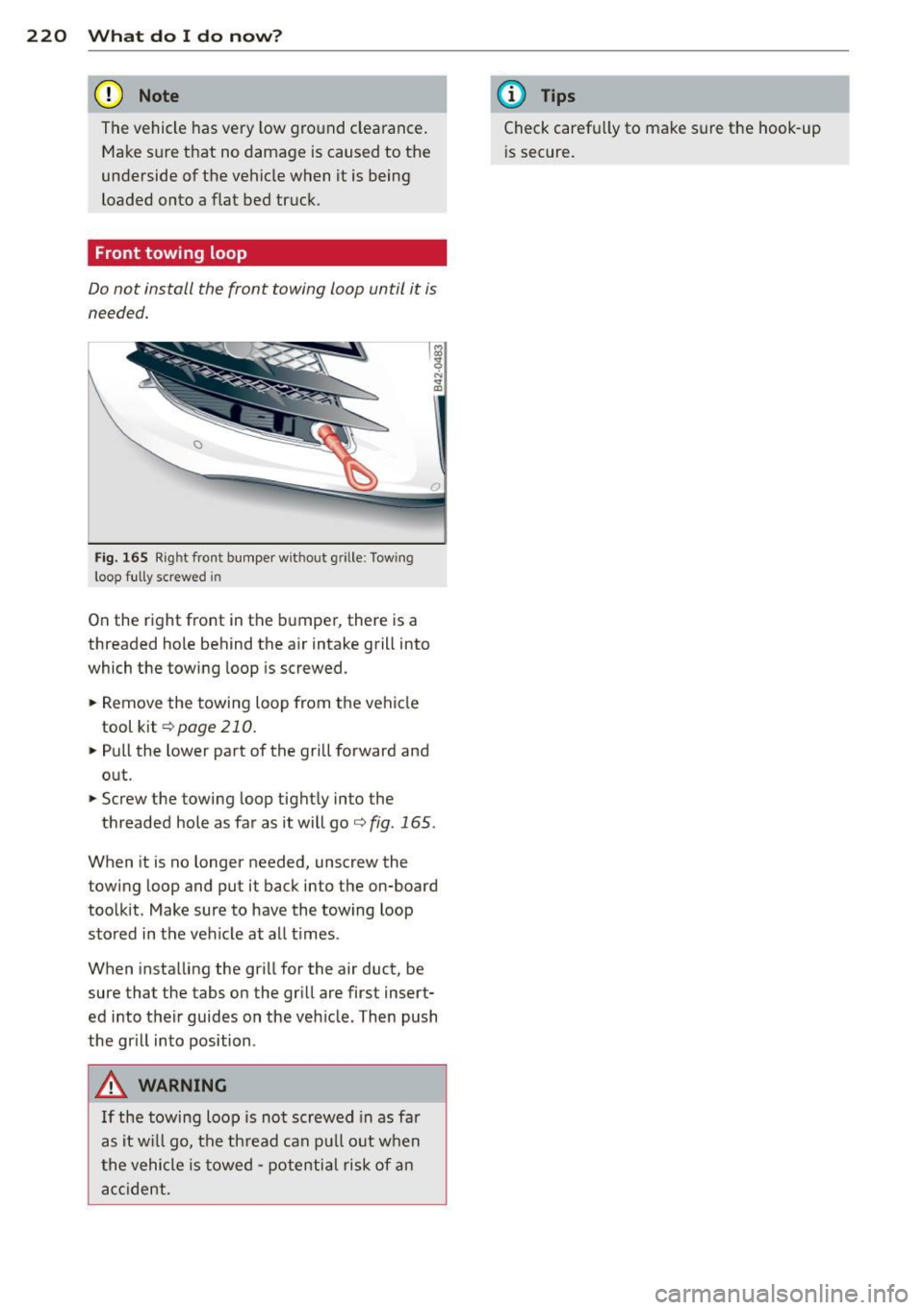
Front towing loop
Do not install the front towing loop until it is
needed.
Fig. 165 Rig ht fron t bumper wit hout g rille: Tow ing
loop fully screwed in
On the r ight front in the bumper, there is a
threaded ho le behind the air intake grill into
which the towing loop
is screwed .
.. Remove the towing loop from the vehicle
tool kit
Q page 210 .
.. Pull the lower part of the grill forward and
out .
.. Screw the towing loop tightly into the
threaded hole as far as it will go¢
fig. 165.
When it is no longer needed, unscrew the
towing loop and put it back into the on-board
toolkit. Make sure to have the towing loop
stored in the vehicle at all times.
When installing the grill for the air duct, be
sure that the tabs on the grill are first insert
ed into their guides on the vehicle . Then push
the gr ill into position .
A WARNING
If the towing loop is not screwed in as far
as it will go, the thread can pull out when
the vehicle is towed -potentia l risk of an
accident.
(D Tips
Check carefu lly to make sure the hook-up
is secure.
Page 230 of 244
228 Con sum er Inf ormation
steadi ly reduced the scope of maintenance
and repairs which can be carried out by vehicle
owners.
Als o, sa fe ty a nd en vir onm ent al con
cerns place very strict limits on the nature of
repairs and adjustments to engine and trans
miss ion parts which an owner can perform .
Maintenance, adjustments and repa irs usua lly
require special tools, testing devices and oth
er equipment available to specially trained
workshop personnel in order to assure proper pe rformance, reliab ility and safety of the vehi
cle and its many systems.
Improper maintenance, adjustments and re
pa irs can impair the operation and reliab ility
of your vehicle and even void your vehicle war
ranty. Therefore, proof of servic ing in accord
ance w ith the ma intenance schedule may be a
condition for upholding a poss ible warranty
claim made within the warranty period.
Above all, operational safety can be adversely
affected, c reating unnecessary risks for you
and your passengers.
If in doubt about any se rv icing, have it done
by your author ized Audi dealer or any other
p roperly equipped and qualified workshop.
We strong ly urge you to give yo ur autho rized
Audi dealer the opportunity to perfo rm all
schedu led maintenance and necessary repairs.
Your dea ler has the facilities, original parts
and trained specialists to keep your vehicle
running properly.
Performing limit ed m aint enance yours elf
The following pages describe a limited num
ber of proced ures which can be performed on
your vehicle with ordinary too ls, shou ld the
need arise and trained personnel be unavaila
ble. Before performing any of these proce
dures, always thoroughly read all of the app li
cable text and carefully follow the instruc
tions given . Always rigorously observe the
WARNINGS p rovided.
Before you ch eck anything in th e eng ine
co mpartm ent , alway s re ad and h eed all
WA RNINGS
c::> .&. and c::> ..&. in Working in the
engine compartment on page 173.
A WARNING
- Serious personal injury may occur as a re
sult of improperly performed mainte
nance, adjustments or repa irs.
- Always be extremely careful when work
ing on the vehicle. Always follow com
monly accepted safety pract ices and gen
eral common sense. Never r is k personal
injury.
- Do not attempt any of the maintenance,
checks or repairs descr ibed on the fol
lowing pages if you are not fu lly fam iliar
with these or other procedures with re
spect to the vehicle, or are uncertain how
to proceed .
- Do not do any work without the proper
too ls and equipment. Have the necessa ry
work done by your authorized A udi deal
er or another proper ly equipped and
qualified workshop.
- Always remove the ignition key before
anyone gets under the vehicle.
- Always support your veh icle with safety
stands if it is necessary to work under
neath the vehicle. The jack* is not ade
quate for this purpose and cou ld collapse
causing ser ious personal inju ry.
- If you must work underneath the vehicle
with the wheels on the ground, a lways
make sure the vehicle is on level ground,
that the wheels a re a lways secure ly
b locked and that t he engine cannot be
started.
- Always make sure the transmission se
lec to r l ever is in
"N" (Neut ral) (R t ron ic)
or Neutral (manual transmission) and
the hand bra ke is f irmly app lied.
@ For the sake of the environment
- Changing the engine sett ings will ad
verse ly affect emission leve ls. Th is is det
r imental to the environment and increas
es fuel consumpt ion .
- Always observe environmenta l regu la
tions when disposing of old eng ine oil,
used brake flu id, dirty engine coo lant,
spent batteries or worn out tires.