battery AUDI R8 SPYDER 2014 User Guide
[x] Cancel search | Manufacturer: AUDI, Model Year: 2014, Model line: R8 SPYDER, Model: AUDI R8 SPYDER 2014Pages: 244, PDF Size: 61.06 MB
Page 40 of 244
38 Convertible top
To p revent dama ge to the c onvertible top:
- do not store any objects in the converti
ble top storage bay .
- make sure there is enough spa ce above
the vehicle when opening or closing the
convertible top.
@ Tips
- When the indicato r lamp N blinks,
the re is a system malfunc tion ¢
page 15 .
-The one- touch openi ng f unction is not
available when the vehicle is traveling
below 4 mph (6 km/h) or above 31 mp h
(SO km/ h). If this is the case, a warning
tone w ill sound and a message will ap
pear in the instrument cluster
¢ page 38.
Error message in the instrument cluster
display
An error message appears
if the convertible
top cannot open or close .
Several conditions must be met for the con
vertible top to ope n or close automatically .
An error message in the inst rument cluster
d isp lay ind icates if one of the condit ions is not
met or there is a malfunction.
Soft top : Please clo se engine lid!
The engine compar tment lid mus t be closed
when opening or closing the convertible top .
T his message appears in the instrument clus
ter d isp lay if the engine compartment lid is
not closed .
Soft top: Cannot be u sed!
This error message appears if the convertib le
top cannot open or close because of safety
reasons or if there is a ma lfunct ion. The fol
low ing causes are possible:
- The veh icle i s tra veling too fast : Converti
ble top operation is deactivated for safety
reasons if the veh icle is t raveling too fast. A
message w ill appear . Reduce the vehicle speed and pu
ll or press the sw itch again to
open or close the convertible top.
- The battery voltage i s too low: The conver
tible top cannot open or close if the battery
voltage is too low. This ens ures the re will be
enough battery vo ltage left to start the ve
hicle . The convertible top can be operated
aga in after the engi ne is started.
- Overload protect ion i s active: Operating the
convert ible top continuously for a long peri
od of time p laces stress on the hydraulic
un it . Overload protect io n is act ivated to pre
vent damage to the syst em . This protective
fu nction preve nts the convertible top from
open ing or clo se fo r approximate ly 15 to 30
m inu tes.
It will funct ion aga in a fter tha t
q &. .
-Malfunction: Failure of sys tem components
is one possib le cause fo r malfunction . If this
happens, you can a lso operate the converti
b le top by hand
¢ page 40 .
- The exte rior temperature i s too low:
The
convertible top will not open in tempera
tures below (5 °F) (-15 QC) .
Soft top not secure
If the co nve rtib le top is not compl etel y open
o r closed and the vehicle is t raveling too fast,
the e rror message above appears and a warn
ing tone sounds. Reduce the vehicle speed
and pull or press the switch again to open or close the convert ible top.
A WARNING ..__
Neve r drive when the convertible top is not
l ocked correctly . The wind from driving
could cause the co nvertib le top to open.
This can resu lt in i njuries and damage to
the veh icle.
Page 51 of 244

Interior lights
Interior lights
The interior lights include the reading lights
for the driver and the front passenger .
Fig. 55 Section from headliner : In terior lights
Activating door contact circu it
• Press the button @. The LED in the button
illuminates.
Deactivating do or contact circu it
• Press the button @. The LED in the button
goes out.
Fr ont re ad ing l ight s
~
• Press one of the switches ® to turn the
right or left reading light on/off .
"' l1l 0
With the door contact circuit, the interior
lights turn on as soon as you unlock the vehi
cle or open the doors. The interior lights are
also turned on when the ignition key is re
moved. The lights turn off about 30 seconds
after the doors are closed . When the vehicle is
locked or when the ignit ion is tu rned on, the
inte rior lights are turned off .
When a door is open, the interior lights are
turned off after about 10 m inutes to prevent
battery draining.
The brightness of the lights is controlled au
tomatically by a dimmer when they are
switched on/off.
Clear vi sion 49
Instrument panel illumination
The illumination of the instruments, displays
and the center console can be adjusted .
Fig . 56 Instrumen t pa nel illuminat ion
You regu late the brightness of the instr u
ments with the left thumbwheel
C1 ~ fig . 56 .
Ignition ON, light switch at @
With the ign ition switched ON, the glow of
in
strument needles
can be adjusted to appea r
brighter o r dimmer.
Ignition ON, light switch at
:oo~ or ~D.
With the lights switched on, the brightness of
instrument cluster (i.e. needles, gauges and
displays) and center conso le illuminat ion can
be adjusted .
(D Note
The instrument cluster and center conso le
ill umination (gauges and need les) comes
on when you sw itch on the ignition and the
v eh icle headlight s are off . Be awa re of the
fo llow ing difference be tween models bu ilt
to US or Canadian specifications:
- USA mo dels: illumination o f the i nstr u
ment cl uster (gauges and need les), dash
and center conso le around the gearshift
lever is controlled by a light sensor locat
ed in the instrument pane l. The instru
ment pa nel illuminat ion w ill automati
cally become dimmer as the daylight
fades away and eventually will go out completely when outs ide light is very
low. This is to remind you, the dr iver, to
switch o n the hea dlights before it ge ts
too d ark .
Page 62 of 244
60 Seats and st o rage
- Never use the cupho lder or adapter as an
ashtray- risk of f ire.
CD Note
On ly drink containe rs with lids should be
carried in the cupho lder. Liquid could spill
out and damage your vehicle's e lectronic
equ ipment or sta in the upholstery, etc.
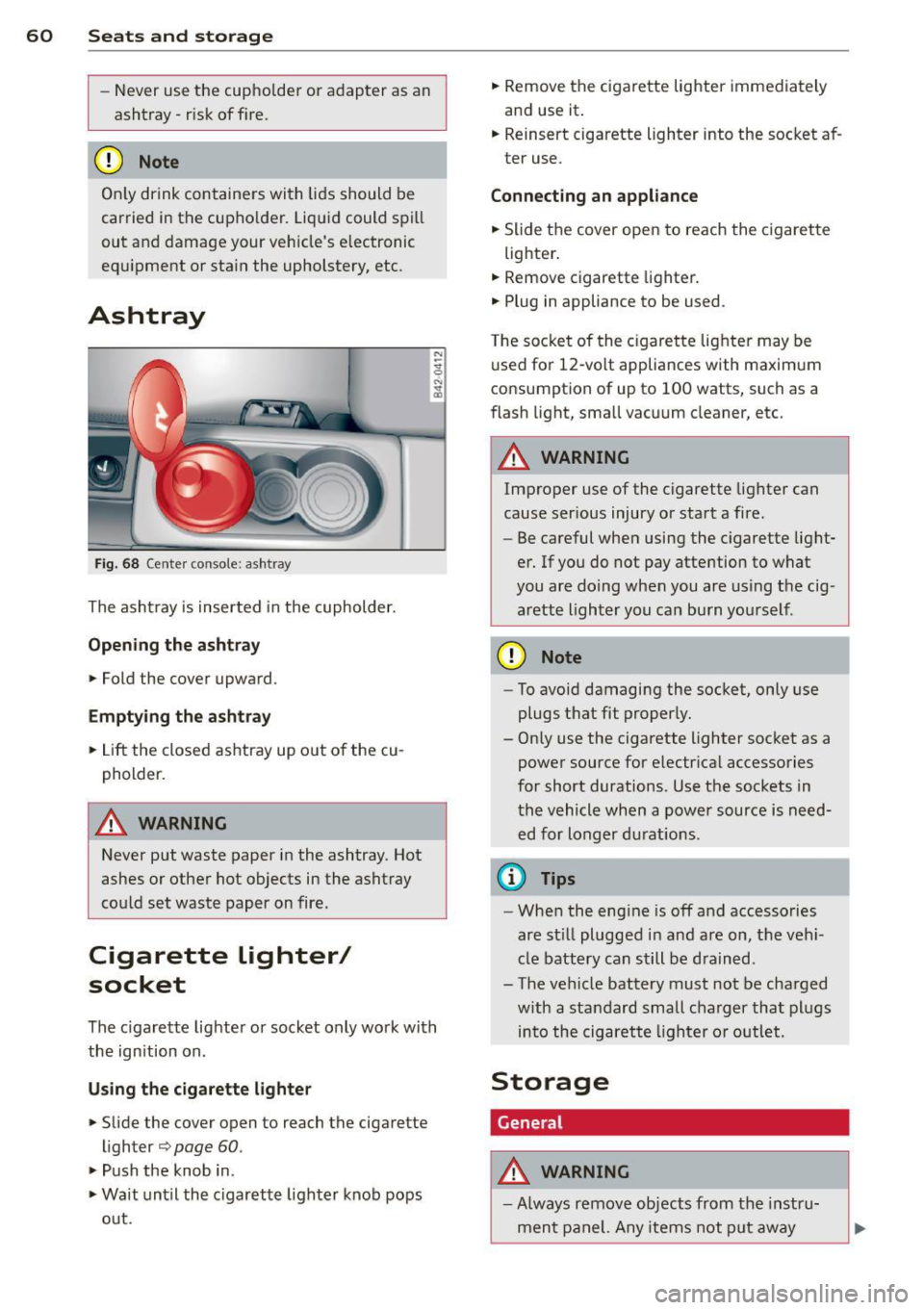
Ashtray
Fig . 68 Center console: ashtray
The asht ray is inserted in the cupholder.
Opening the ashtra y
... Fold the cover upward.
Emptying the a shtray
,.. Lift the closed ashtray up o ut of the cu
pholder.
A WARNING
Never put waste paper in the ashtray. Hot
ashes or other hot objects in the ashtray
cou ld set waste paper on fire.
Cigarette Lighter/
socket
N
-"' 0 ..:. ... m
The c igarette lig hte r or socket only wo rk with
the ign ition on.
Using the cigarette lighter
,.. Slide the cover open to reach the cigarette
lighter
qpage 60.
> Push the knob in.
,.. Wait unt il the cigarette lighte r knob pops
out. ,..
Remove the cigarette lighter immediately
and use it .
... Reinsert cigarette lighter into the socket af
ter use.
Connecting an a ppliance
,.. Slide t he cover open to reach the c igarette
lighter .
,.. Remove cigarette lighter .
... Plug in appliance to be used.
T he socket of the c igarette lighter may be
u sed for 12-volt appliances with maximum
consumption of up to 100 watts, such as a
flash light, small vacuum cleaner, etc.
A WARNING
-Improper use of the cigarette lighter can
cause ser ious injury or start a fire.
- Be careful when using the c igarette light
er. If you do not pay attention to what
you are doing when you are us ing the cig
arette lighter you can burn you rself.
CD Note
- To avoid damaging the socket, only use
plugs t hat fit properly.
- Only use the cigarette lighter socket as a
power source for e lectr ica l accessories
for short durations . Use t he sockets in
the vehicle when a power source is need ed for longer du rat ions .
(0 Tips
-When the eng ine is off and accessories
are st ill plugged in and are on, t he vehi
cle battery can still be d ra in ed.
- The ve hicle battery must not be charged
w ith a standard small charger that pl ugs
into the cigarette lighter or outlet .
Storage
, General
A WARNING
- Always remove objects from the instru
men t pa nel. A ny items not put away
-
Page 71 of 244
you leave your vehicle. This makes vehicle
theft even more difficu lt
r=:, .&. .
Ign ition on @
After switch ing the ignition on, the needles
move all the way up and then down.
If it is difficult to turn the key after you have inserted it into the ignit ion lock, turn the
steer ing whee l back and forth. This will take
the load
off the steering lock mechan ism and
you will be able to turn the key freely and start the engine .
Starting the engine @
In th is position the engine starts. While the
engine is start ing, the power supply to the
headlights and other e lectr ica l cons umers is
temporari ly inter rupted to conserve battery
power. After the engine has started, release
the key and it will return to position @.
Before the starter can be operated again the
key must be turned back to position
(D . The
non-repeat lock prevents you from damaging
the starter when the engine is running.
A WARNING
- Never remove the key from the ign ition
lock while the vehicle is moving. The
steering wheel will lock causing loss of
control.
- If you have to leave your veh icle - even
for just a m inute - a lways remove the ig
nition key and take it with you. This is es
pecially important if you a re going to
leave ch ildren behind i n the vehicle. The
children co uld s tart the engine or use
other vehicle controls . Unsupervised use
of vehicle controls (for example, power
windows) can cause serious personal in
juries.
@ Tips
I f the veh icle bat tery has been d isconnect
ed and then reconnected, then you must
leave the key in pos ition @for abo ut 5
seconds before you can start the engine.
-
On th e ro ad 69
Starting and stopping
the engine
Starting the engine
The engine can only be started with your orig
inal Audi key.
On vehicles with S tron ic*, the e ngine can be
sta rted in the neut ra l position N and in each
gear (1 - 7 a nd R).
" Set the park ing brake
r=:, & .
"On veh icles with manual transmiss ion*, fully
dep ress the clutch peda l.
" Press and hold the brake peda l.
" Tur n the igni tion key to pos it ion @
r=:> page 68, fig . 74 -do not depress the gas
peda l when sta rting the engine .
... Let go of the key as soon as the engine
starts - the starter m ust not cont inue to
run. On vehicles w ith S tronic, select gear
position N.
A cold engine may at first be loud after it has
been started. This is due to the hydraulic
valves bu ild ing up the oil p ressure . Th is is nor
mal and no need for concern .
If the engine does not start immediately, stop
trying after 10 seconds and then try to restart
the engine about 30 seconds later .
A WARNING
- Never start or let the engine run in a con
fined or enclosed area. Exhaust fumes
from the eng ine contain carbon mono x
ide, a co lor less and odorles s gas. Carbon
monox ide can be fata l if inh aled.
- Never leave the engine id ling una ttend
ed. An unat tended ve hicle with a runn ing
engine poses a danger of personal injury
or theft .
- With the engine r unning and a gear en
gaged, you have to hold the veh icle w ith
the foot bra ke.
Page 127 of 244

-Never modify the front bumper or parts
of the veh icle body.
- Always make sure that the side airbag
can inflate without interference:
- Never install seat covers or replace
ment upho lstery ove r the front seat
backs that have not been spec ifically
approved by Audi.
- Never use add itiona l seat cushions that
cover the areas where the side airbags
inflate .
- Damage to the o rigina l seat covers or
to the seam in the area of the side air
bag module must always be repa ired
immediate ly by an authorized Audi
dealer.
- The airbag system can be activated only
once . After an airbag has inflated, it
must be replaced by an author ized Audi
dealer or qualif ied technic ian who has
the techn ica l information, tra ining and
special equipment necessary.
- The airbag system can be deployed only
once. After an a irbag has been deployed,
it must be replaced w ith new replace
ment parts designed and approved espe
c ially for your Aud i model version. Re
placemen t of complete ai rbag systems
or airbag components m ust be per
f ormed by qualified workshops only.
Make su re that any airbag service act ion
is entered in your Audi Warranty
& Main
tenance booklet under
AIRBAG REPLACE
MENT RECORD.
- For safety reasons in severe accidents,
the a lternator and starter are separated
from the vehicle battery with a pyrotech
nic circuit interrupter.
- Work on the pyrote chnic cir cu it inter
rupter must on ly be per formed by a
qualified dealer - risk of an accident!
- If the veh icle or the ci rcuit interrupter
is sc rapped, all applicable safety pre
cautions must be followed .
Airbag system 12 5
@:) For the sake of the environment
Undeployed airbag modules and p reten
sioners might be classified as Perchlorate
Materia l -special handling may apply, see
www. dtsc. ca.gov/hazard o u swa ste/ per-
ch lo rate. When the veh icle or parts of the
restraint system including airbag modules
and safety be lts with pretensioners are
scrapped, all applicab le laws and regu la
tions mus t be obse rved. Your authorized
A udi dealer is familia r wi th these require
ments and we recommend that you have
your dealer perform this service fo r you .
Other things that can affect Advanced
Airbag performance
Chang ing the veh icle's suspens io n system can
c h ange the way that the Advanced Airbag Sys
tem perfo rms in a crash. For examp le, using
tir e-rim combi nat ions not approved by A udi,
l ower ing the veh icle, chang ing the st iffness of
the suspens ion, including the spr ings, suspen
sio n struts, shock absorbers etc. can change
the forces that are measured by the airbag
sensors and sent to the electronic contro l
u nit. Some suspension changes can, for exam
ple, i ncrease the force levels measured by the
sensors and make the airbag system deploy in c rashes in which it wou ld not deploy if the
c h anges had not been made. Other kinds of
c h anges may reduce the fo rce leve ls meas
u red by the sensors and preven t the airbag
from dep loying when i t should.
T he sensors in the safety be lt buc kle for the
drive r and front passenger seat te ll the e lec
tron ic contro l modu le if the s afety be lt is
l atche d or no t. If the safety be lt is being used,
the front airbag will deploy at a slightly high er rate of veh icle deceleration than if the safe
ty belt is not be ing used. Therefore, in a par
ticular coll is ion, it is possible t hat an airbag
will not deploy at a seat ing pos ition where the
safety belt is be ing used b ut w il l inflate at the
pos ition wher e th e safety be lt is not be ing
used. It is impo rtant that noth ing interfere
Ill>
•
•
Page 152 of 244

150 Intellig ent technolog y
Snow chain s
Where t ire cha ins are mandatory on certain
roads, this normally a lso applies to vehicles
with a LL-wheel drive
¢ page 204, Snow
chains .
Replacing wheels /t ir es
Vehicles with all-wheel drive must a lways
have tires of the same size. Also avoid t ires
with different tread depths. For details see
page
¢ page 199, New tires and replacing
tires and wheels.
Off -Ro ad dri ving?
Your Aud i does not have enough ground clear
ance to be used as an off -road veh icle .
It is
therefore best to avoid rough tracks and un
even terrain as much as possible . Also refer to
¢ page 153.
A WARNING
-Always adjust your driving to road and
traffic conditions. Do not let the extra
safety afforded by all-wheel drive tempt
yo u into taking extra risks.
- Although the all-wheel dr ive is very ef
fective, always remember that braking
capacity is limited by t ire traction . You
should the refore not dr ive at excessive
speeds on icy or slippery road su rfaces.
- On wet road surfaces, be careful not to
dr ive too fast because the front wheels
cou ld beg in to s lide on top of the w ater
(aquaplaning) .
If this should occ ur, you
will have no warning from a sudden in
crease in engine speed as with a front
wheel drive vehicle. A lways drive at
speeds wh ich are suited to the road con
ditions. -risk of crash.
Energy management
Starting ability is optimized
Energy management controls the distribution
of electrical energy and thus optimizes the
availability of electrical energy for starting the engine.
If a vehicle with a conventional energy system
is not driven for a long per iod of t ime, the bat
tery is discharged by idling current consumers
(e .g. immobilize r). In certa in circumstances it
can resu lt in the re be ing insufficient energy
available to start the engine.
Intelligent energy management in your vehi
cl e ha ndles the distribution of e lectr ica l ene r
gy . Start ing ability is ma rkedly improved and
the life of the battery is extended .
Bas ica lly, energy management consists of
b att ery diagn osis, idlin g current manage
m ent
and dynamic en erg y manag em ent .
Battery di agnosis
Battery diagnosis continuously determines
the state of the battery. Sensors determine
battery voltage, battery cu rrent and battery
tempe rature. This determines the current
state o f charge and the power of t he battery .
Idling current m anagem ent
Idling current management reduces energy
consumption while the vehicle is standing .
With the ig nition sw itched off, it controls the
energy supply to the various electri ca l compo
nents. Da ta from ba ttery diagnos is is cons id
ered.
Depend ing on the batte ry's state of cha rge,
individual cons ume rs a re g radually turned off
to prevent excessive discharge of the battery
and th us maintain starting capability.
Dynamic energy manag ement
While the vehicle is being d riven, dynamic en
ergy ma nagement distr ibutes the energy gen
era ted a ccord ing to t he needs of the individ u-
al components .
It regula tes consumption, so
t h at more electrical energy is not being used ..,.
Page 153 of 244
than is being generated and ensures an optimal state of charge for the battery.
@ Tips
- But even energy management cannot
negate the limits o f physics. Consider
that the power and life of a battery are
limited.
- If starting ability is threatened, you are
i nformed by a warning
¢ page 151,
Driver notification in the instrument
cluster display.
What you should know
The highest priority is given to maintaining
starting capability.
The battery is severely taxed in short-distance
driving, in city traffic and during the co ld time
of year. Abundant e lectrical energy is re
quired, but only a litt le is generated. It is also
cr itical if the engine is not runn ing and electri
cal components are turned on. In th is in
stance energy is being consumed but none is
be ing gene rated.
It is in precisely these situations that you w ill
notice energy management actively regulat
in g the distribution of energy .
Vehicle stands for an extended period
If you do not drive your vehicle over a period
of several days or weeks, electrical compo
nents are gradually cut back or switched off.
This reduces energy consumption and main
tains sta rting capab ility over a longer per iod.
Take into consideration that when you unlock
your veh icle, some convenience functions,
such as the remote key or power seat adjust
ment, may not be available . The convenience
functions will be ava ilable again whe n you
turn on the igni tion and star t the eng ine.
With the engine turned off
If you listen to the radio, for example, with
the eng ine turned off, the battery is being dis
charged .
Intellig ent technolog y 151
If starting capability is jeopardized d ue to en
ergy consumption, a message appears in the
drive r information d isplay .
You have to start t he engine to charge the
batte ry .
With the engine running
Although electrical energy is generated when
the ve hicl e is being driven, t he battery can be
come disc harged. This happens mostly when
li ttle energy is being generated and a great
deal consumed and the battery's state of
c h arge is not optimal.
T o b ring the energy ba lance back into equili
br ium, consumers which requ ire espec ially
large amounts of energy are temporari ly cut
back or switched off . Heating systems in pa r
ticu lar require a great deal of energy. If you
notice, for example, that the heated seats* or
the heated rear window are not heating, they
have been temporarily cut back or switched
off . These systems w ill be available again as
soon as the ene rgy balance has been restored.
You w ill also notice that engine id le speed has
been increased slightly . Th is is normal and not
a cause for concern . By increas ing engi ne idle
speed the additional energy required is gene r
ated and the battery is charged.
Driver notification in the instrument
cluster display
If battery power drops into the range where it
can limit the ability of the engine to start, this
is shown in the instrument cluster display
with the following driver message:
(•) Low battery charge: battery will be
charged while driving
T his not ificat ion reminds yo u that the start ing
capability of the engine may be limited . As
soon as you sta rt driving again, the battery
will be recharged and the not ificat ion w ill go
out. •
•
Page 154 of 244
152 Intelligent technology
Driver notification appears and goes out
again
If t his driver notification a ppears after the ig
n ition is turned on or while driv ing and it goes
out again after a while, the battery has been
adequately rec harged.
Driver notification appears and does not
go out again
If t his driver notification appears after the ig
ni tion is turned on or while dr iv ing and does
not go out again , the battery's state of charge
i s not i n the optimal rang e. Sta rting abi lity is
r estricte d. Have the bat tery checked as soon
as po ssible by an aut hor ized Audi dealer or
qualif ied wor kshop.
Page 156 of 244
154 Driving and en vironm ent
• Never put too much motor oil in your engine
¢ page 180, Adding engine oil
The cata lytic converter is an efficient "clean
up" device built into the exhaust system of
the vehicle. The catalytic converter burns
many of the pollutants in the exhaust gas be
fore they are released into the atmosphere.
The exclusive use of unleaded fue l is critically
important for the life of the cata lytic convert
er and proper functioning of the engine.
A WARNING
- Do not park or operate the veh icle in
areas where the hot exhaust system may
come in contact with dry grass, brush,
fuel sp ill or other material which can
cause a fi re.
- Do not apply additional undercoating or
rustproofing on or near the exhaust
man ifold, exhaust p ipes, catalytic con
verte r o r heat shie lds . D uring d riving, the
substance used for undercoating cou ld
overheat and cause a fire.
([) Note
- Be aware that just one tank f illing with
le aded fuel will already seriously de
grade the performance of the catalytic
converter.
- Do not exceed the correct engine oil leve l
¢page 180 .
-Do not drive until the fuel tank becomes
completely empty. The eng ine could mis
fire. Unburned f uel could a lso get into
the exhaust system and this could cause
the catalytic converter to overheat.
- Do not turn
off the ignition while the ve
hicle is moving .
- Do not continue to operate your vehicle
under these conditions, as otherwise fuel
can reach the catalytic converter. This
could result in overheat ing of the con
verter, requ iring its replacement.
- To assure efficient operation of the Emis sion Control System: -
Have your vehicle maintained properly
and in accordance with the service rec
ommendat ions in yo ur Warranty
&
Maintenance book let.
- Lack of proper maintenance as we ll as
improper use of the vehicle will impair
the function of the emission contro l
system and could lead to damage.
@ For the sake of the env ironment
Even when the Emission Control System is
operating proper ly, the exhaust gas can
have a sulfur-like exhaust gas smell under
some operat ing states . This depends on
the sulfur content of the fuel being used .
Using a different brand of fue l may help,
or fil ling the tank with lead-free super
grade gasoline.
Shutting down vehicle
If you would like your vehicle to remain inop
erative for a longer per iod of t ime, contact an
Audi or othe r specialized dealer. They can ad
vise you on necessary precautions e.g . corro
sion prevention, maintenance and storage.
Pay attention to additional informat ion con
cerning the battery. Refer to<=>
page 184.
Operation and
maintenance
Fuel economy, env ironmental impact, and
wear on your eng ine, brakes and tires largely
depend on three facto rs:
-your personal driving style
- operating conditions
- technical limitat ions
By having your veh icle regu larly se rviced by an
authorized Audi dea ler helps to ensure that it
runs properly and economica lly. The condition
of your vehicle not only affects its safety and ability to hold its va lue, it also affects
fu el
cons umpt ion.
The amount of oi l used is re lated to engine
l oad and speed.
Page 175 of 244
WARNINGS. The engine compartment of any
vehicle is a hazardous area!
c::> &.
A WARNING
To help avoid injury, before you check any
thing under the engine compartment lid:
- Switch off the engine.
- Remove the ignition key.
- Apply the parking brake.
- Move selector lever of S tronic to "N"
(Neutral); put manual transmission in
Neutral.
- Always let the engine cool down. Hot
components will burn skin on contact.
- To reduce the risk of being burned, never
open the engine compartment lid if you
see or hear steam or coolant escaping
from the engine compartment. Wait un
til no steam or coolant can be seen or heard before carefully opening the en
gine compartment lid .
- Keep children away from the engine com
partment .
-Never spill fluids on hot engine compo
nents. They can cause a fire.
- Never open the coolant reservoir cap when the engine is still warm. The coolant system is pressurized and hot cool
ant could spray out.
- Protect your face, hands and arm from
steam or hot engine coolant by placing a
thick rag over the cap when you open the
coolant reservoir .
- Do not remove the engine cover under
any circumstances. This increases the
risk of burns.
- If work on the fuel system or the electri
cal system is necessary:
- Always disconnect the battery.
- Never smoke or work near heaters or
open flames. Fluids in the engine com
partment could start a fire.
- Keep an approved fire extinguisher im
mediately available.
- To avoid electrical shock and personal in
jury while the engine is running or being
started, never touch:
Checking and filling 173
- Ignition cables
- Other components of the high voltage electronic ignition system.
- If you must perform a check or repair
with the engine running:
- First, fully apply the parking brake,
move selector lever of S tronic to "N"
(Neutral); put manual transmission in
Neutral.
- Always use extreme caution to prevent
clothing, jewelry, or long hair from get
ting caught in the radiator fan, V-belts
or other moving parts, or from contact ing hot parts. Tie back hair before
starting, and wear no clothing that will hang or droop into the engine.
- Minimize exposure to emission and chemical hazards
c::> .&. .
A WARNING
California Proposition 65 Warning:
- Engine exhaust, some of its constituents,
and certain vehicle components contain
or emit chemicals known to the State of
California to cause cancer and birth de
fects and reproductive harm. In addition, certain fluids contained in vehicles and
certain products of component wear con
tain or emit chemicals known to the
State of California to cause cancer and birth defects or other reproductive harm.
- Battery posts, terminals and related ac
cessories contain lead and lead com
pounds, chemicals known to the State of
California to cause cancer and reproduc
tive harms. Wash hands after handling.
@ Note
When adding fluids, always make sure that
they are poured into the proper container
or filler opening, otherwise serious dam
age to vehicle systems will occur.
@ For the sake of the environment
To detect leaks in time, inspect the vehicle
floor pan from underneath regularly. If
you see spots from oil or other vehicle
IJI>
•
•