battery AUDI R8 SPYDER 2014 Owner's Manual
[x] Cancel search | Manufacturer: AUDI, Model Year: 2014, Model line: R8 SPYDER, Model: AUDI R8 SPYDER 2014Pages: 244, PDF Size: 61.06 MB
Page 186 of 244
184 Checking and filling
Therefore, the brake fluid must be changed
ev ery two yea rs. A lways use new brake fluid
which conforms to Federal Motor Vehicle Standard "FMVSS 116 DOT 4".
Brake fl uid is rep laced according to the Audi
maintenance service schedule . Your author
ized Audi dealer is equipped with the necessa
ry special tools and rep lacement parts, has
the necessary expertise, and can d ispose of
the used fluid .
A WARNING
-Brake fluid is po isonous . It must be stor
ed only in the closed orig inal container
out of the reac h of children!
- Brake fa ilure can result from old o r inap
propriate b rake fluid. Observe these pre
c aut ions:
- Use on ly brake fluid that meets SAE
specif icat ion
J 1703 and conforms to
Federal Motor Vehicle Standard 116 .
Always check with your authorized Audi
dealer to make su re you are using the
correct brake flu id. The correct type of
b rake fluid is a lso indicated on the
b rake fluid reservoir.
- The brake fluid must be new. Heavy use
of the brakes can cause a vapor loc k if
t he brake fl uid is left in the system too
long. This can ser ious ly affect the effi
ciency of the brakes as well as yo ur
safety . This could result in an accident.
CJ) Note
Br ake fl uid will damage the paint of your
veh icle.
@.l For the sake of the environment
Because of the problem of prope r d isposa l
of brake fl uid as we ll as the speci al tools
req uired and the necessary expert ise, we
recommend that you have the brake fluid
changed by your authorized Audi dealer .
Battery
General information
Your vehicle is equipped with a specia l bat
te ry, an
ACM battery. This ba tte ry is located
i n the luggage compartmen t an d must be re
placed with an origina l equipment battery .
U nder normal operating conditions, the bat
tery is
maintenance -free.
Have the batte ry checked when yo u take your
vehicle in for service. You are well advised to
replace a battery that is o lde r than 5 years.
Disconnecting the battery te rminals
Some vehicle fu nctions (power window reg u
lators, for ex ample) are lost if the batte ry te r
mina ls are disconnected. These f unctions have
to be relearned after the battery termina ls are
connected again. To prevent this, the battery
sho uld only be disconnected from the veh icle
electrical system when abso lutely necessary
for repairs.
Vehicles not driven for long periods
If you do not drive your vehicle over a period
of seve ral days or weeks , e lectrica l compo
nents are gradually cut back or switched off.
This reduces energy consumption and ma in
ta ins start ing capability over a longer period
r:> page 150. Some of the convenience func
t ions may not operate, such as the inter ior
li ghts or powe r seat ad justment. The conven
ience funct io ns w ill be available again when
you sw itch on the ign it io n and s tart the en
gine.
Winter operation
D uring the winte r months, battery capac ity
tends to dec rease as temperatures drop. This
is because mo re power is a lso co nsumed wh ile
sta rting, and the headlig hts, rear win dow de
f ogger, e tc., are used more often .
Avoid unnecessa ry powe r consumpt ion, pa r
t icu lar ly i n city traffic o r when traveling only
sho rt dist ances. Let yo ur au thori zed Au di
dealer check the capacity of the vehicle bat -
tery before winter sets in
r:> page 187. A well ll>
Page 187 of 244
charg ed batte ry wi ll not only prevent starting
prob lems when the weather is cold, but will
a lso last longer.
Replacing battery
The new battery mu st h ave the same capac i
ty, vo ltage ( 12 volts), amperage, construction
a nd p lug sealing, as the origina l battery . Spec
ifications are listed on the battery housing.
Batteries specially developed by Audi fulfill
the maintenance, output, and safety require
ments.
When insta lling the battery, make sure the ig
nition and all electrica l consumers are switch
ed
off c:> (D .
We recommend that you use maintenance
free or
c y cle- re sis tant /leak-proof batteries
according to the standards TL 82S 06 (from
April 2008) and VW 7 50 73 (from Apr il
2010).
Replacing the battery should be carried by a
qua lified workshop. P lease follow the instruc
tions on the battery cover.
(D Note
-All work on the battery requires techni
ca l knowledge. Please contact an A udi
dealersh ip or another a uthorized facility
fo r quest ions about the battery - danger
of acid burns and explosion hazard!
- The battery must not be opened ! Do not
try to change the battery's liquid leve l,
othe rwise detonating gas w ill escape
from the battery - explos ion ha zard!
- The AGM batte ry in the luggage com
partment ca nnot leak, because the elec
trolyte fo r th is battery is absorbed into a
spec ial glass ma t. T his leak-proof battery
mus t not be repla ce wi th a convention al
batte ry .
- M ake sure the ven tilat ion hose on the
s id e of the b attery is con ne cte d, o ther
wise fumes or ba ttery acid can leak ou t.
- Ba ttery ho lder and term inals always
have to be secured cor rectly.
Checkin g and fillin g 185
-Be fore all wo rk on the batte ry follow the
warnings below co.&. in Working on the
battery on page 186 .
@ For the sake of the environment
Because o f the p rob lem of prope r disposal
of a battery, we recommen d your author
i zed Audi dealer change the battery for
you. Batteries contain sulfur ic acid and
l ead and must always be disposed of prop
e rly in comp liance with a ll environmental
regulat ions. Disposing of veh icle batter ies
i mprope rly is very dange rous to th e envi
r o nment. Make sure that the removed bat
te ry canno t overb alance, othe rwi se su lfu
r ic acid might escape!
(D Tips
If your vehicle is left s tanding for seve ral
weeks at ext remely low temperatures, the
vehicle battery sho uld be removed and
stored where it w ill not freeze . This will
prevent it from be ing damaged and having
to be replaced.
Working on the battery
Be especially careful when working on or near
the battery!
T he bat tery is located in the luggage compar t
ment behind a cover. Befo re you work on or
near the battery,
read and heed all WARN
INGS
co .&, .
A lways heed the
safety warnings , when work
ing on the vehicle battery or the vehicle e lec
trical system to prevent in jury.
The following WARNINGS are very
important wh en working on the battery :
Alway s heed the following WARNING SYM
BOLS and safety pre caution s when working
on the battery .
® Always wear eye protection . !
I). Battery acid contains sulfuric acid_-Al
~ ways wear gloves and eye protection. ..,.
•
•
Page 188 of 244
186 Checking and filling
No
- sparks
@
-flames
-smoking.
--· W hen a b att ery is ch arg ed , it produc es
A hydrogen ga s whi ch i s ex plosive and
could cause p ers onal injury.
®
Alway s keep the battery well out of
reach of children.
A WARNING
Whenever working on the battery or on the electrical system, there is the r isk of
inju ry, acc ident and
even fire. Read and
heed the following WARNINGS:
- Always wear eye protection . Do not let
battery acid or any lead part icles get on
yo ur sk in or cloth ing . Sh ield your eyes .
Explosive gases can cause blindness or
other injury.
- Battery acid contains sulfur ic acid. Sulfu
ric acid can cause blindness and
severe
burns.
- Always wear gloves and eye protection .
Do not tilt the battery because ac id
could lea k out of the vent ilation open
ings.
- If you get battery acid in yo ur eyes or
on your sk in, immediately rinse with
cold water for severa l m inutes and get
medical attention.
- I f you should ingest any battery acid,
see k medical attention immediately.
- Do not expose the battery to an open
flame, electric sparks o r an open ligh t.
- Do not smoke .
- Do not interchange the positive and neg-
ative cables .
- When working on the battery, be sure
not to short-circuit the terminals with
tools or other metal objects. This would
cause the battery to heat up
very quickly,
wh ich could lead to damage or e xplosion
and personal injury.
- When a battery is charged, it produces
hydrogen gas which is explosive and
cou ld cause persona l injury. -
Always keep the battery well out of the
reach of children.
- Before work is done on the elect rical sys
tem, disconnect the negative ground ca
ble.
- Before performing any work on the e lec
tr ica l system, switch off the engine and
ignit ion as well as any electrical equip
ment. The negative cable on the battery
must be disconnected .
If you are just go
i n g to replace a light bulb, then it is
enough to switch off the lights.
- Before disconnecting the battery, switch
off the anti-theft alarm system! Other
wise you wi ll set off the alarm.
- When disconnecting the battery, first
d isconnect the negat ive cab le and then
the posit ive cab le.
- Before reconnecting the batte ry, ma ke
sure all e lectr ica l consumers are sw itch
ed off. Reconne ct the pos it ive cable first
an d then the negative cable. Never inter
change the cables -this could start a fi re!
- Never ch arge a fro zen or a thawed-out
battery. I t could exp lode! I f a battery has
frozen, then it must be replaced . A dis
charged batte ry can freeze
over at 32 °F
(0 oc).
- Make sure the vent hose is always attach
ed to the opening on the s ide of the bat
tery .
- Never use batteries which a re damaged .
Danger of explosion! Always replace a
damaged battery .
A WARNING
California Proposition 65 Warning:
- Battery posts, terminals and related ac
cessories conta in lead and lead com
pounds, chemicals known to the State of
California to cause cancer and reproduc
tive problems . Wash hands after han
dling.
Page 189 of 244
(D Note
-Do not disconnect the vehicle battery
when the ignition is switched on or when
the engine is running, otherwise, you will
damage electronic components in the
electrical system .
- If your vehicle is going to stand for a
long period of time without being driven,
protect the battery from "freezing", oth
erwise it will be damaged and will then have to be replaced.
Charging the battery
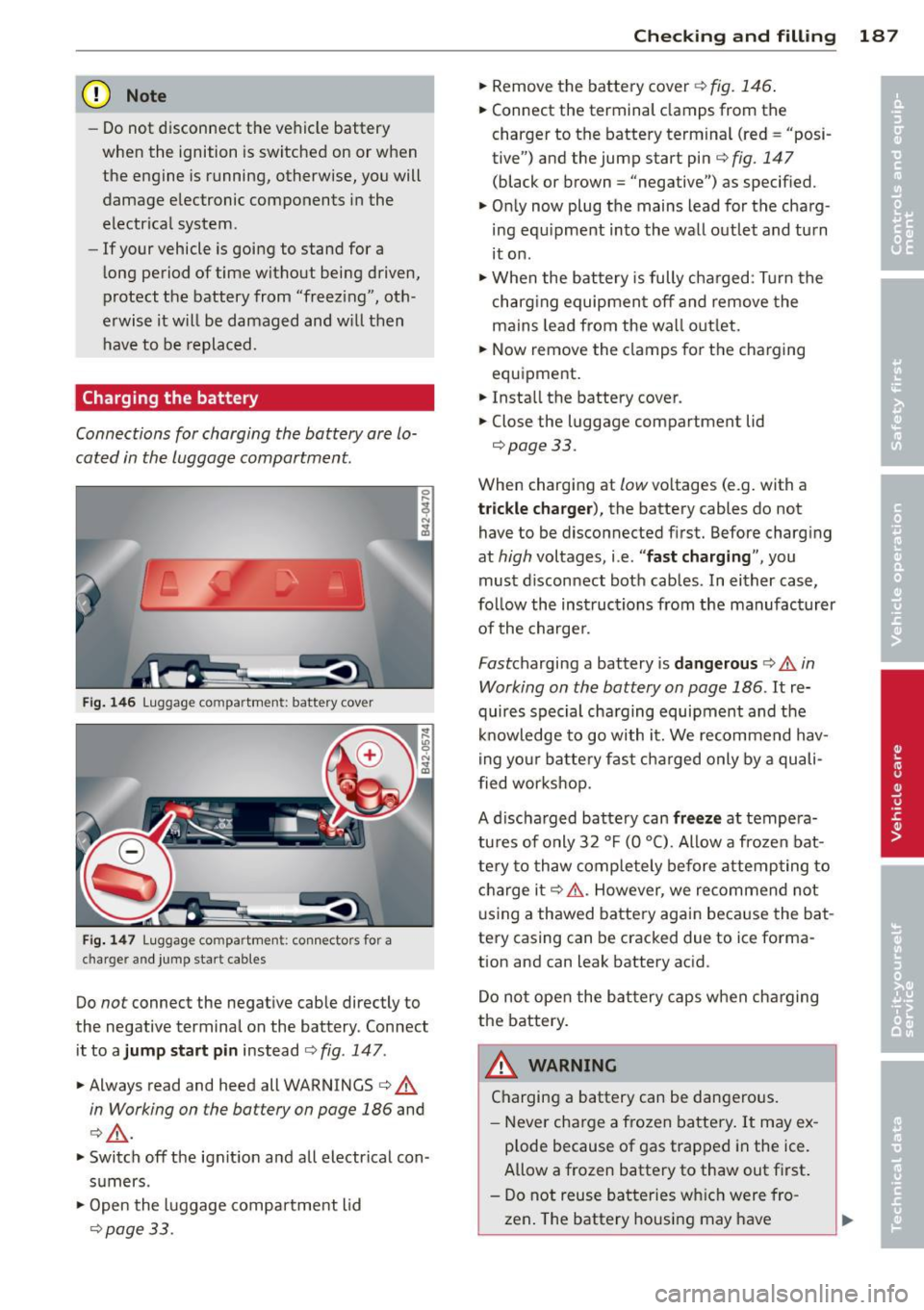
Connections for charging the battery are lo
cated in the Luggage compartment.
Fig. 146 Luggage com pa rtm ent: batt ery cov er
Fig. 147 Luggag e com partm ent: connec tor s for a
c harge r and jump start cables
Do not connect the negative cable direc tly to
the negative terminal on the battery . Connect
it to a
jump start pin instead c::.> fig . 147 .
.. Always read and heed all WARNINGS c::.> .&.
in Working on the ba ttery on page 186 and
Q ,&. .
.. Switch off the ignition and all electrical con
sumers .
.. Open the luggage compartment lid
c::.> page 3 3.
Checking and filling 187
.. Remove the battery cover c::.> fig. 146.
.. Connect the terminal clamps from the
charger to the battery terminal (red = "posi
tive") and the jump start pin
c::.> fig. 147
(black or brown= "negative") as specified.
.. Only now plug the mains lead for the charg
ing equipment into the wall outlet and turn
it on .
.. When the battery is fully charged: Turn the
charging equipment off and
remove the
mains lead from the wall outlet .
.. Now
remove the clamps for the charging
equipment .
.. Install the battery
cover.
.. Close the luggage compartment lid
c::.> page 3 3.
When charging at low voltages (e.g. with a
trickle charger), the battery cables do not
have to be disconnected first. Before charging
at
high voltages, i.e . "fast charging", you
must disconnect both cables. In either case,
follow the instructions from the manufacturer
of the charger.
Fastcharging a battery is
dangerous c::.> .&. in
Working on the battery on page 186 .
It re
quires special charging equipment and the
knowledge to go with it. We recommend hav
ing your battery fast charged only by a quali
fied workshop .
A discharged battery can
freeze at tempera
tures of only 32 °F (0 °C). Allow a frozen bat
tery to thaw completely before attempting to
charge it
c::.> & . However, we recommend not
using a thawed battery again because the bat
tery casing can be cracked due to ice forma
tion and can leak battery acid .
Do not open the battery caps when charging
the battery.
WARNING
Charging a battery can be dangerous.
- Never charge a frozen battery. It may ex
plode because of gas trapped in the ice .
Allow a frozen battery to thaw out first.
- Do not reuse batteries which were fro-
zen. The battery housing may have
Page 190 of 244

188 Checking and filling
cracked and weakened when the battery
froze.
- Charge the battery in a we ll ventilated
area. Keep away from open f lame or elec
trical spark. Do not smoke. Hydrogen gas
generated by the battery is explosive.
- To reduce the danger of explosion, never
connect or disconnect charger cables
wh ile the charger is operating.
- Fast charg ing a battery is dangerous and
should only be attempted by a compe
tent technicia n w ith the proper equip
me nt.
- Battery acid that may spill during charg
ing should be washed off with a solution
of warm water and baking soda to neu
tralize the acid.
(D Note
Never use a fast charger as a booster to
start the engine. This will seriously dam
age sensitive electronic components, such
as control units, relays, rad io, etc., as we ll
as t he battery charger.
(D Tips
- The vehicle battery must not be charged
with a standard small charger that p lugs
i nto the c igarette lighte r o r outlet.
- Only charge the battery through the con
nect ions in the luggage compartment.
Windshield washer
container
Fig. 148 Luggage compartment: Wind shie ld washer
fl uid reser voir
T he washer fluid container is marked with the
symbol
O on its cap ~page 174, fig. 136 .
,. Lift the fi ller cap tongue to add washer flu
id. You can fil l the container to the top.
,. Press the cap back onto the filler neck after
fi lling the container .
You can find the reservo ir
c a p acit y in the table
in
~ page225
Clean water should be used when filling up. If
possible, use soft water to prevent scaling on
the washer jets. Always add a glass cleane r
solution (with frost protection in the winter).
(D Note
- Do not mix e ngine coolant ant ifreeze or
any other additives to fill up the w ind
shield washer reservoir .
- Do not use g lass cleaners conta ining
pai nt so lvent; you risk damaging the
paint.
Page 193 of 244
Groove
means the space between two adjacent tread
ribs.
Load rating (code)
means the maximum load that a tire is rated
to carry for a g iven inflation pressure. You
may not find this information on all tires be
cause it is no t req uired by law.
Maximum load rating
means the load rating for a t ire at the max i
mum permissible inflation pressure for that
tire.
Maximum loaded vehicle weight
means the sum of:
(a) Curb weight
(b) Accessory weight
(c) Vehicle capacity weight, and
(d) Production options weight
Maximum (permissible) inflation pressure
means the maximum cold inflation pressure
to which a tire may be inflated. Also called "maximum inflation pressure."
Normal occupant weight
means 150 lbs. (68 kilograms) times the
number of occupants seated in the vehicle up
to the total seating capacity of your vehicle.
Occupant distribution
means distribution of occupants in a vehicle.
Outer diameter
means the overa ll diamete r of an inflated new
tire.
Overall width
means the linear distance between the exteri
ors of the sidewalls of an inflated tire, includ
in g elevations due to labeling, decorations, or
protective bands or ribs.
Ply
means a layer of rubber-coated parallel cords.
Tires and wheels 191
Production options weight
means the combined weight of those installed
regular production options we ighing over 5
lbs. (2.3 kg) in excess of those standard items
which they replace, not previously considered
in curb weight or accessory weight, including
heavy duty brakes, ride levelers, heavy duty
battery, and special trim.
Radial ply tire
means a pneumatic tire in wh ich the ply cords
that extend to the beads are laid at substan
tia lly 90 degrees to the center line of the
tread .
Recommended inflation pressure
see ¢ page 190, Cold tire inflation pressure.
Reinforced tire
means a t ire designed to operate at higher
loads and at higher inflat ion pressures than
the corresponding standard tire. Reinforced
tires my be identified as "XL", "xl", "E XTRA
LOAD", or "RF" on the sidewall.
Rim
means a metal support for a tire or a tire and
tube assembly upon which the tire beads are
seated.
Rim diameter
means nom inal d iameter of the bead seat. If
you change your wheel s ize, you will have to
purchase new tires to match the new rim di
ameter.
Rim size designation
means r im diameter and width .
Rim width
means nominal distance between rim flanges .
Sidewall
means that portion of a tire between the
tread and bead. •
•
Page 203 of 244

V up to 149 mph (240 km/h)1
)
Z over 149 mph (240 km/h)1)
W up to 168 mph (270 km/h)1l
Y up to 186 mph (298 km/h)1
)
Your veh icle is norma lly factory equipped with
t ires, which posses s excellen t driving charac
ter istics and give your Audi opt imum driving
comfort
~ Ii':,. .
U.S . DOT T ire Identific ation Numbe r (TIN)
a nd tire manufacture d ate
T his is the t ire's "serial number" . It begins
with the letters "DOT " and indicates that the
tire meets all federal standards . The next two
numbers or lette rs indicate the p lant whe re it
was manufactured, and the last four numbers represent the week and year of manufacture.
F or example, the numbers 2213 mean that
the tire was produced in the 22nd week of
2013. The other numbers are marketing co
des that may or may not be used by the t ire
manufac turer. This information is used to con
tact consume rs if a tire defect requires a re
call.
Audi Origin al tire
T ires with the identification "AO" or "RO" have
been spec ially matched with your Aud i. We
recommend using only these tires because
they meet the highest standards regard ing
safety and driving character istics when used
correctly . Your authorized Aud i dealer will
g lad ly provide you with more information .
Tire ply composition and materials used
The number of plies ind icates the number of
layers of rubber -coated fabric in the t ire. In
general, the greater the numbe r of p lies, the
mo re weight a tire can support. Tire manufa c
turers a lso must i ndicate the materials in the
tire, wh ic h include steel, nylon, polyes ter, and
others.
ll Fo r tires wit h a m ax im um s pee d ca pabil ity over 149
mph (2 4 0 k m/h) , tire ma nufa cturers some times use
t h e le tters " ZR."
Tire s an d wheel s 201
Maximum Load Rating
This number indicates the maximum load in
k ilograms and pounds that can be ca rr ied by
the tire .
Tire quality grading for treadwear ,
tract ion, and temp erature resistance
Tread wear, t raction and tempe ra tu re grades
¢page 203 .
Maximum Permissible Inflation Pressure
This number is the greatest amount of a ir
pressure that should ever be put in the tire
u nder norma l dr iv ing cond itions .
Replacing tires or rims on vehicles
equipped with tire pressure monitoring
s ystem
The wheels on yo ur vehicle are equipped with
a sensor which constantly monitors the air
pressure inside the tire, and then transm its
th is information to the tire pressure monitor
ing system. If you are going to repl ace the
whee l rims on your veh icle, make s ure the new
rims also have these sensors . The sensors
mus t be compatib le wit h the t ire pressure
monitori ng system on you r vehicle.
If you install rims, w hich do not have the sen
sors, or have senso rs which are not compat i
ble, then the t ire p ressure monitoring system
will not wor k prope rly. In t his case, t he tire
pressure monitoring system wou ld not be
able to moni tor the tire pressure or warn you
if it is necessary .
- The battery inside of the tire pressure sen
sor has a limited serv ice life.
- Always dr ive with the va lve stem caps se
curely mounted . We recommend using fac
t o ry installed valve stem caps. Ask yo ur au
thorized A udi dealer to rep lace lost valve
stem caps .
T he installat ion of repl acemen t tires with
stee l co rd body p lies in the ti re sidewall may .,..
•
•
Page 219 of 244

-Che ck the tire p re ss ure on the spare imme
diatel y afte r mounting.
- Hav e the wheel b olt tightening torque
checked with a torque wrench a s soon a s
possib le by you r auth orized Audi dealer or
a qu alified ser vice sta tio n.
- With steel and allo y w heel rim s, the wheel
bolts are correctl y tight ened at a to rq ue of
90 ft lb (1 20 Nm ).
- If yo u notice while changin g a ti re th at the
wheel bolts are co rrod ed and diff icult to
turn , then they should be repl aced before
y ou check the t ighten ing to rqu e.
- Replace the flat t ire with a new one and
ha ve it installed on your vehicle as soon as
possib le . R emount th e wh eel co ver .
Until then, driv e with extra care and at re
d uced speeds.
A WARNING
- If you are going to equip your vehicle
with t ires or rims wh ich differ from those
w hich were factory installed, then be
sure to read the informat ion
~page 199,
New tires and replacing tires and
wheels.
- Always store the tools securely in lug
gage compa rtment. Otherw ise, in an ac
c ident o r sudden mane uver they could fly
f orward, causing inju ry to passengers in
the vehicle .
(D Note
Do not use commerc ia lly available t ire
sealants. Othe rwise, the elec trical compo
nents of the tire pressure monitoring sys
tem* will no longer work properly and the
sensor for the tire pressure monitoring
system wi ll have to be replaced by a qua li
fied workshop.
What do I do now? 217
Jump-starting
General
If necessary, the engine can be started by
connecting it to the battery of another vehi
cle.
If the engine should fail to start because of a
discharged or weak battery, the battery can be
connected to the battery of
another vehicle,
us ing a
pair of jump er cabl es to start the en
gine.
Both batteries must be rated at 12 volts . The
capacity (Ah) of the booster battery must not
be substantia lly less than the capac ity of the
discharged battery .
Jumper cables
Use only jumper cables of suff ic ient ly large
cro ss se ction to safely car ry the starter cur
rent . Refer to the manufacturer's specifica
tions .
Use only jumper cab les which have
insulated
term inal clamps and are properly marked for
dist inction:
plu s(+) cable : in most cases colored r ed
m inu s(-) cable :
in most cases colored black
A WARNING ~
Batteries contain e lectric ity, acid, and gas .
Any of these can cause very serious or fata l
injury. Follow the instructions below for
safe handling of your vehicle's battery.
-Always shield your eyes and avo id lean-
ing over the battery whenever poss ible.
- A discharged battery can a lready freeze
at temperatures just below 32 °F (0 °(). Before connect ing a jumper cable , the
frozen battery must be thawed com
pletely, othe rwise it could explode .
- Do not allow battery acid to contact eyes
or skin . Flush any contacted area with
wate r immediately .
- Improper use of a booster battery to
start a vehicle may cause an explosion. •
•
Page 220 of 244

218 Wh at do I do now ?
-Vehicle batteries generate explos ive gas
es. Keep sparks, flame and lighted ciga
rettes away from batteries.
- Do not try to jump start any vehicle with
a low acid level in the battery.
- The voltage of the booster battery must
also have a 12-Volt rating. The capacity
(Ah) of the booster battery should not be
lower than that of the discharged bat
tery. Use of batteries of different voltage or substant ially different "Ah" rating
may cause an explos ion and personal in
Jury.
- Never charge a frozen battery. Gas trap
ped in the ice may cause an explosion.
- Never charge or use a battery that has
been frozen. The battery case may have
be weakened.
- Use of batteries of different voltage or
substant ially different capacity (Ah) rat
ing may cause an explosion and injury.
T he capacity (Ah) of the booster battery
should not be lower than that of the dis
charged battery.
- Before yo u check anything in the engine
compartment, always read and heed all
WARNINGS ¢
page 172, Working in the
engine compartment.
(D Note
- Applying a higher vo ltage booster bat
tery wi ll ca use expensive damage to sen
sitive electronic components, s uch as
control units, relays, radio, etc.
- There m ust be no e lectrica l contact be
tween the vehicles as otherwise current
could already start to flow as soon as the
positive(+) terminals are connected .
(0 Tips
-The discharged battery must be proper ly
connected to the vehicle's electrical sys
tem.
- Switch off any car phone, or follow the
car phone instructions for this situation.
Use of jumper cables
Make sure to connect the jumper cable
clamps in exactly the order described below!
F ig . 1 63 Luggage compartment: co nnectors for a
charge r and jump start cables
Fi g. 1 64 Jump start us ing the battery in a nother vehi
cle: A· Fema le socket, B • D isc harge
The battery is located in the luggage compart
ment¢
page 185. T he front lid can be opened
i n an emergency¢
page 34.
Do not connect the negative cable d irectly to
the negative term inal on the battery. Connect
it to a
jump st a rt pin instead ¢ fig. 163.
Connect the po sitive cable (red ) to the
positive terminal
1. Co nnect one end of the red jumper cable
¢
fig . 164 (!) to the positive terminal of
discharged battery @.
2 . Connect the other end of the red jumper
cable to the positive terminal @of the
booster battery @.
Connect the n egativ e cable (black ) to the
n egati ve terminal
3. Connect one end of the b lack jumper ca
ble @ to the negative terminal of the
booster battery @. .,.
Page 221 of 244
4. Secure the other end to the jump start pin
© for the discharged battery@.
Starting the engine
.,. Start the eng ine of the vehicle providing as
s istance and allow it to run at id le.
.,. Now start the engine of the vehicle with the
discharged battery .
.,. If the engine does not start: Stop trying af
ter 10 seconds and then try again after
about 30 seconds .
.,. Disconnect the cable while the engine is
running in exactly
reverse order to that de
scribed.
The battery is vented to the outside to prevent
gases from entering the vehicle interior. Make
sure that the jumper clamps are well connect
ed with their
metal ports in full contact with
the battery termina ls.
A WARNING
To avoid serious personal i njury and dam
age to the vehicle, heed all warnings and
instructions of the jumper cable manufac
turer.
If in doubt, ca ll for road service .
- Jumper cables must be long enough so
that the vehicles do not touch.
- When connecting jumper cables, make
sure that they cannot get caught in any
moving parts in the engine compart
ment.
- Before you check anything in the engine
compartment, always read and heed all
WARNINGS
c:> page 172, Working in the
engine comportment.
Improper hook-up of jumper cables can ru
in the generator.
- Always connect POSITIVE( +) to POSI
TIVE(+), and NEGATIVE(-) to NEGATIVE
( - ) ground post of the battery manager
control unit.
- Check that all screw plugs on the battery
ce lls are screwed in firmly. If not, tighten
plugs prior to connecting clamp on nega
tive battery terminal.
-
What do I do now? 219
- Please note that the procedure for con
necting a jumper cable as described
above applies specifically to the case of
your vehicle being jump started. When
you are giving a jump start to another ve
hicle, do
not connect the negative(-) ca
ble to the negative(-) terminal on the
discharged battery@. Instead, securely
connect the negative(-) cable to eithe r a
solid metal component that is firmly
bolted to the engine block or to the en
gine block itself. If the battery that is be
ing charged does not vent to the outside,
escaping battery gas could ignite and ex
plode!
Emergency towing
with commercial tow
truck
' General hints
Your Audi requires special handling for tow
ing.
The following information is to be used by commercial tow truck operators who know
how to operate their equipment safely.
- Never tow your Audi, towing will cause dam
age to the engine and transmission.
- Never wrap the safety chains or winch cables around the brake lines.
- To prevent unnecessary damage, your Audi
must be transported w ith a car carrier (flat
bed truck) .
- To load the vehicle on to the flat bed, use
the towing loop found in the vehicle tools
and attach to the front anchorage
c:> page 220 .
A WARNING
A vehicle being towed is not safe for pas
sengers . Never allow anyone to ride in a
vehicle be ing towed, for any reason.
•
•