brake AUDI R8 SPYDER 2014 User Guide
[x] Cancel search | Manufacturer: AUDI, Model Year: 2014, Model line: R8 SPYDER, Model: AUDI R8 SPYDER 2014Pages: 244, PDF Size: 61.06 MB
Page 42 of 244
40 Convertible top
The rear window can be extended comp lete ly
for cleaning. This is ca lled the cleaning posi
tion.
E xtendin g the rear w indow into th e w ind
d efl ector po sit io n
.. Pull and hold the rear window switch
¢ fig. 36 .
.. Re lease the switch once the rea r window has
reached the wind deflector position.
E xte nding th e rear window into th e
cle aning po sition
.. Pull and hold the rear window switch
¢ fig . 36.
.. Release the switch once the rear window has
reached the wind deflector position .
.. Pull and hold the rear w indow switch again .
.. Pull and hold the convertible top switch
within one second
¢ page 37, fig . 32.
Re tra cting the re ar w indow
.. Press and hold the rear window sw itch until
the window has been retracted .
Retra cting the re a r wi ndow using the one
t ouch function
.. Press the rear window switch briefly . There
is no need to hold the switch .
The rear window can only be operated when
t he igni tion is switched on.
The rear window can also be extended or re
tracted when the convertib le top is closed.
A WARNING
- Do not use the rear window to secure car
go or other objects. This could result in
mJury .
- Always pay attention and be careful
when extending or retracting the rear
window . It could cause injury by pinch
ing .
(D Tips
-Keeping all of the w indows raised pro
v ides the best wind protection . - The vehicle must be stationary to bring
the rear window into the cleaning posi
tion . The rear window will retract once
you begin dr iv ing .
Convertible top
emergency operation
General information
The convertible top can be closed by hand if
there is a malfunction .
First check if overload protection is active
¢ page 38. If this is the case, the convertible
top wi ll operate again afte r a short de lay. Oth
erwise the fo llowing steps must be completed
before closing the convertib le top:
.. Activate the pa rking brake .
.. Open the side w indows, if necessary.
.. Remove the key from the ignition.
E mergency loc king is not intended for long
term use or long d rives . The convertible top
will not be completely waterproof after using
the emergency locking procedure because the
seals wi ll not be seated correctly. Only close
the convertible top manually in an emergency .
Please see an authorized Audi R8 dealer to
have the cause of the malfunction corrected .
A WARNING
-The ignition must be sw itched off d uring
the entire closing p rocedu re.
- When pos itioning the convertible top,
avoid contact with the supports or other
movi ng parts. Otherwise you could p inch
your hands.
- Never drive when the convert ible top is
not locked correctly . The wind from d riv
ing could cause the convertible top to
open . This can resu lt in injuries and dam
age to the vehicle.
(D Tips
Have a second person assist when clos ing
the convert ible top. Opening the storage
bay lid and positioning the convertible top
i s easier when a second person is assisting.
Page 44 of 244
42 Convertible top
Opening the conv ertible top stor age bay
lid
• From the r ear of the vehicle, r each into the
center ventilation slot in the sto rage bay lid
wi th both hands and raise the lid approxi
mately 12 in (30 cm).
• Hold the storage bay lid in this posit ion and
pull it toward you until it stops ¢
fig. 40.
A WARNING
When working in the engine compart
ment:
- T urn the engine off.
- Act ivate the park ing brake.
-
- In vehicles with a manua l transm iss ion,
move the sh ifter lever into idle . In
vehicles with the R tronic transmission,
move the se lector lever into the N pos i
t ion.
- Remove the ignit ion key .
- Let the engine cool down .
- Keep children away from the engine com-
partment.
(D Note
To prevent damage to the vehicle, only
open the convertible top storage bay lid
when the engine compartment lid is
closed.
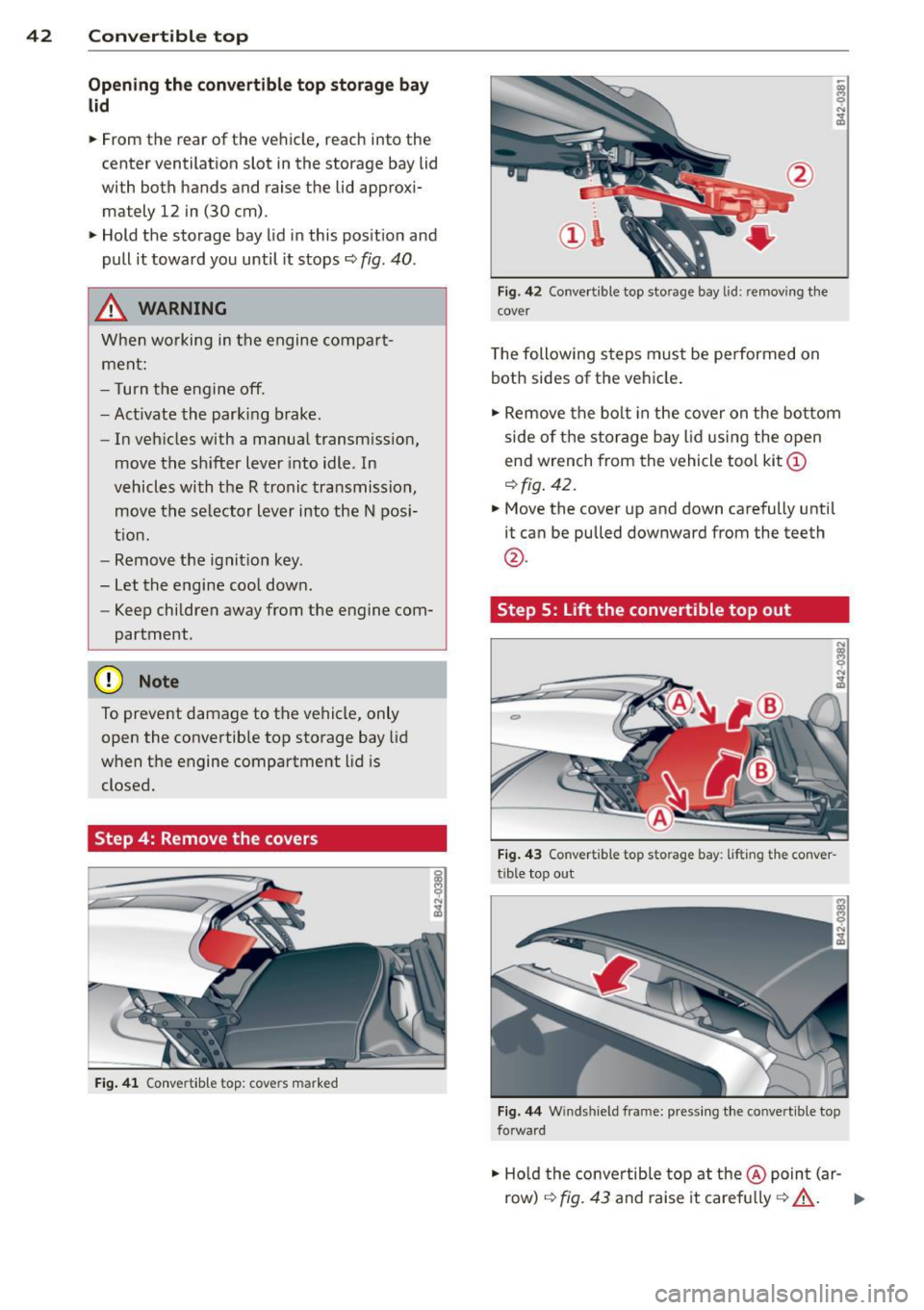
Step 4: Remove the covers
Fi g. 41 Conv ertib le top : cov ers ma rk e d
Fig. 42 Co nver tible top storage bay lid: r em ov ing t he
c o ver
T he following steps mus t be performed on
both sides of the vehicle .
• Remove the bo lt in the cover on the bo ttom
side of the sto rage bay lid using the open
e nd w rench from the vehicle too l kit
(D
¢ fig . 42.
• Move the cover up and down carefully until
it can be pulled downwa rd from the teeth
@ .
Step 5: Lift the convertible top out
Fig. 4 3 Conve rtib le to p sto rage bay: liftin g th e c onve r
tible top o ut
Fig . 44 Wind shi eld fr ame: p res sing the c onvert ible top
fo rwa rd
• Ho ld the conve rtib le top at the@ point (ar
row)
r:!;> fig. 43 and raise it carefu lly ¢ A . .,..
Page 59 of 244
Seats and storage
General recommen
dations
Why is your seat adjustment so important?
The safety belts and the airbag system can
only provide maximum protection if the front
seats are correctly adjusted.
There are various ways of adjusting the front
seats to provide safe and comfortable support
for the driver and the front passenger. Adjust
your seat properly so that :
- you can easily and quick ly reach all the
switches and controls in the instrument
panel
- your body is properly supported thus reduc ing physical stress and fatigue
- the safety belts and airbag system can offe r
maximum protection
¢ page 111.
In the following sections, you will see exactly
how you can best adjust your seats .
There are special regulations and instructions
for installing a child safety seat on the front passenger's seat. Always heed the informa
tion regard ing child safety provided in
¢ page 132, Child Safety.
A WARNING
Incorrect seating position of the driver and
all other passengers can result in serious
personal injury.
- Always keep your feet on the f loor when
the vehicle is in motion -never p ut your
feet on top of the instrument panel, out
of the w indow or on top of the seat cush
ion! This applies espec ially to the passen
gers . If your seating position is incorrect
you increase the r isk of injury in the case
of sudden braking or an acc ident. If the
airbag inflates and the seating position
is incorrect this could result in personal
injury or even death.
- It is important for bo th the driver and
front passenger to keep a distance of a t
Seat s an d sto rage 57
least 10 inches (25 cm) between them
selves and the steering wheel and/or in
strument panel. If you're s itting any
closer than th is, the airbag system can
not protect you properly. In addition to
this, the front seats and head restra ints
must be adjusted to yo ur body height so
that they can give you max imum prote c
tion.
- Always try to keep as much distance as
possible be tween yourself and the s teer
ing wheel o r instrument pane l.
- Do not adjust the driver's or front pas
senger's seat whi le the vehicle is moving.
Your seat may move unexpected ly, caus
ing sudden loss of vehicle control and
personal injury . If you ad just yo ur seat
while the veh icle is moving, you are out
of posit ion.
Driver's seat
The correct seat position is important for safe
and relaxed driving.
We recommend that you adjust the driver's
seat in the fo llowing manner:
.,. Adj ust the seat in fore and aft direction so
t ha t you can easily push the peda ls to the
floor whi le keeping your knee sligh tly bent
c::> A in Why is your seat adjustment so im
portant? on page
57 .
.,. Adjust the seatback so that when you sit
w ith your back against the seatback, you can
still grasp the top of the steering wheel.
.,. Pos it ion the head restrai nt accord ing to the
occupant 's height
c::> page 59. For maxi
mum protection, the top of the head re
straint shou ld be at least at eye level, pref
erably higher and idea lly level with the top
of the head
¢ page 96, fig. 103 .
A WARNING
Never place any objects in the dr iver's foot
well. An object could get into the pedal
area and interfere with pedal funct ion. In
case of sudden braking or an acc ident, you
would not be able to brake or accelerate!
Page 63 of 244
could slide around inside the vehicle
wh ile driving or when accelerating or
when applying the brakes or when driv
ing around a corner .
- When you are driving make sure that
anything you may have placed in the cen
ter console or other storage locations
cannot fa ll out into the footwells . In case
of sudden braking you would not be able
to brake, depress the clutch or acceler
ate.
- Any articles of cloth ing that you have
hung up must not interfere with the driv
er's v iew. The coat hooks are designed
only for lightweight clothing. Never hang
any clothing with hard, pointed or heavy
objects in the pockets on the coat hooks .
During sudden braking or in an accident -
especially if the airbag is deployed -
these objects could injure any passen
gers inside the veh icle .
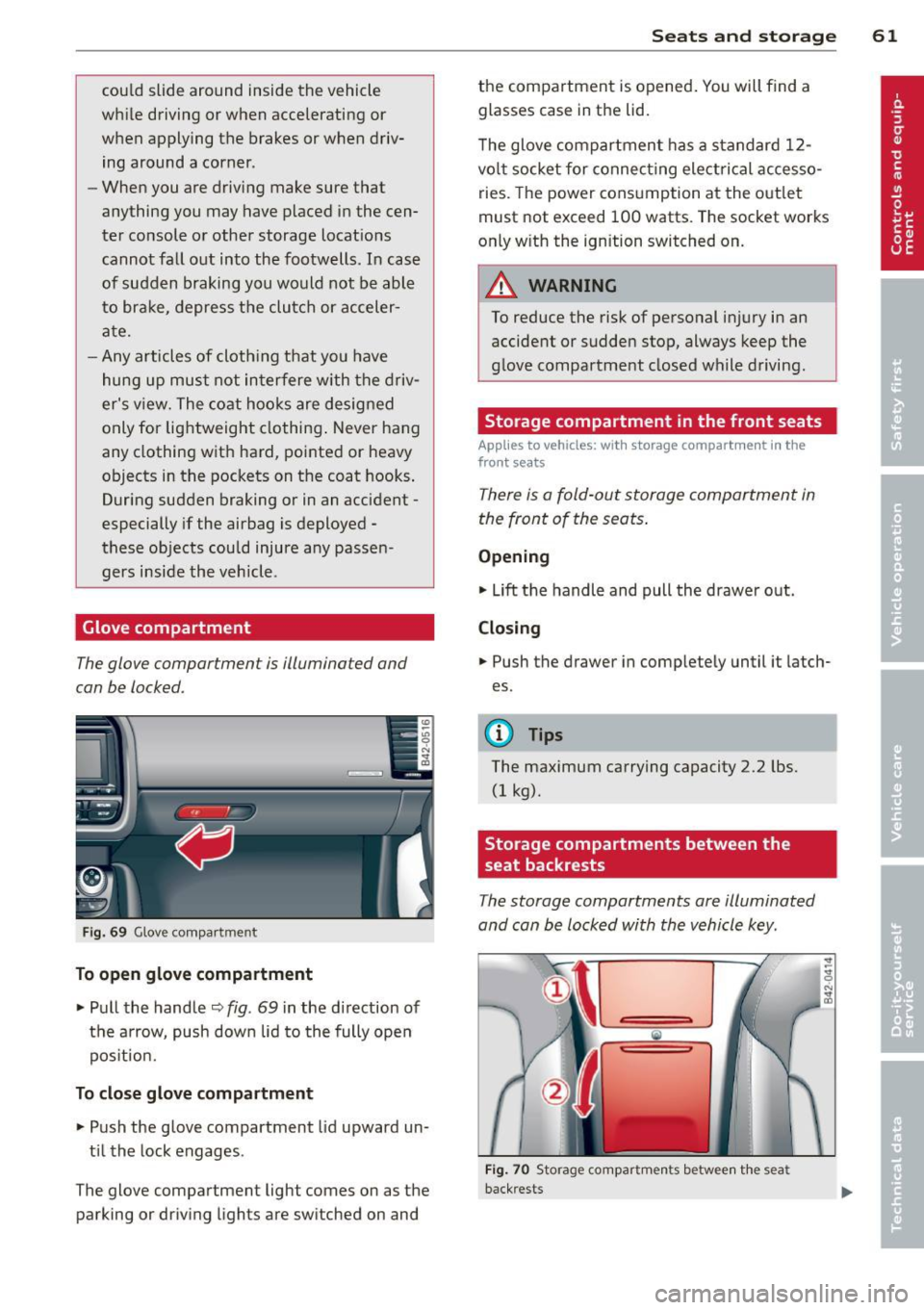
Glove compartment
The glove compartment is illuminated and
can be locked.
Fig. 69 Glove compar tme nt
To open glove compartment
• Pull the handle ~ fig . 69 in the direction of
the arrow, push down lid to the fully open
pos it ion .
To close glove compartment
• Push the glove compartment lid upward un
t il the lock engages .
The glove compartment light comes on as the parking or driving lights are switched on and
Seats and storage 61
the compartment is opened . You will find a
glasses case in the lid.
T he glove compartment has a standard
12-
volt socket for connecting electrical accesso
ries. The power consumption at the outlet
must not exceed 100 watts. The socket works
only w ith the ignition switched on.
_& WARNING
To reduce the risk of personal injury in an
accident or sudden stop, always keep the
g love compartment closed while driving.
Storage compartment in the front seats
Applies to vehicles: with storage compartment in the
front seats
There is a fold-out storage compartment in
the front of the seats .
Opening
• Lift the handle and pull the drawer out.
Closing
-
• Push the drawer in completely until it latch
es.
(D Tips
The maximum carrying capacity 2.2 lbs.
(1 kg).
Storage compartments between the
, seat backrests
The storage compartments are illuminated
and can be locked with the vehicle key.
F ig . 70 Storage compartments betwee n the seat
back rests
Page 71 of 244
you leave your vehicle. This makes vehicle
theft even more difficu lt
r=:, .&. .
Ign ition on @
After switch ing the ignition on, the needles
move all the way up and then down.
If it is difficult to turn the key after you have inserted it into the ignit ion lock, turn the
steer ing whee l back and forth. This will take
the load
off the steering lock mechan ism and
you will be able to turn the key freely and start the engine .
Starting the engine @
In th is position the engine starts. While the
engine is start ing, the power supply to the
headlights and other e lectr ica l cons umers is
temporari ly inter rupted to conserve battery
power. After the engine has started, release
the key and it will return to position @.
Before the starter can be operated again the
key must be turned back to position
(D . The
non-repeat lock prevents you from damaging
the starter when the engine is running.
A WARNING
- Never remove the key from the ign ition
lock while the vehicle is moving. The
steering wheel will lock causing loss of
control.
- If you have to leave your veh icle - even
for just a m inute - a lways remove the ig
nition key and take it with you. This is es
pecially important if you a re going to
leave ch ildren behind i n the vehicle. The
children co uld s tart the engine or use
other vehicle controls . Unsupervised use
of vehicle controls (for example, power
windows) can cause serious personal in
juries.
@ Tips
I f the veh icle bat tery has been d isconnect
ed and then reconnected, then you must
leave the key in pos ition @for abo ut 5
seconds before you can start the engine.
-
On th e ro ad 69
Starting and stopping
the engine
Starting the engine
The engine can only be started with your orig
inal Audi key.
On vehicles with S tron ic*, the e ngine can be
sta rted in the neut ra l position N and in each
gear (1 - 7 a nd R).
" Set the park ing brake
r=:, & .
"On veh icles with manual transmiss ion*, fully
dep ress the clutch peda l.
" Press and hold the brake peda l.
" Tur n the igni tion key to pos it ion @
r=:> page 68, fig . 74 -do not depress the gas
peda l when sta rting the engine .
... Let go of the key as soon as the engine
starts - the starter m ust not cont inue to
run. On vehicles w ith S tronic, select gear
position N.
A cold engine may at first be loud after it has
been started. This is due to the hydraulic
valves bu ild ing up the oil p ressure . Th is is nor
mal and no need for concern .
If the engine does not start immediately, stop
trying after 10 seconds and then try to restart
the engine about 30 seconds later .
A WARNING
- Never start or let the engine run in a con
fined or enclosed area. Exhaust fumes
from the eng ine contain carbon mono x
ide, a co lor less and odorles s gas. Carbon
monox ide can be fata l if inh aled.
- Never leave the engine id ling una ttend
ed. An unat tended ve hicle with a runn ing
engine poses a danger of personal injury
or theft .
- With the engine r unning and a gear en
gaged, you have to hold the veh icle w ith
the foot bra ke.
Page 72 of 244
70 On the road
(D Note
-Avoid hig h engine speeds, fast accelera
tion or heavy engine loads while the en
gine is still cold. Th is could damage the
engine.
- The engine cannot be started by pushing or towing the vehicle.
@) For the sake of the environment
To avoid unnecessary engine wear and to
reduce exhaust emissions, do not let your
veh icle stand and warm up. Be ready to
drive off immediately after starting your
veh icle.
Stopping the engine
On vehicles w ith S tronic*, the engine can be
turned off in the neutral position N and in
each gear (1 -7 and R).
~ Turn the ign ition key to position ©
r:::>page 68, fig . 74 .
_& WARNING
- Never turn off the engine until the vehi
cle has come to a complete stop.
- Th e brake booster and servotronic on ly
work when the engine is running. With
the ignition turned off, you have to apply
more force when steering or braking .
Since you cannot steer and stop norma l
ly, this can lead to accidents and serious
injuries.
(D Note
- If the engine has been under heavy load
for an extended period of time, heat
builds up in the engine compartment af
ter the engine is switched off -there is a
risk of damaging the engine. Allow the
engine to continue to run at idle for a
short time or drive until it has cooled
down before you turn it off¢
page 75.
- If the engine has been under heavy load
for an extended period of time, it can be
come extremely hot. You should not park your vehicle over easily combustib
le ob
jects or areas (e .g. grass or leaves). There
is a risk of starting a fire.
(D Tips
After the engine has been switched off, the
radiator fan can continue to run for up to
10 minutes -even with the ignition switch
ed off. It can also sw itch on again after
some time if the coolant temperature rises
as the result of heat buildup or if the en
gine compartment is heated by the sun's
rays and the engine is hot.
Parking brake
Parking brake
When the parking brake is set, it prevents the
vehicle from rolling away unintentionally
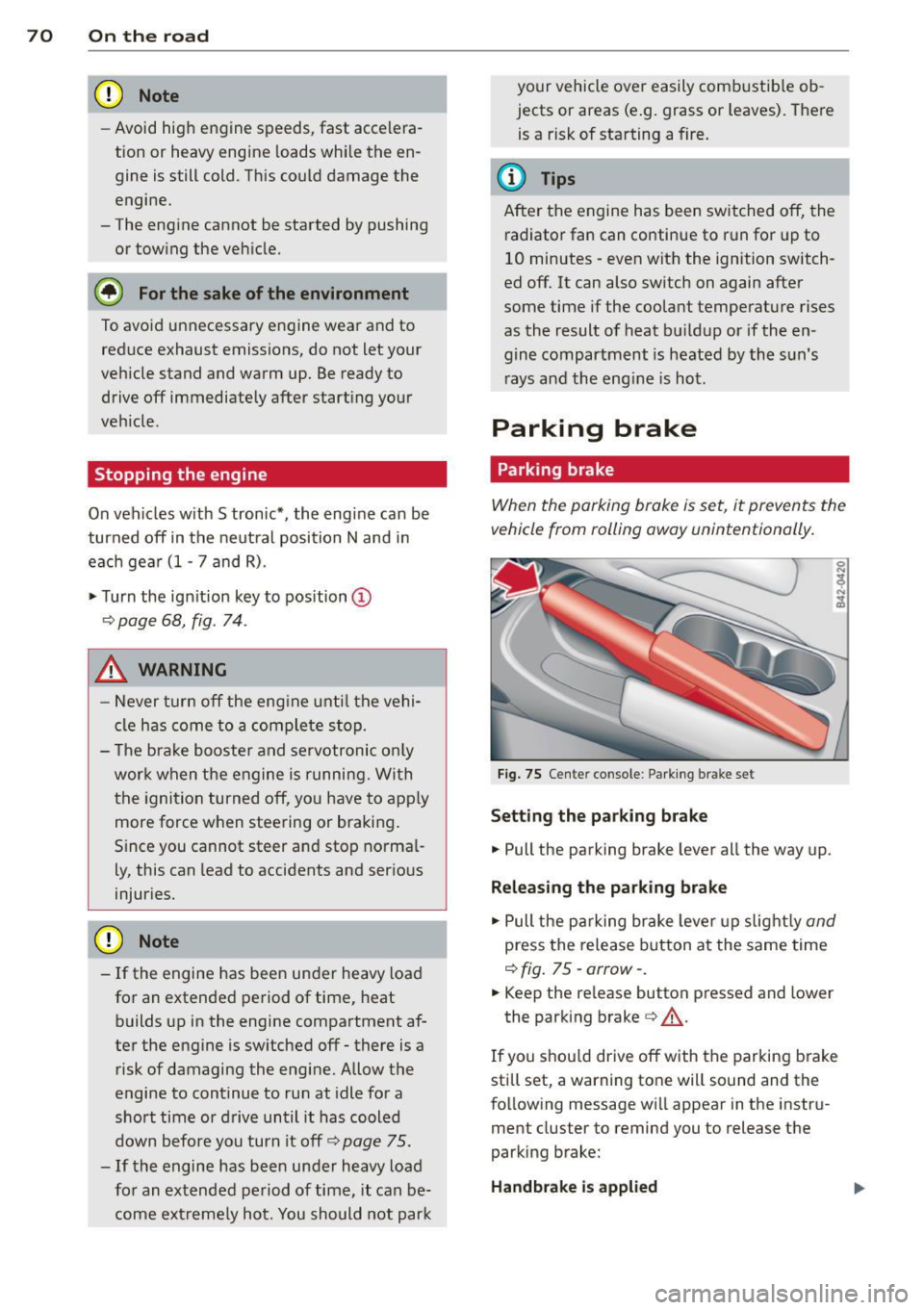
Fig. 75 Center co nsole : Parking brake set
Sett ing the parking brake
~ Pull the parking brake lever all the way up.
Releasing the parking brake
~ Pull the parking brake lever up slight ly and
press the release button at the same time
r:::>fig. 75-arrow- .
~ Keep the release button pressed and lower
the park ing brake ¢,& .
If you shou ld drive off with the parking brake
still set, a warning tone will sound and the
following message will appear in the instru
ment cluster to remind you to release the
parking brake:
Handbrake is applied
Page 73 of 244
The parking brake warning comes on only af
ter you hav e drive n for longer than 3 seconds
and faster than 5 mph (5 km/h).
The parking b rake warning light _
(USA)/ . (CON) illuminates when the parking
brake is set and you switc h on the ignition .
A WARNING
Always release the parking brake com
pletely. A partially engaged brake will
overheat the rear brakes, reduce the ir ef
fectiveness and cause excess ive wear . This
could lead to brake failure and an accident .
On ly after the vehicle has come to com
plete stop, should you f irm ly set the park
ing brake and move the gearshift lever into
a gear.
Parking
Parking
"' Stop the vehicle using the brake pedal.
"' Set the parking brake firmly.
"' Swi tch off the e ngine .
"' Engage a gear
~ ,&. .
In addition on inclines and grad es
"' Turn the steer ing whee l so that your vehicle
will ro ll against the curb i n case it should
sta rt to move .
A WARNING
This is how yo u can reduce the risk of in
jury when leaving your veh icle.
- Never pa rk the vehicle whe re it can come
in contac t wi th dry grass, spille d fu el or
any othe r flammable materials.
- Never allow a nyone - especially small
children -to remain in the vehicle when
it is locked. Locked doors ma ke it mo re
difficult for rescuers to access the pas
senger compartment in the event of an emergency . Danger to life!
- Never leave c hildren unsupervised in the
vehicle . Children co uld re lease the park-
-
On th e ro ad 71
ing brake or move the gearsh ift leve r out
of gear. The vehicle could start to ro ll
away and cause an acc ident.
- No matter what the season is, the tem
perature in a parked ve hicle can reach
dangerous leve ls.
Starting on hills
App lies to vehicles : wi th hill ho ld assist
Hill ho ld assist makes it eas ier to start on
hill s.
The system is activated when the brake peda l
is depressed
for a few second s.
After releasing the brake ped al, the brake
power is held for a
brief moment t o p reven t
the ve hicle from rolling back when starting . A t
this time, you can easi ly begin to move your
vehicle.
A WARNING
- If you did not begin moving immed iate ly
after releasing the brake pedal, under
certa in circumstances, the vehicle would
begin to roll backwa rd . Dep ress the
brake peda l imm ediate ly o r engage the
hand b rake.
- Should t he eng in e sta ll, dep ress th e
bra ke peda l immediate ly o r engage the
ha nd br ake.
- In o rder to prevent the vehicl e from roll
ing back unintentionally whe n starti ng in
s top-and-go tr affic, keep the br ake ped al
depressed fo r a few seconds be fore driv
in g off .
(D Tips
You can find o ut if yo ur vehicle is equ ipped
wi th "Hi ll hold ass ist" at a n au thori ze d
A udi dealersh ip.
Page 76 of 244
74 On the road
8_ WARNING
-Always pay attention to traffic even when
the cruise control is switched on. You are
always responsible for your speed and
the distance between your vehicle and
other vehicles.
- For safety reasons, the cruise control
should not be used in the city, in stop
and-go traffic, on twisting roads and
when road conditions are poor (such as
ice, fog, gravel, heavy rain and hydro
planing) -risk of accident.
- Turn
off the cruise control temporarily
when entering turn lanes, highway exit
lanes or in construction zones.
- Please note that inadvertently "resting"
your foot on the accelerator pedal causes
the cruise control not to brake. This is
because the cruise control is overridden
by the driver's acceleration.
@ Tips
- Vehicles with manual transmission: You
can attain the set speed only if the cur
rently engaged gear allows it and the en
gine is not stressed. Shifting to a higher
or lower gear promptly will allow the en
gine to run smoothly .
- The cruise control cannot maintain a
constant speed when driving downhill.
The vehicle will accelerate under its own
weight. Downshift to a lower gear or use
the brakes to slow down.
Changing speed
.,. Press lever in the 0 or 0 direction
¢ page 73, fig. 79 to increase or decrease
your speed.
.,. Release the lever to save that speed.
You can also press the accelerator pedal down
to increase your speed, e.g. if you want to
pass someone. The speed you saved earlier
will resume as soon as you release the acceler ator pedal.
If, however, you exceed your saved speed by
S mph (10 km/h) for longer than 5 minutes,
the cruise control will turn
off temporarily.
The symbol will go out but the saved speed
will be retained .
Presetting your speed
You can preset your desired speed while the
vehicle is not moving.
.,. Turn on the ignition.
.,. Pull lever into position@~
page 73,
fig. 79.
.,. Press the lever in the 0 or 0 direction to
increase or decrease your speed.
.,. Release the lever to save that speed .
This function makes it possible, for example,
to save the speed you want before driving on
the highway. Once on the highway, activate
the cruise control by pulling the lever toward
CD-
Switching the system off
Temporary deactivation
.,. Press the brake pedal , or
.,. Keep the clutch pedal pressed down longer,
or
.,. Press the lever into position @ (not clicked
into place)
~ page 73, fig. 79 , or
.,. Drive for longer than S minutes at more
than 5 mph (10 km/h) above the stored
speed.
Switching off completely
.,. Press lever into position @(clicked into
place), or
.,. Switch the ignition
off.
The system retains the saved speed if you de
activate the cruise control temporarily. To re
sume the saved speed, release the brake or
clutch pedal and pull the lever to position
(D .
Switching the ignition off erases the saved
speed.
Page 77 of 244
_& WARNING
You should only return to the saved speed if it is not too fast for the current traffic
conditions - risk of an accident!
Audi magnetic ride
Damping can be adjusted to the driver's pref
erence and it adapts automatically to the cur
rent driving situation.
SPORT •
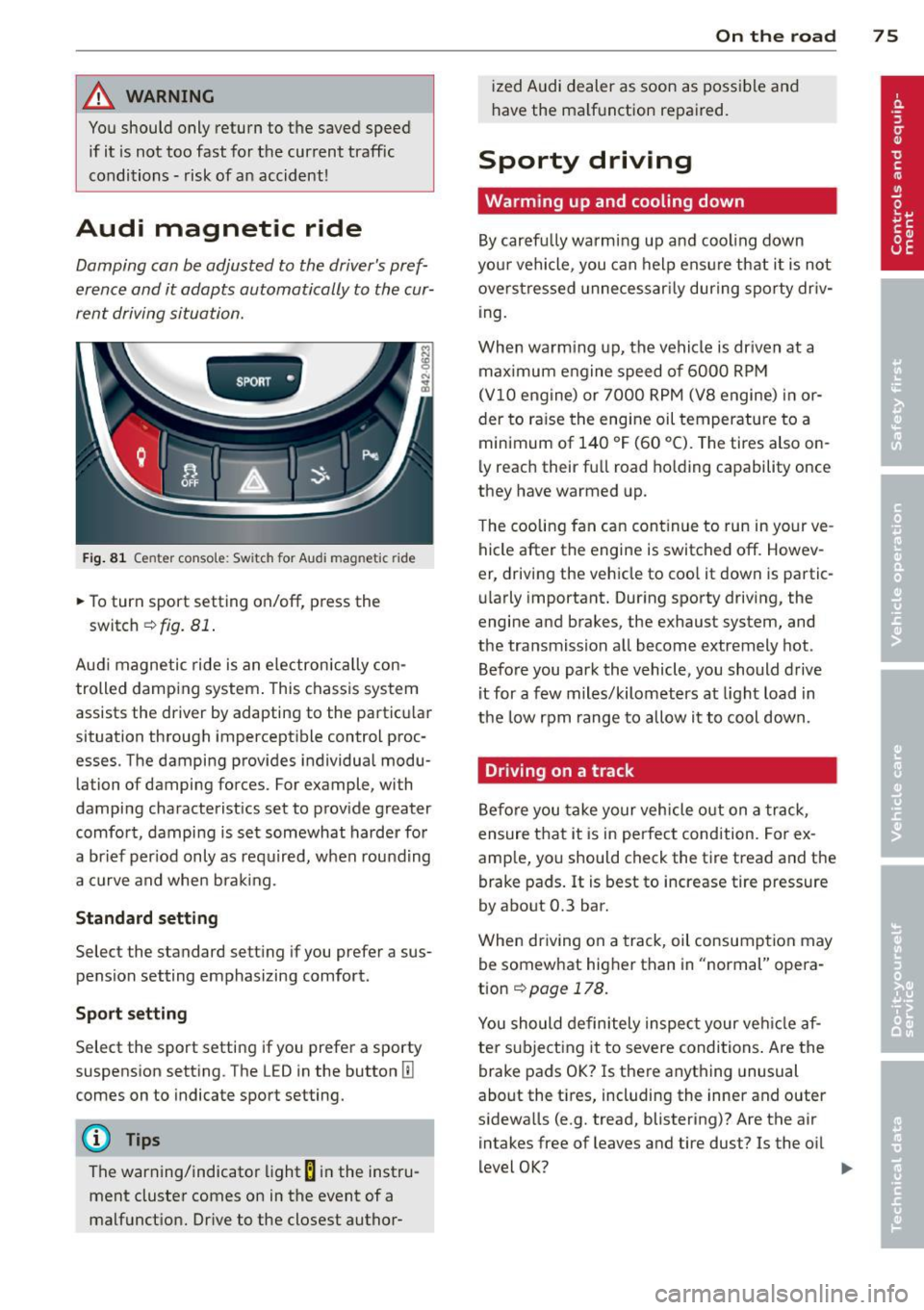
Fig. 81 Center conso le : Switch for Audi magnetic ride
.,. To turn sport setting on/off, press the
switch
¢fi g. 81 .
Aud i magnetic ride is an electronica lly con
trolled damping system . This chassis system
assists the driver by adapting to the particu lar
situation through imperceptible control proc
esses. The damping provides individual modu
lation of damping forces. For example, with
damping characteristics set to prov ide greater
comfort, damping is set somewhat harder for
a brief period only as required, when rounding
a curve and when brak ing.
Standard setting
Select the standard setting if you prefer a sus
pension setting emphasizing comfort.
Sport setting
Select the sport setting if you prefer a sporty
suspension setting. The LED in the button
II]
comes on to indicate sport setting.
@ Tips
The warning/indicator light Bin the instru
ment cluster comes on in the event of a
malfunction. Drive to the closest author-
On the road 75
ized Audi dealer as soon as possible and
have the malfunction repaired.
Sporty driving
Warming up and cooling down
By carefully warming up and cooling down
you r vehicle, you can help ensure that it is not
overstressed unnecessar ily during sporty driv
ing .
When warm ing up, the vehicle is driven at a
maximum engine speed of 6000 RPM
(Vl0 engine) or 7000 RPM (V8 engine) in or
der to raise the engine oil temperature to a
minimum of 140 °F (60 °C). The tires also on
ly reach their full road holding capability once
they have warmed up.
The cooling fan can cont inue to run in your ve
hicle after the engine is switched off. Howev
er, driving the vehicle to coo l it down is partic
ularly important. During sporty driving, the
engine and brakes, the exhaust system, and
the transmission all become extremely hot.
Before you park the vehicle, you should drive
it for a few m iles/kilometers at light load in
the low rpm range to allow it to cool down.
Driving on a track
Before you take your vehicle out on a track ,
ensure that it is in perfect condition. For ex
amp le, you should check the tire tread and the
brake pads. It is best to increase tire pressure
by about 0.3 bar.
When driving on a track, oil consumption may
be somewhat higher than in "normal" opera
tion
r=> page 178.
You should definitely inspect your vehicle af
ter subject ing it to severe conditions . Are the
brake pads OK? Is there anything unusual
about the tires, including the inner and outer
sidewalls (e.g. tread, blistering)? Are the air
intakes free of leaves and tire dust? Is the oil
level OK? .,,.
Page 80 of 244
78 Transmission
@ Tips
-When accelerating using the Launch
Control program, all vehicle parts are
subject to heavy loads. This can result in
increased wear.
- The Launch Control Program only func
tions when the parking brake is released
and the vehicle speed is less than
3 mph
(5 km/h).
S tronic®
Description
Applies to vehicles: with S tronic
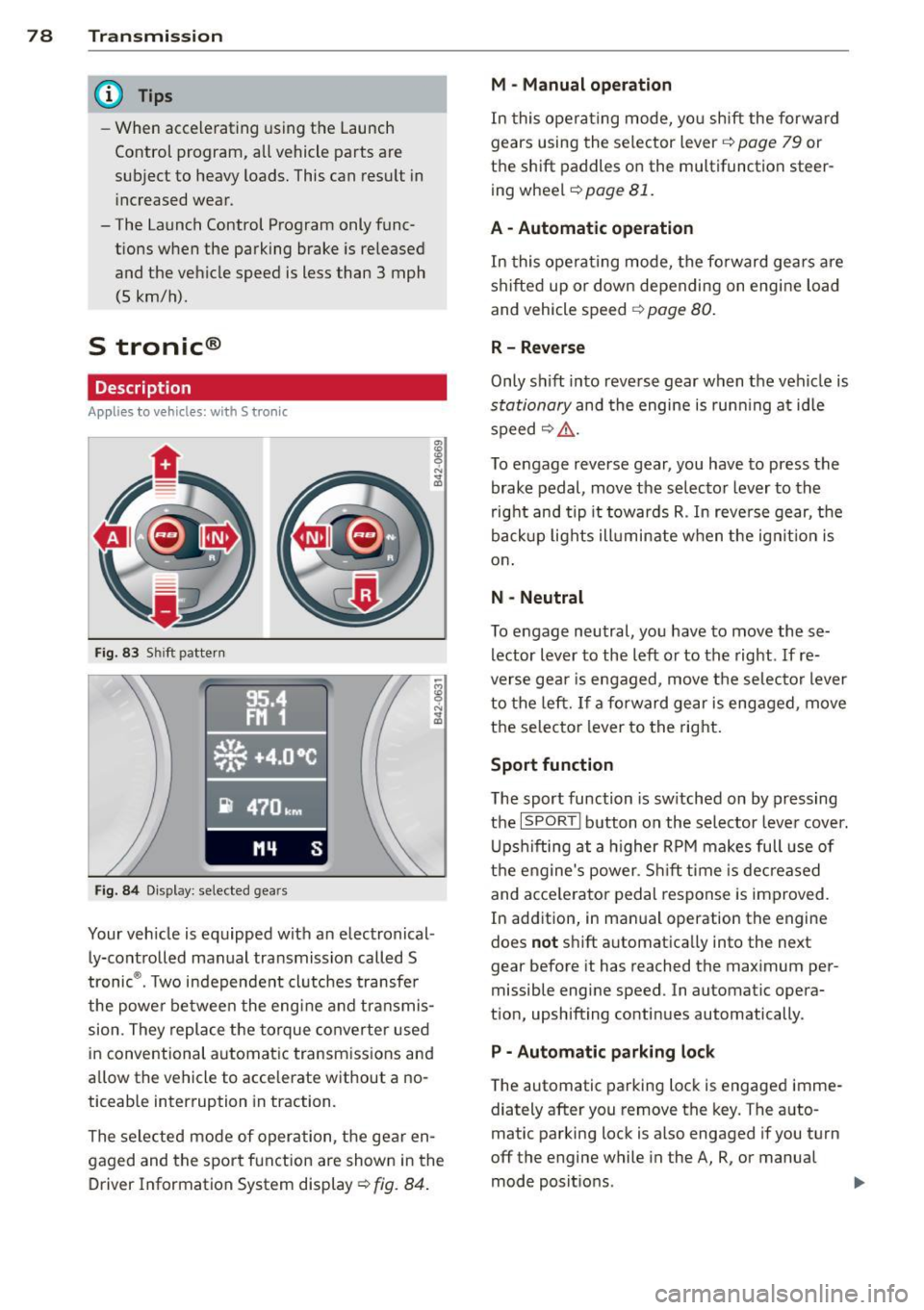
Fig. 83 Shift pattern
Fig. 84 Display: selected gears
Your vehicle is equipped with an electronical
ly-controlled manual transmission called S
tronic ®. Two independent clutches transfer
the powe r between the engine and transmis
sion. They replace the torque converter used
in conventional automatic transmissions and
allow the vehicle to accelerate without a no
ticeable interruption in traction.
The selected mode of operation, the gear en
gaged and the sport function are shown in the
Driver Information System display ¢
fig. 84.
M -Manual operation
In this operating mode, you shift the forward
gears using the selector lever ¢
page 79 or
the shift paddles on the multifunction steer
ing wheel¢
page 81.
A - Automatic operation
In this opera ting mode, the forward gears are
shifted up or down depending on engine load
and vehicle speed ¢
page 80.
R- Reverse
Only shift into reverse gear when the vehicle is
stationary and the engine is running at idle
speed~ ,&..
To engage reverse gear, you have to press the
brake pedal, move the selector lever to the
right and tip it towards R . In reverse gear, the
backup lights illuminate when the ignit ion is
on .
N -Neutral
To engage neutral, you have to move these
lector lever to the left or to the right.
If re
verse gear is engaged, move the selector lever
to the left.
If a forward gear is engaged, move
the selector lever to the right.
Sport function
The sport function is sw itched on by pressing
the
I SPOR T I button on the selector lever cover.
Upshifting at a higher RPM makes full use of
the engine's power. Shift time is decreased
and acce le rator pedal response is improved.
In addition, in manual operation the engine
does
not shift automatically into the next
gear before it has reached the maximum per
missible engine speed. In automatic opera
tion, upshifting continues automatically.
P - Automatic parking lock
The automatic parking lock is engaged imme
diately after you remove the key. The auto
matic parking lock is also engaged if you turn
off the engine while in the A, R, or manual
mode positions. .,..