brakes AUDI R8 SPYDER 2014 User Guide
[x] Cancel search | Manufacturer: AUDI, Model Year: 2014, Model line: R8 SPYDER, Model: AUDI R8 SPYDER 2014Pages: 244, PDF Size: 61.06 MB
Page 149 of 244
The effectiveness of the brakes can be reduced
when the vehicle is dr iven on a salt -covered
road and the brakes are not used. Likewise,
you clean
off accumulated salt coating from
brake discs and pads with a few ca utious ap
plications of the brake<=>,& .
Co rrosion
There may be a tendency for dirt to build up
on the brake pads and corrosion to form on
the discs if the car is not dr iven regularly or
only for short trips with little use of the
brakes.
If the brakes are not used frequently, or if cor rosion has formed on the discs, it is advisable
to clean
off the pads and discs by brak ing
firmly a few times from a moderately high
speed<=> ,&.
Fa ult s in th e bra ke s yste m
If you should notice a sudden increase in
brake pedal travel, then one of the two brake
circu its may have failed. Drive immed iately to
the nearest qualified workshop to have the
damage repa ired. Drive at reduced speed on
the way there and anticipate longer stopping
d istances and higher peda l pressure¢ _&.
Low brake fluid level
Malfunctions can occur in the brake system if
the brake flu id level is too low . The brake fluid
l eve l is monito red electronically .
Brake po wer ass ist un it
The brake power assist un it increases the
pressure that you generate with the brake
pedal. It works only when the eng ine is run
ning.
Br ake lining w ear statu s
Brake lining wear may be checked by visual in
spection of the condition of the brake pads
through the openings in the wheel. If neces
sary, the wheel may be removed for this in
spection
¢ page 214 .
Int ellig ent technolog y 147
_& WARNING
-You should perform braking maneuvers
for the purpose of cleaning the brake
system only if road conditions permit.
Other road use rs must not be put at risk -
you may ca use an accident!
- Before descend ing a steep grade, reduce
speed and sh ift transmission into a lower
gear o r lower dr iving range. Do not ride
the brakes or hold the pedal down too
long o r too often. Th is could cause the
brakes to get hot and diminish braking
efficiency .
- Do not " ride the brakes" by resting you r
foot on the pedal when you do not intend to brake. This may cause the brakes to
overheat, premature wear and increased
stopping distance.
- Under certain cl imatic and operat ing
conditions such as passing through wa
ter, dr iv ing in heavy rain o r after washing
the vehicle, the effectiveness of the brakes can be reduced. In winte r, ice can
accumu late on the bra ke pads, lin ings,
discs and drum s. Carefully app ly bra ke s
for a test. Brakes w ill dry and ice coa t
ings w ill be cleaned
off after a few care
fu l brake applications.
- Driving for an extended period of time on
salt -cove red roads without using your
brakes can a lso affect braking efficiency .
Clean
off accum ulated salt coating from
brake discs and pads with a few cautious
brake applications.
- I f you damage the front spoiler, or if you
install a different spoiler, be sure the air
f low to the front brakes is not obstruct
ed. Otherw ise the brake system could
overheat reducing the effectiveness of
the entire brake system.
- Failure of one b rake circuit will impai r
the braking capab ility result ing in an in
creased stopping distance. Avoid driving
the vehicle a nd have it towed to the near
est A udi dealer or qualified workshop .
- Never let the veh icle roll to a s top with
the engine shut
off. .,.
•
•
Page 155 of 244
Driving and
environment
Break-in period
A new vehicle must be broken in, and the
break-in period should be 1,500 miles (2,500
km) . Do not use full acceleration for the first
600 m iles (1,000 km) and do not exceed the
maximum engine speed of 6,000 rpm You
must also not use full accelerat ion between
600 and 1,200 mi les (1,000 to 2,000 km).
Fr om 1,200 to 1,500 miles (2,000 to 2,500
km), you can gradua lly increase maximum en
gine speed to 8,250 rpm for brief periods.
During the first hours of operation, there is
greater friction in the engine and the trans
mission than later when all the moving parts
have broken in.
The way you drive during the first 1,500 miles
(2,500 km) affects engine quality. If you drive
at moderate eng ine speeds thereafter, partic
ularly when the engine is cold, you reduce en
gine wear and increase the potential mileage
of the engine.
Do not drive at RPMs that are too
low. Shift
down when the engine is no longer running
"smoothly". Extreme ly high RPMs are gov
erned automatically.
Avoid damaging the
vehicle
When you are driving on poor roads, or over
curbs, steep ramps, etc., make certain that
low-lying parts such as spoilers and exhaus t
system parts do not bottom out and get dam
aged.
This is especially true for vehicles with low
slung chassis (sports chassis) and fully loaded
veh icles.
Driving and environment 153
Driving through water
on roads
Note the following to avoid vehicle damage
when driving through water, for example on
flooded roads:
- The water must not be any higher than the
bottom of the vehicle body.
- Do not drive faster than walking speed .
A WARNING
After driving through water, mud, slush,
etc ., the brakes may be slow to take effect
because of wet brake rotors and pads . Dry
the brakes first by braking carefully to re
store the full braking effect.
(D Note
Vehicle components such as the eng ine,
transmission, suspension or electrical sys
tem can be severe ly damaged by dr iv ing
th rough water.
(D Tips
- Check the depth of the water before d riv
ing through it.
- Do not stop the vehicle, drive in reverse
or switch the engine off when driving
through water.
- Keep in mind that oncoming vehicles
may create waves that ra ise the water
level and make it too deep for your vehi
cle to drive through safely.
- Avo id driving through salt water because
it can cause corrosion.
Catalytic converter
It is very important that your emission con
trol system (catalytic converter) is function
ing properly to ensure that your vehicle is run
ning in on environmentally sound manner .
.,. Always use lead-free gasoline ~ page 167,
Fuel supply .
.,. Never run the tank down all the way to emp-
~. ~
•
•
Page 156 of 244
154 Driving and en vironm ent
• Never put too much motor oil in your engine
¢ page 180, Adding engine oil
The cata lytic converter is an efficient "clean
up" device built into the exhaust system of
the vehicle. The catalytic converter burns
many of the pollutants in the exhaust gas be
fore they are released into the atmosphere.
The exclusive use of unleaded fue l is critically
important for the life of the cata lytic convert
er and proper functioning of the engine.
A WARNING
- Do not park or operate the veh icle in
areas where the hot exhaust system may
come in contact with dry grass, brush,
fuel sp ill or other material which can
cause a fi re.
- Do not apply additional undercoating or
rustproofing on or near the exhaust
man ifold, exhaust p ipes, catalytic con
verte r o r heat shie lds . D uring d riving, the
substance used for undercoating cou ld
overheat and cause a fire.
([) Note
- Be aware that just one tank f illing with
le aded fuel will already seriously de
grade the performance of the catalytic
converter.
- Do not exceed the correct engine oil leve l
¢page 180 .
-Do not drive until the fuel tank becomes
completely empty. The eng ine could mis
fire. Unburned f uel could a lso get into
the exhaust system and this could cause
the catalytic converter to overheat.
- Do not turn
off the ignition while the ve
hicle is moving .
- Do not continue to operate your vehicle
under these conditions, as otherwise fuel
can reach the catalytic converter. This
could result in overheat ing of the con
verter, requ iring its replacement.
- To assure efficient operation of the Emis sion Control System: -
Have your vehicle maintained properly
and in accordance with the service rec
ommendat ions in yo ur Warranty
&
Maintenance book let.
- Lack of proper maintenance as we ll as
improper use of the vehicle will impair
the function of the emission contro l
system and could lead to damage.
@ For the sake of the env ironment
Even when the Emission Control System is
operating proper ly, the exhaust gas can
have a sulfur-like exhaust gas smell under
some operat ing states . This depends on
the sulfur content of the fuel being used .
Using a different brand of fue l may help,
or fil ling the tank with lead-free super
grade gasoline.
Shutting down vehicle
If you would like your vehicle to remain inop
erative for a longer per iod of t ime, contact an
Audi or othe r specialized dealer. They can ad
vise you on necessary precautions e.g . corro
sion prevention, maintenance and storage.
Pay attention to additional informat ion con
cerning the battery. Refer to<=>
page 184.
Operation and
maintenance
Fuel economy, env ironmental impact, and
wear on your eng ine, brakes and tires largely
depend on three facto rs:
-your personal driving style
- operating conditions
- technical limitat ions
By having your veh icle regu larly se rviced by an
authorized Audi dea ler helps to ensure that it
runs properly and economica lly. The condition
of your vehicle not only affects its safety and ability to hold its va lue, it also affects
fu el
cons umpt ion.
The amount of oi l used is re lated to engine
l oad and speed.
Page 158 of 244
156 Cleaning and protection
Cleaning and protect ion
General information
Regular core preserves vehicle value .
Regular and correct care will contribute to
maintaining the beauty and value of your
Audi. Furthermore, good care may be a condi
tion for substant iat ing a warranty claim
should corrosion damage or pa int defects oc
cur.
Your authorized Audi R8 dealer has a variety
of
dedicated vehicle-care products. Please
make sure you apply them correctly .
.8, WARNING
-Cleaning agents may be poisonous. Keep
them out of the reach of children.
- Heed all caution labels.
- Always read directions on the container
before using any product . Follow the di
rect ions carefu lly.
- Most chemical cleaners are concentrated
and have to be diluted.
- Use spot removing fluids only in well
ventilated areas.
- Do not use gasoline, kerosene, d iesel
fuel, nail pol ish remover or other volatile
fluids. They may be toxic, flammable or
haza rdous in other ways. Do not wash,
wax or dry the vehicle with the ignit ion
on or the engine running.
- Do not clean the undersides of chassis,
fenders, wheel covers, etc. without pro
tecting your hands and arms. You may cut yourse lf on sharp-edged metal parts.
- Moisture and ice on brakes may impair
braking efficiency¢
page 146, General
information .
Test the brakes carefully
each time you wash the vehicle.
@ For the sake of the environment
Select only environmentally friend ly clean
ing products . Leftover cleaning products
should not disposed of in the household
waste.
Care of exterior
Washing your vehicle
T he longer i nsect remains, bird dropp ings,
tree res in , road and indust rial dust, tar, soot
part icles, road salt, and other aggressive de
posits remain on the vehicle surface, the more
lasting their destructive effect will be . High
temperatures, for example from intense sun
li ght, intens ify the corrosive effect.
After the end of winter road salting, the un
derside of the vehicle should be thoroughly
washed .
Automatic car washes
Before going through an automatic car wash,
yo u should take the usual precautions (closing
the windows). If your vehicle has special ac cessories -e.g . spoilers, radio antenna -it is
best to speak to the operator of the car wash
c:> (D .
Only use car washes where the vehicle re
mains stationary and the cleaning equipment
moves aro und the vehicle while washing and
drying . It is not possib le to use car washes
where the vehicle is moved forward on a con
veyer
c:> ,& .
It is preferab le to wash your vehicle in a
brush less carwash .
Washing with a power washer
When washing yo ur vehicle with a power
washer, be sure to follow the operating in
structions for the power washer . This applies
particularly to the
pressure and the spraying
distance.
Maintain sufficient distance from
soft materials such as rubber hoses, sound
deaden ing mater ial, and the parking aid sen
sors* that are located in the front or rear
bumper .
Do not use washers with
a rotating jet or a
nozzle spraying
a high pressure jet of water in
any case. ..,.
Page 159 of 244
Hand washing
When washing your veh icle by hand, fi rst soft
en the dirt with copious amounts of water and rinse it
off as b est you can.
Then clean the veh icle using a soft
s ponge , an
auto gl ove or a low -press ure wa sh bru sh .
Work from the top down -sta rting with the
roof . Use a
s h ampoo only for very stubborn
dirt.
Rinse the sponge or auto glove thorough ly at
fr equent intervals.
C lea n the wheels, doo r sill s and simi lar a reas
last . Use a separate sponge fo r th is.
_&. WARNING
- Car washes with conveyors can damage
the vehicle tires , which could cause the
ti re to lose pressure sudden ly while driv
ing and put you at risk for an accident.
Do not use car washes with conveyors.
- Switch
off the ignit ion when you wash
yo ur vehicle to avo id an accident.
- Protect yo ur hands and arms from sharp
metal edges when you clean the under
body, the ins ide of the whee l wells or the
wheel covers to avoid cutting yourself .
- When washing your vehicle in the winter:
Moist ure and ice in the brake system can
affect the brakes.
- Never wash tires with a jet that sprays
water in a direct stream . T hi s could cause
invisible damage to the tires and weaken
them, even if the spray is from a relative
ly long distance and for a short time.
Damaged and wea kened tires can fail
and cause a ccidents and pe rsonal inj ury.
0 Note
- Never dr ive your veh icle through any au
tomatic car wash that fails to p rov ide e i
the r suff icient clearance for your veh icle
or sufficient tra ck wid th fo r your tires .
Ris k of expensive damage to the veh icle's
u nderbody, tires, and rims!
- As descr ibed in you r Warra nty
& M ainte
nance booklet , damage or malf unct ion
Cleaning and protec tion 157
due to m isuse o f the vehicle or fai lure to
operate the vehicle in acco rdance with
the inst ruct ions of th is Owner's Manua l
wi ll not be covered under warranty.
- Fold the exte rior mirrors flat -there is a
r isk of damag ing the exterior m irrors .
Power folding exterior mirrors must not
be folded in or out by hand . Use the pow
er function!
- Do not wash the vehicle in d irect sun
light . You may damage the paint.
- Do not use sponges designed to remove
insects, rough k itchen sponges , or s imi
lar products . You risk damag ing the
pai nt s urface.
- Do not wash the vehicle using cleani ng
products that contain alcohol when the
e ng ine is ho t. This increases the risk of
damage to plast ic components, such as
c rack ing .
- You should remove deb ris (such as in
sects) from the headlight lenses on a
regu lar bas is, for example when re fuel
ing your vehicle. Never clean the head
lights with a dry cloth or sponge. Use a
wet cloth o r sponge . It is best to use
soapy water.
- Never clean t ires using a nozz le that
sprays water in a direct stream. Damage
can occur even with a relatively long
spraying distance and for a very short
t ime.
- To avoid damaging your veh icle, always
make sure that there is sufficient dis
tance between the spray head and soft
materials like rubbe r hoses, plast ic parts
and sound-deadening materials. Never
aim the spray head a t the same point for
a long time. This also app lies to cleani ng
head lights and pa inted b umpers . Re
member : the closer the nozz le is to the
surface of the material, the greater the
stress on the materia l.
@ For the sake of the environment
Wash yo ur vehicle on ly at spec ia lly de
signed facilities . They can prevent any dirty
water contaminated by oil from entering
Iii>-
•
•
Page 163 of 244
You should also clean the inside of the win
dow g lass at regular intervals.
The cloth or chamois used on paint s urfaces
contains wax res idue. Use a separate clo th or
chamo is to dry the window glass.
Cl eaning the rear window
Aud i recommends cleaning the window us ing
a soft cotto n cloth and water mixed with
cleaning solution or window cleaner
(1: 1 mix
ture) . To avoid streaks, do not wipe the win
dow dry with paper towels.
D o not use any clean ing so lutions that conta in
ammonia, acids , silicone or fluo ride or clean
e rs that are abrasive or cou ld cause scratches .
Do not use any alkaline cleaning solutions.
A WARNING
- The windshie ld must not be treated with
water-repellent materials. They can in
crease glare under poor visib ility condi
t ions such as wetness, darkness, or when
the sun is low on the horizon. In addi
t ion, they can cause the windshield wip
ers to chatter.
- Always read and heed all WARNINGS and
other information
r:::> page 156.
(D Note
-Never use warm or hot water to remove
snow and ice from windows and mirrors.
This could cause the glass to c rack.
- To prevent damage to the wires of the
rear defogger, do not place any adhesive
stickers on the inside of the rear window
ove r the wires.
- To he lp prevent di rt from scratching the
window, always scrape in a forward d i
r ection - pus hing the scraper away from
you - never back and fo rth.
Wheels
Regular care is required to preserve the deco
rative appearance of the wheels . Road sa lt
and b rake dust must be washed off regu larly
or the wheels wi ll be damaged.
Cleaning and protec tion 16 1
Use only specia l acid -free cleaning agents. You
can find proper wheel cleaner at authorized
Audi dealers and specia lty stores . Do not leave
the cleaner on the whee ls longer than speci
fied. Wheel cleaners containing acid can dam
age the surface of the w heel bo lts .
Pa int polish or other abrasive materials must
not be used when caring for wheels. If the
protective coat ing has been damaged, from
stones for example, touch up the damage as
soon as possible .
A WARNING
-Moisture and ice on brakes may affect
brak ing eff ic iency -
c:::> page 146, General
information.
T est the bra kes ca re fully af
ter each vehicle wash .
- Always read and heed a ll WAR NINGS and
the information¢
page 156.
Exhaust tail pipes
-
Road salt and other corrosive materials wi ll
damage the material in the exhaust tail pipes
if they are not cleaned regularly . Do not clea n
the tail pipes with wheel cleaner, pa int polish,
chrome polish or other abras ive cleaners.
Clean the tail pipes with car care products
that are suitable for stainless steel.
Your authorized Audi dea ler can provide clean
ing products that have been tested and ap
proved for your vehicle.
Care of interior
Radio-/Navigation* display
T he disp lay may be cleaned with a soft cloth
and commercially-avai lab le "LCD cleaner".
The cloth should be coated lightly with the
cleaning so lution when cleaning the disp lay.
Q) Note
To prevent scratches, only clean the dis
play when it is dry .
•
•
Page 186 of 244
184 Checking and filling
Therefore, the brake fluid must be changed
ev ery two yea rs. A lways use new brake fluid
which conforms to Federal Motor Vehicle Standard "FMVSS 116 DOT 4".
Brake fl uid is rep laced according to the Audi
maintenance service schedule . Your author
ized Audi dealer is equipped with the necessa
ry special tools and rep lacement parts, has
the necessary expertise, and can d ispose of
the used fluid .
A WARNING
-Brake fluid is po isonous . It must be stor
ed only in the closed orig inal container
out of the reac h of children!
- Brake fa ilure can result from old o r inap
propriate b rake fluid. Observe these pre
c aut ions:
- Use on ly brake fluid that meets SAE
specif icat ion
J 1703 and conforms to
Federal Motor Vehicle Standard 116 .
Always check with your authorized Audi
dealer to make su re you are using the
correct brake flu id. The correct type of
b rake fluid is a lso indicated on the
b rake fluid reservoir.
- The brake fluid must be new. Heavy use
of the brakes can cause a vapor loc k if
t he brake fl uid is left in the system too
long. This can ser ious ly affect the effi
ciency of the brakes as well as yo ur
safety . This could result in an accident.
CJ) Note
Br ake fl uid will damage the paint of your
veh icle.
@.l For the sake of the environment
Because of the problem of prope r d isposa l
of brake fl uid as we ll as the speci al tools
req uired and the necessary expert ise, we
recommend that you have the brake fluid
changed by your authorized Audi dealer .
Battery
General information
Your vehicle is equipped with a specia l bat
te ry, an
ACM battery. This ba tte ry is located
i n the luggage compartmen t an d must be re
placed with an origina l equipment battery .
U nder normal operating conditions, the bat
tery is
maintenance -free.
Have the batte ry checked when yo u take your
vehicle in for service. You are well advised to
replace a battery that is o lde r than 5 years.
Disconnecting the battery te rminals
Some vehicle fu nctions (power window reg u
lators, for ex ample) are lost if the batte ry te r
mina ls are disconnected. These f unctions have
to be relearned after the battery termina ls are
connected again. To prevent this, the battery
sho uld only be disconnected from the veh icle
electrical system when abso lutely necessary
for repairs.
Vehicles not driven for long periods
If you do not drive your vehicle over a period
of seve ral days or weeks , e lectrica l compo
nents are gradually cut back or switched off.
This reduces energy consumption and ma in
ta ins start ing capability over a longer period
r:> page 150. Some of the convenience func
t ions may not operate, such as the inter ior
li ghts or powe r seat ad justment. The conven
ience funct io ns w ill be available again when
you sw itch on the ign it io n and s tart the en
gine.
Winter operation
D uring the winte r months, battery capac ity
tends to dec rease as temperatures drop. This
is because mo re power is a lso co nsumed wh ile
sta rting, and the headlig hts, rear win dow de
f ogger, e tc., are used more often .
Avoid unnecessa ry powe r consumpt ion, pa r
t icu lar ly i n city traffic o r when traveling only
sho rt dist ances. Let yo ur au thori zed Au di
dealer check the capacity of the vehicle bat -
tery before winter sets in
r:> page 187. A well ll>
Page 192 of 244
190 Tire s and wheel s
-Never mount used tires on yo ur vehicle if
yo u are not sure of their "previous histo
ry." Old used tires may have been dam
aged even though the damage cannot be
seen that can lead to sudden t ire failure
and loss of vehicle control.
- If you notice unusual vibration or if the
vehicle pulls to one side when driving, al
ways stop as soon as it is safe to do so
and check the wheels and tires for dam
age.
(D Note
Please note that summer and winter tires
are designed for the cond itions that are
Glossary of tire and loading terminology
Accessory weight
means the comb ined we ight (in excess of
those standard items which may be rep laced)
of au toma tic tra nsmission, power steer ing,
power brakes, power windows, power seats,
radio, and heater, to the extent that these
items are availab le as factory -installed equip
ment (whether installed or not) .
Aspect ratio
means the ratio of the he ight to the w idth of
the tire in percent . Numbers of 55 or lower in
dicate a low sidewall for improved steering re
sponse and better overall handling on dry pavement .
Bead
means the part of the ti re that is made of
steel wires, wrapped or reinforced by ply cords
and that is shaped to fit the rim.
Bead s eparation
means a b reakdown of the bond between
components in the bead.
Cord
means the strands forming the plies in the
tire . typ
ica l in those seasons . Audi recommends
using winter tires during the winter
months . Low temperatures signif icant ly
decrease the e lasticity of summer tires,
which affects tract ion and brak ing ability.
If summer tires are used in very co ld tem
peratures, cracks ca n form on the tread
bars, res ulting in permanent tire damage
that can cause loud driving no ise and un
balan ced t ires. Audi is not responsible for
th is type of damage .
Cold tire inflation pre ssure
means the t ire p ressure recommended by the
vehicle manufacturer fo r a tire of a des ignated
s ize that has not bee n driven for more than a
coup le of miles (k ilometers) at low speeds in
the three hour period before the tire pressure
is measured or adjusted.
Curb weight
means the we ight of a motor ve hicle w ith
standard equipment including the max imum
capacity of fuel, oil, and coolant, air condi
tioning and additional weight of optiona l
equipment.
E x tra load tire
means a t ire designed to ope rate a t higher
loads and at highe r inflation p ressu res than
the corresponding standard tire. Extra load
tires my be identified as "XL", "xl", "EXTRA
LOAD", or "RF" on the sidewall.
Gross A xle Weight Rating ("GAWR ")
means the load -carry ing capacity of a s ingle
axle system , measured at the tire-ground in
terfaces.
Gr oss Vehicle Weight Rating ("GVWR ")
means the maximum total loaded we ight of
t h e vehi cle. .,.
Page 193 of 244
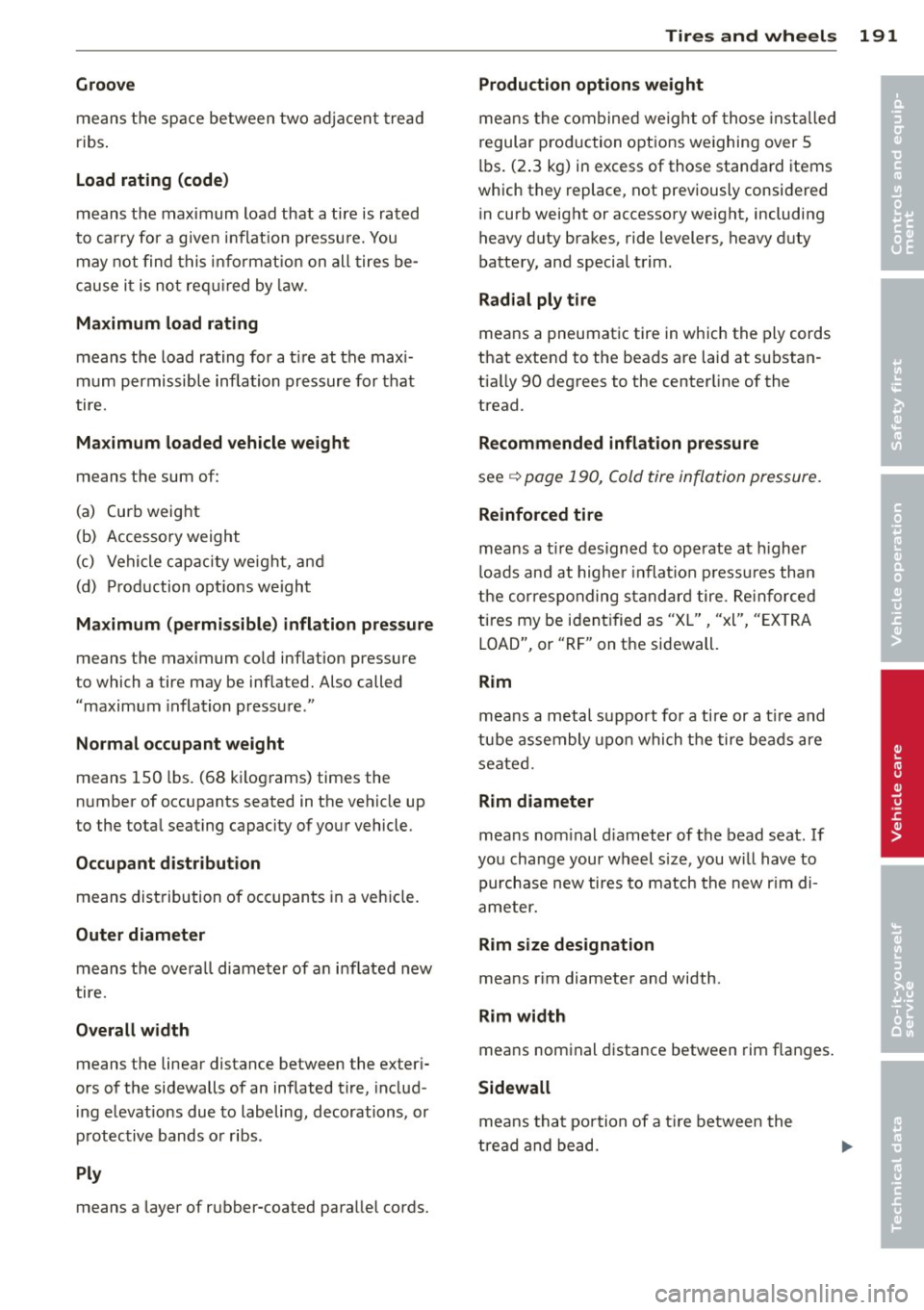
Groove
means the space between two adjacent tread
ribs.
Load rating (code)
means the maximum load that a tire is rated
to carry for a g iven inflation pressure. You
may not find this information on all tires be
cause it is no t req uired by law.
Maximum load rating
means the load rating for a t ire at the max i
mum permissible inflation pressure for that
tire.
Maximum loaded vehicle weight
means the sum of:
(a) Curb weight
(b) Accessory weight
(c) Vehicle capacity weight, and
(d) Production options weight
Maximum (permissible) inflation pressure
means the maximum cold inflation pressure
to which a tire may be inflated. Also called "maximum inflation pressure."
Normal occupant weight
means 150 lbs. (68 kilograms) times the
number of occupants seated in the vehicle up
to the total seating capacity of your vehicle.
Occupant distribution
means distribution of occupants in a vehicle.
Outer diameter
means the overa ll diamete r of an inflated new
tire.
Overall width
means the linear distance between the exteri
ors of the sidewalls of an inflated tire, includ
in g elevations due to labeling, decorations, or
protective bands or ribs.
Ply
means a layer of rubber-coated parallel cords.
Tires and wheels 191
Production options weight
means the combined weight of those installed
regular production options we ighing over 5
lbs. (2.3 kg) in excess of those standard items
which they replace, not previously considered
in curb weight or accessory weight, including
heavy duty brakes, ride levelers, heavy duty
battery, and special trim.
Radial ply tire
means a pneumatic tire in wh ich the ply cords
that extend to the beads are laid at substan
tia lly 90 degrees to the center line of the
tread .
Recommended inflation pressure
see ¢ page 190, Cold tire inflation pressure.
Reinforced tire
means a t ire designed to operate at higher
loads and at higher inflat ion pressures than
the corresponding standard tire. Reinforced
tires my be identified as "XL", "xl", "E XTRA
LOAD", or "RF" on the sidewall.
Rim
means a metal support for a tire or a tire and
tube assembly upon which the tire beads are
seated.
Rim diameter
means nom inal d iameter of the bead seat. If
you change your wheel s ize, you will have to
purchase new tires to match the new rim di
ameter.
Rim size designation
means r im diameter and width .
Rim width
means nominal distance between rim flanges .
Sidewall
means that portion of a tire between the
tread and bead. •
•
Page 196 of 244
194 Tire s and wheel s
that are stored . The system does not recog
nize the load cond ition of your vehicle.
See the il lustration ~
fig. 149 for the location
of the label on dr iver's side 8-pillar (color of
the actua l labe l and exact location on the ve
hicle wi LL vary slightly).
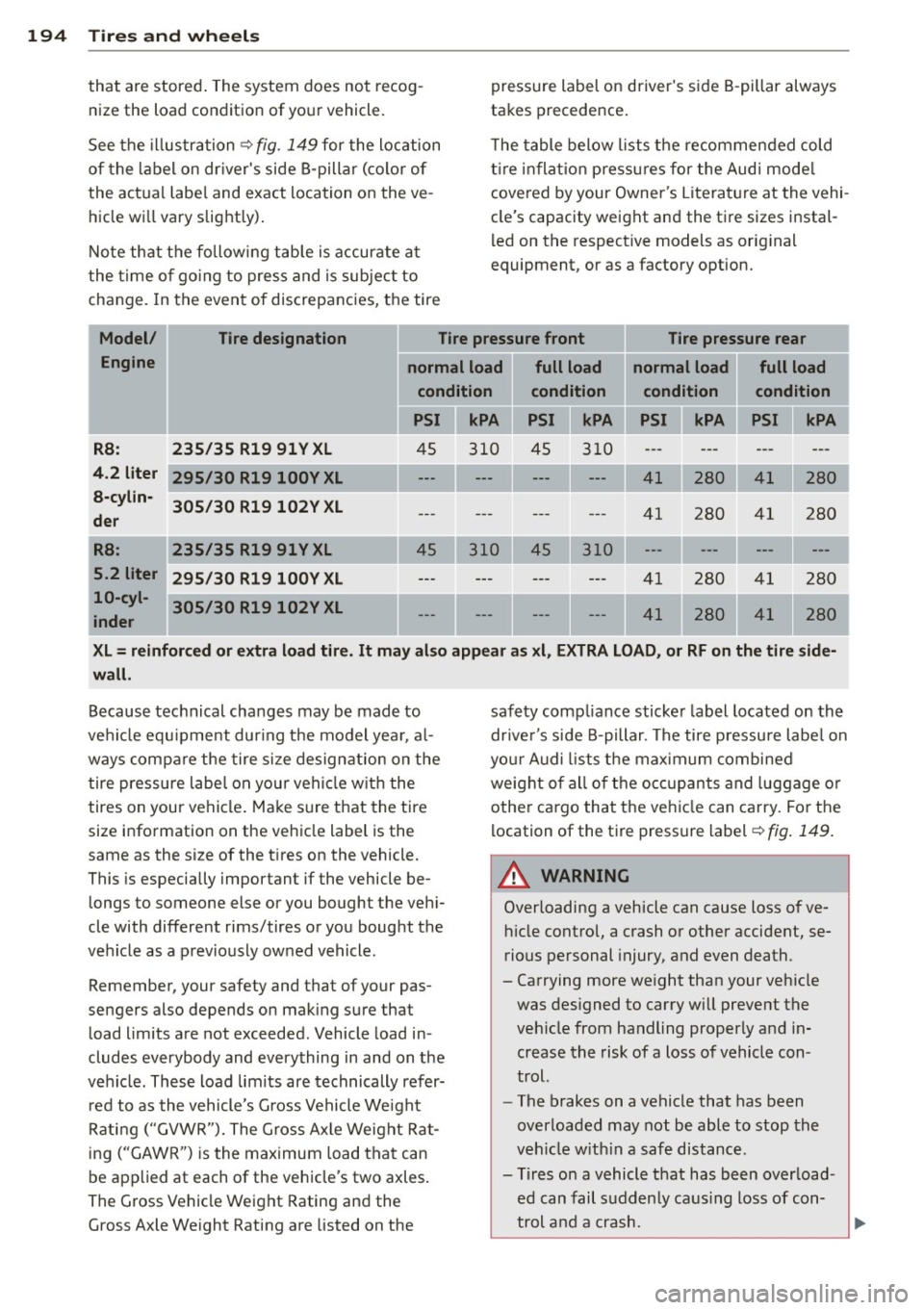
Note that the followi ng tab le is accurate at
the time o f go ing to press and is subject to
change. In the event of discrepancies, the tire pressure label on driver's s
ide 8 -pillar always
takes precedence .
T he table below l ists t he recommended cold
t ire inflat ion pressu res for the Aud i mode l
covered by your Owner's Literat ure at the vehi
cle's capacity weight and the tir e sizes i nstal
l ed on the respective models as orig inal
equipment, or as a facto ry option.
I Model / \I Tire designation
Tire pressure front Tire pressure rear I
Engine
normal load full load normal load full load
condition condition condition condition
PSI II kPA PSI II kPA PSI ]I kPA
PSI II kPA
RS: 235/35 R19 91 Y XL 45
310 45 310
4 .2 liter
295 /30 R19 lOOY X L 280
8-c ylin-
305/30 R1 9 102V
XL
der 41
280 41
280
RS: 235/35 R19 91 Y XL 45
5.2 liter 295 /30 R19 l00Y XL 41 280 41
280
10-cyl-
305 /30 R19 102V XL
inder 41 280 41 280
--XL= reinforc ed or extra load tire. It may also a ppear as xl , EXTRA LOAD, or RF on the tire side·
wall.
Because tec hnical changes may be made to
ve hicle equ ipment dur ing the model yea r, a l
ways compare the tire size designation on the
tire pressure labe l on your vehicle w ith the
tires on your vehicle . Make s ure that the t ire
size information on the ve hicle label is the
same as the size of the tires on the vehicle.
This is especially important if the vehicle be
longs to someone else or you bough t the veh i
cle with different rims/tires or you bought the
ve hicle as a previously owned vehicle .
Remember, your safety and that of your pas
sengers also depends on mak ing sure that
load limits are not exceeded . Vehicle load in
cludes everybody and everything in and on the
vehicle. These load lim its are technically refer
r ed to as the vehicle 's Gross Vehicle We ight
Rating ("GVWR"). The G ross Ax le Weight Rat
ing ("GAWR") is the maximum load that can
be applied at each of the vehicle's two axles .
The Gross Vehicle Weight Rating and the
G ross Axle Weight Rating are listed on the safety compl
iance sticker label located on the
driver's side 8-pillar. The tire p ressure labe l on
yo ur Audi lists the max im um combined
weight of all o f the occ upants and luggage or
othe r ca rgo that the vehicle can carry. Fo r the
location of the tire pressure label
~ fig . 149.
A WARNING
Overloading a vehicle can cause loss of ve
h icle contro l, a crash or other accident, se
rious personal injury, and even death.
- Carrying more we ight than your veh icle
was designed to carry will prevent the
veh icle from handling properly a nd i n
crease the risk of a loss of vehicle con
trol.
- The brakes on a vehicle that has been
overloaded may not be able to stop the
veh icle w ith in a safe distance.
- Tires on a vehicle that has been overload
ed can fail suddenly ca using loss of con
trol and a crash.