instrument panel AUDI R8 SPYDER 2014 User Guide
[x] Cancel search | Manufacturer: AUDI, Model Year: 2014, Model line: R8 SPYDER, Model: AUDI R8 SPYDER 2014Pages: 244, PDF Size: 61.06 MB
Page 120 of 244

118 Airbag system
components is detected. The function of the
airbag indicator light is described in greater
detail below. Because the front passenger
seat contains important parts of the Ad
vanced Airbag System, you must take care to prevent it from being damaged . Damage to
the seat may prevent the Advanced Airbag for
the front passenger seat from doing its job in
a crash .
The front Advanced Airbag System
consists of the following:
-Crash sensors in the front of the vehicle that
measure vehicle acceleration/deceleration
to provide information to the Advanced Air bag System about the severity of the crash.
- An electronic control unit, with integrated
crash sensors for front and side impacts .
The control unit "decides " whether to fire
the front airbags based on the information received from the crash sensors. The control
unit also "decides" whether the safety belt
pre tensioners should be activated.
- An Advanced Ai rbag with gas generator for
the driver inside the steering wheel hub.
- An Advanced Airbag with gas generator in
side the inst rument panel for the front pas
senger.
- A weight-sensing mat under the upholstery
padding of the front passenger seat cushion
that measures the total weight on the seat.
The information registered is sent continu
ously to the electronic control unit to regu
late deployment of the front Advanced Air
bag on the passenger side.
- An airbag monitoring system and indicator
light in the instrument cluster
¢page 121.
- The PASSENGER AIR BAG OFF light comes
on and stays on in the center of the instru
ment panel ¢
page 122, fig. 120 and tells
you when the front Advanced Airbag on the passenger side has been turned off.
- A sensor below the safety belt latch for the
front seat passenger to measure the tension
on the safety belt. The tension on the safety
belt and the weight registered by the
weight-sensing mat help the control unit "decide" whether the front airbag for the front passenger seat should be turned off or
not
¢ page 112, Child restraints on the
front seat -some important things to
know.
- A sensor in the safety belt latch for the driv
er and for the front seat passenger that
senses whether that safety belt is latched or not and transmits this informa tion to the
electronic control unit .
.&_ WARNING
Damage to the front passenger seat can
prevent the front airbag from working
properly.
- Improper repair or disassembly of the
front passenger and driver seat will pre
vent the Advanced Airbag System from
functioning properly.
- Repairs to the front passenger seat must
be performed by qualified and properly
trained workshop personnel.
- Never remove the front passenger or
driver seat from the vehicle.
-Never remove the upholstery from the
front passenger seat.
- Never disassemble or remove parts from
the seat or disconnect wires from it.
- Never carry sharp objects in your pockets
or place them on the seat. If the weight
sensing mat in the passenger seat is
punctured it cannot work properly.
- Never carry things on your lap or carry
objects on the passenger seat. Such
items can increase the weight registered
by the weight-sensing mat and send the
wrong information to the airbag control
unit.
- Never store items under the front pas
senger seat. Parts of the Advanced Air
bag System under the passenger seat
could be damaged, preventing them and
the airbag system from working proper ly.
- Never place seat covers or replacement
upholstery that have not been specifical ly approved by Audi on the front seats .
- Seat covers can prevent the Advanced
-
Airbag System from recognizing child .,..
Page 123 of 244

-The inflating airba g will hit the child
safety seat or infant carrier wit h great
f o rce and w ill smash t he ch ild safety seat
and child aga inst the backrest, cente r
arm rest, d oor or roof.
- Never install a r earward facing child
sa fety seat on the front pass eng er s eat
unless the
PASSENGER AIR BAG OFF
light c omes on and stays on. If the PAS
S ENGER AIR BAG OFF
ligh t does no t
c o m e on and stay on, the inflating airbag
will hit the child safety seat or infant car
rier with great force and will smash the
child safety seat and child against the
backrest, door or roof. Have the airbag
system inspected immediately by your
authorized Audi dealer .
A WARNING
Objects between you and the a irbag will
increase the risk of injury in a crash by in
terfering with the way the airbag unfolds
or by being pushed into you as the a irbag
inflates.
- Never hold th ings in your hands or on
your lap when the vehicle is in use .
- Never transport items on or in the area
of the front passenge r seat. Objects
cou ld move into the area of the front air
bags dur ing braking or other s udden ma
neuver and become dangerous projec
ti les that can cause serious personal in
jury if the airbags inflate.
- Never place o r attach accessories or oth
er objects (such as cup ho lders, tele
phone brackets, large, heavy or b ulky ob
jects) on the doors, over or near the area
marked "AIRBAG" on the steering wheel,
instrument panel, seat backrests or be
tween those a reas and yourself. These
objects could cause injury in a crash, es
pecially when the airbags inflate.
- Never recline the front passenger's seat
to transport objects. Items can also
move in to the area of the side airbag or
the front airbag dur ing braking or in a
sudden maneuver . Objects near the air -
-
Airbag system 12 1
bags can become projectiles and cause
inju ry, partic ularly when the seat is re
clined.
A WARNING
The fine dust created when airbags deploy
can cause breathing prob lems for people
with a history of asthma or other breath
ing cond itions.
- To reduce the risk of breath ing problems,
those with asthma o r other respiratory
conditions shou ld get fresh air r ight
away by getting o ut of the veh icle or
open ing windows or doors.
- If you are in a collision in which airbags
deploy, was h your hands and fa ce with
mild soap and wate r before ea ting.
- Be ca reful not to get the dust into your
eyes, o r into any cuts or sc ratches .
- If the resid ue should get into your eyes,
f lush them w ith wate r.
Monitoring the
Advanced Airbag System
t!~ Airbag monitoring indicator light
Two separate indicators monitor the function
of the Advan ced Airbag System: the airbag
monitoring indi cator light and the
PASSEN
GER AIR BAG OFF
light.
T he Advanced A irbag System (including the
electron ic co ntro l unit, sensor circu its and sys
tem wir ing) is monitored con tinuously to
make sure that it is functioning properly
whenever the ignition is on. Each time you
turn on the ignition, the a irbag mon itoring in
dicator light
I will come on for a few seconds
(self diagnostics).
The sy stem mu st be in spected when th e
indicator light
I :
- does not come on when the ignition is
sw itched on,
- does not go out a few seconds after you
have switched on t he ignition, or
•
•
Page 125 of 244

described in the child restraint manufactur
er 's instructions;
- make sure that the convertible locking fea
ture on the safety be lt for the front passen
ger seat has been activated and that the
safety belt has been pulled tight. The belt
must not be loose or have loops of slack so
that the sensor below the safety belt latch
on the seat can do its job<=>
page 140 .
-make sure that th ings that may increase the
weight of the child and child safety seat are
not being transported on the front passen
ger seat;
- make sure that the safety belt tension sen
sor is not blocked . Shake the safety belt
latch on the front passenge r seat back and
forth;
- If a st rap or tether is being used to tie the
ch ild safety seat to the front passenger
seat, make sure t hat it is not so tigh t that it
ca uses the we ight-sensing mat to meas ure
more weight than is actua lly on the seat .
If the PASSENGER AIR BAG OFF light still
does not com e on and does not stay on con
tinuously (when the igni tion is sw itched on),
- take the ch ild restraint off the front passen·
ger seat and install it p roperly at one of the
rear seat pos itions. Have the a irbag system
i nspec ted by your A udi dealer immediately.
- move the ch ild to a rea r seat posit io n and
make su re th at the chi ld is proper ly res train
ed in a chi ld restraint that is appropriate fo r
its size and age .
The
PASSENGER AIR BAG OFF light shou ld
NO T come on when the ign ition is on and an
ad ult is sitting in a p rope r seat ing pos ition on
the front passenger seat. If the
PASSENGER
AIR BAG OFF
li ght comes on and stays on or
flashes for about 5 seconds while driving, un
der these circumstances, make sure that:
- the ad ult on the front passenger seat is
proper ly seated on the center of the seat
cushion with his or her back up against the
backrest and the backrest is not reclined
<=> page 94, Proper occupant seating posi
tions,
A irbag system 123
- the adult is not tak ing weight off the seat by
holding on to the passenger assist handle
above the front passenger door,
- the safety be lt is being properly worn and
that there is not a lot of s lack in the safety
be lt webbing,
- accesso ry seat covers or cushions or other
things that may cause an incorrect reading
or impression on the weight-sensing mat
under the upho lstery of the seat have been
removed from the front passenger seat,
- a safety belt extender has not been left in
the safety belt latch for the front passenger
seat .
In add ition to the
PASSENGER AIR BAG O FF
light in the center of the instrument panel,
the message
PASSENGER AIR BAG O FF or
PASSENGER AIR BAG ON w ill briefly appear
in the instrument cluster display. This is to in
form the dr iver of the current front passenge r
a irbag status.
Important safety instructions on
monitoring the Advanced Airbag System
A WARNING
An airbag system that is not functioning
p roperly cannot provide supplemental pro
tection in a frontal c rash.
- If the airbag ind icator light comes on, it
means that there may b e something
wrong with the Advan ced Airbag Sys tem.
It is poss ible that the air bag w ill inflate
when it is not supposed to, or will not in
f late when it sho uld .
- Have the airbag system inspe cted imme
diate ly by your Audi dealer.
A WARNING
If the front airbag inflates, a child without
a child restraint, in a rea rward-facing child
safety seat or in a forward-facing child re
straint that has not been proper ly installed
will be ser ious ly injured and can be killed.
- Even tho ugh your vehicle is equipped
with an Advanced A irbag System, make
certain that all children, espec ially 12
-
•
•
Page 128 of 244
126 Airbag system
with the safety belt buckles so that the sen
sors can send the correct information about
safety belt use to the electron ic control unit.
.&_ WARNING
Changing the vehicle 's s uspension includ
ing use of unapproved tire-rim combina
tions can change Advanced Airbag per
formance and increase the risk of serious personal inj ury in a c rash .
- Never install suspens ion components
that do not have the same performance
character istics as the components origi
nally insta lled on yo ur vehicle.
- Never use ti re-rim comb inat io ns that
have not been approved by A udi.
.&_ WARNING
-
Items stored between the safety belt
buckle and the center console can cause
the senso rs in the buckle to send the
wrong information to the electronic con
trol mod ule a nd prevent the Advanced A ir
bag System from work ing properly .
- Always make sure that nothing can inter-
fere with the safety belt buck les and that
they are not obstructed.
Knee airbags
Description of knee airbags
T he knee airbag system can provide supple
mental protection to properly restrained
front seat occupants .
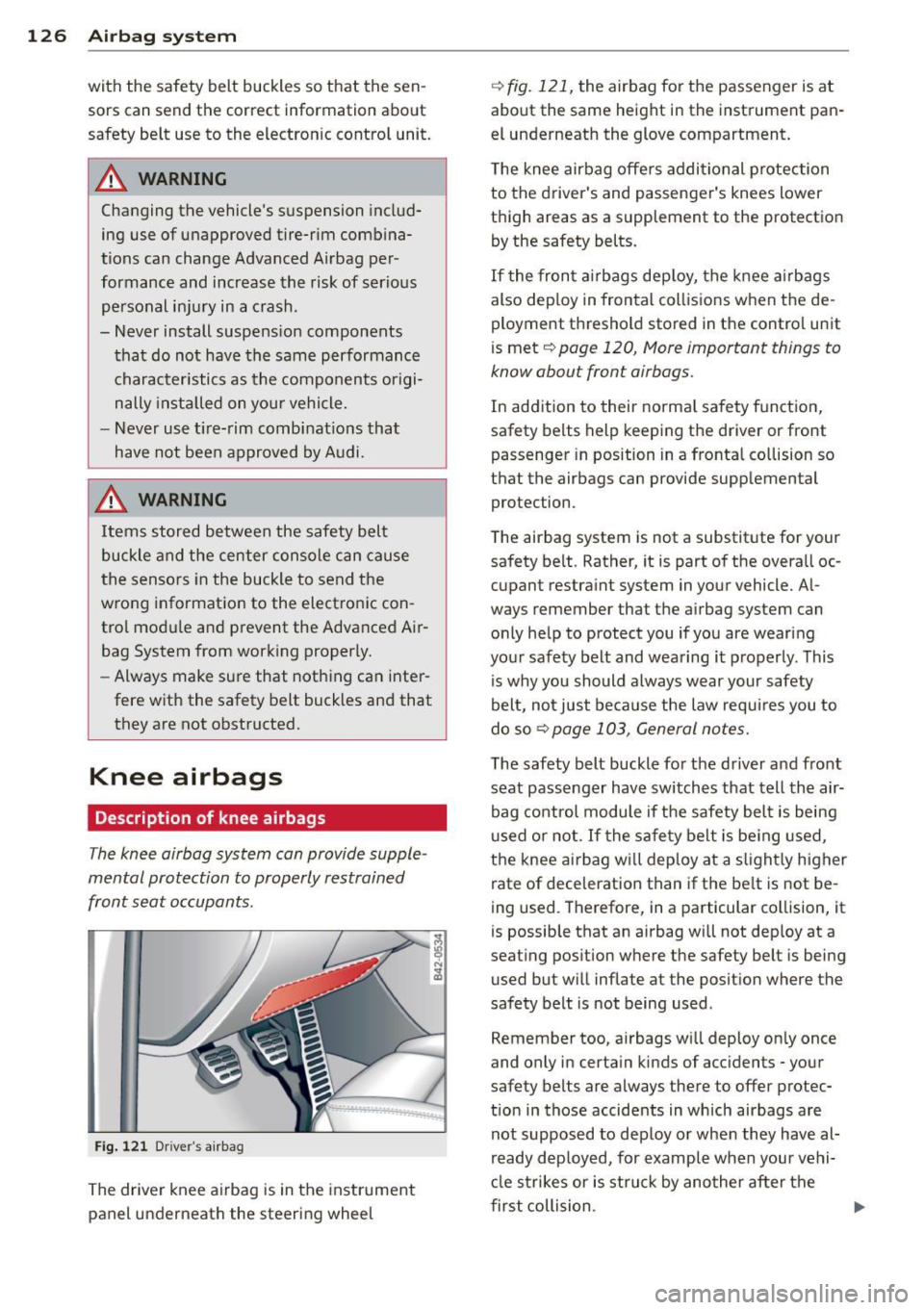
Fig. 121 Driv er 's airbag
The drive r knee airbag is in the instrument
panel underneath the steering whee l
~ fig. 121, the airbag for the passenger is at
about the same height in the instrument pan
el underneath the glove compartment .
T he knee air bag offe rs addi tional p rotec tion
to the driver 's and passenger's knees lower
t h igh areas as a supplement to the protection
by the safety belts .
If the fron t airbags dep loy, the knee a irbags
also dep loy in frontal collisions w hen the de
ployment threshold stored in the control unit
is met ~
page 120, More important things to
know about front airbags .
In addition to their normal sa fety function,
safety belts help keeping the driver or front
passenger in position in a fronta l co llision so
that the airbags can provide supp lemental
protection .
T he airbag system is not a substitute for your
safety belt . Rather, it is part o f the overa ll oc
cupant restra int system in your vehicle. A l
ways remember tha t the a irbag system can
o nly he lp to protect you if you are wearing
you r safety belt and wea ring it properly . This
is why you should a lways wear your safety
belt, not jus t be cause the law requ ires you to
do so~
page 103 , General notes.
The safety belt buckle fo r th e driver and front
seat passenger have switch es that tell the air
bag control module if the safety bel t is being
u sed or not .
If the sa fe ty belt is be ing used ,
t h e knee a irbag w ill deploy at a s light ly h igher
rate of dece leration than if the be lt is not be
ing used . Therefore, in a particular co llision, it
is possib le that an airbag will not dep loy at a
seating pos ition where the safety belt is being
used but will inflate at the posit ion where the
safety belt is not being used .
Remember too, airbags w ill deploy on ly once
and only in certa in kinds of acc idents - your
safety belts are always there to offer protec
t io n in those accidents in which airbags are
not supposed to deploy o r whe n they have al
ready dep loyed, for example when your vehi
cl e s trikes or is st ru ck by ano ther after the
first collision . ..,.
Page 129 of 244
This is just one o f the reasons why an a irbag is
not a substitute for the safety belt . The airbag
system works most effective ly when used wit h
the safety belts. Theref ore, always wear your
safety belts correctly .
It is important to remember that while t he
supp lemental knee a irbag system is des igned
to reduce the like lihood of serious injur ies,
other injuries, for example, swel ling, bruising,
minor abrasions and friction burns can also
occur when a n airbag inflates .
The knee airb ag sy stem ba sically con sist s
of:
-The electronic contro l modu le
- Two inflatable airbags (airbag and gas gen-
erator), one for the driver and one for the
front passenger
- The airbag indicator light in the instrument
panel
The knee airbag system will not d eploy :
-when the ignition is turned off
- in frontal col lisions when the dece lerat ion
measured by the contro l unit is too low
- in s ide coll isions
- in rear-end colli sions
- in ro llovers
- in the event of a system malfunct ion (warn-
ing/ indicator light is on)
~ page 14.
A WARNING
- Saf ety belts and the a irbag system can
o nly p rov ide protection whe n occu pants
are in t he p roper sea ting posit io n
~page 12 0.
- If the air bag indica to r ligh t comes on
when the veh icle is be ing used, have the
system inspected immediately by your
authorized Audi dealer.
-
A irba g sy stem 12 7
How knee airbags work
The risk of injury to the leg area can be re
duced by fully deployed knee airbags.
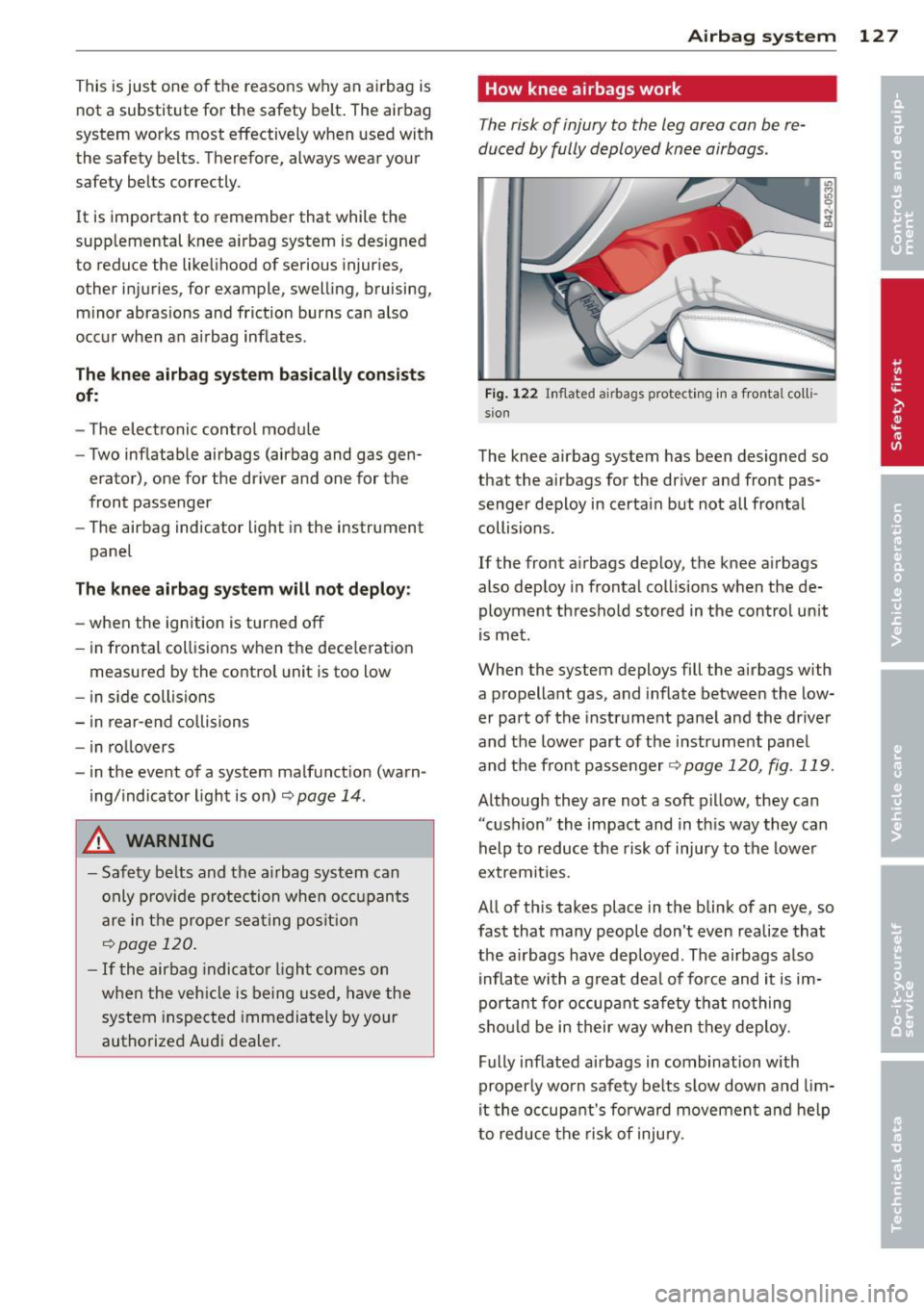
F ig. 1 22 In flated a irbags protect ing in a frontal colli
s io n
The knee airbag system has been designed so
that the airbags for the driver and fro nt pas
senger deploy in certain but not all frontal
collisions .
If the front a irbags dep loy, the knee a irbags
also deploy in frontal col lisions when the de
ployment threshold sto red in the control unit
is met.
When the system deploys fill the airbags with
a p ropellant gas, and inflate between the low
er part of the instrume nt pane l and the dr iver
and the lower part of the instr ument pane l
and the front passe nger
~ page 120, fig. 119.
Although they are not a soft pillow, they can
"cushion" the impact and in th is way they can
help to reduce the risk of injury to the lower
extremit ies.
All of th is takes place in the bli nk of an eye, so
fast that many people don't even realize that
the a irbags have deployed. The airbags a lso
inflate wi th a g reat dea l of fo rce and it is im
po rtant for occup ant safety t hat no thing
sho uld be in their way whe n they deploy.
Fully inflated ai rbags in combination with
properly worn safety be lts s low dow n and lim
it the occup ant's forward movemen t and help
to reduce the risk of inju ry.
Page 130 of 244

128 Airbag system
Important safety instructions on the
knee airbag system
Airbags are only supplemental restraints. Al
ways wear safety belts correctly and ride in a
proper seating position.
There is a lot that you and your passenger
must know and do to help the safety belts and
airbags to provide supplemental protection.
.&_ WARNING
An inflating knee airbag can cause serious injury. Wearing safety belts incorrectly and
improper seating positions increase the
risk of serious personal injury and death
whenever a vehicle is being used.
-
- The knee airbag system cannot protect
you properly if you are seated too close
to any of the airbag locations. When ad
justing their seat positions, it is impor
tant that both the driver and the front
passenger keep their upper bodies and
knees at the following min imum safe
distances:
- at least 10 inches (25 cm) between the
chest and the steering wheel/instru
ment panel.
- at least 4 inches (10 cm) between the
knees and the lower part of the instru
ment panel.
- The risk of personal injury increases if
you lean forward or to the side, or if the
seat is improperly positioned and you are
not wearing your safety belt. The risk in
creases even more should the airbag de
ploy.
- Always make sure that the knee airbag
can inflate without interference. Objects
between you and the airbag can increase
the risk of injury in an accident by inter
fering with the way the airbag dep loys or
by being pushed into you as the airbag
deploys .
- Never let anybody, especially children
or animals in the footwell in front of
the passenger seat.
If the airbag de- ploys, this can result in serious or fatal
injuries.
- No objects of any kind should be car
ried in the footwell area in front of the
driver's or passenger's seat. Bulky ob
jects (shopping bags, for example) can
hamper or prevent proper deployment
of the airbag . Small objects can be
thrown through the vehicle if the air bag deploys and injure you or your pas
sengers.
- Make sure there are no cracks, deep
scratches or other damage in the area of
the instrument panel where the knee air
bags are located.
- If children are incorrectly seated, their
risk of injury increases in a collision
~page 132, Child Safety.
Side airbags
Description of side airbags
The airbag system can provide supplemental
protection to properly restrained front seat
occupants.
Fig. 123 S ide a irbag location in the driver's seat
The side airbags are located in the sides of the
front seat backrests
q fig. 123 facing the
doors. They are identified by the word "AIR
BAG".
Th e side airbag system basically consists of:
-the electronic control module and external
side impact sensors
- the two side airbags located in the sides of
the front backrests
- the airbag warning light in the instrument
cluster .
Page 135 of 244

A WARNING
-=
If, in exceptional circumstances, you must
install a forward-facing child restraint on
the front passenger's seat:
- Always make sure the forward-facing
seat has been designed and certified by
its manufacturer for use on a front seat
with a passenger front and side airbag.
-Always follow the manufacturer's in
structions provided with the child safety
seat or carrier.
- Always move the passenger seat into its
rearmost position in the seat's fore and
aft adjustment range, as far away from
the airbag as possible before installing
the child restraint. The backrest must be
adjusted to an upright position.
- Always make sure that the
PASSENGER
AIR BAG OFF light comes on and stays
on all the time whenever the ignition is
switched on.
(D Tips
Always replace child restraints that were
installed in a vehicle during a crash. Dam
age to a child restraint that is not visible
could cause it to fail in another collision
situation.
Advanced front airbag system and children
Your vehicle is equipped with an "Advanced
Airbag System" in compliance with United
States Federal Motor Vehicle Safety Standard
(FMVSS) 208 as applicable at the time your
vehicle was manufactured.
The Advanced Airbag system in your vehicle
has been certified to meet the "low-risk " re
quirements for 3- and 6- year-old children on
the passenger side and small adults on the
driver side. The low risk deployment criteria
are intended to reduce the risk of injury
through interaction with the airbag that can
occur, for example, by being too close to the
steering wheel and instrument panel when
the airbag inflates. In addition, the system
Child Safety 133
has been certified to comply with the "sup
pression" requirements of the Safety Stand
ard, to turn off the front airbag for infants up
to 12 months who are restrained on the front passenger seat in child restraints that are list
ed in the Standard .
Even though your vehicle is equipped with an
Advanced Airbag system, a child should al
ways ride in the seat properly restrained for
its age and size . The airbag on the passenger
side makes the front seat a potentially dan
gerous place for a child to ride. The front seat
is not the safest place for a child in a forward
facing child safety seat .
It can be a very dan
gerous place for an infant or a larger child in a
rearward-facing seat.
Advanced Airbags and the weight
sensing mat in the front seat
The Advanced Airbag System in your vehicle
detects the presence of an infant or child in a
child restraint on the front passenger seat us
ing the weight-sensing mat in the seat cush
ion and the sensor below the safety belt latch
on the front passenger seat that measures the
tension on the safety belt.
The weight-sensing mat measures total
weight of the child and the child safety seat
and a child blanket on the front passenger
seat. The weight on the front passenger seat
is related to the design of the child restraint
and its "footprint", the size and shape of the
bottom of the child restraint as it sits on the
seat. The weight of a child restraint and its
"footprint" vary for different kinds of child re
straints and for the different models of the
same kind of child restraint offered by child restraint manufacturers.
The weight ranges for the individual types,
makes and models of child restraints that the
NHTSA has specified in the Safety Standard
together with the weight ranges of typical in
fants and typical 1 year-old child have been
stored in the control unit of the Advanced Air
bag System. When a child restraint is being
used on the front passenger seat with a
ll-
•
•
Page 164 of 244
162 Cleaning and protection
Plastic parts and imitation leather
You can clean plastic parts and imitation
l eathe r with a damp cloth .
If this does not re
move the dirt, you can treat these parts only
with specia l
sol vent-free pla st ic cleaning and
care product s.
A WARNING
So lvents can change the properties of
some plastics and make it harder for the
airbag to dep loy .
- Never clean the instrument pane l or the
surface of Airbag modules with cleaning
products that contain solvents .
- Products containing solvents w ill make
the surface of th is part porous.
- Serious injur ies can result if plastic parts
come loose when the airbag is deployed.
- Always read and heed all WARNINGS and
the informat ion
¢ page 156 .
Cleaning agents containing solvents will
attack the material and can change the
way it behaves.
Carbon-fiber parts
App lies to vehicles: with carbon-fibe r parts
The carbon-fiber parts of your vehicle have a
p a inted su rface . They do not require any spe
cial care and are cleaned like plast ic parts
¢ page 162 .
Fabrics and fabric coverings
Fab rics and fabr ic coveri ngs (e.g. seats, doo r
tr im panels, etc.) should be cleaned a t reg ular
inte rva ls with a vacu um cleaner. This removes
surface dirt particles which could become em
bedded in th e fabric thro ugh use. Steam
cleaners shou ld not be used, because the
s team tends to push the dir t deeper into the
f abric and lock i t there.
Normal cleaning
Gener ally, we re commend using a soft sponge
o r a lint -free microfibe r cloth to the clean fab
ric. Brushes s hou ld only be used for carpets
and floor mats, since other fab ric surfaces
could be harmed by b rushes.
Norma l su rface s tains can be cleane d using a
commercially availab le foam cleaner . Spread
the foam on the s urface of the fabric with a
soft sponge and work it in gently . Do not satu
rate the fabric. Then pat the foam dry us ing
absorbe nt, dry cloths (e .g. m icrofiber cloth)
and vacuum i t after it has dried completely .
Cleaning stains
Stains caused by beverag es (e .g. coffee, fr uit
j uice, etc .) can be treated with a mild deter
gen t solution. Apply the detergent solution
with a spo nge . In the case of stubborn stains,
a detergent paste can be applied directly to
the stain and worked i nto the fabric. After
wards, use copious amounts of clean wa ter to
remove the rema ining deterge nt. App ly the
wate r w ith a damp doth or sponge and pat
th e fabric dry wi th an abso rbent, dry cloth .
Stai ns from choco late or ma keup should have
de tergent pa ste (e.g. ox-gall so ap) rubbed in
to them. Afterwa rds, remove the soap wi th
water (damp sponge) .
Alcohol can be used to treat sta ins from
grease, o il, lipstick or a ballpoint pen . M elted
grease or dye mus t be patted off using a b
sorbent ma terial.
It may be necessary to re
treat the areas with detergent paste and wa
ter.
In the case of gene ral soiling of the upho ls
tery and cover material, we recommend hiring
a specia list t hat has the equipment to clean
the seat covers and other fabr ic surfaces by
shampooing and spray extraction.
A WARNING
-A lways read and heed all WARNINGS and
the information
¢ page 156.
Page 224 of 244
222 Fuses and bulbs
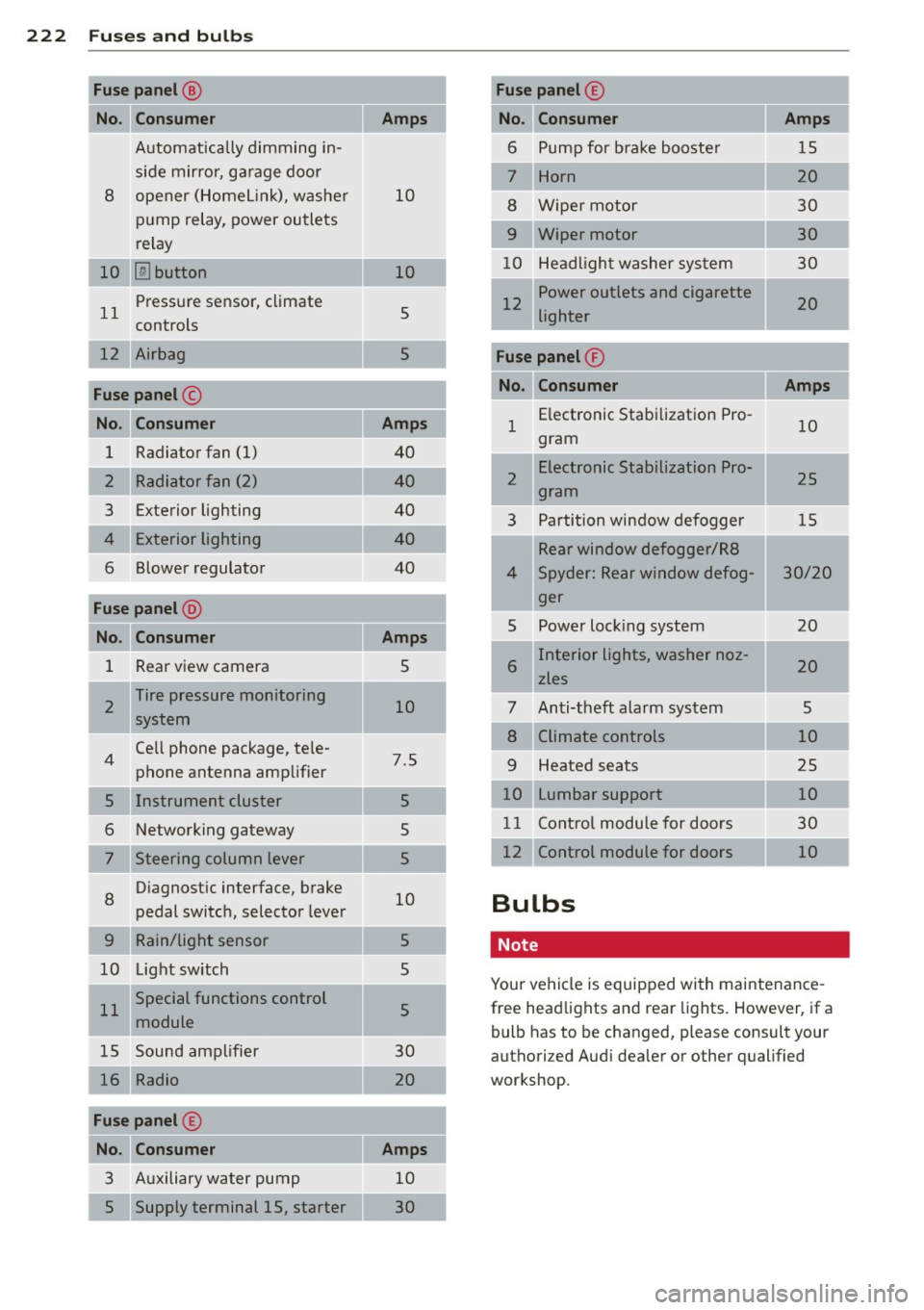
Fuse panel @
Consumer Amps
Automatically dimming in-
side mirror, garage door
8 opener (Homel
ink), washer
10
pump relay, power outlets
relay
10
[ru button 10
11 Pressure sensor, climate
5
controls
12 Airbag 5
Fuse panel@
No . II Consumer
II Amps
1 Radiator fan (1)
40
2 Radia
tor fan (2)
40
3 Exterior lighting
40
4 Exterior lighting 40
6 Blower regulator 40
Fuse panel@
No . II Consumer
II Amps
1 Rear view camera
5
2
Tire pressure monitoring
system 10
4 Cell phone package, te
le-
7.5
phone antenna amplifier
5 Instrument cluster 5
6 Networking gateway
5
7 Steering column lever 5
8 Diagnostic interface, brake
10
pedal switch, selector lever
9 Rain/light sensor 5
10 Light switch 5
11 Special functions control
5
module
15 Sound amplifier 30
Radio 20
Fuse panel E
No. Consumer Amps
3 Auxiliary water pump 10
5 Supply terminal 15, starter 30
Fuse panel @
No. Consumer Amps
6 Pump for brake booster 15
7 Horn
20
8 Wiper motor 30
9 Wiper motor
30
10 Headlight washer system 30
12 Power outlets and cigarette
20
lighter
Fuse panel ®
No. !!Consumer
ll Amps ,
1 E
lectronic Stabilization Pro -
10
gram
2 Electronic
Stabilization Pro-
25
gram
3 Partition window
defogger
15
Rear window defogger/RB
4 Spyder: Rear window defog- 30/20
ger
5 Power lock
ing system 20
6
Interior Lights, washer noz-20
zles
7 Anti-theft alarm system 5
8 Climate controls 10
9 Heated seats 25
10 Lumbar support 10
11 Control module for doors 30
12 Control module for doors
10
Bulbs
Note
Your vehicle is equipped with maintenance
free headlights and rear lights. However, if a
bulb has to be changed, please consult your
authorized Audi dealer or other qualified
workshop.
Page 237 of 244
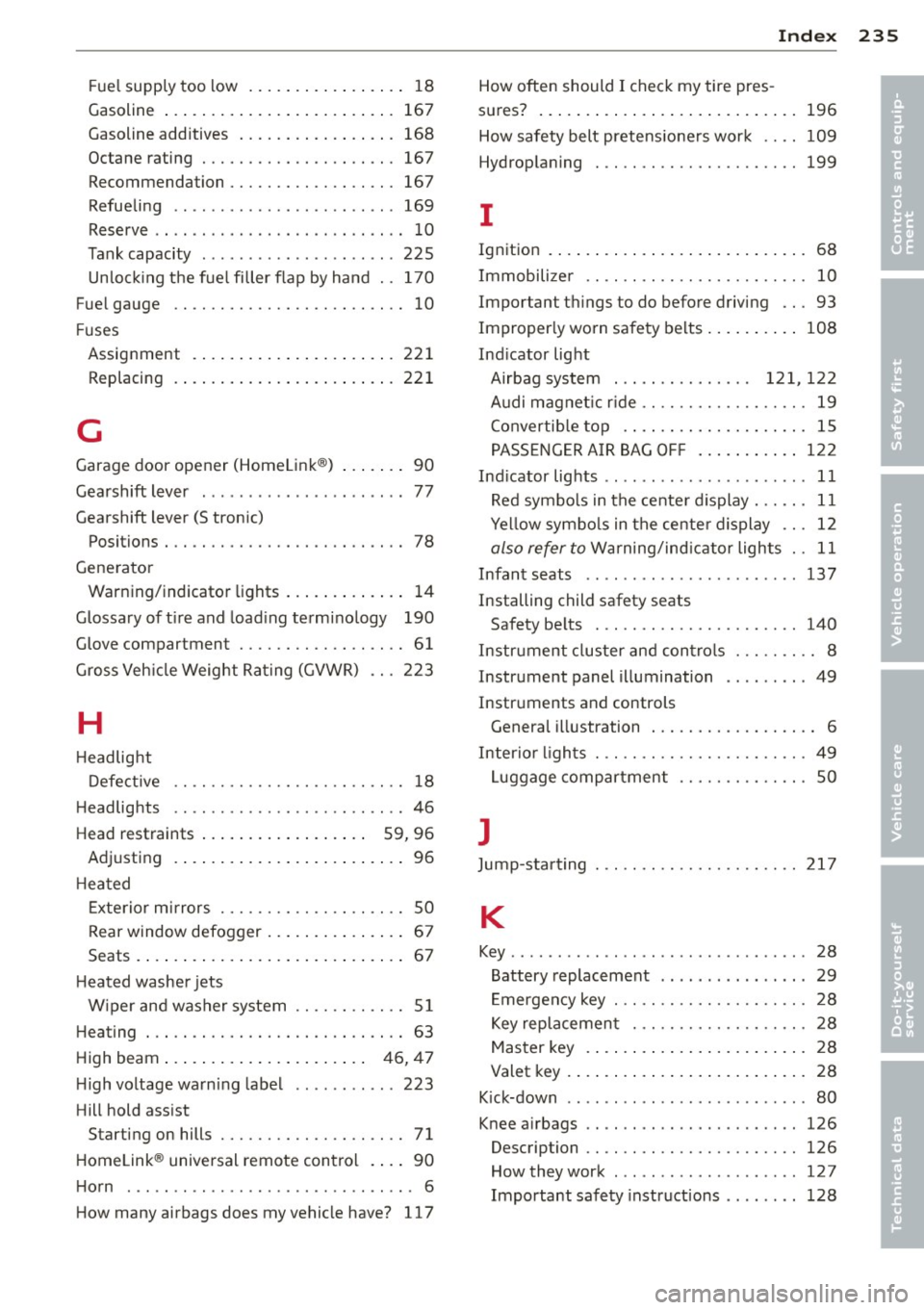
Fuel supply too low . . . . . . . . . . . . . . . . . 18
Gasoline ... .................. .... 167
Gasoline additives ................. 168
Octane rating ............ .... .. ... 167
Recommendation ......... .. .. .. .. . 167
Refueling .. ................ ... ... 169
Reserve . ... ... .. .. ...... .. .. .. .. .. 10
Tank capacity ............... .... .. 225
Unlocking the fuel filler flap by hand . . 170
Fuel gauge .. ............. .... .. .... 10
F uses
Assignment ................ .... .. 221
Replacing . ................. ... ... 221
G
Garage door opener (Homelink®) ... .. .. 90
Gearshift lever . . . . . . . . . . . . . . . . . . . . . . 77
Gearshift lever (S tronic) Positions . . . . . . . . . . . . . . . . . . . . . . . . . . 78
Generator Warning/indicator lights ............. 14
Glossary of tire and loading terminology 190
Glove compartment ........ .. .. .. .. .. 61
Gross Vehicle Weight Rating (GVWR) .. . 223
H
Headlight
Defective
Headlights .
. .... ......... .... .. .. .. 18
46
Head restraints . . . . . . . . . . . . . . . . . . 59, 96
Adjusting .. .. .............. ... .... 96
H eated
Exterior mirrors .......... .. .. .. .. .. 50
Rear window defogger . . . . . . . . . . . . . . . 67
Seats . ..... .. .............. ... .... 67
Heated washer jets
Wiper and washer system .. .. .. .. .. .. 51
Heating .... . .... ......... .... .. .. .. 63
High beam . . . . . . . . . . . . . . . . . . . . . . 46, 47
High voltage warn ing label .. .. .. .. .. . 223
Hill hold assist Starting on hills .......... .. .. .. .. .. 71
H omelink ® universal remote control . ... 90
Horn ..... ... ...... ............. ... . 6
How many airbags does my vehicle have? 117
Index 235
How often should I check my tire pres-
sures? ....... .. .... ............... 196
•
How safety belt pretens ioners work .. .. 109 •
Hydroplaning . .. .. ................. 199
I
Ignition ..... ..... .. ................ 68
Immobilizer .. .. .. .. .. ........... .. . 10
Important things to do before driving .. . 93
Improperly worn safety belts ......... . 108
Indicator light Airbag system . . . . . . . . . . . . . . . 121,122
Audi magnetic ride .... ........... .. . 19
Convertible top .. .. ................ 15
PASSENGER AIR BAG OFF .......... . 122
Ind icator lights .. ... ................. 11
Red symbols in the center display . .. .. . 11
Yellow symbols in the center display .. . 12
also refer to Warning/indicator lights . . 11
Infant seats ....... ...... .......... 137
Installing child safety seats Safety belts . . . . . . . . . . . . . . . . . . . . . . 140
Instrument cluster and controls ... .. .. .. 8
Instrument panel illumination ......... 49
Instruments and controls General illustration . . . . . . . . . . . . . . . . . . 6
Interior lights ... .. .. ............... . 49
Luggage compartment . . . . . . . . . . . . . . 50
J
Jump-starting . .. .. .... ........... .. 217
K
Key ........... ... .. ..... ........... 28
Battery replacement . . . . . . . . . . . . . . . . 29
Emergency key ... .... ........... .. . 28
Key replacement . . . . . . . . . . . . . . . . . . . 28
Master key . ..... .. ................ 28
Valet key . . . . . . . . . . . . . . . . . . . . . . . . . . 28
Kick-down . . . . . . . . . . . . . . . . . . . . . . . . . . 80
Knee airbags .. .. .. ................. 126
Description .. .. .. ................. 126
How they work ..... .. .. ...... ..... 127
Important safety instructions ........ 128