tow AUDI R8 SPYDER 2014 Owner's Manual
[x] Cancel search | Manufacturer: AUDI, Model Year: 2014, Model line: R8 SPYDER, Model: AUDI R8 SPYDER 2014Pages: 244, PDF Size: 61.06 MB
Page 145 of 244
precautions apply when installing a chi ld
safety seat on t he front passen ger seat
Q page 112, Child restraints on th e front
seat -some important things to know.
Deactivating the convertible locking
retractor
The convertible locking retractor for child re
straints will be deactivated automatically when the belt is wound all the way back into the retractor.
.,. Press the red button on the safety belt buck
le . The belt tongue w ill pop out of the buck
le.
.,. Gui de the safety bel t all t he way back into
i ts stowed posit ion.
A lways let the safety belt retract complete ly
i n to its stowed posit ion. The safe ty belt can
now be used as an o rd inary safety be lt wi th
ou t the convert ible lock ing retractor for chi ld
restra ints.
If t h e conver tible locking re tracto r shou ld be
a ctivated inadve rten tly , the safety bel t m ust
be unfastened and guided completely ba ck in
to its stowed position to deactivate this fea
ture. If the co nvertib le locking retractor is not
deactivated, the safety be lt will gradually be
come tighter and uncomfortable to wear.
A WARNING
Improperly installed child safety seats in
crease the risk of ser ious perso nal injury
and death in a collision.
- Never unfasten the safety belt to deacti
va te the convert ible lock ing ret ractor for
child restraints while the veh icle is mov
ing. You would not be rest rained and
co uld be ser iously injure d in an acci dent.
- Always read and heed all WARN INGS
whenever using a child rest rained in ave
hicle is being use d
Qpage 132. Spec ial
precautions apply when installing a ch ild
safety seat on the front passenger seat
Q page 112, Child restraints on the front
seat -some important things to know.
Child Sa fet y 143
Additional Information
Sources of information about child
restraints and their use
There are a number o f sources of additiona l
information abo ut child restraint se lection, in
stallation and use :
N HT SA advises t hat the bes t ch ild safety seat
is the one that fi ts your chi ld and fits in your
vehicle, and that yo u will use correct ly and
consistently.
T ry before yo u buy!
U.S National Highway Traffic Safety Admin
istration
T el.: 1 -888 -3 27-42 36 (TIY: 1-800-4 24-9153)
www. n hts a .gov
National SAFE KIDS Campaign
Tel.: (202) 66 2-0600
www.safe kids.o rg
Safety BeltSafe U .S .A
Tel.: (800) 7 45-SAFE (English)
Te l.: (800) 7 47-SANO (Span ish)
www. carseat.org
Transport Canada Information Centre
Tel.: 1 (800) 333-037 1 or call
1 (613) 998-8616 if you are in the Ottawa
area
h ttp://www.t c.gc.c a/e ng/ ro ad safe ty/
menu .htm
Audi Customer R elation s
Tel.: (800) 82 2-28 34 •
•
Page 149 of 244
The effectiveness of the brakes can be reduced
when the vehicle is dr iven on a salt -covered
road and the brakes are not used. Likewise,
you clean
off accumulated salt coating from
brake discs and pads with a few ca utious ap
plications of the brake<=>,& .
Co rrosion
There may be a tendency for dirt to build up
on the brake pads and corrosion to form on
the discs if the car is not dr iven regularly or
only for short trips with little use of the
brakes.
If the brakes are not used frequently, or if cor rosion has formed on the discs, it is advisable
to clean
off the pads and discs by brak ing
firmly a few times from a moderately high
speed<=> ,&.
Fa ult s in th e bra ke s yste m
If you should notice a sudden increase in
brake pedal travel, then one of the two brake
circu its may have failed. Drive immed iately to
the nearest qualified workshop to have the
damage repa ired. Drive at reduced speed on
the way there and anticipate longer stopping
d istances and higher peda l pressure¢ _&.
Low brake fluid level
Malfunctions can occur in the brake system if
the brake flu id level is too low . The brake fluid
l eve l is monito red electronically .
Brake po wer ass ist un it
The brake power assist un it increases the
pressure that you generate with the brake
pedal. It works only when the eng ine is run
ning.
Br ake lining w ear statu s
Brake lining wear may be checked by visual in
spection of the condition of the brake pads
through the openings in the wheel. If neces
sary, the wheel may be removed for this in
spection
¢ page 214 .
Int ellig ent technolog y 147
_& WARNING
-You should perform braking maneuvers
for the purpose of cleaning the brake
system only if road conditions permit.
Other road use rs must not be put at risk -
you may ca use an accident!
- Before descend ing a steep grade, reduce
speed and sh ift transmission into a lower
gear o r lower dr iving range. Do not ride
the brakes or hold the pedal down too
long o r too often. Th is could cause the
brakes to get hot and diminish braking
efficiency .
- Do not " ride the brakes" by resting you r
foot on the pedal when you do not intend to brake. This may cause the brakes to
overheat, premature wear and increased
stopping distance.
- Under certain cl imatic and operat ing
conditions such as passing through wa
ter, dr iv ing in heavy rain o r after washing
the vehicle, the effectiveness of the brakes can be reduced. In winte r, ice can
accumu late on the bra ke pads, lin ings,
discs and drum s. Carefully app ly bra ke s
for a test. Brakes w ill dry and ice coa t
ings w ill be cleaned
off after a few care
fu l brake applications.
- Driving for an extended period of time on
salt -cove red roads without using your
brakes can a lso affect braking efficiency .
Clean
off accum ulated salt coating from
brake discs and pads with a few cautious
brake applications.
- I f you damage the front spoiler, or if you
install a different spoiler, be sure the air
f low to the front brakes is not obstruct
ed. Otherw ise the brake system could
overheat reducing the effectiveness of
the entire brake system.
- Failure of one b rake circuit will impai r
the braking capab ility result ing in an in
creased stopping distance. Avoid driving
the vehicle a nd have it towed to the near
est A udi dealer or qualified workshop .
- Never let the veh icle roll to a s top with
the engine shut
off. .,.
•
•
Page 150 of 244
148 Intelligent technology
-If the brake booster is not working, for
example when towing your vehicle, or
because the brake booster has somehow
been damaged, the brake pedal must be
pressed considerably harder to make up
for the lack of booster assistance .
Rear spoiler
The rear spoiler improves vehicle handling
and enhances driver control.
SPORT •
Fig. 129 Switch for rea r sp o ile r
The rear spoiler deploys and retracts. Spoi ler
operation can be set for automatic or manual
operation.
Automatic mode (normal operation )
-Extending automatically: This occu rs when
driving faster than approximate ly 62 mph
(100 km/h) or at a certain engine compart
ment temperature
1> .
- Retracting automatically: This occurs when
driv ing s lower than approximately 22 mph
(35 km/h) or at a certain engine compart
ment temperature
1> .
Manual mode
- Extending manually: Press the switch
~ fig. 129 briefly to extend the rear spo iler
completely.
- Retracting manually: When dr iving at
speeds below approximately 12 mph (20
km/h), press and hold the switch to retract
the rear spoiler . When driving at speeds be
tween 12 mph and 62 mph (20 km/h and
l ) The rear s poiler o nly exten ds or ret racts a bove a cer
ta in eng in e te mp erat ure in s ome m odels.
100 km/h), press the switch briefly to re
tract the rear spoiler complete ly. You cannot
retract the rear spoiler if it extended due to
the engine compartment temperature .
Indicator light
When the indicato r light (.-) appears, there is
a system malfunction . The rear spoiler may
not be able to extend . This cou ld change the
vehicle's driving characteristics at high
speeds. Do not exceed 87 mph (140 km/h) .
Drive to your authorized Audi dealer immedi
ately to have the malfunction corrected .
A WARNING
Driving at higher speeds without the rear
spoiler deployed can impair handling char
acteristics, making the vehicle ha rder to
control.
- Imp roper operation of the rear spoiler
can cause crushing injuries. Always ma ke
sure that nobody, especia lly children, is
in the way when the rear spoi ler is de
p loyed or retracted.
- Always obey speed limits and other traf
fic laws .
- Ho t air from the eng ine compartment
can escape thro ugh the rear spoiler when
it is open and it could burn you.
(D Note
- Never push the vehicle or apply force to
t he rear spoiler -it could be damaged.
- Operate the rear spoiler manually only
when the eng ine compartment lid is
closed, otherwise there is a risk of dam
age .
(D Tips
Clean the spoiler compartment every 2 to
3 months. The spoiler compa rtment must
always be free of ice, snow, leaves or other
debris.
Page 151 of 244
Power steering
When the engine is running, power steering
makes it easier for the driver to steer.
Power steering he lps the driver steer the vehi
cle with little physical effort .
If the engine is not runn ing, the power steer
ing system is also not wo rking. In this case,
you will find it extreme ly difficult to turn the
steering whee l.
If you t urn t he steering fully to the le ft or
right when the vehicle is stationary, you place
a very heavy load on t he power steering sys
tem . T urning the steering wheel fu lly to the
left or r ight will cause noise in the system . It
a lso reduces engine idle speed.
(D Note
Do not hold the steering turned fully to
the left or right for more than 10 seconds
when t he engine is running. There is a risk
of damage to the power steeri ng system .
@ Tips
-In the event of a power steering system
failure, or if the eng ine is not running
(while being towed), you wi ll st ill be able
to stee r the ve hicle . However, you will re
quire more effort to do so .
- If the power steer ing system has a leak
or is defective, you should immed iately
contact a qualif ied wo rkshop.
- The powe r stee ring system requires a
spec ial hyd raulic f luid. The powe r stee r
i ng fl uid reservo ir is lo cated in the en
g ine compar tment . Th e cor re ct hydra ulic
f lui d leve l is important for p ro per opera
tion o f the power steering sys tem . The
power steer ing fl uid leve l is checked ac
cord ing to the Aud i maintenance service
schedule.
Dry sump Lubrication
H igh lateral and long itud inal forces affect the
engine and the vehicle d uring sporty driving.
Ory sump lubr ication ensures that your eng ine
Int ellig ent technolog y 149
is supplied wi th oi l and properly lubricated
even under these conditions .
In a "no rma l" veh icle the o il pump sends the
o il from the o il p an t o the lubr ication points in
t h e engine. The oi l then ret urns to the o il pan .
In extreme situations , the oil p ump may draw
in a ir, which results in insufficient oi l pressure.
Wi th dr y sump lubri cat ion, the o il is not in the
oi l pan (it is "dry"), but in a separate oil tank.
While one p ump supplies t he e ngine with oil ,
a second pump suctions the oil out of the en
gine and returns it to the oil tank. Because the
o il tank is tall and narrow, oil pressure is con
stant even under extreme conditions .
In add ition, the oi l pan in vehicles with dry
sump l ubrication is noticeab ly shallower. This
allows the engine to be installed lower in the
vehicle , bring ing down the center of grav ity .
T his imp roves your ve hicle's handling .
Driving with your
quattro ®
With all-wheel drive, all four wheels are driv
en.
General information
With a ll-wheel d rive, powe r is distr ib uted to
al l four wheels. This happens autom atic ally
depen ding on your d riving s tyle and the ro ad
conditions a t the time . See also ¢
page 144.
The all-whee l dr ive concept is des igned for
high eng ine power. Your veh icle is except ion
al ly powe rf ul and h as ex cellen t driving charac
teristics both under normal driving cond itions
and on snow and ice . Always read and follow
safety precaut ions ¢&. .
Winter tires
When dr iving in the win ter, yo ur vehicle wi th
a ll- wheel d rive h as an advantage, even w it h
regular tires. In winter road conditions it may
be advisable to mount winter tires (or all-sea
son tires) for improved driveability and brak
ing : these tires must be mounted on
all four
wheels . See also¢ page 203, Winter tires. .,..
•
•
Page 156 of 244
154 Driving and en vironm ent
• Never put too much motor oil in your engine
¢ page 180, Adding engine oil
The cata lytic converter is an efficient "clean
up" device built into the exhaust system of
the vehicle. The catalytic converter burns
many of the pollutants in the exhaust gas be
fore they are released into the atmosphere.
The exclusive use of unleaded fue l is critically
important for the life of the cata lytic convert
er and proper functioning of the engine.
A WARNING
- Do not park or operate the veh icle in
areas where the hot exhaust system may
come in contact with dry grass, brush,
fuel sp ill or other material which can
cause a fi re.
- Do not apply additional undercoating or
rustproofing on or near the exhaust
man ifold, exhaust p ipes, catalytic con
verte r o r heat shie lds . D uring d riving, the
substance used for undercoating cou ld
overheat and cause a fire.
([) Note
- Be aware that just one tank f illing with
le aded fuel will already seriously de
grade the performance of the catalytic
converter.
- Do not exceed the correct engine oil leve l
¢page 180 .
-Do not drive until the fuel tank becomes
completely empty. The eng ine could mis
fire. Unburned f uel could a lso get into
the exhaust system and this could cause
the catalytic converter to overheat.
- Do not turn
off the ignition while the ve
hicle is moving .
- Do not continue to operate your vehicle
under these conditions, as otherwise fuel
can reach the catalytic converter. This
could result in overheat ing of the con
verter, requ iring its replacement.
- To assure efficient operation of the Emis sion Control System: -
Have your vehicle maintained properly
and in accordance with the service rec
ommendat ions in yo ur Warranty
&
Maintenance book let.
- Lack of proper maintenance as we ll as
improper use of the vehicle will impair
the function of the emission contro l
system and could lead to damage.
@ For the sake of the env ironment
Even when the Emission Control System is
operating proper ly, the exhaust gas can
have a sulfur-like exhaust gas smell under
some operat ing states . This depends on
the sulfur content of the fuel being used .
Using a different brand of fue l may help,
or fil ling the tank with lead-free super
grade gasoline.
Shutting down vehicle
If you would like your vehicle to remain inop
erative for a longer per iod of t ime, contact an
Audi or othe r specialized dealer. They can ad
vise you on necessary precautions e.g . corro
sion prevention, maintenance and storage.
Pay attention to additional informat ion con
cerning the battery. Refer to<=>
page 184.
Operation and
maintenance
Fuel economy, env ironmental impact, and
wear on your eng ine, brakes and tires largely
depend on three facto rs:
-your personal driving style
- operating conditions
- technical limitat ions
By having your veh icle regu larly se rviced by an
authorized Audi dea ler helps to ensure that it
runs properly and economica lly. The condition
of your vehicle not only affects its safety and ability to hold its va lue, it also affects
fu el
cons umpt ion.
The amount of oi l used is re lated to engine
l oad and speed.
Page 157 of 244
It is normal for the oil consumption of a new
engine to reach its lowest value after a certain
mileage has been driven.
You must drive your vehicle about 3,000 miles
(5,000 kilometers) before you can properly
assess oi l consumption.
This also applies to fuel consumption and en
g ine output.
(y Note
-Have your vehicle maintained properly
and in accordance with the service rec
ommendations in your Warranty
& Main
tenance booklet. Lack of proper mainte
nance as well as improper use of the ve
hicle will impair the function of the
emission control system and could lead
to damage.
- Do not alter or remove any component of the Emission Control System unless ap
proved by the manufacturer.
- Do not alter or remove any dev ice, such
as heat shields, switches, ignition wires,
valves, which are designed to protect
your vehicle's Emission Control System
and other important vehicle compo
nents.
(D Tips
The consumpt ion estimates as published
by the ENVIRONMENTAL PROTECTION
AGENCY (EPA) and Transport Canada may
not correspond to your actua l consump
tion on the road, which will vary depend
ing upon vehicle load and speed, road and
weather conditions, trip length, etc.
Trailer towing
General information
Your Audi RB Spyder is not designed to tow a
trailer.
Towing a trai ler with your Audi RB Spyder is
not recommended and can cause damage to
the car . Damaged caused by towing a trailer is
not covered by your Aud i Warranty .
Driving and environment 155
•
•
Page 163 of 244
You should also clean the inside of the win
dow g lass at regular intervals.
The cloth or chamois used on paint s urfaces
contains wax res idue. Use a separate clo th or
chamo is to dry the window glass.
Cl eaning the rear window
Aud i recommends cleaning the window us ing
a soft cotto n cloth and water mixed with
cleaning solution or window cleaner
(1: 1 mix
ture) . To avoid streaks, do not wipe the win
dow dry with paper towels.
D o not use any clean ing so lutions that conta in
ammonia, acids , silicone or fluo ride or clean
e rs that are abrasive or cou ld cause scratches .
Do not use any alkaline cleaning solutions.
A WARNING
- The windshie ld must not be treated with
water-repellent materials. They can in
crease glare under poor visib ility condi
t ions such as wetness, darkness, or when
the sun is low on the horizon. In addi
t ion, they can cause the windshield wip
ers to chatter.
- Always read and heed all WARNINGS and
other information
r:::> page 156.
(D Note
-Never use warm or hot water to remove
snow and ice from windows and mirrors.
This could cause the glass to c rack.
- To prevent damage to the wires of the
rear defogger, do not place any adhesive
stickers on the inside of the rear window
ove r the wires.
- To he lp prevent di rt from scratching the
window, always scrape in a forward d i
r ection - pus hing the scraper away from
you - never back and fo rth.
Wheels
Regular care is required to preserve the deco
rative appearance of the wheels . Road sa lt
and b rake dust must be washed off regu larly
or the wheels wi ll be damaged.
Cleaning and protec tion 16 1
Use only specia l acid -free cleaning agents. You
can find proper wheel cleaner at authorized
Audi dealers and specia lty stores . Do not leave
the cleaner on the whee ls longer than speci
fied. Wheel cleaners containing acid can dam
age the surface of the w heel bo lts .
Pa int polish or other abrasive materials must
not be used when caring for wheels. If the
protective coat ing has been damaged, from
stones for example, touch up the damage as
soon as possible .
A WARNING
-Moisture and ice on brakes may affect
brak ing eff ic iency -
c:::> page 146, General
information.
T est the bra kes ca re fully af
ter each vehicle wash .
- Always read and heed a ll WAR NINGS and
the information¢
page 156.
Exhaust tail pipes
-
Road salt and other corrosive materials wi ll
damage the material in the exhaust tail pipes
if they are not cleaned regularly . Do not clea n
the tail pipes with wheel cleaner, pa int polish,
chrome polish or other abras ive cleaners.
Clean the tail pipes with car care products
that are suitable for stainless steel.
Your authorized Audi dea ler can provide clean
ing products that have been tested and ap
proved for your vehicle.
Care of interior
Radio-/Navigation* display
T he disp lay may be cleaned with a soft cloth
and commercially-avai lab le "LCD cleaner".
The cloth should be coated lightly with the
cleaning so lution when cleaning the disp lay.
Q) Note
To prevent scratches, only clean the dis
play when it is dry .
•
•
Page 166 of 244
164 Cleaning and protection
Cleaning and caring for leather
upholstery and trim
Applies to vehicles: with natural leather
Natural leather requires special care and at
tention.
Normal cleaning
• Clean soiled are as with a slightly moistened
cotton or woolen cloth.
More stubborn dirt
• More stubborn dirt can be removed using a
cloth saturated with a mild soap solution (2
tablespoons mild liquid soap).
• Never allow the soap solution to saturate
the leather , and make certain that no water
soaks into the seams .
• Wipe off the soap solution with a soft, dry
cloth .
Cleaning spots
• Remove fresh water-based spots (such as
coffee, tea, juices, blood) with an absorbent
cloth or paper towel.
• Remove fresh
grease or oil-based spots
(such as butter, mayonnaise , chocolate) with
an absorbent cloth or paper towel, or use
the cleaner from the leather care kit if the
spot has not yet penetrated into the surface
of the leather.
• Use an oil/grease dissolving spray, if
oil/
grease spots have dried on.
• Remove specific kinds of spots (ballpoint
pen, felt marker, fingernail polish, water
based paint, shoe polish, etc.) with a spot
remover specifically formulated for leather .
Leather care
• Every half year use an approved leather care
product (available from your authorized
Audi dealer) to care for the leather .
• Apply the product very sparingly.
• Wipe it off with a damp cloth.
If you have any questions about cleaning and
caring for the leather in your vehicle, it is best
to contact your authorized Audi dealer, who
will be glad to help you and tell you about our
full range of leather care products, such as: -
Leather cleaning and care kit
- Cremes to care for colored leather
- Spot removers for ballpoint pens, shoe pol-
ish, etc.
- Oil/grease dissolving spray
- New and upcoming products .
_&. WARNING
-Always read and heed all WARNINGS and
the information
~ page 156.
(D Note
-Never use chemical solvents (e.g . lighter
fluid, turpentine), waxes, shoe polish or similar products on the leather surfaces
in your Audi .
- To avoid damage, have stubborn stains
removed by a commercial cleaning spe
cialist.
Cleaning Alcantara ® (synthetic suede)
Applies to vehicles: with Alcantara upholstery
Removing dust and dirt
• Moisten a cloth, squeeze out excess water
and wipe down the seat surfaces.
Removing stains
• Moisten a cloth with lukewarm water or
with diluted
ethyl (rubbing) alcohol.
"' Dab at the stain . Start at the outside and
work inwards .
• Once the stain is no longer visible, use a soft
dry cloth or tissue to soak up the moisture.
Do not use leather cleaning products on Al
cantara.
You may use a suitable shampoo for removing dust and dirt .
Dust and grit in the pores and seams can
scratch and damage the surface . If the car is
left standing in the sun for long periods, the
Alcantara covers should be protected against
direct sunlight to prevent it from fading .
Slight color variations will develop in normal
use and are not an indication of material dete-
rioration. ""
Page 200 of 244
198 Tires and wheels
shown on the sti cker
¢ page 193, fig. 149 .
4. The re sulting figure equals
th e available amount of car
go and luggage load capa ci
ty . For example, if the
"XXX"
amount equals 1400 lb s.
and there will be five
150
lbs . passengers in your vehi
cle , the amount of available
cargo and luggage load ca
pacity is
650 lb s. (1400-7 SO
(5
x 150) = 650 lb s.)
5. Determine the combined
weight of luggage and cargo being loaded on the vehicle .
That weight may not safely
exceed the available cargo
and luggage load capacity
calculated in Step
4.
6.
If your vehicle will be towing
a trailer, load from your trail
er will be transferred to your
vehicle. Consult this manual
to determine how this re duces the available cargo
and luggage load capacity of
your vehicle.
..,.Check the tire sidewall
(¢ page 199, fig . 152) to de
termine the designated load rating for a specific tire .
Tire service life
The service life of t ires depends on a lot of
different things including proper installation
and balancing, c orrect tire p ressur e and dr iv
ing style .
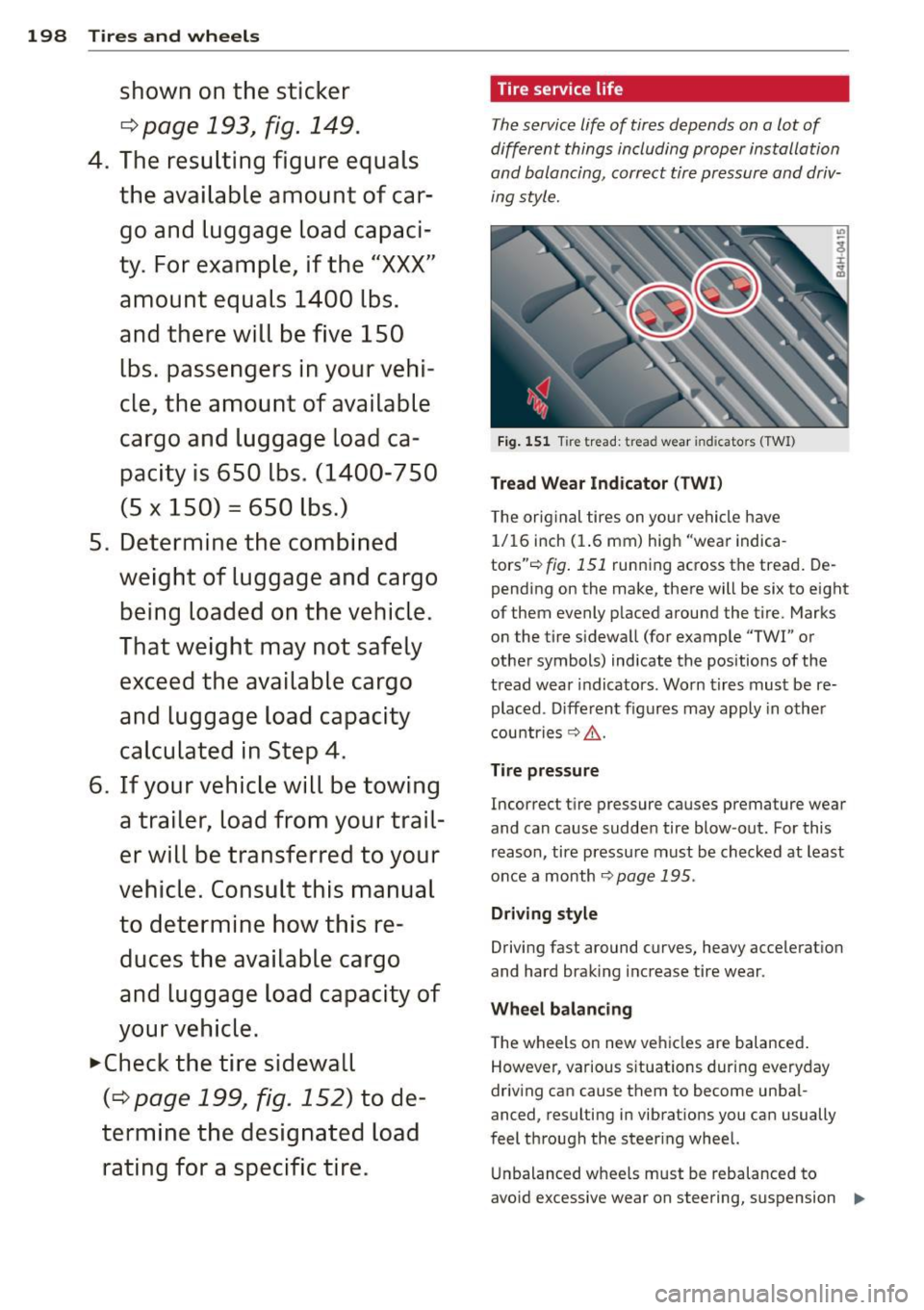
Fig. 151 Tire tread: tread wear indicators (TWI)
Tread Wear Indicator (TWI)
T he or iginal tires on your vehicl e ha ve
1/ 16 inch ( 1.6 mm) hig h "wea r indic a-
tors"<=:>
fi g. 15 1 run ning ac ross the tread . De
pend ing on the make, the re wi ll be six to eight
of them evenly p laced arou nd the ti re. Mar ks
o n the tire s idewall (for example "TWI" or
othe r symbols) ind icate the positions of the
t read wea r indicators. Worn tires mus t be re
placed. Diffe ren t fig ures may apply in oth er
co unt ries
c::> .& -
Tire pressure
Incorrect tire pressure causes premature wea r
and can cause sudd en tire blow-o ut. For this
re as on, tir e pre ssu re m ust be ch ecked at least
o nc e a month
c::>page 195.
Driving style
Driving fast ar ound c urves , heavy accel erat io n
and hard braki ng increase tire wear.
Wheel balancing
T he w heels on new ve hicles are balance d .
H oweve r, va rious s ituati ons dur ing everyday
driv ing can cause them to become unba l
anced, resulti ng i n vib rat ions y ou can usually
f eel th rough th e steer ing whee l.
Un balanced w hee ls m ust be rebalance d to
avo id excessive wear on steering , su sp ension ..,.
Page 221 of 244
4. Secure the other end to the jump start pin
© for the discharged battery@.
Starting the engine
.,. Start the eng ine of the vehicle providing as
s istance and allow it to run at id le.
.,. Now start the engine of the vehicle with the
discharged battery .
.,. If the engine does not start: Stop trying af
ter 10 seconds and then try again after
about 30 seconds .
.,. Disconnect the cable while the engine is
running in exactly
reverse order to that de
scribed.
The battery is vented to the outside to prevent
gases from entering the vehicle interior. Make
sure that the jumper clamps are well connect
ed with their
metal ports in full contact with
the battery termina ls.
A WARNING
To avoid serious personal i njury and dam
age to the vehicle, heed all warnings and
instructions of the jumper cable manufac
turer.
If in doubt, ca ll for road service .
- Jumper cables must be long enough so
that the vehicles do not touch.
- When connecting jumper cables, make
sure that they cannot get caught in any
moving parts in the engine compart
ment.
- Before you check anything in the engine
compartment, always read and heed all
WARNINGS
c:> page 172, Working in the
engine comportment.
Improper hook-up of jumper cables can ru
in the generator.
- Always connect POSITIVE( +) to POSI
TIVE(+), and NEGATIVE(-) to NEGATIVE
( - ) ground post of the battery manager
control unit.
- Check that all screw plugs on the battery
ce lls are screwed in firmly. If not, tighten
plugs prior to connecting clamp on nega
tive battery terminal.
-
What do I do now? 219
- Please note that the procedure for con
necting a jumper cable as described
above applies specifically to the case of
your vehicle being jump started. When
you are giving a jump start to another ve
hicle, do
not connect the negative(-) ca
ble to the negative(-) terminal on the
discharged battery@. Instead, securely
connect the negative(-) cable to eithe r a
solid metal component that is firmly
bolted to the engine block or to the en
gine block itself. If the battery that is be
ing charged does not vent to the outside,
escaping battery gas could ignite and ex
plode!
Emergency towing
with commercial tow
truck
' General hints
Your Audi requires special handling for tow
ing.
The following information is to be used by commercial tow truck operators who know
how to operate their equipment safely.
- Never tow your Audi, towing will cause dam
age to the engine and transmission.
- Never wrap the safety chains or winch cables around the brake lines.
- To prevent unnecessary damage, your Audi
must be transported w ith a car carrier (flat
bed truck) .
- To load the vehicle on to the flat bed, use
the towing loop found in the vehicle tools
and attach to the front anchorage
c:> page 220 .
A WARNING
A vehicle being towed is not safe for pas
sengers . Never allow anyone to ride in a
vehicle be ing towed, for any reason.
•
•