ignition AUDI R8 SPYDER 2014 Workshop Manual
[x] Cancel search | Manufacturer: AUDI, Model Year: 2014, Model line: R8 SPYDER, Model: AUDI R8 SPYDER 2014Pages: 244, PDF Size: 61.06 MB
Page 129 of 244
This is just one o f the reasons why an a irbag is
not a substitute for the safety belt . The airbag
system works most effective ly when used wit h
the safety belts. Theref ore, always wear your
safety belts correctly .
It is important to remember that while t he
supp lemental knee a irbag system is des igned
to reduce the like lihood of serious injur ies,
other injuries, for example, swel ling, bruising,
minor abrasions and friction burns can also
occur when a n airbag inflates .
The knee airb ag sy stem ba sically con sist s
of:
-The electronic contro l modu le
- Two inflatable airbags (airbag and gas gen-
erator), one for the driver and one for the
front passenger
- The airbag indicator light in the instrument
panel
The knee airbag system will not d eploy :
-when the ignition is turned off
- in frontal col lisions when the dece lerat ion
measured by the contro l unit is too low
- in s ide coll isions
- in rear-end colli sions
- in ro llovers
- in the event of a system malfunct ion (warn-
ing/ indicator light is on)
~ page 14.
A WARNING
- Saf ety belts and the a irbag system can
o nly p rov ide protection whe n occu pants
are in t he p roper sea ting posit io n
~page 12 0.
- If the air bag indica to r ligh t comes on
when the veh icle is be ing used, have the
system inspected immediately by your
authorized Audi dealer.
-
A irba g sy stem 12 7
How knee airbags work
The risk of injury to the leg area can be re
duced by fully deployed knee airbags.
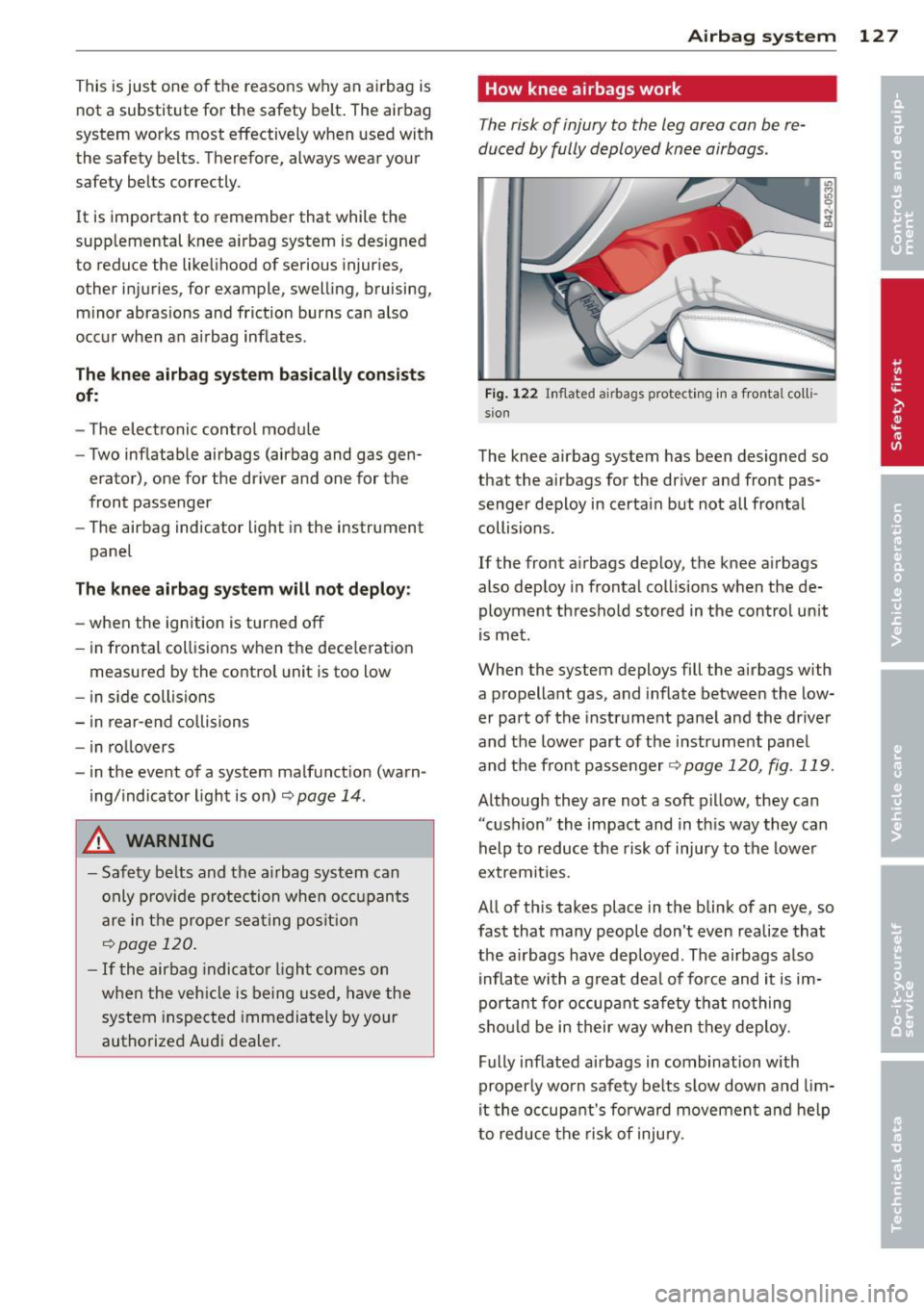
F ig. 1 22 In flated a irbags protect ing in a frontal colli
s io n
The knee airbag system has been designed so
that the airbags for the driver and fro nt pas
senger deploy in certain but not all frontal
collisions .
If the front a irbags dep loy, the knee a irbags
also deploy in frontal col lisions when the de
ployment threshold sto red in the control unit
is met.
When the system deploys fill the airbags with
a p ropellant gas, and inflate between the low
er part of the instrume nt pane l and the dr iver
and the lower part of the instr ument pane l
and the front passe nger
~ page 120, fig. 119.
Although they are not a soft pillow, they can
"cushion" the impact and in th is way they can
help to reduce the risk of injury to the lower
extremit ies.
All of th is takes place in the bli nk of an eye, so
fast that many people don't even realize that
the a irbags have deployed. The airbags a lso
inflate wi th a g reat dea l of fo rce and it is im
po rtant for occup ant safety t hat no thing
sho uld be in their way whe n they deploy.
Fully inflated ai rbags in combination with
properly worn safety be lts s low dow n and lim
it the occup ant's forward movemen t and help
to reduce the risk of inju ry.
Page 135 of 244

A WARNING
-=
If, in exceptional circumstances, you must
install a forward-facing child restraint on
the front passenger's seat:
- Always make sure the forward-facing
seat has been designed and certified by
its manufacturer for use on a front seat
with a passenger front and side airbag.
-Always follow the manufacturer's in
structions provided with the child safety
seat or carrier.
- Always move the passenger seat into its
rearmost position in the seat's fore and
aft adjustment range, as far away from
the airbag as possible before installing
the child restraint. The backrest must be
adjusted to an upright position.
- Always make sure that the
PASSENGER
AIR BAG OFF light comes on and stays
on all the time whenever the ignition is
switched on.
(D Tips
Always replace child restraints that were
installed in a vehicle during a crash. Dam
age to a child restraint that is not visible
could cause it to fail in another collision
situation.
Advanced front airbag system and children
Your vehicle is equipped with an "Advanced
Airbag System" in compliance with United
States Federal Motor Vehicle Safety Standard
(FMVSS) 208 as applicable at the time your
vehicle was manufactured.
The Advanced Airbag system in your vehicle
has been certified to meet the "low-risk " re
quirements for 3- and 6- year-old children on
the passenger side and small adults on the
driver side. The low risk deployment criteria
are intended to reduce the risk of injury
through interaction with the airbag that can
occur, for example, by being too close to the
steering wheel and instrument panel when
the airbag inflates. In addition, the system
Child Safety 133
has been certified to comply with the "sup
pression" requirements of the Safety Stand
ard, to turn off the front airbag for infants up
to 12 months who are restrained on the front passenger seat in child restraints that are list
ed in the Standard .
Even though your vehicle is equipped with an
Advanced Airbag system, a child should al
ways ride in the seat properly restrained for
its age and size . The airbag on the passenger
side makes the front seat a potentially dan
gerous place for a child to ride. The front seat
is not the safest place for a child in a forward
facing child safety seat .
It can be a very dan
gerous place for an infant or a larger child in a
rearward-facing seat.
Advanced Airbags and the weight
sensing mat in the front seat
The Advanced Airbag System in your vehicle
detects the presence of an infant or child in a
child restraint on the front passenger seat us
ing the weight-sensing mat in the seat cush
ion and the sensor below the safety belt latch
on the front passenger seat that measures the
tension on the safety belt.
The weight-sensing mat measures total
weight of the child and the child safety seat
and a child blanket on the front passenger
seat. The weight on the front passenger seat
is related to the design of the child restraint
and its "footprint", the size and shape of the
bottom of the child restraint as it sits on the
seat. The weight of a child restraint and its
"footprint" vary for different kinds of child re
straints and for the different models of the
same kind of child restraint offered by child restraint manufacturers.
The weight ranges for the individual types,
makes and models of child restraints that the
NHTSA has specified in the Safety Standard
together with the weight ranges of typical in
fants and typical 1 year-old child have been
stored in the control unit of the Advanced Air
bag System. When a child restraint is being
used on the front passenger seat with a
ll-
•
•
Page 137 of 244
Model Manufactured on or
after
Cosco Summit Deluxe September 25, 2007
H igh Back Bo oste r
22-262
Co sco High Bac k Boos -September 2S, 2007
ter 22- 209
Evenfl o Tribut e V
379xxxx September 25, 2007
December 1, 1999
E
venflo Genera tions September 25, 2007
35 2xxxx
Grace ComfortSport September 2S, 2007
Grace Toddler Sa fety September 25, 200 7
Seat Step 2
Graco Platinum Cargo September 25, 2007
A WARNING
T o reduce the risk of serious injury, make
sure that the
PASSENGER AIR BAG OFF
light comes on and stays on whenever a
child rest raint is installed on the front pas
senger seat and the ignition is switched
on.
- Never install a rearward facing child
safety seat on the front passenger seat
unless the
PASSENGER AIR BAG OFF
light comes on and stays on. If the PAS
SENGER AIR BAG OFF
light does not
come on a nd stay on the inflating airbag
will hit the child safety seat o r infant ca r
rie r wi th great fo rce and will smash the
c hild s afety seat and child agains t the
backrest, door or roof . Have the airbag
system inspected immedia tely by your
authorized Audi dealer.
(D Tips
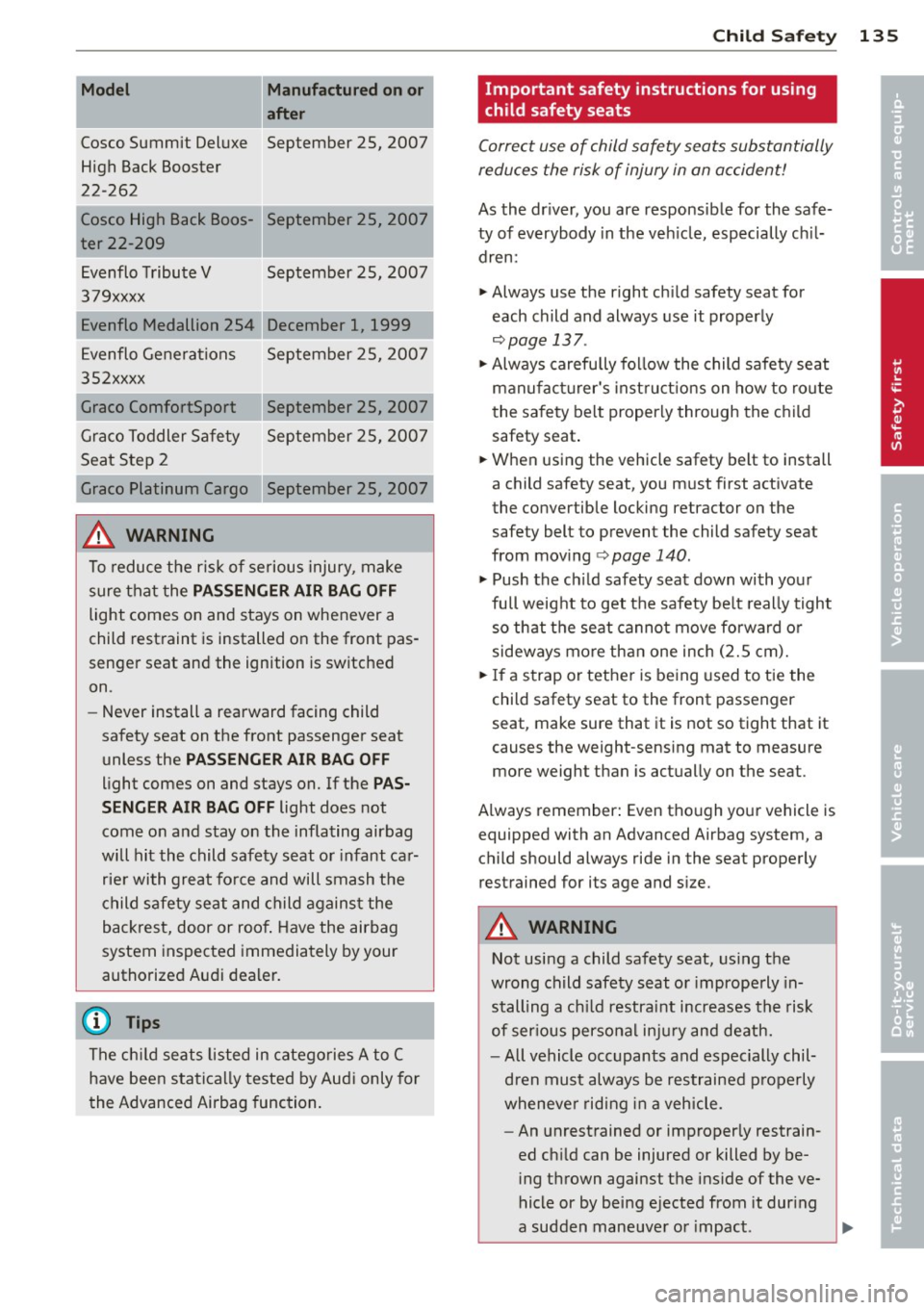
The ch ild seats listed in catego ries A to C
have been sta tica lly tested by Au di only for
the Advanced Airbag function.
.
Child Sa fet y 135
Important safety instructions for us ing
child safety seats
Correct use of child safety seats substantially
reduces the risk of injury in an accident!
As the dr iver, you are respons ible for the safe
ty of everybody in the veh icle , especially ch il
dren:
.. Always use the right ch ild safety seat for
each child and always use it properly
r=;, page 137.
.. Always carefully fo llow the child safe ty seat
manufac turer's inst ruct io ns on how to ro ute
the sa fe ty be lt properly through the c hild
safety seat .
.. When using the vehicle safety belt to install
a child safety seat, you m ust first activate
the convertible locking retractor on the
safety belt to prevent the child safety seat
from mov ing
¢ page 140 .
.. Push the ch ild safety seat down with yo ur
full weight to get the safety be lt really tight
so that the seat cannot
move fo rwa rd o r
sideways more th an one inch
(2.5 cm).
.. If a s trap or tet her is be ing used to tie the
child safety seat to the front passenger
seat, make sure that it is not so tight that it
causes the weight-sensing mat to measure
more weight than is act ually on the seat.
A lways remember : Even tho ugh yo ur vehicle is
equipped with an Advanced Airbag system, a
c hi ld should always ride in the seat properly
restrained for its age and s ize.
A WARNING
N ot using a child safety seat, using the
wrong ch ild safety seat o r imprope rly in
stalling a ch ild restraint increases the risk
of ser ious persona l inju ry and death.
- All vehicle occupants and especially chil
dren must always be restrained p rope rly
wheneve r riding in a vehicle.
-
- An unrest rained or improper ly restrain
ed ch ild can be injured or killed by be
i ng t hrown against the ins ide of the
ve
hicle or by being e jected from it dur ing
a sudden maneuve r o r i mpact .
•
•
Page 138 of 244
136 Child Safety
-An unrestrained or improperly restrain
ed child is at much greater risk of injury
or death by being struck by an inflating
airbag .
- Commercially available child safety seats
are required to comply with U.S. Federal
Motor Vehicle Safety Standard (FMVSS)
213 (in Canada CMVSS 213).
- When buying a child restraint, select
one that fits your child and the vehicle.
- Only use child restraint systems that
fully contact the flat portion of the
seat cushion. The child restraint must
not tip or lean to either side. Audi does
not recommend using child safety
seats that rest on legs or tube-like
frames . They do not provide adequate
contact with the seat .
- Always heed all legal requirements per
taining to the installation and use of
child safety seats and carefully follow
the instructions provided by the manu
facturer of the seat you are using.
- Never let more than one child occupy a
child safety seat.
- Never let babies or older children ride in
a vehicle while sitting on the lap of an
other passenger.
- Holding a child in your arms is never a
substitute for a child restraint system.
- The strongest person could not hold
the child with the forces that exist in
an accident. The child will strike the in
terior of the vehicle and can also be
struck by the passenger .
- The child and the passenger can also
injure each another in an accident.
- Never install a rearward facing child
safety seat on the front passenger seat
unless the
PASSENGER AIR BAG OFF
light comes on and stays on. If the PAS
SENGER AIR BAG OFF
light does not
come on and stay on the inflating airbag
will hit the child safety seat or infant car
rier with great force and will smash the
child safety seat and child against the
backrest, door or roof. Have the airbag system inspected immediately by your
authorized Audi dealer.
- Forward-facing child safety seats instal
led on the front passenger's seat can in
terfere with the airbag when it inflates
and cause serious injury to the child.
- If exceptional circumstances require the
use of a forward-facing child restraint on
the front passenger's seat, the child's
safety and well -being require that the
following special precautions be taken :
- Make sure the forward-facing seat has
been designed and certified by its man
ufacturer for use on a front seat with a
passenger front and side airbag.
- Always carefully follow the manufac
turer's instructions provided with the
child safety seat or carrier.
- Always move the front passenger seat
into the rearmost position of the pas
senger seat 's fore and aft adjustment
range, and as far away from the airbag
as possible before installing the child
restraint.
- Always make sure that nothing pre
vents the front passenger's seat from
being moved to the rearmost position
in its fore and aft adjustment range.
- Always make sure that the backrest is
in the upright position.
- Always buckle the child safety seat firmly
in place even if a child is not sitting in it.
A loose child safety seat can fly around
during a sudden stop or in a collision.
- Always read and heed all WARNINGS
whenever using a child restrained in ave
hicle is being used
¢ page 103, Safety
belts,
¢ page 111, Airbag system and
~ page 132, Child Safety .
A WARNING ~
To reduce the risk of serious injury, make
sure that the
PASSENGER AIR BAG OFF
light comes on and stays on whenever a
child restraint is installed on the front pas
senger seat and the ignition is switched
on.
Page 141 of 244
-Always make sure the backrest 1s in an
upr ight position.
- Make sure that the
PASSENGER AIR BAG
O FF
light comes on and stays on all the
t ime whenever the ignition is switched
on.
- If the light does not stay on, perform the checks.
- If the
PASSENGER AIR BAG O FF light
does not come on and stay on have the
airbag system inspected immed iately by
your Audi dealer.
Booster seats and safety belts
Properly used booster seats con help protect
children weighing between about 40 lbs. and
80 lbs. (18 kg and 36 kg) who ore less than 4
ft. 9 in . (57 inches/1 .45 meters) toll.
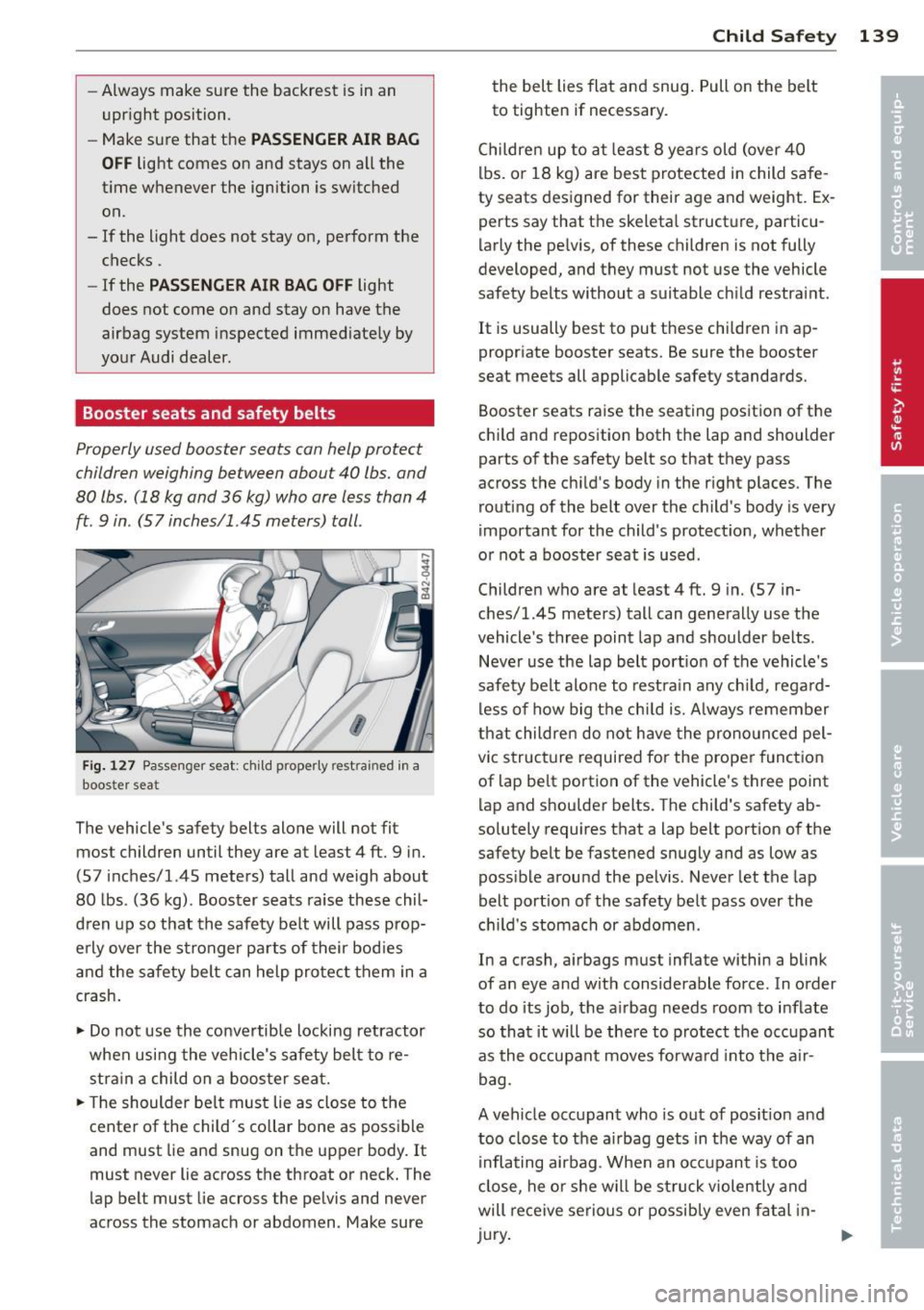
F ig. 12 7 Passenger seat: child proper ly restrained in a
booster seat
The vehicle's safety belts alone will not fit
most children until they are at least 4
ft. 9 in.
(57 inches/1.45 meters) tall and weigh about
80 lbs. (36 kg). Booster seats ra ise these chil
d ren up so that the safety belt will pass prop
erly over the stronger parts of their bod ies
and the safety belt can help protect them in a
crash .
~ Do not use the convertible locking retractor
when usi ng the veh icle's safety belt to re
stra in a child on a booster seat.
~ The shoulder be lt must lie as close to the
cente r of the child· s collar bone as possible
and must lie and snug on the upper body. It must never lie across the throat or neck. The
lap belt must lie across the pelvis and never
across the stomach or abdomen. Make sure
Child S afety 139
the belt lies flat and snug . Pull on the belt
to tighten if necessary.
Childre n up to at least 8 yea rs old (over 40
lbs. o r
18 kg) are best protected in child safe
ty seats designed for their age and weight.
Ex
perts say that the skeletal structure, particu
larly the pe lvis, of these children is not fully
developed, and they must not use the vehicle
safety belts without a suitable ch ild restrai nt.
It is usually best to put these children in ap
propriate booster seats. Be sure the booster
seat meets all applicable safety standards.
Booster seats raise the seating pos ition of the
ch ild and repos ition both the lap and shoulder
parts of the safety belt so that they pass
across the ch ild's body in the r ight places. The
routing of the belt over the child's body is very
important for the child's protect ion, whether
or not a booster seat is used.
Children who are at least 4
ft. 9 in. (57 in
ches/1.45 meters) tall can generally use the
vehicle 's three point lap and shoulder belts.
Never use the lap belt port io n of the vehicle's
safety belt alone to restra in any ch ild, rega rd
less of how big the chi ld is. A lways remember
that children do not have the prono unced pel
vic structure required for the prope r function
of lap belt portion of the vehicle's three point
lap and shoulder belts. The child's safety ab
solutely requires that a lap belt portion of the
safety belt be fastened snugly and as low as poss ible around the pelvis. Never let the lap
belt portion of the safety belt pass over the
ch ild's stomach or abdomen.
In a crash, a irbags must inflate within a blink
of an eye and with considerable force . In order
to do its job, the a irbag needs room to inflate
so that it will be there to p rotect the occupant
as the occupant moves forward into the a ir
bag.
A vehicle occupant who is out of posit ion and
too close to the a irbag gets in the way of an
i nflating airbag. When a n occupant is too
close, he or she will be st ruck violently and
will re ceive se rious or possibly even fatal in -
jury .
ll-
Page 142 of 244
140 Child Safety
In order for the airbag to offer protection, it is
important that all vehicle occupants, especial
ly any children, who must be in the front seat
because of exceptional circumstances, be
properly restrained and as far away from the
airbag as possible. By keeping room between
the child's body and the front of the passen
ger compartment, the airbag can inflate com
pletely and provide supplemental protection
in certain frontal collisions .
& WARNING
Not using a booster seat, using the boos
ter seat improperly , incorrectly installing a
booster seat or using the vehicle safety
belt improperly increases the risk of seri
ous personal injury and death in a collision
or other emergency situation. To help re
duce the risk of serious personal injury
and/or death:
- The shoulder belt must lie as close to the
center of the child's collar bone as possi
ble and must lie and snug on the upper
body .
It must never lie across the throat
or neck. The lap belt must lie across the
pelvis and never across the stomach or
abdomen. Make sure the belt lies flat
and snug. Pull on the belt to tighten if
necessary.
- Failure to properly route safety belts
over a child's body will cause severe inju
ries in an accident or other emergency
situation
c::;,poge 103.
-Children on the front seat of any car,
even with Advanced Airbags, can be seri
ously injured or even killed when an air
bag inflates.
- Never let a child stand or kneel on the
seat.
- Never let a child ride in the cargo area of
your vehicle.
- Always remember that a child leaning
forward, sitting sideways or out of posi
tion in any way during an accident can be
struck by a deploying airbag. This will re
sult in serious personal injury or death.
- If you must install a booster seat on the
front passenger seat because of excep -
-
tional circumstances the PASSENGER
AIR BAG OFF
light must come on and
stay on, whenever the ignition is switch
ed on.
- If the
PASSENGER AIR BAG OFF light
does not come on and stay on, perform
the checks described .
- If the
PASSENGER AIR BAG OFF light
does not come on and stay on whenever
the ignition is switched on the inflating
airbag will hit the child safety seat or in
fant carrier with great force and will
smash the child safety seat and child
against the backrest, door or roof. Have
the airbag system inspected immediately
by your Audi dealer.
- Always read and heed all WARNINGS
whenever using a child restrained in ave
hicle is being used
¢page 103, Safety
belts,
c::;, page 111 , Airbag system and
c::;, page 132, Important things to know.
Installing a child safety
seat
Securing a child safety seat using a
safety belt
Safety belts for the front passenger con be
locked with the convertible locking retractor
to properly secure child safety sea ts.
The safety belts emergency locking retractors
for the front passenger's seat safety belt have
a convertible locking retractor for child re
straints . The safety belt must be locked so
that belt webbing cannot unreel. The retrac
tor can be activated to lock the safety belt and
prevent the safety belt webbing from loosen
ing up during normal driving. A child safety
seat can only be properly installed when the
safety belt is locked so that the child and child
safety seat will stay in place.
Always remember: Even though your vehicle is
equipped with an Advanced Airbag system, a
child should always ride in the seat properly
restrained for its age and size.
II>-
Page 143 of 244
A WARNING
Improperly installed child safety seats in
crease the risk of serious personal injury
and death in a collision.
- Always make sure that the safety belt re
tractor is locked when installing a child
safety seat. An unlocked safety belt re
tractor cannot hold the child safety seat
in place during normal driving or in a
crash .
- Always buckle the child safety seat firmly
in place even if a child is not sitting in it .
A loose child safety seat can fly around
during a sudden stop or in a collision.
- The inflating airbag will hit the child
safety seat or infant carrier with great
force and will smash the child safety seat
and child against the backrest, door or
roof.
- Forward-facing child safety seats or in
fant carriers installed on the front pas
senger's seat may interfere with the de
ployment of the airbag and cause serious
injury to the child.
- Always read and heed all WARNINGS
whenever using a child restrained in ave
hicle is being used
Qpage 132. Special
precautions apply when installing a child
safety seat on the front passenger seat
Q page 112, Child restraints on the front
seat -some important things to know.
A WARNING
Always take special precautions if you
must install a forward or rearward-facing
child restraint on the front passenger's
seat in exceptional situations:
- Whenever a forward or rearward-facing
child restraint is installed on the front
passenger seat, the
PASSENGER AIR
BAG OFF
light must come on and stay on
whenever the ignition is switched on.
- If the PASSENGER AIR BAG OFF light
does not come on and stay on, perform
the checks described .
- If the PASSENGER AIR BAG OFF light
does not come on and stay on whenever
Child Safety 141
the ignition is switched on the inflating
airbag will hit the child safety seat or in
fant carrier with great force and will smash the child safety seat and child
against the backrest, door or roof. Have
the airbag system inspected immediately
by your Audi dealer.
- Improper installation of child restraints
can reduce their effectiveness or even
prevent them from providing any protec
tion.
-An improperly installed child restraint
can interfere with the airbag as it de
ploys and seriously injure or even kill the
child.
-Always carefully follow the manufactur
er's instructions provided with the child
safety seat or carrier.
- Never place additional items on the seat
that can increase the total weight regis
tered by the weight-sensing mat and can
cause injury in a crash.
A WARNING
Forward-facing child restraints:
- Always make sure the forward-facing
seat has been designed and certified by
its manufacturer for use on a front seat
with a passenger front and side airbag.
- Never put the forward-facing child re
straint up, against or very near the in
strument panel.
- Always move the passenger seat into its
rearmost position in the seat's fore and
aft adjustment range, as far away from
the airbag as possible before installing the forward-facing child restraint. The
backrest must be adjusted to an upright
position.
- Make sure that the
PASSENGER AIR BAG
OFF
light comes on and stays on all the
time whenever the ignition is switched
on.
A WARNING
Rearward-facing child restraints: •
•
Page 144 of 244
142 Child Safety
-A child in a rearward-facing child safety
seat installed on the front passenger
seat will be seriously injured and can be killed if the front airbag inflates -even
with an Advanced Airbag System.
- The inflating airbag will hit the child
safety seat or infant carrier with great
force and will smash the child safety seat
and child against the backrest, door or
roof.
-Always be especially careful if you must
install a rearward facing child safety seat
on the front passenger seat in exception
al circumstances.
- A tight tether strap on a rearward-facing
child restraint attached to the front pas
senger seat can put too much pressure
on the weight-mat in the seat and regis
ter a heavier weight in the Advanced Air
bag System. The heavier weight regis
tered can make the system work as
though an adult were on the seat and de ploy the Advanced Airbag when it must
be suppressed causing serious or even
fatal injury to the child.
- Make sure that the
PASSENGER AIR BAG
OFF
light comes on and stays on all the
time whenever the ignition is switched
on.
- Never install a rearward facing child
safety seat on the front passenger seat
unless the
PASSENGER AIR BAG OFF
light comes on and stays on. If the PAS·
SENGER AIR BAG OFF
light does not
come on and stay on have the airbag sys
tem inspected immediately by your Audi
dealer.
Activating the convertible locking retractor
Use the convertible locking retractor to se
cure a child restraint .
Always heed the child safety seat manufactur
er's instructions when installing a child re
straint in your vehicle. To activate the conver
tible locking retractor: ..
Place the child restraint on a seat.
.. Slowly pull the belt
all the way out.
.. Route it around or through the child re
straint belt path
c> ,A .
.. Push the child safety seat down with your
full weight to get the safety belt really tight.
.. Insert the belt tongue into the buckle for
that seating position .
.. Guide the safety belt back into the retractor
until the belt lies flat and snug on the child
safety seat.
.. You should hear a "clicking" noise as the
belt winds back into the inertia reel. Test the
convertible locking retractor by pulling on
the belt. You should no longer be able to pull the belt out of the retractor. The con
vertible locking retractor is now activated .
.. Make sure that the red release button is fac
ing away from the child restraint so that it
can be unbuckled quickly.
.. Pull on the belt to make sure the safety belt
is properly tight and fastened so that the
seat cannot move forward or sideways more
than one inch (2.5 cm).
A WARNING ~
Using the wrong child restraint or an im-
properly installed child restraint can cause
serious personal injury or death in a crash .
- Always make sure that the safety belt re-
tractor is locked when installing a child
safety seat. An unlocked safety belt re
tractor cannot hold the child safety seat in place during normal driving or in a
crash.
- Always buckle the child safety seat firmly
in place even if a child is not sitting in it.
A loose child safety seat can fly around
during a sudden stop or in a crash.
- Always make sure the seat backrest to
which the child restraint is installed is in
an upright position. Otherwise, the seat
back with the child safety seat attached
to it could fly forward in the event of an
accident or other emergency situation.
- Always read and heed all WARNINGS
whenever using a child restrained in ave-
hicle is being used
c> page 132. Special ..,.
Page 156 of 244
154 Driving and en vironm ent
• Never put too much motor oil in your engine
¢ page 180, Adding engine oil
The cata lytic converter is an efficient "clean
up" device built into the exhaust system of
the vehicle. The catalytic converter burns
many of the pollutants in the exhaust gas be
fore they are released into the atmosphere.
The exclusive use of unleaded fue l is critically
important for the life of the cata lytic convert
er and proper functioning of the engine.
A WARNING
- Do not park or operate the veh icle in
areas where the hot exhaust system may
come in contact with dry grass, brush,
fuel sp ill or other material which can
cause a fi re.
- Do not apply additional undercoating or
rustproofing on or near the exhaust
man ifold, exhaust p ipes, catalytic con
verte r o r heat shie lds . D uring d riving, the
substance used for undercoating cou ld
overheat and cause a fire.
([) Note
- Be aware that just one tank f illing with
le aded fuel will already seriously de
grade the performance of the catalytic
converter.
- Do not exceed the correct engine oil leve l
¢page 180 .
-Do not drive until the fuel tank becomes
completely empty. The eng ine could mis
fire. Unburned f uel could a lso get into
the exhaust system and this could cause
the catalytic converter to overheat.
- Do not turn
off the ignition while the ve
hicle is moving .
- Do not continue to operate your vehicle
under these conditions, as otherwise fuel
can reach the catalytic converter. This
could result in overheat ing of the con
verter, requ iring its replacement.
- To assure efficient operation of the Emis sion Control System: -
Have your vehicle maintained properly
and in accordance with the service rec
ommendat ions in yo ur Warranty
&
Maintenance book let.
- Lack of proper maintenance as we ll as
improper use of the vehicle will impair
the function of the emission contro l
system and could lead to damage.
@ For the sake of the env ironment
Even when the Emission Control System is
operating proper ly, the exhaust gas can
have a sulfur-like exhaust gas smell under
some operat ing states . This depends on
the sulfur content of the fuel being used .
Using a different brand of fue l may help,
or fil ling the tank with lead-free super
grade gasoline.
Shutting down vehicle
If you would like your vehicle to remain inop
erative for a longer per iod of t ime, contact an
Audi or othe r specialized dealer. They can ad
vise you on necessary precautions e.g . corro
sion prevention, maintenance and storage.
Pay attention to additional informat ion con
cerning the battery. Refer to<=>
page 184.
Operation and
maintenance
Fuel economy, env ironmental impact, and
wear on your eng ine, brakes and tires largely
depend on three facto rs:
-your personal driving style
- operating conditions
- technical limitat ions
By having your veh icle regu larly se rviced by an
authorized Audi dea ler helps to ensure that it
runs properly and economica lly. The condition
of your vehicle not only affects its safety and ability to hold its va lue, it also affects
fu el
cons umpt ion.
The amount of oi l used is re lated to engine
l oad and speed.
Page 157 of 244
It is normal for the oil consumption of a new
engine to reach its lowest value after a certain
mileage has been driven.
You must drive your vehicle about 3,000 miles
(5,000 kilometers) before you can properly
assess oi l consumption.
This also applies to fuel consumption and en
g ine output.
(y Note
-Have your vehicle maintained properly
and in accordance with the service rec
ommendations in your Warranty
& Main
tenance booklet. Lack of proper mainte
nance as well as improper use of the ve
hicle will impair the function of the
emission control system and could lead
to damage.
- Do not alter or remove any component of the Emission Control System unless ap
proved by the manufacturer.
- Do not alter or remove any dev ice, such
as heat shields, switches, ignition wires,
valves, which are designed to protect
your vehicle's Emission Control System
and other important vehicle compo
nents.
(D Tips
The consumpt ion estimates as published
by the ENVIRONMENTAL PROTECTION
AGENCY (EPA) and Transport Canada may
not correspond to your actua l consump
tion on the road, which will vary depend
ing upon vehicle load and speed, road and
weather conditions, trip length, etc.
Trailer towing
General information
Your Audi RB Spyder is not designed to tow a
trailer.
Towing a trai ler with your Audi RB Spyder is
not recommended and can cause damage to
the car . Damaged caused by towing a trailer is
not covered by your Aud i Warranty .
Driving and environment 155
•
•