tires AUDI R8 SPYDER 2014 Owners Manual
[x] Cancel search | Manufacturer: AUDI, Model Year: 2014, Model line: R8 SPYDER, Model: AUDI R8 SPYDER 2014Pages: 244, PDF Size: 61.06 MB
Page 5 of 244
Monitoring the Advanced Airbag
System . . . . . . . . . . . . . . . . . . . . . . . . . 121
Knee airbags . . . . . . . . . . . . . . . . . . . . . 126
Side airbags . . . . . . . . . . . . . . . . . . . . . 128
Child Safety . . . . . . . . . . . . . . . . . . . 132
Important things to know . . . . . . . . . . 132
C hild safety seats . . . . . . . . . . . . . . . . . 137
Installing a child safety seat . . . . . . . . 140
Additional Information . . . . . . . . . . . . 143
Vehicle operation . . . . . . . . . . . . . 144
Intelligent technology . . . . . . . . 144
Notice about data recorded by vehicle
control modules . . . . . . . . . . . . . . . . . . 144
E lect ronic Stabilization Control (ES C) . 144
B raking . . . . . . . . . . . . . . . . . . . . . . . . . 146
Rear spoiler . . . . . . . . . . . . . . . . . . . . . 148
Power steering . . . . . . . . . . . . . . . . . . . 149
Dry sump lub rication . . . . . . . . . . . . . . 149
Driving with your quattro ® . . . . . . . . . 149
Energy management . . . . . . . . . . . . . . 150
Driving and environment . . . . . 153
Break- in period . . . . . . . . . . . . . . . . . . . 153
Avoid damaging the vehicle . . . . . . . . . 153
Driving through water on roads . . . . . 153
Catalytic converter . . . . . . . . . . . . . . . . 153
Shutting down veh icle . . . . . . . . . . . . . 154
Operation and maintenance . . . . . . . . 154
Trailer towing . . . . . . . . . . . . . . . . . . . . 155
Vehicle care . . . . . . . . . . . . . . . . . . . 156
Cleaning and protection . . . . . . 156
General information . . . . . . . . . . . . . . 156
Care of exterior . . . . . . . . . . . . . . . . . . 156
Care of interior . . . . . . . . . . . . . . . . . . . 161
Fuel supply and filling your
fuel tank . . . . . . . . . . . . . . . . . . . . . . .
167
Gasoline . . . . . . . . . . . . . . . . . . . . . . . . 167
Fuel tank. . . . . . . . . . . . . . . . . . . . . . . . 168
Checking and filling . . . . . . . . . . . 172
Eng ine compartment lid . . . . . . . . . . . 172
Eng ine oil . . . . . . . . . . . . . . . . . . . . . . . 175
Eng ine cooling system . . . . . . . . . . . . . 181
Brake fluid . . . . . . . . . . . . . . . . . . . . . . 183
Table of contents 3
Battery ... .. .... ... .. .......... . 184
Windshield washer container
188
•
•
Tires and wheels ........... .. . 189
Tires ..... .. .... ... .. .......... .
189
Tire pressure monitoring system
206
Do-it-yourself service ........ . 210
What do I do now? ........... . 210
Tr unk escape handle ........... .. .
210
Vehicle tool kit . .. ............... .
210
Tire repair . .. .. .. ............... .
210
What should I be aware of when
h . t· 7 c
anging a rre . . .. .............. . 214
Jump-starting .. .. ... .. .. ... ..... . 217
Em ergency towing with commercial
tow truck ... .. .. .. . ............ . 219
Fuse s and bulbs ... ........... . 221
El ectr ical fuses . .. ............... . 221
Bulbs ..... .. .. .. .. .. ........... . 222
Technical data ..... ........... . 223
General information ......... . 223
Explanation of technical data ...... . 223
Vehicle identification ........... .. .
223
Weights .. .. .. .... .. ........... .
223
Dimens ions .. .. ...... ........... . 224
Data ..... .. .... .. . .. .......... . 225
430 hp, 4.2 liter 8-cyl. engine ...... .
225
525 hp, 5.2 liter 10-cyl. engine .... .
226
Con sumer Information ...... . 227
Warranty coverages .............. . 227
Operating your vehicle outside the
U .S.A . or Canada ... . .. .. ...... .. . 227
Audi Serv ice Repair Manuals and
literature ... .. .. .. . .. .. ..... ... . 227
Maintenance . .. .. ............... . 227
Additional accessories, modifications
and parts replacement . . . . . . . . . . . . 229
Index . . . . . . . . . . . . . . . . . . . . . . . . . . 231
Page 21 of 244
Instrument s and warnin g/indic ator ligh ts 19
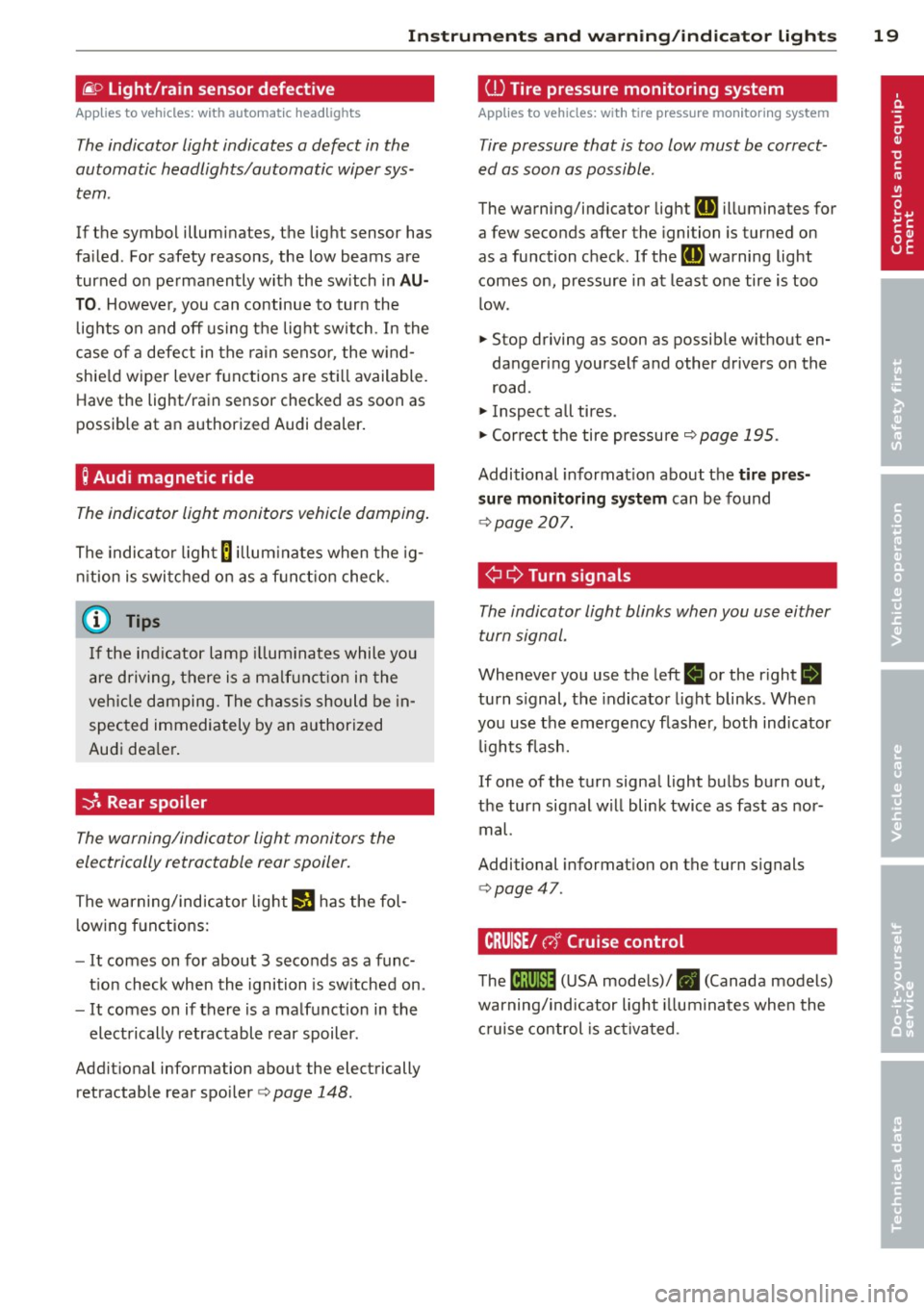
@:> Light/rain sensor defective
Applies to vehicles: with a utomat ic head lights
The indicator light indicates a defect in the
automatic headlights/automatic wiper sys
tem.
If the symbol illuminates, the light sensor has
failed. For safety reasons, the low beams are
turned on permanently with the switch in
A U
TO . However, you can continue to turn the
lights on and off using the light switch . In the
case of a defect in the rain sensor, the w ind
shie ld wiper lever functions are sti ll available.
Have the light/rain sensor checked as soon as
possible at an authorized Audi dealer.
; Audi magnetic ride
The indicator light monitors vehicle damping .
The indicator l ight
B illum inates when the ig
n ition is switched on as a f unct ion check.
@ Tips
If the ind icator lamp illum inates while you
are driving, there is a malfunct ion in the
veh icle damping. The chass is should be in
spected immediately by an authorized
Audi dea ler .
-::}. Rear spoiler
The warning/indicator light monitors the
electrically retractable rear spoiler.
The warning/ind icator ligh t
IJ has the fol
l owing f unctions:
- It comes on for about 3 seconds as a func
t ion check when the ignition is sw itched on.
- It comes on if there is a malfunction in the
electrically retractable rear spoiler.
Addit ional information about the electrically
retractable rear spoi ler
c> page 148.
ill Tire pressure monitoring system
Applies to vehicles : wit h tire press ure mo nitor ing system
Tire pressure that is too low must be correct
ed as soon as possible.
The warning/indicator lig ht
RE illuminates for
a few seconds after the ignition is turned on
as a function check. If the
RE warning light
comes on, pressure in at least one tire is too
l ow .
.,. Stop driving as soon as possible w ithout en
dangering yourself and other drivers on the
road.
.,. Inspect all tires .
.,. Correct t he tire pressure
c> page 195.
Additional informat ion about the
tire pr es
s ur e monit oring system
can be found
c> page 207.
¢ ¢Turn signals
The indicator light blinks when you use either
turn signal.
Whenever you use the left
B or the right B
turn s ignal, the indicator light blinks . Whe n
you use the emergency flashe r, both indicator
lights flash.
If one of the turn signa l light bulbs bu rn out,
the turn signal w ill blink twice as fast as nor
mal.
Additional informat ion on the turn s ignals
c> page47 .
CRUISE/ c,)"' Cruise control
The tB;m~14 (U SA mode ls)/ • (Canada models)
warning/indicator light illuminates when the
c ruise control is activa ted.
Page 74 of 244
7 2 On the road
Speed warning system
Speed warning system
The speed warning system helps you to keep
your driving speed below a set speed limit.
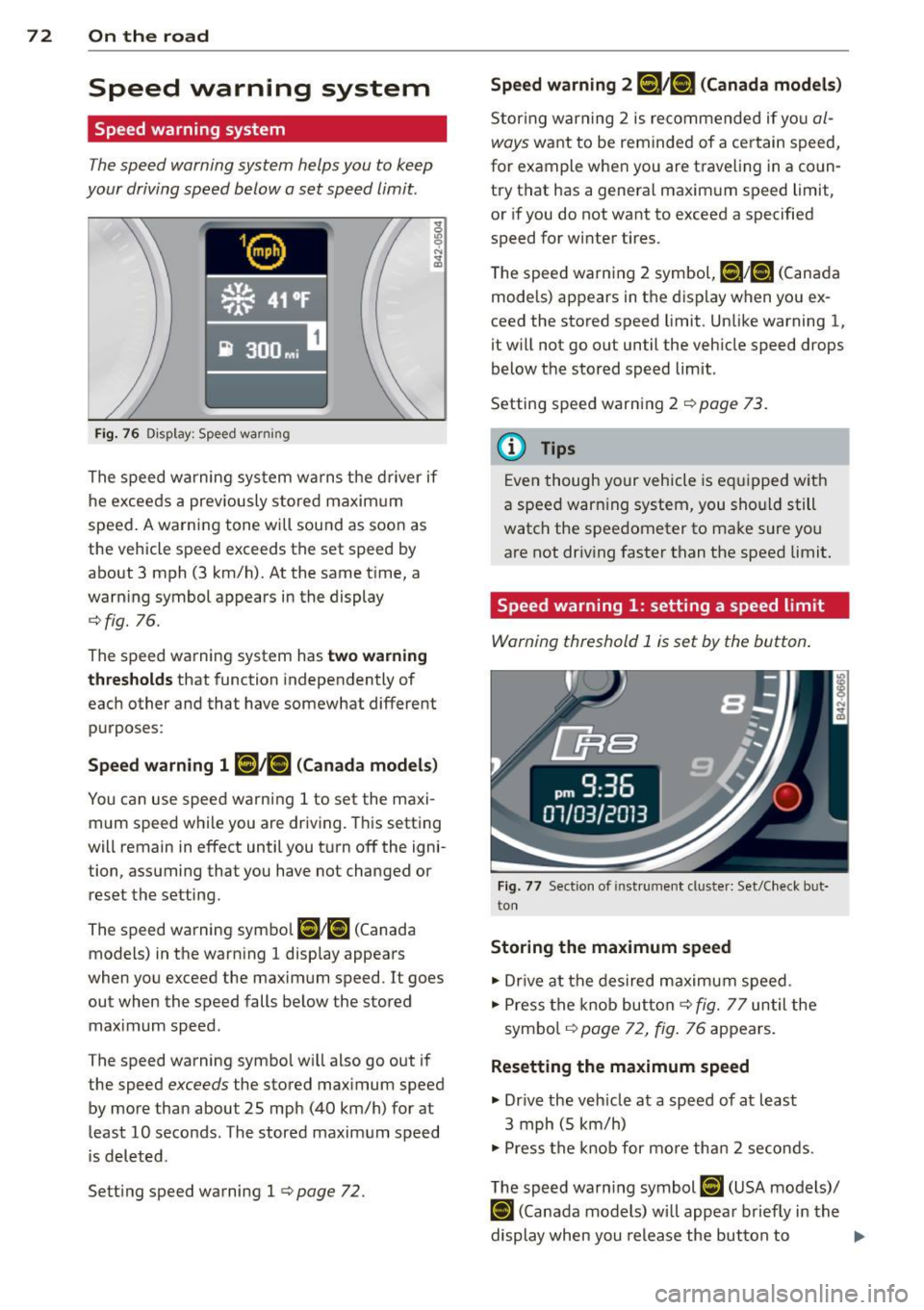
Fi g. 7 6 D isplay: Speed warning
The speed warning sys tem warns the d river if
he exceeds a prev iously stored maxim um
speed. A warning tone will sou nd as soon as
the vehicle speed exceeds the set speed by
about 3 mph (3 km/h). At the same t ime, a
warn ing symbol appears in the display
¢fig. 76.
The speed warning system has
two warning
th reshold s that function independently of
each other and that have somewhat different
purposes:
Speed warn ing 1 HIil/iS) ( Canada model s)
You can use speed warning 1 to set the maxi
m um speed w hile you are driving. This setting
will remain in effect until you t urn off the igni
tion, assuming that you have not changed or
reset the setting.
The speed warning symbo l
[l;[i] (Canada
models) in the warn ing 1 display appears
when you exceed the maximum speed. It goes
out when the speed falls be low the stored
maximum speed .
The speed warning symbo l w ill also go out if
the speed
exceeds the stored max imum speed
by more than about 25 mph (40 km/h) for at
least 10 seconds. The stored maximum speed
i s deleted.
Sett ing speed warning 1
¢page 72.
Speed warning 2 [Cl!r.t] (Canada models)
Stor ing warning 2 is recommende d if you al
ways
want to be reminded of a ce rtain speed,
for example when you are t rave ling in a co un
try that has a general maxim um speed limit,
or if you do not want to exceed a specified
speed for winter tires.
The speed warn ing 2 symbol,
tt]/[f] (Canada
models) appears in t he display when yo u ex
ceed the stored speed limit. Unlike warning 1,
it will not go o ut until the vehicle speed drops
below the stored speed limit .
Setting speed warn ing 2
¢ page 73.
a) Tips
Even though your vehicle is eq uipped w ith
a speed war ning system, you sho uld still
watc h the speedometer to ma ke s ure yo u
are not driv ing faster than the speed limit.
Speed warning 1: setting a speed limit
Warning threshold 1 is set by the button .
Fig. 77 Section of ins trumen t cl uster: Set/C heck bu t
ton
Storing the maximum speed
" Dr ive at the des ired maximum speed.
" Press the knob but ton¢
fig. 77 until the
sym bo l
i=!:> page 72, fig . 76 appears .
Resetting the maximum speed
" Dr ive the veh icle at a speed of at least
3 mph (5 km/h)
" Press the knob for mo re tha n 2 seconds .
The speed warn ing symbol
[CJ (USA mode ls)/
i•j (Canada models) will appea r briefly in the
display when you release the but ton to
Ill>
Page 77 of 244
_& WARNING
You should only return to the saved speed if it is not too fast for the current traffic
conditions - risk of an accident!
Audi magnetic ride
Damping can be adjusted to the driver's pref
erence and it adapts automatically to the cur
rent driving situation.
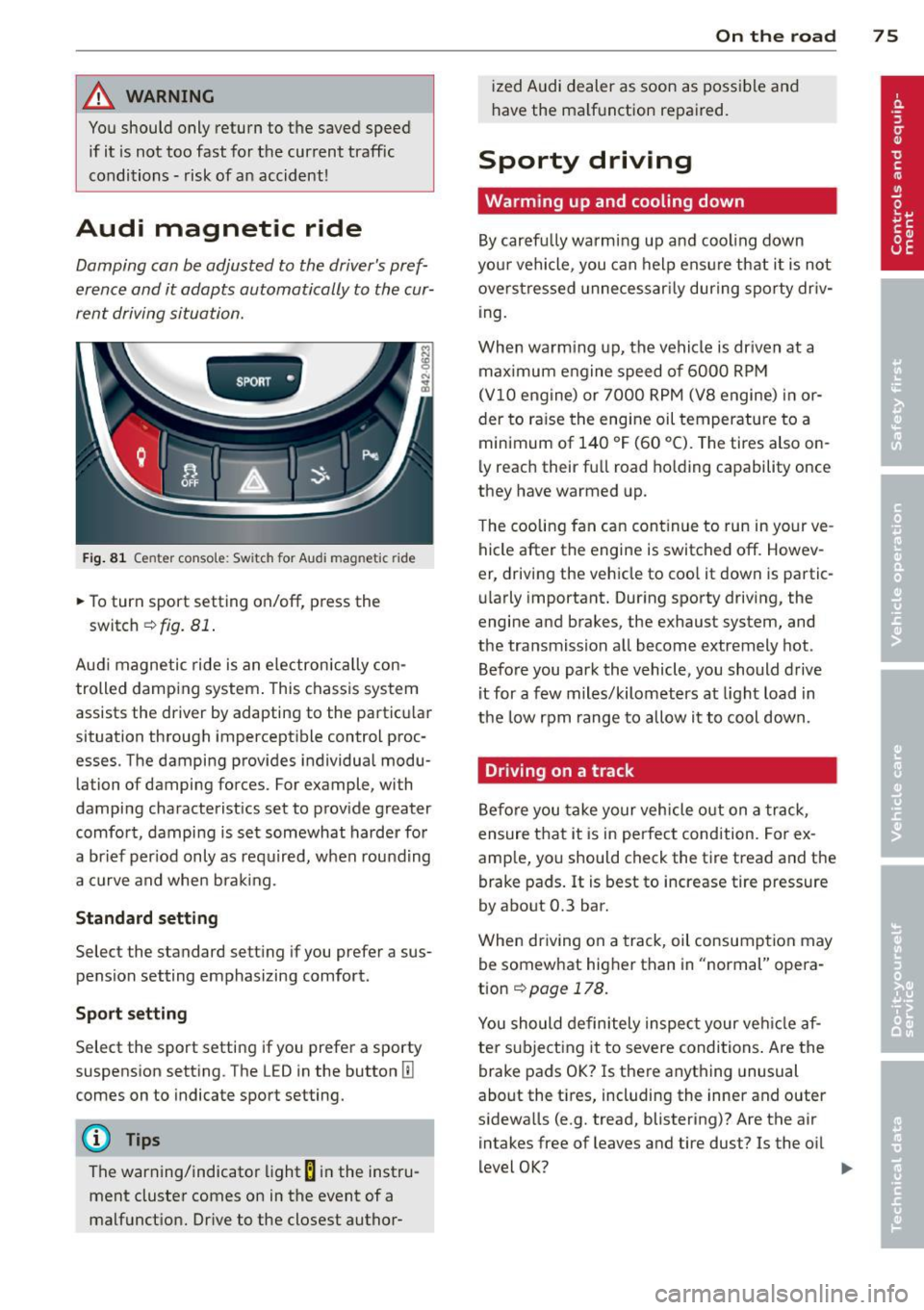
SPORT •
Fig. 81 Center conso le : Switch for Audi magnetic ride
.,. To turn sport setting on/off, press the
switch
¢fi g. 81 .
Aud i magnetic ride is an electronica lly con
trolled damping system . This chassis system
assists the driver by adapting to the particu lar
situation through imperceptible control proc
esses. The damping provides individual modu
lation of damping forces. For example, with
damping characteristics set to prov ide greater
comfort, damping is set somewhat harder for
a brief period only as required, when rounding
a curve and when brak ing.
Standard setting
Select the standard setting if you prefer a sus
pension setting emphasizing comfort.
Sport setting
Select the sport setting if you prefer a sporty
suspension setting. The LED in the button
II]
comes on to indicate sport setting.
@ Tips
The warning/indicator light Bin the instru
ment cluster comes on in the event of a
malfunction. Drive to the closest author-
On the road 75
ized Audi dealer as soon as possible and
have the malfunction repaired.
Sporty driving
Warming up and cooling down
By carefully warming up and cooling down
you r vehicle, you can help ensure that it is not
overstressed unnecessar ily during sporty driv
ing .
When warm ing up, the vehicle is driven at a
maximum engine speed of 6000 RPM
(Vl0 engine) or 7000 RPM (V8 engine) in or
der to raise the engine oil temperature to a
minimum of 140 °F (60 °C). The tires also on
ly reach their full road holding capability once
they have warmed up.
The cooling fan can cont inue to run in your ve
hicle after the engine is switched off. Howev
er, driving the vehicle to coo l it down is partic
ularly important. During sporty driving, the
engine and brakes, the exhaust system, and
the transmission all become extremely hot.
Before you park the vehicle, you should drive
it for a few m iles/kilometers at light load in
the low rpm range to allow it to cool down.
Driving on a track
Before you take your vehicle out on a track ,
ensure that it is in perfect condition. For ex
amp le, you should check the tire tread and the
brake pads. It is best to increase tire pressure
by about 0.3 bar.
When driving on a track, oil consumption may
be somewhat higher than in "normal" opera
tion
r=> page 178.
You should definitely inspect your vehicle af
ter subject ing it to severe conditions . Are the
brake pads OK? Is there anything unusual
about the tires, including the inner and outer
sidewalls (e.g. tread, blistering)? Are the air
intakes free of leaves and tire dust? Is the oil
level OK? .,,.
Page 101 of 244
In a collision, the laws of physics mean that
even smaller items that are loose in the ve hi
cle will become heavy missiles that can cause
serious injury. Items in the vehicle possess en
ergy which vary with vehicle speed and the
weight of the item . Vehicle speed is the most
sig nificant factor.
For examp le, in a frontal coll is ion at a speed
of 30 mph (48 km/h), the forces acting on a
10 -lb (4 .5 kg) object are about 20 times the
norma l we ight of the item. Th is means that
the we ight of the item would suddenly be
about 200 lbs. (90 kg). You can imag ine the
in ju ries that a 200 lbs. (90 kg) item flyi ng
freely th roug h the passenge r compartment
could cause in a collision like this.
~ WARNING
Improperly stored luggage or other items
can fly through the vehicle ca us ing serious
personal in jury in the event of hard brak
ing or an acc ident. To help reduce the risk
of serious personal injury :
-Always put objects, for examp le, luggage
or other heavy items in the luggage com
partment .
A WARNING
Heavy loads will influence the way your ve
hicle handles . T o help reduce the r is k of a
loss of control leading to ser ious personal
injury:
- Always keep i n m ind whe n transporting
heavy objects, that a c hange in t he cen
t er of g ravity c an also cause c hanges in
vehicle handling .
- Never exceed the G ross Ax le Weight R at
ing or the Gross Veh icle Weight R ating
specified on t he safety compliance s tic k
er on the left door jamb. Exceeding pe r
missib le we ight standa rds can cause the
vehicle to s lide and handle differently.
- Please obse rve info rmation on safe driv
ing
c:;, page 93 .
Dr iving S afel y 99
A WARNING
Always make sure that the doors, all win
dows a nd the front lid are secure ly closed
and locked to reduce the r is k of injury
when the vehicle is not be ing used .
- After closing the front lid, always make sure that it is p rope rly closed and locked .
- Never leave your veh icle unattended es
pecially with the front lid left open . A
child co uld craw l into the luggage com
pa rtment and close the front lid becom
ing tr apped and unable to ge t out. Being
trapped in a veh icle can lead to se rious
pe rsonal injury .
- Never let c hild ren play i n or aroun d the
veh icle .
- Never let p assenger s ride in the luggage
comp artment. Vehicle oc cupants mus t
always be prope rly restrained in one of
the vehicle's seating pos it ions .
(D Tips
The t ire press ure mu st cor respond to t he
l oad. The t ire p ress ure is shown on the tire
pressure label. The tire pressure labe l is lo
cated on the d river's side B-pi llar . The t ire
pressure label lists the recommended cold
tire inflation pressures for the vehicle at i ts maximum capac ity we ight and the tires
that we re on your vehicle at the t ime it
was manufactured. For recommended tire
p ressures fo r no rma l load cond it ions,
please see chapter
c:;, page 193.
Reporting Safety
Defects
Applicable to U.S.A.
If you belie ve that your vehi cle
has a d efe ct which could cau se
a crash or could caus e injur y or
d eath, you should immediat ely
inform th e National High way
Tr affi c Safet y Administration
•
•
Page 147 of 244
switched on all the time. In certain situations
when you need less traction, you can switch
off ESC by pressing the button
lru. Be sure to
switch ESC on again when you no longer need
less traction.
Anti-lock braking system (ABS)
ABS prevents the wheels from locking up
when braking . The vehicle can still be steered
even during hard braking . Apply steady pres
sure to the brake pedal. Do not pump the ped
al. A pulsing in the brake pedal indicates that
the system is helping you to brake the vehicle.
Brake assist system
The brake assist system can decrease braking
d istance. It increases braking power when the
driver presses the brake pedal quickly in emer
gency si tuations. You must press and hold the
brake pedal until the situation is over .
Anti-slip regulation (ASR)
ASR reduces engine power when the drive
wheels begin to spin and adapts the force to
the road condit ions. This makes it easier to
start, accelerate and drive up hills.
Electronic differential lock (EDL)
The EDL brakes wheels that are spinning and
transfers the drive power to the other drive
wheel or whee ls if the vehicle is equipped with
all-wheel drive*. This function is available up
to about 60 mph (100 km/h) .
In extreme cases, EDL automat ica lly switches
off to help keep the brake on the braked wheel
from overheating. EDL w ill switch on again au
tomatically when conditions have returned to
normal.
..&, WARNING
- ESC, ABS, ASR and EDL cannot overcome
th e laws of physics. This is especially im
portant on slippery or wet roads.
If the
systems begin acting to stabilize your ve
hicle, you should immediately change
yo ur speed to match the road and traffic
condit ions. Do not let the increased safe
ty provided by these systems tempt you
Intelligent technology 145
to take risks. Doing so will increase the
risk of a lo ss of vehicle control, co llision
and serious personal injuries.
- Always adapt your speed to road, traffic
and weather conditions. The risk of los
ing control of the vehicle increases when
driving too fast, especially through
curves and on slippery or wet roads, and
when driving too close to vehicles up
ahead. ESC, ABS, the brake assist sys
tem, EDL and ASR cannot prevent colli
sions.
- Always accelerate with special care on
even, smooth surfaces such as those that
are wet or covered with ice and snow.
The drive wheels can spin even with
these assistance systems that cannot al
ways he lp to reduce the risk of loss of ve
hicle control.
@ Tips
- ABS and ASR only work correct ly when
all four whee ls are equipped with identi
cal tires. D ifferent tire si zes can lead to a
reduction in engine power.
- You may hear noises when the systems
described are working.
- If the ind icator lightD] orE (USA
models)/ [iJ (Canada models) appears,
there may be a malfunction¢
page 16,
¢ page 15.
Switching on/off
£SC turns on au tomatically when you start
the engine.
-
SPORT •
Fig. 1 28 Cent er console w it h t b utton
Page 151 of 244
Power steering
When the engine is running, power steering
makes it easier for the driver to steer.
Power steering he lps the driver steer the vehi
cle with little physical effort .
If the engine is not runn ing, the power steer
ing system is also not wo rking. In this case,
you will find it extreme ly difficult to turn the
steering whee l.
If you t urn t he steering fully to the le ft or
right when the vehicle is stationary, you place
a very heavy load on t he power steering sys
tem . T urning the steering wheel fu lly to the
left or r ight will cause noise in the system . It
a lso reduces engine idle speed.
(D Note
Do not hold the steering turned fully to
the left or right for more than 10 seconds
when t he engine is running. There is a risk
of damage to the power steeri ng system .
@ Tips
-In the event of a power steering system
failure, or if the eng ine is not running
(while being towed), you wi ll st ill be able
to stee r the ve hicle . However, you will re
quire more effort to do so .
- If the power steer ing system has a leak
or is defective, you should immed iately
contact a qualif ied wo rkshop.
- The powe r stee ring system requires a
spec ial hyd raulic f luid. The powe r stee r
i ng fl uid reservo ir is lo cated in the en
g ine compar tment . Th e cor re ct hydra ulic
f lui d leve l is important for p ro per opera
tion o f the power steering sys tem . The
power steer ing fl uid leve l is checked ac
cord ing to the Aud i maintenance service
schedule.
Dry sump Lubrication
H igh lateral and long itud inal forces affect the
engine and the vehicle d uring sporty driving.
Ory sump lubr ication ensures that your eng ine
Int ellig ent technolog y 149
is supplied wi th oi l and properly lubricated
even under these conditions .
In a "no rma l" veh icle the o il pump sends the
o il from the o il p an t o the lubr ication points in
t h e engine. The oi l then ret urns to the o il pan .
In extreme situations , the oil p ump may draw
in a ir, which results in insufficient oi l pressure.
Wi th dr y sump lubri cat ion, the o il is not in the
oi l pan (it is "dry"), but in a separate oil tank.
While one p ump supplies t he e ngine with oil ,
a second pump suctions the oil out of the en
gine and returns it to the oil tank. Because the
o il tank is tall and narrow, oil pressure is con
stant even under extreme conditions .
In add ition, the oi l pan in vehicles with dry
sump l ubrication is noticeab ly shallower. This
allows the engine to be installed lower in the
vehicle , bring ing down the center of grav ity .
T his imp roves your ve hicle's handling .
Driving with your
quattro ®
With all-wheel drive, all four wheels are driv
en.
General information
With a ll-wheel d rive, powe r is distr ib uted to
al l four wheels. This happens autom atic ally
depen ding on your d riving s tyle and the ro ad
conditions a t the time . See also ¢
page 144.
The all-whee l dr ive concept is des igned for
high eng ine power. Your veh icle is except ion
al ly powe rf ul and h as ex cellen t driving charac
teristics both under normal driving cond itions
and on snow and ice . Always read and follow
safety precaut ions ¢&. .
Winter tires
When dr iving in the win ter, yo ur vehicle wi th
a ll- wheel d rive h as an advantage, even w it h
regular tires. In winter road conditions it may
be advisable to mount winter tires (or all-sea
son tires) for improved driveability and brak
ing : these tires must be mounted on
all four
wheels . See also¢ page 203, Winter tires. .,..
•
•
Page 152 of 244

150 Intellig ent technolog y
Snow chain s
Where t ire cha ins are mandatory on certain
roads, this normally a lso applies to vehicles
with a LL-wheel drive
¢ page 204, Snow
chains .
Replacing wheels /t ir es
Vehicles with all-wheel drive must a lways
have tires of the same size. Also avoid t ires
with different tread depths. For details see
page
¢ page 199, New tires and replacing
tires and wheels.
Off -Ro ad dri ving?
Your Aud i does not have enough ground clear
ance to be used as an off -road veh icle .
It is
therefore best to avoid rough tracks and un
even terrain as much as possible . Also refer to
¢ page 153.
A WARNING
-Always adjust your driving to road and
traffic conditions. Do not let the extra
safety afforded by all-wheel drive tempt
yo u into taking extra risks.
- Although the all-wheel dr ive is very ef
fective, always remember that braking
capacity is limited by t ire traction . You
should the refore not dr ive at excessive
speeds on icy or slippery road su rfaces.
- On wet road surfaces, be careful not to
dr ive too fast because the front wheels
cou ld beg in to s lide on top of the w ater
(aquaplaning) .
If this should occ ur, you
will have no warning from a sudden in
crease in engine speed as with a front
wheel drive vehicle. A lways drive at
speeds wh ich are suited to the road con
ditions. -risk of crash.
Energy management
Starting ability is optimized
Energy management controls the distribution
of electrical energy and thus optimizes the
availability of electrical energy for starting the engine.
If a vehicle with a conventional energy system
is not driven for a long per iod of t ime, the bat
tery is discharged by idling current consumers
(e .g. immobilize r). In certa in circumstances it
can resu lt in the re be ing insufficient energy
available to start the engine.
Intelligent energy management in your vehi
cl e ha ndles the distribution of e lectr ica l ene r
gy . Start ing ability is ma rkedly improved and
the life of the battery is extended .
Bas ica lly, energy management consists of
b att ery diagn osis, idlin g current manage
m ent
and dynamic en erg y manag em ent .
Battery di agnosis
Battery diagnosis continuously determines
the state of the battery. Sensors determine
battery voltage, battery cu rrent and battery
tempe rature. This determines the current
state o f charge and the power of t he battery .
Idling current m anagem ent
Idling current management reduces energy
consumption while the vehicle is standing .
With the ig nition sw itched off, it controls the
energy supply to the various electri ca l compo
nents. Da ta from ba ttery diagnos is is cons id
ered.
Depend ing on the batte ry's state of cha rge,
individual cons ume rs a re g radually turned off
to prevent excessive discharge of the battery
and th us maintain starting capability.
Dynamic energy manag ement
While the vehicle is being d riven, dynamic en
ergy ma nagement distr ibutes the energy gen
era ted a ccord ing to t he needs of the individ u-
al components .
It regula tes consumption, so
t h at more electrical energy is not being used ..,.
Page 156 of 244
154 Driving and en vironm ent
• Never put too much motor oil in your engine
¢ page 180, Adding engine oil
The cata lytic converter is an efficient "clean
up" device built into the exhaust system of
the vehicle. The catalytic converter burns
many of the pollutants in the exhaust gas be
fore they are released into the atmosphere.
The exclusive use of unleaded fue l is critically
important for the life of the cata lytic convert
er and proper functioning of the engine.
A WARNING
- Do not park or operate the veh icle in
areas where the hot exhaust system may
come in contact with dry grass, brush,
fuel sp ill or other material which can
cause a fi re.
- Do not apply additional undercoating or
rustproofing on or near the exhaust
man ifold, exhaust p ipes, catalytic con
verte r o r heat shie lds . D uring d riving, the
substance used for undercoating cou ld
overheat and cause a fire.
([) Note
- Be aware that just one tank f illing with
le aded fuel will already seriously de
grade the performance of the catalytic
converter.
- Do not exceed the correct engine oil leve l
¢page 180 .
-Do not drive until the fuel tank becomes
completely empty. The eng ine could mis
fire. Unburned f uel could a lso get into
the exhaust system and this could cause
the catalytic converter to overheat.
- Do not turn
off the ignition while the ve
hicle is moving .
- Do not continue to operate your vehicle
under these conditions, as otherwise fuel
can reach the catalytic converter. This
could result in overheat ing of the con
verter, requ iring its replacement.
- To assure efficient operation of the Emis sion Control System: -
Have your vehicle maintained properly
and in accordance with the service rec
ommendat ions in yo ur Warranty
&
Maintenance book let.
- Lack of proper maintenance as we ll as
improper use of the vehicle will impair
the function of the emission contro l
system and could lead to damage.
@ For the sake of the env ironment
Even when the Emission Control System is
operating proper ly, the exhaust gas can
have a sulfur-like exhaust gas smell under
some operat ing states . This depends on
the sulfur content of the fuel being used .
Using a different brand of fue l may help,
or fil ling the tank with lead-free super
grade gasoline.
Shutting down vehicle
If you would like your vehicle to remain inop
erative for a longer per iod of t ime, contact an
Audi or othe r specialized dealer. They can ad
vise you on necessary precautions e.g . corro
sion prevention, maintenance and storage.
Pay attention to additional informat ion con
cerning the battery. Refer to<=>
page 184.
Operation and
maintenance
Fuel economy, env ironmental impact, and
wear on your eng ine, brakes and tires largely
depend on three facto rs:
-your personal driving style
- operating conditions
- technical limitat ions
By having your veh icle regu larly se rviced by an
authorized Audi dea ler helps to ensure that it
runs properly and economica lly. The condition
of your vehicle not only affects its safety and ability to hold its va lue, it also affects
fu el
cons umpt ion.
The amount of oi l used is re lated to engine
l oad and speed.
Page 159 of 244
Hand washing
When washing your veh icle by hand, fi rst soft
en the dirt with copious amounts of water and rinse it
off as b est you can.
Then clean the veh icle using a soft
s ponge , an
auto gl ove or a low -press ure wa sh bru sh .
Work from the top down -sta rting with the
roof . Use a
s h ampoo only for very stubborn
dirt.
Rinse the sponge or auto glove thorough ly at
fr equent intervals.
C lea n the wheels, doo r sill s and simi lar a reas
last . Use a separate sponge fo r th is.
_&. WARNING
- Car washes with conveyors can damage
the vehicle tires , which could cause the
ti re to lose pressure sudden ly while driv
ing and put you at risk for an accident.
Do not use car washes with conveyors.
- Switch
off the ignit ion when you wash
yo ur vehicle to avo id an accident.
- Protect yo ur hands and arms from sharp
metal edges when you clean the under
body, the ins ide of the whee l wells or the
wheel covers to avoid cutting yourself .
- When washing your vehicle in the winter:
Moist ure and ice in the brake system can
affect the brakes.
- Never wash tires with a jet that sprays
water in a direct stream . T hi s could cause
invisible damage to the tires and weaken
them, even if the spray is from a relative
ly long distance and for a short time.
Damaged and wea kened tires can fail
and cause a ccidents and pe rsonal inj ury.
0 Note
- Never dr ive your veh icle through any au
tomatic car wash that fails to p rov ide e i
the r suff icient clearance for your veh icle
or sufficient tra ck wid th fo r your tires .
Ris k of expensive damage to the veh icle's
u nderbody, tires, and rims!
- As descr ibed in you r Warra nty
& M ainte
nance booklet , damage or malf unct ion
Cleaning and protec tion 157
due to m isuse o f the vehicle or fai lure to
operate the vehicle in acco rdance with
the inst ruct ions of th is Owner's Manua l
wi ll not be covered under warranty.
- Fold the exte rior mirrors flat -there is a
r isk of damag ing the exterior m irrors .
Power folding exterior mirrors must not
be folded in or out by hand . Use the pow
er function!
- Do not wash the vehicle in d irect sun
light . You may damage the paint.
- Do not use sponges designed to remove
insects, rough k itchen sponges , or s imi
lar products . You risk damag ing the
pai nt s urface.
- Do not wash the vehicle using cleani ng
products that contain alcohol when the
e ng ine is ho t. This increases the risk of
damage to plast ic components, such as
c rack ing .
- You should remove deb ris (such as in
sects) from the headlight lenses on a
regu lar bas is, for example when re fuel
ing your vehicle. Never clean the head
lights with a dry cloth or sponge. Use a
wet cloth o r sponge . It is best to use
soapy water.
- Never clean t ires using a nozz le that
sprays water in a direct stream. Damage
can occur even with a relatively long
spraying distance and for a very short
t ime.
- To avoid damaging your veh icle, always
make sure that there is sufficient dis
tance between the spray head and soft
materials like rubbe r hoses, plast ic parts
and sound-deadening materials. Never
aim the spray head a t the same point for
a long time. This also app lies to cleani ng
head lights and pa inted b umpers . Re
member : the closer the nozz le is to the
surface of the material, the greater the
stress on the materia l.
@ For the sake of the environment
Wash yo ur vehicle on ly at spec ia lly de
signed facilities . They can prevent any dirty
water contaminated by oil from entering
Iii>-
•
•