air condition AUDI R8 SPYDER 2015 User Guide
[x] Cancel search | Manufacturer: AUDI, Model Year: 2015, Model line: R8 SPYDER, Model: AUDI R8 SPYDER 2015Pages: 232, PDF Size: 58.36 MB
Page 109 of 232
..... N
r-N "': ..... \!) 1.1'1
N 1.1'1 .....
The front Advanced Airbag System supp lements
the safety belts to provide additiona l protection
for the driver's and front passenger's heads and
upper bodies in frontal crashes. The a irbags in
flate only in frontal impacts when the vehicle de
celeration is h igh enough .
The front Advanced Airbag System for the front
seat occupants is not a substitute for your safety be lts. Rather, it is pa rt of the overall occupant re
straint system in your vehicle. Always remember
that the airbag system can only help to protect
you, if you are sitt ing upright, wearing your safe
ty belt and weari ng it properly. This is why you
and your passengers m ust always be properly re
strained, no t just because the law req uires you to
be .
The Advanced Airbag System i n your veh icle has
been certified to meet the " low risk " requi re
men ts fo r 3 and 6 yea r-old ch ildren on the pas
senger side and very small ad ults on the driver
side . The low risk deployment criteria are intend
ed to he lp reduce the r isk of injury through inter
action with the front airbag that can occur, for
examp le, by being too close to the steering wheel
and instrument pane l when the airbag inf lates.
In addition, the system has been certif ied to
comp ly w ith the "suppression" requ irements of
the Safety Standard, to turn off the front airbag
for infants 12 months old and younger who are restra ined o n the front passenger seat in c hild re
straints that are listed in the Standard
~ page 124, Child restraints and Advan ced Air
bags.
"S uppression" requires the front airbag on the
passenger side to be turned off if:
- a ch ild up to about one year of age is restrained
on the front passenger seat in one of the rear
facing o r forward-fac ing in fant rest raints listed
in Federa l Moto r Ve hicle Safety Standard
208
with wh ic h t he Advanced Ai rbag System in your
vehicle was cer tified. For a list ing of the ch ild
r es traints that were used to cert ify you r vehi
cle's compliance with t he US Safety Standard
~ page 124, Airbag
syste m
- weight less than a thresho ld level stored in the
cont ro l unit is detected on the front passenger
seat.
When a person is detecte d on the front passen
ger seat, weigh ing more than the tota l we ight of
a chi ld that is about 1 year old restrained in one
of the rear -facing or forwa rd-fac ing infant re
stra ints (listed in Federal Motor Vehicle Safety
Standard
208 with wh ich the Advanced Airbag
System i n your veh icle was certified), the front
airbag on the passenge r side may or may not de
ploy .
The
PASSENGER AIR BAG OFF light comes on
when the elect ro nic cont ro l unit detects a total
we ight on the fro nt passenger sea t that requires
the front airbag to be tu rned off . If the
PASSEN
GER AIR BAG OFF
light does not come on, the
fron t airbag on t he passenger side h as not bee n
tu rned off by the control unit and can dep loy if
t h e con trol unit senses an impact that meets t he
conditions stored in its memo ry .
If the tot al weight on the fr ont p assenge r seat is
more than that o f a typical 1 year-o ld, b ut less
t h an the weight of a small adult, the front airbag
o n the passenge r side may deploy (the
PASSEN
GER AIR BAG O FF
light does not come on).
For example , the airbag ma y deploy if:
- a small ch ild that is heav ie r than a typical 1
yea r-old ch ild is on the front passenge r seat ( re
ga rdless o f whether the chi ld is in one of the
child sa fe ty seats listed~
page 124),
-a child who has outgrown ch ild res traint s is on
t he fron t passenger seat.
If th e front passenger a irbag is turned off, the
PASSENGER AIR BAG OFF light in the center of
t h e instr ume nt pane l w ill come on and s tay on.
The front airbag o n the passenge r side may
not
deploy ( the PASSENGER AIR BAG OFF light does
not ill umi nate and s tay lit) if:
- a small adult or teenager is on the front pas
senger seat
- a passenger who is not s itting upright with
their back aga inst a non-reclined backrest with
their feet on the vehicle floor in front of th e
seat is on t he front passenger sea t.
IJl,
107
Page 124 of 232
Child Safety
Child Safety
Important things to
know
Introduction
The physical principles of what happens when
your vehicle is in a crash apply also to children
c::> page 96, What happens to occupants not
wearing safety belts? .
But unlike adults and
teenagers, the ir muscles and bones are not fully
developed . In many respects children are at
greater risk of serious injury in crashes than
adu lts.
Because children 's bod ies are not fully developed,
they require restra int systems especially de
signed for their size, weight, and body structure. Many countr ies and all states of the United
S ta tes and p rov inces of Canada have laws requi r
ing the use of app roved ch ild restra int systems
for in fan ts and small children .
I n a fronta l crash at a speed of 20-35 mph
(30-56 km/ h) the fo rces acting on a 13-pound
(6 kg) infant w ill be more than 20 t imes the
weight of the child. This means the weight of the
chi ld would sudden ly be more than 260 po unds
(120 kg) . Under these conditions, only an appro
priate ch ild restraint properly used can reduce
the risk of serious injury. Ch ild restraints, like
adu lt safety be lts, must be used p roperly to be
effective . Used improperly, they can increase the
ris k of serious injury in an accident.
Consult the child safety seat manufacturer's in
structions in order to be sure the seat is r ight for
your child's size
c::> page 125, Important safety
instructions for using child safety seats .
Please
be sure to read a nd heed all of t he importa nt in
formation and WARNI NGS about c hild safety, Ad
vanced Ai rbags, and the installa tion of child re
s traints in this chapter .
There is a lot you need to know about the Ad
vanced A irbags in yo ur vehicle and how t hey work
when infants and children in child rest rain ts are
on the fron t passenger seat . Because of the large
amo unt of important informat ion, we cannot re
peat it a ll here. We urge you to read the detai led
122
i nformation in this owner 's man ua l about airbags
and the Advanced Airbag System in your vehicle
and the very important information about trans
porting children on the front passenger seat.
Please be sure to heed the WARNINGS - they are
extremely important for your safety and the safe
ty of your passengers, especially infants and
small chi ld ren .
&_ WARNING
All vehicle occupants and especially chi ld ren
must be res trained p roperly whenever r iding
in a vehicle. An unres trained or imprope rly re
strained chi ld could be inj ured by strik ing the
inte rior or by being ejected from the vehicle
during a sudden maneuver or impact. An un restra ined or improperly restrained child is al
so at greater risk of injury or death through
contact w ith an inf lating a irbag.
&_ WARNING
Children on the front seat of any car even with
Advanced Airbags can be ser iously injured or
even killed when an a irbag inflates . A child in
a re arwa rd-facing child safety seat installed
on the front passenger seat will be serio usly
injured and can be kil led if the front air bag in
f lates.
- The infla ting airbag will h it the ch ild safety
seat or in fant ca rrier with great force and
w ill smash the child safety seat and child
aga inst the backrest, door or roof.
- Never install a rearward facin g child safety
seat on the front passenger seat unless the
PASSENGER AIR BAG OFF light comes on
and stays on. If the
PASSENGER AIR BAG
OFF
li ght does not come on and stay on,
have the airbag system inspected immed i
ately by your Au di dealer .
&_ WARNING
If, in exceptiona l circumstances , you must in
stall a forwa rd-fac ing c hild restra int on the
front p assenger's seat:
Page 136 of 232
Intelligent technology
Intelligent technology
Notice about data
recorded by vehicle
control modules
Your vehicle is not equipped with an Event Data
Reco rder (EDR) , insta lled by some manufactu rers
for the express pu rpose of captur ing data fo r re
trieval after an accident or crash event. ED R 's are
sometimes called "crash recorders" .
Some state laws restrict the retr ieval or down
loading of da ta stored by EDR's that were instal
led in a vehicle for the express p urpose of retriev
ing data after an accident or crash event without
the owner's consent.
Al though you r vehicle is not eq uipped w ith an
E DR, it is equipped with a number of electronic
control modu les for vario us vehicle systems such
as, for example, engine function, emission con
trol, as we ll as for the airbags and safety belts.
These electronic control modules also record ve
hicle-related data during norma l vehicle opera
tion for diagnostic and repair purposes . The re
cording capacity of the electronic contro l mod
ules is lim ited to data (no sound is recorded) and
only a small amount of data is actually recorded
over a very l imited per iod of t ime and stored
when a system fault or other condition is sensed by a control unit. Some of the data then stored
may re late to veh icle speed, direction, braking as
well as restraint system use and performance in
the event of a crash o r other cond ition . Stored
data can only be read and downloaded with spe
cial equipment.
Electronic Stabilization
Control (ESC)
Description
ESC helps to improve road holding and vehicle
dynamics to help reduce the probability of sk id
d ing and loss of veh icle contro l.
It works only
when the engine is runn ing. ESC detects certain
d ifficult driving situations, including when the ve
h icle is beginn ing to spin (yaw) out of control and
he lps you to get the veh icle back under control by
134
selective ly braking the wheels, and/or reducing
engine power and providing steering assistance
to help ho ld the veh icle on the driver's intended
course. The ind icator light
GJ in the instrument
cluster blinks when ESC is taking act ion to help
you contro l the vehicle .
ESC has limitations. It is important to remember
that ESC cannot overcome the laws of physics. It
will not always be able to help out under all con
dit ions you may come up against. For example,
ESC may not always be able to help you master
s ituations where there is a sudden change in the
coefficient of fric tion of the road surface. When
there is a sect ion of dry road that is suddenly cov
ered with water, slush or snow, ESC cannot per
f orm the same way it would on the dry surface . If
the vehicle hydrop lanes (rides on a cushion of wa
ter instead of the road surface), ESC will not be
able to help you steer the vehicle because contact
with the pavement has been interrupted and the
vehicle cannot be braked or steered . During fast
corner ing, particularly on wind ing roads, ESC
cannot always dea l as effectively with difficult
driv ing situations as at lower speeds .
Always adjust your speed and driving style to road, traffic and weather condit ions . ESC cannot
overr ide the veh icle's phys ica l limits, increase the
available traction, or keep a vehicle on the road if
road departure is a result of driver inattention.
Instead, ESC improves the possibility of keeping
the vehicle under control and on the road during
extreme maneuvers by using the driver's steering
inputs to help keep the vehicle going in the in
tended direction. If you are traveling at a speed
that causes you to run off the road before ESC
can prov ide any assistance, you may not experi
ence the benefits of ESC.
ESC includes and/or works together with the an
ti-lock brake system (ABS), brake assist sys tem
and anti -slip regulation (ASR) . ESC is sw itched on
all the t ime . In certai n situations when you need
less tract ion, you ca n sw itch off ESC by p ress ing
the button
l!l . Be sure to sw itch ESC on again
when you no longe r need less traction. .,..
Page 139 of 232
..... N
r-N "': ..... \!) 1.1'1
N 1.1'1 .....
This can cause a temporary reduction in braking
force compared to dry brakes. You can compen
sate for this by pressing the brake pedal harder.
Cor ro sion
There may be a tendency for dirt to bui ld up on
the brake pads and corrosion to fo rm on the discs
if the car is not driven regularly or only for short
trips with little use of the brakes.
If the b rakes are not used frequently, or if corro
sion has formed on the discs, it is advisab le to
clean off the pads and discs by braking firmly a
few times from a moderately high speed
c:> &. .
Faults in the brake sy stem
If you should notice a sudden increase in brake
pedal travel, then one of the two brake circuits
may have fai led
c:> .&, .
Low brak e flu id le vel
Malfunct ions can occur in the brake system if the
brake fluid level is too low. The brake flu id leve l is
monitored e lectronically.
Br ake power assis t un it
T he brake power assist unit increases the pres
sure that you generate with the brake pedal.
It
works only when the eng ine is running .
Brak e lining wear sta tu s
Brake lining wear may be checked by visual in
spection of the condition of the brake pads
through the openings in the wheel. If necessary,
the wheel may be removed for this inspection
c:> page 203 .
.8, WARNING
-New brake pads don't have the best stop
ping power and must be "broken-in" during
the init ial 250 mi les ( 400 km) of normal city
driving. The break -in period can be consider
ably longer for vehicles with ceramic brake
rotors *. You can compensate for this by
pressing the brake pedal more firmly. This
also applies later when new pads are instal
led .
- You should perform brak ing maneuvers for
the purpose of clean ing the brake system
Int elli ge nt te chn olo gy
only if road conditions permit. Other road
users must not be put at r isk -you may
cause an accident!
- Before descending a steep grade, reduce
speed and sh ift transmission into a lower
gear or lower dr iving range. Do not ride the
brakes or hold the pedal down too long or
too often. This could cause the bra kes to get
hot and dimin ish braking effic iency .
- Do not "ride the brakes" by rest ing your foot
on the pedal when you do not intend to
brake. This may cause the brakes to over
heat, premat ure wear and increased stop
ping distance.
- Under certain cl imatic and operat ing condi
tions such as passing thro ugh water, dr iv ing
in heavy rain or after washing the vehicle,
the effectiveness of the brakes can be re
duced . In winter, ice can accumulate on the
brake pads, lin ings, discs and drums. Care
fully apply brakes for a test. Brakes will dry and ice coatings will be cleaned off after a
few careful brake applications.
- Driving for an extended period of t ime on
salt-covered roads without using your brakes can also affect braking efficiency .
Clean off accum ulated salt coating from
b rake discs and pads with a few cautious
brake applications.
- If you damage the front spoiler, or if you in
stall a different spoiler, be su re the air flow
to the front brakes is not obstructed . O ther
wise the brake system could overheat reduc
ing the effectiveness of the entire brake sys
tem .
- Fai lure of one brake circuit will impai r the
braking capability resu lting in an increased
stopping distance . Avoid driving the vehicle
and have it towed to the nearest Aud i dea ler
or qualif ied workshop.
- Never let the vehicle roll to a stop with the
engine shut off.
- If the brake booster is not working, for ex
ample when towing your veh icle, or because
the brake booster has somehow been dam
aged, the brake pedal must be pressed con
siderably harder to make up for the lack of booster assistance.
1 37
Page 141 of 232
..... N
r-N "': ..... \!) ..,.,
N ..,., .....
Power steering
When the engine is running, power steering
makes i t easier for the driver to steer.
Power steering helps the driver steer the vehicle
with litt le physical effort.
If the engine is not running, the power steering
system is also not working. In this case, you will
find it extremely difficult to turn the steering
wheel.
If you turn the steering fully to the left or right
when the vehicle is stationary, you place a very
heavy load on the power steering system. Turning
the steering wheel fully to the left or right wi ll
cause noise in the system . It also reduces engine
idle speed.
(D Note
Do not hold the steering turned fully to the
left or right for more than 10 seconds when
the engine is running. There is a risk of dam
age to the power steering system.
@ Tips
- In the event of a power steering system fail
ure, or if the engine is not running (while
being towed), you will still be able to steer
the vehicle. However, you will require more
effort to do so.
- If the power steering system has a leak or is
defective, you should immediately contact a
qualified workshop .
- The power steering system requires a spe
cial hydraul ic fluid . The power steering fluid
reservoir is located in the engine compart
ment. The correct hydraulic fluid level is im
portant for proper operation of the power
steering system. The power steering fluid
l evel is checked according to the Audi main
tenance service schedule.
Dry sump lubrication
High lateral and longitudinal forces affect the en
gine and the vehicle during sporty driving. Dry
sump lubrication ensures that your engine is sup-
Intelligent technology
plied with oil and properly lubricated even under
these conditions.
In a "norma l" vehicle the oil pump sends the oil
from the oil pan to the lubrication points in the
engine . The oil then returns to the oil pan. In ex
treme situations, the oil pump may draw in air,
wh ich results in insufficient oi l pressure .
With dry sump lubrica tion, the oil is not in the oil
pan (it is "dry"), but in a separate oi l tank. While
one pump supplies the engine with oil, a second
pump suct ions the oil out of the engine and re
turns it to the o il tank. Because the oil tank is tall
and narrow, oil pressure is constant even under
extreme conditions .
In add ition, the oi l pan in vehicles with dry sump
lubrication is noticeably shallower . This allows
the engine to be installed lower in the vehicle,
bringing down the center of gravity . This im
proves your vehicle's handling.
Driving with your quattro
With oil-wheel drive, all four wheels are driven .
General information
With all-wheel drive, power is distributed to all
four wheels . This happens automatically depend
ing on your driving style and the road conditions
at the time . See also
c:::.> page 134.
The all-whee l drive concept is designed for high
engine power . Your vehicle is exceptionally pow
erful and has excellent driving characterist ics
both under normal driving conditions and on
snow and ice. Always read and fo llow safety pre
cautions
c:::.> .&_ .
Winter tires
When driving in the winter, your vehicle with all
wheel drive has an advantage, even with regular
t ir es . In winter road condit ions it may be advisa
ble to mount winter tires (or all-season t ires) for
improved driveability and brak ing: these tires
must be mounted on
all four wheels. See also
c:::.> page 193 , Winter tires.
139
Page 145 of 232
..... N
r-N "': ..... \!) ..,.,
N ..,., .....
The exclusive use of unleaded fuel is critically im
portant for the life of the catalytic converter and
proper functioning of the engine.
A WARNING
- Do not park or operate the vehicle in areas where the hot exhaust system may come in contact with dry grass, brush, fuel spill or
other material which can cause a fire .
- Do not apply additional undercoating or
rustproofing on or near the exhaust mani
fold, exhaust pipes, catalytic converter or
heat shields. During driving, the substance
used for undercoating could overheat and
cause a fire.
([) Note
-Be aware that just one tank filling with lead
ed
fuel will already seriously degrade the
performance of the catalytic converter.
- Do not exceed the correct engine oil level
~page 160.
- Do not drive until the fuel tank becomes
completely empty. The engine could misfire.
Unburned fuel could also get into the ex
haust system and this could cause the cata
lytic converter to overheat.
- Do not turn off the ignition while the vehicle
is moving.
- Do not continue to operate your vehicle un
der these conditions, as otherwise fuel can
reach the catalytic converter. This could re
sult in overheating of the converter, requir
ing its replacement.
- To assure efficient operation of the Emission
Control System:
- Have your vehicle maintained properly and in accordance with the service recommen
dations in your Warranty
& Maintenance
booklet.
- Lack of proper maintenance as well as im
proper use of the vehicle will impair the
function of the emission control system
and could lead to damage.
Driving and environment
{® For the sake of the environment
Even when the Emission Control System is op
erating properly, the exhaust gas can have a
sulfur-like exhaust gas smell under some op
erating states. This depends on the sulfur
content of the fuel being used. Using a differ
ent brand of fuel may help, or filling the tank
with lead-free super grade gasoline .
Shutting down vehicle
If you would like your vehicle to remain inopera
tive for a longer period of time , contact an Audi
or other specialized dealer. They can advise you
on necessary precautions e.g. corrosion preven
tion, maintenance and storage. Pay attention to
additional information concerning the battery.
Refer to~
page 164.
Operation and
maintenance
Fuel economy, environmental impact, and wear
on your engine, brakes and tires largely depend
on three factors:
-your personal driving style
- operating conditions
- technical limitations
By having your vehicle regularly serviced by an
authorized Audi dealer helps to ensure that it runs properly and economically. The condition of
your vehicle not only affects its safety and ability
to hold its value, it also affects
fuel consump
tion.
The amount of oil used is related to engine load
and speed.
It is normal for the oil consumption of a new en
gine to reach its lowest value after a certain mile
age has been driven.
You must drive your vehicle about 3,000 miles (5,000 kilometers) before you can properly as
sess oil consumption .
This also applies to fuel consumption and engine output . .,,.
143
Page 150 of 232
Vehicle care and cleaning
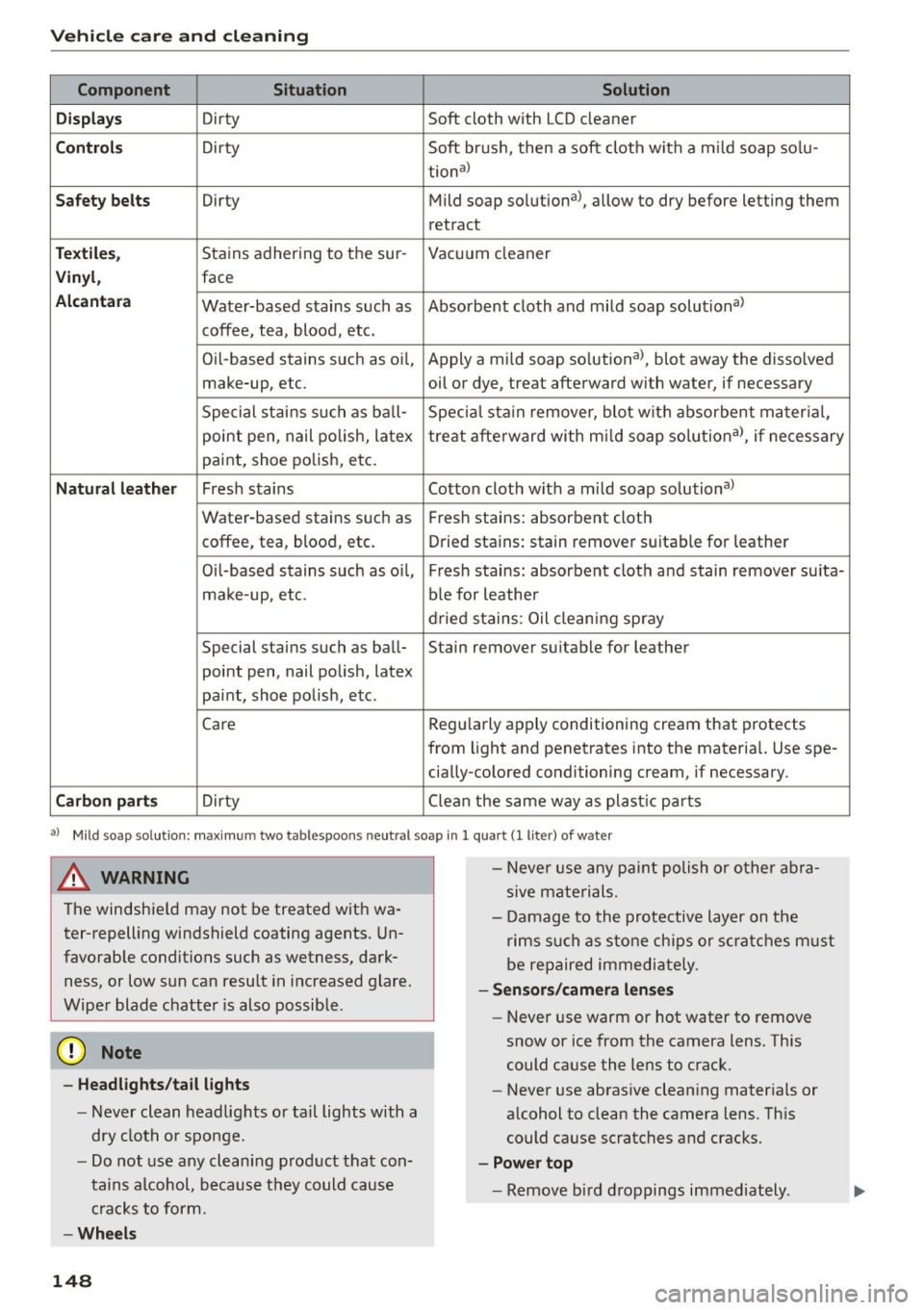
Component Situation Solution
Displays
Dirty Soft cloth with LCD cleaner
Controls Dirty Soft brush, then a soft cloth with a mild soap solu-
tional
Safety belts Dirty Mild soap solution a>, allow to dry before letting them
retr act
Textiles, Stains adhering to the sur- Vacuum cleaner
Vinyl, face
Alcantara Water-based stains such as Absorbent cloth and mild soap solutional
coffee, tea, blood, etc.
Oil-based stains such as o il, Apply a mi ld soap solutiona>, blot away the disso lved
make-up, etc. oil ori dye, treat afterward with water, if necessary
Special stains such as ball- Special stain remover, blot with absorbent material,
point pen, nail polish, latex treat afterward with mild soap solutional, if necessary
paint, shoe polish, etc.
Natural leather Fresh stains Cotton cloth with a mild soap solutional
Water-based stains such as
Fresh stains: absorbent cloth
coffee, tea, blood, etc. Dried stains: stain remover suitable for leather
Oil-based stains such as oil, Fresh stains: absorbent cloth and stain remover suita-
make-up, etc. ble for leather
dried stains: Oil cleaning spray
Special stains such as ball- Stain remover suitable for leather
point pen, nail polish, latex
paint, shoe polish, etc.
Care Reg
ula rly apply conditioning cream that protects
from light and penetrates into the materia l. Use spe-
cially-co lored conditioning cream, if necessary.
Carbon parts Dirty Clealil the same way as plastic parts
aJ Mild soap so lution: max im um two ta blespoo ns neut ral so ap in 1 quart (l lite r) of w ate r
A WARNING
Th e windshie ld may not be treated with wa
ter-repelling windshield coating agents. Un
favorable conditions such as wetness, dark
ness, or low sun ca n resu lt in increased glare.
Wiper blade chatter is also possible .
(D Note
-Headlights/tail lights
- Never clean headlights or tail lights with a
dry cloth or sponge.
- Do not use any cleaning product that con
tains alcohol, because they could cause
cracks to form.
-Wheels
148
-
- Never use any paint polish or other abra
sive materials.
- Damage to the protective layer on the
r ims such as stone chips or scratches must
be repaired immed iately.
-Sensors/camera lenses
- Never use warm or hot water to remove
snow or ice from the camera lens. This
could cause the lens to crack.
- Never use abrasive clean ing materials or
a lcohol to clean the camera lens. This
could cause scratches and cracks.
- Power top
- Remove bird droppings immediately .
Page 166 of 232
Checking and filling
-Turn the cap slowly and very carefully in a
counter-clockwise direction while applying
light, downward pressure on the top of
the cap .
- To avoid being burned, do not spill anti
freeze or coolant on the exhaust system or hot engine parts. Under certain condi
tions, the ethylene glycol in engine cool
ant can catch fire .
- Antifreeze is poisonous. Always store anti
freeze in its original container and well out of the reach of children .
- If you drain the coolant, it must be caught
and safely stored in a proper container
clearly marked "poison".
CD Note
-Coolant pollutes the environment and could
cause an engine fire . Excess coolant will be
forced out through the pressure relief valve
in the cap when the engine becomes hot.
-If, in an emergency, only water can be add
ed, the correct ratio between water and an
tifreeze
¢ page 161 must be restored as
soon as possible.
@ For the sake of the environment
Drained coolant should not be reused. Always
dispose of used coolant while observing all
environmental regulations.
Brake fluid
Have the brake fluid changed by an experienced
technician.
Brake fluid absorbs moisture from the air. If the
water content in the brake fluid is too high, cor
rosion in the brake system may result after a peri
od of time. The boiling point of the brake fluid
will also decrease considerably and decrease
braking performance.
Therefore, the brake fluid must be changed
every
two years.
Always use new brake fluid which con
forms to Federal Motor Vehicle Standard "FMVSS
116 DOT 4".
164
Brake fluid is replaced according to the Audi
maintenance service schedule . Your authorized
Audi dealer is equipped with the necessary spe
cial tools and replacement parts, has the neces
sary expertise, and can dispose of the used fluid .
A WARNING
-Brake fluid is poisonous . It must be stored
only in the closed original container out of
the reach of children!
- Brake failure can result from old or inappro priate brake fluid. Observe these precau
tions:
- Use only brake fluid that meets SAE speci
fication
J 1703 and conforms to Federal
Motor Vehicle Standard
116. Always check
with your authorized Audi dealer to make
sure you are using the correct brake fluid .
The correct type of brake fluid is also indi cated on the brake fluid reservoir.
- The brake fluid must be new . Heavy use of
the brakes can cause a vapor lock if the brake fluid is left in the system too long.
This can seriously affect the efficiency
of
the brakes as well as your safety . This
could result in an accident.
CD Note
Brake fluid will damage the paint of your vehi
cle.
@ For the sake of the environment
Because of the problem of proper disposal of
brake fluid as well as the special tools re
quired and the necessary expertise, we rec
ommend that you have the brake fluid
changed by your authorized Audi dealer.
Battery
General information '
Your vehicle is equipped with a special battery, an
ACM battery . This battery is located in the lug
gage compartment and must be replaced with an
original equipment battery. Under normal oper
ating conditions, the battery is
maintenance-
free. ..,_
Page 189 of 232
.... N
" N ": ... IO "? N
"' ....
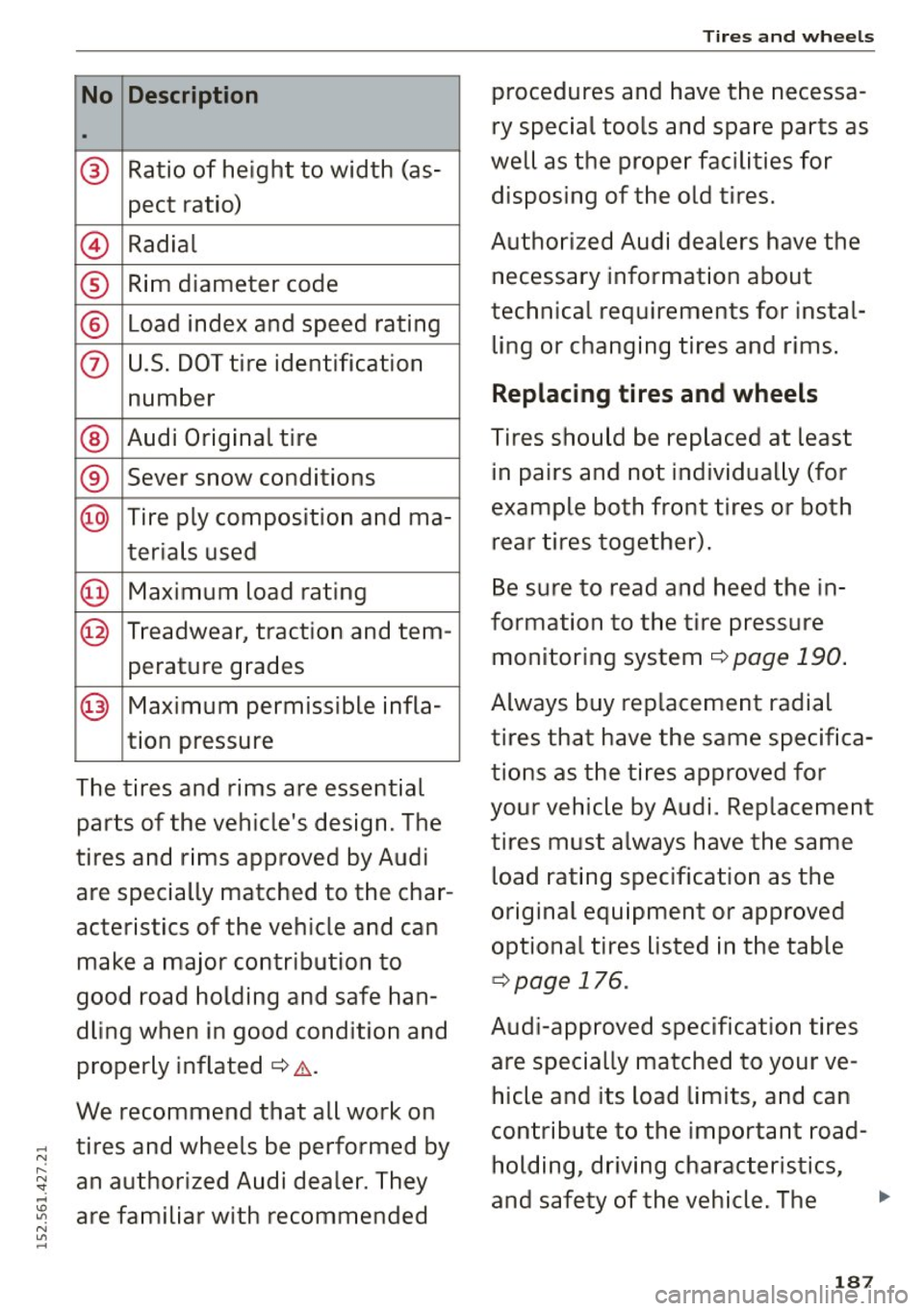
No Descript ion
•
® Ratio of height to width (as -
pect ratio)
© Radial
® Rim diameter code
® Load index and speed rating
(j) U.S. DOT tire identification
number
® Audi Original tire
® Sever snow conditions
@ Tire ply composition and ma-
terials used
@ Maximum load rating
@ Treadwear, traction and tern-
perature grades
@ Maximum permissible infla-
tion pressure
The tires and rims are essential parts of the vehicle's design. The
tires and rims approved by Audi
are specially matched to the char
acteristics of the vehicle and can
make a major contribution to
good road holding and safe han
dling when in good condition and
properly inflated ¢
&.
We recommend that all work on
tires and wheels be performed by
an authorized Audi dealer. They
are familiar with recommended
Tires and wheels
procedures and have the necessa
ry special too ls and spare parts as
well as the proper facilities for
disposing of the old ti res.
Authorized Audi dealers have the necessary information about
technical requirements for insta l
ling or changing tires and rims.
Replacing tire s and wheel s
Tires should be replaced at least
in pairs and not individually (for
example both front tires or both rear tires together).
Be sure to read and heed the in
formation to the tire pressure
monitoring system¢
page 190.
Always buy replacement radial
tires that have the same specifica
tions as the tires approved for
your vehicle by Audi . Replacement
tires must always have the same
load rating specification as the
original equipment or approved
optional tires listed in the table
i=> page 176 .
Audi-approved specification tires
are specially matched to your ve
hicle and its load limits, and can
contribute to the important road holding, driving characteristics,
and safety of the vehicle. The .,.
187
Page 192 of 232
Tires a nd wh eels
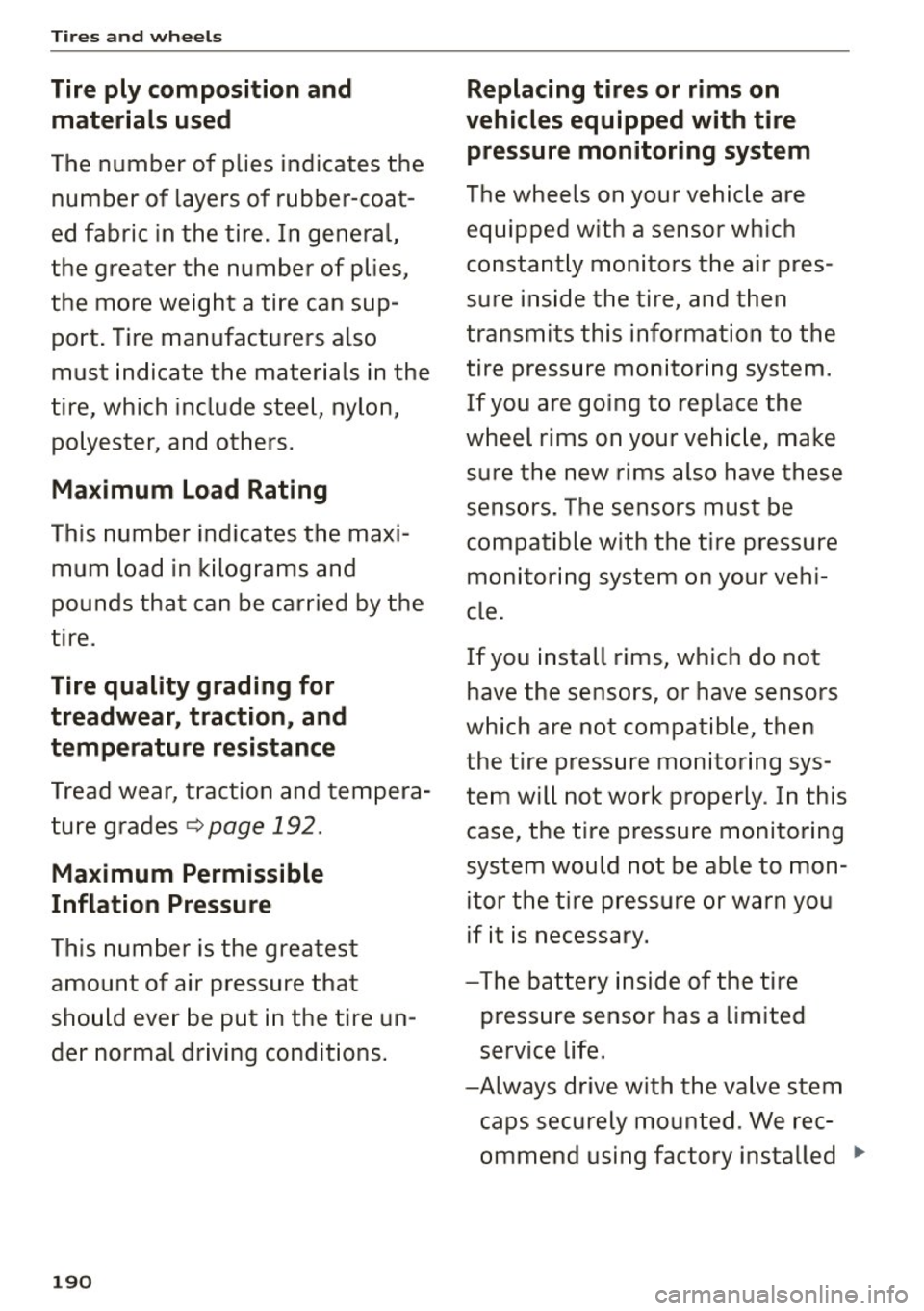
Tire ply composition and
materials used
The number of plies indicates the
number of layers of rubber-coat
ed fabric in the tire. In general,
the greater the number of plies,
the more weight a tire can sup
port . Tire manufacturers also
must indicate the materials in the
tire, which include steel, nylon, polyester, and others .
Maximum Load Rating
This number indicates the maxi
mum load in kilograms and
pounds that can be carried by the
tire .
Tire quality grading for
treadwear , traction , and
temperature resistance
Tread wear, traction and tempera
ture grades ~
page 192.
Maximum Permissible
Inflation Pressure
This number is the greatest
amount of air pressure that
should ever be put in the tire un
der normal driving conditions .
190
Replacing tires or rims on
vehicles equipped with tire pressure monitoring sy stem
The wheels on your vehicle are
equipped with a sensor which
constantly monitors the air pres
sure inside the tire, and then
transmits this information to the
tire pressure monitoring system.
If you are go ing to replace the
wheel rims on your vehic le, make
sure the new rims also have these
sensors. The sensors must be
compatible with the tire pressure monitoring system on your vehi
cle.
If you install rims, which do not have the sensors, or have sensors
which are not compatible, then
the tire pressure monitoring sys
tem will not work properly . In this
case, the tire pressure monitoring
system would not be able to mon itor the tire pressure or warn you
if it is necessary .
-The battery inside of the tire pressure sensor has a limited
service life.
-Always drive with the valve stem caps securely mounted . We rec
ommend using factory installed ""