brakes AUDI R8 SPYDER 2015 User Guide
[x] Cancel search | Manufacturer: AUDI, Model Year: 2015, Model line: R8 SPYDER, Model: AUDI R8 SPYDER 2015Pages: 232, PDF Size: 58.36 MB
Page 139 of 232
..... N
r-N "': ..... \!) 1.1'1
N 1.1'1 .....
This can cause a temporary reduction in braking
force compared to dry brakes. You can compen
sate for this by pressing the brake pedal harder.
Cor ro sion
There may be a tendency for dirt to bui ld up on
the brake pads and corrosion to fo rm on the discs
if the car is not driven regularly or only for short
trips with little use of the brakes.
If the b rakes are not used frequently, or if corro
sion has formed on the discs, it is advisab le to
clean off the pads and discs by braking firmly a
few times from a moderately high speed
c:> &. .
Faults in the brake sy stem
If you should notice a sudden increase in brake
pedal travel, then one of the two brake circuits
may have fai led
c:> .&, .
Low brak e flu id le vel
Malfunct ions can occur in the brake system if the
brake fluid level is too low. The brake flu id leve l is
monitored e lectronically.
Br ake power assis t un it
T he brake power assist unit increases the pres
sure that you generate with the brake pedal.
It
works only when the eng ine is running .
Brak e lining wear sta tu s
Brake lining wear may be checked by visual in
spection of the condition of the brake pads
through the openings in the wheel. If necessary,
the wheel may be removed for this inspection
c:> page 203 .
.8, WARNING
-New brake pads don't have the best stop
ping power and must be "broken-in" during
the init ial 250 mi les ( 400 km) of normal city
driving. The break -in period can be consider
ably longer for vehicles with ceramic brake
rotors *. You can compensate for this by
pressing the brake pedal more firmly. This
also applies later when new pads are instal
led .
- You should perform brak ing maneuvers for
the purpose of clean ing the brake system
Int elli ge nt te chn olo gy
only if road conditions permit. Other road
users must not be put at r isk -you may
cause an accident!
- Before descending a steep grade, reduce
speed and sh ift transmission into a lower
gear or lower dr iving range. Do not ride the
brakes or hold the pedal down too long or
too often. This could cause the bra kes to get
hot and dimin ish braking effic iency .
- Do not "ride the brakes" by rest ing your foot
on the pedal when you do not intend to
brake. This may cause the brakes to over
heat, premat ure wear and increased stop
ping distance.
- Under certain cl imatic and operat ing condi
tions such as passing thro ugh water, dr iv ing
in heavy rain or after washing the vehicle,
the effectiveness of the brakes can be re
duced . In winter, ice can accumulate on the
brake pads, lin ings, discs and drums. Care
fully apply brakes for a test. Brakes will dry and ice coatings will be cleaned off after a
few careful brake applications.
- Driving for an extended period of t ime on
salt-covered roads without using your brakes can also affect braking efficiency .
Clean off accum ulated salt coating from
b rake discs and pads with a few cautious
brake applications.
- If you damage the front spoiler, or if you in
stall a different spoiler, be su re the air flow
to the front brakes is not obstructed . O ther
wise the brake system could overheat reduc
ing the effectiveness of the entire brake sys
tem .
- Fai lure of one brake circuit will impai r the
braking capability resu lting in an increased
stopping distance . Avoid driving the vehicle
and have it towed to the nearest Aud i dea ler
or qualif ied workshop.
- Never let the vehicle roll to a stop with the
engine shut off.
- If the brake booster is not working, for ex
ample when towing your veh icle, or because
the brake booster has somehow been dam
aged, the brake pedal must be pressed con
siderably harder to make up for the lack of booster assistance.
1 37
Page 144 of 232
Driving and en vironment
Driving and environment
Break-in period
A new vehicle must be broken in, and the break-in
period shou ld be 1 ,500 miles (2,500 km) . Do not
use full acceleration for the first 600 miles
(1 ,000 km) and do not exceed the maximum en
gine speed of 6,000 rpm You must also not use
full accelerat ion between 600 and 1,200 miles
(1,000 to 2,000 km) . From 1,200 to 1,500 miles
(2 ,000 to 2,500 km), you can gradually increase
maximum eng ine speed to 8,250 rpm for brief
pe riods.
During the first hours of operation, there is
greater fr iction in the eng ine and the transmis
sion than later when all the moving pa rts have
b roken in .
The way you drive during the first 1,500 miles
(2 ,500 km) affects engine quality . If you drive at
modera te engine speeds thereafter, part icu larly
when the engine is cold, yo u red uce eng ine wea r
and increase the potential mileage o f the engine.
Do not dr ive at RPMs that a re too
low. Shift down
when the engine is no longe r runni ng "smooth
ly". Extremely high RPMs are gover ned automati
cally.
Avoid damaging the
vehicle
W hen you are driving on poor roads, or over
curbs, steep ramps, etc ., make certain that low
lying parts such as spoilers and exhaust system
parts do not bottom out and get damaged .
This is especially true for vehicles with low-slung
chassis (sports chassis) and fully loaded vehicles.
Driving through water on
roads
Note the following to avoid vehicle damage when
d riving through water, for examp le on flooded
roads:
- The water must no t be any h igher than the bot
tom of the vehicle body.
142
- Do not drive faster than walk ing speed .
A WARNING
After driv ing through water, mud, s lush, etc .,
the brakes may be s low to take effect because
of wet brake rotors and pads. Dry the brakes
first by brak ing carefully to restore the full
braking effect.
(D Note
Vehicle components such as the eng ine,
transmission , suspension or e lectrical system
can be severe ly damaged by dr iv ing t hrough
water .
(D Tips
- Check the dept h of the water before driving
through it.
- Do not stop the vehicle, drive in reverse or switch the engine off when driv ing through
water.
- Keep in mind that oncoming veh icles may
create waves that raise the water level and
make it too deep for your vehicle to d rive
through safely .
- Avoid driving through salt water because it
can cause corrosion.
Catalytic converter
It is very important that your emission control
system (catalytic converter) is functioning prop
erly to ensure that your vehicle is running in an
environmen tally sound manner.
.,. Always use lead-free gasoline ~ page 151,
Fuel supply.
.,. Never r un the tank down all the way to empty.
.,. Never put too much mo tor o il in yo ur engi ne
~ page 160, Adding engine oil 'l::r..
.,. Never try to push- or tow-sta rt your vehicle .
The cata lytic converter is an effi cien t "clean -up"
device built in to the exhaust system of the vehi
cle. The cata lytic conve rter burns many of the
po llutants in the exhaust gas before they are re
l eased into the atmosphere.
-
Page 145 of 232
..... N
r-N "': ..... \!) ..,.,
N ..,., .....
The exclusive use of unleaded fuel is critically im
portant for the life of the catalytic converter and
proper functioning of the engine.
A WARNING
- Do not park or operate the vehicle in areas where the hot exhaust system may come in contact with dry grass, brush, fuel spill or
other material which can cause a fire .
- Do not apply additional undercoating or
rustproofing on or near the exhaust mani
fold, exhaust pipes, catalytic converter or
heat shields. During driving, the substance
used for undercoating could overheat and
cause a fire.
([) Note
-Be aware that just one tank filling with lead
ed
fuel will already seriously degrade the
performance of the catalytic converter.
- Do not exceed the correct engine oil level
~page 160.
- Do not drive until the fuel tank becomes
completely empty. The engine could misfire.
Unburned fuel could also get into the ex
haust system and this could cause the cata
lytic converter to overheat.
- Do not turn off the ignition while the vehicle
is moving.
- Do not continue to operate your vehicle un
der these conditions, as otherwise fuel can
reach the catalytic converter. This could re
sult in overheating of the converter, requir
ing its replacement.
- To assure efficient operation of the Emission
Control System:
- Have your vehicle maintained properly and in accordance with the service recommen
dations in your Warranty
& Maintenance
booklet.
- Lack of proper maintenance as well as im
proper use of the vehicle will impair the
function of the emission control system
and could lead to damage.
Driving and environment
{® For the sake of the environment
Even when the Emission Control System is op
erating properly, the exhaust gas can have a
sulfur-like exhaust gas smell under some op
erating states. This depends on the sulfur
content of the fuel being used. Using a differ
ent brand of fuel may help, or filling the tank
with lead-free super grade gasoline .
Shutting down vehicle
If you would like your vehicle to remain inopera
tive for a longer period of time , contact an Audi
or other specialized dealer. They can advise you
on necessary precautions e.g. corrosion preven
tion, maintenance and storage. Pay attention to
additional information concerning the battery.
Refer to~
page 164.
Operation and
maintenance
Fuel economy, environmental impact, and wear
on your engine, brakes and tires largely depend
on three factors:
-your personal driving style
- operating conditions
- technical limitations
By having your vehicle regularly serviced by an
authorized Audi dealer helps to ensure that it runs properly and economically. The condition of
your vehicle not only affects its safety and ability
to hold its value, it also affects
fuel consump
tion.
The amount of oil used is related to engine load
and speed.
It is normal for the oil consumption of a new en
gine to reach its lowest value after a certain mile
age has been driven.
You must drive your vehicle about 3,000 miles (5,000 kilometers) before you can properly as
sess oil consumption .
This also applies to fuel consumption and engine output . .,,.
143
Page 166 of 232
Checking and filling
-Turn the cap slowly and very carefully in a
counter-clockwise direction while applying
light, downward pressure on the top of
the cap .
- To avoid being burned, do not spill anti
freeze or coolant on the exhaust system or hot engine parts. Under certain condi
tions, the ethylene glycol in engine cool
ant can catch fire .
- Antifreeze is poisonous. Always store anti
freeze in its original container and well out of the reach of children .
- If you drain the coolant, it must be caught
and safely stored in a proper container
clearly marked "poison".
CD Note
-Coolant pollutes the environment and could
cause an engine fire . Excess coolant will be
forced out through the pressure relief valve
in the cap when the engine becomes hot.
-If, in an emergency, only water can be add
ed, the correct ratio between water and an
tifreeze
¢ page 161 must be restored as
soon as possible.
@ For the sake of the environment
Drained coolant should not be reused. Always
dispose of used coolant while observing all
environmental regulations.
Brake fluid
Have the brake fluid changed by an experienced
technician.
Brake fluid absorbs moisture from the air. If the
water content in the brake fluid is too high, cor
rosion in the brake system may result after a peri
od of time. The boiling point of the brake fluid
will also decrease considerably and decrease
braking performance.
Therefore, the brake fluid must be changed
every
two years.
Always use new brake fluid which con
forms to Federal Motor Vehicle Standard "FMVSS
116 DOT 4".
164
Brake fluid is replaced according to the Audi
maintenance service schedule . Your authorized
Audi dealer is equipped with the necessary spe
cial tools and replacement parts, has the neces
sary expertise, and can dispose of the used fluid .
A WARNING
-Brake fluid is poisonous . It must be stored
only in the closed original container out of
the reach of children!
- Brake failure can result from old or inappro priate brake fluid. Observe these precau
tions:
- Use only brake fluid that meets SAE speci
fication
J 1703 and conforms to Federal
Motor Vehicle Standard
116. Always check
with your authorized Audi dealer to make
sure you are using the correct brake fluid .
The correct type of brake fluid is also indi cated on the brake fluid reservoir.
- The brake fluid must be new . Heavy use of
the brakes can cause a vapor lock if the brake fluid is left in the system too long.
This can seriously affect the efficiency
of
the brakes as well as your safety . This
could result in an accident.
CD Note
Brake fluid will damage the paint of your vehi
cle.
@ For the sake of the environment
Because of the problem of proper disposal of
brake fluid as well as the special tools re
quired and the necessary expertise, we rec
ommend that you have the brake fluid
changed by your authorized Audi dealer.
Battery
General information '
Your vehicle is equipped with a special battery, an
ACM battery . This battery is located in the lug
gage compartment and must be replaced with an
original equipment battery. Under normal oper
ating conditions, the battery is
maintenance-
free. ..,_
Page 173 of 232
(D Note
- Please note that summer and
winter t ires are designed for
the conditions that are typical in those seasons . Audi recom
mends using winter tires dur
ing the winter months . Low
temperatures significantly de
crease the elasticity of summ
er tires, which affects traction
and braking ability. If summer
tires are used in very cold tem peratures, cracks can form on
the tread bars, resulting in
Tires and wheels
permanent tire damage that
can cause loud driving noise
and unbalanced tires . Audi is
not responsible for this type
of damage.
- Burnished, polished or
chromed rims must not be
used in winter road condi
tions . The surface of the rims
does not have sufficient corro
sion protection for this and
could be permanently dam aged by road salt or similar
substances .
Glossary of tire and loading terminology
Accessory weight
means the combined weight (in
excess of those standard items
which may be replaced) of auto
matic transmission, power steer
ing, power brakes, power win
dows , powe r seats , radio , and
heater , to the extent that these
items a re available as factory-in
stalled equipment (whether in
stalled or not).
Aspect ratio
means the ratio of the height to
;:;: the width of the tire in percent .
" ~ Numbers of 55 or lower indicate a ...
~ low sidewall for improved steer -
"' ....
ing response and better overall
handling on dry pavement.
Bead
means the part of the tire that is
made of steel wires, wrapped or
reinforced by ply cords and that is
shaped to f it the rim .
Bead separation
means a breakdown of the bond
between components in the bead .
Cord
means the strands forming the
plies in the tire.
17 1
...
Page 175 of 232
.... N
" N ": ... IO "? N U'> .....
Normal occupant weight
means 150 lbs. (68 kilograms)
times the number of occupants
seated in the vehicle up to the to
tal seating capacity of yo ur vehi
c le .
Occupant distribution
means distribution of occupants
in a vehicle.
Outer diameter
means the overall diameter of an
inflated new tire .
Overall width
means the linear distance be
tween the exteriors of the side
walls of an inflated tire, including elevations due to labeling, deco
rations, or protective bands or
ribs .
Ply
means a layer of rubber-coated
parallel cords .
Production options weight
means the combined weight of
those installed regular product ion
options weighing over 5 lbs. (2 .3
kg) in excess of those standard
items which they replace, not pre
viously considered in curb weight
or accessory weight, including
Tir es a nd whe els
heavy duty brakes, ride levelers,
heavy duty battery, and special
trim.
Radial ply tire
means a pneumatic tire in which
the ply cords that extend to the beads are laid at substantially
90
degrees to the centerline of the
tread.
Recommended inflation
pre ssure
see c::> page 172, Cold tire infla
tion pressure.
R einforced tire
means a tire designed to operate
at higher loads and at higher in
flation pressures than the corre
sponding standard tire. Rein
forced tires my be identified as
"X L", "xl", "EXTRA LOAD", or "RF"
on the sidewall.
Rim
means a metal support for a tire
or a tire and tube assembly upon
which the tire beads are seated.
Rim di ameter
means nominal diameter of the
bead seat. If you change your
1 73
Page 181 of 232
.... N
" N ": ... IO "? N U'> .....
.&_ WARNING
Overloading a vehicle can cause loss of vehicle control, a crash
or other accident, serious per
sonal injury, and even death .
-Carrying more weight than your vehicle was designed to carry will prevent the vehicle
from handling properly and in crease the risk of a loss of ve
hicle control.
-The brakes on a vehicle that has been overloaded may not
be able to stop the vehicle
within a safe distance .
-Tires on a vehicle that has been overloaded can fail sud
denly causing loss of control
and a crash.
A WARNING
-
- Incorrect tire pressures and/or
underinflation can lead to a
serious or fatal accident.
-Incorrect tire pressures and/or underinflation cause increased
tire wear and can affect the
handling of the vehicle.
- Incorrect tire pressures and/or
underinflation can also lead to
sudden tire failure, including a blowout and sudden deflation,
causing loss of vehicle control.
Tires and wheels
Checking tire pressure
The correct tire pressure for the
tires originally installed on your
vehicle is listed on the tire pres
sure label located on driver 's side
8-pillar .
The recommended tire pressures
are on the tire pressure label and
in the table
c:::> page 176 , Cold tire
inflation pressure.
This means
that the pressure must be checked and adjusted when the
tire has not been driven for more
than a couple of m iles (kilome
ters) at low speeds during the
previous three hours. Air in the
tires expands when the t ire heats
up as a result of internal friction
as it flexes in use . The tire pres
sure is higher when the tire has
warmed up than when it is "cold".
It is the inflation pressure in a
"cold" tire that counts. Therefore,
you shou ld never let air out of a
warm tire to match "Cold tire in
flation pressure" recommenda
tions
c:::> page 176. The tires would
then be underinflated and could
fail suddenly.
The tire pressure label on your
Audi lists the recommended cold
tire inflation pressures for the
1 79
Page 185 of 232
.... N
" N ": ... IO "? N U'> .....
technically referred to as the vehi
cle's
Gross Vehicle We ight Rating
("GVWR") .
The "GVWR" includes the weight
of the basic vehicle, all factory in
stalled accessories, a full tank of
fuel, oil, coolant and other fluids plus maximum load. The maxi
mum load includes the number of
passengers that the vehicle is in
tended to carry ("seating capaci
ty") with an assumed weight of
150 lbs. (68 kg) for each passen
ger at a designated seating posi
tion and the total weight of any
luggage in the vehicle.
The
Gross Axle Weight Rating
("GAWR") is the maximum load
that can be applied at each of the
vehicle's two axles .
The Gross Vehicle Weight Rating and the Gross Axle Weight Rating
are listed on the safety compli
ance sticker label located on the
driver's side B-pillar. Your Audi
has 2 seating positions . Each
seating position has a safety belt
¢ page 95, Safety belts.
The fact that there is an upper
limit to your vehicle's Gross Vehi
cle Weight Rating means that the
total weight of whatever is being
Tires and wheels
carried in the vehicle is limited.
The more passengers in the vehi
cle or passengers who are heavier
than the standard weights as
sumed mean that less weight can
be carried as luggage.
The tire pressure label on your
Audi also lists the maximum com
bined weight of all of the occu
pants and luggage or other cargo
that the vehicle can carry. For the location of the label¢
page 176,
fig. 147.
A WARNING
-
Overloading a vehicle can cause
loss of vehicle control, a crash
or other accident, serious per
sonal injury, and even death.
-Carrying more weight than
your vehicle was designed to
carry will prevent the vehicle
from handling properly and in
crease the risk of the loss of
vehicle control.
-The brakes on a vehicle that has been overloaded may not be able to stop the vehicle
within a safe distance .
-Tires on a vehicle that has been overloaded can fail sud
denly, including a blowout and •
183
Page 222 of 232
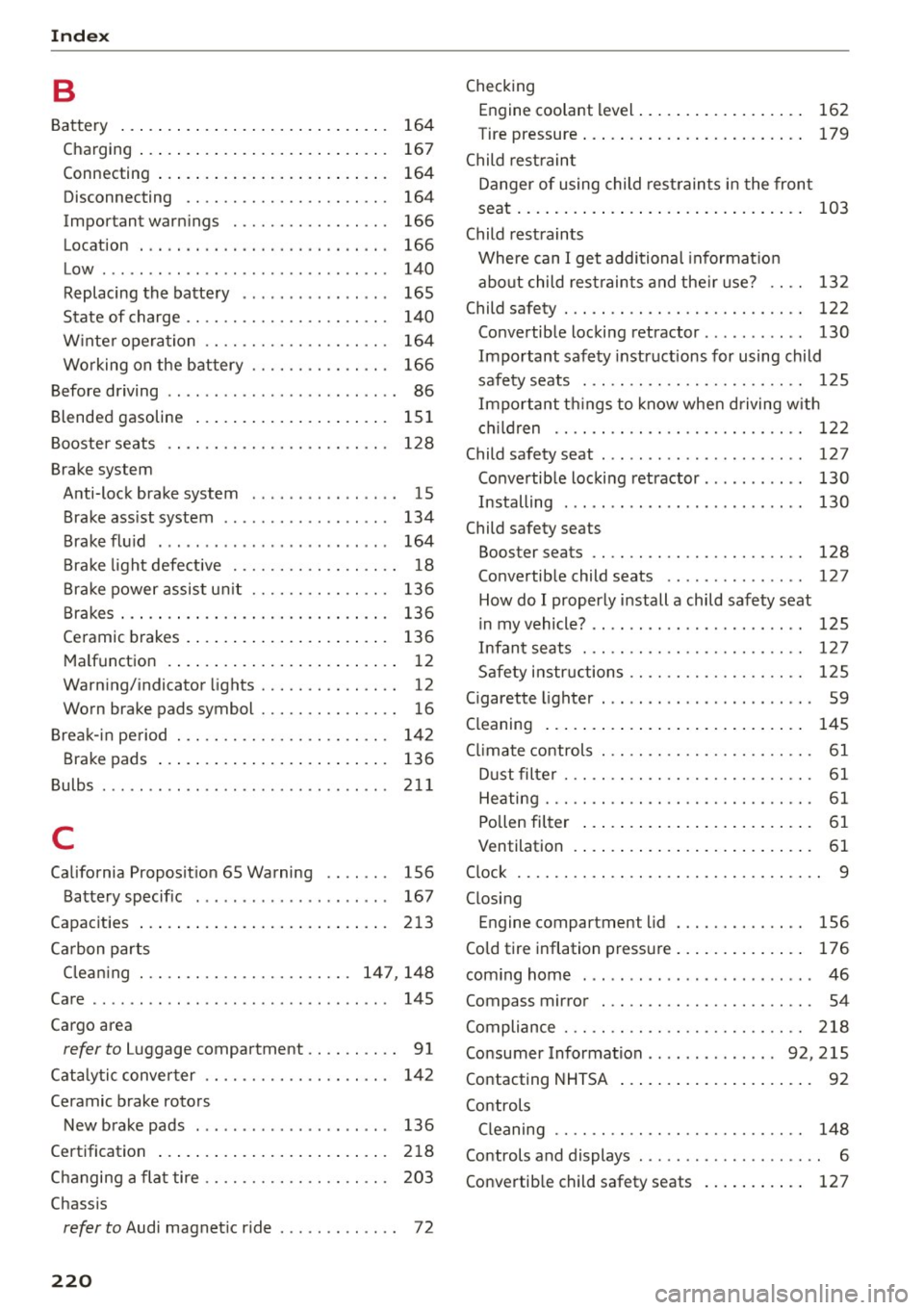
Index
B
Battery . . . . . . . . . . . . . . . . . . . . . . . . . . . . . 164
Charging . . . . . . . . . . . . . . . . . . . . . . . . . . . 167
Connecting . . . . . . . . . . . . . . . . . . . . . . . . . 164
Disconnecting . . . . . . . . . . . . . . . . . . . . . . 164
Important warnings . . . . . . . . . . . . . . . . . 166
Location . . . . . . . . . . . . . . . . . . . . . . . . . . . 166
Low ...... ... .. ................ ... . 140
Replacing the battery . . . . . . . . . . . . . . . . 165
State of charge . . . . . . . . . . . . . . . . . . . . . . 140
W inter operation . . . . . . . . . . . . . . . . . . . . 164
Working on the battery . . . . . . . . . . . . . . . 166
Before driving . . . . . . . . . . . . . . . . . . . . . . . . . 86
Blended gasoline . . . . . . . . . . . . . . . . . . . . . 151
Booster seats . . . . . . . . . . . . . . . . . . . . . . . . 128
Brake system
Anti-lock brake system . . . . . . . . . . . . . . . .
15
Brake assist system . . . . . . . . . . . . . . . . . . 134
Brake fluid . . . . . . . . . . . . . . . . . . . . . . . . . 164
Brake light defective . . . . . . . . . . . . . . . . . . 18
Brake power assist unit . . . . . . . . . . . . . . . 136
Brakes . . . . . . . . . . . . . . . . . . . . . . . . . . . . . 136
Ceramic brakes . . . . . . . . . . . . . . . . . . . . . . 136
Malfunction . . . . . . . . . . . . . . . . . . . . . . . . . 12
Warning/indicator lights . . . . . . . . . . . . . . . 12
Worn brake pads symbol . . . . . . . . . . . . . . . 16
Break-in period . . . . . . . . . . . . . . . . . . . . . . . 142
Brake pads . . . . . . . . . . . . . . . . . . . . . . . . . 136
Bulbs . . . . . . . . . . . . . . . . . . . . . . . . . . . . . . . 211
C
California Proposition 65 Warning . . . . . . . 156
Battery specific . . . . . . . . . . . . . . . . . . . . . 167
Capacities . . . . . . . . . . . . . . . . . . . . . . . . . . . 213
Carbon parts
Cleaning . . . . . . . . . . . . . . . . . . . . . . .
147, 148
Care . . . . . . . . . . . . . . . . . . . . . . . . . . . . . . . . 145
Cargo area
refer to Luggage compartment.. .. .. .. .. 91
Catalytic converter . . . . . . . . . . . . . . . . . . . . 142
Ceramic brake rotors
New brake pads . . . . . . . . . . . . . . . . . . . . .
136
C 'f ' . ert1 1cat1on ..... .............. ... .. .
Changing a flat tire ........... .. .. .. .. .
Chassis 218
203
refer to Audi magnetic ride . . . . . . . . . . . . . 72
220
Checking
Engine coolant level. . . . . . . . . . . . . . . . . .
162
Tire pressure . . . . . . . . . . . . . . . . . . . . . . . . 179
Child restraint
Danger of using child restraints in the front
seat . . . . . . . . . . . . . . . . . . . . . . . . . . . . . . .
103
Child restraints
Where can I get additional informat ion
about child restraints and the ir use? . . . .
132
Child safety . . . . . . . . . . . . . . . . . . . . . . . . . . 122
Convertible locking retractor . . . . . . . . . . . 130
Important safety instructions for using child
safety seats . . . . . . . . . . . . . . . . . . . . . . . .
125
Important things to know when driving w ith
ch ildren . . . . . . . . . . . . . . . . . . . . . . . . . . .
122
Child safety seat . . . . . . . . . . . . . . . . . . . . . . 127
Convertible locking retractor. . . . . . . . . . . 130
Installing . . . . . . . . . . . . . . . . . . . . . . . . . . 130
Child safety seats
Booster seats . . . . . . . . . . . . . . . . . . . . . . .
128
Convertible child seats . . . . . . . . . . . . . . . 127
How do I properly install a child safety seat
. h' l 7 125 in myve rc e ... .. .. .. ... ..... ... .. . .
Infant seats . . . . . . . . . . . . . . . . . . . . . . . . 127
Safety instructions . . . . . . . . . . . . . . . . . . . 125
Cigarette lighter . . . . . . . . . . . . . . . . . . . . . . . 59
Cleaning . . . . . . . . . . . . . . . . . . . . . . . . . . . . 145
Climate controls . . . . . . . . . . . . . . . . . . . . . . . 61
Dust filter . . . . . . . . . . . . . . . . . . . . . . . . . . . 61
Heating . . . . . . . . . . . . . . . . . . . . . . . . . . . . . 61
Pollen filter . . . . . . . . . . . . . . . . . . . . . . . . . 61
Ventilation . . . . . . . . . . . . . . . . . . . . . . . . . . 61
Clock . . . . . . . . . . . . . . . . . . . . . . . . . . . . . . . . . 9
Closing Engine compartment lid . . . . . . . . . . . . . .
156
Cold tire inflation pressure. . . . . . . . . . . . . . 176
coming home . . . . . . . . . . . . . . . . . . . . . . . . . 46
Compass mirror . . . . . . . . . . . . . . . . . . . . . . . 54
Compliance . . . . . . . . . . . . . . . . . . . . . . . . . . 218
Consumer Information .............. 92, 215
Contacting NHTSA . . . . . . . . . . . . . . . . . . . . . 92
Controls
Cleaning . . . . . . . . . . . . . . . . . . . . . . . . . . .
148
Controls and displays . . . . . . . . . . . . . . . . . . . . 6
Convertible child safety seats . . . . . . . . . . .
127