child lock AUDI R8 SPYDER 2015 User Guide
[x] Cancel search | Manufacturer: AUDI, Model Year: 2015, Model line: R8 SPYDER, Model: AUDI R8 SPYDER 2015Pages: 232, PDF Size: 58.36 MB
Page 127 of 232
..... N
r-N "': ..... \!) 1.1'1
N 1.1'1 .....
A WARNING ,~
To reduce the risk of serious injury, make sure
that the
PASSENGER AIR BAG OFF light
comes on and stays on whenever a child re
straint is installed on the front passenger seat
and the ignition is switched on.
- Never install a rearward facing child safety
seat on the front passenger seat unless the
PASSENGER AIR BAG OFF light comes on
and stays on. If the
PASSENGER AIR BAG
OFF
light does not come on and stay on the
inflating airbag will hit the child safety seat
or infant carrier with great force and will
smash the child safety seat and child against the backrest, door or roof. Have the
airbag system inspected immediately by
your authorized Audi dealer.
{!) Tips
The child seats listed in categories A to C have been statically tested by Audi only for the Ad
vanced Airbag function.
Important safety instructions for using
child safety seats
Correct use of child safety seats substantially re
duces the risk of injury in an accident!
As the driver, you are responsible for the safety of
everybody in the vehicle, especially children:
.. Always use the right child safety seat for each
child and always use it properly
c;, page 127.
.. Always carefully follow the child safety seat
manufacturer's instructions on how to route
the safety belt properly through the child safe
ty seat.
.. When using the vehicle safety belt to install a
child safety seat, you must first activate the
convertible locking retractor on the safety belt
to prevent the child safety seat from moving
c;, poge 130.
.. Push the child safety seat down with your full
weight to get the safety belt really tight so that
the seat cannot move forward or sideways more
than one inch (2 .5 cm) .
.. If a strap or tether is being used to tie the child
safety seat to the front passenger seat, make
Child Safety
sure that it is not so tight that it causes the
weight-sensing mat to measure more weight than is actually on the seat.
Always remember: Even though your vehicle is
equipped with an Advanced Airbag system, a
child should always ride in the seat properly re
strained for its age and size.
A WARNING
-Not using a child safety seat, using the wrong
child safety seat or improperly installing a
child restraint increases the risk of serious personal injury and death.
- All vehicle occupants and especially children must always be restrained properly whenev
er riding in a vehicle.
- An unrestrained or improperly restrained
child can be injured or killed by being
thrown against the inside of the vehicle or
by being ejected from it during a sudden
maneuver or impact.
- An unrestrained or improperly restrained
child is at much greater risk of injury or
death by being struck by an inflating air bag .
- Commercially available child safety seats
are required to comply with U.S. Federal Mo
tor Vehicle Safety Standard (FMVSS) 213 (in
Canada CMVSS 213).
- When buying a child restraint, select one
that fits your child and the vehicle .
- Only use child restraint systems that fully
contact the flat portion of the seat cush
ion. The child restraint must not tip or
lean to either side. Audi does not recom
mend using child safety seats that rest on
legs or tube-like frames. They do not pro
vide adequate contact with the seat.
- Always heed all legal requirements per
taining to the installation and use of child
safety seats and carefully follow the in
structions provided by the manufacturer
of the seat you are using.
- Never let more than one child occupy a child
safety seat.
~
125
Page 129 of 232
..... N
l'
N "1: ..... I.O
"' N
"' .....
Child safety seats
Infant seats
Babies and infants up to about one year old and
20 lbs. or 9 kg need special rearward -facing
child restraints that support the back, neck and
head in a crash.
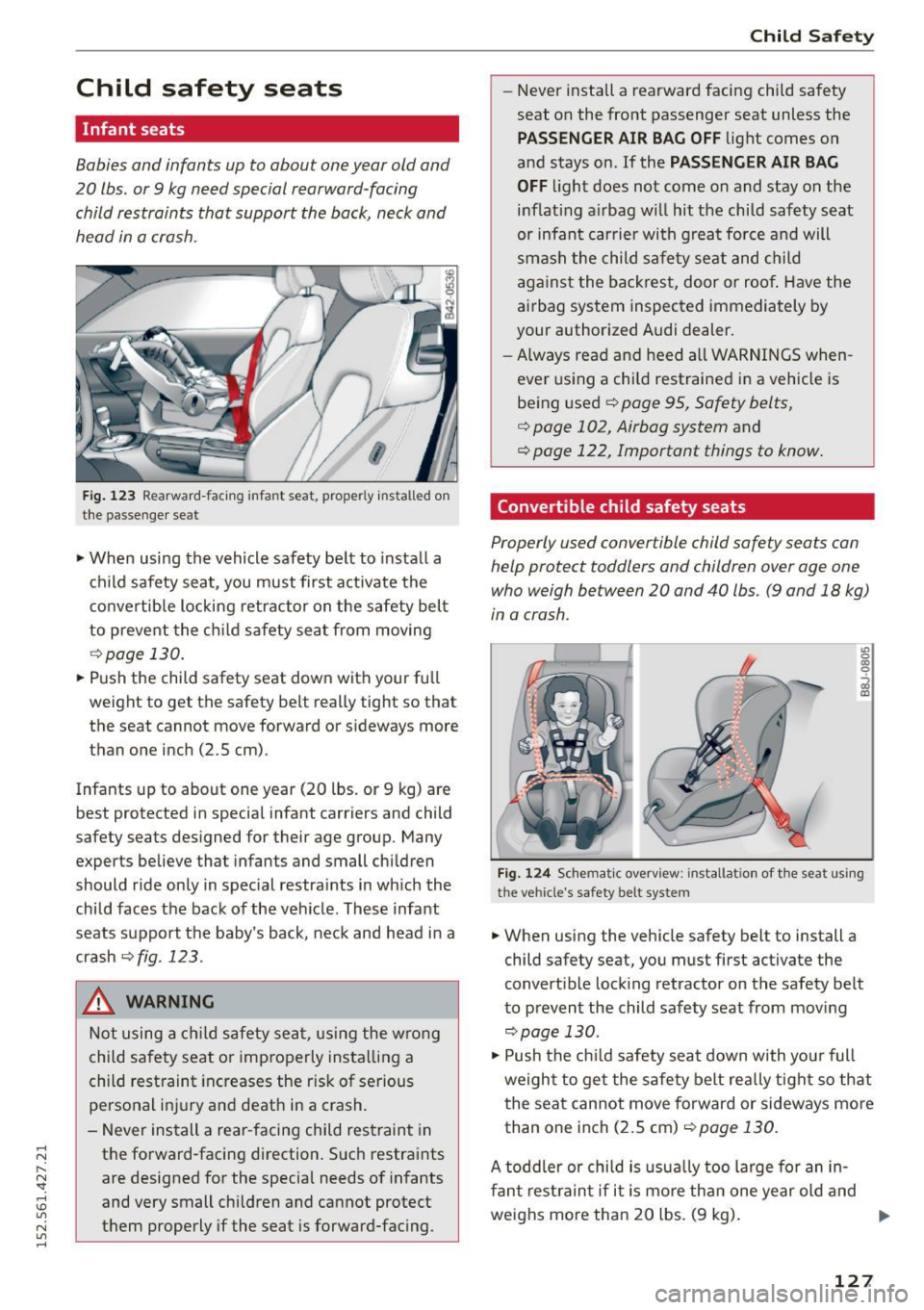
Fig. 123 Rearward-facing infa nt seat, prope rly installed on
the passenger seat
"'W hen using the vehicle safety belt to install a
child safety seat, you must first activate the
convertible locking retractor on the safety belt
to prevent the child safety seat from moving
¢page 130.
"'Push the child safety seat down with your fu ll
weight to get the safety be lt really tight so that
the seat cannot move forward or sideways more
than one inch (2.5 cm) .
Infants up to about one year (20 lbs. or 9 kg) are
best protected in special infant carriers and child
safety seats designed for their age group . Many
experts believe that infants and small children
should ride only in spec ial restra ints in wh ich the
child faces the back of the vehicle. These infant
seats support the baby's back , neck and head in a
crash
¢ fig. 123 .
A WARNING
Not using a child safety seat, using the wrong
child safety seat or improperly installing a
child rest raint increases the risk of serious
personal injury and death in a crash.
- Never install a rear -facing child restraint in
the forward-facing direction. Such restraints
are designed for the special needs of infants
and very small children and cannot protect
them properly if the seat is forward-facing.
Child Safety
- Never install a rearward facing child safety
seat on the front passenger seat unless the
PASSENGER AIR BAG OFF light comes on
and stays on.
If the PASSENGER AIR BAG
OFF
light does not come on and stay on the
inflating a irbag will hit the child safety seat
or infant carrier with great force and will
smash the child safety seat and child
against the backrest, door or roof . Have the
airbag system inspected immediately by
your authorized Audi dealer.
- Always read and heed all WARNINGS when
ever using a child restrained in a vehicle is
being used ¢
page 95, Safety belts,
¢ page 102, Airbag system and
¢ page 122, Important things to know.
Convertible child safety seats
Properly used convertible child safety seats can
help protect toddlers and children over age on e
who weigh between 20 and 40 lbs.
(9 and 18 kg)
in a crash .
.,, 0
~ -', a, m
Fig. 124 Schemat ic overv iew: instal lat io n of t he sea t usi ng
t he ve hicle's sa fety belt system
.,. When using the vehicle safety belt to install a
child safety seat, you must first activate the
convertible locking retractor on the safety be lt
to prevent the child safety seat from mov ing
¢ page 130.
"' Push the child safety seat down with your full
weight to get the safety belt really tight so that
the seat cannot move forward or sideways more
than one inch (2.5 cm)¢
page 130.
A toddler or child is usually too large for an in
fant restraint if it is more tha n one year old and
weighs mo re than 20 lbs. (9 kg). .,.
127
Page 131 of 232
..... N
r-N "': ..... \!) 1.1'1
N 1.1'1 .....
stronger parts of their bodies and the safety belt
can help protect them in a crash.
.,. Do not use the convertible locking retractor
when using the vehicle's safety belt to restrain
a child on a booster seat.
... The shoulder belt must lie as close to the cen
ter of the child 's collar bone as possible and
must lie and snug on the upper body. It must
never lie across the throat or neck. The lap belt
must lie across the pelvis and never across the
stomach or abdomen . Make sure the belt lies
flat and snug. Pull on the belt to tighten if nec essary.
Children up to at least 8 years old (over 40 lbs . or
18 kg) are best protected in child safety seats de
signed for their age and weight. Experts say that
the skeletal structure, particularly the pelvis, of
these children is not fully developed, and they
must not use the vehicle safety belts without a
suitable child restraint.
It is usually best to put these children in appro
priate booster seats. Be sure the booster seat
meets all applicable safety standards.
Booster seats raise the seating position of the
child and reposition both the lap and shoulder
parts of the safety belt so that they pass across
the child's body in the right places. The routing of
the belt over the child's body is very important
for the child 's protection, whether or not a boos
ter seat is used.
Children who are at least 4
ft. 9 in. (57 inches/
1.45 meters) tall can generally use the vehicle's
three point lap and shoulder belts. Never use the lap belt portion of the vehicle's safety belt alone
t o re strain any child, regardless of how big the
child is . Always remember that children do not
have the pronounced pelvic structure required for
the proper function of lap belt portion of the ve
hicle's three point lap and shoulder belts . The
child's safety absolutely requires that a lap belt
portion of the safety belt be fastened snugly and
as low as possible around the pelvis. Never let
the lap belt portion of the safety belt pass over
the child's stomach or abdomen.
In a crash, airbags must inflate within a blink of
an eye and with considerable force. In order to do
Child Safety
its job, the airbag needs room to inflate so that it
will be there to protect the occupant as the occu pant moves forward into the airbag .
A vehicle occupant who is out of position and too
close to the airbag gets in the way of an inflating
airbag. When an occupant is too close, he or she
will be struck violently and will receive serious or
possibly even fatal injury.
In order for the airbag to offer protection, it is
important that all vehicle occupants, especially
any chi ldren, who must be in the front seat be
cause of exceptional circumstances, be properly
restrained and as far away from the airbag as
possible. By keeping room between the child's
body and the front of the passenger compart
ment, the airbag can inflate completely and pro
vide supplemental protection in certain frontal
collisions.
A WARNING
-Not using a booster seat, using the booster
seat improperly, incorrectly installing a boos
ter seat or using the vehicle safety belt im
properly increases the risk of serious personal
injury and death in a collision or other emer
gency situation. To help reduce the risk of se
rious personal injury and/or death :
- The shoulder belt must lie as close to the
center of the child's collar bone as possible
and must lie and snug on the upper body .
It
must never lie across the throat or neck . The
lap belt must lie across the pelvis and never
across the stomach or abdomen. Make sure
the belt lies flat and snug. Pull on the belt
to tighten if necessary.
- Fai lure to properly route safety belts over a
child's body w ill cause severe injuries in an
accident or other emergency situation
~ page 95.
- Children on the front seat of any car, even
with Advanced Airbags, can be seriously in
jured or even killed when an airbag inflates.
- Never let a child stand or kneel on the seat.
- Never let a child ride in the cargo area of
your vehicle.
- Always remember that a child leaning for
ward, sitting sideways or out of position in
129
Page 132 of 232
Child Safety
any way during an accident can be struck by
a deploying airbag. This will result in serious personal injury or death.
- If you must install a booster seat on the
front passenger seat because of exceptional
circumstances the
PASSENGER AIR BAG
OFF
light must come on and stay on, when
ever the ignition is switched on .
- If the
PASSENGER AIR BAG OFF light does
not come on and stay on, perform the
checks described .
- If the
PASSENGER AIR BAG OFF light does
not come on and stay on whenever the igni
tion is switched on the inflating airbag will hit the child safety seat or infant carrier
with great force and will smash the child
safety seat and child against the backrest,
door or roof. Have the airbag system in
spected immediately by your Audi dealer.
- Always read and heed all WARNINGS when
ever using a child restrained in a vehicle is
being used
~ page 95, Safety belts,
¢ page 102, Airbag system
and
¢ page 122, Important things to know.
Installing a child safety
seat
Securing a child safety seat using a safety
belt
Safety belts for the front passenger can be
locked with the convertible locking retractor to
properly secure child safety seats .
The safety belts emergency locking retractors for
the front passenger's seat safety belt have a con
vertible locking retractor for child restraints . The
safety belt must be locked so that belt webbing
cannot unreel. The retractor can be activated to
lock the safety belt and prevent the safety belt
webbing from loosening up during normal driv
ing. A child safety seat can only be properly in
stalled when the safety belt is locked so that the
child and child safety seat will stay in place.
Always remember : Even though your vehicle is
equipped with an Advanced Airbag system, a
child should always ride in the seat properly re
strained for its age and size.
130
A WARNING ,.
Improperly installed child safety seats in-
crease the risk of serious personal injury and
death in a collision .
-
-Always make sure that the safety belt re
tractor is locked when installing a child safe
ty seat . An unlocked safety belt retractor
cannot hold the child safety seat in place
during normal driving or in a crash.
-Always buckle the child safety seat firmly in
place even if a child is not sitting in it. A
loose child safety seat can fly around during
a sudden stop or in a collision.
- The inflating airbag will hit the child safety
seat or infant carrier with great force and
will smash the child safety seat and child
against the backrest, door or roof.
- Forward-facing child safety seats or infant
carriers installed on the front passenger's
seat may interfere with the deployment of
the airbag and cause serious injury to the
child.
- Always read and heed all WARNINGS when
ever using a child restrained in a vehicle is being used
¢page 122. Special precautions
apply when installing a child safety seat on
the front passenger seat
¢ page 103, Child
restraints on the front seat -some impor
tant things to know.
A WARNING
Always take special precautions if you must
install a forward or rearward-facing child re
straint on the front passenger's seat in excep
tional situations:
- Whenever a forward or rearward-facing
child restraint is installed on the front pas
senger seat, the
PASSENGER AIR BAG OFF
light must come on and stay on whenever
the ignition is switched on.
- If the
PASSENGER AIR BAG OFF light does
not come on and stay on, perform the
checks described .
- If the
PASSENGER AIR BAG OFF light does
not come on and stay on whenever the igni
tion is switched on the inflating airbag will
hit the child safety seat or infant carrier .,,.
Page 133 of 232
..... N
r-N "': ..... \!) ..,.,
N ..,., .....
with great force and will smash the child
safety seat and child against the backrest,
door or roof. Have the airbag system in
spected immediately by your Audi dealer.
- Improper installation of child restraints can
reduce their effectiveness or even prevent
them from providing any protection .
- An improperly installed child restraint can
interfere with the airbag as it deploys and
seriously injure or even kill the child.
- Always carefully follow the manufacturer's
instructions provided with the child safety
seat or carrier .
- Never place additional items on the seat
that can increase the total weight registered
by the weight-sensing mat and can cause in
jury in a crash.
A WARNING
Forward-facing child restraints:
-Always make sure the forward-facing seat
has been designed and certified by its man
ufacturer for use on a front seat with a pas
senger front and side airbag.
- Never put the forward-facing child restraint
up, against or very near the instrument pan
el.
-Always move the passenger seat into its
rearmost position in the seat's fore and aft
adjustment range, as far away from the air
bag as possible before installing the for
ward-facing child restraint. The backrest must be adjusted to an upright position.
- Make sure that the
PASSENGER AIR BAG
OFF
light comes on and stays on all the time
whenever the ignition is switched on.
A WARNING
Rearward-facing child restraints:
- A child in a rearward-facing child safety seat
installed on the front passenger seat will be
seriously injured and can be killed if the
front airbag inflates - even with an Ad
vanced Airbag System .
- The inflating airbag will hit the child safety
seat or infant carrier with great force and
Child Safety
will smash the child safety seat and child
against the backrest, door or roof.
- Always be especially careful if you must in
stall a rearward facing child safety seat on
the front passenger seat in exceptional cir
cumstances.
- A tight tether strap on a rearward-facing
child restraint attached to the front passen
ger seat can put too much pressure on the
weight -mat in the seat and register a heavi
er weight in the Advanced Airbag System .
The heavier weight registered can make the
system work as though an adult were on the
seat and deploy the Advanced Airbag when
it must be suppressed causing serious or
even fatal injury to the child.
- Make sure that the
PASSENGER AIR BAG
OFF
light comes on and stays on all the time
whenever the ignition is switched on.
- Never install a rearward facing child safety
seat on the front passenger seat unless the
PASSENGER AIR BAG OFF light comes on
and stays on. If the
PASSENGER AIR BAG
OFF
light does not come on and stay on
have the airbag system inspected immedi
ately by your Audi dealer .
Activating the convertible locking retractor
Use the conver tible locking re trac tor to secure a
child restraint.
Always h eed the child safety seat manufacturer's
instructions when installing a child restraint in
your vehicle. To ac tiva te the convertible locking
retractor:
.. Place the child restraint on a seat.
.. Slowly pull the belt
all the way out .
.. Route it around or through the child restraint
belt path
c:> ,&. .
.. Push the child safety seat down with your full
weight to get the safety belt really tight.
.,. Insert the belt tongue into the buckle for that
seating position.
.. Guide the safety belt back into the retractor un
til the belt lies flat and snug on the child safety
seat. ..,.
131
Page 134 of 232
Child Safety
"' You should hear a "clicking" noise as the be lt
winds back into the inertia ree l. Test the con
vertib le lock ing retractor by pulling on the belt .
You should no longer be ab le to pull the be lt
out of the retractor. The convert ible locking re
tractor is now activated.
"' Make sure that the red release button is facing
away from the ch ild restraint so that it can be
unbuckled quic kly.
"' Pull on the be lt to make sure the safety belt is
properly tight and fastened so tha t the seat
cannot move forwa rd or sideways more than
one inc h (2.5 cm).
A WARNING
Us ing the wrong child restra int or an improp
er ly installed ch ild restra int can cause serious
personal injury or death in a crash .
- Always make sure that the safety belt re
tractor is locked when installing a child safe
ty seat . An un locked safety be lt retractor
cannot hold the ch ild safety seat in place
dur ing no rma l driving o r in a crash.
- Always buckle the child safety seat firmly in
place even if a child is not s itting in it . A
loose child safety seat can fly around du ring
a sudden stop or in a crash.
- Always make sure the seat backrest to wh ich
t h e chi ld restraint is insta lled i s in an up
right posi tion. Othe rwise , the seatback wi th
the chi ld safety seat at tached to it could fly
forward in the event of an accident o r other
emergency situation.
- Always read and heed all WARN INGS when
ever using a child restrained in a vehicle is
being used
r::!) page 122. Specia l precautions
apply when installing a child safety seat on
the front passenger seat¢
page 103, Child
restraints on the front seat -some impor
tant things to know .
132
· Deactivating the convertible locking
retractor
The convertible locking retractor for child re
straints will be deactivated automatically when the belt is wound all the way back into the re
tractor.
"' Press the red button on the safety belt buckle.
T he be lt tong ue will pop out of the b uc kle .
"' Guide the safety be lt a ll the way back into its
stowed position .
Always let the safety be lt ret ract completely i nto
i ts stowed pos it ion. The safe ty belt can now be
u sed as an ordina ry safety belt without the con
vertib le locking retractor for child restraints .
If the conve rtib le locking retractor sho uld be ac
tivated inadvertent ly, the sa fety be lt mus t be un
fastened and guided comp letely back into its
stowed position to deactivate this feature .
If the
convertible locking retractor is not deactivated,
the safety belt will gradually become tighter and
uncomfortable to wear.
A WARNING
Improperly installed chi ld safety seats in
crease the risk of serious pe rsonal injury and
death in a co llision.
-
- Never unfasten the safety belt to deactivate
the convertible locki ng retractor for child re
straints while the vehicle is moving. You
wou ld not be restra ined and could be ser i
ously inj ured in an accident.
- Always read and heed all WARNINGS when
eve r using a child res trained in a vehicle is
be ing used
¢page 122. Special precaut ions
apply when installing a child sa fety seat on
the front passenger seat
¢ page 103, Child
restraints on the front seat -some impor
tant things to know.
Additional Information
Sources of information about child
. restraints and their use
There are a number of sources of additiona l infor
mation about child restraint se lection, insta lla
tion and use :
Page 165 of 232
..... N
r-N "': ..... \!) ..,.,
N ..,., .....
"' Press and ho ld the rear window switch too unti l
the convertible top moves into the service posi
t ion
r::!) fig. 142.
Opening th e cool ant e xp ansi on tank cov er
"' Stop the engine and allow it to coo l.
"' Switch the ignition off.
"' Carefu lly remove the bolts in the cover(!) using
a screwdriver and remove the cover. The cool
ant reservoir is located be low
c:> fig. 143 .
Check ing th e engine coolant l eve l
"' Place a rag or cloth on the cap of the coo lant
expansion tank and turn the cap
ca re full y to
the left (counter-clockwise)
c:> A .
"'Read the coo lant level inside the coolant expan
s ion tank
c:> fig . 143. With a co ld engine, it
must be above the "min" mark. W ith a hot en
gine, it can be a little above the ind icated
range .
To obtain an accurate read ing, the eng ine must
be switched off.
The expansion tank in your vehicle is equipped
with an electric coolant level sensor
r::!) page 14.
We still recommend you check the coolant level
from time to time .
Coolant lo ss
Coolant loss may indicate a leak in the cooling
system . In the event of coolant loss, the cooling
system should be inspected immediately by your
author iz ed Audi dealer. It is not enough merely
to add coolant.
In a
s e a led system, losses can occur only if the
boiling point of the coo lant is exceeded as a re
sult of overheat ing.
A WARNING
- The cooling system is under pressure. Do
not open the cap of the coolant expans ion
tank when the engine is hot. You risk being
sca lded.
-
- The coolant add itive, and therefore the cool
ant itself, is hazardous to health. Keep the
c oolant additive in the or igina l co ntainer out
of the re ach of children.
It is a poison haz
ard.
Ch eck ing and fillin g
(D Note
Do not add any type of radiator leak sea lant
to your vehicle's engine coolant . Add ing radia
tor repair fluid may adversely affect the func
tion and performance of your cooling system
and could result in damage not covered by
your New Veh icle Limited Warranty.
Adding coolant
Befo re you check a nyth ing in the eng ine compart
ment,
alwa ys read and he ed all WARNING S
r::!) A in Working in the engine compartment on
page 155.
"' Add coolant m ixed in the correct rat io
c:> page 161, Coolant.
"' Twist the cap on again tightly.
"'Tighten the cap(!) <::!)page 162, fig. 143 again .
Replacement engine coo lant must conform to ex
act specifications
c:> page 161, Coolant .
We recommend using only coolant add it ive Gl2+
+, G l3
or in an emergency Gl2 +. Do not use a
different additive. In an emergency use pla in wa
ter unt il you ca n get the correct add itive and can
restore the co rrect ratio . This should be done as
soon as possib le .
If you have los t a considerab le amount of cool
ant, then you shou ld add cold antifreeze and cold
water only when the engine is co ld .
Always use
new engine coo lant when refilling .
Do not fill coolant above the "max" mark. Excess
coolant will be forced out through the pressure
relief valve in the cap when the eng ine becomes
hot.
A WARNING
- The cooling system is under pressure and
can get very hot. Reduce the risk of scalding
from hot coolant by following these steps .
- Turn off the engine and allow it to cool
down .
- Protect your face, hands and arms from escaping fluid and steam by covering the
cap with a large, thick rag.
163
Page 166 of 232
Checking and filling
-Turn the cap slowly and very carefully in a
counter-clockwise direction while applying
light, downward pressure on the top of
the cap .
- To avoid being burned, do not spill anti
freeze or coolant on the exhaust system or hot engine parts. Under certain condi
tions, the ethylene glycol in engine cool
ant can catch fire .
- Antifreeze is poisonous. Always store anti
freeze in its original container and well out of the reach of children .
- If you drain the coolant, it must be caught
and safely stored in a proper container
clearly marked "poison".
CD Note
-Coolant pollutes the environment and could
cause an engine fire . Excess coolant will be
forced out through the pressure relief valve
in the cap when the engine becomes hot.
-If, in an emergency, only water can be add
ed, the correct ratio between water and an
tifreeze
¢ page 161 must be restored as
soon as possible.
@ For the sake of the environment
Drained coolant should not be reused. Always
dispose of used coolant while observing all
environmental regulations.
Brake fluid
Have the brake fluid changed by an experienced
technician.
Brake fluid absorbs moisture from the air. If the
water content in the brake fluid is too high, cor
rosion in the brake system may result after a peri
od of time. The boiling point of the brake fluid
will also decrease considerably and decrease
braking performance.
Therefore, the brake fluid must be changed
every
two years.
Always use new brake fluid which con
forms to Federal Motor Vehicle Standard "FMVSS
116 DOT 4".
164
Brake fluid is replaced according to the Audi
maintenance service schedule . Your authorized
Audi dealer is equipped with the necessary spe
cial tools and replacement parts, has the neces
sary expertise, and can dispose of the used fluid .
A WARNING
-Brake fluid is poisonous . It must be stored
only in the closed original container out of
the reach of children!
- Brake failure can result from old or inappro priate brake fluid. Observe these precau
tions:
- Use only brake fluid that meets SAE speci
fication
J 1703 and conforms to Federal
Motor Vehicle Standard
116. Always check
with your authorized Audi dealer to make
sure you are using the correct brake fluid .
The correct type of brake fluid is also indi cated on the brake fluid reservoir.
- The brake fluid must be new . Heavy use of
the brakes can cause a vapor lock if the brake fluid is left in the system too long.
This can seriously affect the efficiency
of
the brakes as well as your safety . This
could result in an accident.
CD Note
Brake fluid will damage the paint of your vehi
cle.
@ For the sake of the environment
Because of the problem of proper disposal of
brake fluid as well as the special tools re
quired and the necessary expertise, we rec
ommend that you have the brake fluid
changed by your authorized Audi dealer.
Battery
General information '
Your vehicle is equipped with a special battery, an
ACM battery . This battery is located in the lug
gage compartment and must be replaced with an
original equipment battery. Under normal oper
ating conditions, the battery is
maintenance-
free. ..,_
Page 221 of 232
..... N
r-N "': ..... \!) 1.1'1
N 1.1'1 .....
A
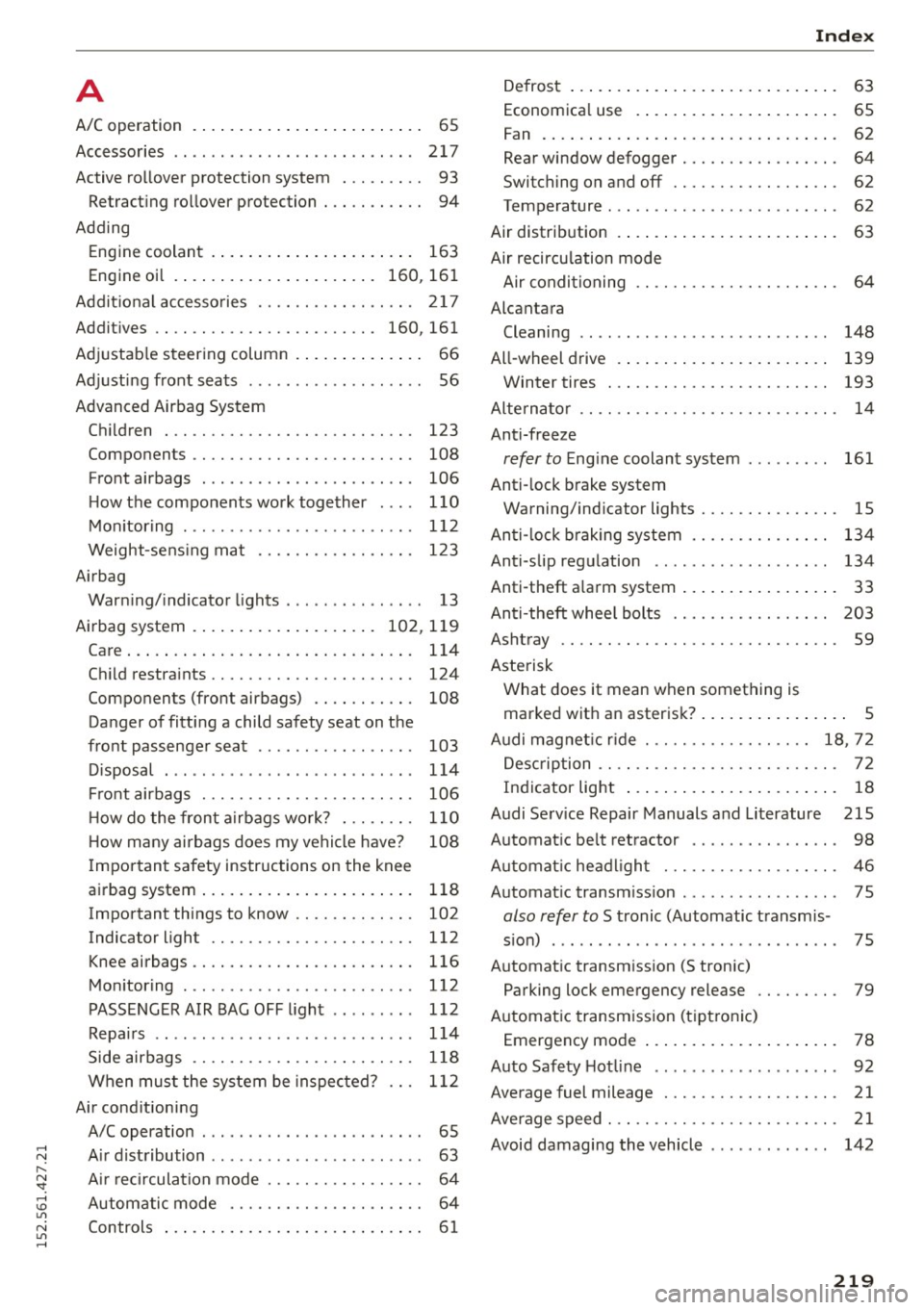
A/C operation . . . . . . . . . . . . . . . . . . . . . . . . . 65
Accessories . . . . . . . . . . . . . . . . . . . . . . . . . . 217
Active rollover protection system . . . . . . . . . 93
Retracting rollover protection . . . . . . . . . . . 94
Adding Engine coolant . . . . . . . . . . . . . . . . . . . . . . 163
Engine oil . . . . . . . . . . . . . . . . . . . . . . 160, 161
Addit ional accessories . . . . . . . . . . . . . . . . . 217
Additives . . . . . . . . . . . . . . . . . . . . . . . . 160, 161
Adjustab le steering column . . . . . . . . . . . . . . 66
Adjusting front seats . . . . . . . . . . . . . . . . . . . 56
Advanced Airbag System Children . . . . . . . . . . . . . . . . . . . . . . . . . . . 123
Components . . . . . . . . . . . . . . . . . . . . . . . . 108
Front airbags . . . . . . . . . . . . . . . . . . . . . . . 106
How the components work together . . . . 110
Monitoring . . . . . . . . . . . . . . . . . . . . . . . . . 112
Weight-sens ing mat . . . . . . . . . . . . . . . . . 123
Airbag Warn ing/indicator lights . . . . . . . . . . . . . . . 13
Airbag system ................ ... . 102, 119
Care.. ..... .. ................ ..... . 114
Child restraints. . . . . . . . . . . . . . . . . . . . . . 124
Components (front airbags) . . . . . . . . . . . 108
Danger of fitting a child safety seat on the
front passenger seat . . . . . . . . . . . . . . . . . 103
Disposal . . . . . . . . . . . . . . . . . . . . . . . . . . . 114
Front airbags . . . . . . . . . . . . . . . . . . . . . . . 106
H ow do the front airbags work? . . . . . . . . 110
H ow many airbags does my vehicle have? 108
Important safety instruc tions on the knee
airbag system............... ... .... . 118
Important things to know . . . . . . . . . . . . . 102
Indicator light . . . . . . . . . . . . . . . . . . . . . . 112
Knee airbags ........................ 116
Monitoring . . . . . . . . . . . . . . . . . . . . . . . . . 112
PASSENGER AIR BAG OFF light . . . . . . . . . 112
Repairs . . . . . . . . . . . . . . . . . . . . . . . . . . . . 114
Side airbags . . . . . . . . . . . . . . . . . . . . . . . . 118
When must the system be inspected? . . . 112
Air cond itionin g
A/C operation . . . . . . . . . . . . . . . . . . . . . . . . 65
Air distribution . . . . . . . . . . . . . . . . . . . . . . . 63
A ir recirculation mode . . . . . . . . . . . . . . . . . 64
Automatic mode . . . . . . . . . . . . . . . . . . . . . 64
Controls . . . . . . . . . . . . . . . . . . . . . . . . . . . . 61
Index
Defrost . . . . . . . . . . . . . . . . . . . . . . . . . . . . . 63
Economical use . . . . . . . . . . . . . . . . . . . . . . 65
Fan . . . . . . . . . . . . . . . . . . . . . . . . . . . . . . . . 62
Rear window defogger . . . . . . . . . . . . . . . . . 64
Switching on and off . . . . . . . . . . . . . . . . . . 62
Temperature . . . . . . . . . . . . . . . . . . . . . . . . . 62
Air distribution . . . . . . . . . . . . . . . . . . . . . . . . 63
Air recirculation mode
Air conditioning . . . . . . . . . . . . . . . . . . . . . . 64
Alcantara Cleaning . . . . . . . . . . . . . . . . . . . . . . . . . . . 148
All-wheel drive . . . . . . . . . . . . . . . . . . . . . . . 139
Winter tires . . . . . . . . . . . . . . . . . . . . . . . . 193
Alternator . . . . . . . . . . . . . . . . . . . . . . . . . . . . 14
Anti-freeze
refer to Engine coolant system . . . . . . . . . 161
Anti- lock brake system
Warning/indicator lights . . . . . . . . . . . . . . . 15
Anti-lock braking system . . . . . . . . . . . . . . . 134
Anti-slip regulation . . . . . . . . . . . . . . . . . . . 134
Anti-theft alarm system . . . . . . . . . . . . . . . . . 33
Anti-theft wheel bolts . . . . . . . . . . . . . . . . . 203
Ashtray . . . . . . . . . . . . . . . . . . . . . . . . . . . . . . 59
Asterisk What does it mean when something is
marked with an asterisk? . . . . . . . . . . . . . . . . 5
Audi magnet ic r ide . . . . . . . . . . . . . . . . . . 18, 72
Description . . . . . . . . . . . . . . . . . . . . . . . . . . 72
Indicator light . . . . . . . . . . . . . . . . . . . . . . . 18
Audi Serv ice Repair Manuals and Literature 215
Automatic be lt retractor . . . . . . . . . . . . . . . . 98
Automatic headlight . . . . . . . . . . . . . . . . . . . 46
Automatic transmission . . . . . . . . . . . . . . . . . 75
also refer to S tronic (Automatic transmis-
s ion) . . . . . . . . . . . . . . . . . . . . . . . . . . . . . . . 75
Automatic transmission (S tronic) Parking lock emergency release . . . . . . . . . 79
Automatic transmission (tiptron ic)
Emergency mode . . . . . . . . . . . . . . . . . . . . . 78
Auto Safety Hotline . . . . . . . . . . . . . . . . . . . . 92
Average fuel mileage . . . . . . . . . . . . . . . . . . . 21
Average speed . . . . . . . . . . . . . . . . . . . . . . . . . 21
Avoid damaging the vehicle . . . . . . . . . . . . . 142
219
Page 222 of 232
Index
B
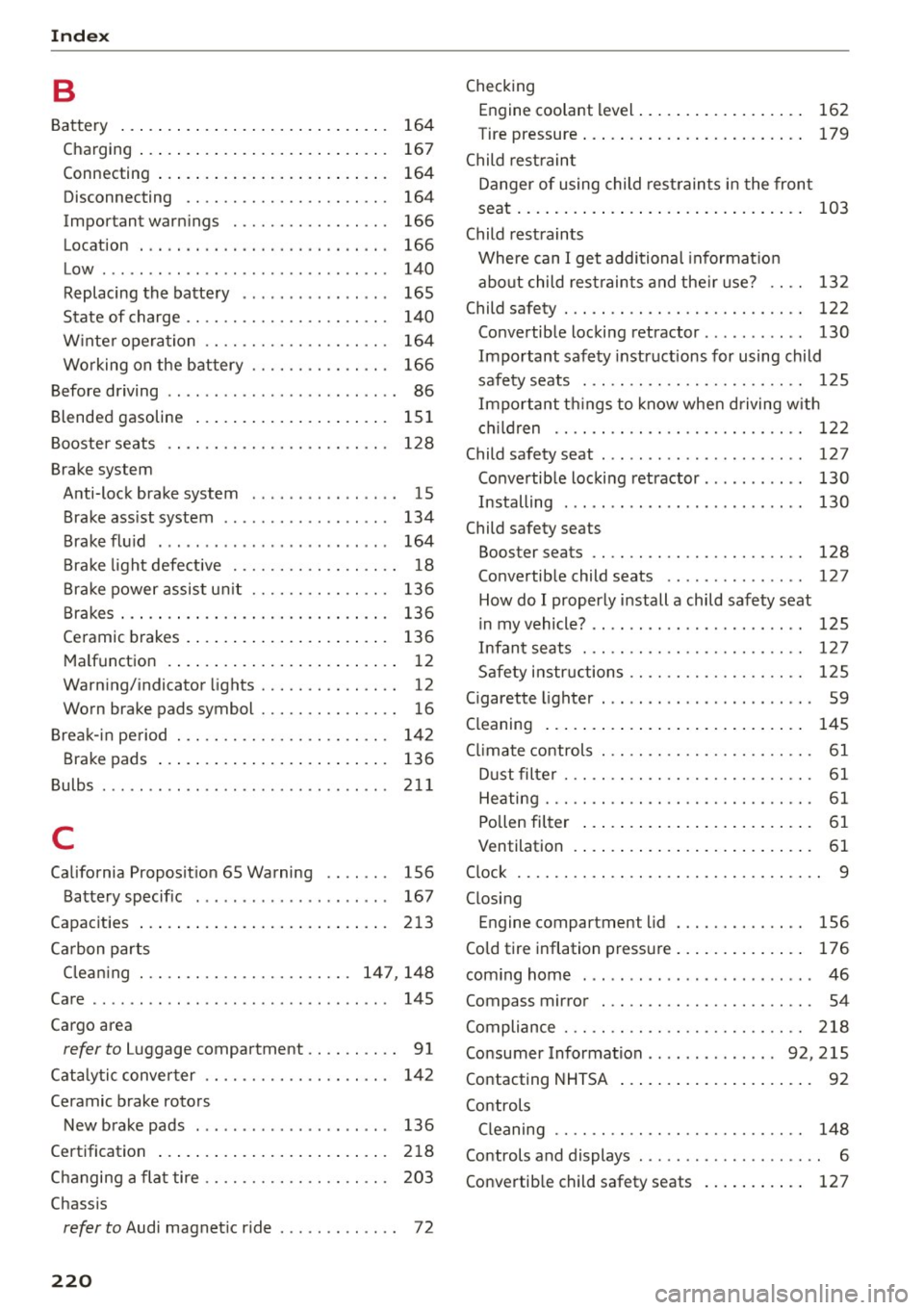
Battery . . . . . . . . . . . . . . . . . . . . . . . . . . . . . 164
Charging . . . . . . . . . . . . . . . . . . . . . . . . . . . 167
Connecting . . . . . . . . . . . . . . . . . . . . . . . . . 164
Disconnecting . . . . . . . . . . . . . . . . . . . . . . 164
Important warnings . . . . . . . . . . . . . . . . . 166
Location . . . . . . . . . . . . . . . . . . . . . . . . . . . 166
Low ...... ... .. ................ ... . 140
Replacing the battery . . . . . . . . . . . . . . . . 165
State of charge . . . . . . . . . . . . . . . . . . . . . . 140
W inter operation . . . . . . . . . . . . . . . . . . . . 164
Working on the battery . . . . . . . . . . . . . . . 166
Before driving . . . . . . . . . . . . . . . . . . . . . . . . . 86
Blended gasoline . . . . . . . . . . . . . . . . . . . . . 151
Booster seats . . . . . . . . . . . . . . . . . . . . . . . . 128
Brake system
Anti-lock brake system . . . . . . . . . . . . . . . .
15
Brake assist system . . . . . . . . . . . . . . . . . . 134
Brake fluid . . . . . . . . . . . . . . . . . . . . . . . . . 164
Brake light defective . . . . . . . . . . . . . . . . . . 18
Brake power assist unit . . . . . . . . . . . . . . . 136
Brakes . . . . . . . . . . . . . . . . . . . . . . . . . . . . . 136
Ceramic brakes . . . . . . . . . . . . . . . . . . . . . . 136
Malfunction . . . . . . . . . . . . . . . . . . . . . . . . . 12
Warning/indicator lights . . . . . . . . . . . . . . . 12
Worn brake pads symbol . . . . . . . . . . . . . . . 16
Break-in period . . . . . . . . . . . . . . . . . . . . . . . 142
Brake pads . . . . . . . . . . . . . . . . . . . . . . . . . 136
Bulbs . . . . . . . . . . . . . . . . . . . . . . . . . . . . . . . 211
C
California Proposition 65 Warning . . . . . . . 156
Battery specific . . . . . . . . . . . . . . . . . . . . . 167
Capacities . . . . . . . . . . . . . . . . . . . . . . . . . . . 213
Carbon parts
Cleaning . . . . . . . . . . . . . . . . . . . . . . .
147, 148
Care . . . . . . . . . . . . . . . . . . . . . . . . . . . . . . . . 145
Cargo area
refer to Luggage compartment.. .. .. .. .. 91
Catalytic converter . . . . . . . . . . . . . . . . . . . . 142
Ceramic brake rotors
New brake pads . . . . . . . . . . . . . . . . . . . . .
136
C 'f ' . ert1 1cat1on ..... .............. ... .. .
Changing a flat tire ........... .. .. .. .. .
Chassis 218
203
refer to Audi magnetic ride . . . . . . . . . . . . . 72
220
Checking
Engine coolant level. . . . . . . . . . . . . . . . . .
162
Tire pressure . . . . . . . . . . . . . . . . . . . . . . . . 179
Child restraint
Danger of using child restraints in the front
seat . . . . . . . . . . . . . . . . . . . . . . . . . . . . . . .
103
Child restraints
Where can I get additional informat ion
about child restraints and the ir use? . . . .
132
Child safety . . . . . . . . . . . . . . . . . . . . . . . . . . 122
Convertible locking retractor . . . . . . . . . . . 130
Important safety instructions for using child
safety seats . . . . . . . . . . . . . . . . . . . . . . . .
125
Important things to know when driving w ith
ch ildren . . . . . . . . . . . . . . . . . . . . . . . . . . .
122
Child safety seat . . . . . . . . . . . . . . . . . . . . . . 127
Convertible locking retractor. . . . . . . . . . . 130
Installing . . . . . . . . . . . . . . . . . . . . . . . . . . 130
Child safety seats
Booster seats . . . . . . . . . . . . . . . . . . . . . . .
128
Convertible child seats . . . . . . . . . . . . . . . 127
How do I properly install a child safety seat
. h' l 7 125 in myve rc e ... .. .. .. ... ..... ... .. . .
Infant seats . . . . . . . . . . . . . . . . . . . . . . . . 127
Safety instructions . . . . . . . . . . . . . . . . . . . 125
Cigarette lighter . . . . . . . . . . . . . . . . . . . . . . . 59
Cleaning . . . . . . . . . . . . . . . . . . . . . . . . . . . . 145
Climate controls . . . . . . . . . . . . . . . . . . . . . . . 61
Dust filter . . . . . . . . . . . . . . . . . . . . . . . . . . . 61
Heating . . . . . . . . . . . . . . . . . . . . . . . . . . . . . 61
Pollen filter . . . . . . . . . . . . . . . . . . . . . . . . . 61
Ventilation . . . . . . . . . . . . . . . . . . . . . . . . . . 61
Clock . . . . . . . . . . . . . . . . . . . . . . . . . . . . . . . . . 9
Closing Engine compartment lid . . . . . . . . . . . . . .
156
Cold tire inflation pressure. . . . . . . . . . . . . . 176
coming home . . . . . . . . . . . . . . . . . . . . . . . . . 46
Compass mirror . . . . . . . . . . . . . . . . . . . . . . . 54
Compliance . . . . . . . . . . . . . . . . . . . . . . . . . . 218
Consumer Information .............. 92, 215
Contacting NHTSA . . . . . . . . . . . . . . . . . . . . . 92
Controls
Cleaning . . . . . . . . . . . . . . . . . . . . . . . . . . .
148
Controls and displays . . . . . . . . . . . . . . . . . . . . 6
Convertible child safety seats . . . . . . . . . . .
127