seats AUDI R8 SPYDER 2015 User Guide
[x] Cancel search | Manufacturer: AUDI, Model Year: 2015, Model line: R8 SPYDER, Model: AUDI R8 SPYDER 2015Pages: 232, PDF Size: 58.36 MB
Page 91 of 232
..... N
r--N "': ..... \!) ..,.,
N ..,., .....
to incorrect position ing of the sa fety belt
and improper seating posit ion.
- Children must always ride in child seats
<=> page 122. Special precautions apply
when installing a child seat on the front pas
senger seat
<=> page 102.
Proper adjustment of head restraints
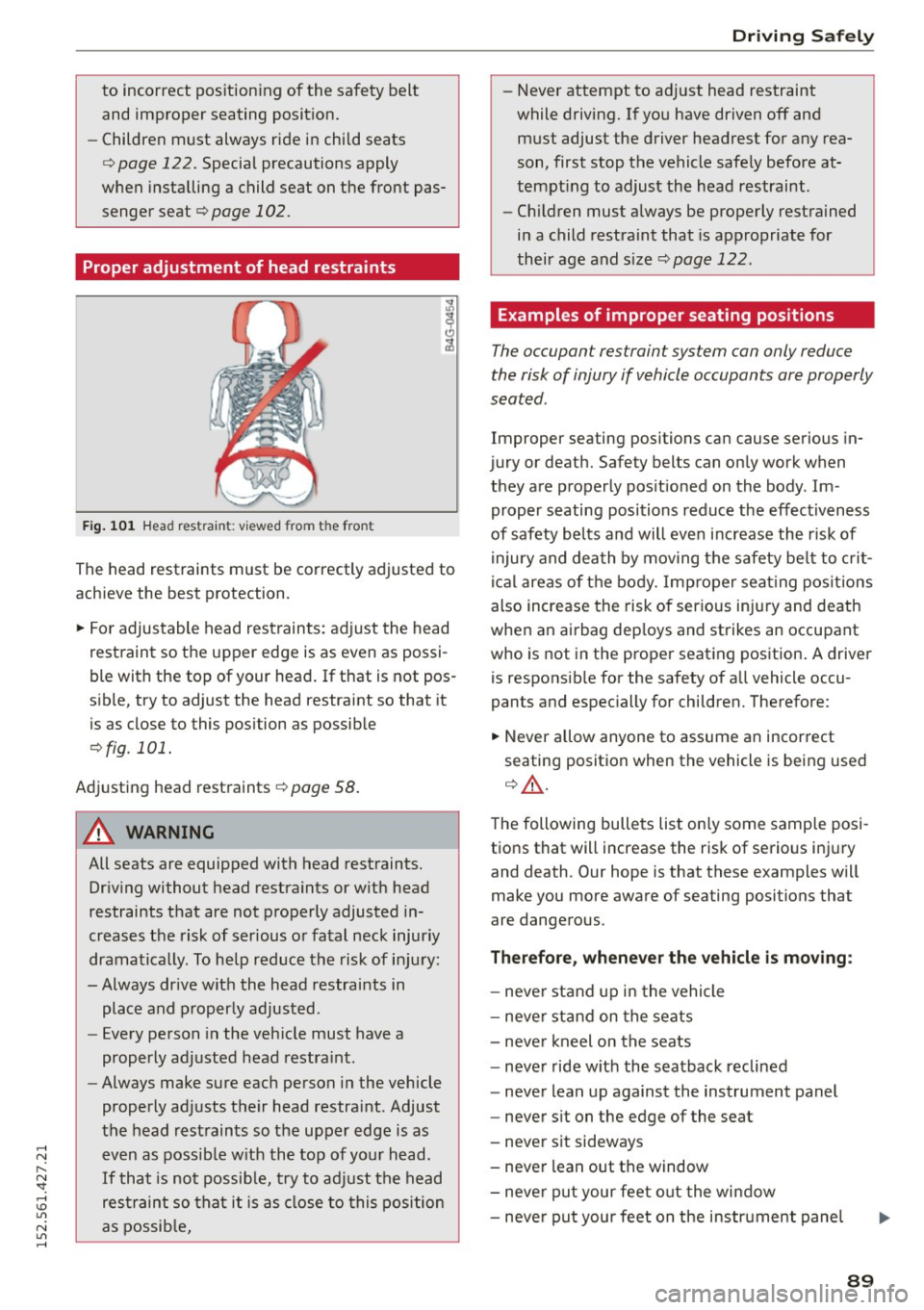
Fig . 101 H ea d re str ain t: v ie w ed fro m the front
The head restraints must be correctly adjusted to
achieve the best protection .
.. Fo r adjustable head restraints: adj ust the head
restraint so the upper edge is as even as possi
ble with the top of your head. If that is not pos
sible, t ry to adjust the head restraint so that it
is as close to this pos ition as possib le
<=> fig . 101.
Adj usting head restraints<=> page 58.
&_ WARNING
All seats are equipped with head restraints.
Dr iv ing without head restraints or w ith head
restraints that are not properly adjusted in
creases the risk of serious or fatal neck injuriy
dramatically . To help reduce the risk of inju ry:
- Always drive with the head restraints in place and properly adjusted .
- Every person in the veh icle must have a
properly ad justed head restra int.
- Always make sure each person in the vehicle
properly adjusts their head restraint. Adjust
the head rest raints so the upper edge is as
even as possib le w ith the top of you r head .
If that is not possib le, try to ad just the head
res traint so that it is as close to this position
as possib le,
Dr iving Sa fel y
-Never attempt to adjust head restraint
while driving. If you have driven off and
must adjust the driver headrest for any rea
son, first stop the vehicle safe ly before at
tempt ing to adjust the head restraint .
- Ch ildren must a lways be properly restrained
in a child restraint that is appropriate for
their age and size <=>
page 122 .
Examples of improper seating positions
The occupan t res traint sys tem can only reduce
the risk of injury if vehicle occupants are properly
seated .
Improper seating positions can cause serious in
jury or death. Safety belts can on ly work when
they are properly pos it ioned on the body . Im
proper seating positions reduce the effectiveness
of safety be lts and will eve n increase the r isk of
i njury and dea th by mov ing the safety be lt to c rit
ical areas of the body. Imp roper seat ing pos itions
also increase the risk of serio us injury and death
when an airbag dep loys and strikes an occupant
who is not in the prope r seat ing pos ition. A driver
is respons ible for the safety of a ll vehicle occu
pan ts and espec ially for children. Therefore :
.. Never allow anyone to assume an incorrect
seating position when the vehicle is being used
Q &. -
The following bullets lis t on ly some samp le posi
tions that will increase the risk of serious inj ury
and death . Our hope is that these examples will
make you more aware of seating positions that
are dangerous .
Therefore, whene ver the vehicle is movi ng:
-never stand up i n the vehicle
- never stand on the seats
- neve r kneel on the seats
- neve r ride w ith the seatback reclined
- never lean up against the instrument panel
- never s it on the edge of the seat
- never sit sideways
- never lean out the window
- never put your feet o ut the window
- neve r put your feet on the instrument pane l
89
Page 97 of 232
..... N
r-N "': ..... \!) 1.1"1
N
"' .....
Safety belts
General notes
Always wear safety belts!
Wearing safety belts correctly saves lives !
This chapte r exp lains why safety be lts are neces
sary, how they work and how to adjust and wear
them correctly .
.. Read a ll the informat ion that fo llows and heed
all of the instructions and WARNINGS .
A WARNING
Not wearing safety belts or wearing them im
prope rly i ncreases the r isk of serious personal
injury and death.
- Safety belts are the sing le most effective
means availab le to red uce the r isk of serious
injury and death in automobile accide nts .
For yo ur protection and tha t of your passen
gers, always corre ct ly wear safety belts
w hen the veh icle is moving.
- P re g nant women, injured, or physically im
paired pe rso ns mu st also use safety belts .
Lik e all ve hicle occupants, t hey are more
likely to be seriously injured if they do no t
wea r safety be lts . The best way to protect a
fetus is to protect the mother -th rougho ut
the enti re pregnancy.
Number of seats
Your Audi R8 has two seating posit ions in the
front. Each seating position has a safety belt.
A WARNING
Not wearing safety belts or wearing them im
prope rly i ncreases the risk of se rious personal
injury and death.
- Never st rap more than one person, includ
ing small ch ildren, into any belt .
It is espe
c ially da ngerous to place a safety belt over a
c hild sitting on you r lap.
- Never let mo re people ride in the ve hicle
t h an t he re are safety be lts ava ilable.
Sa fety bel ts
- Be s ure everyone riding in the vehicle is
properly restrained w ith a separate sa fety
be lt or chi ld restraint.
4 Safety belt warning light
Your vehicle hos o warning system for the driver
and front seat passenger to remind you about the impor tance of buckling up.
Fig . 1 06 Safety bel t wa rning lig ht in the instr ument clus
te r - en lar ged
Before dr iving off, alway s:
"' m
.. Fasten yo ur safety belt and make s ure you wea r
it properly .
.,. Make sure that your passengers also buck le up
and wear their safety belts properly .
.,. Protect childre n with a child restraint system
app ropriate for the s ize and age .
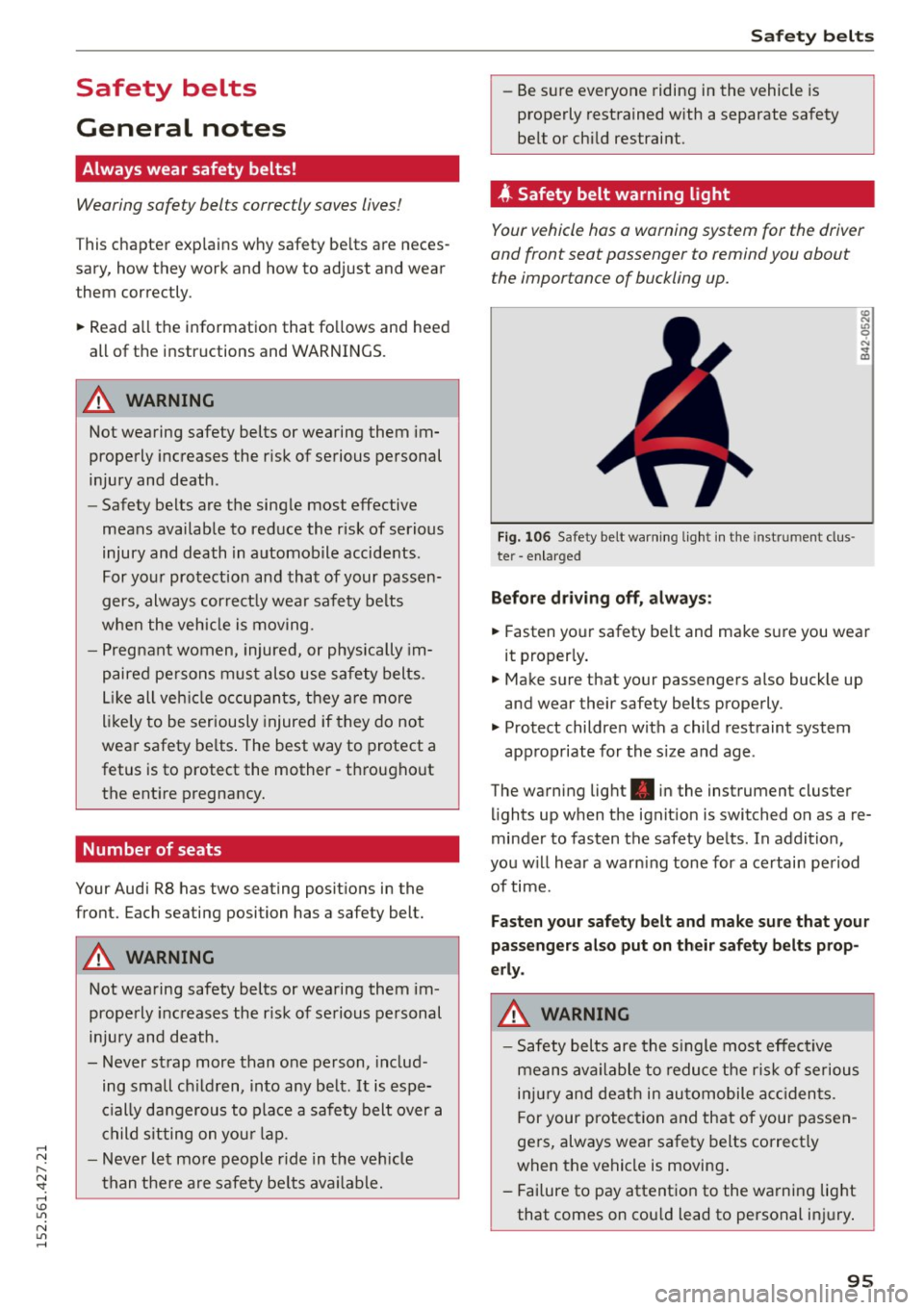
The warning lig ht . in the instrument cluster
li ghts up when the ign it ion is switched on as a re
minder to fasten the safety be lts . In addi tion ,
you w ill hear a warn ing tone for a certai n pe riod
of time.
Fasten your safety belt and make sure that your
passengers al so put on their safety belts prop
erly .
A WARNING
-Safety belts are the s ingle most effective
mean s ava ilable to reduce t he r is k o f seriou s
in jur y and de ath in au tom obile acc iden ts.
F or your protec tion and that of your passen
ge rs, always wear safety belts correct ly
when the vehicle is moving .
- Fai lure to pay attent io n to the warni ng lig ht
that comes on cou ld lead to personal in jury.
-
95
Page 99 of 232
.... N
l'
N "1: .... I.O
"' N
"' ....
Remember too, that airbags will deploy only once
and that your safety belts are always there to of
fer protection in those accidents in which airbags
are not supposed to deploy or when they have al ready deployed . Unbelted occupants can also be
thrown out of the vehicle where even more severe
or fatal injuries can occur .
Safety belts protect
People think it's possible to use the hands to
brace the body in a minor collision . It 's simply
not true!
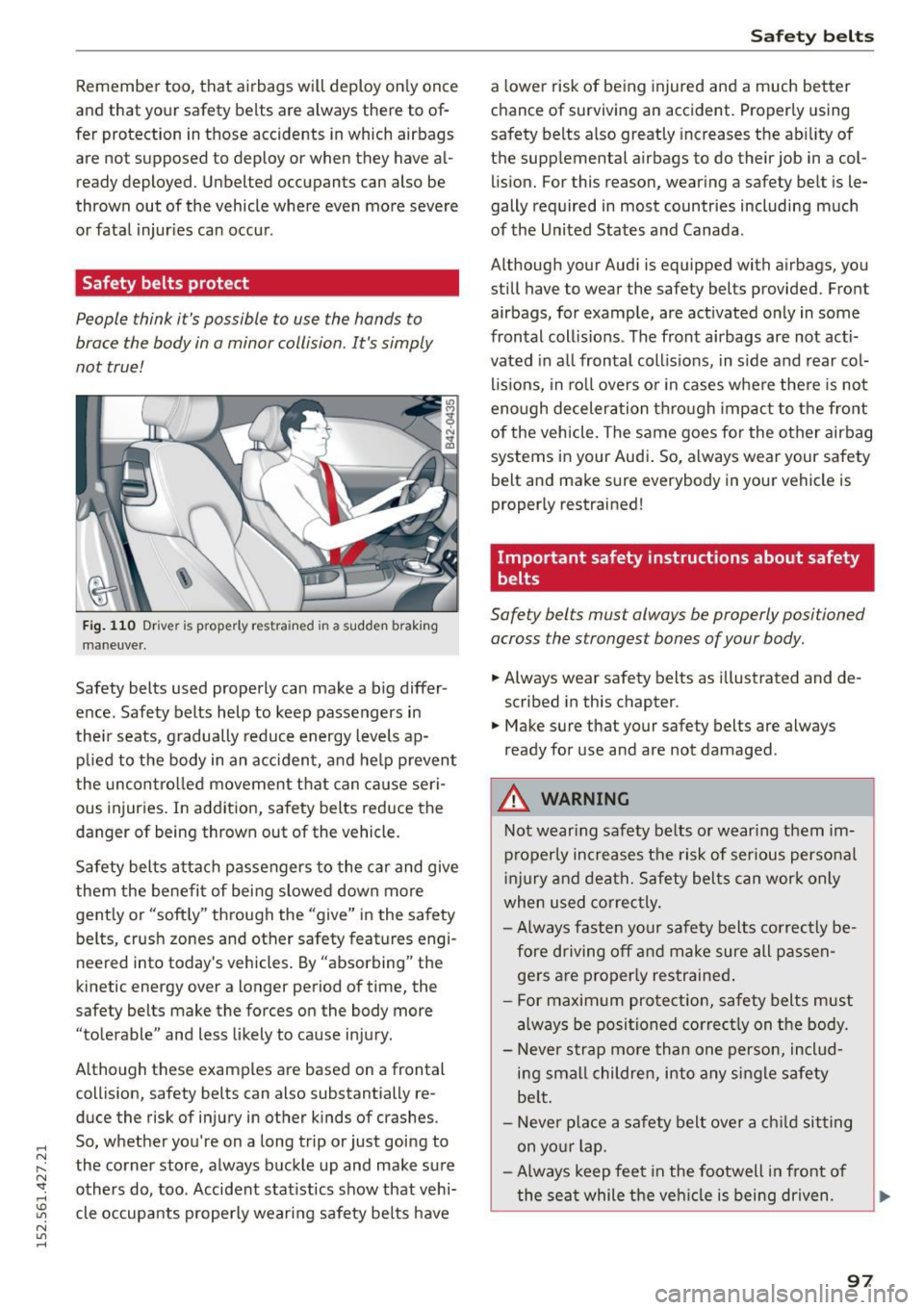
Fig. 110 Dr ive r is properly restrained in a sudden b raking
maneuver.
Safety belts used properly can make a big differ
ence. Safety belts help to keep passengers in
the ir seats, gradually reduce energy levels ap
plied to the body in an accident, and help prevent
the uncontro lled movement that can cause seri
ous injuries. In addition, safety belts reduce the
danger of being thrown out of the vehicle.
Safety belts attach passengers to the car and give
them the benefit of being slowed down more
gently or "softly '' through the "give" in the safety
belts, crush zones and other safety features engi
neered into today's vehicles . By "absorbing" the
kinetic energy over a longer period of time, the
safety belts make the forces on the body more
"tolerable" and less likely to cause injury.
Although these examples are based on a frontal collision, safety belts can also substantially re
duce the risk of injury in other kinds of crashes .
So, whether you're on a long trip or just going to
the corner store, always buckle up and make sure others do, too. Accident stat istics show that vehi
cle occupants properly wearing safety be lts have
Safety belts
a lower risk of being injured and a much better
chance of surviving an accident. Properly using
safety belts also greatly increases the ability of
the supp lemental airbags to do their job in a col
lision. For this reason., wearing a safety belt is le
gally required in most countries including much
of the United States and Canada.
Although your Audi is equipped with airbags, you
still have to wear the safety belts provided. Front airbags, for example, are activated only in some
frontal coll isions. The front airbags are not acti
vated in all frontal collisions, in side and rear col
lisions, in roll overs or in cases where there is not
enough deceleration through impact to the front
of the vehicle. The same goes for the other airbag
systems in your Audi . So, always wear your safety
belt and make sure everybody in your vehicle is
properly restrained!
Important safety instructions about safety
belts
Safety belts must always be properly positioned
across the strongest bones of your body.
• Always wear safety belts as illustrated and de
scribed in this chapter.
• Make sure that your safety belts are always
ready for use and are not damaged.
A WARNING
-Not wearing safety belts or wearing them im-
properly increases the risk of ser ious personal
in jury and death. Safety belts can work only
when used correctly.
- Always fasten your safety belts correctly be
fore driving off and make sure all passen
gers are properly restrained .
- For maximum protection, safety belts must
always be positioned correctly on the body.
- Never strap more than one person, includ
i ng smal l children, into any single safety
be lt.
- Never plac e a safety belt over a child sitting
on your lap .
- Always keep feet in the footwell in front of
the seat while the vehicle is being driven .
97
Page 101 of 232
.... N
l'
N "1: rl I.O
"' N
"' ....
Convertible locking retractor
Every safety belt except the one on the driver
seat is equipped with a convertible locking retrac
tor that
must be used when the safety belt is
used to attach a child seat. Be sure to read the
important information about this feature
c::;,page 130.
A WARNING
Improperly positioned safety belts can cause
serious injury in an accident
c::;, page 99,
Safety belt position.
- Safety belts offer optimum protection only
when the seatback is upright and belts are
properly positioned on the body.
- Never attach the safety belt to the buckle
for another seat. Attaching the belt to the
wrong buckle will reduce safety belt effec
tiveness and can cause serious personal in
jury .
- A passenger who is not properly restrained
can be seriously injured by the safety belt it
self when it moves from the stronger parts
of the body into critical areas like the abdo
men .
- Always lock the convertible locking retractor
when you are securing a child seat in the ve
hicle
c::;, page 131.
Safety belt position
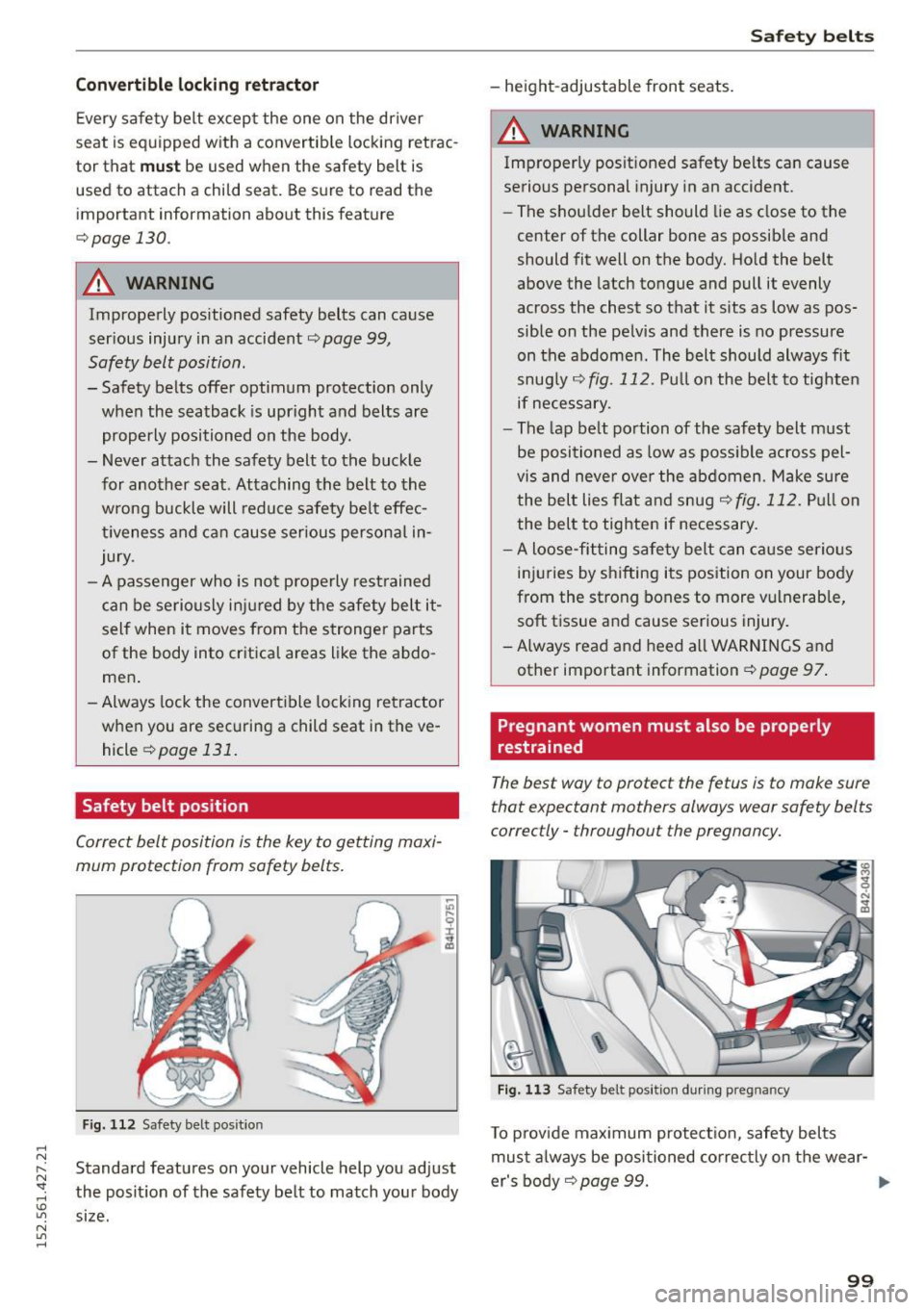
Correct belt position is the key to getting maxi
mum protection from safety belts.
Fig. 112 S afety be lt pos it io n
Standard features on your vehicle help you adjust
the position of the safety belt to match your body
size .
Safety belts
-height -adjustable front seats.
A WARNING
Improperly positioned safety belts can cause
serious personal injury in an accident .
- The shou lder belt should lie as close to the
center of the collar bone as possible and
should fit well on the body. Hold the belt
above the latch tongue and pull it evenly
across the chest so that it sits as low as pos
sible on the pelvis and there is no pressure
on the abdomen. The belt should always fit
snugly
<> fig. 112. Pull on the belt to tighten
if necessary.
- The lap belt portion of the safety belt must
be positioned as low as poss ible across pel
vis and never over the abdomen. Make sure
the belt lies flat and snug
c::;, fig. 112 . Pull on
the belt to tighten if necessary.
- A loose-fitting safety belt can cause serious
injuries by shifting its position on your body
from the strong bones to more vulnerable,
soft tissue and cause serious injury.
-Always read and heed all WARNINGS and
other important information
c::;, page 97 .
Pregnant women must also be properly
restrained
Th e best way to protect th e fetus is to make sure
that expectant mothers always wear safety belts
correc tly- throughout the pregnancy.
Fig. 113 Safety be lt po sition during preg nan cy
To prov ide max imum protect ion, safety belts
must a lways be positioned correctly on the wear-
er's body
r::!;>page 99. .,.
99
Page 105 of 232
..... N
r-N "': ..... \!) 1.1'1
N 1.1'1 .....
also not inflate in side or rear co llisions, or in roll
overs .
Alwa ys rememb er: Airbag s wi ll deploy on ly once,
and on ly in cer tain kinds of collisions. Your safety
b e lts a re a lways there to offer protection in those
situations in which airbags are not supposed to
deploy, or when they have already deployed; for
examp le, when your vehicle str ikes or is struck by
another after the first collision .
This is just one of the reasons why an airbag is a
supp lementary restraint and is not a substitute
for a safety belt. The airbag system works most
effectively when used w ith the safety belts.
Therefore, always properly wear your safety belts
c::>page 95.
A WARNING
Sitting too close to the steer ing whee l or in
st rument panel will decrease the effect ive
ness of the airbags and will in cr ease the risk
o f persona l injury in a coll is ion .
- Never sit closer than 10 inches ( 25 cm) to
the steering wheel or instrument panel.
- If you cannot sit mo re than 10 in ches
( 2 5 cm) from the steer ing whee l, investi
gate whethe r adaptive equipmen t may be
available to help yo u reach the peda ls and
increase your seating distance from the
steering wheel.
- If you are unrestrained, lean ing forward, sit
ting s ideways or out of position in any way,
your risk of in jury is much higher.
- Yo u will also receive serio us injuries and
cou ld even be killed if you are up against the
airbag or too close to it when it inf lates -
even with an Advanced Airbag.
- To reduce the r isk of injury when an airbag
inflates, always wear safety belts properly
i=> page 98, Safety belts.
- Never let children ride unrestrained or im
properly restrained in the veh icle. Adjust the
front seats properly. If ch ildren are not
properly restrained, they may be severely in
jured or killed when an airbag inflates .
- Never r ide with the backrest recl ined .
- Always s it as far as possib le from the steer-
ing wheel or the instrument panel
-
Airbag syste m
c::> page 87, Proper occupant seating posi
tions.
- Always sit upright with your back against
the backrest of your seat.
- Never p lace your feet on the instrument
panel or on the seat. Always keep both feet
on the floor in front of the seat to help pre
vent ser ious injuries to the legs and hips if
the airbag inflates.
- Never recline the front passenger 's seat to
transport objects. Items can also move into
the area of the side airbag or the front air bag du ring bra king or in a sudden maneu
ver. Objects near the airbags can become p rojectiles and cause in ju ry when an airbag
inflates.
A WARNING
A irb ags th at have deployed i n a crash mus t be
r eplaced.
- Use on ly orig inal equipment airbags ap
p roved by Aud i and installed by a tr ained
technician who has the necessary too ls and
diagnostic equipment to properly rep lace
any airbag in yo ur vehicle and assu re system
effectiveness in a crash.
- Never permit salvaged or recycled airbags to
be installed in your vehicle.
Child restraints on the front seat -some
important things to know
"' Be sure to read the important information and
head the WARNINGS for important details
about c hildren and Advanced Airbags
c::>page 122.
The airbag on the passenger s ide makes the front
seat a potent ially dangerous p lace for a child to
r ide. The front seat is not the safest p lace for a
c hi ld in a forwa rd-fac ing c hild safety seat.
It can
be a ve ry dangero us p lace for an infant or a c hild
in a rearward-facing seat.
T he Adva nced A irbag Sys tem in you r vehicle has
been certified to comply wi th the Requiremen ts
of United States Federal Motor Vehicle Safety
Standard 208 as applicable at the time your ve hi-
cle was manufactured. ..,.
103
Page 106 of 232
Airbag system
The Standard requires the front airbag on the
passenger side to be turned off ("suppressed") if
a child up to about one year of age restrained in
one of the rear-facing or forward-facing infant re
straints listed in Federal Motor Vehicle Safety
Standard 208 with which the Advanced Airbag
System in your vehicle was certified has been in
stalled on the front passenger seat. For a listing
of the child restraints that were used to certify
comp liance with the US Safety Standard
¢page 124.
The PASSENGER AIR BAG OFF light in the instru
men t panel tells you when the front Advanced
A irbag on the passenger side has been turned off
by the electronic control unit.
Each time you turn on the ignition, the
PASSEN
GER AIR BAG OFF
light w ill come on for a few
seconds and:
- will stay o n if the front passenger seat is not
occupied,
- will stay on if there is a small child or ch ild re
stra int on the front passenger seat,
- will go off if the front passenger seat is occu
pied by an adult as registered by the weight
sensing mat¢
page 112, Monitoring the Ad
vanced Airbag System.
The PASSENGER AIR BAG OFF light comes on
when the control un it detects a total weight on
the front passenger seat that requires the front
a ir bag to be turned off.
If the total weight on the front passenger seat is
more than that of a typical 1 year-old child but
less than the we ight of a small adult, the front
a ir bag on the passenger side can deploy (the
PASSENGER AIR BAG OFF light does not come
on) . If the
PASSENGER AIR BAG OFF light does
not come on, the front airbag on the passenger
side has not been turned off by the e lectronic
contro l unit and can deploy if the control unit
senses an impact that meets the conditions stor
ed in its memory.
For example, the airbag may deploy if:
-a small child that is heavier than a typical 1
year-old child is on the front passenger seat (re-
104
gardless of whether the child is in one o f the
child safety seats listed¢
page 124), or
- a child who has outgrown child restraints is on
the front passenger seat.
If the front passenger ai rbag is turned off, the
PASSENGER AIR BAG OFF light comes on in the
instrument panel and stays on.
The front airbag on the passenger side may
not
deploy (the PASSENGER AIR BAG OFF light does
not illuminate and stay lit) even if a smal l adult
o r teenager, or a passenger who is not sitting up
right with their back against a non-reclined back
rest with their feet on the vehicle floor in front of
the seat is on the front passenger seat
¢ page 87, Proper seating position for the driver.
If the front passenger airbag deploys, the Federal
Standard requires the airbag to meet the "low
risk" deployment criteria to reduce the risk of in
ju ry through interaction with the a irbag. "Low
risk" deployment occurs in those crashes that
take place at lower decelerations as defined in
the electronic control un it
¢page 112, PASSEN
G£R AIR BAG OFF light.
Always remember, a child safety seat or infant
carr ier installed on the front seat may be struck
and knocked out of position by the rapidly inflat
in g passenge r's airbag in a frontal collision . The
a irbag could greatly reduce the effec tiveness of
the child res traint and even seriously injure the
child during inflation.
_&. WARNING
A child in a rearward-facing chi ld safety seat
installed on the front passenger seat will be
seriously injured and can be killed if the front
a ir bag inflates -even with an Advanced Airbag
System.
- The inflating airbag will hit the ch ild safety
seat or infant carrier with great force and
will smash the child safety seat and child
aga inst the backrest, door or roof.
- Never install a rearward facing child safety
seat on the front passenger seat unless the
PASSENGER AIR BAG OFF light comes on
and stays on. If the
PASSENGER AIR BAG
Page 107 of 232
..... N
r-N "': ..... \!) 1.1'1
N 1.1'1 .....
OFF light does not come on and stay on the
inflating airbag will hit the child safety seat
or infant carrier w ith great force and w ill
smash the ch ild safety seat and ch ild
against the backrest, door or roof . Have the
airbag system inspected immed iately by
your authorized Aud i dealer .
- Forward-fac ing ch ild safety seats installed
on the front passenge r's seat may inte rfe re
with the deployment of the airbag and cause se rious personal injury to the child .
A WARNING
If, in exceptional c ircumstances, you mus t in
stall a forward -facing ch ild restraint on the
front passenger's seat:
- Always make sure the forward-fac ing seat
has been designed and ce rtified by its man
ufact urer for use on a front seat with a pas
senger front and side airbag.
- Never put the forward-facing child restraint
up against or ve ry near the instr ument pan
el.
- Always move the passenger seat into its
rearmost position in the seat's fore and aft
adjustment range, as far away from the air
bag as possib le before installing the for
ward -fac ing child restra int. The backrest
must be adjusted to an up right posit io n.
- Make sure that the
PASSENGER AIR BAG
OFF
light comes o n and stays on all the t ime
whenever the ignition is switched on .
A WARNING
To reduce the risk of serious injury, make sure
that the
PASSENGER AIR BAG OFF light wi ll
be di splayed w henever a child res traint is in
stalled on the front passenger sea t and the
ign ition is swi tched on .
-If the PASSENGER AIR BAG OFF light does
not stay on, per form the checks described
<:? page 112, Monitoring the Advanced Air
bag System .
-Have the airbag system inspecte d by your
Audi dealer immed iately .
Airbag syste m
- Always carefu lly follow instr uctions from
child restraint manufacture rs when instal
ling child restrain ts.
A WARNING
If, in except iona l circumstances, you m ust in
stall a forwa rd or rearward -fac ing ch ild re
strai nt on the front passenger's sea t:
- Improper installation of ch ild restra ints can
red uce their effectiveness or even prevent
them from providing any protect ion.
- An improperly installed ch ild restra int can
interfere with the airbag as it deploys and
serio usly injure or even kill the child -even
wit h an Adva nced A irbag System.
- Always carefu lly follow the manufact urer's
instr uctions provided w ith th e child safety
seat o r carr ie r.
- Never p lace add itiona l items on the seat
that can increase the total weight reg iste red
by the we ight-sensing mat and can c ause in
jury in a cr ash.
105
Page 108 of 232
Airb ag syst em
Front airbags
Description of front airbags
The airbag system can provide supplemental
protection to properly restrained front seat occu
pants .
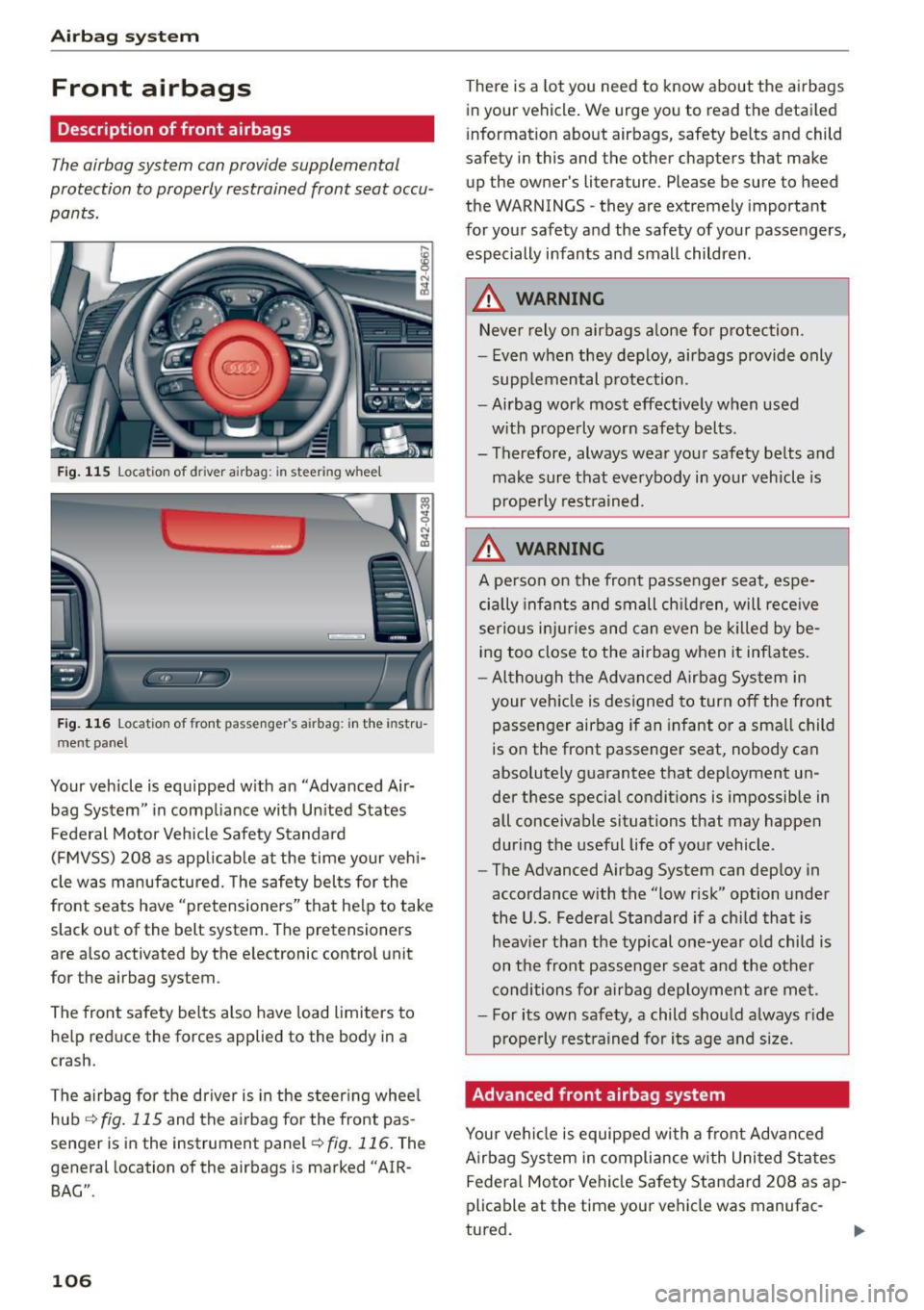
Fig. 115 Location of driver airbag : in steering whee l
Fig. 116 Location of front passenger's airbag: in the instru
ment panel
Your vehicle is equ ipped with an "Advanced Air
bag System" in comp liance with Un ited States
Federal Motor Vehicle Safety Standard
(FMVSS) 208 as applicab le at the time your veh i
cle was manufactured. The safety belts for the
front seats have "pretensioners" that he lp to take
slack out of the belt system. The pretensioners
are also activated by the electronic control unit
for the airbag system.
The front safety belts a lso have load limiters to
help reduce the forces applied to the body in a
crash.
The airbag for the driver is in the steer ing wheel
hub
¢ fig . 115 and the airbag for the front pas
senger is in the instrument panel¢
fig. 116. The
general location of the airbags is marked "AIR
BAG".
106
There is a lot you need to know about the airbags
in your vehicle . We urge you to read the detailed
i nformation about airbags, safety belts and child
safety in this and the other chapters that make
up the owner's literature. Please be sure to heed
the WARNINGS -they are extremely important
for your safety and the safety of your passengers, especially infants and small children .
,&_ WARNING -
Never rely on airbags alone for protection.
- Even when they deploy, airbags provide only supp lemental p rotection.
- Airbag work most effectively when used with properly worn safety belts .
- Therefore, always wear your safety be lts and
make sure that everybody in your vehicle is
prope rly restrained.
,&_ WARNING
A person on the front passenger seat, espe
cially infants and small ch ild ren, will rece ive
serious i njur ies and can even be killed by be
ing too close to the airbag when it inf lates .
- Although the Advanced Airbag System in your vehicle is designed to turn off the front passenger airbag if an infant or a sma ll child
is on the front passenger seat, nobody can
absolutely guarantee that dep loyment un
der these special condit ions is impossible in
all conceivable situations that may happen
during the useful life of your vehicle .
- The Advanced Airbag System can dep loy in
accordance with the "low risk" option under
the U .S. Federal Standard if a chi ld that is
heav ier than the typical one-year old child is
on the front passenger seat and the other
conditions for airbag deployment are met.
- For its own safety, a child shou ld always r ide
prope rly rest rained for i ts age a nd si ze.
Advanced front airbag system -
Your vehicle is equipped with a front Advanced
Airbag System
in compliance with United States
Federa l Motor Vehicle Safety Standard 208 asap
plicable at the time your vehicle was manufac
tured.
Page 109 of 232
..... N
r-N "': ..... \!) 1.1'1
N 1.1'1 .....
The front Advanced Airbag System supp lements
the safety belts to provide additiona l protection
for the driver's and front passenger's heads and
upper bodies in frontal crashes. The a irbags in
flate only in frontal impacts when the vehicle de
celeration is h igh enough .
The front Advanced Airbag System for the front
seat occupants is not a substitute for your safety be lts. Rather, it is pa rt of the overall occupant re
straint system in your vehicle. Always remember
that the airbag system can only help to protect
you, if you are sitt ing upright, wearing your safe
ty belt and weari ng it properly. This is why you
and your passengers m ust always be properly re
strained, no t just because the law req uires you to
be .
The Advanced Airbag System i n your veh icle has
been certified to meet the " low risk " requi re
men ts fo r 3 and 6 yea r-old ch ildren on the pas
senger side and very small ad ults on the driver
side . The low risk deployment criteria are intend
ed to he lp reduce the r isk of injury through inter
action with the front airbag that can occur, for
examp le, by being too close to the steering wheel
and instrument pane l when the airbag inf lates.
In addition, the system has been certif ied to
comp ly w ith the "suppression" requ irements of
the Safety Standard, to turn off the front airbag
for infants 12 months old and younger who are restra ined o n the front passenger seat in c hild re
straints that are listed in the Standard
~ page 124, Child restraints and Advan ced Air
bags.
"S uppression" requires the front airbag on the
passenger side to be turned off if:
- a ch ild up to about one year of age is restrained
on the front passenger seat in one of the rear
facing o r forward-fac ing in fant rest raints listed
in Federa l Moto r Ve hicle Safety Standard
208
with wh ic h t he Advanced Ai rbag System in your
vehicle was cer tified. For a list ing of the ch ild
r es traints that were used to cert ify you r vehi
cle's compliance with t he US Safety Standard
~ page 124, Airbag
syste m
- weight less than a thresho ld level stored in the
cont ro l unit is detected on the front passenger
seat.
When a person is detecte d on the front passen
ger seat, weigh ing more than the tota l we ight of
a chi ld that is about 1 year old restrained in one
of the rear -facing or forwa rd-fac ing infant re
stra ints (listed in Federal Motor Vehicle Safety
Standard
208 with wh ich the Advanced Airbag
System i n your veh icle was certified), the front
airbag on the passenge r side may or may not de
ploy .
The
PASSENGER AIR BAG OFF light comes on
when the elect ro nic cont ro l unit detects a total
we ight on the fro nt passenger sea t that requires
the front airbag to be tu rned off . If the
PASSEN
GER AIR BAG OFF
light does not come on, the
fron t airbag on t he passenger side h as not bee n
tu rned off by the control unit and can dep loy if
t h e con trol unit senses an impact that meets t he
conditions stored in its memo ry .
If the tot al weight on the fr ont p assenge r seat is
more than that o f a typical 1 year-o ld, b ut less
t h an the weight of a small adult, the front airbag
o n the passenge r side may deploy (the
PASSEN
GER AIR BAG O FF
light does not come on).
For example , the airbag ma y deploy if:
- a small ch ild that is heav ie r than a typical 1
yea r-old ch ild is on the front passenge r seat ( re
ga rdless o f whether the chi ld is in one of the
child sa fe ty seats listed~
page 124),
-a child who has outgrown ch ild res traint s is on
t he fron t passenger seat.
If th e front passenger a irbag is turned off, the
PASSENGER AIR BAG OFF light in the center of
t h e instr ume nt pane l w ill come on and s tay on.
The front airbag o n the passenge r side may
not
deploy ( the PASSENGER AIR BAG OFF light does
not ill umi nate and s tay lit) if:
- a small adult or teenager is on the front pas
senger seat
- a passenger who is not s itting upright with
their back aga inst a non-reclined backrest with
their feet on the vehicle floor in front of th e
seat is on t he front passenger sea t.
IJl,
107
Page 112 of 232
Airbag system
-If the PASSENGER AIR BAG OFF light does
not come on and stay on, have the airbag
system inspected by your Audi dealer.
How the Advanced Airbag System
components work together
The front Advanced Airbag System and the side
ai rbags supplement the protection offered by the
front three-point safety be lts with pretensioners
and load limiters and the adjustable head re
straints to help reduce the risk of injury in a wide
range of accident and crash situations. Be sure to
read the important information about safety and
heed the WARNINGS in this chapter.
Deployment of the Advanced Airbag System and
the activation of the safety be lt pr etensioners de
pend on the deceleration measured by the crash
sensors and registered by the electronic control
unit. Crash sever ity depends on speed and decel
eration as well as the mass and stiffness of the
veh icle or object involved in the crash.
When the electronic control unit registers a low
severity crash and the safety belt is being used,
the airbag will not deploy . If the safety belt is not
be ing used , the first stage deploys, followed by
the second stage after a much later time in the
crash sequence.
If the electronic control un it reg isters a crash of
medium severity, the first stage of the airbag de
p lo ys followed by the second stage at a much lat
er time in the crash sequence -regardless of
whether the safety belt is being used or not. In
h ig her severity crashes as registered by the elec
tronic control unit, both the first and second
stages deploy almost at the same time .
On the passenger side, regard less of safety belt
use, the airbag will be turned off if the weight on
the passenger seat is less than the amount pro
grammed in the electronic contro l unit. The front
airbag on the passenger side w ill also be turned
off if one of the child safety seats that has been
cert ified under Federal Motor Veh icle Safety
Standard 208 has been recogn ized on the seat.
The
PASSENGER AIR BAG OFF light comes on
and stays on to tell you when the front Advanced
Airbag on the passenger side has been turned off
110
q page 103, Child restraints on the front seat -
some important things to know.
A WARNING
To reduce the risk of injury when an airbag in
flates, always wear safety belts properly.
- If you are unrestrained, leaning forward, sit
ting sideways or out of position in any way,
your r isk of injury is much higher .
- You will also receive serious injuries and
could even be killed if you are up aga inst the
airbag or too close to it when it inflates -
even with an Advanced Airbag
q page 102.
More important things to know about front
airbags
Fig. 117 Infla ted fro nt airbags
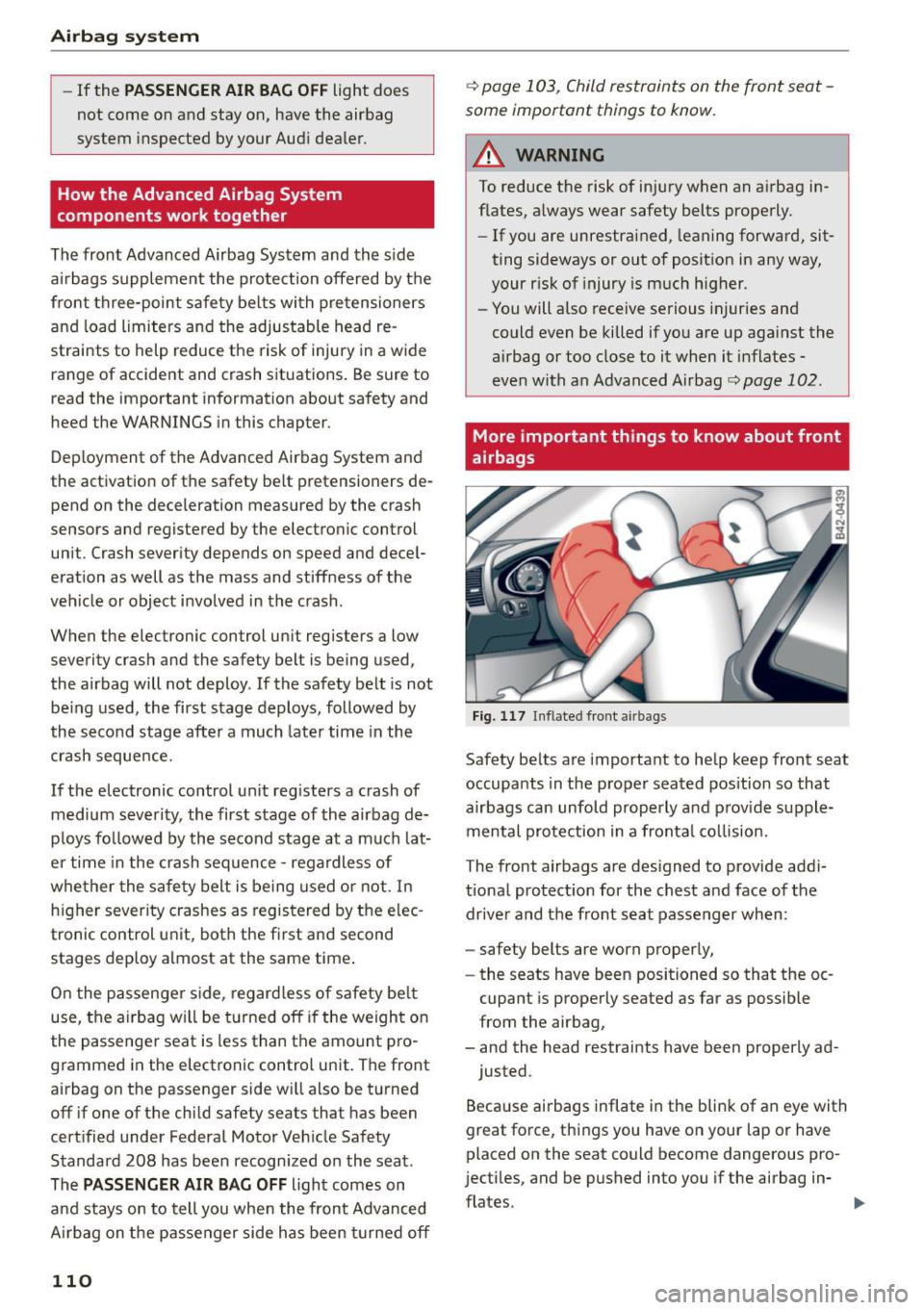
Safety belts are important to help keep front seat
occupants in the proper seated pos ition so that
airbags can unfold properly and prov ide supple
mental protection in a fronta l collision .
The front airbags are des igned to provide addi
tional protect ion for the chest and face of the
dr ive r and the front seat passenger when:
- safety belts are worn properly,
- the seats have been positioned so that the oc -
cupant is properly seated as far as possible
from the airbag,
- and the head restraints have been properly ad-
justed .
Because airbags inflate in the blink of an eye with
great force, things you have on your lap or have
placed on the seat could become dangerous pro
jectiles, and be pushed into you if the airbag in-
flates.
~