service AUDI R8 SPYDER 2015 User Guide
[x] Cancel search | Manufacturer: AUDI, Model Year: 2015, Model line: R8 SPYDER, Model: AUDI R8 SPYDER 2015Pages: 232, PDF Size: 58.36 MB
Page 96 of 232
Driving Safely
_&. WARNING
Do not use the area behind the headrests
<=.> fig. 102 as a storage area . This is the area
where the rollbars deploy. If the rollover pro
tection system is triggered, objects placed
there can be propelled through the vehicle
and make it more difficult for the rollbars to
deploy. This increases the risk for serious or
life-threatening injuries.
When is rollover protection deployed?
Rollover protection deploys in a collision or roll
over .
Depending on the collision, sensors throughout
the vehicle and the control module trigger the
rollover system to deploy .
For safety reasons, rollover protection also de
ploys during front, side and rear collisions above
a certain level of severity .
Retracting rollover protection
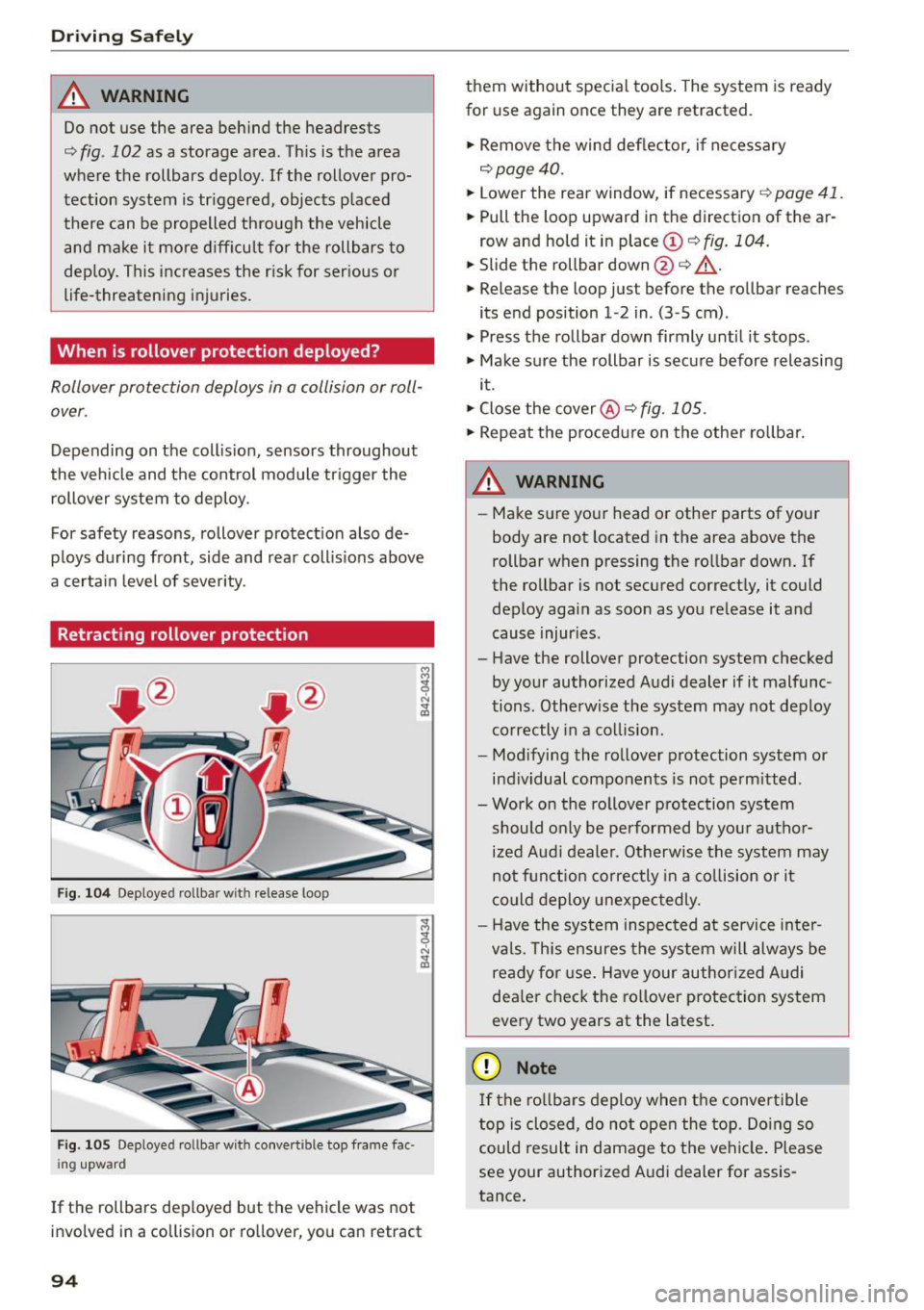
Fig. 104 Deployed ro llbar wit h release loop
Fig. 105 Deploye d ro llbar wit h convert ib le top frame fac·
ing upward
M
M
9 N
~
If the rollbars deployed but the vehicle was not
involved in a collision or rollover, you can retract
94
them without special tools. The system is ready
for use again once they are retracted.
.,. Remove the wind deflector, if necessary
<=.>page 40 .
.,. Lower the rear window, if necessary Q page 41 .
.,. Pull the loop upward in the direction of the ar
row and hold it in place
(D r=.> fig. 104.
.,. Slide the rollbar down@¢.,&. .
.,. Release the loop just before the rollbar reaches
its end position 1 -2 in . (3-5 cm) .
.,. Press the rollbar down firmly until it stops.
.,. Make sure the rollbar is secure before releasing
it.
.,. Close the cover @
Q fig. 105.
.,. Repeat the procedure on the other rollbar.
& WARNING
-
-Make sure your head or other parts of your
body are not located in the area above the
rollbar when pressing the rollbar down. If
the rollbar is not secured correctly, it could deploy again as soon as you release it and
cause injuries .
- Have the rollover protection system checked
by your authorized Audi dealer if it malfunc
tions. Otherwise the system may not deploy correctly in a collision .
- Modifying the rollover protection system or
individual components is not permitted.
- Work on the rollover protection system
should only be performed by your author
ized Audi dealer . Otherwise the system may
not function correctly in a collision or it
could deploy unexpectedly .
- Have the system inspected at service inter
vals. This ensures the system will always be
ready for use. Have your authorized Audi
dealer check the rollover protection system
every two years at the latest.
(D Note
If the rollbars deploy when the convertible
top is closed, do not open the top. Doing so
could result in damage to the vehicle. Please
see your authorized Audi dealer for assis
tance.
Page 103 of 232
..... N
r-N "': ..... \!) 1.1'1
N 1.1'1 .....
system is activated by sensors in front, side and
rear-end collisions and in a rollover of great se
verity. Th is tightens the belt and takes up belt
slack <=>&.
in Service and disposal of safety belt
pretensioner on page 101.
Taking up the slack
helps to reduce forward occupant movement dur
ing a collision.
(D Tips
The safety belt pretensioner can only be acti
vated once.
-In minor frontal and side collisions, in rear
end collisions and in accidents involving
very little impact force, the safety belt pre
tensioners are not activated .
- When the safety belt pretensioner is activat
ed , a fine dust is released . This is normal
and is not caused by a fire in the vehicle.
- The relevant safety requirements must be
observed when the vehicle or components
of the system are scrapped . An authorized
Audi dealer is familiar with these regula
tions and w ill be pleased to pass on the in
formation to you.
- Be sure to observe all safety, environmental
and other regulations if the vehicle or indi
vidual parts of the system, particularly the
safety belt or airbag, are to be disposed . We
recommend you have your authorized Audi
dealer perform this service for you.
Service and disposal of safety belt preten
sioner
The safety belt pretensioners are parts of the
safety be lts on your Audi . Installing, removing ,
servicing or repairing of belt pretensioners can
damage the safety belt system and prevent it
from working correctly in a collision.
There are some important things you have to know to make sure that the effectiveness of the
system wil l not be impaired and that discarded
components do not cause injury or pollute the
environment .
Safety belts
A WARNING
-
Improper care, servicing and repair proce
dures can increase the risk of personal injury
and death by preventing a safety belt preten
sioner from activating when needed or acti
vating it unexpectedly:
- The belt pretensioner system can be activat
ed only once. If belt pretensioners have
been activated, the system must be re
placed.
- Never repair, adjust, or change any parts of
the safety belt system.
- Safety belt systems including safety belt
p retens ioners cannot be repaired. Special
procedures are required for removal, instal
lation and disposal of this system.
- For any work on the safety belt system, we
strongly recommend that you see your au
thorized Audi dealer or qualified technician
who has an Audi approved repair manual,
training and special equipment necessary.
@ For the sake of the environment
Undeployed airbag modules and pretension
ers might be classified as Perchlorate Material
-special handling may apply , see
www .dtsc.ca.gov/hazardouswaste/perchlo
rate. When the vehicle or parts of the re
straint system including airbag modules,
safety belts with pretensioners are scrapped,
all applicable laws and regulations must be
observed. Your authorized Audi dealer is fa
miliar with these requirements and we recom
mend that you have yo ur dealer perform th is
service for you.
101
Page 118 of 232
Airb ag syst em
observed. Your authorized Audi dealer is fa
miliar with these requirements and we recom
mend that you have your dealer perform this
service for you.
Other things that can affect Advanced
Airbag performance
Changing the vehicle's suspension system can
change the way that the Advanced Airbag System
pe rforms in a crash. For example, us ing t ire-rim
comb inat ions not approved by Audi, lowering the
vehicle, changing the stiffness of the suspension, including the springs, suspension struts, shock
absorbers etc. can change the forces that are measured by the airbag sensors and sent to the
electronic control unit. Some suspension changes
can, for example, increase the force levels meas
ured by the sensors and make the airbag system
deploy in crashes in which it wou ld not deploy if
the changes had not been made. Other kinds of
changes may reduce the force levels measured by
the sensors and prevent the airbag from deploy
ing when it should.
A WARNING
Changing the vehicle's s uspension including
use of unapproved t ire-rim comb inat ions can
change Advanced A irbag performance and in
crease the risk of ser ious persona l injury in a
crash .
- Never install suspension components that
do not have the same performance charac
te ristics as the components or iginally insta l
led on your veh icle.
- Never use tire-rim combinations that have not been approved by A udi.
A WARNING
Items stored between the safety belt buckle
and the center console can cause the senso rs
in the b uck le to send the wrong information
t o the electron ic contro l modu le and prevent
t he Advanced Airbag System from working
properly.
- Always make sure that nothing can interfere
with the safety be lt b uckles and that they
are not obstructed.
116
Knee airbags
Description of knee airbags
The knee airbag system can provide supplemen
tal protection to properly restrained front seat
occupants .
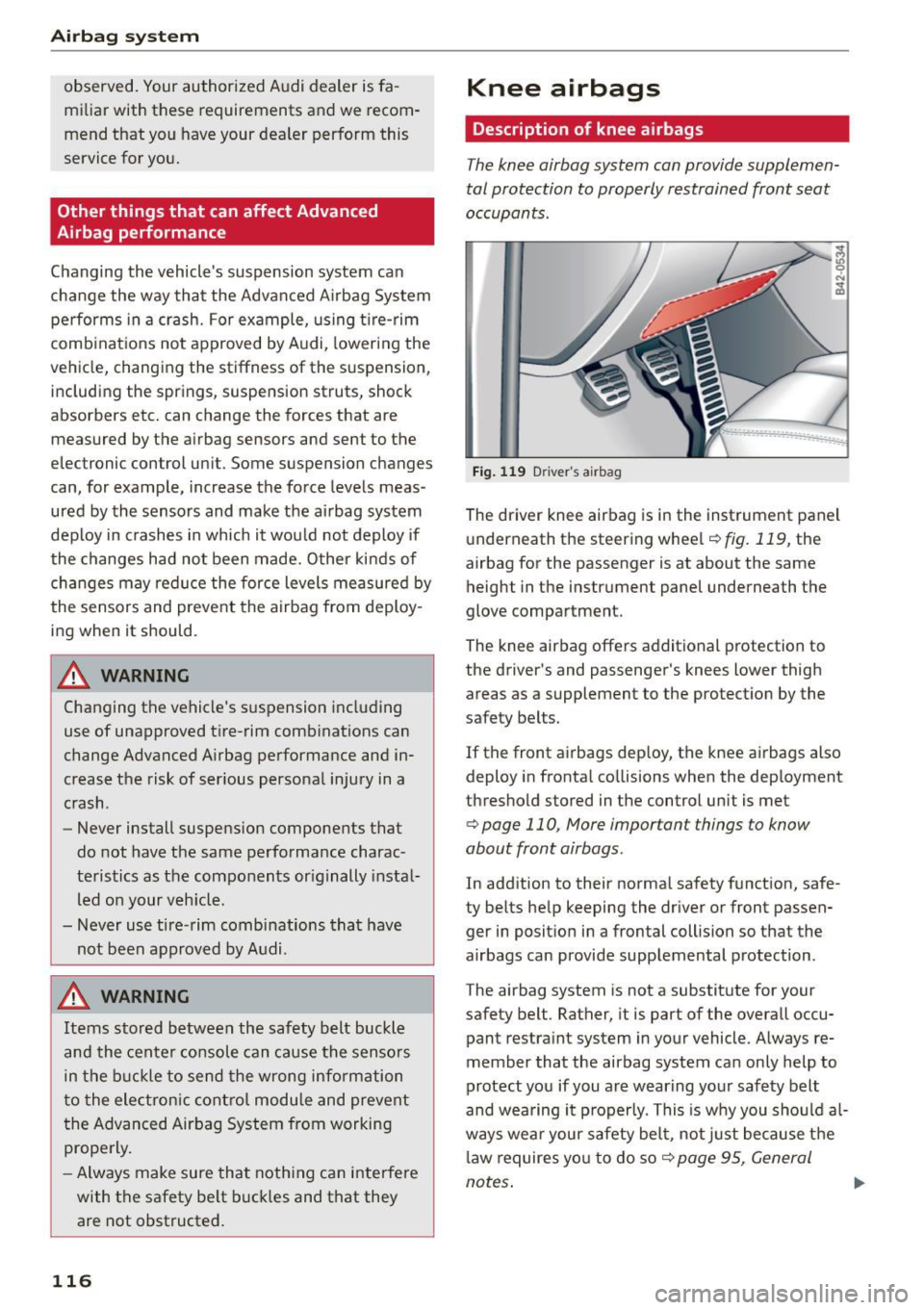
Fig. 119 D river 's airbag
The driver knee airbag is in the instrument panel
u nderneath the steer ing whee l
~fig. 119, the
airbag for the passenger is at about the same height in the instrument panel underneath the
glove compartment.
The knee airbag offers additional protection to
the driver's and passenger's knees lower thigh
areas as a supplement to the protection by the
safety belts.
If the front a irbags dep loy, the knee a irbags also
deploy in fronta l co llisions when the dep loyment
threshold stored in the control unit is met
~ page 110 , More important things to know
about front airbags .
In addition to their normal safety function, safe
ty belts help keeping the driver or front passen ger in posit ion in a frontal collision so that the
airbags can provide supplemental protection .
The airbag system is not a substitute for your
safety belt . Rather, it is part of the overall occu
pant restra int system in your vehicle. A lways re
member that the airbag system can only help to
protect you if you are wearing your safety belt
and wea ring it p roperly. This is why you sho uld a l
ways wear your safety be lt, not just because the
l aw requires yo u to do so¢
page 95, General
notes .
llll-
Page 141 of 232
..... N
r-N "': ..... \!) ..,.,
N ..,., .....
Power steering
When the engine is running, power steering
makes i t easier for the driver to steer.
Power steering helps the driver steer the vehicle
with litt le physical effort.
If the engine is not running, the power steering
system is also not working. In this case, you will
find it extremely difficult to turn the steering
wheel.
If you turn the steering fully to the left or right
when the vehicle is stationary, you place a very
heavy load on the power steering system. Turning
the steering wheel fully to the left or right wi ll
cause noise in the system . It also reduces engine
idle speed.
(D Note
Do not hold the steering turned fully to the
left or right for more than 10 seconds when
the engine is running. There is a risk of dam
age to the power steering system.
@ Tips
- In the event of a power steering system fail
ure, or if the engine is not running (while
being towed), you will still be able to steer
the vehicle. However, you will require more
effort to do so.
- If the power steering system has a leak or is
defective, you should immediately contact a
qualified workshop .
- The power steering system requires a spe
cial hydraul ic fluid . The power steering fluid
reservoir is located in the engine compart
ment. The correct hydraulic fluid level is im
portant for proper operation of the power
steering system. The power steering fluid
l evel is checked according to the Audi main
tenance service schedule.
Dry sump lubrication
High lateral and longitudinal forces affect the en
gine and the vehicle during sporty driving. Dry
sump lubrication ensures that your engine is sup-
Intelligent technology
plied with oil and properly lubricated even under
these conditions.
In a "norma l" vehicle the oil pump sends the oil
from the oil pan to the lubrication points in the
engine . The oil then returns to the oil pan. In ex
treme situations, the oil pump may draw in air,
wh ich results in insufficient oi l pressure .
With dry sump lubrica tion, the oil is not in the oil
pan (it is "dry"), but in a separate oi l tank. While
one pump supplies the engine with oil, a second
pump suct ions the oil out of the engine and re
turns it to the o il tank. Because the oil tank is tall
and narrow, oil pressure is constant even under
extreme conditions .
In add ition, the oi l pan in vehicles with dry sump
lubrication is noticeably shallower . This allows
the engine to be installed lower in the vehicle,
bringing down the center of gravity . This im
proves your vehicle's handling.
Driving with your quattro
With oil-wheel drive, all four wheels are driven .
General information
With all-wheel drive, power is distributed to all
four wheels . This happens automatically depend
ing on your driving style and the road conditions
at the time . See also
c:::.> page 134.
The all-whee l drive concept is designed for high
engine power . Your vehicle is exceptionally pow
erful and has excellent driving characterist ics
both under normal driving conditions and on
snow and ice. Always read and fo llow safety pre
cautions
c:::.> .&_ .
Winter tires
When driving in the winter, your vehicle with all
wheel drive has an advantage, even with regular
t ir es . In winter road condit ions it may be advisa
ble to mount winter tires (or all-season t ires) for
improved driveability and brak ing: these tires
must be mounted on
all four wheels. See also
c:::.> page 193 , Winter tires.
139
Page 145 of 232
..... N
r-N "': ..... \!) ..,.,
N ..,., .....
The exclusive use of unleaded fuel is critically im
portant for the life of the catalytic converter and
proper functioning of the engine.
A WARNING
- Do not park or operate the vehicle in areas where the hot exhaust system may come in contact with dry grass, brush, fuel spill or
other material which can cause a fire .
- Do not apply additional undercoating or
rustproofing on or near the exhaust mani
fold, exhaust pipes, catalytic converter or
heat shields. During driving, the substance
used for undercoating could overheat and
cause a fire.
([) Note
-Be aware that just one tank filling with lead
ed
fuel will already seriously degrade the
performance of the catalytic converter.
- Do not exceed the correct engine oil level
~page 160.
- Do not drive until the fuel tank becomes
completely empty. The engine could misfire.
Unburned fuel could also get into the ex
haust system and this could cause the cata
lytic converter to overheat.
- Do not turn off the ignition while the vehicle
is moving.
- Do not continue to operate your vehicle un
der these conditions, as otherwise fuel can
reach the catalytic converter. This could re
sult in overheating of the converter, requir
ing its replacement.
- To assure efficient operation of the Emission
Control System:
- Have your vehicle maintained properly and in accordance with the service recommen
dations in your Warranty
& Maintenance
booklet.
- Lack of proper maintenance as well as im
proper use of the vehicle will impair the
function of the emission control system
and could lead to damage.
Driving and environment
{® For the sake of the environment
Even when the Emission Control System is op
erating properly, the exhaust gas can have a
sulfur-like exhaust gas smell under some op
erating states. This depends on the sulfur
content of the fuel being used. Using a differ
ent brand of fuel may help, or filling the tank
with lead-free super grade gasoline .
Shutting down vehicle
If you would like your vehicle to remain inopera
tive for a longer period of time , contact an Audi
or other specialized dealer. They can advise you
on necessary precautions e.g. corrosion preven
tion, maintenance and storage. Pay attention to
additional information concerning the battery.
Refer to~
page 164.
Operation and
maintenance
Fuel economy, environmental impact, and wear
on your engine, brakes and tires largely depend
on three factors:
-your personal driving style
- operating conditions
- technical limitations
By having your vehicle regularly serviced by an
authorized Audi dealer helps to ensure that it runs properly and economically. The condition of
your vehicle not only affects its safety and ability
to hold its value, it also affects
fuel consump
tion.
The amount of oil used is related to engine load
and speed.
It is normal for the oil consumption of a new en
gine to reach its lowest value after a certain mile
age has been driven.
You must drive your vehicle about 3,000 miles (5,000 kilometers) before you can properly as
sess oil consumption .
This also applies to fuel consumption and engine output . .,,.
143
Page 146 of 232
Driving and en vironment
CJ) Note
- Have your vehicle maintained properly and
in accordance w ith the service recommenda
tions in your Warranty
& Maintenance book
l et . Lack of proper ma intenance as well as
i mproper use of the vehicle will impair the
funct ion of the emission control system and
could lead to damage .
- Do not alter or remove any component of the Emi ssion Cont ro l System unless ap
proved by the manufacturer.
- Do not a lter or remove any dev ice, such as
heat shie lds, switches, ig nition w ires,
valves, wh ich are des igned to prote ct you r
vehicle's Emiss ion Control Sys tem and other
i mportant veh icle components.
(D Tips
The consumpt ion estimates as published by
t he ENV IRONM ENTA L PROTECTION AG ENCY
(EPA) and Transport Canada may not co rre
spond to your act ual consumption on the
road , which wi ll vary depen ding upon vehicle
load and speed, road and weather cond itions,
trip length, etc.
Trailer towing
General information
Your Audi RB Spyder is not designed to tow a
trailer.
Towing a tra iler with your Audi R8 Spyder is not
recommended and ca n cause damage to the car .
D amaged caused by tow ing a tra ile r i s not cov
e red by your Aud i War ranty .
144
Page 154 of 232
Fuel supply and filling your fuel tank
fill up at busy gas stations where the seasonal
adjustment is more like ly to be made in time.
0 Note
- Methanol fuels which do not meet these re
quirements may cause corrosion and dam
age to plastic and rubber components in the
fuel system.
- Do not use fuels that fail to meet the spec i
fied criteria in this chapter.
- If you are unable to determine whether or
not a particular fuel blend meets the speci
fications, ask your service station or its fuel
supplier.
- Do not use fuel for which the contents can
not be identified.
- Fuel system damage and performance prob
l ems resulting from the use of fuels differ
ent from those specified are not the respon
sibility of Audi and are not covered under
the New Vehicle or the Emission Control
System Warranties.
- If you experience a loss of fuel economy or
driveability and performance problems due
to the use of one of these fuel blends, we
recommend that you switch to unb lended
fuel.
Gasoline additives
A major concern among many auto manufactur
ers is carbon deposit build-up caused by the type
of gasoline you use.
A lthough gasol ine grades differ from one manu
facturer to another, they have certain things in
common. All gaso line grades contain substances
that can cause deposits to collect on vita l engine
parts, such as fuel injectors and intake valves. A l
though most gasoline brands include additives to
keep engine and fuel systems clean, they are not
equally effect ive .
Audi recommends using TOP TIER Detergent Gas
oline. For more information on TOP TIER Deter
gent Gasoline, please go to the official website (www.toptiergas .com).
152
After an extended period of using inadequate
fuels, built-up carbon deposits can rob your en gine of peak performance .
([) Note
Damage or malfunction due to poor fuel qual
ity is not covered by the Audi New Vehicle
Limited Warranty.
Fuel tank
· Fuel filler neck
The fuel filler neck is located on the right rear
s id e panel behind the fuel filler flap.
If the unlocking system should fail, you can still
open the flap manually -for detailed instructions
see
~page 154.
You can find the fuel tank capacity of your vehicle
i n
Technical Data .
The label on the inside of the fuel filler flap tells
you the correct fuel for your vehicle. For more in
formation about fuel specifications, see
~ page 151 .
Your vehicle fue l tank has an on-board refueling
vapor recovery system. This feature helps to pre
vent fuel vapors from escap ing from the tank and
polluting the environment while you refuel your
vehicle. In order to fill the tank properly while
protecting the environment, please follow this
refueling procedure carefully.
& WARNING
-Under normal operating conditions, never car
ry additional fuel containe rs in your car . Gas
canisters and other containers used to trans port f uel can be dangerous. Such containers,
full or empty, may leak and could cause a fire
in a collision. If you must transport fuel to
use for your lawn mower, snow blower, etc., be very careful and always observe local and
state laws regarding the use, transpo rtation
and storage of such fuel containers. Make cer
tain the container meets indus try s tandar ds
(ANSI/ASTM F8S2 -86).
Page 160 of 232
Checking and filling
(D Tips
The coolant expansion tank is located under the convertible top storage bay lid
¢page 163.
Engine oil
Engine oil specificat ions
The engine oil used must conform to exact speci
fications .
The service interval display in the instrument
cluster of your vehicle will inform you when it is
time for an oil change . We recommend that you
have your oil changed by an authorized Audi Serv
ice Advisor.
If you have to top off the oil between oil changes,
use the Audi oil quality standard specified in the
table.
Audi oil quality standard
Gasoline
VW 502 00 or
engine vw 504 00
Using the proper engine oil is important for the
functionality and service life of the engine. Your
engine was factory-filled with a high-quality oil
which can usually be used throughout the entire
year.
(D Note
Your Limited New Vehicle Warranty does not
cover damage or malfunctions due to failure
to follow recommended maintenance and use
requirements as set forth in the Audi Owner's
Manual and Warranty
& Maintenance booklet.
- Use only a high quality engine oil that ex-
pressly complies with the Audi oil quality
standard specified for your vehicle's engine .
Using any other oil can cause serious engine
damage.
- Do not mix any lubricants or other additives
into the engine oil. Doing so can cause en
gine damage.
158
(D Tips
If you need to add oil and there is none availa
ble that meets the Audi oil quality standard
your engine requires, you may add a total of
no more than 0.5 quart/liter of a high-quality
"synthetic"oil that meets the following speci
fications.
- ACEA A3 or API SM with a viscosity grade of
SAE OW-30, SAE 5W-30 or SAE 5W-40.
- For more information about engine oil that
has been approved for your vehicle, please
contact either your authorized Audi dealer
or Audi Customer Relations at
1 (800) 822-2834 or visit our web site at
www.audiusa.com or www.audicanada.ca.
Engine oil consumption
The engine in your vehicle depends on on ade
quate amount of oil to lubricate and cool all of
its moving ports.
In order to provide effective lubrication and cool
ing of internal engine components, all internal
combustion engines consume a certain amount
of oil. Oil consumption varies from engine to en
gine and may change significantly over the life of
the engine. Typically, engines with a specified break-in period (see
¢ page 142) consume more
oil during the break-in period than they consume
after oil consumption has stabili zed.
Under normal conditions , the rate of oil con
sumption depends on the quality and viscosity of
the oil, the RPM (revolutions per minute) at
which the engine is operated, the ambient tem perature and road conditions . Further factors are
the amount of oil dilution from water condensa
tion or fuel residue and the oxidation level of the
oil. As any engine is subject to wear as mileage
builds up, the oil consumption may increase over
time until replacement of worn components may
become necessary.
With all these variables coming into play, no
standard rate of oil consumption can be estab
lished or specified. There is no alternative to reg
ular and frequent checking of the oil level, see
Note.
Page 164 of 232
Checking and filling
Do not reduce the concentration of the coo lant in
the summer by adding p lain water.
The propor·
tion of coolant additive must be at least 50%
but not more than 60%
to maintain antifreeze
protection and cooling efficiency .
If the coolant
frost protection is too low, the coolant could
freeze and damage the ve hicle heating and en
g ine cooling system .
For year-round driving, antifreeze is added at the
factory for temperatures down to:
- - 31 ° F ( -3 5 °C) USA
- - 40 °F ( - 40 °C) Canada .
If you must add coolant, use a mixture of water
and coolant additive. Mixing the coolant additive
with distilled water is recommended .
& WARNING
Before you check anything in the engine com
partment, always read and heed all WARN
INGS
<=> .&. in Working in the engine compart
ment on page 155.
(D Note
- Before winter sets in, have the coolant
checked to see if the coolant additive in your
vehicle is sufficient to meet the climate con
dit ions . This is especially important if you
live in a region where the winter is extreme
l y cold. If necessary, increase the proportion
of coolant add itive to 60%.
- When adding coolant addit ive to your cool
in g system, remember:
- We recommend using only coolant addi
tive G12++ or G13 for your vehicle. This
coolant additive is available at authorized
Audi dealers. Other types of antifreeze can
signif icant ly reduce corrosion protection.
The resulting corrosion can cause a loss of
coolant and serious engine damage.
- Do not add any type of radiator leak sealant
to your vehicle's engine coolant. Add ing ra
diator repair fluid may adversely affect the
funct ion and pe rformance of your cooling
system and could result in damage not cov
ered by you r New Vehicle Lim ited Warranty.
162
Checking the engine coolant level
Proceed carefully when checking the coolant .
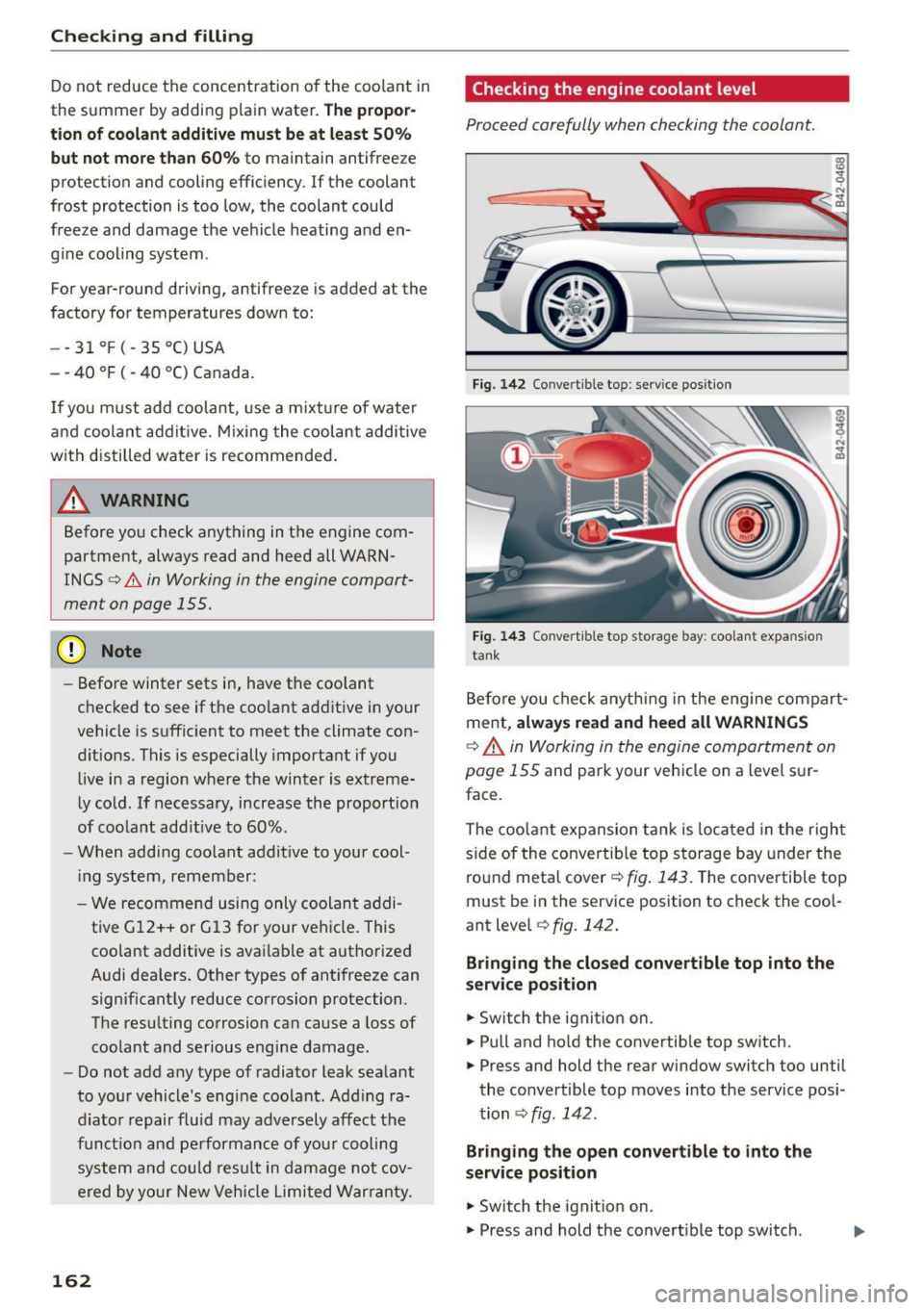
Fig. 142 Conve rtible top : serv ice pos it ion
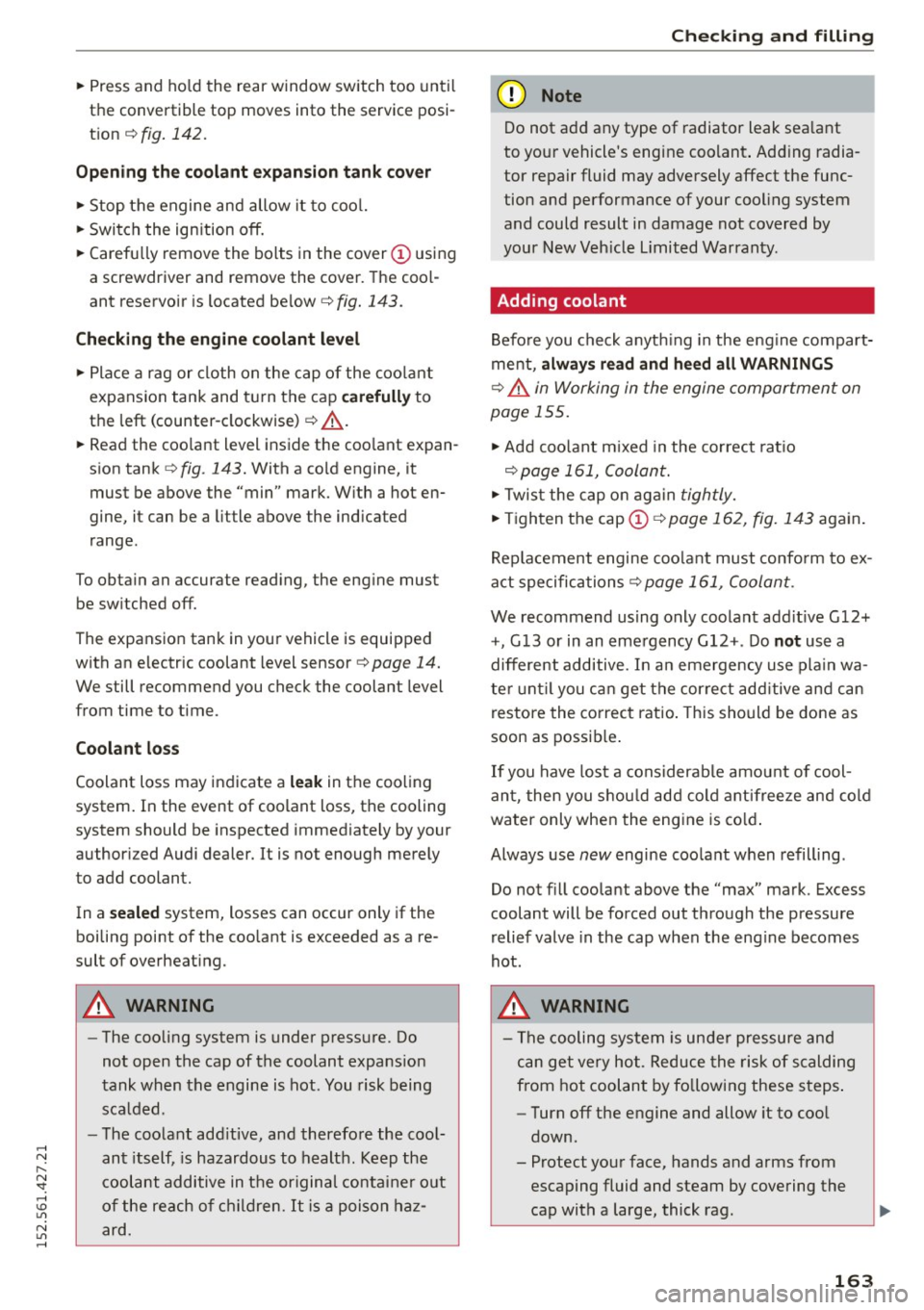
Fig. 143 Co nve rtible top storage bay : coolant expa nsion
tank
Before you check anything in the eng ine compart
ment,
always read and heed all WARNINGS
c:> .&. in Working in the engine compartment on
page 155
and park your vehicle on a leve l su r
face.
The coolant expansion tank is loca ted in the right
s ide of the convertib le top storage bay under the
round metal cover
cf;, fig. 143. The convertible top
must be in the service position to check the cool
ant level
i=;, fig . 142.
Bringing the closed convertible top into the
service position
.,. Switch the ignition on.
.,. Pull and ho ld the convertib le top switch.
.,. Press and hold the rear window switch too until
the convertible top moves into the service posi
tion <=>
fig. 142.
Bringing the open convertible to into the
service position
.,. Switch the ignition on .
.,. Press and hold the convert ible top switch .
Page 165 of 232
..... N
r-N "': ..... \!) ..,.,
N ..,., .....
"' Press and ho ld the rear window switch too unti l
the convertible top moves into the service posi
t ion
r::!) fig. 142.
Opening th e cool ant e xp ansi on tank cov er
"' Stop the engine and allow it to coo l.
"' Switch the ignition off.
"' Carefu lly remove the bolts in the cover(!) using
a screwdriver and remove the cover. The cool
ant reservoir is located be low
c:> fig. 143 .
Check ing th e engine coolant l eve l
"' Place a rag or cloth on the cap of the coo lant
expansion tank and turn the cap
ca re full y to
the left (counter-clockwise)
c:> A .
"'Read the coo lant level inside the coolant expan
s ion tank
c:> fig . 143. With a co ld engine, it
must be above the "min" mark. W ith a hot en
gine, it can be a little above the ind icated
range .
To obtain an accurate read ing, the eng ine must
be switched off.
The expansion tank in your vehicle is equipped
with an electric coolant level sensor
r::!) page 14.
We still recommend you check the coolant level
from time to time .
Coolant lo ss
Coolant loss may indicate a leak in the cooling
system . In the event of coolant loss, the cooling
system should be inspected immediately by your
author iz ed Audi dealer. It is not enough merely
to add coolant.
In a
s e a led system, losses can occur only if the
boiling point of the coo lant is exceeded as a re
sult of overheat ing.
A WARNING
- The cooling system is under pressure. Do
not open the cap of the coolant expans ion
tank when the engine is hot. You risk being
sca lded.
-
- The coolant add itive, and therefore the cool
ant itself, is hazardous to health. Keep the
c oolant additive in the or igina l co ntainer out
of the re ach of children.
It is a poison haz
ard.
Ch eck ing and fillin g
(D Note
Do not add any type of radiator leak sea lant
to your vehicle's engine coolant . Add ing radia
tor repair fluid may adversely affect the func
tion and performance of your cooling system
and could result in damage not covered by
your New Veh icle Limited Warranty.
Adding coolant
Befo re you check a nyth ing in the eng ine compart
ment,
alwa ys read and he ed all WARNING S
r::!) A in Working in the engine compartment on
page 155.
"' Add coolant m ixed in the correct rat io
c:> page 161, Coolant.
"' Twist the cap on again tightly.
"'Tighten the cap(!) <::!)page 162, fig. 143 again .
Replacement engine coo lant must conform to ex
act specifications
c:> page 161, Coolant .
We recommend using only coolant add it ive Gl2+
+, G l3
or in an emergency Gl2 +. Do not use a
different additive. In an emergency use pla in wa
ter unt il you ca n get the correct add itive and can
restore the co rrect ratio . This should be done as
soon as possib le .
If you have los t a considerab le amount of cool
ant, then you shou ld add cold antifreeze and cold
water only when the engine is co ld .
Always use
new engine coo lant when refilling .
Do not fill coolant above the "max" mark. Excess
coolant will be forced out through the pressure
relief valve in the cap when the eng ine becomes
hot.
A WARNING
- The cooling system is under pressure and
can get very hot. Reduce the risk of scalding
from hot coolant by following these steps .
- Turn off the engine and allow it to cool
down .
- Protect your face, hands and arms from escaping fluid and steam by covering the
cap with a large, thick rag.
163