service AUDI R8 SPYDER 2015 Owner's Manual
[x] Cancel search | Manufacturer: AUDI, Model Year: 2015, Model line: R8 SPYDER, Model: AUDI R8 SPYDER 2015Pages: 232, PDF Size: 58.36 MB
Page 166 of 232
Checking and filling
-Turn the cap slowly and very carefully in a
counter-clockwise direction while applying
light, downward pressure on the top of
the cap .
- To avoid being burned, do not spill anti
freeze or coolant on the exhaust system or hot engine parts. Under certain condi
tions, the ethylene glycol in engine cool
ant can catch fire .
- Antifreeze is poisonous. Always store anti
freeze in its original container and well out of the reach of children .
- If you drain the coolant, it must be caught
and safely stored in a proper container
clearly marked "poison".
CD Note
-Coolant pollutes the environment and could
cause an engine fire . Excess coolant will be
forced out through the pressure relief valve
in the cap when the engine becomes hot.
-If, in an emergency, only water can be add
ed, the correct ratio between water and an
tifreeze
¢ page 161 must be restored as
soon as possible.
@ For the sake of the environment
Drained coolant should not be reused. Always
dispose of used coolant while observing all
environmental regulations.
Brake fluid
Have the brake fluid changed by an experienced
technician.
Brake fluid absorbs moisture from the air. If the
water content in the brake fluid is too high, cor
rosion in the brake system may result after a peri
od of time. The boiling point of the brake fluid
will also decrease considerably and decrease
braking performance.
Therefore, the brake fluid must be changed
every
two years.
Always use new brake fluid which con
forms to Federal Motor Vehicle Standard "FMVSS
116 DOT 4".
164
Brake fluid is replaced according to the Audi
maintenance service schedule . Your authorized
Audi dealer is equipped with the necessary spe
cial tools and replacement parts, has the neces
sary expertise, and can dispose of the used fluid .
A WARNING
-Brake fluid is poisonous . It must be stored
only in the closed original container out of
the reach of children!
- Brake failure can result from old or inappro priate brake fluid. Observe these precau
tions:
- Use only brake fluid that meets SAE speci
fication
J 1703 and conforms to Federal
Motor Vehicle Standard
116. Always check
with your authorized Audi dealer to make
sure you are using the correct brake fluid .
The correct type of brake fluid is also indi cated on the brake fluid reservoir.
- The brake fluid must be new . Heavy use of
the brakes can cause a vapor lock if the brake fluid is left in the system too long.
This can seriously affect the efficiency
of
the brakes as well as your safety . This
could result in an accident.
CD Note
Brake fluid will damage the paint of your vehi
cle.
@ For the sake of the environment
Because of the problem of proper disposal of
brake fluid as well as the special tools re
quired and the necessary expertise, we rec
ommend that you have the brake fluid
changed by your authorized Audi dealer.
Battery
General information '
Your vehicle is equipped with a special battery, an
ACM battery . This battery is located in the lug
gage compartment and must be replaced with an
original equipment battery. Under normal oper
ating conditions, the battery is
maintenance-
free. ..,_
Page 167 of 232
..... N
r-N "': ..... \!) 1.1'1
N 1.1'1 .....
Have the battery checked when you take your ve
hicle in for service. You are well advised to re
place a battery that is older than 5 years .
Disconnecting the batt ery terminal s
Some vehicle funct ions (power w indow regula
tors , fo r example) are lost if the battery termi
na ls are disconnected. These functions have to be
re learned after the battery terminals are con
nected again. To prevent this , the batte ry shou ld
only be disconnected from the vehicle electrical
system when absolutely necessary for repairs.
V ehicl es not dri ven fo r lo ng p eriod s
If you do not drive your vehicle over a period of
several days or weeks , e lectrica l components are
gradually cut back or switched off. This reduces
energy consumption and maintains s tarting ca
pability over a longer period<=> page 140. Some
of the convenience funct ions may not operate ,
such as the inter ior lights or powe r seat ad just
ment. The convenience functions will be ava ilable
again when you switch on the ignition and start
the eng ine.
Wint er op erati on
During the winter months, battery capacity tends
to decrease as temperatures drop . This is because
more power is also consumed w hile start ing , and
the head lights, rear w indow defogger, etc., are
used more often.
Avoid unnecessary power consumption, part icu
l arly in city traffic o r when traveling only short
d ista nces . Let you r a utho rized Aud i dea le r check
the capacity of the vehicle battery before w inter
sets in <=> page 167. A well charged battery will
not on ly prevent starting prob lems when the
w eather is cold, but will also last longer.
R eplacing battery
The new battery mu st ha ve the same capacity,
voltage
(12 vo lts), amperage, construction and
p lug sealing, as the original battery . Specifica
tions are listed on the battery housing. Batteries
specia lly deve loped by Audi fulfill the mainte
nance, output, and safety requ irements .
Check ing and fillin g
When installing the battery, make sure the igni
tion and all electrica l consumers are switched off
<=> 0 .
We recommend that you use main tenance-free or
cycle -res istant /leak-p roof batteries according to
the standards TL
825 06 (from Apri l 2008) and
VW 7
50 73 (from Apr il 2010).
Replac ing the bat tery shou ld be carried by a
qualified workshop. Please fo llow the ins truc
tions on the battery cover .
(D Note
-All work on the battery req uires techn ica l
knowledge . Please contact an Audi dealer
ship or another authorized facility for ques
tions about the battery - danger of ac id
burns and explosion ha zard!
- The battery must not be opened! Do not try
to change the battery's liquid level, other
w ise detonating gas will escape from the
battery- exp losion hazard!
- The AGM battery in the luggage compart ment cannot leak, because the e lectrolyte
for this battery is absorbed into a special glass mat . This leak-proof battery must not
be replace with a convent ional battery.
- Make sure the ventilation hose on the side
of the battery is connected, otherwise
fumes or battery ac id can leak out.
- Battery holder and terminals always have to
be sec ured correctly .
- Before all work on the battery follow the
warnings be low <=>&. in Working on the bat
tery on page 166.
@ For the sake of the environment
Because of the prob lem of proper disposal of
a battery, we recommend your autho rized
Audi dealer change the battery for you . Bat
teries contain sulfur ic acid and lead and must
a lways be d isposed of properly in compliance
with all envi ronmental regula tions . Disposing
of vehicle batteries improperly is very danger
ous to the environment . Make sure that the
removed battery cannot overba lance, other
wise sulf uric ac id might escape!
165
Page 184 of 232
Tires and wheels
-The use of incorrect tire pressure values can lead to acci
dents or other damage. There
fore it is essential that the driver observe the specified
tire pressure values for the
tires and the correct pressures
for the function of the tire pressure monitoring system.
-Always inflate tires to the rec ommended and correct tire
pressure before driving off.
-Driving with underinflated tires bend more, letting them get too hot resulting in tread
separation, sudden tire failure
and loss of control.
-Excessive speed and/overload
ing can cause heat build-up,
sudden tire failure and loss of
control.
-If the tire pressure is too low
or too high, the tires will wear
prematurely and the vehicle
will not handle well.
-If the tire is not flat and you do not have to change a wheel
immediately, drive at reduced
speed to the nearest service
station to check the tire pres
sure and add air as required .
182
d) Note
Driving without valve stem caps
can cause damage to the tire
valves. To prevent this, always
make sure that factory instal
led valve stem caps on all
wheels are securely mounted on the valve.
@ For the sake of the environment
Underinflated tires will also in
crease the fuel consumption.
Tires and vehicle load limits
There are limits to the amount of
load or weight that any vehicle
and any tire can carry. A vehicle
that is overloaded will not handle
well and is more difficult to stop. Overloading can not only lead to
loss of vehicle control, but can al
so damage important parts of the
vehicle and can lead to sudden
tire failure, including a blowout and sudden deflation that can
cause the vehicle to crash.
Your safety and that of your pas
sengers also depends on making
sure that load limits are not ex
ceeded. Vehicle load includes ev
erybody and everything in and on
the vehicle. These load limits are ...
Page 187 of 232
.... N ,..: N "': ....
"' "' N
"' .....
Tire service life
The service life of tires depends
on a lot of different things includ
ing proper installation and bal
ancing, correct tire pressure and
driving style.
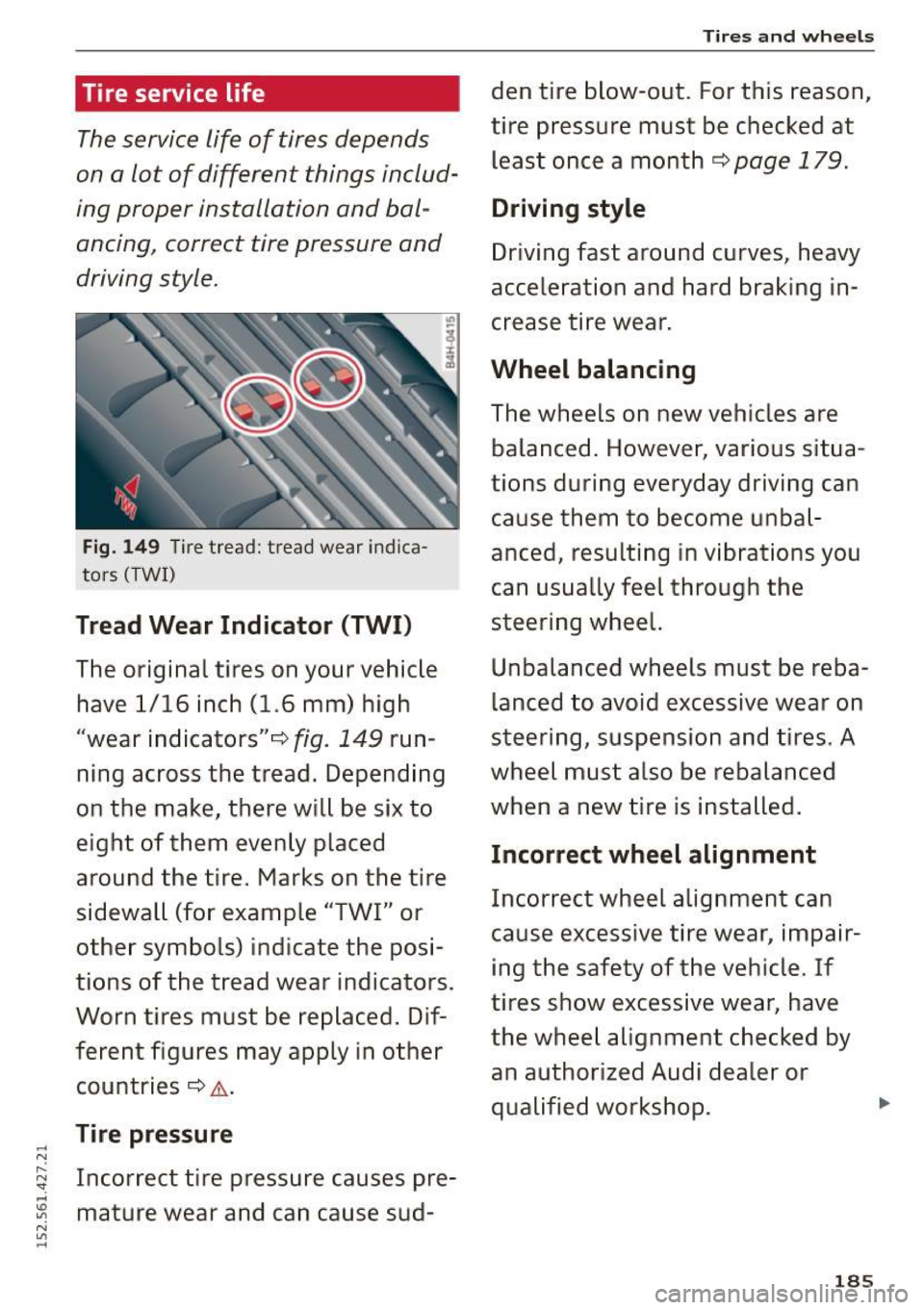
Fig. 149 Tire tread: tread wear indica
tors (TWI)
Tread Wear Indicator (TWI)
The original tires on your vehicle
have 1/16 inch (1 .6 mm) high
"wear indicators"c::>
fig. 149 run
ning across the tread. Depending
on the make, there will be s ix to
eight of them evenly placed
around the tire. Marks on the tire
sidewall (for example "TWI" or
other symbols) indicate the posi
tions of the tread wear indicators.
Worn tires must be replaced. Dif
ferent figures may apply in other
countries c::>
.&..
Tire pressure
Incorrect tire pressure causes pre
mature wear and can cause sud-
Tires and wheels
den tire blow-out. For this reason,
tire pressure must be checked at least once a month c::>
page 179.
Driving style
Driving fast around curves, heavy
acceleration and hard braking in
crease tire wear.
Wheel balancing
The wheels on new vehicles are
balanced. However, various situa
tions during everyday driving can
cause them to become unbal
anced, resulting in vibrations you
can usually feel through the
steering wheel.
Unbalanced wheels must be reba
lanced to avoid excessive wear on
steering, suspension and tires . A
wheel must also be rebalanced
when a new tire is installed .
Incorrect wheel alignment
Incorrect wheel alignment can
cause excessive tire wear, impair
ing the safety of the vehicle. If
tires show excessive wear, have
the whee l alignment checked by
an authorized Audi dealer or
qualified workshop.
185
Page 192 of 232
Tires a nd wh eels
Tire ply composition and
materials used
The number of plies indicates the
number of layers of rubber-coat
ed fabric in the tire. In general,
the greater the number of plies,
the more weight a tire can sup
port . Tire manufacturers also
must indicate the materials in the
tire, which include steel, nylon, polyester, and others .
Maximum Load Rating
This number indicates the maxi
mum load in kilograms and
pounds that can be carried by the
tire .
Tire quality grading for
treadwear , traction , and
temperature resistance
Tread wear, traction and tempera
ture grades ~
page 192.
Maximum Permissible
Inflation Pressure
This number is the greatest
amount of air pressure that
should ever be put in the tire un
der normal driving conditions .
190
Replacing tires or rims on
vehicles equipped with tire pressure monitoring sy stem
The wheels on your vehicle are
equipped with a sensor which
constantly monitors the air pres
sure inside the tire, and then
transmits this information to the
tire pressure monitoring system.
If you are go ing to replace the
wheel rims on your vehic le, make
sure the new rims also have these
sensors. The sensors must be
compatible with the tire pressure monitoring system on your vehi
cle.
If you install rims, which do not have the sensors, or have sensors
which are not compatible, then
the tire pressure monitoring sys
tem will not work properly . In this
case, the tire pressure monitoring
system would not be able to mon itor the tire pressure or warn you
if it is necessary .
-The battery inside of the tire pressure sensor has a limited
service life.
-Always drive with the valve stem caps securely mounted . We rec
ommend using factory installed ""
Page 207 of 232
..... N
r-N "': ..... \!) 1.1'1
N 1.1'1 .....
~ Then comp lete ly unscrew th e othe r whee l bolts
as descr ibed above.
~ Takeoff the wheel le aving the alignment pin in
t he bolt hole
Q (D.
Putting on th e w hee l
~ Lift the spare wheel and carefully slide it over
the alignment pin to guide it in place
q (D.
~ Use the hexagonal socket in the screwdriv er
hand le to screw in and tighten all wheel bo lts
s ligh tly.
~ Unscrew the alignmen t pin and insert and
t ighten the remaining wheel bolt s light ly like
the rest .
~ Turn the jack handle counter-clockw ise to lowe r
the vehi cle until the jack is fu lly released.
The wheel bolts must be clean and turn easily. Check the contact surfaces of wheel and hub . Re
move contaminants on these surfaces before in
stall ing the wheel.
The hexagonal socket in the screwdriver handle makes it eas ier to hand le the wheel bolts . The re
ve rsible blade shou ld be removed .
When mounting
un idirectional tires, observe the
d irection of rotation
q page 203 .
When removing or install ing the wheel, the
r im could hit the brake rotor/ceramic brake
roto r* and damage the rotor. Wo rk ca refully
an have a second pe rson help you .
{D) Tips
Never use the hexagonal socket in the handle
of t he screwdr iver to loose n or tighten the
wheel bo lts.
Tightening wheel bolts
~ Fi t the wheel bolt wrench ove r th e wheel bo lt
and push it down as fa r as it will go
l).
~ Close your grip aro und the end of the wrench
hand le for max im um torq ue and turn eac h
whee l bolt
cloc kwi se u ntil it s its t ight .
l) You need t he appro pria te adapte r to t ight en th e an ti- th eft
wheel bo lts
<=:> p age 20 3.
What do I d o now?
Have the tightening torque of the wheel bolts
checked as soon as possib le with a torqu e
w renc h. It should be 120 Nm .
Check the
tire pre ssure as soon as possible.
Return the veh icle tool k it to its p roper place .
A WARNING
Loosening the whee l bolts is p roh ibited; dan
ger of an accident!
(D Tips
- Never try and use the hexagonal socket in
the handle of the screwdrive r to loosen o r
tighten t he whee l bolts.
- If you hav e determined that wheel bolts are
co rroded and difficult to turn, the bolts
must be replaced before checki ng t he tor
que.
- Unt il the t ightening to rque is checked, d rive
a t redu ced s peed s as a precaution.
Notes on wheel change
Please read t he info rmation q page 186, New
tires and replacing tires and wheels,
if yo u are
going to us e a spare tire w hich is different from
the ti res on your vehicle.
After you change a tire:
- Che ck the tire pre ssure on the spar e imm ed i
ate ly after mounting .
- Have the wheel bolt tightening torque
c he cked with a torque wrench as soon as po s
s ible by your authorized Audi d ealer or a
qualified service station .
- With steel and all oy wheel rim s, th e wheel
bolts ar e corre ctl y tightened at a torque of 90
ft lb
( 120 Nm ).
- If you noti ce while changing a tire that the
wheel bolts are corroded and diffi cult to turn ,
then the y should be replaced before you check
the tightening to rque .
IJ>-
205
Page 209 of 232
.... N
l'
N "1: rl I.O
"' N
"' ....
(D Note
-Applying a higher vo ltage booster battery
will cause expensive damage to sensitive electronic components, such as control
units, relays, radio, etc.
- T here m ust be no e lectrica l contact between
the vehicles as otherwise current could al
ready start to flow as soon as the pos itive
(+) terminals are connected .
@ Tips
-The discharged battery must be properly
con nected to the vehicle's electrical system.
- Switch
off any car phone, or follow the car
phone instruct ions for this situation.
Use of jumper cables
Make sure to connect the jumper coble clomps in
exa ctly the order described below!
F ig . 161 Luggag e comp artm ent: conn ectors fo r a charg er
an d jump start cab les
®
Fig . 162 Jump start using th e batte ry in a not her ve hicl e: A
• Fe male sock et, B • D isch arge
The batte ry is located in the luggage compart
ment ~
page 166 . The front lid can be opened in
a n emergency
r=;, poge 33.
What do I do no w?
Do not connect the negative cable d irect ly to the
n egat ive terminal on the battery . Connect it to a
jump start pin instead r=;, fig. 161.
Connect the po sitive cable (r e d ) to the
po sitive terminal
1. Connect one end of the red jumper cab le
r=;, fig . 162 (D to th e positive t erminal of dis
charged battery @.
2. Connect the o ther end of the red jumper ca
ble to the positive term inal @ofthe booster
battery @.
Conne ct the neg ative c able (bl ack ) to the
neg ativ e terminal
3. Connect one end of the b lack jumper cable @
to the negative term inal of the booster bat
tery @.
4. Secu re the other end to the jump start pin@
for the d isc harged battery @.
Starting the engine
"'Start the engine of the veh icle provid ing assis
tance and allow it to run at idle .
"' Now sta rt the engine of the vehicle with the
d ischa rged ba ttery.
"'I f the engine does not star t: Stop trying afte r
10 seconds and then try again after about 30
seconds .
"' Disconnect the cable while the engine is run-
ning in exact ly
reverse orde r to that described.
T he bat tery is vented to the outside to p reven t
gases from entering the vehicle interior . Make
s u re that th e jumper clamps ar e well connect ed
with their
metal ports in full contact with the
battery terminals.
A WARNING .
To avoid se rious personal injury and damage
to the veh icle , heed all warnings and ins truc
tions of the jumper cable manufacture r. If in
doubt, call for road service.
- Ju mpe r cables m ust be long eno ugh so that
the vehicles do not touch .
- When connecting jumper cables, make sure
that they can not g et caug ht in any moving
parts in the eng ine compartment. ..,.
207
Page 217 of 232
..... N
r-N "': ..... \!) 1.1"1
N 1.1"1 .....
Consumer Information
Warranty coverages
Your Audi is covered by the following warran
ties:
- New Vehicle Limited Warranty
- Limited Warranty Against Corrosion Perfora-
tion
- Emissions Control System Warranty
- Emissions Performance Warranty
- California Emissions Control Warranty (USA
vehicles only)
- California Emissions Performance Warranty
(USA vehicles only)
Detailed information regarding your warranties
can be found in your
Warranty & Maintenance
booklet .
Operating your vehicle
outside the U.S.A. or
Canada
Government regulations in the United States and
Canada require that automob iles meet specific
emission regulations and safety standards.
Therefore, veh icles built for the U.S.A. and Cana
da differ from vehicles sold in other countries.
If you plan to take your vehicle outside the conti
nental limits of the United States or Canada,
there is the possibility that:
- unleaded fuels for vehicles with catalytic con
verter may not be available;
- fuel may have a considerably lower octane rat
ing . Improper fuel may cause engine damage;
- serv ice may be inadequate due to lack of proper
serv ice faci lities , tools or testing equipment;
- replacement parts may not be readily available .
- Nav igat ion systems for vehicles built for the
U.S.A. and Canada will not necessar ily work in
Europe , and may not work in other countries
outside of North America .
Consumer Information
(D Note
Audi cannot be responsible for mechanical
damage that could result from inadequate
fuel, service or parts availab ility.
Audi Service Repair
Manuals and Literature
Audi Official Factory Service Manuals and L itera
ture are published as soon as possible after mod el i ntroduction . Service Manuals and literature
are available to o rder from the Audi Technical Lit
erature Ordering Center at:
https:/ /www.au di.techliterature.com
Maintenance
General
Your vehicle has been designed to help keep
maintenance requirements to a minimum. How
ever, a certain amount of regular maintenance is
still necessary to assure your vehicle's safety,
economy and reliability . For detailed vehicle
maintenance consult your Warranty & Mainte
nance book let .
Under difficult operating conditions, for exam
ple at extremely low outside temperatures, in
very dusty regions, etc., some se rvice work
shou ld be performed between the intervals
spec ified. This applies particularly to:
- oil changes, and
- cleaning or replacing the air f ilter.
@ For the sake of the environment
By regu larly maintaining your vehicle, you
help make sure that emission standards are
maintained, thus min imizing adverse effects
on the environment .
' Important considerations for you and your
vehicle
The increasing use of electron ics, soph isticated
f uel injection and emission control systems, and
the generally increasing technical complexity of
today's automobiles, have steadily reduced the
lllJ,,
215
Page 219 of 232
..... N
r-N "': ..... \!) 1.1"1
N 1.1"1 .....
-Undeployed airbag modules and pretension
ers might be classified as Perchlorate Mate
rial -spec ia l handling may apply, see
www.dtsc.ca.gov/hazardouswaste/perchlo
rate. When the vehicle or parts of the re
stra int system including airbag modules
safety be lts with pretensioners are scrap
ped, a ll applicab le laws and regulations
must be observed. Your author ized Audi
dealer is fami lia r wi th these req uiremen ts
and we recommend t hat you have your deal
er perform this service for you.
Additional accessories, modifications and parts
replacement
Additional accessories and parts replacement
Always consult on authorized Audi dealer before
purchasing accessories.
Your veh icle incorporates the latest safety design
features ensuring a high standard of active and
passive safety.
This safety could be compromised by non -ap
proved changes to the ve hicle . For this reason, if
parts have to be replaced, p lease observe the fo l
lowing po ints when insta lling addit ional accesso
ries:
Approved Audi accessories and genuine Audi parts are ava ilable from a uthorized Audi dea lers.
These dealers also have the necessary fac ilities,
too ls and trained specialists to insta ll the parts
and accessories properly.
A WARNING
Using the wrong spare parts or using non-ap
proved accessories can cause damage to the
vehicle and ser ious persona l injury.
- Use only accessor ies expressly approved by
Audi and genu ine Audi spare parts
- These parts and accessor ies have been spe
c ially designed to be used on your ve hicle.
- Never install accessories such as telephone
cradles or beverage holders on airbag covers
Con sumer Information
or w ith in the airbag deployment zones. Do
ing so will increase the r isk of injury if a ir
bags are triggered in an acc ident!
- Before you check anything in the engine
compartment, always read and heed all
WARNINGS¢
page 155.
(D Note
- If items other than genu ine A udi spa re
parts, add-on equipment and accessory
items are used or if repair work is not per
formed according to specified methods , this
can result in severe damage to yo ur vehicle's
eng ine and body (such as corrosion) and ad
verse ly affect your ve hicle's war ranty.
- The i nnovat ive a luminium concept of your
Audi means that all servicing, repa irs or oth
er wo rk on the vehicle body m ust be carried
out exclusively by an Audi work shop.
- If emergency re pa irs must be performed
elsew here, have t he veh icle examined by an
a u thori zed A udi d ealersh ip as soon as poss i
ble.
- Th e manufac turer can not be held liable for
d amage wh ich o cc ur s du e to fail ure to com
ply with t hese stipulations .
Technical Modifications
Our guidelines must be complied with when tech
nical modifications ore mode .
Always consult an author ized Audi dealer before
sta rting wor k on any modifications.
This will help ensure that veh icle function, pe r
fo rmance and safety are not impa ired ¢,& .
Attempt ing to work on e lectronic components
and the software used with them can cause ma l
funct ions . Because of the way electronic compo
nents a re inte rconnected with each other, such
malfu nctions can a lso have an adverse affe ct on
othe r systems that a re not direc tly invo lved. This
means tha t you risk both a subs tan tial red uction
i n the operationa l safety of your veh icle and an
inc reased wear of vehicle parts ¢.&. .
ll>
217
Page 228 of 232
Index
Safety belt warning light . . . . . . . . . . . . . . . . 1 4
Safety compliance sticker . . . . . . . . . . . . . . 212
Safety equipment . . . . . . . . . . . . . . . . . . . . . . 86
Safety fea tures for occup ant res tra in t and
protec tion . . . . . . . . . . . . . . . . . . . . . . . . . . . . 86
Safety guideli nes
Seat adjustment . . . . . . . . . . . . . . . . . . . . . . 56
Safety instructions
For using child safety seats . . . . . . . . . . . . 125
For using safety belts . . . . . . . . . . . . . . . . . 97
Mon itor ing t he Advanced Airbag System 114
Seat adjustment Driver's seat . . . . . . . . . . . . . . . . . . . . . . . . . 56
Front passenger 's seat.. . . . . . . . . . . . . . . . 57
Front seats . . . . . . . . . . . . . . . . . . . . . . . . . . 56
H ead r estr aints . . . . . . . . . . . . . . . . . . . . . . 89
P owe r seats .................. ... .. .. 57
Safety guideli nes . . . . . . . . . . . . . . . . . . . . . 56
Seat covers
Clea ning . . . . . . . . . . . . . . . . . . . . . . . . . . . 148
Seating capacity . . . . . . . . . . . . . . . . . . . . . . . 95
Seating position Driver . . . . . . . . . . . . . . . . . . . . . . . . . . . . . . 87
Fr ont p assenge r . . . . . . . . . . . . . . . . . . . . . . 8 8
I ncorrect seat posit ion . . . . . . . . . . . . . . . . . 89
Seats Number of seats . . . . . . . . . . . . . . . . . . . . . 9S
Selector lever (S tronic)
Pos1t1ons . . . . . . . . . . . . . . . . . . . . . . . . . . . . 7 5
Service and disposal Safety belt pretensioner . . . . . . . . . . . . . . 10 1
Service inte rval d isp lay . . . . . . . . . . . . . . . . . . 2 4
Service pos ition for w indshield wipers . . . . . 53
Se t menu. ..... .. ... .. ..... ... .. .. .... 23
Se tt ing the time . . . . . . . . . . . . . . . . . . . . . . . . 9
Shift paddles (S tronic) . . . . . . . . . . . . . . . . . . 78
Shutt ing down vehicle . . . . . . . . . . . . . . . . . 143
Side airbags
Descript io n . . . . . . . . . . . . . . . . . . . . . . . . . 118
H ow they work .. .............. .... .. 119
Side marker lights . . . . . . . . . . . . . . . . . . . . . 46
Snow ch ains . . . . . . . . . . . . . . . . . . . . . . . . . 194
Socket . . . . . . . . . . . . . . . . . . . . . . . . . . . . . . . 59
So und system display . . . . . . . . . . . . . . . . . . . 20
Sources of info rmat ion about c hild restra ints
a nd the ir use . . . . . . . . . . . . . . . . . . . . . . . . . 132
226
Speedometer . . . . . . . . . . . . . . . . . . . . . . . . . 10
Speed rat ing letter code . . . . . . . . . . . . . . . . 189
Speed warning system . . . . . . . . . . . . . . . . . . 69
Spoi le r . . . . . . . . . . . . . . . . . . . . . . . . . . . . . . 138
Sport function (S tronic) . . . . . . . . . . . . . . . . 75
Sport mode . . . . . . . . . . . . . . . . . . . . . . . . . . 135
Start ing o n hill s
Hill ho ld assis t . . . . . . . . . . . . . . . . . . . . . . . 69
Start ing the engine . . . . . . . . . . . . . . . . . 66, 67
What should I do if t he engine does not
start? . . . . . . . . . . . . . . . . . . . . . . . . . . . . . . 67
Steering co lumn
Adjust ing . . . . . . . . . . . . . . . . . . . . . . . . . . . 66
Locking the steering . . . . . . . . . . . . . . . . . . 66
Steering wheel Shift padd les (5 tronic) . . . . . . . . . . . . . . . . 78
Steps for determin ing corre ct load limit . . . 184
Stopping the engine . . . . . . . . . . . . . . . . . . . . 68
Storage . . . . . . . . . . . . . . . . . . . . . . . . . . . . . . 59
5 tronic (Automatic transmission) . . . . . . . . . 75
Automat ic shift ing . . . . . . . . . . . . . . . . . . . . 77
Ki ck-down . . . . . . . . . . . . . . . . . . . . . . . . . . . 77
La un ch con trol prog ram . . . . . . . . . . . . . . . 77
Manua l shifting . . . . . . . . . . . . . . . . . . . . . . 76
Pa rking . . . . . . . . . . . . . . . . . . . . . . . . . . . . . 76
Sport fu nction . . . . . . . . . . . . . . . . . . . . . . . 75
Steering wheel with shift paddles . . . . . . . . 78
Su n visors . . . . . . . . . . . . . . . . . . . . . . . . . . . . 51
Symbols
refer to War ning/Ind icator lights . . . . . . . . 11
T
Tachometer . . . . . . . . . . . . . . . . . . . . . . . . . . . . 9
Tail lights Cleaning . . . . . . . . . . . . . . . . . . . . . . . . . . . 146
Tank flap Unl ocking the fuel fill erflapby hand .. .. 15 4
Technical Data . . . . . . . . . . . . . . . . . . . . . . . . 212
Technical modifications . . . . . . . . . . . . . . . . 217
Tempe rat ure . . . . . . . . . . . . . . . . . . . . . . . . . . 62
Textiles Cleaning . . . . . . . . . . . . . . . . . . . . . . . . . . . 148
Tighte ning whee l bolts . . . . . . . . . . . . . . . . . 203
Tire mob ility system . . . . . . . . . . . . . . . . . . . 199
Tire pressure . . . . . . . . . . . . . . . . . . . . . . . . . 179