ECO mode AUDI R8 SPYDER 2015 Owner's Manual
[x] Cancel search | Manufacturer: AUDI, Model Year: 2015, Model line: R8 SPYDER, Model: AUDI R8 SPYDER 2015Pages: 232, PDF Size: 58.36 MB
Page 117 of 232
..... N
r-N "': ..... \!) ..,.,
N ..,., .....
vehicle can damage a part of an airbag system
and prevent that system from working properly
in a co llision.
There are some important things you have to know to make sure that the effectiveness of the
system wi ll not be impaired and that discarded
components do not cause injury or pollute the
environment.
A WARNING
Improper care, servicing and repair proce
dures can increase the risk of personal injury
and death by prevent ing an a irbag from de
ploying when needed or dep loying an airbag
unexpectedly:
- Never cover, obstruct, o r change the steer
ing wheel horn pad or a irbag cover or the in
strument panel or mod ify them in any way.
- Never attach any objects such as cup holders
or te lephone moun tings to the su rfaces cov
er ing the airbag units.
- F or cleaning the ho rn pad or instrument
pane l, use only a soft, d ry cloth or one mois
tened with plain water. Solvents or cleaners
cou ld damage the a irbag cover or change
the stiffness o r strength of the mater ial so
that the airbag cannot dep loy and protect
properly.
- Never repa ir, adjust, or change any parts of
the airbag system.
- All wo rk on the stee ring wheel, inst rument
pane l, front seats or elect rical system (in
cluding the installation of aud io equipment,
cellu lar telep hones and CB radios, etc.)
must be performed by a qualified technician
who has the train ing and special eq uipment
necessary.
- For any work on the airbag system, we
strongly recommend that you see you r au
tho rized Aud i dea le r o r qualified workshop.
- Never mod ify the front bumper or parts of
the vehicle body .
- Always make sure that the side airbag can
inflate without inte rfe rence:
- N ever install seat covers or replacement
up ho lstery over the front seatbacks that
Airbag syste m
have not been specif ically approved by
Audi.
- Never use additional seat c ushions that
cover the areas where the side a irbags in
flate.
- Damage to the orig inal seat cove rs or to
the seam in the area of the side airbag
module must a lways be repaired immedi
ate ly by an authorized Aud i dealer .
- The airbag system can be activated only
once. After an airbag has inflated, it must
be rep laced by an authorized A udi dealer or
qualified technic ian who has the technical
info rmation, t raining and specia l equipment
necessary.
- The airbag system can be deployed only
once. After an airbag has been deployed, it m ust be replaced w ith new repla cemen t
p ar ts des igned and app roved especially for
your Aud i model version . Replacement of
comp lete airbag systems or airbag compo
nents must be perfo rmed by qualified wor k
shops only. Make sure that any airbag serv
ice action is entered in your Audi Warranty
&
Maintenance book let under AIRBAG RE
PLACEMENT RECORD.
- For safety reasons in severe accidents, the
alternator and starte r are separated from
the vehicle batte ry w ith a pyrotechnic circuit
interrupter.
- Work on the pyrotechnic circuit interrupt
er must on ly be performed by a qua lified
dealer - risk of an acc ident!
- If the vehicle or the circuit interr upter is
scrapped, all applicable safety precautions
must be followed.
@ For the sake of the environment
Undeployed airbag modules and pretension
ers might be classified as Perchlorate Material
-specia l hand ling may apply, see
www.dtsc.ca.gov/hazardouswaste/perchlo rate. When the vehicle or parts of the re
stra int system including airbag modules and
safety belts with pretensioners are scrapped,
a ll applicable laws and regulations must be ..,_
115
Page 126 of 232
Child Safety
the safety belt for the front seat passenge r
measures the tension on the be lt . T he inp ut from
this sensor is then used w ith the weight to "de
cide", whether there is a child restra int w ith a
t ypical 1 year-old child on the front passenger
seat and whether or not the airbag must be
turned off .
Child restraints and Advanced Airbags
Regardless of the chi ld restraint that you use,
make sure that it has been ce rtified to meet Un it
ed States Federal Motor Vehicle Safety Standards
and has been certified by its manufact urer for
use with an airbag. If in exceptional circ umstan
ces yo u must use it on the front passenger seat,
caref ully read all of the information on child safe
ty and Advanced Airbags and heed all of the ap
plicable WARNINGS . Make certain that the child
restraint is correctly recognized by the we ight
sensing mat ins ide the front passenger seat, that
the front passenger a irbag is tu rned off and that
the airbag status is a lways correctly signaled by
the
PASSENGER AIR BAG OFF light .
Many types and models of c hild restra ints have
been ava ilable ove r the years, new models a re in
troduced regu larly incorporat ing new and im
p roved des igns and o lder models are taken out o f
p rod uction. Child rest raints are not standardized.
Chi ld restraints of the same type typically have
d ifferent weights and sizes and different 'foot
prints,' the si ze and shape of the bottom of the
child restraint that sits on the seat, when they
are installed on a veh icle seat . These differences
make it v irtually impossible to certify compliance
with the requ irements for advanced ai rbags with
each and eve ry child rest raint that has ever been
sold in the past or will be sold ove r the course of
the useful life of your vehicle.
For this reason, the United States Nat iona l H igh
way Traffic Safety Admin istration has p ublished a
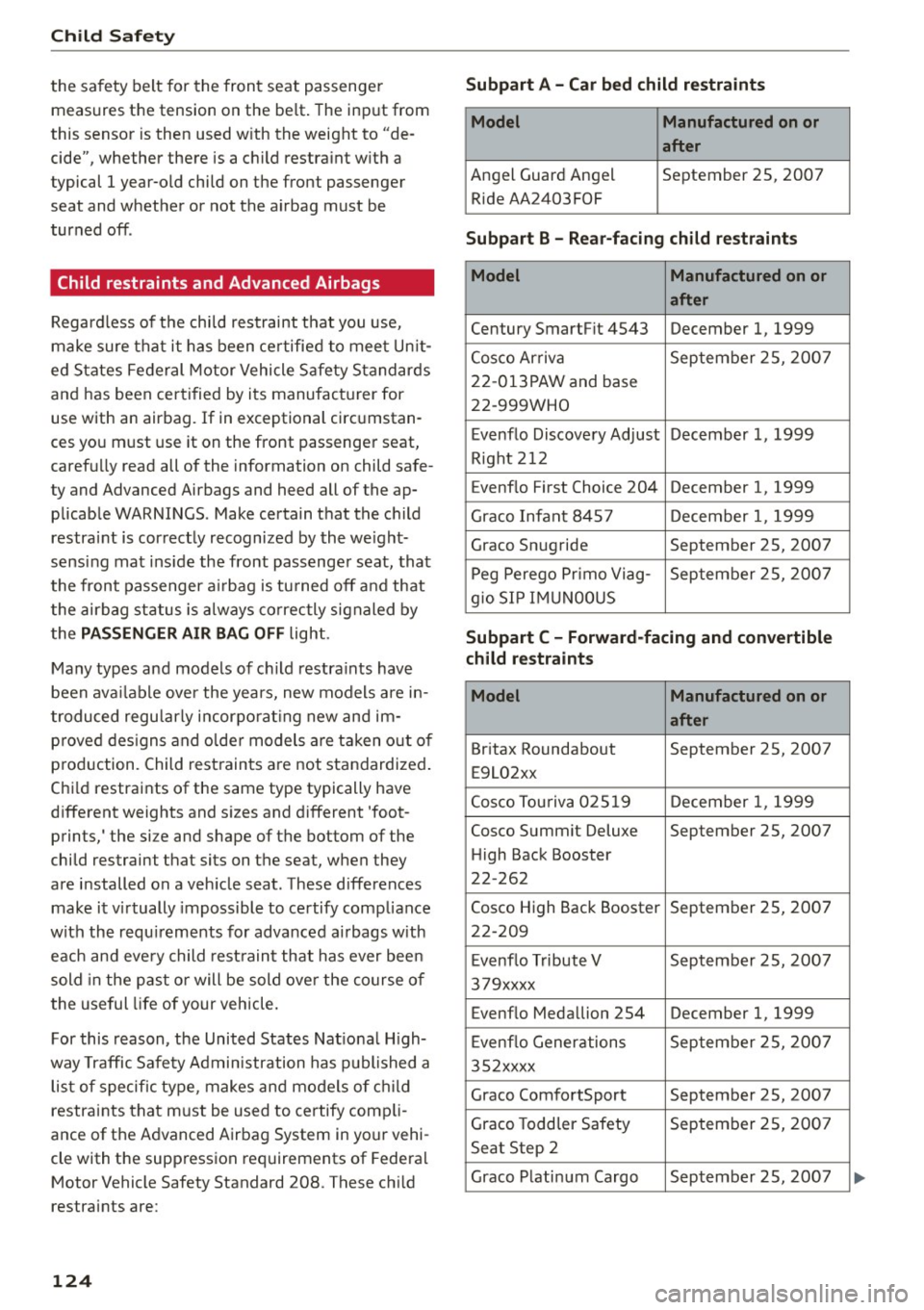
lis t of specific type , makes and models o f chi ld
restraints that m ust be used to certify comp li
ance of the Advanced Airbag System in your vehi
cle with the suppression requirements of Federal Motor Vehicle Safety Standard 208. These chi ld
restraints are:
124
Subpart A - Car b ed child restra ints
Model Manufactured on or
after
Angel Guard Angel September 25, 2007 Ride AA2403FOF
Subpart B -Rear -facing child restraint s
Model Manufactured on or
after
Century SmartFit 4543 December 1, 1999
Cosco Arriva September 25, 2007
22 -013PAW and base
22-999WHO
Evenflo Discovery Adjust December 1, 1999
Right 2 12
E venf lo First Choice 204 December 1, 1999
Graco Infant 8457 December 1, 1999
Graco Snug ride September 25, 2007
Peg Perego Pr imo Viag- September 25, 2007
gio SIP I MUNOOUS
Subpart C - Forward-facing and convertible
child re straint s
Model Manufactured on or
after
Britax Roundabout September 25, 2007
E9L02xx
Cosco Tou riva 025 19 December 1, 1999
Cosco Summit Deluxe September 25, 2007 H igh Back Booster
22 -262
Cosco High Back Booster September 25, 2007
22-209
Evenflo Tribute V September 25, 2007
379xxxx
Evenflo Meda llion 254 December 1, 1999
E venflo Generations September 25, 2007
352xxxx
Graco ComfortSport September 25, 2007
Graco Todd ler Safety
September 25, 200 7
Seat Step 2
Graco Platinum Cargo September 25, 2007
Page 138 of 232
Intelligent technology
Press the I!! button briefly¢ fig. 126 . The II in
dicator light turns on and Sport control Warn
ing! Restricted st abilit y appears in the driver in
formation system d isplay. Driving stability is lim
ited in sport mode.
Sw itch ing ESC off
Press and hold the
l!I button for three seconds .
The ESC indicator light
fl turns on and Stabil i
z atio n prog ram off appears in the display. ASR is
also switched off when ESC is sw itched off.
Sw itch ing on
Press the
l!J button again. The message Stabili
zation progr am on appears briefly in the disp lay .
_& WARNING
You should only sw itch the ESC off if your dr iv
ing ability and the traffic s ituation allow. This
could increase the risk of slipp ing.
- The stabilizing function is limited in ESC
sport mode. The driving wheels could spin and the vehicle could swerve, especially on
slick or slippery road surfaces.
- There is no vehicle stabilization when ESC is
switched off.
(D Tips
If there is a malfunction in the retractable
rear spo iler* or the A udi magnetic ride*, it
may not be possible to activate ESC sport
mode or normal mode may act ivate aga in au
tomatically.
Braking
What affects braking efficiency?
New brake pad s
During the f irst 250 miles (400 km), new brake
pads do not possess the ir full braking effect, they
have to be "broken in" first¢.&. . The break- in pe
riod can be considerab ly longer for vehicles w ith
ceramic b rake roto rs*. You can compensate for
this s light ly reduced b ra ki ng power by push ing
ha rder on the b rake peda l. Avoid heavy braking
loads during the bre ak-in period.
136
Operating conditions and driving habits
The bra kes on today's automobiles a re s till sub
j ect to wear, depend ing largely on operating con
ditions and driving habits ¢& . On vehicles that
a re either driven most ly in stop-and-go city traf
fic or are driven hard, the brake pads should be
checked by your authorized Aud i dealer more of
te n tha n specified in the Warranty
& Maint e
nance bookl et. Failure to have you r brake pads
i nspected can resu lt in reduced b rake pe rform
ance.
On steep slopes, you shou ld use the braking ef
fect of the engine . This way, you prevent un nec
essary wear on the brake system . If you must use
you r brakes, do not hold the bra kes down cont in
u o usly. Pump the brakes at in tervals.
Operating noise
Noises may occur when braki ng depending on the
speed, braking force and outs ide cond it ions such
as tempera ture and hum idity.
Due to the nature of the materia ls used i n ceram
i c brake rotors*, noises may become more appa
r ent at low speeds.
Effect of water and road salt
In certa in situations, for examp le after driv ing
through water , in heavy rain, after overnight con
densation or after washing your car, the braking
effect can be reduced by moisture or ice on the
brake rotors and brake pads . The brakes must be
dr ied fi rst w ith a few careful b rake app lications.
At higher speeds and with the windsh ield wipers
turned on, the brake pads press against the brake r otors for a short amount of time. This occurs at
r egular intervals without the dr iver not ic ing and
provides fo r be tter brake response time under
wet cond it ions.
The effect iveness of the brakes ca n be red uced
when the v ehicle is d riv en on a salt-cove red road
and the b rakes are no t used. Likewise, you clean
off a ccumula ted salt coating from b rake d iscs
and pads with a few ca utious app lications of the
brake ¢& .
D ue to the ir sur fa ce character istics, cerami c
brake ro tors * absorb moistu re in such co ndi tions . ..,.
Page 163 of 232
-If your skin has come in contact with the en
gine oil, you must subsequently cleanse it
thoroughly.
0 Note
- The oil level must not be above range
¢ page 159, fig. 137 0-danger of convert
er or engine damage! Contact an authorized
Audi dealer to draw off oil, if necessary.
- Audi does not recommend the use of oil ad
ditives. They may damage the engine and
adversely affect your New Vehicle Warranty.
@ For the sake of the environment
- Under no circumstances can the oil come in
contact with the sewage network or the soil.
- Observe and follow legal regu lations when
disposing of empty oil containers.
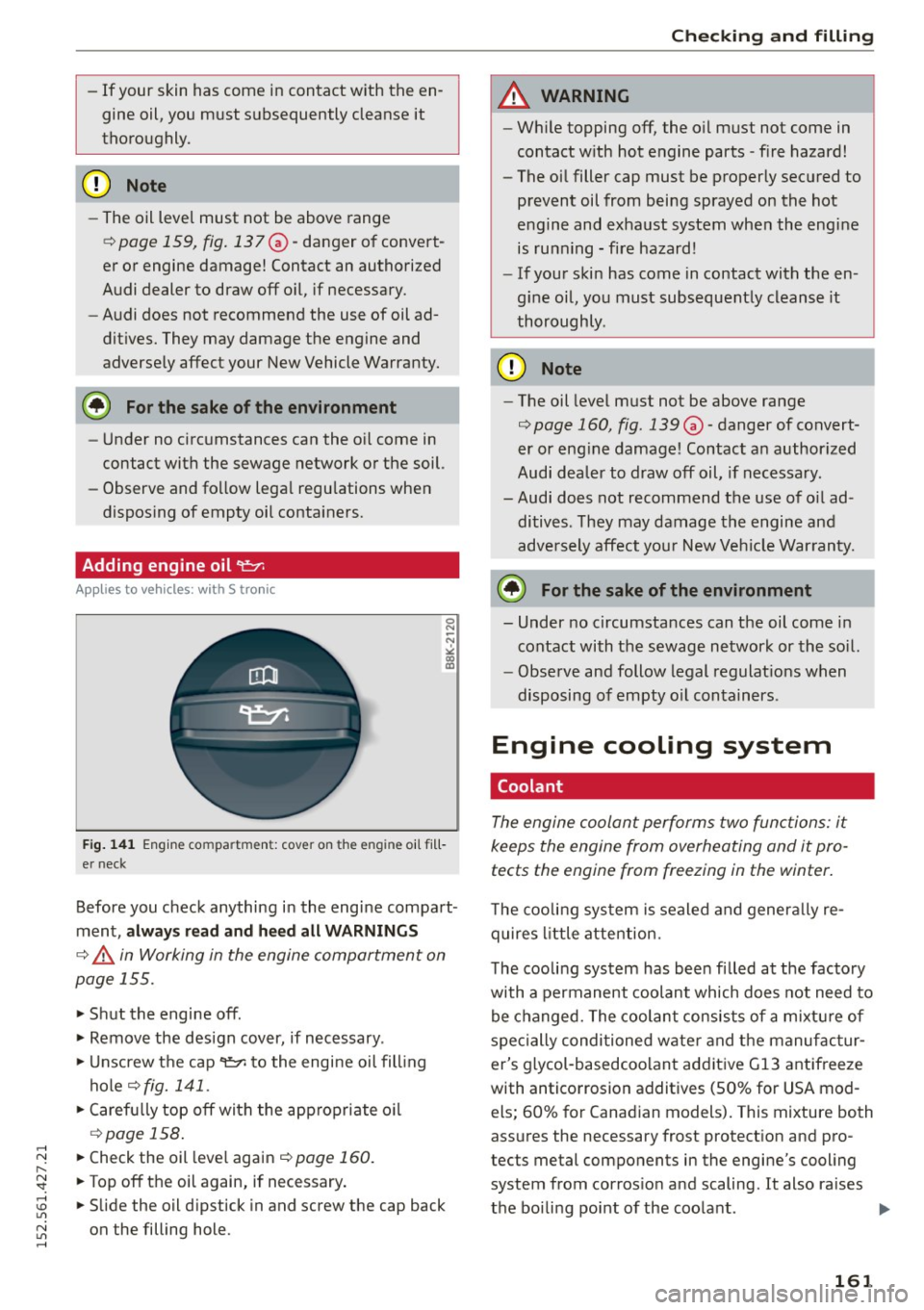
Adding engine oil~
Applies to vehicles: with S tron ic
0 N
-N
~
"' a,
F ig . 141 Engin e co mp artm en t: cove r on t he engin e oil fi ll
er neck
Before you check anything in the engine compart
ment,
always read and heed all WARNINGS
¢.&. in Working in the engine compartment on
page 155.
.,. Shut the engine off .
.. Remove the design cover, if necessary .
.,. Unscrew the cap
'l=?1 to the engine oil fill ing
hole ¢
fig. 141 .
.. Carefully top off with the appropriate o il
¢page 158.
.. Check the oil level again ¢ page 160.
.. Top off the oil again, if necessary .
.. Slide the oil dipstick in and screw the cap back
on the filling hole.
Chec king and filling
A WARNING
- While topping off, the oil must not come in
contact with hot engine parts -fire hazard!
- The oil filler cap must be properly secured to
prevent oil from being sprayed on the hot
engine and exhaust system when the engine
is running -fire hazard!
- If your skin has come in contact with the en
g ine oil, you must subsequently cleanse it
thoroughly .
(D Note
-The oil level must not be above range
¢ page 160, fig . 139 0 -danger of convert
er or eng ine damage! Contact an author ized
Audi dea ler to draw off oil, if necessary.
- Audi does not recommend the use of oil ad
ditives . They may damage the engine and
adversely affect you r New Vehicle Warranty.
@ For the sake of the environment
- Under no circumstances can the oil come in
contact with the sewage network or the soil.
- Observe and follow legal regulations when
disposing of empty o il containers .
Engine cooling system
Coolant
The engine coolant performs two functions: it
keeps the engine from overheating and it pro
tects the engine from freezing in the winter.
T he coo ling system is sealed and genera lly re
quires little attention.
The cooling system has been filled at the factory
with a permanent coolant which does not need to
be changed. The coolant consists of a mixtu re of
specially conditioned wate r and the manufactur
er's glycol-basedcoolant additive Gl3 antifreeze
with anticorrosion additives (50% for USA mod els; 60% for Canadian models). This mixture both
assures the necessary frost protection and pro
tects metal components in the engine's cooling
system from corrosio n and scaling. It also ra ises
the boiling point of the coolant .
1111-
161
Page 179 of 232
...
would then be underinflated a nd
could fail suddenly .
M ainta ining proper tire pressure
is one of the most important
things you can do to he lp avoid
s u dden tire fai lure . Under inflated
tires are a major cause of sudden
tire fa ilure . Keeping tires at the
r ight pressure is also important
for safe and responsive vehic le
handling, traction, braking and
load carrying.
Tire pressures are
particularly important when the
vehicle is be ing dr iven at higher
speeds, and then especially when
heavily loaded even within the
permissib le load-carrying capaci
ties approved for your vehicle .
The recommended tire pressures
for your Audi depend on the kind of tires on your vehicle and the
number of passengers and/or
amount of luggage you will be
transport ing .
The tire pressure label is located
on the driver's side 8-pillar . The
tire pressure label lists the recom mended cold tire inflation pres
s u res for the vehicle at its maxi
mum capacity weight and tires
~ that were on your vehicle at the
": ;;; time it was manufactured. "? N
"' ....
Tir es a nd whe els
If you wish to improve comfort
when operating the vehicle at
normal load (up to 2 occupants ),
you can adjust tire pressu res to
those specified for normal vehi
cle load . Before operating the ve
hicle at ma ximum load, you
must increa se the ti re pressures
to those specified for maximum
vehic le load
c:::> .&. .
Bear in mind that the tire pres
sure monitoring system can only monitor the tire pressures that
are stored. The system does not recognize the load condition of
your vehicle .
See the illustration
c:::> fig. 147 for
the location of the labe l on driv
er's side 8-pillar (color of the ac
tual label and exact location on
the vehicle will vary slightly).
Note that the following table is
accurate a t the time of going to
press and is subject to change . In
the event of discrepancies, the
tire pressure label on driver's side 8-pillar always takes precedence.
The table below lists the recom
mended cold tire inflation pres
sures for the Audi model covered by your Owner 's Literature at the
vehicle's capac ity weight and the .,.
177
Page 194 of 232
Tires and wheels
-Temperature grades apply to tires that are properly inflated and not over or underinflated.
-For technical reasons it is not always possible to use wheels
from other vehicles -in some
cases not even wheels from
the same vehicle model.
-Do not use run-flat tires on your vehicle. Using run-flat
tires can lead to vehicle damage or crashes.
(D Note
-For technical reasons, it is not generally possible to use the
wheel rims from other
vehicles. This can hold true for
wheels of the same vehicle
type.
-If you should put different wheels and tires on your vehi
cle (e.g. winter wheels and
tires), you must be certain
that the wheels and tires are compatible with the tire pres
sure monitoring system. Oth
erwise the system will register
a malfunction and a fault message will be displayed. For
more information, contact
your authorized Audi dealer.
192
(D Note
-When installing new tires, be careful not to damage the
valves or tire pressure moni
toring system sensors.
-Never drive without the valve stem cap. The valves could get
damaged.
-If the sensors must be re placed, then the valve must
also be replaced at the same
time.
@) For the sake of the environment
Dispose of old tires in accord
ance with the local require
ments.
(D Tips
Tires with the identification "ROl" have been specially matched with your Audi. We
recommend using only these
tires because they meet the highest standards regarding
safety and driving characteris
tics when used correctly. Your authorized Audi RB dealer will
gladly provide you with more information.
· Uniform tire quality grading
- Tread wear
- Traction AA AB C
- Temperature ABC
Page 197 of 232
..... N
r-N "': ..... \!) 1.1'1
N 1.1'1 .....
CD Note
-Remove snow chains before driving on roads
not covered with snow to avoid damaging
tires and wearing the snow chains down un necessarily.
- Snow chains, which come into direct contact
with the wheel rim, can scratch or damage
it. Therefore, make sure that the snow
chains are suitably covered . Check the posi
tion of the snow chains after driving a few
yards and correct if necessary. Follow the in
structions from the snow chain manufactur
er when doing so.
(j) Tips
Where snow chains are mandatory on certain
roads, this normally also applies to vehicles
with all-wheel drive.
Wheel bolts
Wheel bolts must always be tightened to the
correct torque .
The design of wheel bolts is matched to the fac
tory installed rims. If different rims are fitted,
the correct wheel bolts with the right length and
correctly shaped bolt heads must be used. This
ensures that wheels are fitted securely and that
the brake system functions correctly.
In certain circumstances, you may not use wheel
bolts from a different vehicle -even if it is the
same model ¢
page 217.
A WARNING
Improperly tightened or maintained wheel
bolts can become loose causing loss of con
trol, a collision and serious personal injury.
-
- Always keep the wheel bolts and the threads
in the wheel hubs clean so the wheel bolts
can turn easily and be properly tightened.
- Never grease or oil the wheel bolts and the
threads in the wheel hubs. They can become
loose while driving if greased or oiled, even
if tightened to the specified torque.
- Only use wheel bolts that belong to the rim
being installed.
Tires and wheels
- Never use different wheels bolts on your ve
hicle.
- Always maintain the correct tightening tor
que for the wheel bolts to reduce the risk of
a wheel loss. If the tightening torque of the
wheel bolts is too low, they can loosen and
come out when the vehicle is moving. If the
tightening torque is too high, the wheel bolts and threads can be damaged and the
wheel can become loose.
CD Note
The specified torque for the wheel bolts is 90
ft lb (120 Nm) with a tolerance of± 7 .4 ft lb
(± 10 Nm) . Torque wheel bolts diagonally. Af
ter changing a wheel, the torque must be
checked as soon as possible with a torque
wrench -preferably by an authorized Audi
dealer or qualified workshop.
Low aspect ratio tires
Your Audi is factory-equipped with low aspect ra
tio tires. These tires have been thoroughly tested
and been selected specifically for your model for
their superb performance, road feel and handling under a variety of driving conditions . Ask your au
thorized Audi dealer for more details.
The low aspect ratio of these tires is indicated by
a numeral of
55 or less in the tire's size designa
tion. The numeral represents the ratio of the
tire's sidewall height in relation to its tread width
expressed in percentage. Conventional tires have
a height/width ratio of 60 or more.
The performance of low-aspect-ratio tires is par
ticularly sensitive to improper inflation pres
sure. It is therefore important that low aspect
ratio tires are inflated to the specified pressure
and that the inflation pressure is regularly
checked and maintained. Tire pressures should be checked at least once a month and always
before a long trip
c> page 179, Checking tire
pressure.
195
Page 219 of 232
..... N
r-N "': ..... \!) 1.1"1
N 1.1"1 .....
-Undeployed airbag modules and pretension
ers might be classified as Perchlorate Mate
rial -spec ia l handling may apply, see
www.dtsc.ca.gov/hazardouswaste/perchlo
rate. When the vehicle or parts of the re
stra int system including airbag modules
safety be lts with pretensioners are scrap
ped, a ll applicab le laws and regulations
must be observed. Your author ized Audi
dealer is fami lia r wi th these req uiremen ts
and we recommend t hat you have your deal
er perform this service for you.
Additional accessories, modifications and parts
replacement
Additional accessories and parts replacement
Always consult on authorized Audi dealer before
purchasing accessories.
Your veh icle incorporates the latest safety design
features ensuring a high standard of active and
passive safety.
This safety could be compromised by non -ap
proved changes to the ve hicle . For this reason, if
parts have to be replaced, p lease observe the fo l
lowing po ints when insta lling addit ional accesso
ries:
Approved Audi accessories and genuine Audi parts are ava ilable from a uthorized Audi dea lers.
These dealers also have the necessary fac ilities,
too ls and trained specialists to insta ll the parts
and accessories properly.
A WARNING
Using the wrong spare parts or using non-ap
proved accessories can cause damage to the
vehicle and ser ious persona l injury.
- Use only accessor ies expressly approved by
Audi and genu ine Audi spare parts
- These parts and accessor ies have been spe
c ially designed to be used on your ve hicle.
- Never install accessories such as telephone
cradles or beverage holders on airbag covers
Con sumer Information
or w ith in the airbag deployment zones. Do
ing so will increase the r isk of injury if a ir
bags are triggered in an acc ident!
- Before you check anything in the engine
compartment, always read and heed all
WARNINGS¢
page 155.
(D Note
- If items other than genu ine A udi spa re
parts, add-on equipment and accessory
items are used or if repair work is not per
formed according to specified methods , this
can result in severe damage to yo ur vehicle's
eng ine and body (such as corrosion) and ad
verse ly affect your ve hicle's war ranty.
- The i nnovat ive a luminium concept of your
Audi means that all servicing, repa irs or oth
er wo rk on the vehicle body m ust be carried
out exclusively by an Audi work shop.
- If emergency re pa irs must be performed
elsew here, have t he veh icle examined by an
a u thori zed A udi d ealersh ip as soon as poss i
ble.
- Th e manufac turer can not be held liable for
d amage wh ich o cc ur s du e to fail ure to com
ply with t hese stipulations .
Technical Modifications
Our guidelines must be complied with when tech
nical modifications ore mode .
Always consult an author ized Audi dealer before
sta rting wor k on any modifications.
This will help ensure that veh icle function, pe r
fo rmance and safety are not impa ired ¢,& .
Attempt ing to work on e lectronic components
and the software used with them can cause ma l
funct ions . Because of the way electronic compo
nents a re inte rconnected with each other, such
malfu nctions can a lso have an adverse affe ct on
othe r systems that a re not direc tly invo lved. This
means tha t you risk both a subs tan tial red uction
i n the operationa l safety of your veh icle and an
inc reased wear of vehicle parts ¢.&. .
ll>
217
Page 221 of 232
..... N
r-N "': ..... \!) 1.1'1
N 1.1'1 .....
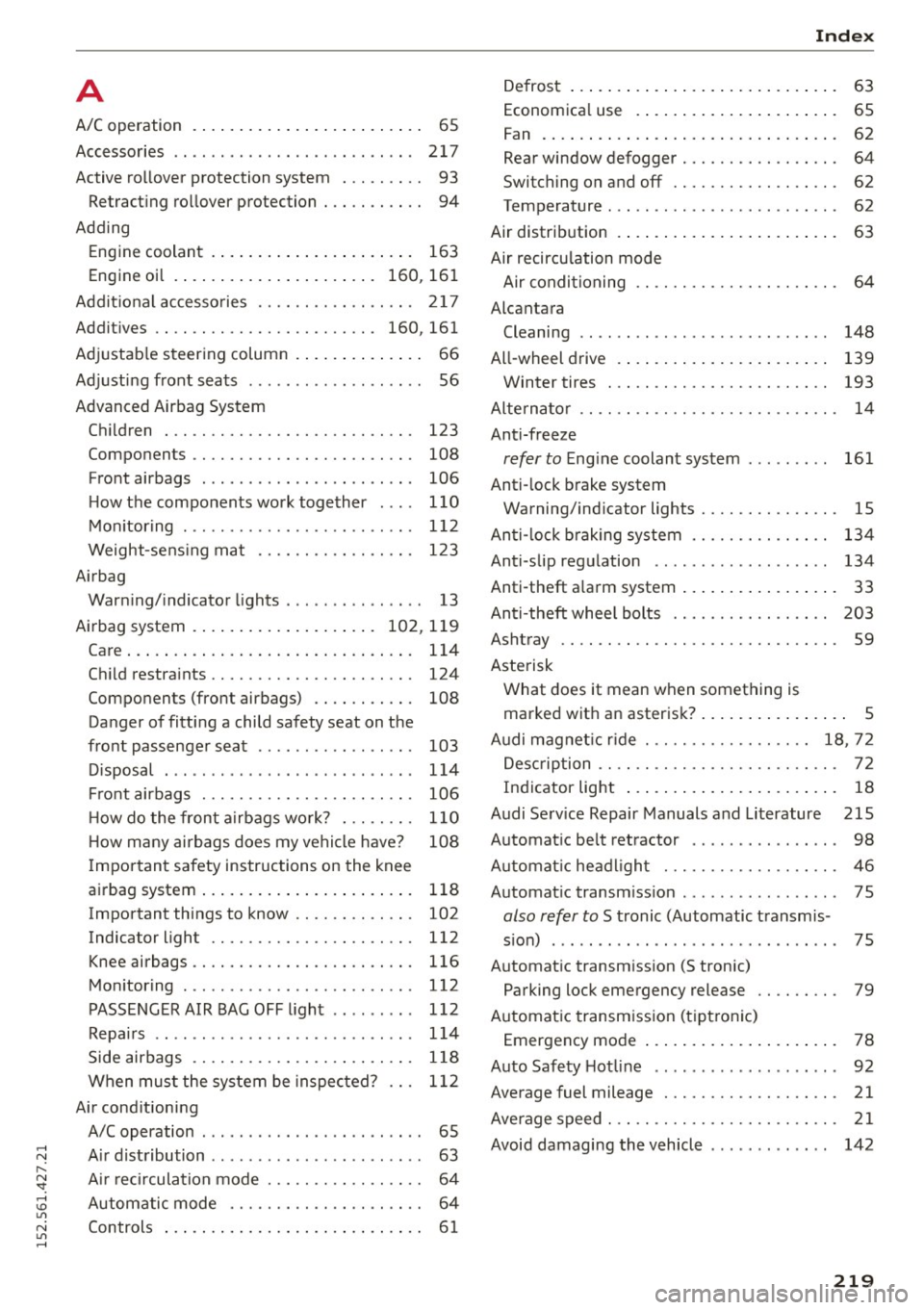
A
A/C operation . . . . . . . . . . . . . . . . . . . . . . . . . 65
Accessories . . . . . . . . . . . . . . . . . . . . . . . . . . 217
Active rollover protection system . . . . . . . . . 93
Retracting rollover protection . . . . . . . . . . . 94
Adding Engine coolant . . . . . . . . . . . . . . . . . . . . . . 163
Engine oil . . . . . . . . . . . . . . . . . . . . . . 160, 161
Addit ional accessories . . . . . . . . . . . . . . . . . 217
Additives . . . . . . . . . . . . . . . . . . . . . . . . 160, 161
Adjustab le steering column . . . . . . . . . . . . . . 66
Adjusting front seats . . . . . . . . . . . . . . . . . . . 56
Advanced Airbag System Children . . . . . . . . . . . . . . . . . . . . . . . . . . . 123
Components . . . . . . . . . . . . . . . . . . . . . . . . 108
Front airbags . . . . . . . . . . . . . . . . . . . . . . . 106
How the components work together . . . . 110
Monitoring . . . . . . . . . . . . . . . . . . . . . . . . . 112
Weight-sens ing mat . . . . . . . . . . . . . . . . . 123
Airbag Warn ing/indicator lights . . . . . . . . . . . . . . . 13
Airbag system ................ ... . 102, 119
Care.. ..... .. ................ ..... . 114
Child restraints. . . . . . . . . . . . . . . . . . . . . . 124
Components (front airbags) . . . . . . . . . . . 108
Danger of fitting a child safety seat on the
front passenger seat . . . . . . . . . . . . . . . . . 103
Disposal . . . . . . . . . . . . . . . . . . . . . . . . . . . 114
Front airbags . . . . . . . . . . . . . . . . . . . . . . . 106
H ow do the front airbags work? . . . . . . . . 110
H ow many airbags does my vehicle have? 108
Important safety instruc tions on the knee
airbag system............... ... .... . 118
Important things to know . . . . . . . . . . . . . 102
Indicator light . . . . . . . . . . . . . . . . . . . . . . 112
Knee airbags ........................ 116
Monitoring . . . . . . . . . . . . . . . . . . . . . . . . . 112
PASSENGER AIR BAG OFF light . . . . . . . . . 112
Repairs . . . . . . . . . . . . . . . . . . . . . . . . . . . . 114
Side airbags . . . . . . . . . . . . . . . . . . . . . . . . 118
When must the system be inspected? . . . 112
Air cond itionin g
A/C operation . . . . . . . . . . . . . . . . . . . . . . . . 65
Air distribution . . . . . . . . . . . . . . . . . . . . . . . 63
A ir recirculation mode . . . . . . . . . . . . . . . . . 64
Automatic mode . . . . . . . . . . . . . . . . . . . . . 64
Controls . . . . . . . . . . . . . . . . . . . . . . . . . . . . 61
Index
Defrost . . . . . . . . . . . . . . . . . . . . . . . . . . . . . 63
Economical use . . . . . . . . . . . . . . . . . . . . . . 65
Fan . . . . . . . . . . . . . . . . . . . . . . . . . . . . . . . . 62
Rear window defogger . . . . . . . . . . . . . . . . . 64
Switching on and off . . . . . . . . . . . . . . . . . . 62
Temperature . . . . . . . . . . . . . . . . . . . . . . . . . 62
Air distribution . . . . . . . . . . . . . . . . . . . . . . . . 63
Air recirculation mode
Air conditioning . . . . . . . . . . . . . . . . . . . . . . 64
Alcantara Cleaning . . . . . . . . . . . . . . . . . . . . . . . . . . . 148
All-wheel drive . . . . . . . . . . . . . . . . . . . . . . . 139
Winter tires . . . . . . . . . . . . . . . . . . . . . . . . 193
Alternator . . . . . . . . . . . . . . . . . . . . . . . . . . . . 14
Anti-freeze
refer to Engine coolant system . . . . . . . . . 161
Anti- lock brake system
Warning/indicator lights . . . . . . . . . . . . . . . 15
Anti-lock braking system . . . . . . . . . . . . . . . 134
Anti-slip regulation . . . . . . . . . . . . . . . . . . . 134
Anti-theft alarm system . . . . . . . . . . . . . . . . . 33
Anti-theft wheel bolts . . . . . . . . . . . . . . . . . 203
Ashtray . . . . . . . . . . . . . . . . . . . . . . . . . . . . . . 59
Asterisk What does it mean when something is
marked with an asterisk? . . . . . . . . . . . . . . . . 5
Audi magnet ic r ide . . . . . . . . . . . . . . . . . . 18, 72
Description . . . . . . . . . . . . . . . . . . . . . . . . . . 72
Indicator light . . . . . . . . . . . . . . . . . . . . . . . 18
Audi Serv ice Repair Manuals and Literature 215
Automatic be lt retractor . . . . . . . . . . . . . . . . 98
Automatic headlight . . . . . . . . . . . . . . . . . . . 46
Automatic transmission . . . . . . . . . . . . . . . . . 75
also refer to S tronic (Automatic transmis-
s ion) . . . . . . . . . . . . . . . . . . . . . . . . . . . . . . . 75
Automatic transmission (S tronic) Parking lock emergency release . . . . . . . . . 79
Automatic transmission (tiptron ic)
Emergency mode . . . . . . . . . . . . . . . . . . . . . 78
Auto Safety Hotline . . . . . . . . . . . . . . . . . . . . 92
Average fuel mileage . . . . . . . . . . . . . . . . . . . 21
Average speed . . . . . . . . . . . . . . . . . . . . . . . . . 21
Avoid damaging the vehicle . . . . . . . . . . . . . 142
219