fuel AUDI R8 SPYDER 2015 Owner's Manual
[x] Cancel search | Manufacturer: AUDI, Model Year: 2015, Model line: R8 SPYDER, Model: AUDI R8 SPYDER 2015Pages: 232, PDF Size: 58.36 MB
Page 156 of 232
Fuel supply and filling your fuel tank
the trunk). Static electricity can build up
while filling and can ignite fuel vapors
causing a fire.
- Always place a portable fuel container on
the ground before f illing.
- Always keep the fi ller nozzle comp letely
inside the portable container before and
during filling.
- If filling a portable container made of
metal, the filler nozzle must always be in
contact with the container. This will help prevent static electricity from discharging
and cause a fire .
- Never sp ill fuel inside the vehicle or lug
gage compartment. Fuel vapors are highly
f la mmab le.
- Always observe local and state/provincial
laws regarding the use, storage and trans
portat ion of fuel containers.
- Make certain the fuel container meets in
dustry standards (ANSI/ ASTM F8S2 -86) .
(D Note
If any fuel has spilled onto the car, it should
be removed immediately to prevent damage
to the paint .
@ For the sake of the environment
As soon as the correctly operated nozzle
switches off automatically for the first time,
the tank is full. Do not try to add more fuel
because fuel may spill out. In addition, the
expansion space in the fuel tank will be filled -
causing the fuel to overflow when it becomes
warm and pollute the enviro nment.
@ Tips
- Running your engine while refueling may
cause vapors to escape or even fue l to spill
out of the tank. This would then shut off the
fuel nozzle before the tank is full.
- Do not refuel your vehicle w ith the ignition
switched on . The fuel gauge may otherwise
not indicate the correct fuel level after refu
e ling.
154
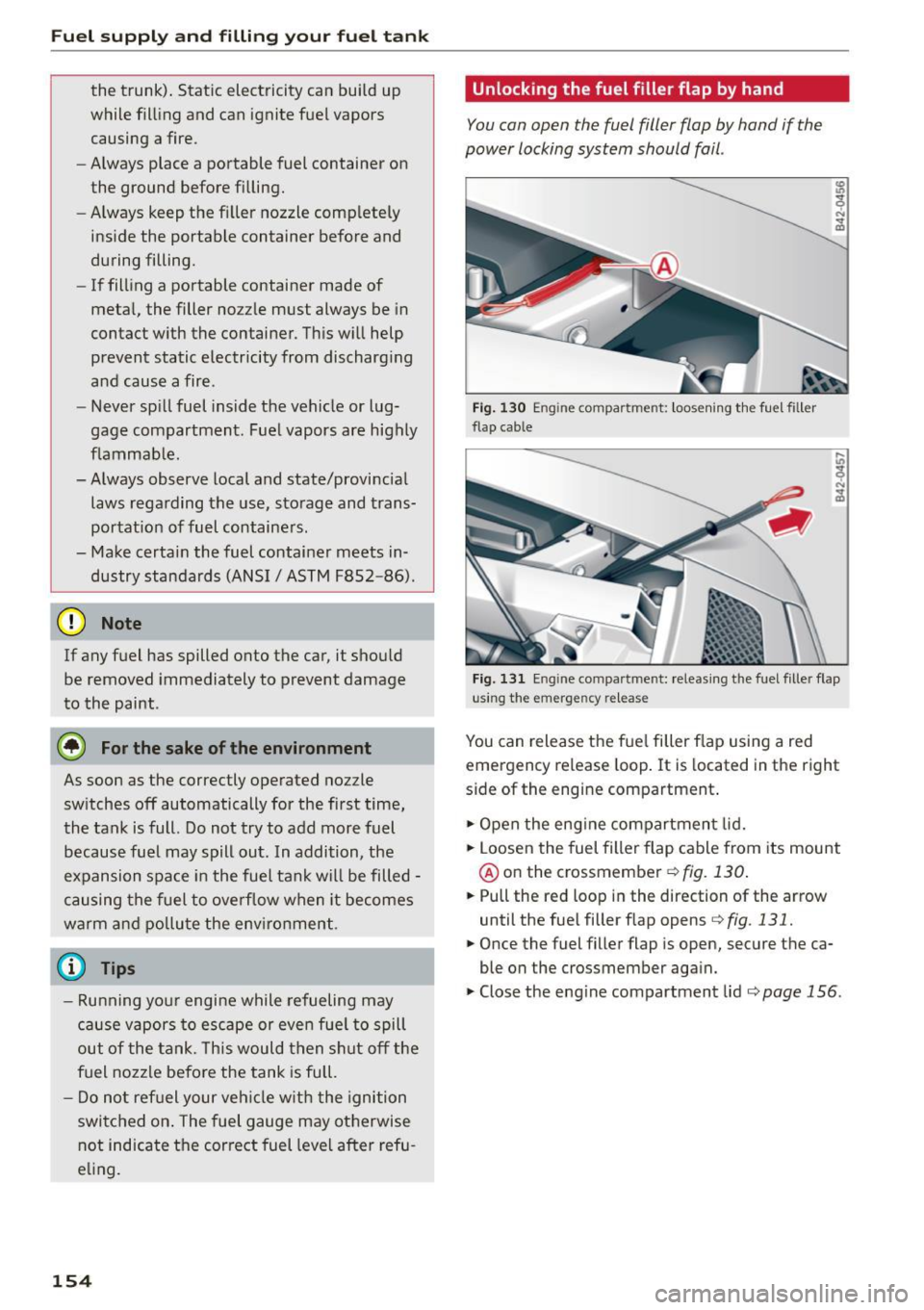
Unlocking the fuel filler flap by hand
You can open the fuel filler flap by hand if the
power locking system should fail .
Fig. 130 Engine compartme nt: loosening the fuel filler
flap cable
Fig. 131 Eng ine compa rtment: releasing the fuel filler flap
using the emergency re lease
You can release the fue l filler f lap using a red
emergency release loop . It is located in the right
side of the engine compartment .
.,. Open the engine compartment lid.
.,. Loosen the fuel filler flap cable from its mount
@ on the crossmember
r::;, fig. 130 .
.,. Pull the red loop in the direction of the arrow
until the fue l filler flap opens
r::;, fig. 131.
.,. Once the fuel filler flap is open, secure the ca
ble on the crossmember again .
.,. Close the eng ine compartment lid
r::;, page 156.
Page 158 of 232
Checking and filling
-Move selector lever of S tronic to "N" (Neu
tral); put manual transmission in Neutral.
- Always let the engine cool down. Hot com
ponents will burn skin on contact .
- To reduce the risk of being burned, never
open the engine compartment lid if you see
or hear steam or coolant escaping from the
engine compartment. Wait until no steam
or coolant can be seen or heard before care
fully opening the engine compartment lid.
- Keep children away from the engine com
partment .
- Never spill fluids on hot engine compo
nents. They can cause a fire.
- Never open the coolant reservoir cap when
the engine is still warm . The coolant system
is pressurized and hot coolant could spray
out .
- Protect your face, hands and arm from
steam or hot engine coolant by placing a
thick rag over the cap when you open the coolant reservoir .
- Do not remove the engine cover under any
circumstances . This increases the risk of
burns.
- If work on the fuel system or the electrical
system is necessary :
- Always disconnect the battery.
- Never smoke or work near heaters or open
flames. Fluids in the engine compartment
could start a fire.
- Keep an approved fire extinguisher imme
diately available .
- To avoid electrical shock and personal injury
while the engine is running or being started,
never touch:
- Ignition cables
- Other components of the high voltage
electronic ignition system.
- If you must perform a check or repair with
the engine running:
- First, fully apply the parking brake, move
selector lever of S tronic to
"N" (Neutral);
put manual transmission in Neutral.
- Always use extreme caution to prevent
clothing, jewelry, or long hair from getting
caught in the radiator fan, V-belts or other
156
moving parts, or from contacting hot
parts. Tie back hair before starting, and
wear no clothing that will hang or droop into the engine.
- Minimize exposure to emission and chemi
cal hazards
¢ .&..
A WARNING
California Proposition 65 Warning:
- Engine exhaust, some of its constituents,
and certain vehicle components contain or
emit chemicals known to the State of Cali
fornia to cause cancer and birth defects and reproductive harm. In addition, certain flu
ids contained in vehicles and certain prod
ucts of component wear contain or emit
chemicals known to the State of California
to cause cancer and birth defects or other
reproductive harm.
- Battery posts, terminals and related acces
sories contain lead and lead compounds,
chemicals known to the State of California
to cause cancer and reproductive harms.
Wash hands after handling.
@ Note
When adding fluids, always make sure that
they are poured into the proper container or
filler opening, otherwise serious damage to
vehicle systems will occur.
@ For the sake of the environment
To detect leaks in time , inspect the vehicle
floor pan from underneath regularly. If you
see spots from oil or other vehicle fluids, have
your vehicle inspected by an authorized Audi
dealer .
· Closing the engine compartment lid
.. Make sure that the rear spoiler is retracted
¢page 138 .
.. Pull the engine compartment lid down until the
pressure from the struts is reduced.
.. Press the engine compartment lid closed
¢ _A . ..,
Page 160 of 232
Checking and filling
(D Tips
The coolant expansion tank is located under the convertible top storage bay lid
¢page 163.
Engine oil
Engine oil specificat ions
The engine oil used must conform to exact speci
fications .
The service interval display in the instrument
cluster of your vehicle will inform you when it is
time for an oil change . We recommend that you
have your oil changed by an authorized Audi Serv
ice Advisor.
If you have to top off the oil between oil changes,
use the Audi oil quality standard specified in the
table.
Audi oil quality standard
Gasoline
VW 502 00 or
engine vw 504 00
Using the proper engine oil is important for the
functionality and service life of the engine. Your
engine was factory-filled with a high-quality oil
which can usually be used throughout the entire
year.
(D Note
Your Limited New Vehicle Warranty does not
cover damage or malfunctions due to failure
to follow recommended maintenance and use
requirements as set forth in the Audi Owner's
Manual and Warranty
& Maintenance booklet.
- Use only a high quality engine oil that ex-
pressly complies with the Audi oil quality
standard specified for your vehicle's engine .
Using any other oil can cause serious engine
damage.
- Do not mix any lubricants or other additives
into the engine oil. Doing so can cause en
gine damage.
158
(D Tips
If you need to add oil and there is none availa
ble that meets the Audi oil quality standard
your engine requires, you may add a total of
no more than 0.5 quart/liter of a high-quality
"synthetic"oil that meets the following speci
fications.
- ACEA A3 or API SM with a viscosity grade of
SAE OW-30, SAE 5W-30 or SAE 5W-40.
- For more information about engine oil that
has been approved for your vehicle, please
contact either your authorized Audi dealer
or Audi Customer Relations at
1 (800) 822-2834 or visit our web site at
www.audiusa.com or www.audicanada.ca.
Engine oil consumption
The engine in your vehicle depends on on ade
quate amount of oil to lubricate and cool all of
its moving ports.
In order to provide effective lubrication and cool
ing of internal engine components, all internal
combustion engines consume a certain amount
of oil. Oil consumption varies from engine to en
gine and may change significantly over the life of
the engine. Typically, engines with a specified break-in period (see
¢ page 142) consume more
oil during the break-in period than they consume
after oil consumption has stabili zed.
Under normal conditions , the rate of oil con
sumption depends on the quality and viscosity of
the oil, the RPM (revolutions per minute) at
which the engine is operated, the ambient tem perature and road conditions . Further factors are
the amount of oil dilution from water condensa
tion or fuel residue and the oxidation level of the
oil. As any engine is subject to wear as mileage
builds up, the oil consumption may increase over
time until replacement of worn components may
become necessary.
With all these variables coming into play, no
standard rate of oil consumption can be estab
lished or specified. There is no alternative to reg
ular and frequent checking of the oil level, see
Note.
Page 174 of 232
Tires and wheels
Cold tire infl ation pre ssure
means the tire pressure recom
mended by the vehicle man ufac
turer for a tire of a designated
size that has not been driven fo r
more than a couple of miles (kilo
meters) at low speeds in the three
hour period before the tire pres
sure is measured or adjusted .
Curb weight
means the weight of a motor ve
hicle with standard equipment in
cluding the maximum capacity of
fuel, oil, and coolant, air condi
tioning and additiona l weight of
optional equipment.
E x tra load tire
means a tire designed to operate
at higher loads and at higher in
flation pressures than the corre sponding standard tire. Extra load
tires my be identified as "XL",
"xl ", "EXTRA LOAD", or "RF" on
the sidewall.
Gross Axle Weight Rating ("GAWR" )
means the load-carrying capacity
of a single axle system, measured
at the tire -ground interfaces.
1 72
Gross Vehicle Weight Rating
("GVWR")
means the maximum total loaded
weight of the vehicle.
Groove
means the space between two ad
jacent tread ribs.
Load rating (code )
means the maximum load that a
tire is rated to carry for a given in
flation pressure . You may not find
this information on all tires be
cause it is not required by law .
Maximum load rating
means the load rating for a tire at
the maximum permissible infla
tion pressure for that tire .
Maximum loaded vehicle
weight
means the sum of :
(a) Curb weight
(b) Accessory weight
(c) Vehicle capacity weight, and
(d) Production options weight
Ma ximum (permissible )
inflation pressure
means the maximum cold infla
tion pressure to which a tire may be inflated. A lso called "maxi-
mum inflation pressure ." .,.
Page 184 of 232
Tires and wheels
-The use of incorrect tire pressure values can lead to acci
dents or other damage. There
fore it is essential that the driver observe the specified
tire pressure values for the
tires and the correct pressures
for the function of the tire pressure monitoring system.
-Always inflate tires to the rec ommended and correct tire
pressure before driving off.
-Driving with underinflated tires bend more, letting them get too hot resulting in tread
separation, sudden tire failure
and loss of control.
-Excessive speed and/overload
ing can cause heat build-up,
sudden tire failure and loss of
control.
-If the tire pressure is too low
or too high, the tires will wear
prematurely and the vehicle
will not handle well.
-If the tire is not flat and you do not have to change a wheel
immediately, drive at reduced
speed to the nearest service
station to check the tire pres
sure and add air as required .
182
d) Note
Driving without valve stem caps
can cause damage to the tire
valves. To prevent this, always
make sure that factory instal
led valve stem caps on all
wheels are securely mounted on the valve.
@ For the sake of the environment
Underinflated tires will also in
crease the fuel consumption.
Tires and vehicle load limits
There are limits to the amount of
load or weight that any vehicle
and any tire can carry. A vehicle
that is overloaded will not handle
well and is more difficult to stop. Overloading can not only lead to
loss of vehicle control, but can al
so damage important parts of the
vehicle and can lead to sudden
tire failure, including a blowout and sudden deflation that can
cause the vehicle to crash.
Your safety and that of your pas
sengers also depends on making
sure that load limits are not ex
ceeded. Vehicle load includes ev
erybody and everything in and on
the vehicle. These load limits are ...
Page 185 of 232
.... N
" N ": ... IO "? N U'> .....
technically referred to as the vehi
cle's
Gross Vehicle We ight Rating
("GVWR") .
The "GVWR" includes the weight
of the basic vehicle, all factory in
stalled accessories, a full tank of
fuel, oil, coolant and other fluids plus maximum load. The maxi
mum load includes the number of
passengers that the vehicle is in
tended to carry ("seating capaci
ty") with an assumed weight of
150 lbs. (68 kg) for each passen
ger at a designated seating posi
tion and the total weight of any
luggage in the vehicle.
The
Gross Axle Weight Rating
("GAWR") is the maximum load
that can be applied at each of the
vehicle's two axles .
The Gross Vehicle Weight Rating and the Gross Axle Weight Rating
are listed on the safety compli
ance sticker label located on the
driver's side B-pillar. Your Audi
has 2 seating positions . Each
seating position has a safety belt
¢ page 95, Safety belts.
The fact that there is an upper
limit to your vehicle's Gross Vehi
cle Weight Rating means that the
total weight of whatever is being
Tires and wheels
carried in the vehicle is limited.
The more passengers in the vehi
cle or passengers who are heavier
than the standard weights as
sumed mean that less weight can
be carried as luggage.
The tire pressure label on your
Audi also lists the maximum com
bined weight of all of the occu
pants and luggage or other cargo
that the vehicle can carry. For the location of the label¢
page 176,
fig. 147.
A WARNING
-
Overloading a vehicle can cause
loss of vehicle control, a crash
or other accident, serious per
sonal injury, and even death.
-Carrying more weight than
your vehicle was designed to
carry will prevent the vehicle
from handling properly and in
crease the risk of the loss of
vehicle control.
-The brakes on a vehicle that has been overloaded may not be able to stop the vehicle
within a safe distance .
-Tires on a vehicle that has been overloaded can fail sud
denly, including a blowout and •
183
Page 196 of 232
Tires and wheels
Ask your authorized Audi dealer or qualified
workshop for permitted
winter tire sizes. Use on
ly radial winter tires.
Winter tires lose their effectiveness when the
tread is worn down to a depth of 0.157 inch
(4 mm).
Only drive with winter tires under winter condi
tions. Summer tires handle better when there is
no snow or ice on the roads and the temperature
is above 45 °F (7 °().
Please always remember that winter ti res may
have a lower speed rating than the tires originally
installed on your vehicle at the time it was manu
factured . Please see¢ page 189, Speed roting
(letter code) for a listing of the speed rat ing let
ter codes and the maximum speed at which the
t ires can be driven.
The speed rating letter code(¢ page 174) is on
the side wall of the tire ¢page 186.
A WARNING
Winter tires have maximum speed limits that
may be lower than your vehicle's maximum
speed. Always know the maximum speed be
fore driving off . Never drive faster than the
speed permitted for your specific winter tires .
This will cause damage to the tires leading to
an accident and serious personal injury to you
and your passengers.
A WARNING
Driving faster than the maximum speed for
which the winter tires on your vehicle were designed can cause tire failure including a
blowout and sudden deflation, loss of contro l,
crashes and serious personal injuries. Have
worn or damaged tires replaced immediately.
- Winter tires have maximum speed rating that may be lower than your vehicle's maxi
mum speed .
- Never drive faster than the speed for which
the winter or other tires installed on your
vehicle are rated.
194
-
A WARNING ,_ -
Always adjust your driving to the road and
traffic conditions . Never let the good accelera
tion of the winter tires and all-wheel drive
tempt you into taking extra risks. Always re
member:
- When braking, an all-wheel drive vehicle
handles in the same way as a front drive ve
hicle.
- Drive carefully and reduce your speed on icy
and slippery roads, even winter tires cannot
help under black ice conditions.
@ For the sake of the environment
Use summer tires when weather conditions
permit . They are quieter, do not wear as
quickly and reduce fuel consumption.
, Snow chains
Snow cha ins may be fitted only to the rear
wheels , and only to certain tire sizes. Ask your au
thorized Audi dealer on which tire sizes snow
chains can be used.
The snow chains must have low-profile links and
must not be thicker than 0.53 inch (13 .5 mm) ,
including the lock.
Remove wheel center covers before putting snow
chains on your vehicle ¢Ci) . For safety reasons
cover caps must then be fitted over the wheel
bolts . These are available from authorized Audi
dealers .
A WARNING
Using the wrong snow chains for your vehicle
or installing them incorrectly can increase the
risk of loss of control leading to serious per
sonal injury .
- Snow chains are available in different sizes.
Always make sure to follow the instructions
provided by the snow chain manufacturer .
- When driving with snow chains, never drive
faster than the speed permitted for your
specific snow chains .
- Always observe local regulations.
Page 198 of 232
Tires and wheel s
What you can do to avoid tire and rim
damag e
Low aspect ratio tires can be damaged more easi
ly by impact with potholes, curbs, gullies or
ridges on the road, part icularly if the t ire is un
derinflated.
In order to minimize the occurrence of impact
damage to the tires of your vehicle, we recom mend that you observe the following precau
tions:
- Always maintain recommended inflation pres
su res. Check your tire pressure every 2.000
miles (3.000 km) and add air if necessary .
- Drive carefu lly on roads w ith potholes, deep
gull ies or r idges. The impact from driving
through or over such obstacles can damage
your tires . Impact with a curb may also cause
damage to you r tires .
- After any impact, immediately inspec t your
tires or have them inspected by the nearest au
thorized Audi dealer. Replace a damaged tire as soon as possib le.
- Inspect you r tires every 2 .000 miles (3 .000 km)
for damage and wear. Damage is not always easy to see. Damage can lead to loss of ai r and
u nderinflation , which cou ld eventua lly cause
t ir e fa ilure. If yo u be lieve that a tire may have
been damaged, rep lace the tire as soon as pos
sible .
- T hese tires may wear more q uick ly than others .
- Please a lso remembe r that, wh ile these ti res
deliver responsive handling, t hey may ride less
com fortab ly and make more noise than other
choices.
R educed performance in winter /cold season
condit ions
All ti res are designed for certain pu rposes . The
low aspect ratio, u ltra high performance tires
originally insta lled on your vehicle are intended
for maximum dry and wet road performance and handling. They are not suitable for cold, snowy or
icy weather cond itions . If you drive under those
circumstances, you should equip your vehicle
with all-season or winter tires, which offer better traction under those conditions. We suggest you
196
u se the recommended snow or all-season tires
specified for your vehicle, or their equivalent.
Refer to~
page 193 for more de tailed informa
tion regarding w inter t ires.
Tire pressure monitoring
system
General notes
E ach tire, incl uding the spare ( if prov ided),
shou ld be checked monthly when co ld and inflat
ed to the inflation pressure recommended by the
vehicle manufacturer on the vehicle placa rd or
tire inflation pressure labe l (If your vehicle has
tires of a different s iz e than the si ze indicated on
the ve hicle placard or tire inflation pressure la
bel, you should determine the proper t ire infla
tion pressure for those tires .) .
As an added safety feature, your veh icle has been
equipped with a tire pressure mon itor ing system
(TPMS) that illuminates a low t ire pressure tell
ta le when one or more of your t ires is sign ificant
l y unde r-inflated. According ly, when the low tire
pressure te lltale illuminates, you shou ld stop and
chec k yo ur ti res as soon as poss ible, and infla te
them to the proper pressure . Dr iv ing on a signifi
cant ly under-inflated tire ca uses the t ire to over
heat and ca n lead to tire failure . Under-inflation
also reduces fuel effic iency and tire tread life,
and may affect the vehicle 's handling and stop
ping abili ty .
Please note that the TPMS is not a substitute for
proper tire maintenance, and it is the driver's re
spons ibility to maintain correct tire pressure,
even if under-infla tion has not reached the level
to trigger illumination of the TPMS low tire pres
sure telltale.
Your vehicle has also been equipped with a TPMS malfunc tion indicator to indicate when the sys
tem is not operat ing properly . The TPMS mal
funct ion indicator is combined with the low t ire
pressure te lltale. When the system detects a
malfu nction, the tellta le w ill flash for approxi
mately one m inute and then remain cont inuo usly
i ll uminated. This seq uence will continue upon .,.
Page 199 of 232
subsequent vehicle start-ups as long as the mal
function exists.
When the malfunction indicator is illuminated,
the system may not be able to detect or signa l
l ow tire pressure as intended. TPMS malfunctions
may occur for a variety of reasons, including the
installation of rep lacement or a lternate tires or
wheels on the vehicle that prevent the TPMS from functioning properly. Always check the
T PMS malfunction telltale after replacing one or
more tires or wheels on your vehicle to ensure
that the replacement or alternate tires and
wheels allow the TPMS to continue to function
properly .
Introduction
The tire pressure monitoring system monitors air
pressure in all four road wheels while the vehicle
is moving.
As soon as the tire pressure monitoring system
senses a s ignificant loss of a ir pressure in one or
several tires, text messages and ye llow symbo ls
appear in the instrument cluster display to a le rt
the driver. The
[I] warning light in the instru
ment cluster comes on when the tire is signifi
cantly underinflated .
The warning
light [l'J also illuminates in the case
of a system malfunction.
Be aware that tire p ressure is also dependent on
the temperat ure of the t ire. For every 18 ° F
(10 °() increase in tire temperature, tire pressure
increases by about 1.5 psi (0.1 bar) . The tire
warms up while the vehicle is moving and tire
pressure rises. So you shou ld adjust tire pressure
only when they are
cold, when the temperature
of the tires is roughly the same as the ambient
air temperature.
In order to keep the tire pressure monitoring sys
tem properly calibrated, tire pressure on all four
tires should be checked at regular intervals .
The tire pressure is shown on the label located on
~ the driver 's side B-pillar (visible when the door is r--
~ open) .
,...., \!) ..,.,
N
"' ,....,
Tires a nd w hee ls
A WARNING
-
When the tire pressure monitoring system
warning light is lit, one or more of your tires is
significantly under- inflated . You should stop
and check your t ires as soon as poss ible, and
i nflate them to the proper pressure as indicat
ed on the vehicle 's t ire pressure label
¢ page 176. Driving on a significant ly under
inflated tire causes the tire to overheat and
can lead to tire failure. Under-inflation also is
likely to impair the vehicle's handling and
stopping ability.
@ For the sake of the environment
Driving with under -inflated tires reduces fuel
efficiency and tire tread life.
(D Tips
- Each tire should be checked monthly when
the temperature of the tires is about the
same as ambient air temperature and set to
the recommended inflation pressure as
specified on the tire pressure label
¢page 176.
- The tire pressure mon itoring system helps
the driver to keep an eye on tire pressures.
But the driver still has the responsib ility for
ma inta ining the correct tire pressure.
- Tire pressure must only be adjusted when
the temperature of the tires is about the
same as amb ient air temperature.
- When tires are replaced, the sensors and
valves should not be exchanged. The valve
core, nut, valve seal ing and seal washer (re
placement kit) needs to be replaced. If nec
essary, the valve and the wheel electronics
have to be replaced.
- The tire pressure mon itoring system on your
Audi was calibrated using tires with "RO"
identification. We recommend using these
tires .
- If you sho uld put different wheels and tires
on your vehicle (e .g. winter whee ls and
tires), you must be certain that the wheels
197
Page 214 of 232
Technical Dat a
Technical Data
Vehicle identification
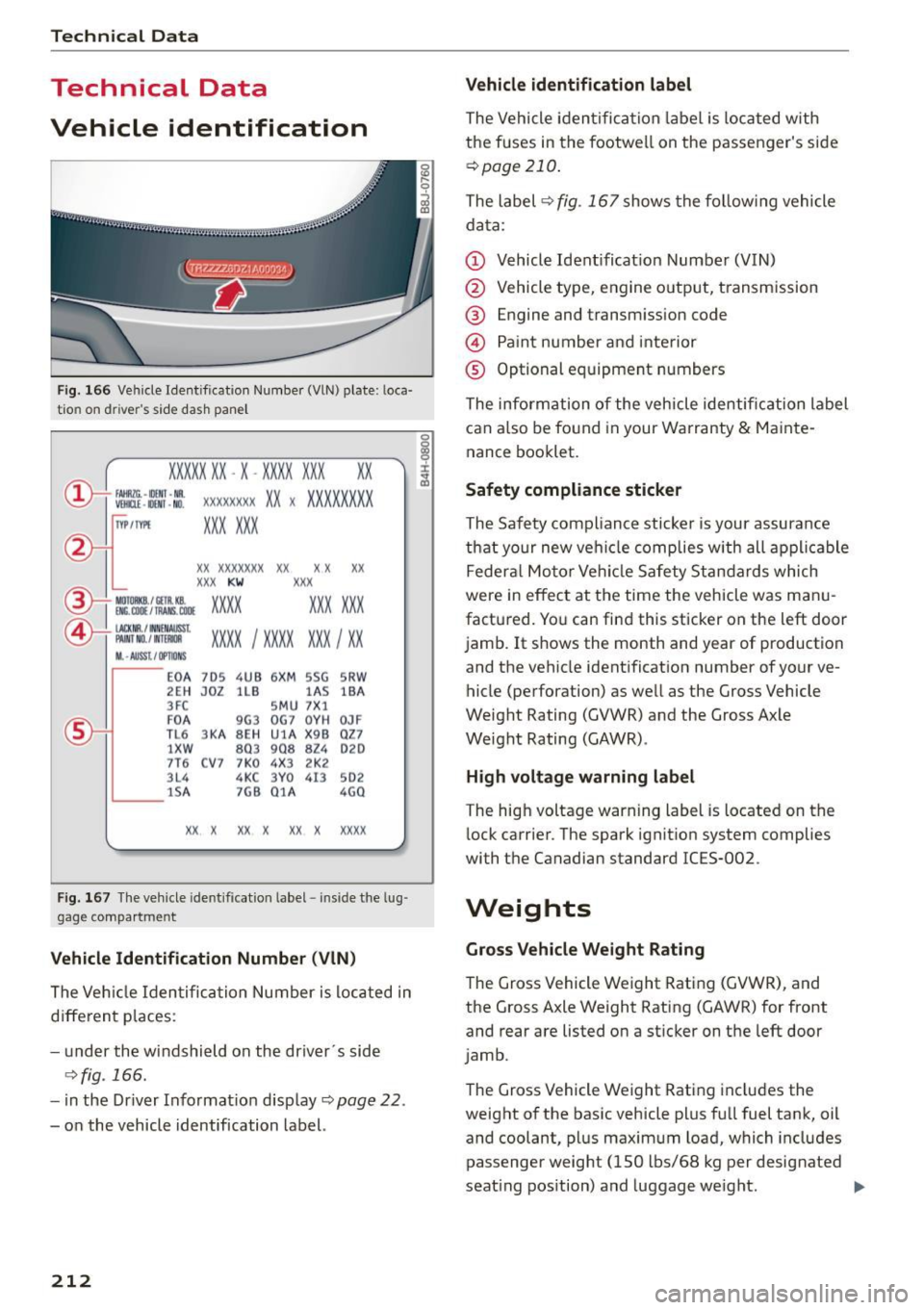
F ig. 166 Ve hicle Ident if icat ion Number (VlN) p late: loca·
tio n on d river 's side dash pane l
XXXXX XX -X -XX XX XXX XX
@-+ ~J:~t::1 ::: xxxxxxxx xx x xxxx xxx x
IYP lf'VPE XXX X XX
xx xxxxxxx xx xx xx
XXX KW
XXX
EM:. COil / fAANS , COOE xxxx XXX XXX ®i MOIOlll
©-+ IAC KIIR . / tNN EN AIJSSt
XXXX I XXXX XXX I XX PAI NT NO./ WT£Jldl
II. -AUSST. / OPTIO NS
E0 A 7D5 4UB 6X
M SSG SR W
2EH JOZ lLB lAS
1BA
3FC SM U 7 X1
F0 A
9G3 0
G7 0Y H
0JF
TL 6 3 KA 8EH UlA X 9B Q
Z7
l XW
803 908
8Z4 020
7T6 C V7 7 K0 4X3 2K2
3L4 4KC 3Y0 413
502
lS A 7GB 01A
4G0
XX X XX X
XX X xxxx
Fig. 167 The ve hicle ide ntif ic ati on label - inside t he lug ·
gage compar tmen t
Vehicle Identificat ion Number (VlN )
The Veh icle Iden tifica tion Number is located in
differen t places :
- u nder the windshield on the driver· s side
¢ fig . 166.
-in the Dr iver Informat ion disp lay ~ page 22 .
- on the vehicle identification label.
212
V ehicle identification label
The Vehicle iden tifica tion label is located with
the fuses in the footwe ll on the passenger's side
¢ page 210 .
The label ~ fig. 167 shows the fo llow ing vehicle
da ta:
(D Vehicle Ident ificat ion Number (VIN)
@ Vehicle ty pe, engine o utp ut, t ransmission
® E ngine and transm ission code
@ Pa int number and inte rior
® Optional eq uipment numbers
The information of the vehicle identification label
can a lso be fo und in your Warranty
& Ma inte
nance booklet.
Safety compliance sticker
The Safety compliance sticke r is your assurance
that your new veh icle complies with all appli cable
Federa l Mo to r Veh icl e Safety Standards which
were in effect at the time the vehicle was man u
factu red. Yo u can find this sticker on the left door
j amb.
It shows the month and year of production
and the vehicle ident ificat ion number of your ve·
hide (perforation) as well as the Gross Vehicle
Weight Rating (GVWR) and the Gross Axle
We ight Rating (GAWR) .
High volt age warning label
The hig h voltage warning label is located on the
l ock carrier. The spark ignit ion system complies
with the Canadian standard ICES-002 .
Weights
Gross Vehicle Weight Rating
The Gross Vehicle Weight Rating (GVWR), and
the Gross Axle Weight Rating (GAWR) for front
and rear are listed on a st icker on the left door
jamb .
T he Gross Vehicle Weight Rating includes the
weight o f the basic vehicle plus fu ll fuel tank, oil
and coolant, pl us maxim um load, which includes
passenger weight (150 lbs/68 kg per designated
seat ing pos ition) and luggage we ight.
1111>