wheel AUDI R8 SPYDER 2015 Repair Manual
[x] Cancel search | Manufacturer: AUDI, Model Year: 2015, Model line: R8 SPYDER, Model: AUDI R8 SPYDER 2015Pages: 232, PDF Size: 58.36 MB
Page 198 of 232
Tires and wheel s
What you can do to avoid tire and rim
damag e
Low aspect ratio tires can be damaged more easi
ly by impact with potholes, curbs, gullies or
ridges on the road, part icularly if the t ire is un
derinflated.
In order to minimize the occurrence of impact
damage to the tires of your vehicle, we recom mend that you observe the following precau
tions:
- Always maintain recommended inflation pres
su res. Check your tire pressure every 2.000
miles (3.000 km) and add air if necessary .
- Drive carefu lly on roads w ith potholes, deep
gull ies or r idges. The impact from driving
through or over such obstacles can damage
your tires . Impact with a curb may also cause
damage to you r tires .
- After any impact, immediately inspec t your
tires or have them inspected by the nearest au
thorized Audi dealer. Replace a damaged tire as soon as possib le.
- Inspect you r tires every 2 .000 miles (3 .000 km)
for damage and wear. Damage is not always easy to see. Damage can lead to loss of ai r and
u nderinflation , which cou ld eventua lly cause
t ir e fa ilure. If yo u be lieve that a tire may have
been damaged, rep lace the tire as soon as pos
sible .
- T hese tires may wear more q uick ly than others .
- Please a lso remembe r that, wh ile these ti res
deliver responsive handling, t hey may ride less
com fortab ly and make more noise than other
choices.
R educed performance in winter /cold season
condit ions
All ti res are designed for certain pu rposes . The
low aspect ratio, u ltra high performance tires
originally insta lled on your vehicle are intended
for maximum dry and wet road performance and handling. They are not suitable for cold, snowy or
icy weather cond itions . If you drive under those
circumstances, you should equip your vehicle
with all-season or winter tires, which offer better traction under those conditions. We suggest you
196
u se the recommended snow or all-season tires
specified for your vehicle, or their equivalent.
Refer to~
page 193 for more de tailed informa
tion regarding w inter t ires.
Tire pressure monitoring
system
General notes
E ach tire, incl uding the spare ( if prov ided),
shou ld be checked monthly when co ld and inflat
ed to the inflation pressure recommended by the
vehicle manufacturer on the vehicle placa rd or
tire inflation pressure labe l (If your vehicle has
tires of a different s iz e than the si ze indicated on
the ve hicle placard or tire inflation pressure la
bel, you should determine the proper t ire infla
tion pressure for those tires .) .
As an added safety feature, your veh icle has been
equipped with a tire pressure mon itor ing system
(TPMS) that illuminates a low t ire pressure tell
ta le when one or more of your t ires is sign ificant
l y unde r-inflated. According ly, when the low tire
pressure te lltale illuminates, you shou ld stop and
chec k yo ur ti res as soon as poss ible, and infla te
them to the proper pressure . Dr iv ing on a signifi
cant ly under-inflated tire ca uses the t ire to over
heat and ca n lead to tire failure . Under-inflation
also reduces fuel effic iency and tire tread life,
and may affect the vehicle 's handling and stop
ping abili ty .
Please note that the TPMS is not a substitute for
proper tire maintenance, and it is the driver's re
spons ibility to maintain correct tire pressure,
even if under-infla tion has not reached the level
to trigger illumination of the TPMS low tire pres
sure telltale.
Your vehicle has also been equipped with a TPMS malfunc tion indicator to indicate when the sys
tem is not operat ing properly . The TPMS mal
funct ion indicator is combined with the low t ire
pressure te lltale. When the system detects a
malfu nction, the tellta le w ill flash for approxi
mately one m inute and then remain cont inuo usly
i ll uminated. This seq uence will continue upon .,.
Page 199 of 232
subsequent vehicle start-ups as long as the mal
function exists.
When the malfunction indicator is illuminated,
the system may not be able to detect or signa l
l ow tire pressure as intended. TPMS malfunctions
may occur for a variety of reasons, including the
installation of rep lacement or a lternate tires or
wheels on the vehicle that prevent the TPMS from functioning properly. Always check the
T PMS malfunction telltale after replacing one or
more tires or wheels on your vehicle to ensure
that the replacement or alternate tires and
wheels allow the TPMS to continue to function
properly .
Introduction
The tire pressure monitoring system monitors air
pressure in all four road wheels while the vehicle
is moving.
As soon as the tire pressure monitoring system
senses a s ignificant loss of a ir pressure in one or
several tires, text messages and ye llow symbo ls
appear in the instrument cluster display to a le rt
the driver. The
[I] warning light in the instru
ment cluster comes on when the tire is signifi
cantly underinflated .
The warning
light [l'J also illuminates in the case
of a system malfunction.
Be aware that tire p ressure is also dependent on
the temperat ure of the t ire. For every 18 ° F
(10 °() increase in tire temperature, tire pressure
increases by about 1.5 psi (0.1 bar) . The tire
warms up while the vehicle is moving and tire
pressure rises. So you shou ld adjust tire pressure
only when they are
cold, when the temperature
of the tires is roughly the same as the ambient
air temperature.
In order to keep the tire pressure monitoring sys
tem properly calibrated, tire pressure on all four
tires should be checked at regular intervals .
The tire pressure is shown on the label located on
~ the driver 's side B-pillar (visible when the door is r--
~ open) .
,...., \!) ..,.,
N
"' ,....,
Tires a nd w hee ls
A WARNING
-
When the tire pressure monitoring system
warning light is lit, one or more of your tires is
significantly under- inflated . You should stop
and check your t ires as soon as poss ible, and
i nflate them to the proper pressure as indicat
ed on the vehicle 's t ire pressure label
¢ page 176. Driving on a significant ly under
inflated tire causes the tire to overheat and
can lead to tire failure. Under-inflation also is
likely to impair the vehicle's handling and
stopping ability.
@ For the sake of the environment
Driving with under -inflated tires reduces fuel
efficiency and tire tread life.
(D Tips
- Each tire should be checked monthly when
the temperature of the tires is about the
same as ambient air temperature and set to
the recommended inflation pressure as
specified on the tire pressure label
¢page 176.
- The tire pressure mon itoring system helps
the driver to keep an eye on tire pressures.
But the driver still has the responsib ility for
ma inta ining the correct tire pressure.
- Tire pressure must only be adjusted when
the temperature of the tires is about the
same as amb ient air temperature.
- When tires are replaced, the sensors and
valves should not be exchanged. The valve
core, nut, valve seal ing and seal washer (re
placement kit) needs to be replaced. If nec
essary, the valve and the wheel electronics
have to be replaced.
- The tire pressure mon itoring system on your
Audi was calibrated using tires with "RO"
identification. We recommend using these
tires .
- If you sho uld put different wheels and tires
on your vehicle (e .g. winter whee ls and
tires), you must be certain that the wheels
197
Page 200 of 232
Tires and wheels
and tires are compatible with the tire pres
sure monitoring system. Otherwise the sys
tem will register a malfunction and a fault message will be displayed. For more infor
mation, contact your authorized Audi deal
er.
- For Declaration of Compliance to United
States FCC and Industry Canada regulations
c:> page 218.
Programming a new set of tires
Applies to veh icles: w ith tire pressure monitoring syste m
When driving with a new set of tires, you can pro
gram them to the tire pressure monitoring sys
tem using the menu disp lay.
.,. Turn the ignition on .
.,. Select the menu:
Set> Tire pressure > Wheel
change.
.,. Confirm that you would like to begin the pro
gramming process . The message
Wheel sen
sors are being initialised. This may take a few
minutes ...
appears in the instrument cluster
display.
You can switch between programmed tire sets at
any time without reinitializing the system.
(D Tips
- If the programming process was not com
pleted successfully, the message
Wheel
sensors could not be initialised
appears in
the display and them indicator light
turns on. If this happens, repeat the proce
dure.
- Do not store the tire pressure if there are
snow chains on the tire.
TPMS Tire pressure monitoring system
malfunction
A malfunction can have various causes.
If the [I] warning light in the instrument cluster
flashes for approximately one minute and then
remains continuously illuminated and additional
ly
the m symbol appears in the display, the tire
pressure monitoring system is not available. The
198
text Tire pressure! System malfunction appears
in the display. This can have various causes.
- A wheel sensor or other component may have
fai led.
- During initialization the system has detected
more than 4 wheels on the vehicle, for example
while driving next to another car with a tire pressure monitoring system.
- Audi replacement parts were not used.
- If snow cha ins are being used, system function
can be compromised due to the shielding prop
erties of the chains .
- The tire pressure monitoring system may not
be available because of a rad io malfunction.
- Transmitters with the same frequency, such as
radio headphones in the vehicle or radio equip
ment, can cause a temporary disruption of the
system through excessive electromagnetic
fields .
- Eliminate the interference if you can and then
proceed as follows: Turn off the engine for 20
minutes. Then drive another 10 minutes.
If the
warning light comes on again, you should con
tact your authorized Audi dealer immediately
to have the problem corrected.
- Do not use commercially available tire sealants.
Otherwise, the electrical components of the
tire pressure monitoring system will no longer
work properly and the sensor for the tire pres
sure monitoring system will have to be replaced
by a qualified workshop.
Page 201 of 232
What do I do now? Trunk escape handle
Appl ies to vehicles: with trunk escape handle
In case of an emergency, the front lid can be
opened from the inside using the trunk escape
handle.
.. To open the front lid pull the handle.
The trunk escape handle inside t he luggage com
partment is made of fluorescent material to glow
in the dark .
.&_ WARNING
The trunk escape handle is to be used only in
an emergency.
Vehicle tool kit
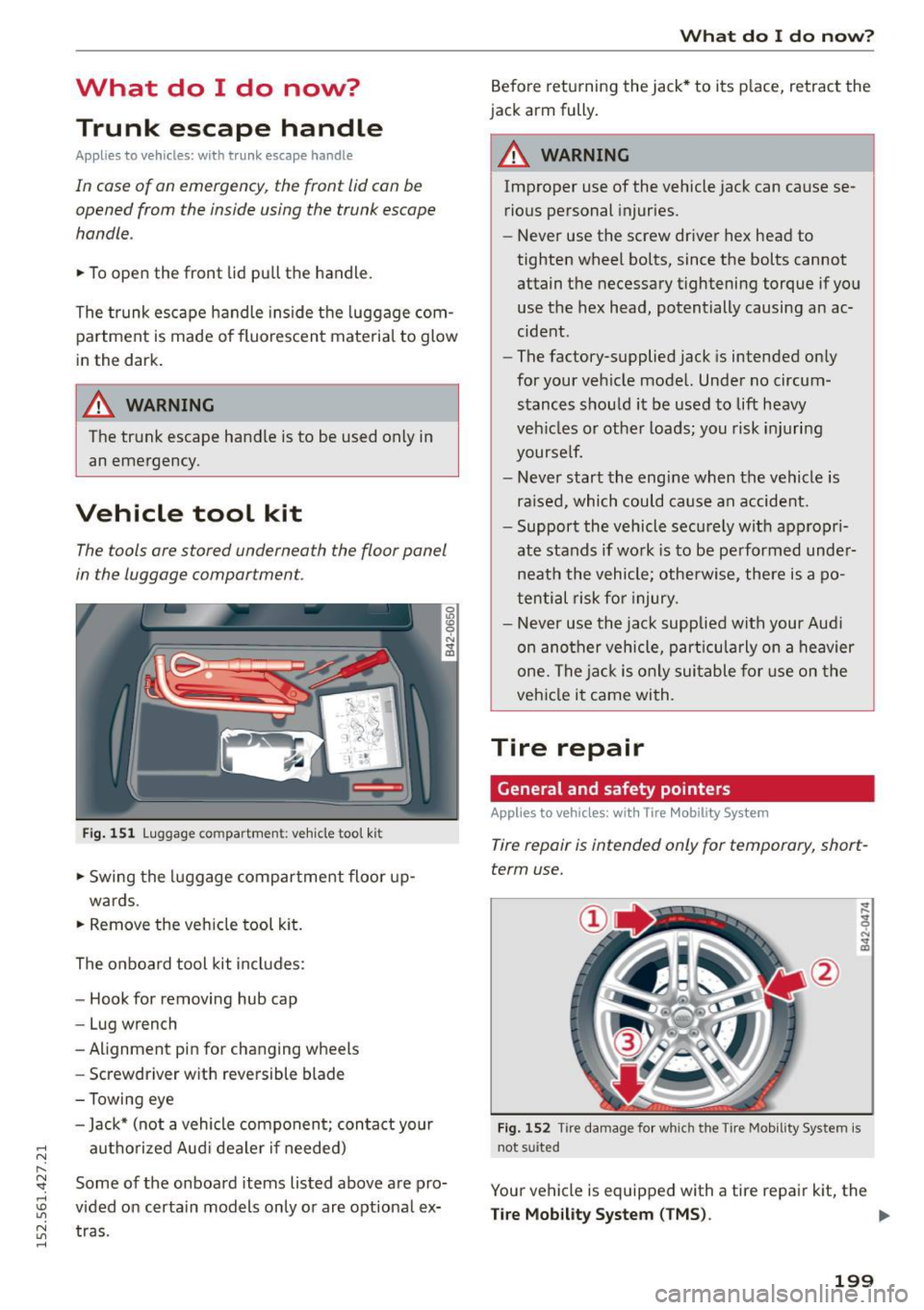
The tools are stored underneath the floor panel
in the luggage compartment.
Fig. 151 Luggage compartment: veh icle tool kit
"' Swing the luggage compar tment floo r up-
wards .
.. Remove the vehicle tool kit.
The onboard tool kit incl udes:
- Hook for removing hub cap
- Lug wrench
- Alignment pin for changing wheels
- Screwdr iver w ith reversible blade
- Towing eye
- Jack* (not a vehicle component; contact your
,..... authorized Aud i dealer i f needed)
N
I'-
~ Some of the on board items listed above are pro-
.... :5: vided on certa in models only or are optiona l ex-
N l/1 .... tras.
What do I do no w?
Before returning the jack* to its p lace, retract the
jack arm fully.
.&_ WARNING
-
Improper use of the vehicle jack can cause se-
rious personal injuries.
- Never use the screw driver hex head to
tighten wheel bo lts, since the bolts cannot
attain the necessary tightening torque if yo u
use the hex head, potentially causing an ac
cident.
- The factory-supplied jack is intended only
for your veh icle model. Under no circum
stances should it be used to
lift heavy
veh icles or other loads; you risk injuring
yourse lf.
- Never start the engine when the vehicle is
raised, which could cause an accident.
- Support the vehicle securely with appropri
ate stands if work is to be pe rformed under
neath the vehicle; otherwise, the re is a po
tential risk fo r injury.
- Never use the jack supplied with your Aud i
on another vehicle, part icularly on a heavier
one. The jack is only suitable for use on the
vehicle it came with.
Tire repair
General and safety pointers
Applies to vehicles: with Tire Mobility System
Tire repair is intended only for temporary, short
term use.
Fig. 152 Tire damage for which the Tire Mobility System Is
not suited
Your vehicle is equipped with a tire repa ir kit, the
T ire Mob il it y Sy stem ( TMS). .,.
19 9
Page 205 of 232
.... N
l'
N "1: .... I.O
"' N
"' ....
What should I be aware of when changing a tire?
Tires with unidirectional tread design
Tires with unidirectional tread design must be
mounted with their tread pattern pointed the
right direction .
A unidirectiona l tire can be ident ified by arrow s
on th e sidewall ,
which point in the di rection of
the rotat ion. You mus t fo llow the spe cified direc
tion of rotation. This is necessary in order fo r
these tires to develop the ir opt imum characteris
tics regarding grip, road noise, wear, and hydro
p laning .
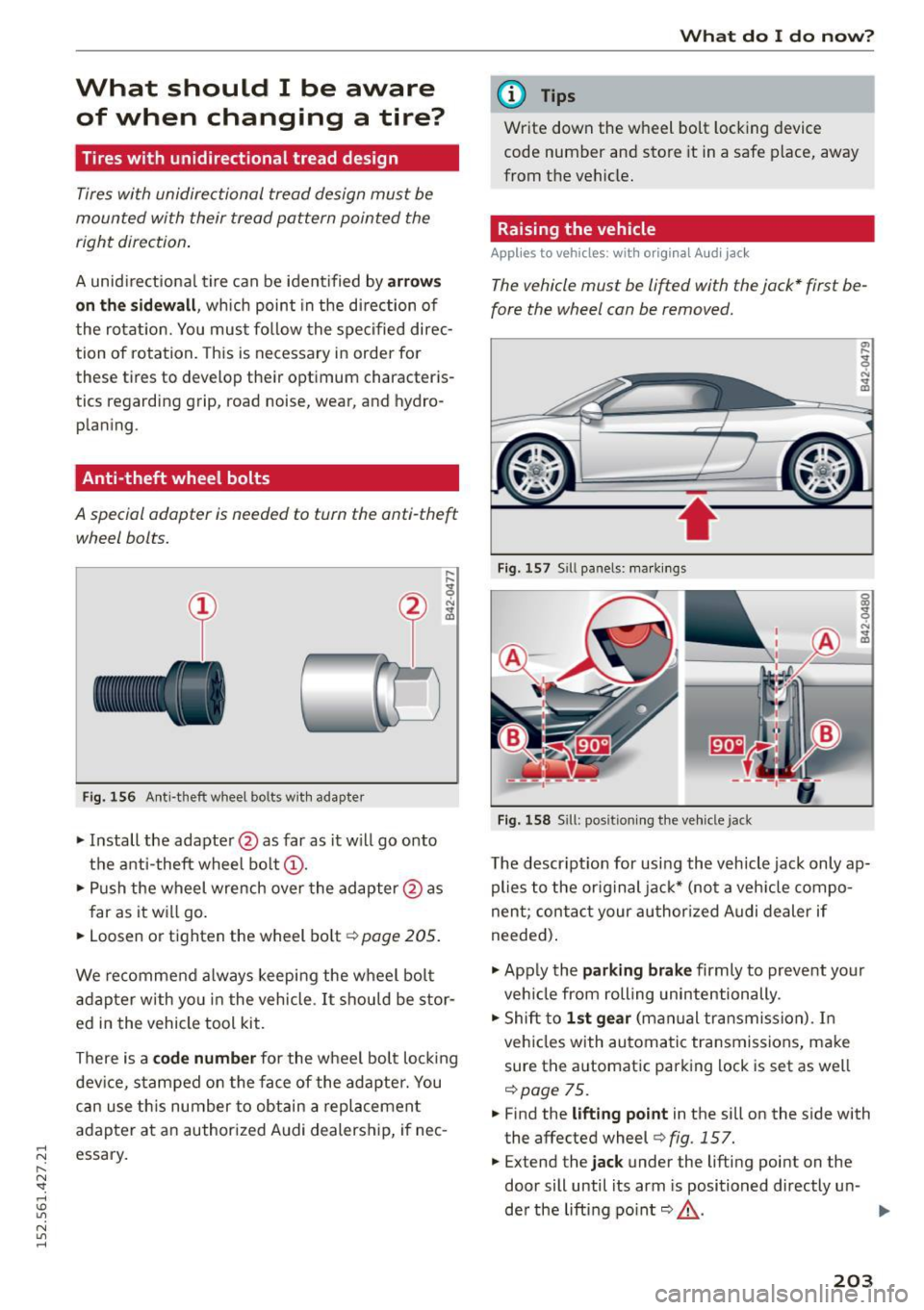
Anti-theft wheel bolts
A special adopter is needed to turn the anti-the~
wheel bolts.
2
Fi g. 1 56 A nti-theft wheel bo lts wit h adapter
.. Install the adapter @as far as it w ill go onto
the ant i-theft wheel bolt @ .
.. Pu sh the wheel wrench over the adapter @as
far as it will go .
.. Loosen or tighten the wheel bolt ¢
page 205 .
We re commend a lways keepi ng the wheel bo lt
adapter with yo u in the vehicle . It s hould be s tor
ed in the vehicle tool kit.
There is a
c od e number for the w heel bolt lock ing
dev ice, stamped on the face of the adapte r. You
can use th is number to obt ain a repl acement
adapter at a n author ized A udi dealers hip, if nec
essary.
What do I do no w?
(D Tips
Write down the wheel bo lt lock ing device
code number and store it in a safe place, away
from the vehicle.
Raising the vehicle
Appl ies to veh icles : w ith or ig inal A udi jack
The vehicle must be li~ed with the jock* first be
fore the wheel can be removed.
•
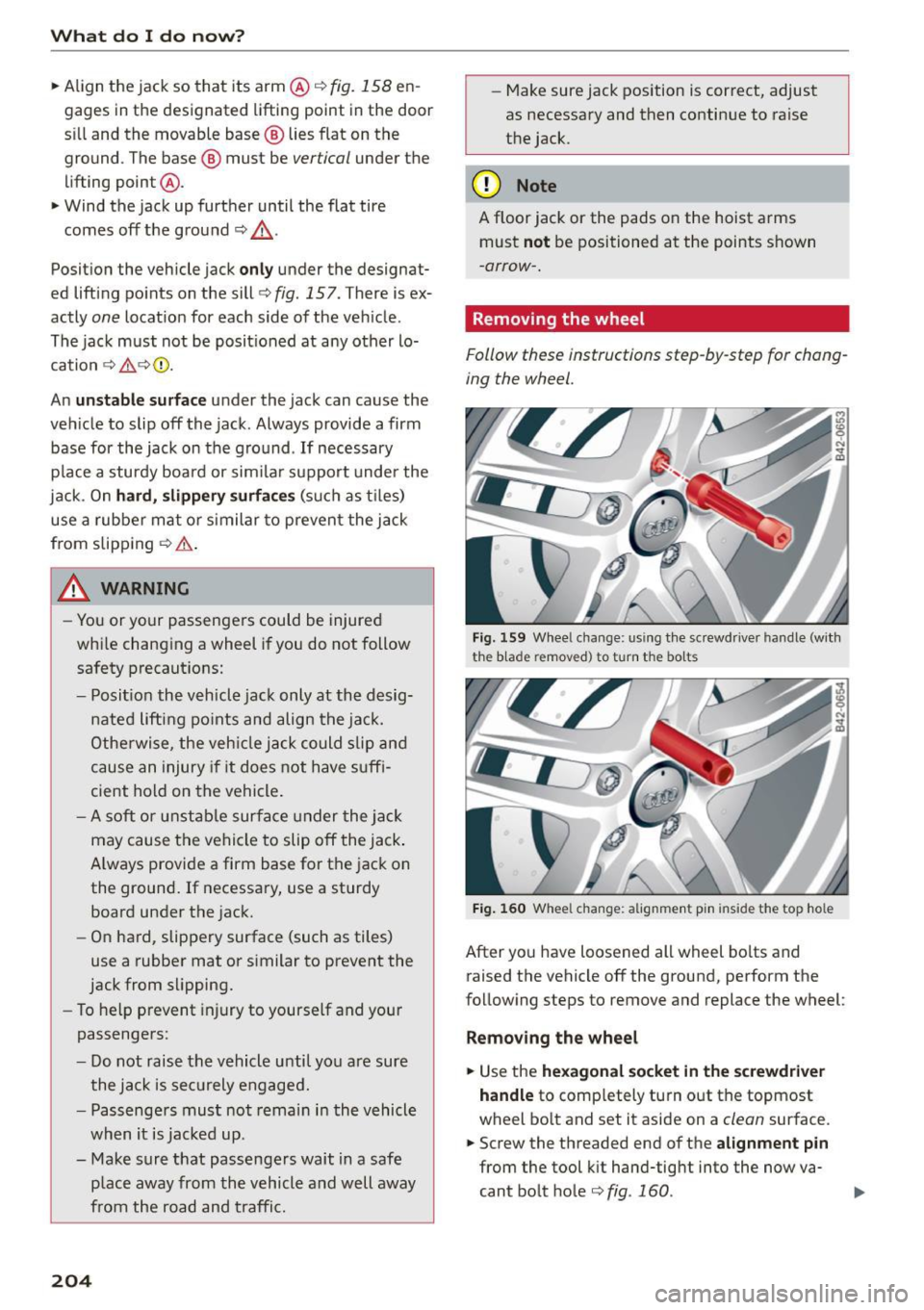
F ig. 157 Sill panels: ma rk in gs
Fig. 158 Sill: posit io nin g the ve hicle jack
The descr ipt ion for usi ng the veh icl e jac k only ap
plies to the or ig inal ja ck* (not a veh icle compo
nen t; contact your au thor ized A udi dealer if
needed) .
.. App ly th e
parking brake firmly to prevent your
veh icle from rolling unintentionally.
.. Shift to
1 st gear (manual tra nsmission). I n
veh icles with automatic transmissions, make
sure t he a utomat ic parking lock is set as we ll
r:!) page 75.
.. Find the lifting point in the sill on the side with
the affected wheel<=>
fig. 157 .
.. Extend the jack under the lifting point on the
door sill until its arm is positioned directly un-
der the lifti ng po int
r:!) ,&. . ..,_
203
Page 206 of 232
What do I do now?
• Align the jack so that its arm@ c> fig. 158 en
gages in the designated lifting point in the door
s ill and the movable base @ lies flat on the
ground . The base @ must be
vertical under the
lifting point @.
• Wind the jack up further until the flat tire
comes off the ground
c> ,&. .
Position the vehicle jack only under the designat
ed lifting points on the sill<=>
fig. 157. There is ex
actly
one location for each side of the vehicle .
The jack must not be posit ioned at any other lo
cation
c> .&, c>(D .
An unstable surface under the jack can cause the
vehicle to slip off the jack . Always provide a firm
base for the jack on the ground . If necessary
place a sturdy board or similar support under the
jack. On
hard, slippe ry surfac es (such as tiles)
use a rubber mat or similar to prevent the jack
from slipping
c> .&, .
A WARNING
-
-You or your passengers could be injured
while changing a wheel if you do not follow
sa fety precautions:
- Position the vehicle jack only at the desig
nated lifting points and align the jack.
Otherwise, the vehicle jack could slip and
cause an injury if it does not have suffi
cient hold on the vehicle.
- A soft or unstable surface under the jack
may cause the vehicle to slip off the jack .
Always provide a firm base for the jack on
the ground. If necessary, use a sturdy
board under the jack.
- On hard, slippery surface (such as tiles)
use a rubber mat or similar to prevent the
jack from slipping.
- To help prevent injury to yourself and your
passengers:
- Do not raise the vehicle until you are sure
the jack is securely engaged.
- Passengers must not remain in the vehicle
when it is jacked up.
- Make sure that passengers wait in a safe
place away from the vehicle and well away
from the road and traffic.
204
- Make sure jack position is correct, adjust
as necessary and then continue to raise
the jack.
(D Note
A floor jack or the pads on the hoist arms
must
not be positioned at the points shown
-arrow-.
Removing the wheel
Follow these instructions step-by-step for chang
ing the wheel.
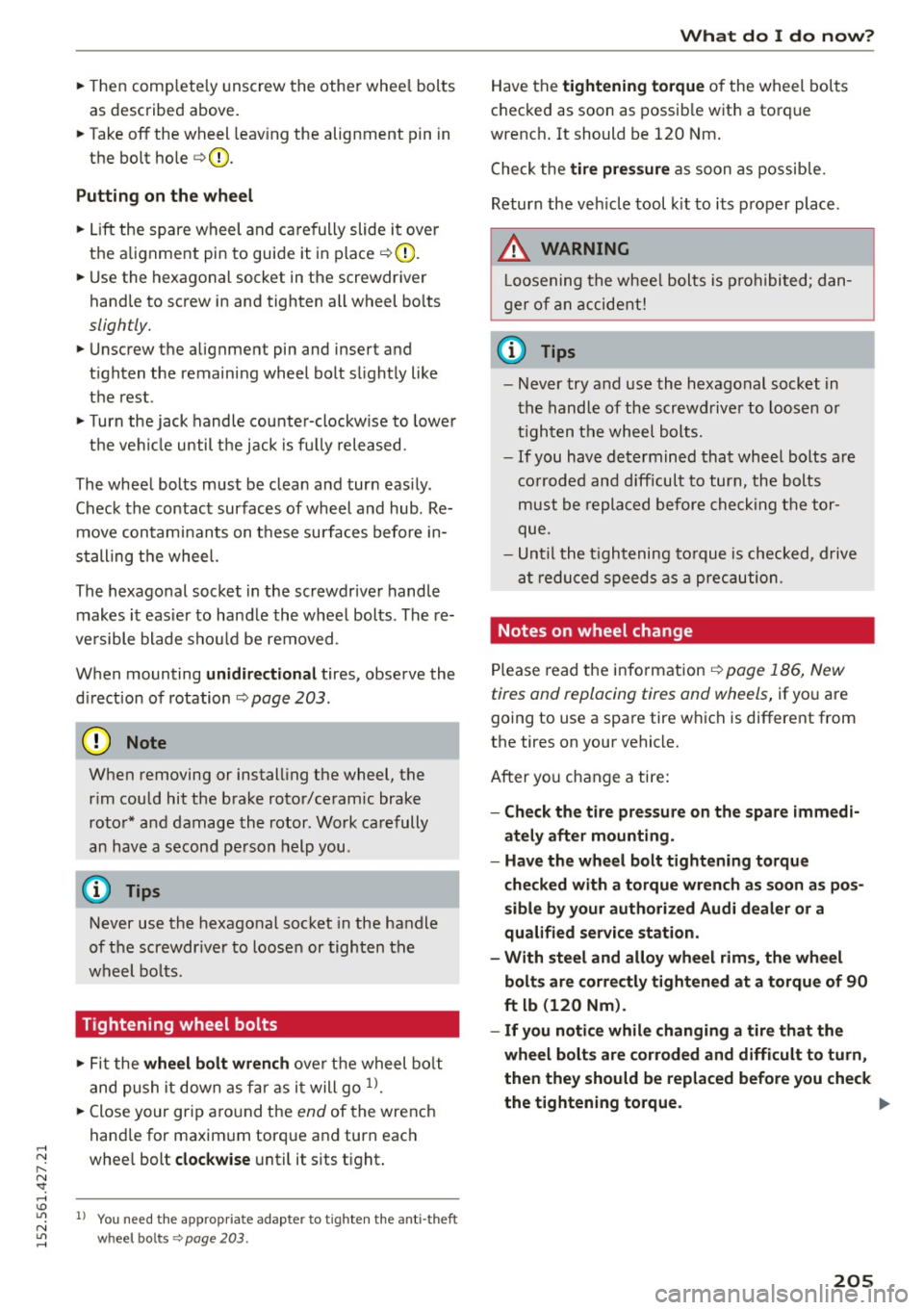
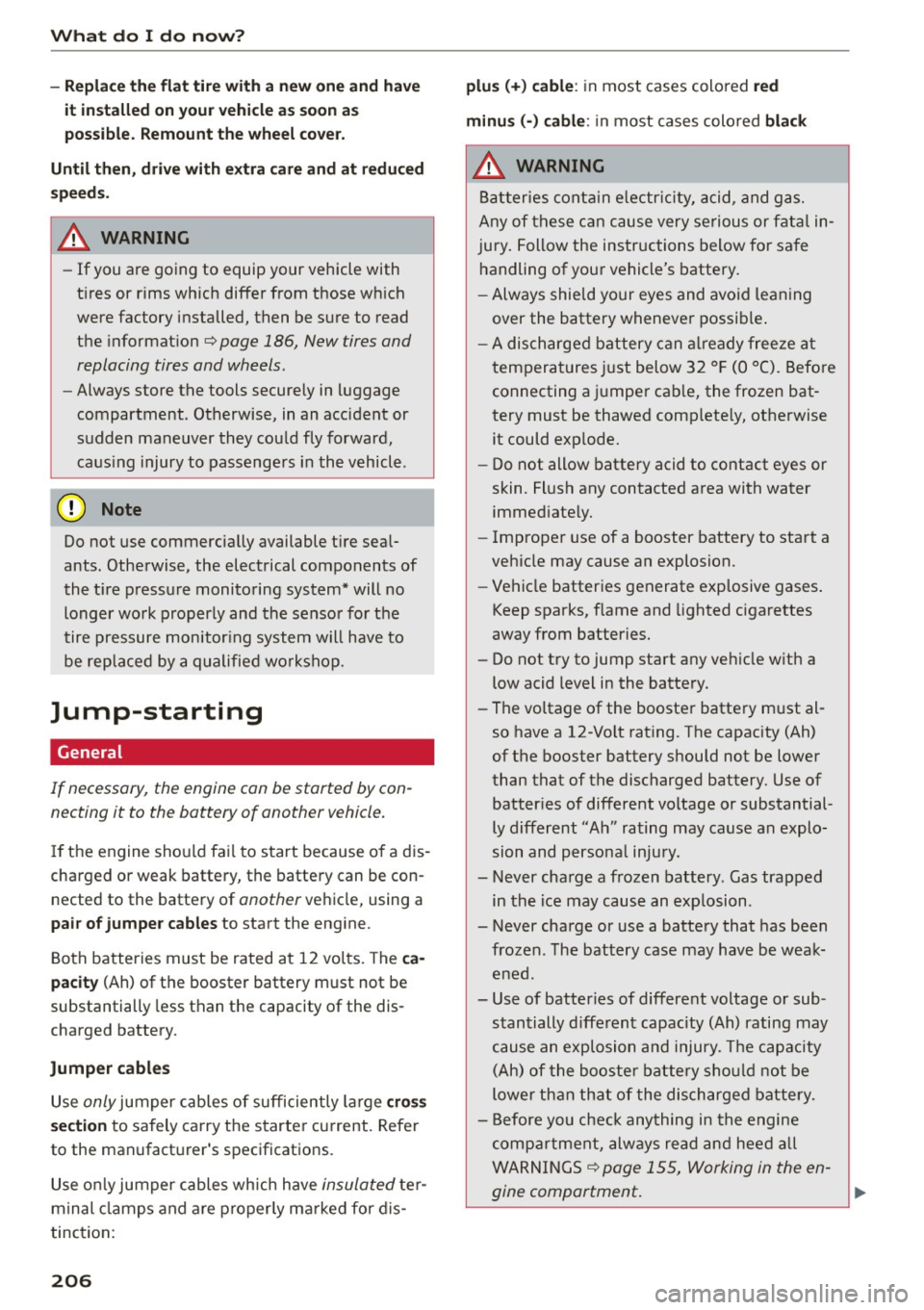
Fig. 159 Whee l chan ge: using the screwd river handle (wit h
the blade removed) to turn t he bolts
Fig. 160 Whee l chan ge: alignme nt pin inside the top hole
After you have loosened all wheel bolts and
raised the vehicle off the ground, perform the
following steps to remove and replace the wheel:
Removing the wheel
• Use the hexagonal socket in the screwdriver
handle
to completely turn out the topmost
wheel bolt and set it aside on a
clean surface .
• Screw the threaded end of the
alignment pin
from the tool kit hand-tight into the now va
cant bolt hole<=>
fig. 160.
Page 207 of 232
..... N
r-N "': ..... \!) 1.1'1
N 1.1'1 .....
~ Then comp lete ly unscrew th e othe r whee l bolts
as descr ibed above.
~ Takeoff the wheel le aving the alignment pin in
t he bolt hole
Q (D.
Putting on th e w hee l
~ Lift the spare wheel and carefully slide it over
the alignment pin to guide it in place
q (D.
~ Use the hexagonal socket in the screwdriv er
hand le to screw in and tighten all wheel bo lts
s ligh tly.
~ Unscrew the alignmen t pin and insert and
t ighten the remaining wheel bolt s light ly like
the rest .
~ Turn the jack handle counter-clockw ise to lowe r
the vehi cle until the jack is fu lly released.
The wheel bolts must be clean and turn easily. Check the contact surfaces of wheel and hub . Re
move contaminants on these surfaces before in
stall ing the wheel.
The hexagonal socket in the screwdriver handle makes it eas ier to hand le the wheel bolts . The re
ve rsible blade shou ld be removed .
When mounting
un idirectional tires, observe the
d irection of rotation
q page 203 .
When removing or install ing the wheel, the
r im could hit the brake rotor/ceramic brake
roto r* and damage the rotor. Wo rk ca refully
an have a second pe rson help you .
{D) Tips
Never use the hexagonal socket in the handle
of t he screwdr iver to loose n or tighten the
wheel bo lts.
Tightening wheel bolts
~ Fi t the wheel bolt wrench ove r th e wheel bo lt
and push it down as fa r as it will go
l).
~ Close your grip aro und the end of the wrench
hand le for max im um torq ue and turn eac h
whee l bolt
cloc kwi se u ntil it s its t ight .
l) You need t he appro pria te adapte r to t ight en th e an ti- th eft
wheel bo lts
<=:> p age 20 3.
What do I d o now?
Have the tightening torque of the wheel bolts
checked as soon as possib le with a torqu e
w renc h. It should be 120 Nm .
Check the
tire pre ssure as soon as possible.
Return the veh icle tool k it to its p roper place .
A WARNING
Loosening the whee l bolts is p roh ibited; dan
ger of an accident!
(D Tips
- Never try and use the hexagonal socket in
the handle of the screwdrive r to loosen o r
tighten t he whee l bolts.
- If you hav e determined that wheel bolts are
co rroded and difficult to turn, the bolts
must be replaced before checki ng t he tor
que.
- Unt il the t ightening to rque is checked, d rive
a t redu ced s peed s as a precaution.
Notes on wheel change
Please read t he info rmation q page 186, New
tires and replacing tires and wheels,
if yo u are
going to us e a spare tire w hich is different from
the ti res on your vehicle.
After you change a tire:
- Che ck the tire pre ssure on the spar e imm ed i
ate ly after mounting .
- Have the wheel bolt tightening torque
c he cked with a torque wrench as soon as po s
s ible by your authorized Audi d ealer or a
qualified service station .
- With steel and all oy wheel rim s, th e wheel
bolts ar e corre ctl y tightened at a torque of 90
ft lb
( 120 Nm ).
- If you noti ce while changing a tire that the
wheel bolts are corroded and diffi cult to turn ,
then the y should be replaced before you check
the tightening to rque .
IJ>-
205
Page 208 of 232
What do I do now?
-Repl ace th e fl at ti re with a n ew one and h ave
it ins talled on you r vehicle as soon as
po ssible. Remount the wheel co ve r.
Until th en, driv e with extr a car e and at redu ced
s pe eds .
A WARNING
-If you are go ing to equip your vehicle with
t ires or rims which differ from those wh ich
were factory installed, then be sure to read
the informat ion¢
page 186, New tires and
replacing tires and wheels.
- Always store the tools securely in luggage
compartment . Otherwise, in an accident or
sudden maneuver they cou ld fly forward,
caus ing injury to passengers i n the vehicle .
(D Note
Do not use commercially available t ire sea l
ants. Otherwise, the electrical components of
the t ire pressure monito ring system* will no
longer wo rk properly and the sensor fo r the
tire pressure monitor ing system will have to
be rep laced by a qualified workshop.
Jump-starting
General
If necessary, the engine can be started by con
necting it to the battery of another vehicle.
-
If the engine sho uld fail to start because of a d is
charged or weak battery, the battery can be con
nected to the battery of
another vehicle, using a
pai r of jumpe r cable s to start the engine.
Both batteries must be rated at 12 vo lts. The
ca
pacit y
(Ah) of the booster battery must not be
substantially less than the capacity of the dis
charged battery.
Jump er c ables
Use only jumper cables of sufficiently large cro ss
s e ctio n
to safely carry the s tarte r cu rrent . Refer
to the manufact urer's specifications.
Use o nly jumper cables wh ich have
insulated ter
minal clamps and are p roperly marked for d is
tinction:
206
plu s(+) ca ble : in most cases colo red red
minu s(-) c abl e:
in most cases colo red bla ck
A WARNING
-
Batteries conta in e lectr ic ity, acid, and gas.
Any of these can cause very serious or fata l in
jury . Follow the instructions below for sa fe
handling of your vehicle's battery.
- Always shie ld your eyes and avoid leaning
over the battery whenever possib le .
- A discharged battery can a lready freeze at
tempera tures just below 32 °F (0 °C). Befo re
connecting a jumper cab le, the frozen bat
tery must be thawed comp lete ly, otherwise
it could exp lode.
- Do not allow battery acid to contact eyes or
skin . Flush any contacted area with water
immed iately.
- Improper use of a booster battery to start a
veh icle may cause an explosion.
- Vehicle batter ies generate explosive gases .
Keep sparks, f lame and lighted cigarettes
away from batteries.
- Do not try to jump start any vehicle with a
low acid level in the battery.
- The voltage of the booster battery must al
so have a 12 -Vo lt rat ing. The capacity (Ah)
of the booster battery should not be lower
than that of the discharged battery. Use of batter ies of different voltage or substantial
ly different "Ah" rating may cause an explo
sion and personal injury.
- Never charge a frozen battery. Gas trapped
in the ice may cause an exp losion .
- Never charge or use a battery that has been frozen. The battery case may have be weak
ened.
- Use of batter ies of different voltage or sub
stantially d iffe rent capacity (Ah) rating may
cause an exp losion and injury. The capacity
(Ah) of the booster battery sho uld not be
lower than that of the discharged battery.
- Before you check anything in the engine
compa rtment, always re ad and heed all
WARNINGS
¢page 155, Working in the en -
gine comportment. .,,.
Page 210 of 232
What do I do now?
- Be fo re you check a nything in t he e ngine
compartment, always read and heed all
WARNINGS
Q page 155, Working in the en
gine compartment .
CD Note
Improper hook-up of jumper cables can ruin
the generator.
- Always connect POSITIVE( +) to POSITIVE
( + ), and NEGA TIVE(-) to NEGATIV E(-)
gro und post of the battery manager control
unit.
- Check that a ll screw plugs on the battery
cells are screwed in firmly . If not, tighten
plugs prior to connect ing clamp on negat ive
battery terminal.
- Please note that the procedure for connect
i ng a jumper cable as described above ap
plies specifically to the case of your vehicle
being jump started. When you a re g iving a
ju mp sta rt to another vehicle, do
not con
n e ct the neg ative(- ) ca b le to the negative
( - ) terminal o n the discharged battery @.
Instead, se curely connect the negative(-)
cab le to either a solid metal component
that is f irm ly bolted to the engine block or
to the engine block itself . If the battery that
i s bei ng charged does not vent to the out
s ide , escap ing battery gas could ignite and
explode!
Emergency towing with
commercial tow truck
General hints
Your Audi requires special handling for towing.
The fo llow ing in formation is to be used by com
mercial tow truck operators who know how to op
erate their equipment safely .
- Never tow your A ud i, tow ing will cause damage
to the engine and transmiss ion .
- Never wrap the safety chains o r winch cables
around the b rake lines.
- To preven t un ne cessary d am age, yo ur Audi
mus t be transpor ted with a car carrier ( flat bed
t ruck) .
208
-To load the vehicle on to the flat bed , use the
tow ing loop found in the vehicle tools and at
tach to the front anchorage
Q page 208.
_& WARNING
A veh icle being towed is not safe for passen
gers. Never a llow anyone to ride in a vehicle
being towed, fo r any reason.
CD Note
The vehicle has ver y low ground clearance.
M ake sure that no damage is caused to the
underside of the vehicle when it is being load
ed onto a flat bed truck .
Front towing loop
Do not install the front towing loop un til it is
needed.
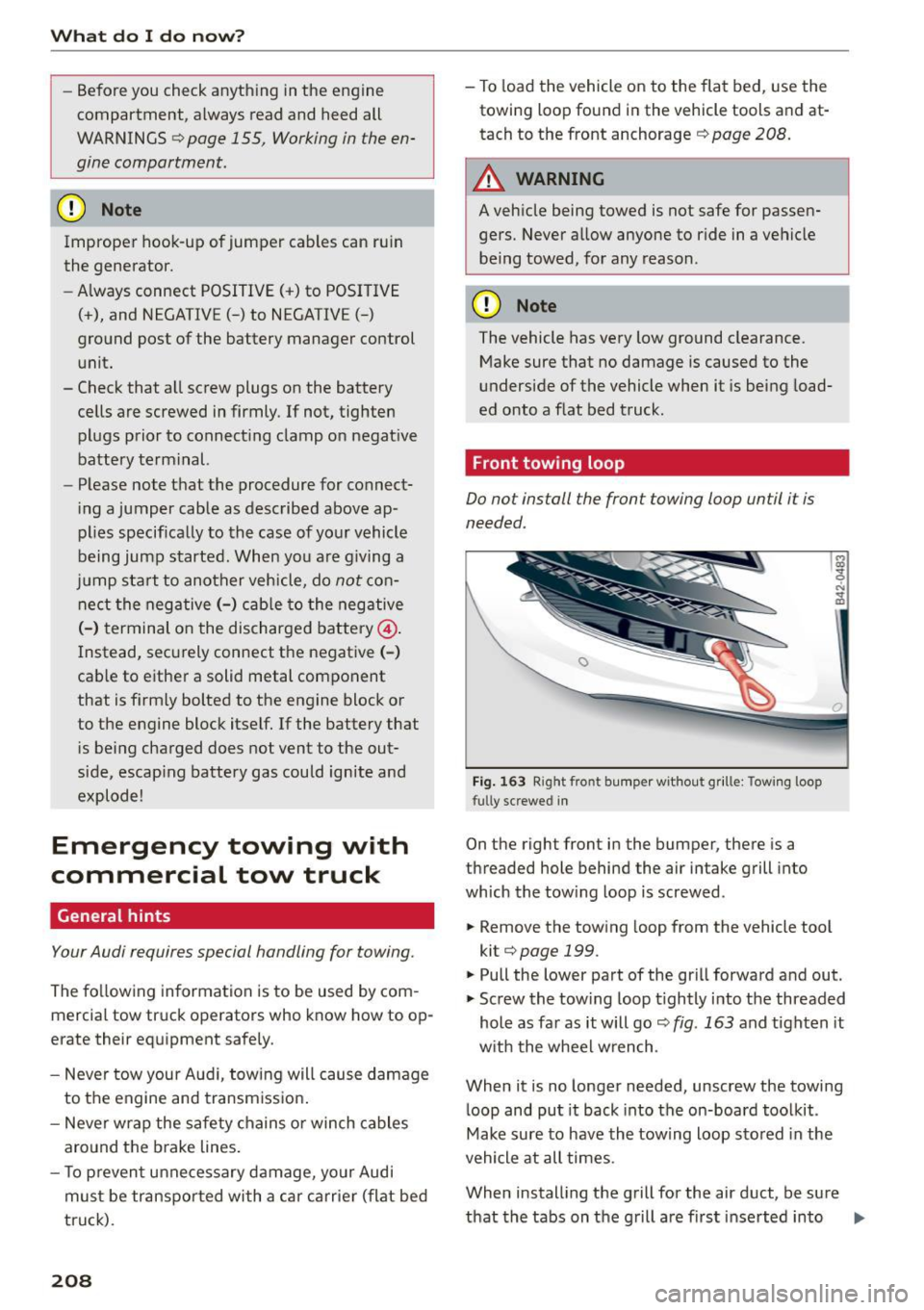
Fi g. 163 Righ t fro nt bu m per w it h ou t gr ille: Tow ing loo p
full y screwe d in
On the right front in the bumper , there is a
t h readed hole behind the air intake g rill into
which the tow ing loop is screwed .
.,. Remove the tow ing loop from the vehicle tool
kit
Q page 199 .
.,. Pull the lower part of the gr ill forward a nd out .
.,. Sc rew the tow ing loop t ightly into t he threaded
hol e as fa r as it will go
Q fig . 163 and tighten it
w ith the wheel w rench .
When it is no longer needed, unscrew the towing
l oop and put it back into the on-boa rd too lkit .
Make sure to have th e towing loop sto red in the
vehicle at all times .
When install ing the grill for the air duct, be sure
that the tabs on t he g rill a re first inserted into .,..
Page 212 of 232

Fuses and bulbs
Fuses and bulbs
Electrical fuses
Replacing fuses
Fuses that have blown will have metal strips
that have burned through .
Fig. 164 Passenger's s ide wheel well: Foot rest with fuse
arrangement
The fuses are located in the footwell area on the
passenger's side behind a cover .
.. Switch the ignition and all e lectrica l equipment
off .
.. Check the following table to see which fuse be-
longs to the equipment .
.,. Remove the floor mat .
.,. Fo ld the foot rest back~
fig. 164 .
.,. Remove the clamp from the holder in the fuse
box .
.. Remove the fuse using the clamp and replace
the b lown fu se with an ident ica l new one .
.. Fo ld the foot rest down again .
Fuse color identification
Color Current in amps
B lack 1
Purple 3
Light b rown 5
Brown 7 .5
Red 10
B lue 15
Yellow 20
Whit e or transparent 25
Green 30
Ora nge 40
210
A WARNING
Do not repa ir fuses and never replace a blown
f u se w ith one that has a highe r amp rating.
This can cause damage to the electr ica l sys
t e m and a fire.
(D Note
If a new fuse blows again shortly after you
have installed it, have the electrical system
checked by an a uth orized Audi dea le r or a u
thoriz ed Audi Serv ice Facility .
@ Tips
-The followi ng table does not list fuse loca
t ions that are not used .
- Some of the equipment listed in the fo llow
ing tables applies on ly to certa in model ver
sions or certa in optiona l equipment .
Fuse assignment
Fig. 165 Pas senge r footwell: Fuse panel
Fuse panel @
No . Consumer
1 VOA interface
2 Heated windshield washer nozzle