wheel AUDI R8 SPYDER 2015 Owner's Guide
[x] Cancel search | Manufacturer: AUDI, Model Year: 2015, Model line: R8 SPYDER, Model: AUDI R8 SPYDER 2015Pages: 232, PDF Size: 58.36 MB
Page 139 of 232
..... N
r-N "': ..... \!) 1.1'1
N 1.1'1 .....
This can cause a temporary reduction in braking
force compared to dry brakes. You can compen
sate for this by pressing the brake pedal harder.
Cor ro sion
There may be a tendency for dirt to bui ld up on
the brake pads and corrosion to fo rm on the discs
if the car is not driven regularly or only for short
trips with little use of the brakes.
If the b rakes are not used frequently, or if corro
sion has formed on the discs, it is advisab le to
clean off the pads and discs by braking firmly a
few times from a moderately high speed
c:> &. .
Faults in the brake sy stem
If you should notice a sudden increase in brake
pedal travel, then one of the two brake circuits
may have fai led
c:> .&, .
Low brak e flu id le vel
Malfunct ions can occur in the brake system if the
brake fluid level is too low. The brake flu id leve l is
monitored e lectronically.
Br ake power assis t un it
T he brake power assist unit increases the pres
sure that you generate with the brake pedal.
It
works only when the eng ine is running .
Brak e lining wear sta tu s
Brake lining wear may be checked by visual in
spection of the condition of the brake pads
through the openings in the wheel. If necessary,
the wheel may be removed for this inspection
c:> page 203 .
.8, WARNING
-New brake pads don't have the best stop
ping power and must be "broken-in" during
the init ial 250 mi les ( 400 km) of normal city
driving. The break -in period can be consider
ably longer for vehicles with ceramic brake
rotors *. You can compensate for this by
pressing the brake pedal more firmly. This
also applies later when new pads are instal
led .
- You should perform brak ing maneuvers for
the purpose of clean ing the brake system
Int elli ge nt te chn olo gy
only if road conditions permit. Other road
users must not be put at r isk -you may
cause an accident!
- Before descending a steep grade, reduce
speed and sh ift transmission into a lower
gear or lower dr iving range. Do not ride the
brakes or hold the pedal down too long or
too often. This could cause the bra kes to get
hot and dimin ish braking effic iency .
- Do not "ride the brakes" by rest ing your foot
on the pedal when you do not intend to
brake. This may cause the brakes to over
heat, premat ure wear and increased stop
ping distance.
- Under certain cl imatic and operat ing condi
tions such as passing thro ugh water, dr iv ing
in heavy rain or after washing the vehicle,
the effectiveness of the brakes can be re
duced . In winter, ice can accumulate on the
brake pads, lin ings, discs and drums. Care
fully apply brakes for a test. Brakes will dry and ice coatings will be cleaned off after a
few careful brake applications.
- Driving for an extended period of t ime on
salt-covered roads without using your brakes can also affect braking efficiency .
Clean off accum ulated salt coating from
b rake discs and pads with a few cautious
brake applications.
- If you damage the front spoiler, or if you in
stall a different spoiler, be su re the air flow
to the front brakes is not obstructed . O ther
wise the brake system could overheat reduc
ing the effectiveness of the entire brake sys
tem .
- Fai lure of one brake circuit will impai r the
braking capability resu lting in an increased
stopping distance . Avoid driving the vehicle
and have it towed to the nearest Aud i dea ler
or qualif ied workshop.
- Never let the vehicle roll to a stop with the
engine shut off.
- If the brake booster is not working, for ex
ample when towing your veh icle, or because
the brake booster has somehow been dam
aged, the brake pedal must be pressed con
siderably harder to make up for the lack of booster assistance.
1 37
Page 141 of 232
..... N
r-N "': ..... \!) ..,.,
N ..,., .....
Power steering
When the engine is running, power steering
makes i t easier for the driver to steer.
Power steering helps the driver steer the vehicle
with litt le physical effort.
If the engine is not running, the power steering
system is also not working. In this case, you will
find it extremely difficult to turn the steering
wheel.
If you turn the steering fully to the left or right
when the vehicle is stationary, you place a very
heavy load on the power steering system. Turning
the steering wheel fully to the left or right wi ll
cause noise in the system . It also reduces engine
idle speed.
(D Note
Do not hold the steering turned fully to the
left or right for more than 10 seconds when
the engine is running. There is a risk of dam
age to the power steering system.
@ Tips
- In the event of a power steering system fail
ure, or if the engine is not running (while
being towed), you will still be able to steer
the vehicle. However, you will require more
effort to do so.
- If the power steering system has a leak or is
defective, you should immediately contact a
qualified workshop .
- The power steering system requires a spe
cial hydraul ic fluid . The power steering fluid
reservoir is located in the engine compart
ment. The correct hydraulic fluid level is im
portant for proper operation of the power
steering system. The power steering fluid
l evel is checked according to the Audi main
tenance service schedule.
Dry sump lubrication
High lateral and longitudinal forces affect the en
gine and the vehicle during sporty driving. Dry
sump lubrication ensures that your engine is sup-
Intelligent technology
plied with oil and properly lubricated even under
these conditions.
In a "norma l" vehicle the oil pump sends the oil
from the oil pan to the lubrication points in the
engine . The oil then returns to the oil pan. In ex
treme situations, the oil pump may draw in air,
wh ich results in insufficient oi l pressure .
With dry sump lubrica tion, the oil is not in the oil
pan (it is "dry"), but in a separate oi l tank. While
one pump supplies the engine with oil, a second
pump suct ions the oil out of the engine and re
turns it to the o il tank. Because the oil tank is tall
and narrow, oil pressure is constant even under
extreme conditions .
In add ition, the oi l pan in vehicles with dry sump
lubrication is noticeably shallower . This allows
the engine to be installed lower in the vehicle,
bringing down the center of gravity . This im
proves your vehicle's handling.
Driving with your quattro
With oil-wheel drive, all four wheels are driven .
General information
With all-wheel drive, power is distributed to all
four wheels . This happens automatically depend
ing on your driving style and the road conditions
at the time . See also
c:::.> page 134.
The all-whee l drive concept is designed for high
engine power . Your vehicle is exceptionally pow
erful and has excellent driving characterist ics
both under normal driving conditions and on
snow and ice. Always read and fo llow safety pre
cautions
c:::.> .&_ .
Winter tires
When driving in the winter, your vehicle with all
wheel drive has an advantage, even with regular
t ir es . In winter road condit ions it may be advisa
ble to mount winter tires (or all-season t ires) for
improved driveability and brak ing: these tires
must be mounted on
all four wheels. See also
c:::.> page 193 , Winter tires.
139
Page 142 of 232
Intelligent technology
Snow chain s
Where tire cha ins are mandatory on certai n
roads, this normally a lso applies to vehicles with
all-wheel drive
¢ page 194, Snow chains .
Replacing wheels /tires
Vehicles w ith all-whee l drive must a lways have
tires of the same si ze. Also avoid t ires with differ
ent tread depths. Fo r deta ils see page
¢ page 186, New tires and replacing tires and
wheels.
Off-Road driving?
Your Audi does not have enough ground clear
an ce to be used as an off-road veh icle.
It is there
fore best to avo id rough tracks and uneven ter
rain as m uch as possible . A lso re fer to
¢ page 142.
A WARNING
-Always adjust your driving to road and traf
fic cond itions. Do not let the extra safety af·
forded by all-whee l dr ive tempt you into tak
ing extra r isks .
- Althoug h the all-wheel dr ive is very effec
t ive, always remember that brak ing capac ity
is limited by tire tract ion. You should there
fore not dr ive at excessive speeds on icy o r
slippery road su rfaces.
- On wet road su rfaces, be careful not to drive
too fast because th e front whee ls cou ld be
gin to slide o n top of the water (aquap lan
ing).
If t his s hou ld o cc ur , you will have no
warning from a sudde n increase in engine
speed as with a front -whee l drive vehicle .
Always drive at speeds which are s uited to
the road conditions. -ris k of crash.
Energy management
Starting ability is optimized
Energy management controls the distribution of
electrical energy and thus optimizes the availa
bility of electrical energy for starting the engine.
If a vehicle w it h a conventional energy system is
not drive n for a long per iod of t ime, the battery
is discharged by idli ng cur rent consumers (e.g .
140
immob ili zer). In certain c ircumstances it can re
s ul t in the re being insufficient energy available to
start the eng ine.
I ntelligent energy managemen t in your veh icle
hand les the d istribution of electrical energy .
Starting ability is markedly improved and the life
of the battery is extended.
B asically, energy managemen t consis ts of
bat
tery diagnosi s, idling current management
and
dynamic energy management.
Battery diagnosis
Battery diagnosis continuously dete rm ines t he
st ate of the bat tery. Sensors dete rm ine battery
vo ltage, batte ry cur rent and battery tempera
ture . This de termines the current state of cha rge
and t he power of the battery.
Idling current management
Idli ng cur ren t management reduces energy con
sumption whi le the vehicle is s tanding. W it h the
i gni tion swi tched off, it contro ls the energy s up
ply to the various electrical components . Data
from battery d iagnosis is considered.
Depend ing o n the ba tte ry's st ate of ch arge, indi
vidual consumers are gradua lly tur ned o ff to pre
vent excessive discharge of the batte ry and thus
maintain starting capa bility .
Dynamic energy management
While t he ve hicle is being driven, dynamic e ne rgy
m anag eme nt dis trib utes the energy ge nerated
accord ing to the needs of the individ ua l compo
nents . It regu lates consumption, so that more
e lectrica l ene rgy is not be ing used than is being
generated and ens ures an optima l state of
c h arge for the battery.
(D Tips
- But even ene rgy management cannot neg
ate the lim its of physics. Cons ider that the
p ower and life of a batte ry are lim ited.
- If start ing ability is threa tened, you are in
formed by a warning ¢
page 141, Driver
notification in the instrument cluster dis
play.
Page 148 of 232
Vehicle care and cleaning
A WARNING
-Only wash the vehicle when the ignition is
off and follow the instructions from the car
wash operator to reduce the risk of acci
dents.
- To reduce the risk of cuts, protect yourself
from sharp metal components when wash ing the underbody or the inside of the wheel
housings.
- After washing the vehicle, the braking effect
may be delayed due to moisture on the
brake rotors or ice in the winter. The bra kes
must be dried first with a few caref ul brake
applications .
@ Note
-If you wash the ve hicle in an au tomatic car
wash, you must retract the extend able rear
spoi ler * if necessary, and fold the exterior
mirrors in to reduce the risk of damage .
Power folding exterior mirrors* must only
be fo lded in and out using the power folding
funct ion.
- To prevent paint damage, do not wash the
vehicle in direct sunlight.
- To red uce the risk of damage, do not wash
the power top with a pressure washer. -
To reduce the risk of damage, do not wash
decorative decals * with a pressure washer.
- T o reduce the risk of damage to the surface,
do not use insect remov ing sponges, kitchen
sponges or similar items.
- Matte finish painted vehicle components:
- To reduce the risk of damage to the sur-
face, do not use polish ing agents or hard
wax.
- Never use car wash cycles that apply pro
tective wax. It can destroy the matte fin ish effect .
- Do not place any stickers or magnet ic
signs on vehicle parts painted w ith matte
finish paint. The pa int could be damaged
when the stickers o r magnets are re
moved.
- Do not wash the vehicle using cleaning
products that contain alcohol when the en
gine is hot. This increases the risk of dam
age to plastic components, such as cracking.
@ For the sake of the environment
Only wash the vehicle in facilities spec ial ly de
signed for that purpose. This w ill reduce the
risk of dirty water contaminated with oil from
entering the sewer system .
Cleaning and care information
When cleaning and caring for individual vehicle
components, refer to the following table . The in
formation contained there is simp ly recommen
dations. For questions or for components that are not listed, refer to an authorized Audi dealer
or a qualified workshop. A
lso fo llow the informa
tion found in
¢ .&. .
Cleaning exterior
Component Situation Solution
Wiper blades
Dirty ¢ page 53, Cleaning windshield wiper blades
Headlights/ Dirty Soft sponge with a mild soap solutiona>
tail lights
Sensors
/
Dirty Sensors: soft cloth with a solvent-free cleaning product
camera lenses Camera lenses: soft cloth w ith an alcoho l-free clean ing sol-
ution
Snow/ice Hand brush/solvent-free de-icing spray
Wheels Road salt Water
Brake dust Acid-free special cleaning solution
146
...
Page 150 of 232
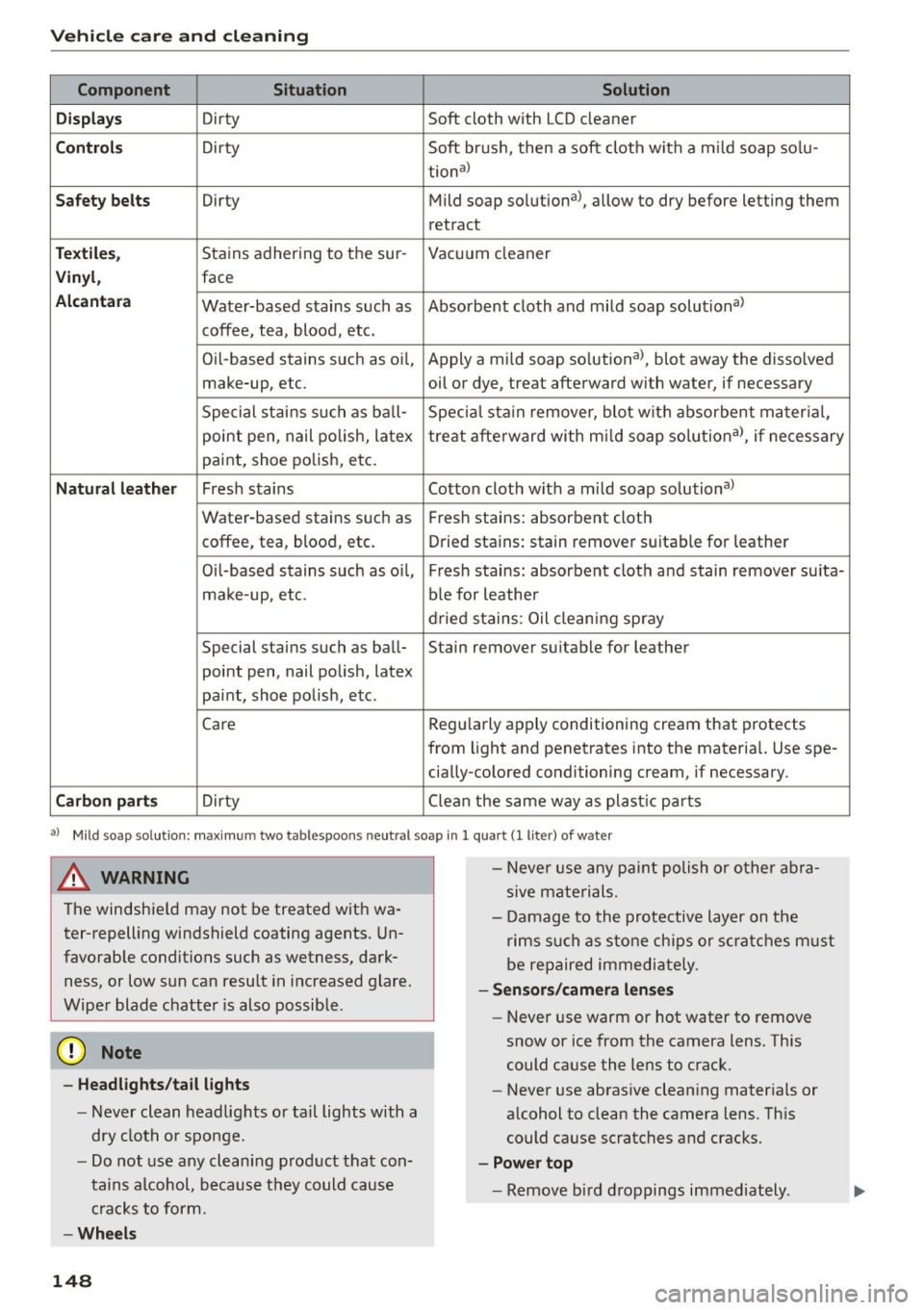
Vehicle care and cleaning
Component Situation Solution
Displays
Dirty Soft cloth with LCD cleaner
Controls Dirty Soft brush, then a soft cloth with a mild soap solu-
tional
Safety belts Dirty Mild soap solution a>, allow to dry before letting them
retr act
Textiles, Stains adhering to the sur- Vacuum cleaner
Vinyl, face
Alcantara Water-based stains such as Absorbent cloth and mild soap solutional
coffee, tea, blood, etc.
Oil-based stains such as o il, Apply a mi ld soap solutiona>, blot away the disso lved
make-up, etc. oil ori dye, treat afterward with water, if necessary
Special stains such as ball- Special stain remover, blot with absorbent material,
point pen, nail polish, latex treat afterward with mild soap solutional, if necessary
paint, shoe polish, etc.
Natural leather Fresh stains Cotton cloth with a mild soap solutional
Water-based stains such as
Fresh stains: absorbent cloth
coffee, tea, blood, etc. Dried stains: stain remover suitable for leather
Oil-based stains such as oil, Fresh stains: absorbent cloth and stain remover suita-
make-up, etc. ble for leather
dried stains: Oil cleaning spray
Special stains such as ball- Stain remover suitable for leather
point pen, nail polish, latex
paint, shoe polish, etc.
Care Reg
ula rly apply conditioning cream that protects
from light and penetrates into the materia l. Use spe-
cially-co lored conditioning cream, if necessary.
Carbon parts Dirty Clealil the same way as plastic parts
aJ Mild soap so lution: max im um two ta blespoo ns neut ral so ap in 1 quart (l lite r) of w ate r
A WARNING
Th e windshie ld may not be treated with wa
ter-repelling windshield coating agents. Un
favorable conditions such as wetness, dark
ness, or low sun ca n resu lt in increased glare.
Wiper blade chatter is also possible .
(D Note
-Headlights/tail lights
- Never clean headlights or tail lights with a
dry cloth or sponge.
- Do not use any cleaning product that con
tains alcohol, because they could cause
cracks to form.
-Wheels
148
-
- Never use any paint polish or other abra
sive materials.
- Damage to the protective layer on the
r ims such as stone chips or scratches must
be repaired immed iately.
-Sensors/camera lenses
- Never use warm or hot water to remove
snow or ice from the camera lens. This
could cause the lens to crack.
- Never use abrasive clean ing materials or
a lcohol to clean the camera lens. This
could cause scratches and cracks.
- Power top
- Remove bird droppings immediately .
Page 171 of 232
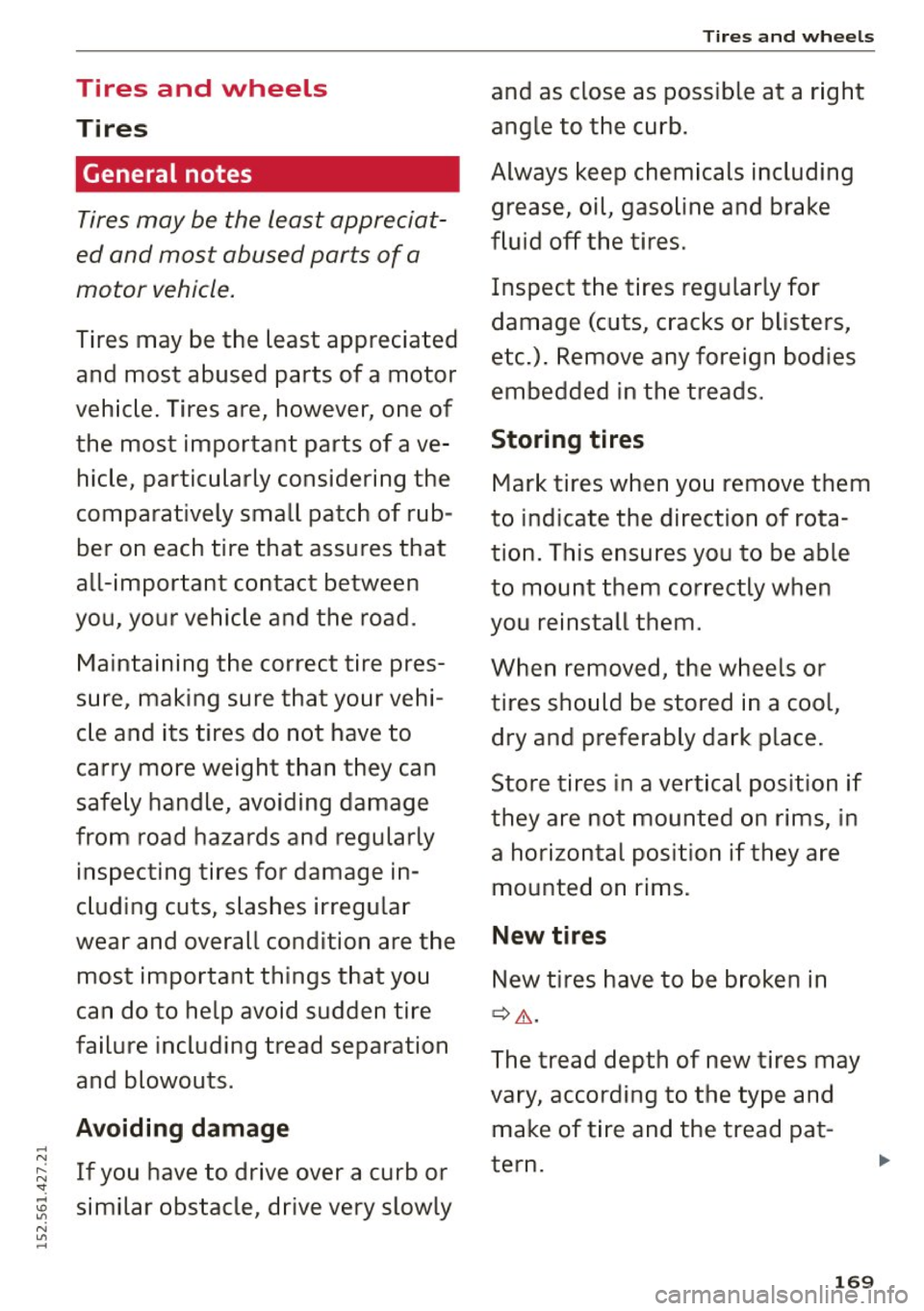
.... N
Tires and wheels
Tires
General notes
Tires may be the least appreciat
ed and most abused parts of a
motor vehicle.
Tires may be the least appreciated
and most abused parts of a motor
veh ic le . Tires are, however, one of
the most important parts of ave
hicle, particularly considering the
comparatively small patch of rub
ber on each tire that assu res that
all-important contact between
you, your vehicle and the road .
Maintain ing the correct t ire pres
sure, making sure that your vehi
c le and its tires do not have to
carry more weight than they can
safe ly handle, avoiding damage
from road hazards and regularly inspecting tires for damage in
c luding cuts, slashes i rregular
wear and overall condition are the most important th ings that you
can do to help avo id sudden tire
failure including tread separation
and blowouts.
Avoiding damage
~ If you have to dr ive over a curb or ":
~ similar obstacle, drive very s lowly
N U'> .....
Tir es a nd whe els
and as close as possible at a right
ang le to the curb.
Always keep chemicals including
grease, oil, gasoline and brake
fluid off the tires. Inspect the tires regularly fo r
damage (cuts, cracks or blisters ,
etc.) . Remove any foreign bodies
embedded in the treads.
Storing tires
Mark tires when you remove them
to indicate the direction of rota
tion. This ensures you to be able
to mount them correctly when
you reinstall them.
When removed, the w heels or
tires sho uld be stored in a coo l,
dry and preferably dark place.
Store tires in a vertical position if
they are not mounted on rims, in
a horizon tal position if they are
mounted on rims .
New tires
New tires have to be broken in
¢,&.
The tread depth of new tires may
vary, according to the type and make of tire and the tread pa t
tern.
1 69
...
Page 172 of 232
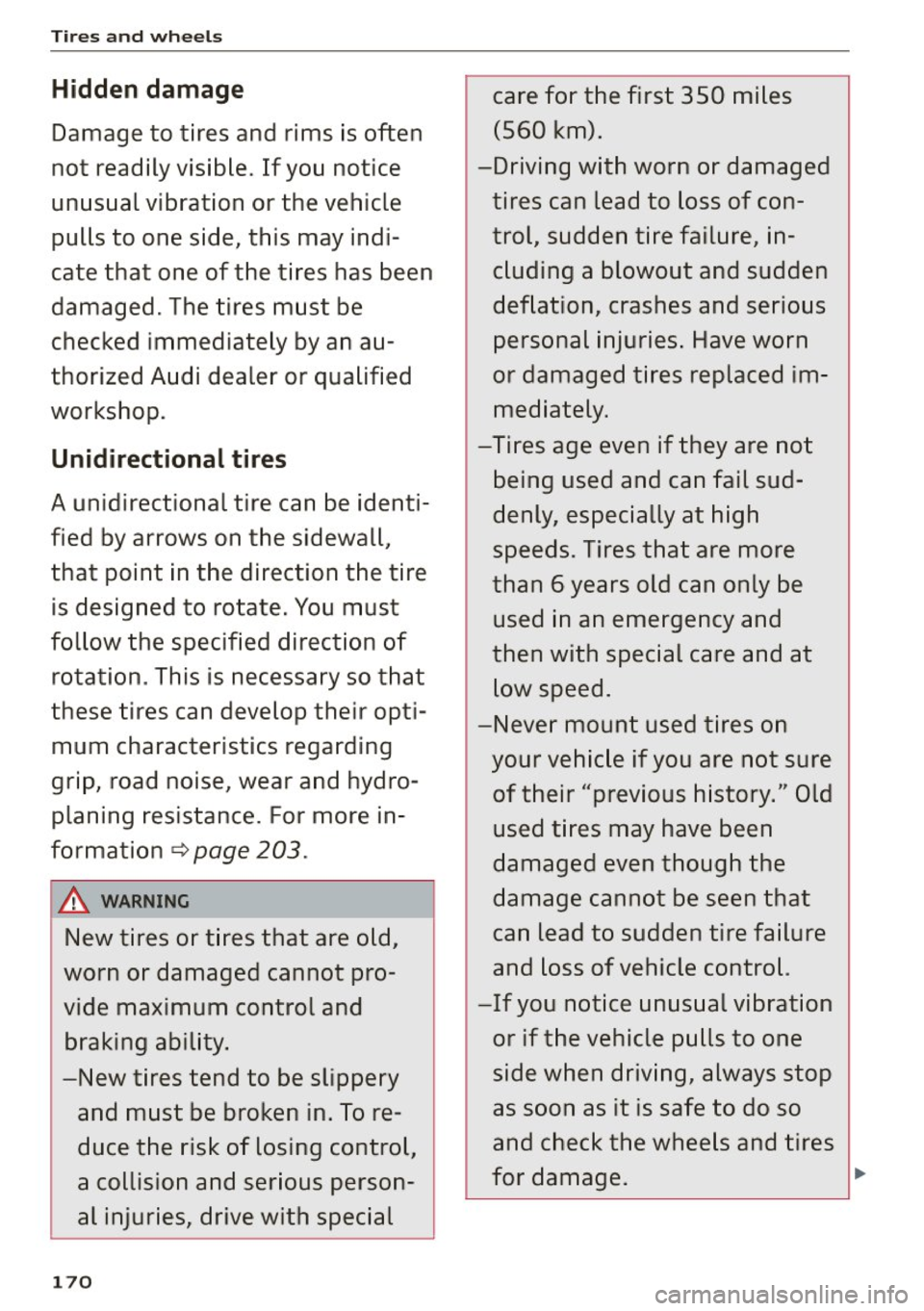
Tires and wheels
Hidden damage
Damage to tires and rims is often
not readily visible. If you notice
unusual vibration or the vehicle
pulls to one side, this may indi
cate that one of the tires has been
damaged. The tires must be
checked immediately by an au
thorized Audi dealer or qualified
workshop.
Unidirectional tires
A unidirectional tire can be identi
fied by arrows on the sidewall,
that point in the direction the tire
is designed to rotate. You must
follow the specified direction of
rotation . This is necessary so that
these tires can develop their opti
mum characteristics regarding
grip, road noise, wear and hydro
planing resistance. For more in
formation
¢ page 203 .
A WARNING ~ -
New tires or tires that are old,
worn or damaged cannot pro
vide maximum control and
braking ability.
-New tires tend to be slippery
and must be broken in. To re
duce the risk of losing control,
a collision and serious person
al injuries, drive with special
170
care for the first 350 miles (560 km).
-Driving with worn or damaged tires can lead to loss of con
trol, sudden tire failure, in
cluding a blowout and sudden
deflation, crashes and serious
personal injuries. Have worn
or damaged tires replaced im
mediately.
-Tires age even if they are not being used and can fail sud
denly, especially at high
speeds. Tires that are more
than 6 years old can only be
used in an emergency and
then with special care and at
low speed.
-Never mount used tires on your vehicle if you are not sure
of their "previous history." Old
used tires may have been
damaged even though the
damage cannot be seen that
can lead to sudden tire failure
and loss of vehicle control.
-If you notice unusual vibration
or if the vehicle pulls to one
side when driving, always stop
as soon as it is safe to do so
and check the wheels and tires
for damage.
..
Page 173 of 232
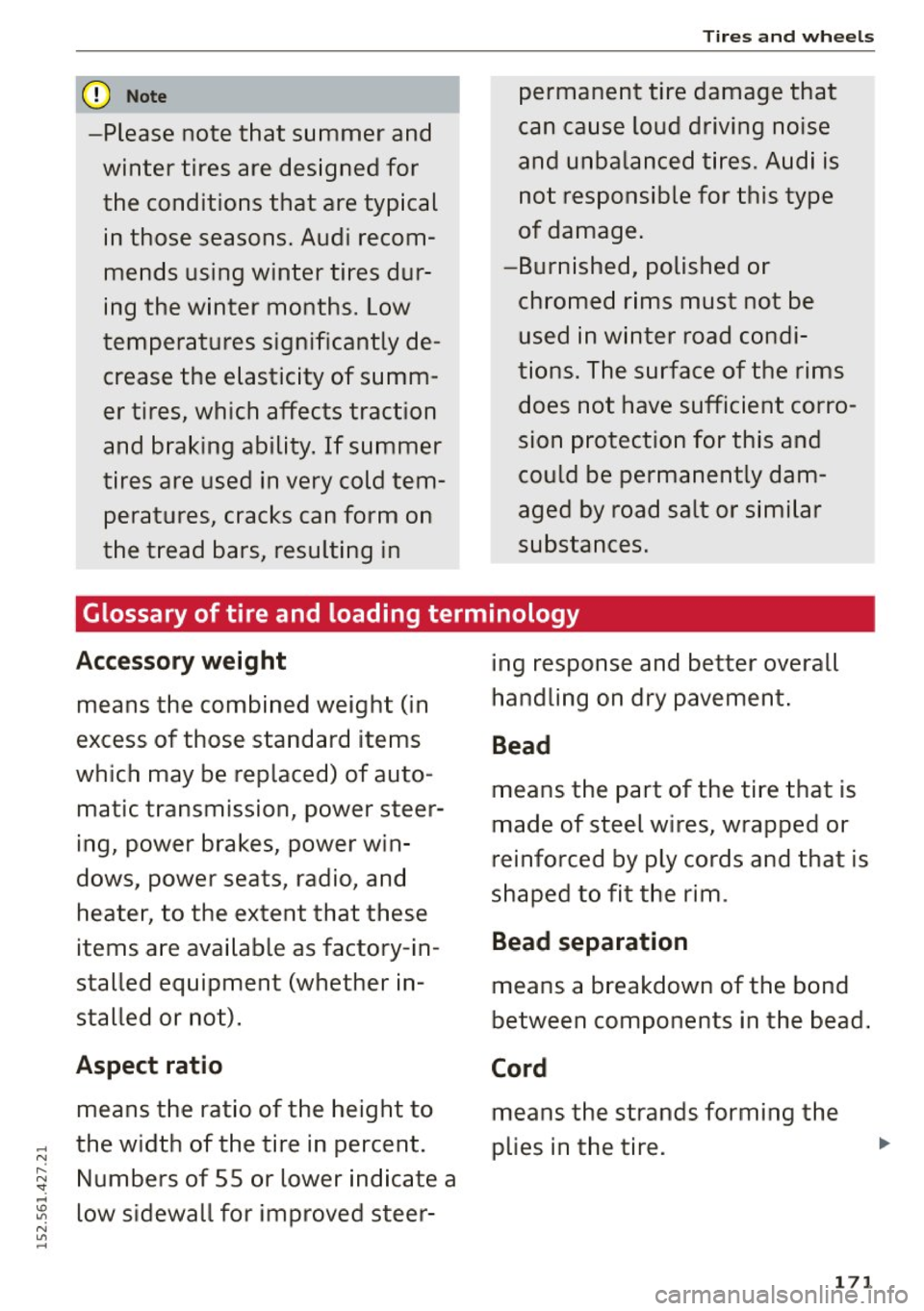
(D Note
- Please note that summer and
winter t ires are designed for
the conditions that are typical in those seasons . Audi recom
mends using winter tires dur
ing the winter months . Low
temperatures significantly de
crease the elasticity of summ
er tires, which affects traction
and braking ability. If summer
tires are used in very cold tem peratures, cracks can form on
the tread bars, resulting in
Tires and wheels
permanent tire damage that
can cause loud driving noise
and unbalanced tires . Audi is
not responsible for this type
of damage.
- Burnished, polished or
chromed rims must not be
used in winter road condi
tions . The surface of the rims
does not have sufficient corro
sion protection for this and
could be permanently dam aged by road salt or similar
substances .
Glossary of tire and loading terminology
Accessory weight
means the combined weight (in
excess of those standard items
which may be replaced) of auto
matic transmission, power steer
ing, power brakes, power win
dows , powe r seats , radio , and
heater , to the extent that these
items a re available as factory-in
stalled equipment (whether in
stalled or not).
Aspect ratio
means the ratio of the height to
;:;: the width of the tire in percent .
" ~ Numbers of 55 or lower indicate a ...
~ low sidewall for improved steer -
"' ....
ing response and better overall
handling on dry pavement.
Bead
means the part of the tire that is
made of steel wires, wrapped or
reinforced by ply cords and that is
shaped to f it the rim .
Bead separation
means a breakdown of the bond
between components in the bead .
Cord
means the strands forming the
plies in the tire.
17 1
...
Page 174 of 232
Tires and wheels
Cold tire infl ation pre ssure
means the tire pressure recom
mended by the vehicle man ufac
turer for a tire of a designated
size that has not been driven fo r
more than a couple of miles (kilo
meters) at low speeds in the three
hour period before the tire pres
sure is measured or adjusted .
Curb weight
means the weight of a motor ve
hicle with standard equipment in
cluding the maximum capacity of
fuel, oil, and coolant, air condi
tioning and additiona l weight of
optional equipment.
E x tra load tire
means a tire designed to operate
at higher loads and at higher in
flation pressures than the corre sponding standard tire. Extra load
tires my be identified as "XL",
"xl ", "EXTRA LOAD", or "RF" on
the sidewall.
Gross Axle Weight Rating ("GAWR" )
means the load-carrying capacity
of a single axle system, measured
at the tire -ground interfaces.
1 72
Gross Vehicle Weight Rating
("GVWR")
means the maximum total loaded
weight of the vehicle.
Groove
means the space between two ad
jacent tread ribs.
Load rating (code )
means the maximum load that a
tire is rated to carry for a given in
flation pressure . You may not find
this information on all tires be
cause it is not required by law .
Maximum load rating
means the load rating for a tire at
the maximum permissible infla
tion pressure for that tire .
Maximum loaded vehicle
weight
means the sum of :
(a) Curb weight
(b) Accessory weight
(c) Vehicle capacity weight, and
(d) Production options weight
Ma ximum (permissible )
inflation pressure
means the maximum cold infla
tion pressure to which a tire may be inflated. A lso called "maxi-
mum inflation pressure ." .,.
Page 176 of 232
Tires and wheels
wheel size, you will have to pur
chase new tires to match the new rim diameter .
Rim size designat ion
means rim diameter and width .
Rim width
means nominal distance between
rim flanges.
Sidewall
means that portion of a tire be
tween the tread and bead .
Speed rating (letter code )
means the speed at which a tire is
designed to be driven for extend
ed periods of time. The ratings range from 93 mph (150 km/h)
to 186 mph (298 km/h)
c::;, page 189. You may not find
this information on all tires be
cause it is not required by law.
T he speed rat ing letter code,
where applicable, is mo lded on
the tire sidewall and indicates the
maximum permissible road
speeds
c::;, .& in Winter tires on
page 194 .
Tire pressure monitoring
system
means a system that detects
when one or more of a vehicle's
1 7 4
tires are underinflated and ill umi
nates a low tire p ressure warning
telltale.
Tread
means that portion of a tire that
comes into contact with the road .
Tread separation
means pulling away of the tread
from the tire carcass .
Treadwear indicators (TWI)
means the projections within the
principal grooves designed to give
a visual indication of the degrees
of wear of the t read. See
c::;, page 185 , Tread Wear Indica
tor (TWI) for more information
on measuring tire wear.
Uniform Tire Quality Grading
is a tire information system devel
oped by the United States Nation
a l Highway Traffic Safety Adminis
tration (NHTSA) that is designed
to help buye rs make relative com
parisons among tires . The UTQG is
not a safety rating an d not a guar
antee tha t a tire will last for a
prescr ibed number of mi les or
perform in a certain way. It sim
ply gives tire buyers addit ional in
formation to combine w ith other
considerat ions, such as pr ice,
...