tire pressure AUDI R8 SPYDER 2015 Owners Manual
[x] Cancel search | Manufacturer: AUDI, Model Year: 2015, Model line: R8 SPYDER, Model: AUDI R8 SPYDER 2015Pages: 232, PDF Size: 58.36 MB
Page 5 of 232
..... N
r-N "': ..... \!) 1.1'1
N 1.1'1 .....
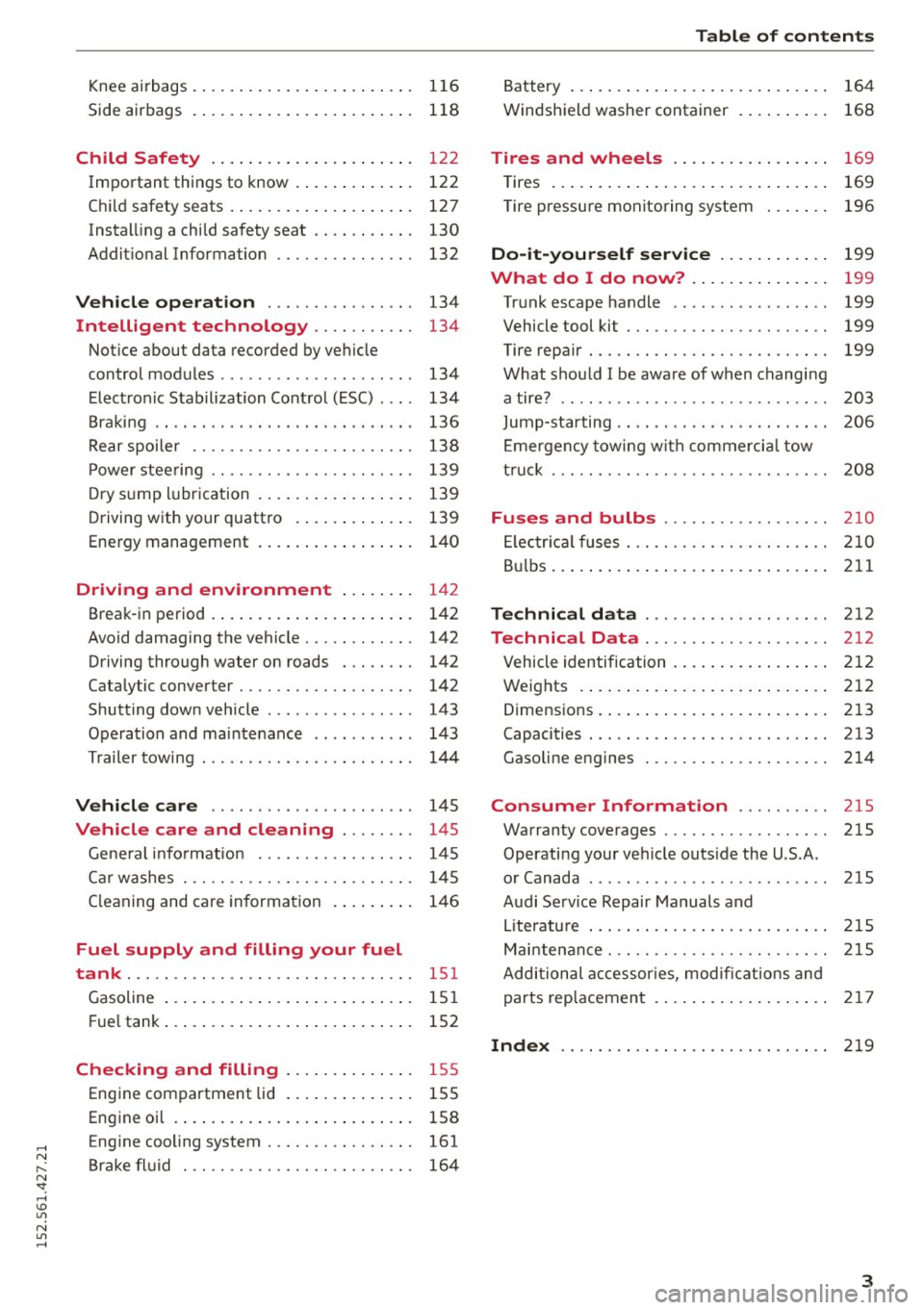
Kneeairbags .. ........... .. .. .. .. ... 116
Side airbags . . . . . . . . . . . . . . . . . . . . . . . . 118
Ch ild Safety . . . . . . . . . . . . . . . . . . . . . . 122
Important things to know . . . . . . . . . . . . . 122
C hild safety seats . . . . . . . . . . . . . . . . . . . . 127
Instal ling a chi ld safety seat . . . . . . . . . . . 130
Additional Information . . . . . . . . . . . . . . . 132
Vehicle operation . . . . . . . . . . . . . . . . 134
Intelligent technology . . . . . . . . . . . 134
Notice about data recorded by vehicle
control modules . . . . . . . . . . . . . . . . . . . . . 134
Electronic Stabilization Control (ESC) . . . . 134
Braking . . . . . . . . . . . . . . . . . . . . . . . . . . . . 136
Rear spoiler . . . . . . . . . . . . . . . . . . . . . . . . 138
Power steering . . . . . . . . . . . . . . . . . . . . . . 139
D ry s ump lubr ication . . . . . . . . . . . . . . . . . 139
Driving with your quattro . . . . . . . . . . . . . 139
Energy management . . . . . . . . . . . . . . . . . 140
Driving and environment . . . . . . . . 142
Break-in period . . . . . . . . . . . . . . . . . . . . . . 142
Avoid damaging the vehicle . . . . . . . . . . . . 142
Driving through water on roads . . . . . . . . 142
Catalytic converter . . . . . . . . . . . . . . . . . . . 142
Shutting down vehicle . . . . . . . . . . . . . . . . 143
Operation and maintenance . . . . . . . . . . . 143
Trailer towing . . . . . . . . . . . . . . . . . . . . . . . 144
Vehicle care . . . . . . . . . . . . . . . . . . . . . . 145
Vehicle c are and cleaning . . . . . . . . 145
General information . . . . . . . . . . . . . . . . . 145
Car washes . . . . . . . . . . . . . . . . . . . . . . . . . 145
Cleaning and care information . . . . . . . . . 146
Fuel supply and filling your fuel
tank ... .. .. .... ............. .. .. .. .
151
Gasoline . . . . . . . . . . . . . . . . . . . . . . . . . . . 151
Fu el tank . . . . . . . . . . . . . . . . . . . . . . . . . . . 152
Checking and filling . . . . . . . . . . . . . . 155
Engine compartment lid . . . . . . . . . . . . . . 155
Engine oil . . . . . . . . . . . . . . . . . . . . . . . . . . 158
Eng ine cooling system . . . . . . . . . . . . . . . . 161
Brake fl uid . . . . . . . . . . . . . . . . . . . . . . . . . 164
Table of contents
Battery . . . . . . . . . . . . . . . . . . . . . . . . . . . . 164
Windshield washer container . . . . . . . . . . 168
Tires and wheel s . . . . . . . . . . . . . . . . . 169
Tires . . . . . . . . . . . . . . . . . . . . . . . . . . . . . . 169
Tire pressure monitoring system . . . . . . . 196
Do-it-yourself service . . . . . . . . . . . . 199
What do I do now? . . . . . . . . . . . . . . . 199
Trunk escape handle . . . . . . . . . . . . . . . . . 199
Vehicle tool kit . . . . . . . . . . . . . . . . . . . . . . 199
Tire repair . . . . . . . . . . . . . . . . . . . . . . . . . . 199
What should I be aware of when changing
a tire? . . . . . . . . . . . . . . . . . . . . . . . . . . . . . 203
Jump-starting . . . . . . . . . . . . . . . . . . . . . . . 206
Emergency towing with commercial tow
truck . . . . . . . . . . . . . . . . . . . . . . . . . . . . . . 208
Fu ses and bulb s . . . . . . . . . . . . . . . . . . 210
El ectr ical fuses . . . . . . . . . . . . . . . . . . . . . . 210
Bulbs......... .. .. ........... .. .. .. 211
Technical data . . . . . . . . . . . . . . . . . . . . 212
Technical Data . . . . . . . . . . . . . . . . . . . . 212
Vehicle identification . . . . . . . . . . . . . . . . . 2 12
Weights . . . . . . . . . . . . . . . . . . . . . . . . . . . 212
Dimensions......................... 213
Capacities . . . . . . . . . . . . . . . . . . . . . . . . . . 213
Gasoline engines . . . . . . . . . . . . . . . . . . . . 214
Consumer Information . . . . . . . . . . 215
Warranty coverages . . . . . . . . . . . . . . . . . . 21S
Operating your vehicle outside the U.S.A .
o r Canada . . . . . . . . . . . . . . . . . . . . . . . . . . 21S
Audi Servi ce Repair Manuals and
Literature . . . . . . . . . . . . . . . . . . . . . . . . . . 215
Maintenance. .. .. ... .......... .. .. .. 215
Additional accessor ies, modifications and
parts replacement 217
Index . . . . . . . . . . . . . . . . . . . . . . . . . . . . . 219
3
Page 13 of 232
..... N
r-N "': ..... \!) 1.1'1
N 1.1'1 .....
Instruments and warning/indicator lights
field. The vehicle cannot be operated
c:;, page28.
Voltmeter display
The vo ltmeter shows the voltage in the vehicle
electrical system. If the reading drops below 12
volts w ith the engine running, you should have
the power supply (battery and generator) in
spected by an authorized Aud i dealer .
(D Tips
Voltage can drop below 8 volts when you start
the engine.
Warning/indicator lights
Descript ion
The indicator lights in the instrument cluster
blink or turn on. They indicate functions or mal
functions
c:;, ,&. .
Messages may appear with some indicator lights.
The messages turn
off after a short time. To dis
play a message aga in, press the Set/Check but
ton
c:;, page 8, fig. 3 (J) . If there is more than one
malfunction, the indicator lights will turn on one
after the other for approximately two seconds
each .
Some indicators lights in the display can turn on
in several colors.
A WARNING
- Failure to heed warning lights and other im
portant vehicle information may result in
serious persona l injury or vehicle damage.
- Whenever stalled or stopped for repa ir,
move the vehicle a safe distance off the
road, stop the engine, and turn on the emer
gency flasher
c:;, page 48.
-The engine compartment of any motor vehi
cle is a potentially hazardous area. Before
you check anything in the engine compart
ment, stop the engine and let it cool down.
Always exercise extreme caution when work
ing under the hood
c:> page 155, Working in
the engine compartment
Overview
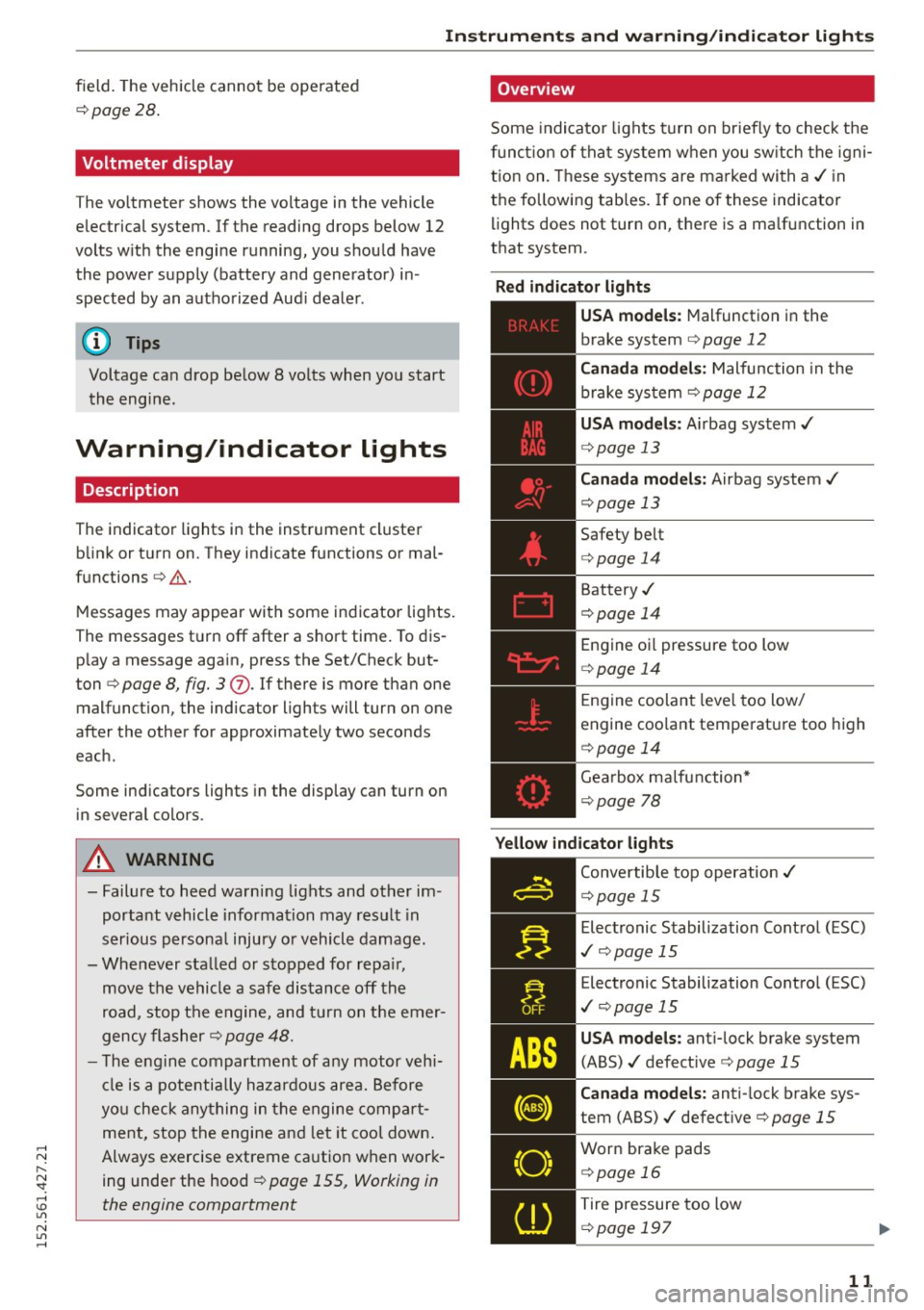
Some indicator lights turn on briefly to check the
function of that system when you sw itch the igni
tion on. These systems are marked with a,/ in
the following tables. If one of these indicator
lights does not turn on, there is a ma lfunction in
that system.
Red indicator lights
---------------
US A models: Malfunction in the
brake system
c:;, page 12
Canada models: Malfunction in the
brake system
¢ page 12
USA models : Airbag system,/
c:> page 13
Canada models: Airbag system,/
c:>page 13
Safety belt
c:>page 14
Battery,/
c:>page 14
Engine oi l pressure too low
c:> page 14
Engine coolant leve l too low/
engine coo lant temperature too high
c:>page 14
Gearbox malfunction*
c:>page 78
Yellow indicator lights
Convertible top operation ,/
c:>page 15
Electronic Stabilization Control (ESC)
,I c:;,page 15
Electronic Stabilization Control (ESC)
,I c:;, page 15
USA models: ant i-lock brake system
(ABS) ,/ defect ive
c:;, page 15
Canada models: anti-lock brake sys
tem (ABS),/ defective
c:;, page 15
Worn brake pads
c:> page 16
Tire pressure too low
c:>page 197
11
Page 20 of 232
Instruments and warning/indicator lights
A WARNING
- Light bulbs are pressurized and cou ld ex
plode while they are being changed causing
serious persona l injury.
-
- Work with due care when handling the high
vo ltage section of gas discharge (xenon)
lamps. Fa iling to do so could result in death
or serious injury!
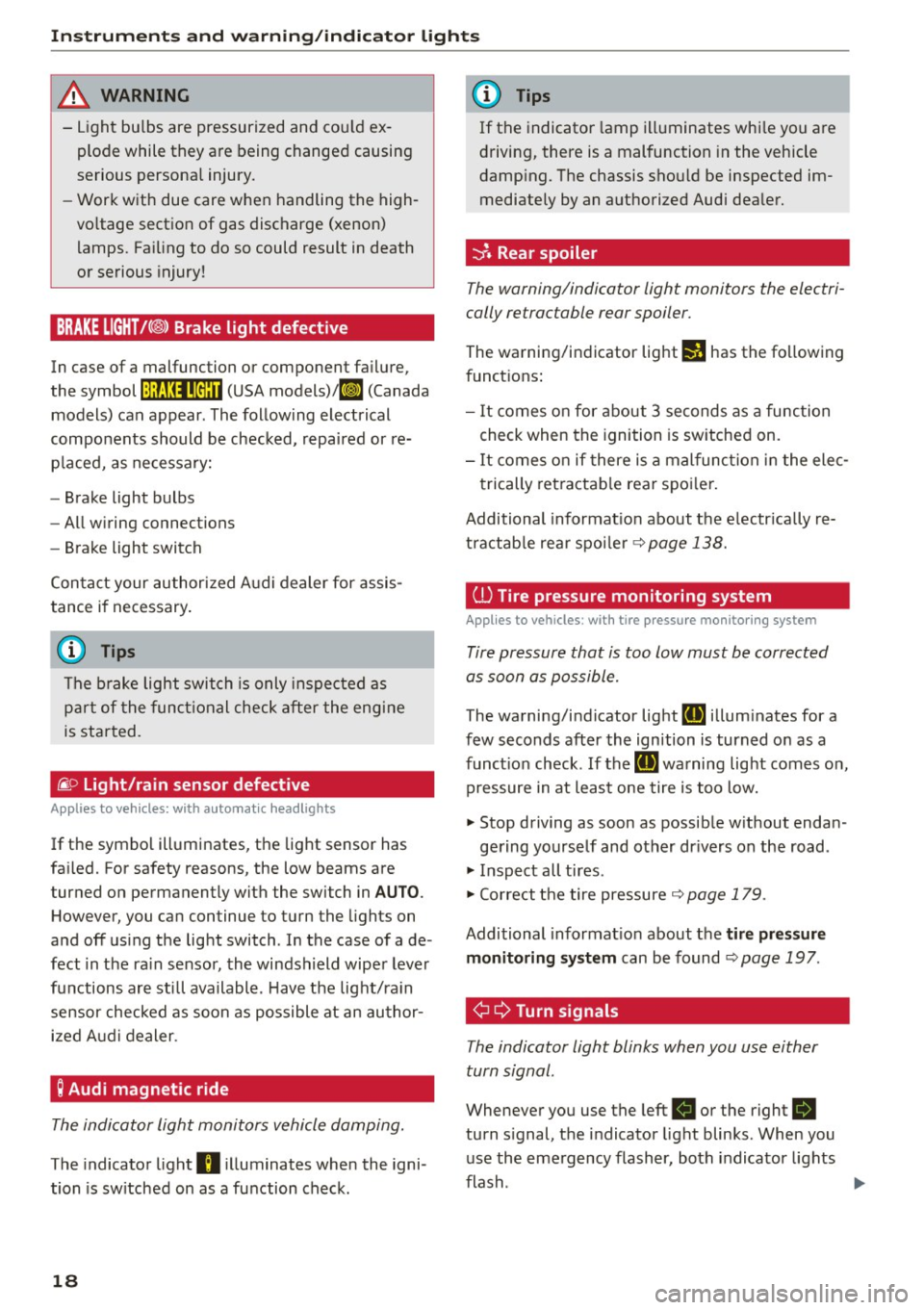
BRAKE LIGHT!< ®> Brake light defective
In case of a malfunction or component failure,
the symbol
!:ljf:Ul•@:U (USA models)/ ll] (Canada
models) can appear. The following electrical
components should be checked, repaired or re
p laced, as necessary:
- Brake light bulbs
- All wiring connections
- Brake light switch
Con tact your authorized Audi dealer for assis
tance if necessary.
(D Tips
The brake light switch is only inspected as
part of the functional check after the engine
is started.
/i. O
Light/rain sensor defective
Applies to veh icles: w ith automatic headlights
If the symbol illuminates, the light sensor has
fai led. For safety reasons, the low beams are
turned on permanently with the switch in
AUTO.
However, you ca n continue to turn the lights on
and off using the light switch . In the case of a de
fect in the ra in sensor, the windshield wiper lever
functions are still available . Have the light/ra in
sensor checked as soon as possible at an author ized Audi dealer.
; Audi magnetic ride
The indicator light monitors vehicle damping.
The indicator light B illuminates when the igni
tion is sw itched on as a function check.
18
(D Tips
If the indicator lamp illuminates whi le you are
driving, there is a malfunction in the vehicle
damping. The chassis should be inspected im
mediately by an authorized Audi dealer.
-::}. Rear spoiler
The warning/indicator light monitors the electri
cally retractable rear spoiler.
The warning/indicator light I! has the fo llowing
funct ions :
- It comes on for about 3 seconds as a function
check when the ignition is switched on.
- It comes on if there is a malfunction in the elec
trically retractable rear spoiler.
Additional informat ion about the e lectr ically re
tractable rear spoiler
~ page 138.
ill Tire pressure monitoring system
Applies to vehicles: with tire pressure monitoring system
Tire pressure that is too low must be corrected
as soon as possible.
The warning/indicator light [IJ illum inates for a
few seconds after the ignition is turned on as a
function check. If the
[IJ warning light comes on,
pressure in at least one tire is too low.
.. Stop driving as soon as possible w ithout endan -
gering yourself and other dr ivers on the road .
.. Inspect all tires .
.. Correct the tire pressure ~
page 179.
Additional informat ion about the tire pr essure
monitoring system
can be found~ page 197 .
¢ Q Turn signals
The indicator light blinks when you use either
turn signal .
Whenever you use the left B or the right R
turn signal, the indicator light blinks. When you
use the emergency flasher, both indicator lights
flash .
Iii>
Page 25 of 232
.... N
l'
N "1: rl I.O
"' N
"' ....
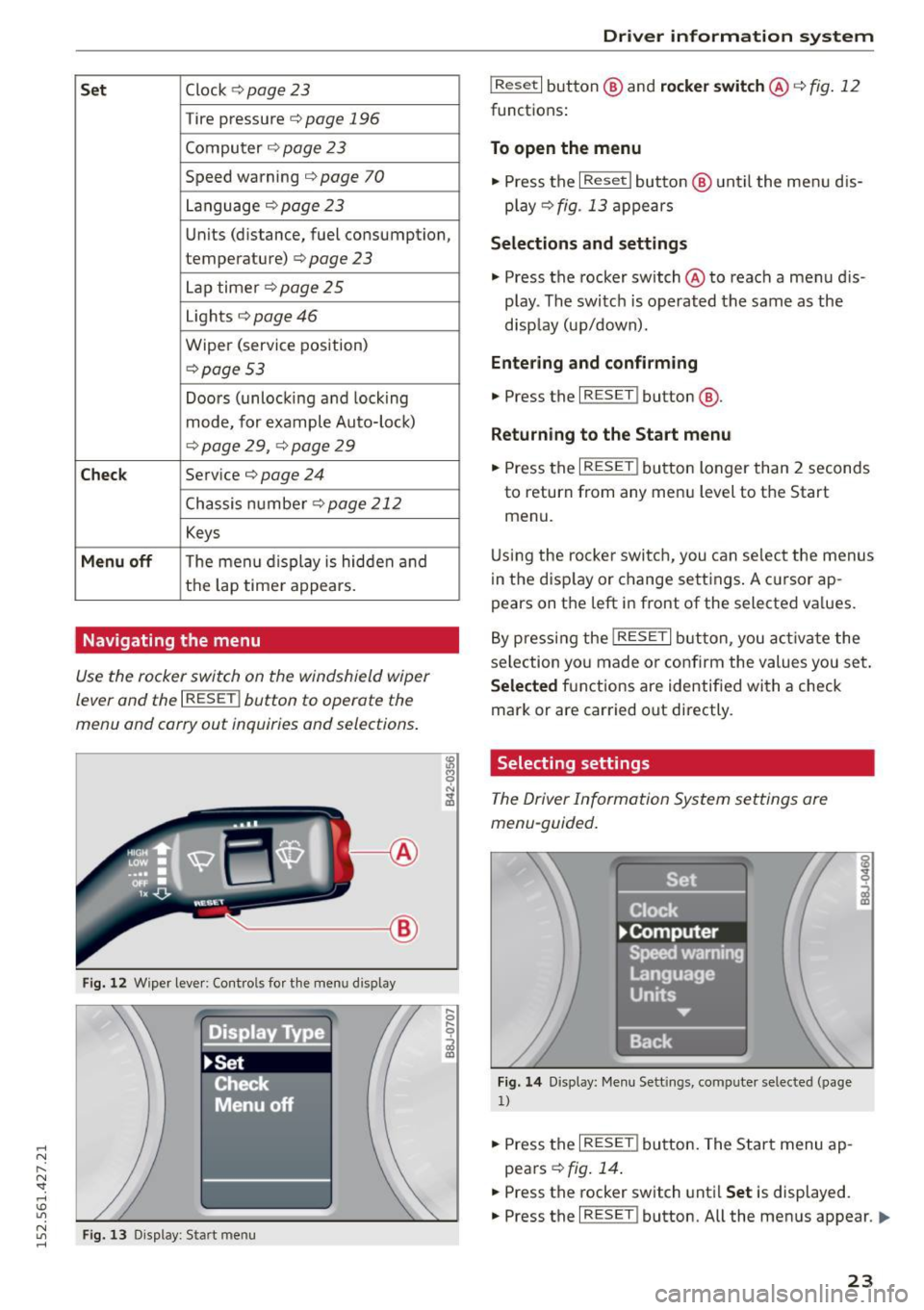
Set Clock ¢ page 23
Tire pressure c::> page 196
Computer c::> page 2 3
Speed warning c::> page 70
Language c::>page23
Units (distance, fuel consumption,
temperature)
c::> page 23
Lap timer c::> page 25
Lights c::> page 46
Wiper (service position)
c::>page 53
Doors (unlocking and locking
mode, for example Auto-loc k)
c::> page 29, ¢ page 29
Chec k Service c::> page 24
Chassis number c::>page 212
Keys
Menu off The menu display is hidden and
the lap time r appears.
Navigating the menu
Use the rocker switch on the windshield wiper
lever and the
I RESET ! button to operate the
menu and carry out inquiries and selections.
-----®
Fig. 12 Wiper lever: Cont rols fo r th e menu d isplay
Fi g. 13 Display: Start menu
Dr iver inform atio n sy stem
I Reset I button @ and rocker switch @ c::> fig. 12
functions:
To open the menu
• Press the I Reset I button @ until the menu d is
play
c::> fig . 13 appears
Selection s and settings
• Press the rocker switch @ to reach a menu dis
play . The switc h is operated the same as the
disp lay (up/down).
Entering and confirming
• Press the I RESET ! button@.
Returning to the Start menu
.. Press the I RESET ! button longer than 2 seconds
to return from any menu level to the Start
menu.
U sing the rocke r switch, you can select the menus
in the disp lay or change settings . A c ursor ap
pears on the left in front of the selected va lues.
By pressing the
! RESET I button, you activa te the
selection yo u made or confirm the values you set .
Selected fu nctions are identified with a check
mark or are car ried out directly.
Selecting settings
The Driver Information System settings are
menu-guided.
Fi g. 14 Display: Me nu Sett ings, computer selected (page
1)
.. Press the I RESET ! button. The Start menu ap
pears
c::> fig . 14 .
.. Press the rocker switch until Set is displayed.
.. Press the
I RESET ! button. All the menus appear. Ill-
23
Page 43 of 232
..... N
r-N "': ..... \!) ..,.,
N ..,., .....
This is called the wind deflector position
¢ fig . 38 .
The rear w indow can be extended comp lete ly for
cleaning. This is ca lled the cleaning posit io n.
Extend ing the rear window into the w ind
deflector position
~ Pull and hold the rear window switch ¢ fig. 39.
~ Re lease the switch once the rear window has
reached the wind deflector position.
Extending the rear window into the cleaning
posit ion
~ P ull and hold t he rear window switch ~ fig. 39.
~ Release the switch once the rear window has
reached the wind deflector position.
~ Pull and hold the rear window switch again .
~ Pull and hold the convertible top switch within
one second
¢page 38, fig. 35.
Retracting th e rear w indow
~ Press and ho ld the rear window switch until the
window has been retracted .
Retracting the rear w indow using the one
touch fun ction
~ Press the rear window switch briefly . There is
no need to hold the switch.
The rear w indow can on ly be operated when the
ignition is switched on.
The rear w indow can also be extended or retract
ed when the convertible top is closed .
A WARNING
-Do not use the rear window to secure cargo
or othe r ob jects. This co uld res ult in inj ury .
- Always pay attention and be ca reful when
extend ing o r ret racting the rea r window.
It
cou ld cause injury by pinching.
(D Tips
- Keepi ng a ll of the w indows raised provides
the best wi nd p rotection .
- The v ehicle must be stat ionary to bring the
r ear w indow into the cleaning position. The
rear w indow w ill retract on ce you beg in driv
i ng.
Con vertible top
Convertible top
emergency operation
General information
The convertible top can be closed by hand if
there is a malfunction.
First check if overload protection is active
~ page 39. I f this is the case, the conve rtible top
will operate again after a short delay. Otherwise
the following s teps mus t be comp leted befo re
closing the convertible top :
~ Activate the parking brake.
~ Open the side windows , if necessa ry.
~ Remove the key from the igni tion .
~ Pull or p ress the convertib le top switch
¢
page 38, fig . 35 for approximate ly 10 sec
onds.
Emergency locking is not intended for long -term
u se or long dr ives. The convertib le top wi ll not be
complete ly waterproof afte r using the emergency
l ocking procedure because the seals wi ll not be
seated correctly. Only close the convertible top
manua lly in an emergency . P lease see an autho r
ized Audi R8 dealer to have the cause of the mal
funct ion corrected.
A WARNING
- The ignition must be sw itched off d uring the
entire clos ing pro cedure.
- When pos itioning the convertib le top, avoid
contact w ith the s upports o r other moving
pa rts. Otherwise you cou ld pinch your
hands .
- I f conve rtible top operation fails whe n
open ing or closing the top, do not hold o r
touch the supports or other moving pa rts
when releasing the pressure. The converti
b le top will sink down and co uld p inch your
hands.
- Never d rive when the convert ible top is not
locked correctly. The wind from dr iving
could cause the convertible top to open.
This can result in injuries and damage to the
veh icle. .,,.
41
Page 94 of 232
Driving Sa fel y
could crawl into the l uggage compartment
and close the front lid becoming trapped and unable to get out. Being trapped in ave
hicle can lead to ser ious personal injury.
- Never let children p lay in or around the vehi
cle.
- Never let passengers ride in the luggage compartment. Veh icle occupants must al
ways be proper ly restrained in one of the
ve
hicle's seat ing positions .
@ Tips
The tire pressure must correspond to the
load . The tire pressure is shown on the tire
pressure labe l. The t ire pressure label is locat
ed on the d river's s ide B-pillar . The t ire p res
sure label lists the recommended cold ti re in
flation pressures for t he ve hicle at its ma xi
m um c apaci ty weigh t and the tires t hat were
on yo ur vehicle at the time it w as m anuf ac
tured . For recommende d tire pressures for
normal load conditions, please see chapter
¢ page 176.
Reporting Safety Defects
Applicable to U.S.A.
If you belie ve that your vehicle
ha s a defect which could cause a
crash or could cau se injury or
death, you should immediatel y in
form the National Highwa y Tr affic
Safet y Admini stration (NHTSA) in
addition to notif ying Audi of
America, Inc.
If NHTSA re ceiv e s similar com
plaint s, it ma y op en an in vestiga
tion , and if it finds that a safe ty
def ects exis ts i n a group of
vehicle s, it may order a re call and
reme dy campaign. However,
92
NHTSA cannot b ecome in vol ve d in
indi vidual p roblems bet ween you,
y o ur deal er, or Audi of Am eric a,
In c.
To contact NHTSA, you may c all
the Vehicle Safety Hotline toll
free at:
Tel.: 1-888-327-4236 (TTY :
1-800-424-915 3) or
1-800-424-9393
o r you m ay wri te to :
Admini strator
NHTSA 1200 New Jersey A venue, SE
Wa shington, D.C. 20590
You can also obtain other infor
mation about m otor vehi cle safe
t y fr om :
http: //w ww.safercar.gov
Applicable to Canada
If you live in Canada and you be
lie ve that your vehicle has a de
fect that could cause a crash , in
j ur y or death, you should immedi
atel y inform Transport Canada,
Defect In vestigations and Recall s.
You should also notify Au di C an a
da, Inc.
Can adian cu stomer s who wi sh to
r e po rt a s afet y-related defe ct to ..,.
Page 137 of 232
.... N
l'
N "1: .... I.O
"' N
"' ....
Anti-loc k br aking sy stem (ABS )
ABS prevents the wheels from locking up when
brak ing . T he vehicle can st ill be stee red even dur
ing hard braking. App ly steady pressure to the
brake peda l. Do not pump the peda l. A pulsing in
the brake pedal indicates that the system is help
ing you to brake the vehicle.
Brake assist sy ste m
The brake assist system can decrease braking dis
tance. It increases braking power when the dr iver
presses the brake pedal quick ly in emergency sit
uations. You must press and ho ld the brake pedal
until the situation is over.
Anti -slip regulation (ASR )
ASR reduces engine power when the drive whee ls
begin to spin and adapts the force to the road
conditions. This makes it easier to start, acceler
ate and dr ive up h ills.
Electronic diff erential lock (EDL )
The EDL brakes wheels that are spinning and
transfers the drive power to the other drive wheel or wheels if the vehicle is equipped w ith all-whee l
drive*. This function is available up to about 60
mph (100 km/h) .
I n extreme cases , EDL automatically switches off
to help keep the brake on the braked wheel from
overheating . EDL wi ll switch on again automati
cally when conditions have returned to normal.
A WARNING
- ESC, ABS, ASR and EDL cannot overcome the
laws of phys ics. Th is is especially important
on slippery or wet roads. If the syst ems be
gin act ing to stab ilize your vehicle, you
sho uld immediately cha nge your speed to
match the roa d and traffic con ditions. Do
not let the increased safety provided by
these systems tempt you to take risks . Do
ing so wi ll increase the risk of a loss of vehi
cle contro l, collis ion and serio us personal in
juries .
- Always adapt your speed to road, traffic and
weather cond it ions. The risk of losing con
tro l of the veh icle increases when driving
Int ellig ent t echnolo gy
too fast, especially through curves and on
slippery or wet roads, and when dr iving too
close to vehicles up ahead. ESC, ABS, the
brake assist system, EDL and ASR cannot
prevent coll is ions .
- Always accelerate with special care on even,
smooth surfaces such as those that are wet
or covered with ice and snow. The drive
wheels can spin even with these assistance sys tems that cannot always help to reduce
the risk of loss of veh icle control.
(D Tips
- ABS and ASR only wo rk correctly when all
four wheels are eq uipped with ident ical
tire s. Different tire s izes can lead to a reduc
t ion i n engine power.
- Yo u may hear noises when the systems de
sc ribed a re wo rking.
- If the ind icator light GJ or II (USA mod
els) ;tiJ (Canada models) appea rs, there
may be a malfunction~
page 15,
~ page 15.
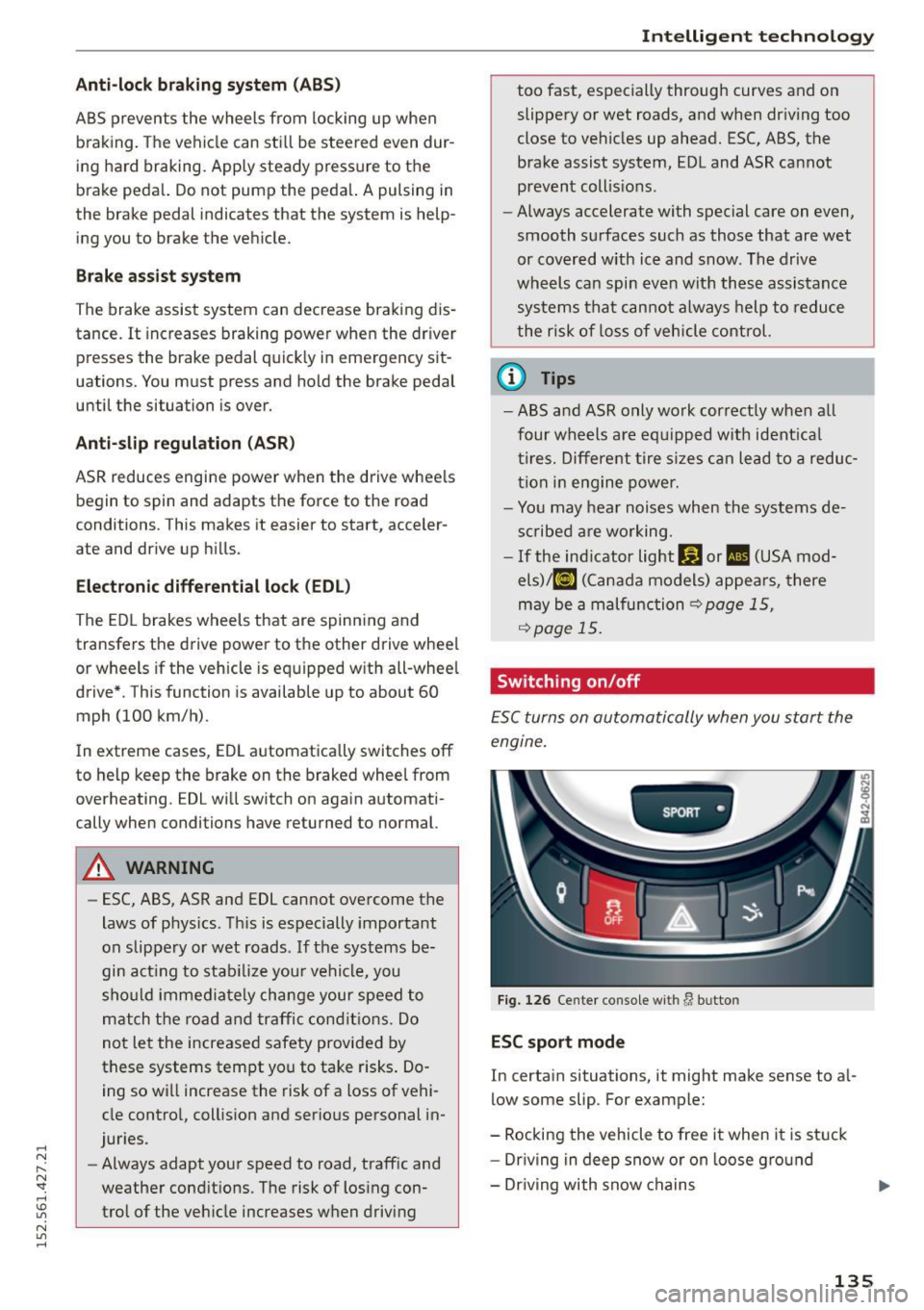
Switching on/off
ESC turns on automatically when you start the
engine.
SPORT •
Fig . 12 6 Cente r co nsole wit h lJ bu tto n
ESC sport mode
In certain situations, it might make sense to a l
low some slip. For example:
- Rocking the vehicle to free it when it is st uck
- Driving in deep snow or on loose gro und
- Dr iving with snow chains
135
Page 141 of 232
..... N
r-N "': ..... \!) ..,.,
N ..,., .....
Power steering
When the engine is running, power steering
makes i t easier for the driver to steer.
Power steering helps the driver steer the vehicle
with litt le physical effort.
If the engine is not running, the power steering
system is also not working. In this case, you will
find it extremely difficult to turn the steering
wheel.
If you turn the steering fully to the left or right
when the vehicle is stationary, you place a very
heavy load on the power steering system. Turning
the steering wheel fully to the left or right wi ll
cause noise in the system . It also reduces engine
idle speed.
(D Note
Do not hold the steering turned fully to the
left or right for more than 10 seconds when
the engine is running. There is a risk of dam
age to the power steering system.
@ Tips
- In the event of a power steering system fail
ure, or if the engine is not running (while
being towed), you will still be able to steer
the vehicle. However, you will require more
effort to do so.
- If the power steering system has a leak or is
defective, you should immediately contact a
qualified workshop .
- The power steering system requires a spe
cial hydraul ic fluid . The power steering fluid
reservoir is located in the engine compart
ment. The correct hydraulic fluid level is im
portant for proper operation of the power
steering system. The power steering fluid
l evel is checked according to the Audi main
tenance service schedule.
Dry sump lubrication
High lateral and longitudinal forces affect the en
gine and the vehicle during sporty driving. Dry
sump lubrication ensures that your engine is sup-
Intelligent technology
plied with oil and properly lubricated even under
these conditions.
In a "norma l" vehicle the oil pump sends the oil
from the oil pan to the lubrication points in the
engine . The oil then returns to the oil pan. In ex
treme situations, the oil pump may draw in air,
wh ich results in insufficient oi l pressure .
With dry sump lubrica tion, the oil is not in the oil
pan (it is "dry"), but in a separate oi l tank. While
one pump supplies the engine with oil, a second
pump suct ions the oil out of the engine and re
turns it to the o il tank. Because the oil tank is tall
and narrow, oil pressure is constant even under
extreme conditions .
In add ition, the oi l pan in vehicles with dry sump
lubrication is noticeably shallower . This allows
the engine to be installed lower in the vehicle,
bringing down the center of gravity . This im
proves your vehicle's handling.
Driving with your quattro
With oil-wheel drive, all four wheels are driven .
General information
With all-wheel drive, power is distributed to all
four wheels . This happens automatically depend
ing on your driving style and the road conditions
at the time . See also
c:::.> page 134.
The all-whee l drive concept is designed for high
engine power . Your vehicle is exceptionally pow
erful and has excellent driving characterist ics
both under normal driving conditions and on
snow and ice. Always read and fo llow safety pre
cautions
c:::.> .&_ .
Winter tires
When driving in the winter, your vehicle with all
wheel drive has an advantage, even with regular
t ir es . In winter road condit ions it may be advisa
ble to mount winter tires (or all-season t ires) for
improved driveability and brak ing: these tires
must be mounted on
all four wheels. See also
c:::.> page 193 , Winter tires.
139
Page 147 of 232
.....
Vehicle care and cleaning General information
Regular, proper care helps to maintain your vehi
cle's value.
It can a lso be a req uirement when
submitting warranty claims for corrosion damage
and paint defects on the body.
The required cleaning and care products can be
obtained from your authorized Audi dea ler or a
qualified workshop. Read and follow the instruc
tions for use on the packaging.
A WARNING
-Us ing clean ing and care products incorrectly
can be dangerous to your health.
- Always store cleaning and care products out
of reach of children to reduce the r isk of poi
soning.
@ For the sake of the environment
- Preferably use environmentally-friendly products when buying cleaning agents.
- Do not dispose of leftover cleaning and care
products with household trash.
Car washes
The longer deposits remain on the vehicle, the
more the surface can be damaged. High tempera
tures such as those caused by sunlight increase
the damaging effect .
Before washing, wet heavy deposits with plenty
of water.
Stubborn depos its such as bird droppings or tree
sap are best removed with plenty of water and a
microfiber cloth .
A lso, was h the underside of your vehicle once
road salt stops being used for the season.
Pressure washers
When washing your veh icles w ith a pressure
washer, always follow the operating instructions
"' provided with the pressure washer. This is espe-
r--
~ cially important in regard to the pressure and
; spraying distance . Do not aim the spray directly
~ at seals on side windows, doors, the engine com -,.... Vehicle care and cleaning
partment lid, the front lid
or the convertible top
or at tires, rubber hoses, insulating material
orsensors* or camera lenses *. Keep a distance of
at least 16 inches (40 cm).
Do not remove snow and ice with a pressure
washer .
Never use rotary nozzles or high pressure noz
zles.
The water temperature must not be above 140 °F
(60 °().
Automatic car washes
Spray off the veh icle before washing.
Make sure that the windows are closed and the
windshield wipers are off. Follow instructions
from the car wash operator, especially if there are
accessor ies attached to your vehicle .
If possible, use car washes that do not have
brushes .
Only use car washes where the vehicle remains
stationary and the washing equipment moves
around t he vehic le when washing and drying. Car
washes that move the vehicle through the car
wash using a chain are not recommended.
Washing by hand
Clean the vehicle starting from the top and work
ing down using a soft sponge or cleaning brush.
Use solvent-free cleaning prod ucts .
Washing vehicles with matte finish paint by
hand
To avoid damaging the paint when washing, first
remove dust and large particles from your vehi
cle. Insects, grease spots and fingerprints are
best removed with a spec ia l cleaner for matte
finish paint.
Apply the prod uct using a microfiber cloth . To
avo id damaging the paint surface, do not use too
much pressure.
Rinse the vehicle thoroughly with water. Then
c lean using a neutral shampoo and a soft micro
fiber cloth.
Rinse the vehi cle thoroughly again and let it air
dry. Remove any water residue using a sham my . .,.
145
Page 174 of 232
Tires and wheels
Cold tire infl ation pre ssure
means the tire pressure recom
mended by the vehicle man ufac
turer for a tire of a designated
size that has not been driven fo r
more than a couple of miles (kilo
meters) at low speeds in the three
hour period before the tire pres
sure is measured or adjusted .
Curb weight
means the weight of a motor ve
hicle with standard equipment in
cluding the maximum capacity of
fuel, oil, and coolant, air condi
tioning and additiona l weight of
optional equipment.
E x tra load tire
means a tire designed to operate
at higher loads and at higher in
flation pressures than the corre sponding standard tire. Extra load
tires my be identified as "XL",
"xl ", "EXTRA LOAD", or "RF" on
the sidewall.
Gross Axle Weight Rating ("GAWR" )
means the load-carrying capacity
of a single axle system, measured
at the tire -ground interfaces.
1 72
Gross Vehicle Weight Rating
("GVWR")
means the maximum total loaded
weight of the vehicle.
Groove
means the space between two ad
jacent tread ribs.
Load rating (code )
means the maximum load that a
tire is rated to carry for a given in
flation pressure . You may not find
this information on all tires be
cause it is not required by law .
Maximum load rating
means the load rating for a tire at
the maximum permissible infla
tion pressure for that tire .
Maximum loaded vehicle
weight
means the sum of :
(a) Curb weight
(b) Accessory weight
(c) Vehicle capacity weight, and
(d) Production options weight
Ma ximum (permissible )
inflation pressure
means the maximum cold infla
tion pressure to which a tire may be inflated. A lso called "maxi-
mum inflation pressure ." .,.