tires AUDI R8 SPYDER 2015 Owners Manual
[x] Cancel search | Manufacturer: AUDI, Model Year: 2015, Model line: R8 SPYDER, Model: AUDI R8 SPYDER 2015Pages: 232, PDF Size: 58.36 MB
Page 5 of 232
..... N
r-N "': ..... \!) 1.1'1
N 1.1'1 .....
Kneeairbags .. ........... .. .. .. .. ... 116
Side airbags . . . . . . . . . . . . . . . . . . . . . . . . 118
Ch ild Safety . . . . . . . . . . . . . . . . . . . . . . 122
Important things to know . . . . . . . . . . . . . 122
C hild safety seats . . . . . . . . . . . . . . . . . . . . 127
Instal ling a chi ld safety seat . . . . . . . . . . . 130
Additional Information . . . . . . . . . . . . . . . 132
Vehicle operation . . . . . . . . . . . . . . . . 134
Intelligent technology . . . . . . . . . . . 134
Notice about data recorded by vehicle
control modules . . . . . . . . . . . . . . . . . . . . . 134
Electronic Stabilization Control (ESC) . . . . 134
Braking . . . . . . . . . . . . . . . . . . . . . . . . . . . . 136
Rear spoiler . . . . . . . . . . . . . . . . . . . . . . . . 138
Power steering . . . . . . . . . . . . . . . . . . . . . . 139
D ry s ump lubr ication . . . . . . . . . . . . . . . . . 139
Driving with your quattro . . . . . . . . . . . . . 139
Energy management . . . . . . . . . . . . . . . . . 140
Driving and environment . . . . . . . . 142
Break-in period . . . . . . . . . . . . . . . . . . . . . . 142
Avoid damaging the vehicle . . . . . . . . . . . . 142
Driving through water on roads . . . . . . . . 142
Catalytic converter . . . . . . . . . . . . . . . . . . . 142
Shutting down vehicle . . . . . . . . . . . . . . . . 143
Operation and maintenance . . . . . . . . . . . 143
Trailer towing . . . . . . . . . . . . . . . . . . . . . . . 144
Vehicle care . . . . . . . . . . . . . . . . . . . . . . 145
Vehicle c are and cleaning . . . . . . . . 145
General information . . . . . . . . . . . . . . . . . 145
Car washes . . . . . . . . . . . . . . . . . . . . . . . . . 145
Cleaning and care information . . . . . . . . . 146
Fuel supply and filling your fuel
tank ... .. .. .... ............. .. .. .. .
151
Gasoline . . . . . . . . . . . . . . . . . . . . . . . . . . . 151
Fu el tank . . . . . . . . . . . . . . . . . . . . . . . . . . . 152
Checking and filling . . . . . . . . . . . . . . 155
Engine compartment lid . . . . . . . . . . . . . . 155
Engine oil . . . . . . . . . . . . . . . . . . . . . . . . . . 158
Eng ine cooling system . . . . . . . . . . . . . . . . 161
Brake fl uid . . . . . . . . . . . . . . . . . . . . . . . . . 164
Table of contents
Battery . . . . . . . . . . . . . . . . . . . . . . . . . . . . 164
Windshield washer container . . . . . . . . . . 168
Tires and wheel s . . . . . . . . . . . . . . . . . 169
Tires . . . . . . . . . . . . . . . . . . . . . . . . . . . . . . 169
Tire pressure monitoring system . . . . . . . 196
Do-it-yourself service . . . . . . . . . . . . 199
What do I do now? . . . . . . . . . . . . . . . 199
Trunk escape handle . . . . . . . . . . . . . . . . . 199
Vehicle tool kit . . . . . . . . . . . . . . . . . . . . . . 199
Tire repair . . . . . . . . . . . . . . . . . . . . . . . . . . 199
What should I be aware of when changing
a tire? . . . . . . . . . . . . . . . . . . . . . . . . . . . . . 203
Jump-starting . . . . . . . . . . . . . . . . . . . . . . . 206
Emergency towing with commercial tow
truck . . . . . . . . . . . . . . . . . . . . . . . . . . . . . . 208
Fu ses and bulb s . . . . . . . . . . . . . . . . . . 210
El ectr ical fuses . . . . . . . . . . . . . . . . . . . . . . 210
Bulbs......... .. .. ........... .. .. .. 211
Technical data . . . . . . . . . . . . . . . . . . . . 212
Technical Data . . . . . . . . . . . . . . . . . . . . 212
Vehicle identification . . . . . . . . . . . . . . . . . 2 12
Weights . . . . . . . . . . . . . . . . . . . . . . . . . . . 212
Dimensions......................... 213
Capacities . . . . . . . . . . . . . . . . . . . . . . . . . . 213
Gasoline engines . . . . . . . . . . . . . . . . . . . . 214
Consumer Information . . . . . . . . . . 215
Warranty coverages . . . . . . . . . . . . . . . . . . 21S
Operating your vehicle outside the U.S.A .
o r Canada . . . . . . . . . . . . . . . . . . . . . . . . . . 21S
Audi Servi ce Repair Manuals and
Literature . . . . . . . . . . . . . . . . . . . . . . . . . . 215
Maintenance. .. .. ... .......... .. .. .. 215
Additional accessor ies, modifications and
parts replacement 217
Index . . . . . . . . . . . . . . . . . . . . . . . . . . . . . 219
3
Page 20 of 232
Instruments and warning/indicator lights
A WARNING
- Light bulbs are pressurized and cou ld ex
plode while they are being changed causing
serious persona l injury.
-
- Work with due care when handling the high
vo ltage section of gas discharge (xenon)
lamps. Fa iling to do so could result in death
or serious injury!
BRAKE LIGHT!< ®> Brake light defective
In case of a malfunction or component failure,
the symbol
!:ljf:Ul•@:U (USA models)/ ll] (Canada
models) can appear. The following electrical
components should be checked, repaired or re
p laced, as necessary:
- Brake light bulbs
- All wiring connections
- Brake light switch
Con tact your authorized Audi dealer for assis
tance if necessary.
(D Tips
The brake light switch is only inspected as
part of the functional check after the engine
is started.
/i. O
Light/rain sensor defective
Applies to veh icles: w ith automatic headlights
If the symbol illuminates, the light sensor has
fai led. For safety reasons, the low beams are
turned on permanently with the switch in
AUTO.
However, you ca n continue to turn the lights on
and off using the light switch . In the case of a de
fect in the ra in sensor, the windshield wiper lever
functions are still available . Have the light/ra in
sensor checked as soon as possible at an author ized Audi dealer.
; Audi magnetic ride
The indicator light monitors vehicle damping.
The indicator light B illuminates when the igni
tion is sw itched on as a function check.
18
(D Tips
If the indicator lamp illuminates whi le you are
driving, there is a malfunction in the vehicle
damping. The chassis should be inspected im
mediately by an authorized Audi dealer.
-::}. Rear spoiler
The warning/indicator light monitors the electri
cally retractable rear spoiler.
The warning/indicator light I! has the fo llowing
funct ions :
- It comes on for about 3 seconds as a function
check when the ignition is switched on.
- It comes on if there is a malfunction in the elec
trically retractable rear spoiler.
Additional informat ion about the e lectr ically re
tractable rear spoiler
~ page 138.
ill Tire pressure monitoring system
Applies to vehicles: with tire pressure monitoring system
Tire pressure that is too low must be corrected
as soon as possible.
The warning/indicator light [IJ illum inates for a
few seconds after the ignition is turned on as a
function check. If the
[IJ warning light comes on,
pressure in at least one tire is too low.
.. Stop driving as soon as possible w ithout endan -
gering yourself and other dr ivers on the road .
.. Inspect all tires .
.. Correct the tire pressure ~
page 179.
Additional informat ion about the tire pr essure
monitoring system
can be found~ page 197 .
¢ Q Turn signals
The indicator light blinks when you use either
turn signal .
Whenever you use the left B or the right R
turn signal, the indicator light blinks. When you
use the emergency flasher, both indicator lights
flash .
Iii>
Page 72 of 232
On the road
Speed warning 1 lGJ /laJ
speed while you are driving. This setting wi ll re
main in effect until you turn off the ignition, as
suming that you have not changed or reset the
setting .
The speed warning symbo l
lDJ/[f] (Canada mod
els) in the warning
1 display appears when you
exceed the maximum speed. It goes out when
the speed falls below the stored maximum
speed.
The speed warning symbo l will also go out if the
speed
exceeds the stored maximum speed by
more than about
25 mph (40 km/h) for at least
10 seconds. The stored maximum speed is delet
ed.
Sett ing speed warning 1
¢ page 70.
Speed warning 2 lCl/lDJ
want to be reminded of a certain speed, for ex
ample when you are trave ling in a country that
has a general maximum speed limit, or if you do
not want to exceed a specified speed for winter
tires.
The speed warning 2 symbol
lCIJ(a1 (Canada
models) appears in the disp lay when you exceed
the stored speed limit. Unlike warning 1, it will
not go out until the vehicle speed drops be low
the stored speed limit.
Sett ing speed warning 2
¢ page 70.
@ Tips
Even though your vehicle is equipped with a
speed warning system, you should still watch
the speedometer to make sure you are not
driving faster than the speed limit.
70
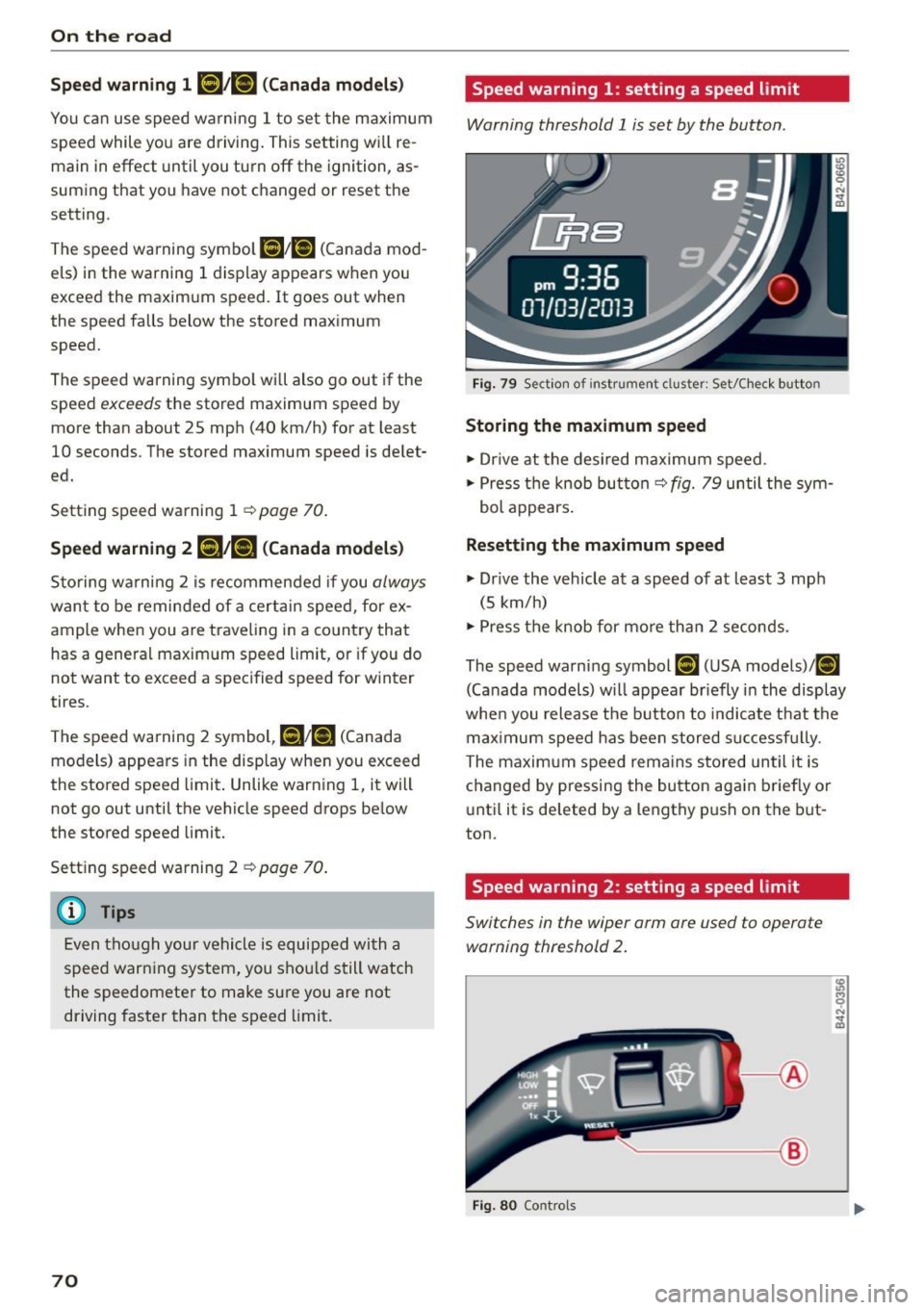
Speed warning 1: setting a speed limit
Warning threshold 1 is set by the button .
Fig. 79 Section of instrument cluster: Set/C hec k button
Storing the maximum speed
.,. Dr ive at the desired maximum speed .
.,. Press the knob butto n
c::> fig. 79 until the sym
bol appears.
Resetting the maximum speed
.,. Dr ive the vehicle at a speed of at least 3 mph
(5 km/h)
.,. Press the knob for more than 2 seconds .
The speed warning symbol
[IH (USA models)/ (01
(Canada models) w ill appear br iefly in the display
when you release the button to indicate that the
max imum speed has been stored s uccessfu lly.
The maximum speed rema ins stored until it is
changed by pressing the button again briefly or
until it is deleted by a lengthy push on the but
ton.
Speed warning 2: setting a speed limit
Switches in the wiper arm ore used to operate warning threshold 2 .
~--®
Fig. 80 Controls
Page 75 of 232
throug h im perce ptib le contro l processes . The
damping provides individua l modulation of
damping forces. For example, with damping
characterist ics set to prov ide greater comfort,
damping is set somewhat harder for a brief peri
od only as requ ired, when round ing a curve and
when braking .
Standard setting
Select the standard sett ing if you prefer a sus
pension setting emphasi zing comfort.
Sport s etting
Select the sport setting if you prefe r a spor ty sus
pension setting. The LED in the button
[l] comes
on to indicate sport setting .
@ Tips
The warning/indicato r ligh t R in the instr u
ment cluster comes on in the event of a mal
function. Drive to the closest a uthorized Audi
dea ler as soon as possible and have the mal
function repaired.
Sporty driving
Warming up and cooling down
B y care fully warming up and cooling down you r
veh icle, you can he lp ensure tha t it is not over
stressed unnecessarily du ring sporty driving.
W hen warming up , the veh icle is driven a t a max
i mum eng ine speed of 6 000 R PM
(Vl O engine) or
70 00 RPM (V8 engine) in order to raise the en
g ine oi l tempe ratu re to a minimum of 140 °F
(60 °() . The tires also only reach the ir full road
h olding capability once they have warmed up.
The cooling fan can continue to run in you r vehi
cle after the engine is switched off . However,
d riving the vehicle to cool it down is part icu larly
important. During sporty driving, the engine and
brakes, the exhaust system, and the transmission
all become extremely hot . Before you park the
ve hicle, you should dr ive it for a few m iles/kilo-
~ mete rs a t light load in the low rpm range to al-
~ low i t to cool down. "': ,...., \!) 1.1'1
N 1.1'1 ,....,
On th e road
Driving on a track
Befo re you take your veh icle o ut on a track, en
s u re th at i t is in perfe ct condi tion. Fo r ex ample ,
yo u should chec k the tire trea d an d the bra ke
pads . It is bes t to inc rease tire pressu re by about
0 .3 bar.
W hen dr iving on a track , oil consump tion may be
somewhat higher than in "norma l" ope rat ion
¢ page 159 .
You should definitely inspec t your ve hicle afte r
s u bje cting it to seve re condi tions. Are the br ake
pads OK? Is there any thing unusua l about the
t ir es, including the inner and outer sidewalls (e .g.
tread , blistering)? A re the air intakes free of
l eaves and tire dust? Is the o il level OK?
Your a uth orized Audi dea ler or q ua lified wor k
sho p will be happy to underta ke an inspection be
fore and after use on the race track .
A WARNING ._
Some race tracks (e.g. steeply banked turns)
may affect the response of t he ESC.
(D Tips
- Review the t rack requ irements and condi
tions befo re you sta rt driv ing.
- W hen d riven on a race track, all vehicle
parts are severe ly stressed. This can result
in increased wear .
73
Page 94 of 232
Driving Sa fel y
could crawl into the l uggage compartment
and close the front lid becoming trapped and unable to get out. Being trapped in ave
hicle can lead to ser ious personal injury.
- Never let children p lay in or around the vehi
cle.
- Never let passengers ride in the luggage compartment. Veh icle occupants must al
ways be proper ly restrained in one of the
ve
hicle's seat ing positions .
@ Tips
The tire pressure must correspond to the
load . The tire pressure is shown on the tire
pressure labe l. The t ire pressure label is locat
ed on the d river's s ide B-pillar . The t ire p res
sure label lists the recommended cold ti re in
flation pressures for t he ve hicle at its ma xi
m um c apaci ty weigh t and the tires t hat were
on yo ur vehicle at the time it w as m anuf ac
tured . For recommende d tire pressures for
normal load conditions, please see chapter
¢ page 176.
Reporting Safety Defects
Applicable to U.S.A.
If you belie ve that your vehicle
ha s a defect which could cause a
crash or could cau se injury or
death, you should immediatel y in
form the National Highwa y Tr affic
Safet y Admini stration (NHTSA) in
addition to notif ying Audi of
America, Inc.
If NHTSA re ceiv e s similar com
plaint s, it ma y op en an in vestiga
tion , and if it finds that a safe ty
def ects exis ts i n a group of
vehicle s, it may order a re call and
reme dy campaign. However,
92
NHTSA cannot b ecome in vol ve d in
indi vidual p roblems bet ween you,
y o ur deal er, or Audi of Am eric a,
In c.
To contact NHTSA, you may c all
the Vehicle Safety Hotline toll
free at:
Tel.: 1-888-327-4236 (TTY :
1-800-424-915 3) or
1-800-424-9393
o r you m ay wri te to :
Admini strator
NHTSA 1200 New Jersey A venue, SE
Wa shington, D.C. 20590
You can also obtain other infor
mation about m otor vehi cle safe
t y fr om :
http: //w ww.safercar.gov
Applicable to Canada
If you live in Canada and you be
lie ve that your vehicle has a de
fect that could cause a crash , in
j ur y or death, you should immedi
atel y inform Transport Canada,
Defect In vestigations and Recall s.
You should also notify Au di C an a
da, Inc.
Can adian cu stomer s who wi sh to
r e po rt a s afet y-related defe ct to ..,.
Page 141 of 232
..... N
r-N "': ..... \!) ..,.,
N ..,., .....
Power steering
When the engine is running, power steering
makes i t easier for the driver to steer.
Power steering helps the driver steer the vehicle
with litt le physical effort.
If the engine is not running, the power steering
system is also not working. In this case, you will
find it extremely difficult to turn the steering
wheel.
If you turn the steering fully to the left or right
when the vehicle is stationary, you place a very
heavy load on the power steering system. Turning
the steering wheel fully to the left or right wi ll
cause noise in the system . It also reduces engine
idle speed.
(D Note
Do not hold the steering turned fully to the
left or right for more than 10 seconds when
the engine is running. There is a risk of dam
age to the power steering system.
@ Tips
- In the event of a power steering system fail
ure, or if the engine is not running (while
being towed), you will still be able to steer
the vehicle. However, you will require more
effort to do so.
- If the power steering system has a leak or is
defective, you should immediately contact a
qualified workshop .
- The power steering system requires a spe
cial hydraul ic fluid . The power steering fluid
reservoir is located in the engine compart
ment. The correct hydraulic fluid level is im
portant for proper operation of the power
steering system. The power steering fluid
l evel is checked according to the Audi main
tenance service schedule.
Dry sump lubrication
High lateral and longitudinal forces affect the en
gine and the vehicle during sporty driving. Dry
sump lubrication ensures that your engine is sup-
Intelligent technology
plied with oil and properly lubricated even under
these conditions.
In a "norma l" vehicle the oil pump sends the oil
from the oil pan to the lubrication points in the
engine . The oil then returns to the oil pan. In ex
treme situations, the oil pump may draw in air,
wh ich results in insufficient oi l pressure .
With dry sump lubrica tion, the oil is not in the oil
pan (it is "dry"), but in a separate oi l tank. While
one pump supplies the engine with oil, a second
pump suct ions the oil out of the engine and re
turns it to the o il tank. Because the oil tank is tall
and narrow, oil pressure is constant even under
extreme conditions .
In add ition, the oi l pan in vehicles with dry sump
lubrication is noticeably shallower . This allows
the engine to be installed lower in the vehicle,
bringing down the center of gravity . This im
proves your vehicle's handling.
Driving with your quattro
With oil-wheel drive, all four wheels are driven .
General information
With all-wheel drive, power is distributed to all
four wheels . This happens automatically depend
ing on your driving style and the road conditions
at the time . See also
c:::.> page 134.
The all-whee l drive concept is designed for high
engine power . Your vehicle is exceptionally pow
erful and has excellent driving characterist ics
both under normal driving conditions and on
snow and ice. Always read and fo llow safety pre
cautions
c:::.> .&_ .
Winter tires
When driving in the winter, your vehicle with all
wheel drive has an advantage, even with regular
t ir es . In winter road condit ions it may be advisa
ble to mount winter tires (or all-season t ires) for
improved driveability and brak ing: these tires
must be mounted on
all four wheels. See also
c:::.> page 193 , Winter tires.
139
Page 142 of 232
Intelligent technology
Snow chain s
Where tire cha ins are mandatory on certai n
roads, this normally a lso applies to vehicles with
all-wheel drive
¢ page 194, Snow chains .
Replacing wheels /tires
Vehicles w ith all-whee l drive must a lways have
tires of the same si ze. Also avoid t ires with differ
ent tread depths. Fo r deta ils see page
¢ page 186, New tires and replacing tires and
wheels.
Off-Road driving?
Your Audi does not have enough ground clear
an ce to be used as an off-road veh icle.
It is there
fore best to avo id rough tracks and uneven ter
rain as m uch as possible . A lso re fer to
¢ page 142.
A WARNING
-Always adjust your driving to road and traf
fic cond itions. Do not let the extra safety af·
forded by all-whee l dr ive tempt you into tak
ing extra r isks .
- Althoug h the all-wheel dr ive is very effec
t ive, always remember that brak ing capac ity
is limited by tire tract ion. You should there
fore not dr ive at excessive speeds on icy o r
slippery road su rfaces.
- On wet road su rfaces, be careful not to drive
too fast because th e front whee ls cou ld be
gin to slide o n top of the water (aquap lan
ing).
If t his s hou ld o cc ur , you will have no
warning from a sudde n increase in engine
speed as with a front -whee l drive vehicle .
Always drive at speeds which are s uited to
the road conditions. -ris k of crash.
Energy management
Starting ability is optimized
Energy management controls the distribution of
electrical energy and thus optimizes the availa
bility of electrical energy for starting the engine.
If a vehicle w it h a conventional energy system is
not drive n for a long per iod of t ime, the battery
is discharged by idli ng cur rent consumers (e.g .
140
immob ili zer). In certain c ircumstances it can re
s ul t in the re being insufficient energy available to
start the eng ine.
I ntelligent energy managemen t in your veh icle
hand les the d istribution of electrical energy .
Starting ability is markedly improved and the life
of the battery is extended.
B asically, energy managemen t consis ts of
bat
tery diagnosi s, idling current management
and
dynamic energy management.
Battery diagnosis
Battery diagnosis continuously dete rm ines t he
st ate of the bat tery. Sensors dete rm ine battery
vo ltage, batte ry cur rent and battery tempera
ture . This de termines the current state of cha rge
and t he power of the battery.
Idling current management
Idli ng cur ren t management reduces energy con
sumption whi le the vehicle is s tanding. W it h the
i gni tion swi tched off, it contro ls the energy s up
ply to the various electrical components . Data
from battery d iagnosis is considered.
Depend ing o n the ba tte ry's st ate of ch arge, indi
vidual consumers are gradua lly tur ned o ff to pre
vent excessive discharge of the batte ry and thus
maintain starting capa bility .
Dynamic energy management
While t he ve hicle is being driven, dynamic e ne rgy
m anag eme nt dis trib utes the energy ge nerated
accord ing to the needs of the individ ua l compo
nents . It regu lates consumption, so that more
e lectrica l ene rgy is not be ing used than is being
generated and ens ures an optima l state of
c h arge for the battery.
(D Tips
- But even ene rgy management cannot neg
ate the lim its of physics. Cons ider that the
p ower and life of a batte ry are lim ited.
- If start ing ability is threa tened, you are in
formed by a warning ¢
page 141, Driver
notification in the instrument cluster dis
play.
Page 145 of 232
..... N
r-N "': ..... \!) ..,.,
N ..,., .....
The exclusive use of unleaded fuel is critically im
portant for the life of the catalytic converter and
proper functioning of the engine.
A WARNING
- Do not park or operate the vehicle in areas where the hot exhaust system may come in contact with dry grass, brush, fuel spill or
other material which can cause a fire .
- Do not apply additional undercoating or
rustproofing on or near the exhaust mani
fold, exhaust pipes, catalytic converter or
heat shields. During driving, the substance
used for undercoating could overheat and
cause a fire.
([) Note
-Be aware that just one tank filling with lead
ed
fuel will already seriously degrade the
performance of the catalytic converter.
- Do not exceed the correct engine oil level
~page 160.
- Do not drive until the fuel tank becomes
completely empty. The engine could misfire.
Unburned fuel could also get into the ex
haust system and this could cause the cata
lytic converter to overheat.
- Do not turn off the ignition while the vehicle
is moving.
- Do not continue to operate your vehicle un
der these conditions, as otherwise fuel can
reach the catalytic converter. This could re
sult in overheating of the converter, requir
ing its replacement.
- To assure efficient operation of the Emission
Control System:
- Have your vehicle maintained properly and in accordance with the service recommen
dations in your Warranty
& Maintenance
booklet.
- Lack of proper maintenance as well as im
proper use of the vehicle will impair the
function of the emission control system
and could lead to damage.
Driving and environment
{® For the sake of the environment
Even when the Emission Control System is op
erating properly, the exhaust gas can have a
sulfur-like exhaust gas smell under some op
erating states. This depends on the sulfur
content of the fuel being used. Using a differ
ent brand of fuel may help, or filling the tank
with lead-free super grade gasoline .
Shutting down vehicle
If you would like your vehicle to remain inopera
tive for a longer period of time , contact an Audi
or other specialized dealer. They can advise you
on necessary precautions e.g. corrosion preven
tion, maintenance and storage. Pay attention to
additional information concerning the battery.
Refer to~
page 164.
Operation and
maintenance
Fuel economy, environmental impact, and wear
on your engine, brakes and tires largely depend
on three factors:
-your personal driving style
- operating conditions
- technical limitations
By having your vehicle regularly serviced by an
authorized Audi dealer helps to ensure that it runs properly and economically. The condition of
your vehicle not only affects its safety and ability
to hold its value, it also affects
fuel consump
tion.
The amount of oil used is related to engine load
and speed.
It is normal for the oil consumption of a new en
gine to reach its lowest value after a certain mile
age has been driven.
You must drive your vehicle about 3,000 miles (5,000 kilometers) before you can properly as
sess oil consumption .
This also applies to fuel consumption and engine output . .,,.
143
Page 147 of 232
.....
Vehicle care and cleaning General information
Regular, proper care helps to maintain your vehi
cle's value.
It can a lso be a req uirement when
submitting warranty claims for corrosion damage
and paint defects on the body.
The required cleaning and care products can be
obtained from your authorized Audi dea ler or a
qualified workshop. Read and follow the instruc
tions for use on the packaging.
A WARNING
-Us ing clean ing and care products incorrectly
can be dangerous to your health.
- Always store cleaning and care products out
of reach of children to reduce the r isk of poi
soning.
@ For the sake of the environment
- Preferably use environmentally-friendly products when buying cleaning agents.
- Do not dispose of leftover cleaning and care
products with household trash.
Car washes
The longer deposits remain on the vehicle, the
more the surface can be damaged. High tempera
tures such as those caused by sunlight increase
the damaging effect .
Before washing, wet heavy deposits with plenty
of water.
Stubborn depos its such as bird droppings or tree
sap are best removed with plenty of water and a
microfiber cloth .
A lso, was h the underside of your vehicle once
road salt stops being used for the season.
Pressure washers
When washing your veh icles w ith a pressure
washer, always follow the operating instructions
"' provided with the pressure washer. This is espe-
r--
~ cially important in regard to the pressure and
; spraying distance . Do not aim the spray directly
~ at seals on side windows, doors, the engine com -,.... Vehicle care and cleaning
partment lid, the front lid
or the convertible top
or at tires, rubber hoses, insulating material
orsensors* or camera lenses *. Keep a distance of
at least 16 inches (40 cm).
Do not remove snow and ice with a pressure
washer .
Never use rotary nozzles or high pressure noz
zles.
The water temperature must not be above 140 °F
(60 °().
Automatic car washes
Spray off the veh icle before washing.
Make sure that the windows are closed and the
windshield wipers are off. Follow instructions
from the car wash operator, especially if there are
accessor ies attached to your vehicle .
If possible, use car washes that do not have
brushes .
Only use car washes where the vehicle remains
stationary and the washing equipment moves
around t he vehic le when washing and drying. Car
washes that move the vehicle through the car
wash using a chain are not recommended.
Washing by hand
Clean the vehicle starting from the top and work
ing down using a soft sponge or cleaning brush.
Use solvent-free cleaning prod ucts .
Washing vehicles with matte finish paint by
hand
To avoid damaging the paint when washing, first
remove dust and large particles from your vehi
cle. Insects, grease spots and fingerprints are
best removed with a spec ia l cleaner for matte
finish paint.
Apply the prod uct using a microfiber cloth . To
avo id damaging the paint surface, do not use too
much pressure.
Rinse the vehicle thoroughly with water. Then
c lean using a neutral shampoo and a soft micro
fiber cloth.
Rinse the vehi cle thoroughly again and let it air
dry. Remove any water residue using a sham my . .,.
145
Page 171 of 232
.... N
Tires and wheels
Tires
General notes
Tires may be the least appreciat
ed and most abused parts of a
motor vehicle.
Tires may be the least appreciated
and most abused parts of a motor
veh ic le . Tires are, however, one of
the most important parts of ave
hicle, particularly considering the
comparatively small patch of rub
ber on each tire that assu res that
all-important contact between
you, your vehicle and the road .
Maintain ing the correct t ire pres
sure, making sure that your vehi
c le and its tires do not have to
carry more weight than they can
safe ly handle, avoiding damage
from road hazards and regularly inspecting tires for damage in
c luding cuts, slashes i rregular
wear and overall condition are the most important th ings that you
can do to help avo id sudden tire
failure including tread separation
and blowouts.
Avoiding damage
~ If you have to dr ive over a curb or ":
~ similar obstacle, drive very s lowly
N U'> .....
Tir es a nd whe els
and as close as possible at a right
ang le to the curb.
Always keep chemicals including
grease, oil, gasoline and brake
fluid off the tires. Inspect the tires regularly fo r
damage (cuts, cracks or blisters ,
etc.) . Remove any foreign bodies
embedded in the treads.
Storing tires
Mark tires when you remove them
to indicate the direction of rota
tion. This ensures you to be able
to mount them correctly when
you reinstall them.
When removed, the w heels or
tires sho uld be stored in a coo l,
dry and preferably dark place.
Store tires in a vertical position if
they are not mounted on rims, in
a horizon tal position if they are
mounted on rims .
New tires
New tires have to be broken in
¢,&.
The tread depth of new tires may
vary, according to the type and make of tire and the tread pa t
tern.
1 69
...