fog AUDI RS5 CABRIOLET 2013 User Guide
[x] Cancel search | Manufacturer: AUDI, Model Year: 2013, Model line: RS5 CABRIOLET, Model: AUDI RS5 CABRIOLET 2013Pages: 286, PDF Size: 71 MB
Page 127 of 286
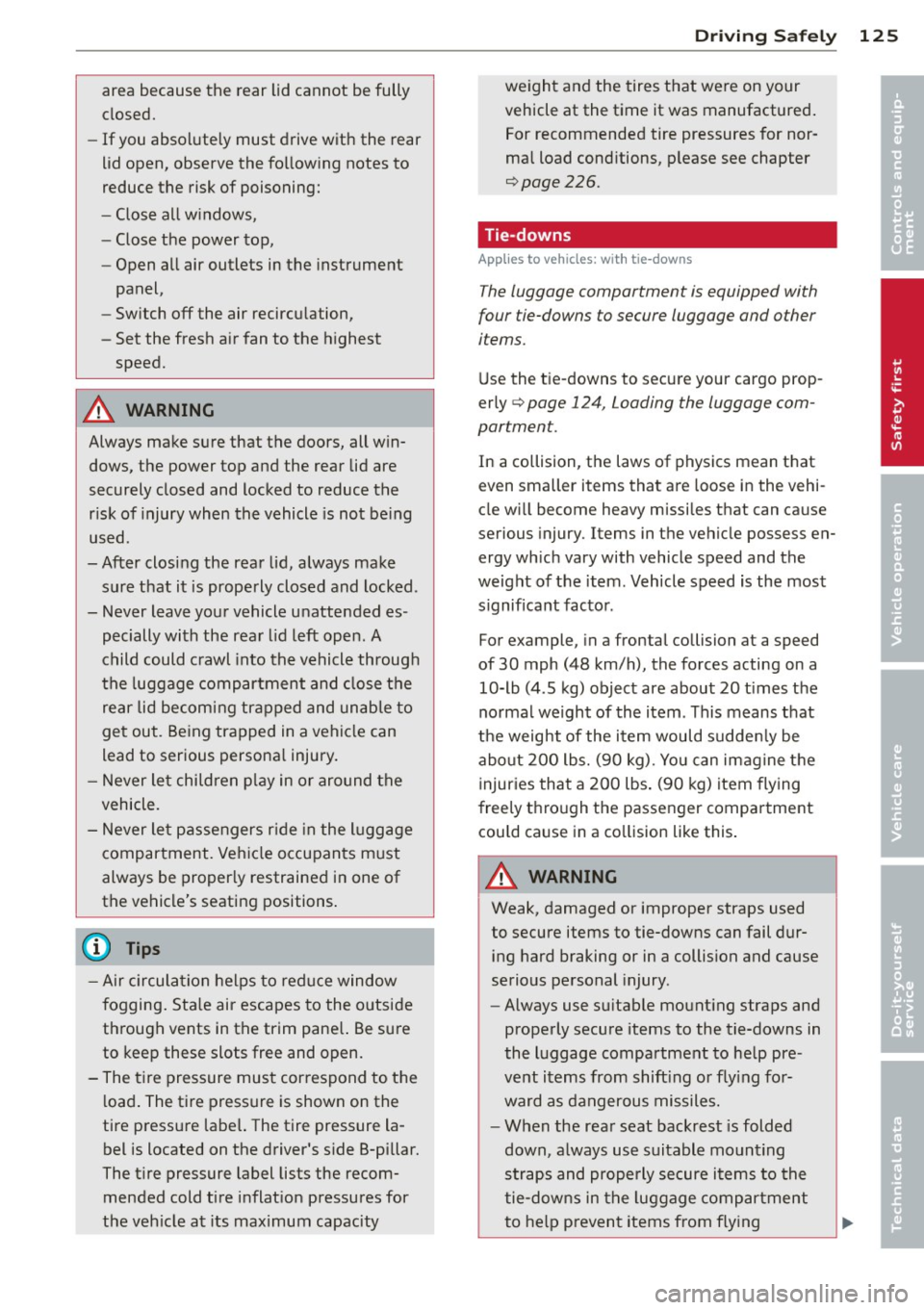
area because the rear lid cannot be fully
closed.
-If you absolutely must drive with the rear
lid open, observe the following notes to
reduce the risk of poisoning:
- Close all windows,
- Close the power top,
- Open all air outlets in the instrument
panel,
- Switch off the air recirculation,
- Set the fresh air fan to the highest
speed.
A WARNING
Always make sure that the doors, all win
dows, the power top and the rear lid are
securely closed and locked to reduce the
risk of injury when the vehicle is not being
used.
-After closing the rear lid, always make sure that it is properly closed and locked.
- Never leave your vehicle unattended es
pecially with the rear lid left open. A
child could crawl into the vehicle through
the luggage compartment and close the
rear lid becoming trapped and unable to
get out. Being trapped in a vehicle can
lead to serious personal injury.
- Never let children play in or around the
vehicle.
- Never let passengers ride in the luggage
compartment. Vehicle occupants must
always be properly restrained in one of
the vehicle's seating positions.
(D Tips
- Air circulation helps to reduce window
fogging. Stale air escapes to the outside
through vents in the trim panel. Be sure
to keep these slots free and open.
- The tire pressure must correspond to the
load. The tire pressure is shown on the
tire pressure label. The tire pressure la bel is located on the driver's side B-pillar.
The tire pressure label lists the recom mended cold tire inflation pressures for
the vehicle at its maximum capacity
.
Driving Safely 125
weight and the tires that were on your
vehicle at the time it was manufactured.
For recommended tire pressures for nor
mal load conditions, please see chapter
¢page 226.
Tie-downs
App lies to vehicles : wi th t ie-downs
The luggage compartment is equipped with
four tie-downs to secure luggage and other
items.
Use the tie-downs to secure your cargo prop
erly ¢
page 124, Loading the luggage com
partment .
In a collision, the laws of physics mean that
even smaller items that are loose in the vehi
cle will become heavy missiles that can cause
serious injury. Items in the vehicle possess en
ergy which vary with vehicle speed and the
weight of the item. Vehicle speed is the most significant factor.
For example, in a frontal collision at a speed
of 30 mph (48 km/h), the forces acting on a 10-lb (4.5 kg) object are about 20 times the
normal weight of the item . This means that
the weight of the item would suddenly be
about 200 lbs. (90 kg). You can imagine the injuries that a 200 lbs. (90 kg) item flying
freely through the passenger compartment
could cause in a collision like this.
A WARNING
Weak, damaged or improper straps used
to secure items to tie-downs can fail dur ing hard braking or in a collision and cause
serious personal injury.
- Always use suitable mounting straps and
properly secure items to the tie-downs in
the luggage compartment to help pre
vent items from shifting or flying for
ward as dangerous missiles.
- When the rear seat backrest is folded
down, always use suitable mounting
straps and properly secure items to the
tie-downs in the luggage compartment
to help prevent items from flying
•
•
Page 197 of 286
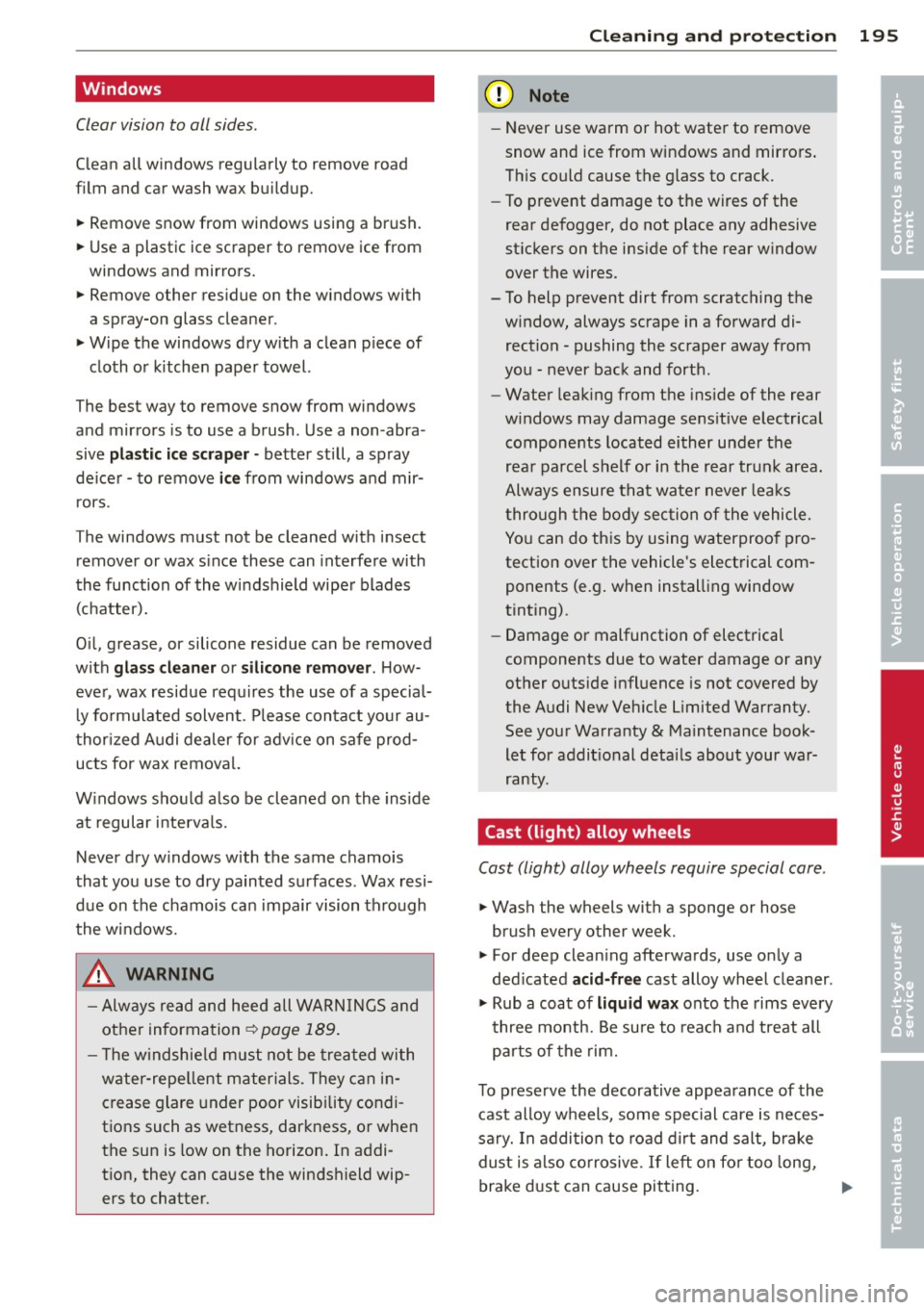
Windows
Clear vision to all sides.
Clean all windows regularly to remove road
film and car wash wax buildup.
• Remove snow from windows using a brush.
• Use a plastic ice scraper to remove ice from
windows and mirrors.
• Remove other residue on the windows with
a spray-on glass cleaner .
• Wipe the windows dry w ith a clean p iece of
cloth or kitchen paper towel.
The best way to remove snow from windows
and mirrors is to use a brush. Use a non -abra
sive
p la stic ic e scrap er -better still, a spray
de icer - to remove
ic e from windows and mir
r ors.
T he windows must not be cleaned with insect
remover or wax s ince these can interfere with
the function of the w indshield wiper blades
(chatter).
O il, grease, or silicone residue can be removed
w ith
glass cleaner or silicon e re mover. H ow
ever, wax residue requ ires the use of a special
l y form ulated solvent. P lease contact your au
thor ized Audi dealer for adv ice on safe prod
ucts for wax removal.
W indows shou ld a lso be cleaned on the inside
at regular i nterva ls.
Never dry w indows with the same chamois
that you use to dry painted surfaces . Wax resi
due on the chamois can impair vision through
the windows.
.8, WARNING
- Alw ays re ad and heed all WARN INGS and
other information
~ page 189.
- The windshie ld m ust not be treated with
water-repe llent m aterials. They can i n
crease glare under poor visib ility condi
tions such as wetness, darkness, or whe n
the sun is low on the horizon . In addi
t ion, they can cause the windshield wip
ers to chatter.
Cleaning and protec tion
@ Note
- Never use warm or hot water to remove
snow and ice from w indows and mirrors .
Th is could cause the glass to crack.
- To prevent damage to the wires of the
rear defogger, do not place any adhesive
st ickers on the ins ide of the rear w indow
over the wires.
- To help prevent dirt from scratching the window, always scrape in a forward di
rection - pushing the scraper away from
you - never back and forth.
- Water leak ing from the inside of the rear
w indows may damage sens itive electrical
compone nts located either under the
rear parcel shelf or in the rear trunk area.
Always ensure tha t water never lea ks
t hro ugh the body section of the vehicle.
Yo u can do th is by using waterproof pro
tection over the vehicle's electrical com
ponents (e.g . when install ing window
tinting) .
- Damage or malfunction of electrical
components due to water damage or any
other o utside infl uence is not covered by
the Audi New Veh icle Limited Warranty.
See your Warranty
& Maintenance book
let for addit ional details about your war
ranty.
Cast (light) alloy wheels
Cast (light) alloy wheels require special care .
• Wash the wheels with a sponge or hose
brush every other week.
• For deep clean ing afterwards, use on ly a
ded icated
acid-fr ee cast alloy wheel cleaner .
• Rub a coat of
liquid wa x onto the rims every
three month. Be su re to reach and treat all
pa rts of the rim.
To preserve the decorative appearance of the cast alloy wheels, some special care is neces
sary. In addi tion to road dirt and salt, brake
dust is also co rrosive . If left on fo r too long,
brake dust can cause pitting.
IJI>
195
•
•
Page 220 of 286
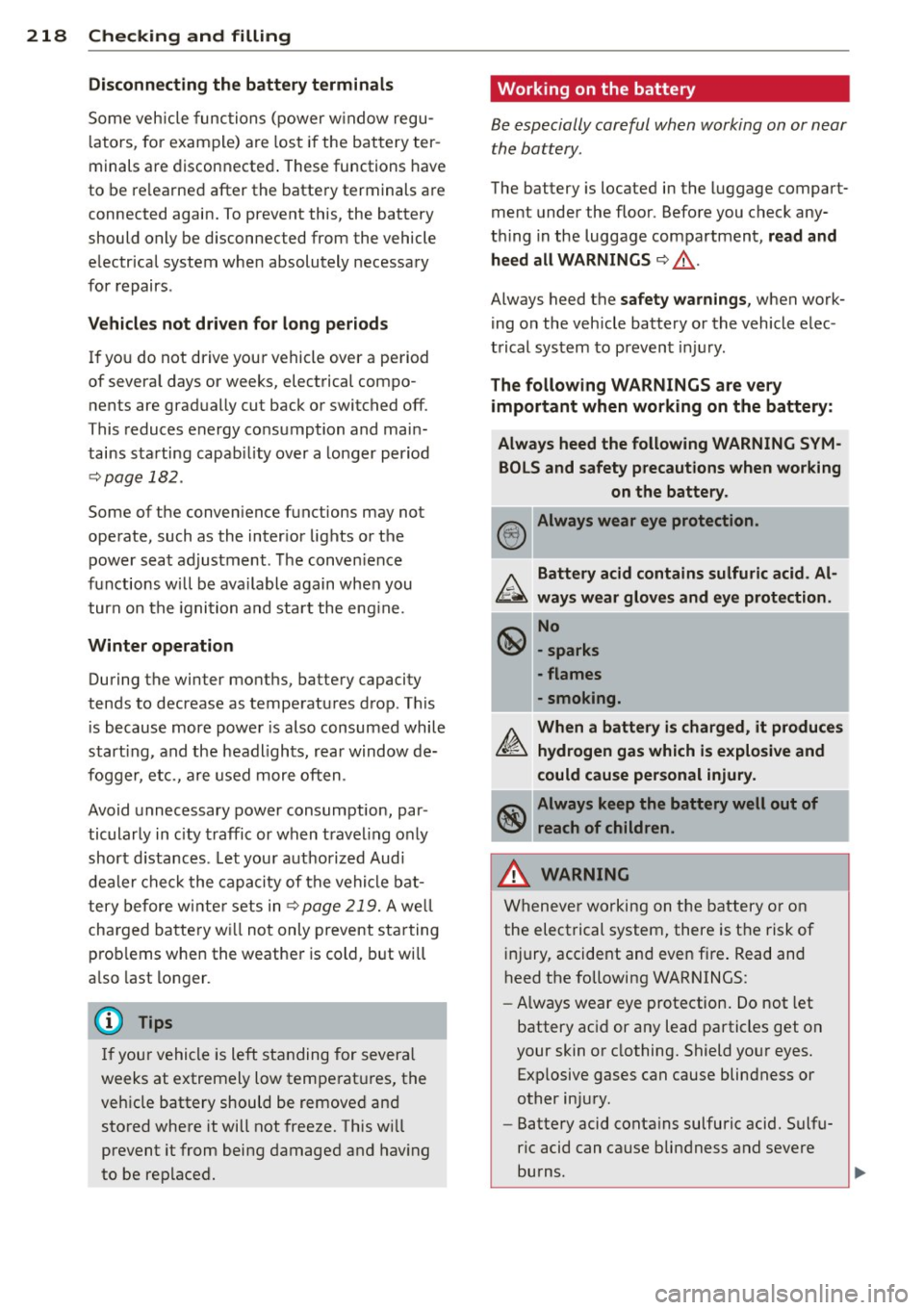
218 Check ing and filling
Di sconnect ing the batt ery terminal s
Some vehicle functions (power window regu
l ators, for example) are lost if the battery ter
minals are disconnected . These functions have
to be re learned after the battery terminals are
connected again. To prevent this, the battery
should only be disconnected from the vehicle
electrical system when absolutely necessary
for repairs .
Vehicles not dri ven fo r lo ng period s
If you do not drive your vehicle over a period
of several days or weeks, electrical compo
nents are gradually cut back or switched off.
This reduces energy consumption and main
tains starting capab ility over a longer period
~ page 182.
Some of the conven ience functions may not
operate, such as the inter ior lights or the
power seat adjustment . The conven ience
functions will be ava ilable again when you
turn on the ignition and start the eng ine.
Winter operati on
During the winter months, battery capacity
tends to decrease as temperatures drop . This
is because more power is also consumed while
start ing, and the headlights, rear window de
fogger, etc., are used more often .
Avoid unnecessary power consumption, par
ticularly in c ity traffic or when traveling only
short d istances . Let you r authorized Audi
dealer check the capacity of the vehicle bat
tery before winte r sets in
~ page 219. A well
charged battery w ill not only prevent starting
prob lems when the weather is cold, but wi ll
a lso last longer .
(D Tips
If your vehicle is left standing for severa l
weeks at extremely low temperat ures, the
veh icle battery should be removed and
stored where it will not freeze. This w ill
prevent it from being damaged and hav ing
to be replaced.
Working on the battery
Be especially careful when working on or near
the battery.
The battery is located in the luggage compart ment under the floor. Before you check any
th ing in the luggage compartment,
read and
h ee d all WARNINGS
~ ,&,
Always heed the safet y warnings , when work
ing on the vehicle battery or the vehicle e lec
trical system to prevent injury.
The following WARNINGS are ve ry
i mportant wh en wor king on the battery :
Alway s heed the following WARNING S YM
BOLS and safety prec autions when working
on the battery .
® Always wear eye protection .
b.. Battery acid contains sulfuric acid . Al
~ ways wear gloves and e ye protect ion.
-No
~ -sparks
-flames
--
-smoking.
A When a battery i s charged , it produ ce s
~ hy drogen gas which is e xplosi ve and
could cau se pe rsonal injur y.
--Always keep the battery well out of
® reach of children .
_& WARNING
=
Whenever working on the battery or on
the electrical system, there is the risk of i njury, accident and even fire . Read and
heed the following WARNINGS:
- Always wear eye protection. Do not let
battery acid or any lead particles get on
your skin or clothing. Shield your eyes. Exp losive gases can cause blindness or
other injury . -
-Battery acid conta ins sulfuric acid. Sulfu
ric acid can cause blindness and severe
burns.
Page 275 of 286

Engine hood
C losing .... .... .. .... ... .. .. .. ... 207
H ow to release the hood ... .. .. .. .. . 207
E ng ine oil . .. ............. .. .. .. ... 209
Adding .. .. .. ........... .. .. .. ... 212
Addit ives ... .... .. .... ... .. .. .. ... 212
C hanging . ... .... .... ... .. .. .. ... 213
Chec koil leve l .. ...... ... .. .. .. ... 212
Consumpt ion ............ .... .. ... 212
Indicator light ........... .... .. 17,21
O il consumption ............. .... .. 211
O il grades .. ... .. .. ...... .. .. .. .. . 209
O il level symbol ............. ... ... . 21
Pr essu re malfunction ...... .. .. .. .. .. 17
Sensor defective . . . . . . . . . . . . . . . . . . . . 2 1
Specific ation and viscos ity . ... .. .. .. . 209
temperature indicator . . . . . . . . . . . . . . . 28
E ng ine speed limitat ion ........ .. .... . 21
E nvironment
Break- in period ........... .... .. .. . 184
Catalytic converter . . . . . . . . . . . . . . . . . 185
D isposing of your vehicle batte ry ... .. 221
Driving at h igh spe eds ........ .... .. 187
Dr iving to m inim ize pollu tion and no ise 186
Fu el ... .. .. .... ............. .. .. . 204
Fu el economy ............ .. .. .. .. . 186
L eaks under your veh icle ... .. .. .. .. . 20 7
L etting the ve hicle stand and warm up . 187
Prope r disposal of dra ined brake fluid . 2 17
Prope r disposal of drained engine coo l-
ant . .. ... . .... ............. .. .. . 214
Proper disposal of dra ined engine
oil ...... ... ...... .......... 212,213
R ecycl ing used engine oil . ......... .. 212
Un leaded f uel ............ .... .. .. . 20 2
Wha t should I do wi th an old ba ttery? . 22 1
EPC
refer to Electronic power control . . . . . . 20
ESC (Electronic Stabilization Cont rol)
Warn ing/ indicator lights ... .. .. .. .. .. 19
E vent Data Recorder ( EDR) ... .. .. .. .. . 176
Exhaust tail p ipes
C lean ing . ..... ........... ... ... .. 196
Expansion tank ............ .... .. ... 214
E xterio r ligh ting . . . . . . . . . . . . . . . . . . . . . 52
Inde x 273
Exterior m irrors
Adjusting . . . . . . . . . . . . . . . . . . . . . . . . . 55
D imm ing . ... .. .. .. . .. ... .... ... .. . 56
Heating ... .. .. .. ................. . 55
F
Fan
Radiator
Fasten ing
B oos ter sea ts . ... .. . .. ... .... ... . .
Co nvertib le child sa fety seats . ... .. . .
Infant seats ..... ... .. .. ..... ... . .
Flat tire 216
166
165
164
Changi ng ... .. ...... ............. 245
Floor mats .. .. .. .. .... ... .... .... .. 123
Fog lights ( rear) ..... . .. .. ..... ... .. . 52
Fo lding the rea r seats . ... .. ..... ..... . 67
Foot pedals . .. .. .. .. .. ........... .. 123
Fo r the sake of the envi ronmen t
Gasoline fumes and the env ironment . . 204
Letting the engine warm up . . . . . . 74 , 77
Ref ueling ... .. ...... ............. 204
Saving f uel by early upsh ifting ... .. .. . 11
Fron t air bags
Description . ... .... . ... ...... ... .. 14 1
How they work ..... . .. .. ..... ... .. 146
Frontal coll is io ns and the laws of p hys ics 130
Front passenger's door emergency lock ing 36
Fron t seats
Adjusting ... .. .... . ... ...... ... .. 120
Child restraints in the front seat . ... .. 138
Upper cabin heating . ........... .... . 72
Fuel Additives . ... .. .... .. .. ...... ... .. 20 2
B lended gaso line ... . .. .. ..... ... .. 202
Consumption ...... . .. .. ..... ... .. . 25
Filler neck ... .. ...... ............. 203
Fuel gauge . . . . . . . . . . . . . . . . . . . . . . . . 12
Gasoline .. .. .. .. ................. 202
Gasoline addit ives .. ... ....... .... . 203
Low fuel level symbol . . . . . . . . . . . . . . . 21
Octane rat ing .. .. .. . ....... ..... .. 202
Recommendat ion . ............. .. .. 202
Ref uell ing ... .. .... ... .......... .. 2 04
Rese rve ... .. .... .. . .. .. ..... ... .. . 12
Tank capac ity .... .. . .. .. ..... ... .. 263
•
•
Page 277 of 286

K
Key ... .... .. .. .... .. .... ... .. .. .... 32
Battery rep lacement ... ... .. .. .. .. .. 33
Check light ..... ...... ... .. .. .. .... 33
Emergency key . . . . . . . . . . . . . . . . . 32, 76
Ignition/engine on/off ............... 74
Key replaceme nt . . . . . . . . . . . . . . . . . . . 32
Mechanical key . . . . . . . . . . . . . . . . . 32, 33
removing . . . . . . . . . . . . . . . . . . . . . . . . . 76
u nl ocking/ locking . . . . . . . . . . . 34, 35, 36
Kick-down . . . . . . . . . . . . . . . . . . . . . . . . . . 89
Knee airbags .... .. ..... ... .. .. .. ... 152
Descript io n ..... .. .... ... .. .. .. ... 152
How t hey work . ... .... ... .. .. .. ... 153
Important safety instructions . . . . . . . . 154
L
Lane Change Ass istant
refer to side assist ..... ... .. .. .. .. . 10 1
L ap time r .. .. .... ......... .... .. .. .. 28
E v a lu ating times . . . . . . . . . . . . . . . . . . . 29
Pausing tim ing . .. ..... ... .. .. .. .. .. 28
Starting ... .. .. ...... ... .. .. .. .... 28
L A T CH .. .. ...................... .. 172
D escr ip ti on ..... ......... .... .. .. . 173
I ns tall ing a chi ld res traint ........... 174
L ocat ion . . . . . . . . . . . . . . . . . . . . . . . . . 17 3
M ounting and releasing the ancho rage
hook . ..... .. ... ..... ... .. .. .. ... 174
L aunch Cont ro l Program .............. 90
Leather . . . . . . . . . . . . . . . . . . . . . . . . . . . 198
C leaning . ................ ...... .. 199
L eaving home . . . . . . . . . . . . . . . . . . . . . . . 53
L eft ha nd d rive . ........... .. .. .. .... 54
Lifting jack .. ............. .... .. ... 248
L ifting vehicle .. .. .. .... ... .. .. .. ... 259
Light adapt ive light ...... ...... .. .. .. .. .. 52
Com ing/ Leavi ng home ............... 53
D aytime r unning lig hts . . . . . . . . . . 52, 53
E xterior lighting . . . . . . . . . . . . . . . . 5 2, 53
I nter ior/reading .. ..... ... .. .. .. .. .. 55
L ow beam . ... .... .... ... .. .. .. .... 52
Rear fog lights . . . . . . . . . . . . . . . . . . . . . 52
Side marker lights . . . . . . . . . . . . . . . . . . 52
Travel mode . . . . . . . . . . . . . . . . . . . . . . . 54
Inde x 275
Light/ rain senso r
Head lights . ... .... . ... ...... ... .. . 52
Intermittent (w indshie ld w ipers) ... .. . 57
Sensor defective . . . . . . . . . . . . . . . . . . . . 22
L ights
E mergency flashe rs . . . . . . . . . . . . . . . . . 54
Hig h beam . ..... ... .. .. ..... ... .. . 53
Turn signals ... .. .. .. ... ..... ... .. . 53
Locking Re ar li d ... .... .. .. . ............... 37
Locking/unlock ing
at the lock cylinder . . . . . . . . . . . . . . . . . . 36
by remote control . . . . . . . . . . . . . . . . . . 34
with t he centra l locking sw itch ... .. .. . 35
wi th t he conve nien ce key .......... .. . 35
Low beams . . . . . . . . . . . . . . . . . . . . . . . . . 52
Lower anchorage locator button ... .. .. 173
Lower universal a nc horage bars (Canada) 172
Lower universal anchorages (Canada) 172
Luggage Stow ing . ... .... .. . .. .. ..... ... .. 124
Luggage compartm ent . . . . . . . . . . . . . . . . 67
En larging . .. .. .. ................. . 67
Li d ............................... 37
L oad ing ... .. .... .. . .. .. ..... ... .. 124
S ki sack ... .. .... .. . .. .. ..... ... .. . 68
Tie-downs . . . . . . . . . . . . . . . . . . . . 68, 125
Luggage compar tment l id
E mergency un lock ing .. ......... .. .. . 38
Lumbar support . . . . . . . . . . . . . . . . . . . . . 62
M
Maintenance .. .. .. .... ........... .. 264
Malfunc tion Ind icator Lamp (MIL) . . 20, 29
Matte finish paint ................... 192
Mechan ica l key . . . . . . . . . . . . . . . . . . 32, 33
Memo ry func tion . . . . . . . . . . . . . . . . . . . . 64
Mileage Average ................ ........... 25
Instantaneous ... .. . .. .... ...... .. . 25
Mirrors Adjusting the exterior mirrors . . . . . . . . . 5S
Compass .. .. .. .. ................. . 59
dimming .. ... .... ........... ...... 56
Vanity mir ro rs .... ........... ...... 57
Monitoring the Advanced Airbag System 148
•
•
Page 279 of 286
Power windows . . . . . . . . . . . . . . . . . . . . . . 39
M alfunctions ............ .. .. .. .... 40
Pr egnant wome n
Special considerations when weari ng a
safety belt . . . . . . . . . . . . . . . . . . . . . . . 134
Proper occupa nt seat ing posit ions ..... 119
Proper safety belt position . . . . . . . . . . . . 134
Prop er seat ing position
Front passenger .......... .... .. .. . 120
Occupants .. .. ........... .. .. .. ... 119
Rear passengers ............ .. .. ... 121
Q
Qua rtz clock . ............. .... .. .. .. 12
q uattro ®
refer to all-wheel dr ive .... .. .. .. .. . 18 1
Question What happens to unbelted occupants? 130
Why safety belts? . . . . . . . . . . . . . . . . . 129
R
Radiator fan
216
R ain /light sensor
H eadlights . . . . . . . . . . . . . . . . . . . . . . . . 52
I ntermittent (windshield wipers) . ... .. 57
Sensor defective . . . . . . . . . . . . . . . . . . . . 22
Reading lights ............. .... .. .. .. 55
Rear fog lights . . . . . . . . . . . . . . . . . . . . . . 52
Rear lid
Escape hand le . .......... .. .. .. .... 38
Opening and closing ............ .. .. 37
R ear light
Defective . . . . . . . . . . . . . . . . . . . . . . . . . 21
Rear view camera Parking mode 1 ........... ... ... .. 11 1
P ark ing mode 2 ....... ... .. .. .. .. . 112
Rear view mirror . . . . . . . . . . . . . . . . . . . . . 56
Rear window heating ....... .. .. .. .. .. 71
Recirculation mode (automatic climate
control) . . . . . . . . . . . . . . . . . . . . . . . . . . . . 70
Refuelling . .. ............. .... .. .. . 204
Release lever for hood ........ .. .. .. . 207
Remote control
H omelink . . . . . . . . . . . . . . . . . . . . . . . . 114
Index 277
Remote control key . . . . . . . . . . . . . . . . . . . 32
Personalizing .. .... . ............ .. . 32
un locking/loc king .. . .. ........ .. .. . 34
Remote rear lid release .......... .. .. . 37
Repair ma nuals .. .. .. . ... ...... ... .. 264
Repairs Airbag system ... .. . .......... .. .. 150
Replacement key . . . . . . . . . . . . . . . . . . . . 32
Rep lacing bulbs . .. .... ............. 254
Replacing tires and wheels ........ .. .. 234
Replacing wiper blades ............. .. 58
Reporting Sa fety Defects ............. 126
Reset button . . . . . . . . . . . . . . . . . . . . . . . . 12
Retractor ......... .. ............... 133
Right hand drive . . . . . . . . . . . . . . . . . . . . . 54
Rims Cast alloy ..... ...... ............. 195
Rollbar
refer to Active rollover protection sys-
tem ......... ... .. ..... .......... 127
s
SAFE .. .. .. .. .. .. .. .. ... ...... .... . 12
Safe driving habits ... . .. ........ .. .. 118
Safety belt position .. . .. .. ..... ..... 134
Safety belts wo rn by pregnant women . 134
Safety be lt pretensioner ............ .. 135
Serv ice and disposal .............. . 136
Safety belts ... .... .. . .. .......... .. 132
Be lt positioner . ...... ............. 132
Cleaning .. .. .. .. ... ............ .. 200
Danger to passengers who do not wear a
safety belt .. .. .... .......... ..... 130
Fastening ... .. .... .......... ..... 133
Improperly worn ................. . 135
Not worn ... .. .. ... ............ .. 130
Safety belt position ... ......... .. .. 134
Safety instructions . ... ......... .. .. 132
Securing child safety seats .......... 168
Specia l considerations for pregnant
women ..... .. ...... ............. 134
Unf astening ... .. ... ............ .. 135
Warning/indicator light ........... .. 129
Warning light . . . . . . . . . . . . . . . . . . . . . . 17
WhyYOUMUSTwearthem ......... . 129
Worn proper ly . . . . . . . . . . . . . . . . . . . . 131
•
•