tow AUDI RS5 CABRIOLET 2013 Owner's Manual
[x] Cancel search | Manufacturer: AUDI, Model Year: 2013, Model line: RS5 CABRIOLET, Model: AUDI RS5 CABRIOLET 2013Pages: 286, PDF Size: 71 MB
Page 126 of 286
124 Driving Safel y
the pedals or the ability to control the
vehicle.
- Never place or insta ll floor mats or other
floor coverings on top of already insta l
led floor mats. Additional floor mats and
other coverings will reduce the size of
the pedal area and interfere with the
peda ls.
- Always proper ly reinstall and secure floor
mats that have been taken out fo r clean
ing.
- Always make sure that objects cannot
fall into the driver footwell wh ile the ve
hicle is moving. Objects can become
trapped unde r the b rake pedal and accel
erator peda l causing a loss of veh icle
contro l.
Stowing luggage
Loading the luggage compartment
All luggage and other objects must be prop
erly stowed and secured in the luggage com
portment.
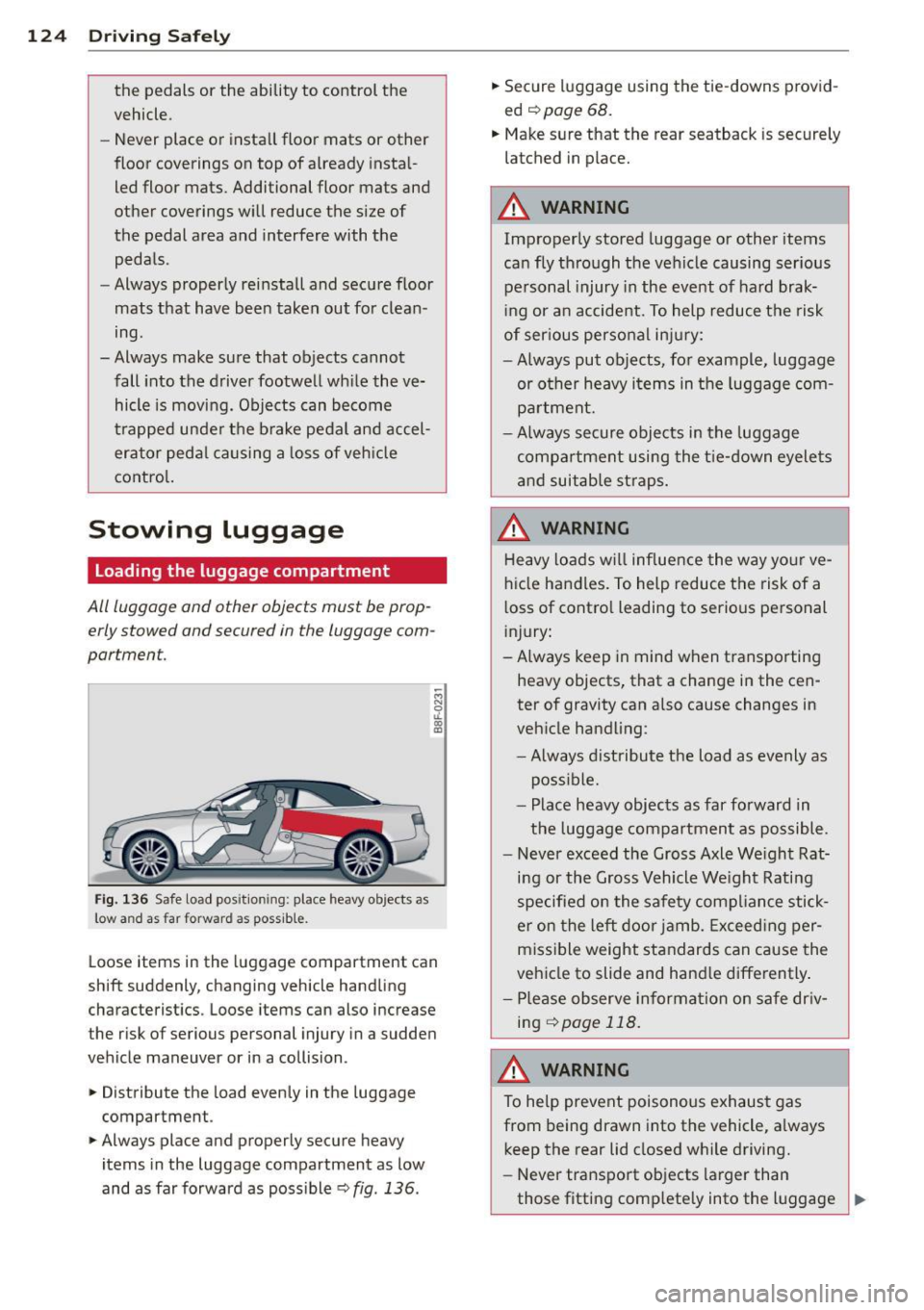
Fig. 136 Safe load pos it io nin g: place heavy objects as
low a nd as fa r forward as possible .
-M N 0 u.
l:l
Loose items in the luggage compartment can
shift suddenly, changing vehicle hand ling
characteristics . Loose items can also increase
the risk o f serious personal injury in a sudden
vehicle maneuver or in a collision .
... Distribute the load evenly in the luggage
compartment .
... Always place and properly secure heavy
items in the luggage compartment as low
and as far forward as poss ible
cc> fig . 136 .
... Secure luggage using the tie-downs provid
ed
c:> poge 68.
... Make sure that the rear seatback is securely
latched in p lace.
A WARNING ,..__
Improperly stored luggage or other items
can fly through the vehicle causing ser ious
personal injury in the event of hard brak
i ng or an accident. To help reduce t he risk
of ser ious personal inj ury:
- Always put objects, for example, luggage
or other heavy i tems in the luggage com
pa rtment.
- Always secure objects in the luggage
compa rtment using the t ie-down eyele ts
and suitab le st raps.
A WARNING
Heavy loads w ill influence the way yo ur ve
hicle handles. To help reduce the risk of a
l oss of contro l leading to serious pe rsonal
injury :
-Always keep in mind when transporting heavy objects , that a change in the cen
ter of gravity can also cause changes in
veh icle handling:
- Always distribute the load as evenly as poss ible.
- Place heavy objects as far forward in
the luggage compartment as possible .
- Never exceed the Gross Axle We ight Rat
i n g or the Gross Vehicle We ight Rating
specified o n the safety compliance stick
er on the left door jamb. Exceed ing per
missible weight standards can cause the
veh icle to slide and hand le differently .
- P lease observe informa tion on sa fe dr iv
ing
~ page 118.
A WARNING
To help prevent poisonous exhaust gas
from being drawn into the vehicle, a lways
keep the rear lid closed while driving.
- Never transpo rt objects larger than
those fitting comp lete ly into the luggage
~
Page 137 of 286
_& WARNING
Improperly positioned safety belts can
cause serious personal injury in an acci
dent .
- Expectant mothers must a lways wear the
lap portion of the safety belt as low as
poss ible across the pelv is and be low the
rounding of the abdomen.
- Always read and heed all WARNINGS and
other important information
¢ &. in Fas
tening safety belts on page 133.
Unfastening safety belts
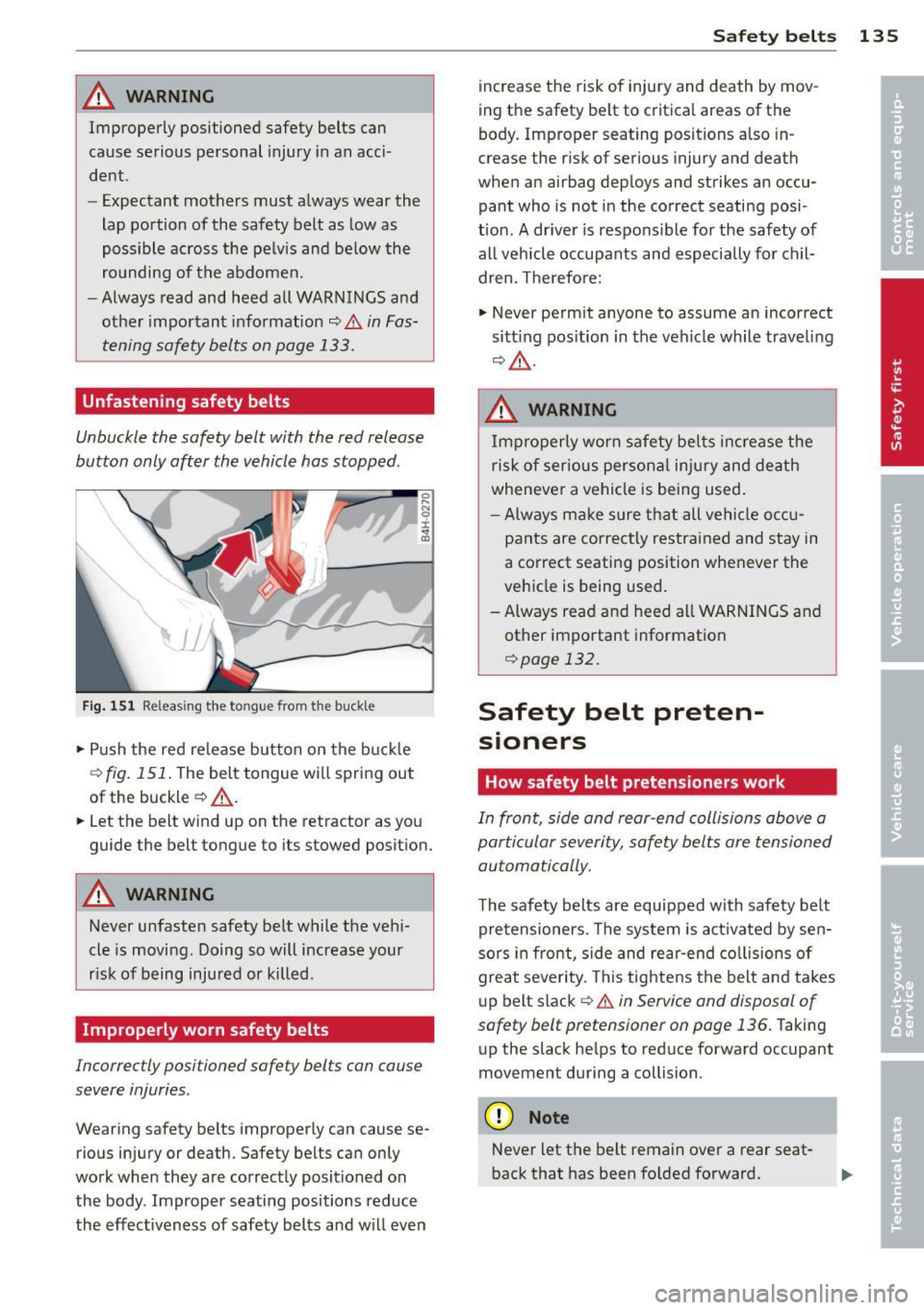
Unbuckle the safety belt with the red release
button only after the vehicle has stopped .
Fig. 151 Relea sing the to ngue from the buckle
... Push the red re lease but ton on the buc kle
¢
fig. 151 . The belt tongue wi ll spring out
of the buckle
¢ ,&. .
0 .... N 9 :r
~
... Let the belt wind up on the retractor as you
gu ide the belt tongue to its stowed position.
_& WARNING
Never unfasten safety belt while the veh i
cle is moving. Doing so will increase your
r isk of being injured or killed .
Improperly worn safety belts
Incorrectly positioned safety bel ts can cause
severe injuries .
Wearing safety be lts improperly can cause se
rious injury or death. S afety belts can only
work when they are correctly positioned on
the body . Improper seating positions reduce
the effect iveness of safety belts and w ill even
Safety belts 135
increase the risk of injury and death by mov
ing the safety be lt to critica l areas of the
body. Improper seating positions a lso in
crease the risk of serious injury and death
when an airbag deploys and strikes an occu
pant who is not in the correct seating posi
t ion. A driver is respo ns ible for the safety of
all vehicle occupants and especially for chil
dren. Therefore:
... Never perm it anyone to assume an incorrect
sitt ing pos ition in the vehicle while traveli ng
¢ ,&. .
_& WARNING
Improperly worn safety bel ts increase the
r isk of ser ious persona l injury and death
whenever a vehicle is being used .
- Always ma ke s ure that all vehi cle occu
pants are correctly restrained and stay in
a co rrect seating position whenever the
veh icle is being used .
- Always read and heed a ll WARNI NGS and
other important information
¢ page 132.
Safety belt preten-
• s1oners
How safety belt pretensioners work
In front, side and rear-end collisions above a
particular severity, safety belts are tensioned automatically.
T he safety belts are equipped with safety belt
pretensioners . The system is act ivated by se n
sors i n fro nt, side and rear -end co llisions of
great seve rity . This tightens the belt and takes
up belt slack¢
& in Service and disposal of
safety b elt pretension er on page 136.
Taking
up the slack he lps to reduce fo rward occupant
movement during a collision .
(D Note
Never let the belt remain ove r a rear seat
back that has been fo lded forward .
Page 147 of 286

-Improper repair or disassembly of the
front passenger and driver seat will pre
vent the Advanced Airbag System from
functioning properly .
- Repairs to the front passenger seat must
be performed by qualified and properly
trained workshop personnel.
- Never remove the front passenger or
driver seat from the vehicle .
- Never remove the upholstery from the
front passenger seat .
- Never disassemble or remove parts from
the seat or disconnect wires from it.
- Never carry sharp objects in your pockets
or place them on the seat. If the weight
sensing mat in the passenger seat is
punctured it cannot work properly.
- Never carry things on your lap or carry
objects on the passenger seat . Such
items can increase the weight registered
by the weight-sensing mat and send the
wrong information to the airbag control
unit.
- Never store items under the front pas
senger seat. Parts of the Advanced Air
bag System under the passenger seat
could be damaged, preventing them and
the airbag system from working proper
ly.
- Never place seat covers or replacement
upholstery that have not been specifical
ly approved by Audi on the front seats.
- Seat covers can prevent the Advanced
Airbag System from recognizing child re
straints or occupants on the front pas
senger seat and prevent the side airbag in the seat backrest from deploying prop
erly.
- Never use cushions, pillows, blankets or
similar items on the front passenger
seat . The additional padding will prevent
the weight-sensing mat in the seat from
accurately registering the child restraint
or person on the seat and prevent the
Advanced Airbag System from function
ing properly.
- If you must use a child restraint on the
front passenger seat and the child re-
Airbag system 145
straint manufacturer's instructions re
quire the use of a towel, foam cushion or
something else to properly position the
child restraint, make certain that the
PASSENGER AIR BAG OFF light comes
on and stays on whenever the child re
straint is installed on the front passen
ger seat.
- If the
PASSENGER AIR BAG OFF light
does not come on and stay on, immedi
ately install child restraint in a rear seat
ing position and have the airbag system
inspected by your authorized Audi dealer .
How the Advanced Airbag System
components work together
The front Advanced Airbag System and the
side airbags supplement the protection of
fered by the front three-point safety belts
with pretensioners and load limiters and the
adjustable head restraints to help reduce the
risk of injury in a wide range of accident and
crash situations. Be sure to read the impor
tant information about safety and heed the
WARNINGS in this chapter.
Deployment of the Adv a need Airbag System
and the activation of the safety belt preten
sioners depend on the deceleration measured
by the crash sensors and registered by the
electronic control unit. The amount of infla
tion of the front airbags can also be adapted
to the front sea t position, depending on the
distance between the respective front seat
and the steering wheel or instrument panel as registered by sensors in the seats. Crash se
verity depends on speed and deceleration as
well as the mass and stiffness of the vehicle
or object involved in the crash.
On the passenger side, regardless of safety
belt use, the airbag will be turned off if the
weight on the passenger seat is less than the
amount programmed in the electronic control
unit. The front airbag on the passenger side
will also be turned off if one of the child safe-
ty seats that has been certified under Federal
Motor Vehicle Safety Standard 208 has been
recogni zed on the seat . The
PASSENGER AIR .,,.
•
•
Page 172 of 286
1 70 Child Safety
Activating the convertible locking retractor
Use the convertible locking retractor to se
cure a child restraint.
Always heed the child safety seat manufactur
er's instructions when installing a child re
straint in your vehicle. To activate the conver
tible locking retractor:
• Place the child restraint on a seat, prefera
bly on the rear seat.
• Slowly pull the belt
all the way out.
• Route it around or through the child re
straint belt path¢.&_ .
• Push the child safety seat down w ith your
full weight to get the safety belt really tight.
• Insert the belt tongue into the buckle for
that seating position.
• Guide the safety belt back into the retractor
until the belt lies flat and snug on the child
safety seat .
• You should hear a "clicking " noise as the
belt winds back into the inertia reel. Test the
convertible locking retractor by pulling on
the belt. You should no longer be able to
pull the belt out of the retractor. The con
vertible locking retractor is now activated.
• Make sure that the red release button is fac
ing away from the child restraint so that it
can be unbuckled quickly .
•Pullon the belt to make sure the safety belt
is properly tight and fastened so that the
seat cannot move forward or sideways more
than one inch (2.5 cm).
.&_ WARNING
Using the wrong child restraint or an im
properly installed child restraint can cause
serious personal injury or death in a crash.
- Always make sure that the safety belt re-
tractor is locked when installing a child
safety seat. An unlocked safety belt re
tractor cannot hold the child safety seat in place during normal driving or in a
crash .
- Always buckle the child safety seat firmly
in place even if a child is not sitting in it.
-
A loose child safety seat can fly around
during a sudden stop or in a crash.
- Always make sure the seat backrest to
which the child restraint is installed is in
an upright position and securely latched
into place and cannot fold forward. Oth
erwise, the seatback with the child safety
seat attached to it could fly forward in
the event of an accident or other emer
gency situation.
- Always read and heed all WARNINGS
whenever using a child restrained in ave
hicle is being used
¢page 158. Special
precautions apply when installing a child
safety seat on the front passenger seat
¢ page 138, Child restraints on the front
seat -some important things to know.
'
Deactivating the convertible locking
retractor
T he convertible locking retractor for child re
strain ts will be deactiva ted automatically
when the bel t is wound all the way back in to
the retractor .
• Press the red button on the safety belt buck
le . The belt tongue will pop out of the buck
le .
• Guide the safety belt all the way back into
its stowed position .
Always let the safety bel t retract completely
into its stowed position . The safety belt can
now be used as an ordinary safety belt with
out the convertible locking retractor for child
restraints.
If the convertible locking retractor should be
activated inadvertently, the safety belt must be unfastened and guided completely back in
to its stowed position to deactivate this fea
ture. If the convertible locking retractor is not
deactivated , the safety belt will gradually be-
come tighter and uncomfortable to wear.
11>-
Page 178 of 286

176 Intelligent technology
Intelligent technology
Notice about data
recorded by vehicle
control modules
Your vehicle is not equipped with an Event Da
ta Recorder (EDR), installed by some manu
facturers fo r the express purpose of capturing
data for retrieval after an accident or crash
event . EDR's are sometimes ca lled "crash re
corders".
Some state laws restrict the retr ieval or down
loading of data stored by EDR's that were in
stalled in a vehicle for the express purpose of
retrieving data after an accident or crash
event without the owner's consent.
A lthough your vehicle is not equipped with an
EDR, it is equipped with a number of electron
ic control modules for various vehicle systems
such as, for examp le, eng ine function, em is
sion control, as well as for the airbags and
safety belts.
These electronic contro l modules also record
vehicle-re lated data during normal vehicle op
eration for diagnostic and repair purposes.
The recording capacity of the electronic con
trol modules is limited to data (no sound is re
corded) and only a small amount of data is ac
tually recorded over a very limited pe riod of
time and stored when a system fault or other
condition is sensed by a control unit. Some of
the data then stored may relate to vehicle
speed, direction, braking as we ll as restraint
system use and performance in the event of a
crash or other condition. Stored data can only
be read and downloaded with special equip
ment.
Electronic Stabilization
Control (ESC)
Description
ESC helps to improve road holding and vehicle
dynamics to help reduce the probability of
skidd ing and loss of vehicle control. It works
only when the engine is running. ESC detects certain difficult driving situat
ions, including
when the vehicle is beginning to spin (yaw)
out of control and helps you to get the veh icle
back under control by se lectively braking the
wheels, and/or reducing engine power and
providing steering assistance to help hold the
vehicle on the driver's intended course. The in
dicator light
G) in the instrument cluster
blinks when ESC is taking action to help you
control the vehicle.
ESC has limitations.
It is important to remem
ber that ESC cannot overcome the laws of
physics. It wi ll not always be able to help out
under all conditions you may come up against.
For example, ESC may not always be able to
help you master situations where there is a
sudden change in the coefficient of friction of
the road surface. When there is a section of
dry road that is suddenly covered with water,
slush or snow, ESC cannot perform the same
way it wou ld on the dry surface . If the vehicle
hydroplanes (rides on a cushion of water in
stead of the road surface), ESC will not be
able to help you steer the vehicle because con
tact with the pavement has been interrupted
and the vehicle cannot be braked or steered.
During fast cornering, particularly on winding
roads, ESC cannot always deal as effectively
with difficult driving situations than at lower
speeds. When towing a trailer, ESC is not able
to help you regain control as it would if you
were not tow ing a trailer.
Always adjust your speed and driving style to road, traffic and weather condit ions. ESC can
not override the vehicle's physical limits, in
crease the available traction, or keep a vehicle
on the road if road departure is a result of
drive r inattention. Instead, ESC improves the
poss ibility of keeping the vehicle under con
trol and on the road during ex treme maneu
vers by using the driver's steering inputs to
help keep the vehicle going in the intended di
rection . If you are traveling at a speed that
causes you to run off the road before ESC can
provide any assistance, you may not experi
ence the benefits of ESC.
Page 182 of 286

180 Intelligent technology
8_ WARNING
-New brake pads don't have the best stop
ping power and must be "broken -in" dur
ing the initial 100 to 150 miles (150 to
200 kilometers) of normal city driving .
The break-in period can be considerably
longer for vehicles with ceramic brake ro
tors*. You can compensate for this by pressing the brake pedal more firmly.
This also applies later when new pads are
installed.
- You should perform braking maneuvers
for the purpose of cleaning the brake
system only if road conditions permit.
Other road users must not be put at risk -
you may cause an accident!
- Before descending a steep grade, reduce
speed and shift transmission into a lower
gear or lower driving range. Do not ride
the brakes or hold the pedal down too
long or too often. This could cause the
brakes to get hot and diminish braking
efficiency .
- Do not "ride the brakes" by resting your
foot on the pedal when you do not intend
to brake . This may cause the brakes to
overheat, premature wear and increased
stopping distance.
- Under certain climatic and operating
conditions such as passing through wa
ter, driving in heavy rain or after washing
the vehicle, the effectiveness of the
brakes can be reduced. In winter, ice can
accumulate on the brake pads, linings,
discs and drums . Carefully apply brakes
for a test . Brakes will dry and ice coat
ings will be cleaned
off after a few care
ful brake applications.
- Driving for an extended period of time on
salt-covered roads without using your
brakes can also affect braking efficiency.
Clean
off accumulated salt coating from
brake discs and pads with a few careful
brake applications.
- If you damage the front spoiler, or if you
install a different spoiler, be sure the air
flow to the front brakes is not obstruct- ed
. Otherwise the brake system could
overheat reducing the effectiveness of
the entire brake system.
- Failure of one brake circuit will impair
the braking capability resulting in an in
creased stopping distance. Avoid driving
the vehicle and have it towed to the near
est authorized Audi dealer or qualified
workshop.
- Never let the vehicle roll to a stop with
the engine shut off.
- If the brake booster is not working, for
example when towing your vehicle, or
because the brake booster has somehow
been damaged, the brake pedal must be
pressed considerably harder to make up
for the lack of booster assistance.
Electro-mechanical
power assist, dynamic
steering
The electro-mechanical power assist helps
the driver when steering .
Power steering adapts electronically based on
the vehicle speed.
Indicator lights and messages
• Steering defective! Do not drive vehicle!
If this indicator light turns on and stays on
and this message appears, the power steering
may have failed.
Do
not continue driving . See your authorized
Audi dealer or other qualified repair facility
for assistance .
''!'Y Dynamic steering: System fault! You can
continue driving
If the indicator light turns on and the mes
sage appears, the steering may be more diffi
cult to
move or more sensitive than usual. The
steering wheel may also be at an angle when
driving straight .
Drive slowly to your authorized Audi dealer or
qualified workshop to have the malfunction
corrected. .,..
Page 187 of 286

A WARNING ,~
After driving through water, mud, slush,
etc., the brakes may be slow to take effect
because of wet brake rotors and pads. Dry
the brakes first by braking carefully to re
store the full brak ing effect.
([) Note
Vehicle components such as the engine,
transmiss ion, suspension or electrical sys
tem can be severely damaged by driving
through wate r.
@ Tips
- Check the depth of the water before dr iv
i ng through it.
- Do not stop the veh icle, dr ive in reverse
or switch the engine off when driving
th rough water.
- Keep in mind that oncoming vehicles may create waves that raise the water
level and make it too deep for you r vehi
cle to drive through safely.
- Avoid dr iving through salt water because
i t can cause corrosion.
Warming up and
cooling down
By carefully warming up and cooling down
your vehicle, you can he lp ensure that it is not
overstressed unnecessarily during sporty driv ing.
When warming up, the vehicle is driven at a maximum engine speed of 6000 RPM in order
to raise the engine oil temperature to a mini mum of 140 °F (60 °C) . The tires also only
reach their full road holding capability once
they have warmed up .
The cooling fan can continue to run in your ve h icle after the engine is switched off. Howev
er, driving the vehicle to cool it down is part ic
ularly important . Du ring sporty driving, the
engine and brakes, the exha ust system, and
the transm ission all become ext remely hot.
Before you park the vehicle, you shou ld drive
Dri vin g and en vironm ent 185
it for a few miles/kilometers at light load in
the low rpm range to allow it to cool down.
Catalytic converter
It is very important that your emission con
trol system (catalytic converter) is function
ing properly to ensure that your vehicle is run
ning in on environmentally sound manner.
"" Always use lead-free gasoline c> page 202,
Fuel supply.
"" Never run the tank down all the way to emp
ty.
"" Never put too much motor o il in your engine
<=> page 212, ~ Adding engine oil .
""Never try to push- or tow-sta rt you r vehicle.
The catalyt ic converter is an efficient "clean
up" device bui lt into the exhaust system of
the ve hicl e. The cata lytic conve rter bu rns
many of t he pollutants in the exha ust gas be
fo re t hey are re leased into the atmosphere.
The exclusive use of unleaded fue l is critically
important for the life of the catalyt ic convert
er and proper funct ion ing of the engine.
A WARNING ~
- The temperature of the exhaust system
is high, both when driving and after stop
ping the engine.
- Never touch the exhaust tail pipes once they have become hot . This could result
in burns .
- Do not park or operate the vehicle in areas where the hot exha ust system may
come in contact with dry grass, brush,
fuel spill or other material wh ich can
cause a fire.
- Do not apply additional undercoating or rustproof ing on or near the exhaust
manifold, exhaust pipes, catalytic con
verter or heat shields . Dur ing driving, the
substanc e used fo r undercoating could
overheat and cause a fire. •
•
Page 197 of 286
Windows
Clear vision to all sides.
Clean all windows regularly to remove road
film and car wash wax buildup.
• Remove snow from windows using a brush.
• Use a plastic ice scraper to remove ice from
windows and mirrors.
• Remove other residue on the windows with
a spray-on glass cleaner .
• Wipe the windows dry w ith a clean p iece of
cloth or kitchen paper towel.
The best way to remove snow from windows
and mirrors is to use a brush. Use a non -abra
sive
p la stic ic e scrap er -better still, a spray
de icer - to remove
ic e from windows and mir
r ors.
T he windows must not be cleaned with insect
remover or wax s ince these can interfere with
the function of the w indshield wiper blades
(chatter).
O il, grease, or silicone residue can be removed
w ith
glass cleaner or silicon e re mover. H ow
ever, wax residue requ ires the use of a special
l y form ulated solvent. P lease contact your au
thor ized Audi dealer for adv ice on safe prod
ucts for wax removal.
W indows shou ld a lso be cleaned on the inside
at regular i nterva ls.
Never dry w indows with the same chamois
that you use to dry painted surfaces . Wax resi
due on the chamois can impair vision through
the windows.
.8, WARNING
- Alw ays re ad and heed all WARN INGS and
other information
~ page 189.
- The windshie ld m ust not be treated with
water-repe llent m aterials. They can i n
crease glare under poor visib ility condi
tions such as wetness, darkness, or whe n
the sun is low on the horizon . In addi
t ion, they can cause the windshield wip
ers to chatter.
Cleaning and protec tion
@ Note
- Never use warm or hot water to remove
snow and ice from w indows and mirrors .
Th is could cause the glass to crack.
- To prevent damage to the wires of the
rear defogger, do not place any adhesive
st ickers on the ins ide of the rear w indow
over the wires.
- To help prevent dirt from scratching the window, always scrape in a forward di
rection - pushing the scraper away from
you - never back and forth.
- Water leak ing from the inside of the rear
w indows may damage sens itive electrical
compone nts located either under the
rear parcel shelf or in the rear trunk area.
Always ensure tha t water never lea ks
t hro ugh the body section of the vehicle.
Yo u can do th is by using waterproof pro
tection over the vehicle's electrical com
ponents (e.g . when install ing window
tinting) .
- Damage or malfunction of electrical
components due to water damage or any
other o utside infl uence is not covered by
the Audi New Veh icle Limited Warranty.
See your Warranty
& Maintenance book
let for addit ional details about your war
ranty.
Cast (light) alloy wheels
Cast (light) alloy wheels require special care .
• Wash the wheels with a sponge or hose
brush every other week.
• For deep clean ing afterwards, use on ly a
ded icated
acid-fr ee cast alloy wheel cleaner .
• Rub a coat of
liquid wa x onto the rims every
three month. Be su re to reach and treat all
pa rts of the rim.
To preserve the decorative appearance of the cast alloy wheels, some special care is neces
sary. In addi tion to road dirt and salt, brake
dust is also co rrosive . If left on fo r too long,
brake dust can cause pitting.
IJI>
195
•
•
Page 201 of 286
preservative cream that contains UV
blockers and that works into the leather .
This cream w ill nourish and mo istur ize
the leather, he lp ing it to breathe and
stay supple. It also helps to build up a
protective coating on the surface.
- Clean the leather every 2 - 3 months,
and clean any areas that get soiled.
- Remove fresh marks made by ballpoint pens, ink, lipst ick, shoe polish, etc. as
soon as possib le.
- Preserve the color of the leather as need
ed by using a special colored leather care
cream to touch up areas of uneven color.
Cleaning and caring for leather
upholstery and trim
Applies to vehicles: with natural leather
Natural leather requires special care and at
tention.
Norm al cleaning
.,. Clean soiled areas with a slightly mo istened
cotton or woolen cloth.
Mor e stub born dir t
.,. More stubborn dirt can be removed using a
cloth saturated with a m ild soap so lution (2
tablespoons m ild liquid soap) .
.,. Never allow the soap solution to saturate
the leather, and make certa in that no water
soaks into the seams .
.,. Wipe off the soap solution with a soft, dry
cl oth.
Cleaning spots
.,. Remove fresh w ater -b ased spots (such as
coffee, tea, ju ices, blood) w ith an absorbent
cloth or paper towel.
.,. Remove fresh
grea se or oil -based spot s
(such as butter, mayon naise , chocolate) wi th
an absorbent cloth or paper towe l, or use
the cleaner from the leat her ca re kit i f the
spot has not yet penetrated into the s urface
of the leather .
.,. Use an oil/grease dissolv ing spray, if
oil /
grease spots h ave d ried on.
Cleaning and protec tion 199
.,. Remove specific kinds of spots (ballpoint
pe n, fe lt marker, fingernai l polish, water
based pa int, shoe po lish, etc .) with a spot
remover specifically formu lated for leather.
L e ather care
.,. Every half yea r use an approved leather care
product (available from your authorized
Audi dea ler) to ca re for the leather .
.,. App ly the product very spar ingly.
.,. Wipe it off w ith a damp cloth.
If you have any q uestions about cleaning and
caring for the leather in your vehicle, it is best
to contact your authorized Audi dealer, who
will be glad to help you and tell you about our
full range of leather care products, such as :
- Leather cleaning and care kit
- Creams to ca re fo r colored leather
- Spot removers for ballpoin t pens, shoe pol-
ish, etc.
- Oil/grease d issolving spray
- New and upcom ing products .
.&_ WARNING
Always read and heed all WARN INGS and
other in formation
r:!) page 189 .
(D Note
- Never use chem ica l so lvents (e .g . lighte r
fluid, tu rpe nti ne), waxes, s hoe polish o r
simi la r prod ucts on the lea ther surfaces
i n yo ur Audi .
- To avoid damage, have stubbo rn sta ins
removed by a comme rcial clean ing spe
c ialist .
Cleaning Alcantara ® (synthetic suede)
Applies to vehicles: with Alcantara® upholste ry
R emoving du st and dirt
.,. Moisten a cloth, squeeze out excess water
and wipe down the seat surfaces .
Removing stains
.,. Moisten a cloth with lukewa rm wate r or
w ith di luted
ethyl (rubbing ) alc ohol.
•
•
Page 232 of 286
230 Tire s and wheel s
@ For the sa ke of the environment
Underinflated tires will a lso increase the
fue l consumption.
Tires and vehicle load limits
There are limits to the amount of load or
weight that any vehicle and any t ire can carry.
A vehicle that is overloaded w ill not handle
well and is more difficult to stop. Overload ing
can not only lead to loss of vehicle control, but can also damage important pa rts of the
vehicle and can lead to s udden tire failure, in
cluding a blowout and sudden deflation that
can cause the vehicle to crash.
Your safety and that of your passenge rs a lso
depends on making s ure that load limi ts are
not exceeded . Vehicle load includes everybody
and everything in and on the vehicle. These
load limits are technica lly referred to as the
vehicle's
Gross Veh icle We ight R ating
("GVWR").
The "GVWR" includes the weight of the basic
vehicle, all factory installed accessories, a full
tank of f uel, oi l, coo lant and other fluids pl us
maximum load. The maximum load includes
the number of passengers that the vehicle is intended to carry ("seating capacity") with an
assumed weight of 150 lbs . (68 kg) for each
passenger at a des ignated seat ing pos ition
and the tota l we ight of any l uggage in the ve
h icle. If you tow a trailer, the weight o f the
trai ler hitch and the tong ue weight of the
loaded trailer must be included as part of the
vehicle load.
The
Gro ss Axl e W eight Rating ("GAWR") is
the maximum load that can be app lied at each
of the vehicle's two axles.
The G ross Vehicle Weight Rating and the
Gross Axle Weigh t Rating are listed on the
safety compliance sticker labe l located on the
driver's side B-pi llar . Audi has 4 seati ng posi
tions, 2 in the front and 2 in the rear for tota l
seating capacity of 4 . Each seating position
has a seat belt¢
page 129, Safety belts.
T he fact that there is an upper limit to yo ur
vehicle's G ross Vehicle Weight Rating means
that the total weight of whatever is being car ried in the vehicle ( includ ing the weight of a
trailer hitch and the tongue weight of the
loaded tra iler) is lim ited . The more passen
gers in the vehicle or passengers who are
heavier than the standard we ights assumed
mea n tha t less we ight can be carried as lug
gage.
T he t ire pressure label on your Aud i also lists
the max imum combined weig ht of a ll of the
occupants and luggage or other cargo that
the vehi cle can carry . For the location of the
label¢
page 226, fig. 185.
.&, WARNING ~ -
Overloading a vehicle can cause loss of ve
h icle contro l, a crash or other accident, se
rious personal injury, and even death.
- Ca rrying more weight than your vehicle
was des igned to carry wi ll prevent the
vehicle from handling properly and in
crease the risk of the loss of vehicle con
trol.
- The brakes on a vehicle that has been
overloaded may not be able to stop the
veh icle w ith in a safe distance.
- Tires on a vehicle that has been overload
ed can fail suddenly, including a blowout
and sudden deflation, causing loss of
control and a crash .
- Always make sure that the total load be
ing transported -including the weight of
a trailer hitch and the tongue we ight of a
loaded trailer - does not ma ke the vehi
cle heavier than the vehicle's G ross Vehi
cle Weight Rating.
Determining correct load limit
U se th e exa mple b elow to ca l
c ulat e th e total w eight of the