brake light AUDI RS5 CABRIOLET 2013 Owner's Guide
[x] Cancel search | Manufacturer: AUDI, Model Year: 2013, Model line: RS5 CABRIOLET, Model: AUDI RS5 CABRIOLET 2013Pages: 286, PDF Size: 71 MB
Page 209 of 286

Checking and filling Engine hood
Releasing and opening the engine hood
The engine hood is released from inside the
vehicle .
Fig. 175 Dr iver's side footwell: eng ine hood release
lever
F ig . 176 Re lease lever un der the engine hood
Before opening the engine hood, make sure
that the windshield wipers are flat against the
windshield. Otherwise, they could damage the
paint on the hood.
.. Pull the release lever on the left under the
instrument panel in the direction of the ar
row
<::)fig. 175.
.. Raise the hood slightly Q &.
.. Press the rocker switch under the hood up
ward
c::> fig . 176 . This re leases the catch .
.,. Open the hood.
& WARNING
Hot engine coo lant can burn you.
- To redu ce the r isk of being burned, never
open the hood if yo u see or hear steam
or coolant escaping from the engine
compartment. Wait until no steam or
Checkin g and fillin g 207
coolant can be seen or heard before care
fully opening the hood.
Closing the engine hood
.. Pull the hood down until the pressure from
the struts is reduced .
.. Let the hood
drop down and latch in place .
Do not try to push it shut; it may fail to en
gage
c::> &, .
_&. WARNING
-
A hood that is not comple tely latched
could fly up and b lock your view while dr iv
ing.
- When you close the engine hood, chec k it
to make sure the safety catch has p rope r
ly engaged . The hood sho uld be flush
with the surrounding vehicle body parts .
-If you notice while driv ing that the hood
is not secured properly, stop at once and
close it.
Working in the engine compartment
Be especially careful whenever you work in the engine compartment .
Whenever yo u mu st p erform an y w or k in th e
eng ine compa rtment, for example checking
and filling differ ent fluid s, there i s a ri sk of
injury , burn s and accide nts. To prevent per
sonal injury al ways obser ve the foll owing
WARNINGS . The eng ine compa rtment of an y
v ehicle is a hazardous are a
QA .
_&. WARNING
To help avoid injury, before you check any
thing under the hood:
- Turn off the engine.
- Remove the ignition key.
- Apply the parking brake .
- Move selector lever of automatic trans -
mission to "P" (Park).
- Always le t the engine cool down . Hot
components wi ll bur n skin on contact .
Page 211 of 286

Checking and fillin g 209
Engine compartment
Engine compartment
These are the most important items that you can check.
Fig. 177 Typical layout for containers and engine oil filler cap
(D Coolant expansion tank (- L) . . . 214
@ Jump start point(+) under a cov-
er .. .. ... ....... ........ ..
219, 256
@ Engine o il filler cap (
head screw ............ .... .
219,256
© Brake flu id reservoi r((())) . . . . . 216
® W indshie ld/headlight* washer
container
(0) . . . . . . . . . . . . . . 221
A WARNING
Before yo u check anything in the engine
compartment, always read and heed all
WARNINGS
q .& in Working in the engine
compartment on page 207.
-
Engine oil
Engine oil specifications
The engine oil used in your Audi needs the
right kind of oil .
The engine in your Audi is a sophisticated
power p lant that was bu ilt to exacting specifi
cations. This eng ine needs the right k ind of
engine oil that meets specifications regarding
quality and viscosity so that it can run
smooth ly and reliab ly. Choosing the rig ht o il
and changi ng oil within the t ime and mileage
i n tervals printed in you r vehicle's Warranty
&
Maintenance booklet matters a lot more to
day than it did years ago . Audi has developed
a specia l quality standard for engine oil that
will help assure that your vehicle's engine w ill
get the lubr ication it needs for proper opera
tion.
Page 218 of 286

216 Check ing and filling
-If you drain the coolant, it must be
caught and safely stored in a proper con
tainer clearly marked "poison".
(D Note
-Do not add any type of radiator leak seal
ant to your vehicle's engine coo lant.
Adding rad iator repair fluid may adverse
ly affect the function and performance of
your cooling system and could result in
damage not covered by your New Vehicle Limited Warranty .
- Coolant pollutes the environment and
could cause an engine fire . Excess cool
ant wil l be forced out through the pres
s u re re lief valve in the cap when the en
gine becomes hot.
- If, in an emergency , only water can be
added, the correct ratio between wate r
and antifreeze
c::> page 214 must be re
stored as soon as possib le .
@ For the sake of the environment
Dra ined coolant should not be reused. Al
ways dispose of used coolant while observ ing all environmental regulations.
Radiator fan
The radiator fan switches on automatically by
itself.
The radiator fan is dr iven by the engine via the
V-be lt . T he viscous clutch regulates the speed
of the fan accord ing to the temperature o f the
coolant .
A n auxiliary e lectr ic radiator fan* switches on
and off depending on coolant temperature
and other vehi cle operating conditions.
After you switch the engine off, the auxiliary
fan can cont inue runn ing for up to 10 minutes
- even with the ignition off.
It can even sw itch
on again later by itself
c::> .&. , if
- the temperature of the engine coolant rises
due to the heat bu ild-up from the eng ine in
the engine compartment, or -
the engine compa rtment heats up because
the vehicle is parked in intense sunlight.
.&_ WARNING .........
- To reduce the risk of personal injury nev
er touch the radiator fan.
- The auxiliary electric fan is temperature
contro lled and can switch on suddenly
even when the engine is not running.
- The auxiliary radiator fan sw itches on au
tomatically when the engine coo lant
reaches a certain temperature and will
continue to run until the coolant temper
ature drops .
Brake fluid
Checking brake fluid level
The brake fluid level can be checked with a
quick glance.
Fig . 182 Engin e compart men t: Cove r on the b rake flu
id reservoi r
Before you check anyth ing in the engine com
partment,
a lwa ys re ad and hee d all WARN
ING S c::> .&. in Working in the engine compart
ment on page
207.
~ Read the brake fluid level from the brake
fluid reservoir
c::> fig. 182, c::> page 209,
fig . 177. The brake fluid level must be be
tween the "MIN" and "MAX" markings .
The brake fluid reservoir is located at the rear
partition of the engine compartment on the
left s ide
c::> page 209.
The fluid level may drop
slightly after some
t ime due to the automatic adjustment of the
brake pads. This is not cause for a larm . .,._
Page 219 of 286
If the brake fluid level falls considerably be
l ow the "MIN" mark, the brake warning/indi
cator light (U.S . mode ls:
1111 . Canad ian
models: .) will come on
¢ page 15. Do not
continue to operate the vehicle. The complete brake system should be thoroughly checked
by an authorized Audi dealer or qualified
workshop and the cause co rrected . If the
b rake fluid level is too low, the brake warn ing/
in dicator light w ill illuminate. Contact an a u
thor ized Audi dealer
imm ediatel y.
@ Tips
The brake fluid rese rvoir is located unde r
neath the cover.
Changing brake fluid
Hove the broke fluid changed by on experi
enced technician .
Brake fluid absorbs moistu re from the a ir. If
the water content in the brake fluid is too
hi gh , corrosion in the b rake system may resul t
after a per iod of t ime . The bo iling po int of t he
b rake fluid w ill also decrease considerably and
decrease braking performance.
Therefore, the brake flu id must be changed
e ver y two year s. Always use new b rake fluid
which conforms to Federal Motor Vehicle
Standard "FMVSS 116 DOT 4".
The brake flu id rese rvoi r ca n be difficult to
r eac h, therefore , we recommend th at yo u
h ave the brake f luid changed by yo ur autho r
ized
Audi dealer . Your deale r has the correct
too ls, the right brake fluid and the know -how
to do th is for you.
A WARNING
- Brake fluid is po isonous . It must be stor
ed only in the closed orig inal container
out of the reac h of children!
- Brake fa ilure can result from old or inap
propr iate brake fluid . Observe these pre
caut ions:
- Use on ly bra ke fluid that meets SAE
specification
J 1 7 03 and conforms to
Checkin g and fillin g 217
Federa l Moto r Ve hicle Standard 1 16 .
Always check with your authorized Audi
dealer to make sure you are using the correct brake fluid . The correct type of
brake flu id is also ind icated on the
brake f luid rese rvoir .
- The brake fluid must be new . Heavy use
of the brakes ca n cause a vapo r lock if
the b rake fluid is left i n the system too
l ong. This can se riou sly affect the effi
c iency of the brakes as well as your
safe ty . T his co uld resu lt in an accident.
(D Note
B ra ke fluid wi ll damage the paint o f you r
vehicle.
@ For the sake of the environment
Because of the p rob lem of proper disposal
of bra ke fluid as well as the spec ial too ls
r equired and the necessary expertise, we
r ecomme nd th at yo u have the br ake fl uid
changed by yo ur autho rized Aud i dea le r.
Battery
General information
Un der normal operating cond itions , the bat
te ry in you r Audi does not need any ma inte
nance . With
high outside temperatures o r
long da ily d rives we recommend that you have
t h e e lectrolyte leve l chec ked by an au thori zed
A udi dealer or qualified workshop . The elec
trolyte leve l should also be checked each time
the batte ry is charged
¢ page 219.
Have the battery checked when yo u take your
vehicle in for se rvice. You are well advised to
replace a battery that is older than 5 years.
Wi th cer tain types of airbag deployment, the
ba ttery is disconnected from the veh icle elec
trical system for safety reasons¢.&
in Re
pair, core and disposal of the airbags on
page 151.
~
•
•
Page 248 of 286

24 6 What do I do no w?
• Engage the par king br ake to prevent your
vehicle from rolling unintentionally
c> _&..
• Move the sel ector le ver to the P po sition.
• Take the jack c> page 243 out of the luggage
compartment.
A WARNING
You or your passengers could be injured
wh ile cha nging a wheel if you do not fol
low these safety precautions:
- If you have a flat t i re, move a safe dis
tance off the road . Turn off the engine,
tu rn the emergen cy flashers on and use
other wa rning dev ices to alert other mo
torists.
- Make su re that passengers wait i n a safe
pla ce away from the vehicle and well
away from the road and traff ic.
- T o help prevent the veh icle from mov ing
sudden ly and possibly slipping off the
jack, a lways fully set the parking brake
and block the whee l diagona lly opposite
the whee l being changed with the fo ld
ing chocks or other objects. When one
front whee l is lifted off the ground, plac
ing the Automat ic Transmiss ion in "P"
(Pa rk) w ill
not prevent the vehicle from
moving.
- Before you change a wheel, be sure the ground is level and firm . If necessary,
use a sturdy board unde r the jack.
- Always store the vehicle tool kit, the
jack* and the replaced tire in the luggage
compartment
c> page 124.
(D Note
If you are chang ing the wheel on a steep
incline, use a rock or similar object to
b loc k the opposite wheel to prevent the
veh icle from mov ing.
Obey all laws.
-
Changing a wheel
When you change a wheel, follow these
quence described below step-by-step and in
exactly that order .
l. Remove the wheel bolt caps* . For more
details see also
c> page 247, Wheels with
wheel bolt caps.
2. Loosen the wh eel bolts c>page 247.
3. Locate the p roper mounting point fo r the
ja ck a nd align the jack below that point
c>page248 .
4. Lift the car with the jack c> page 248 .
5. Remove the wheel with the flat tire and
then insta ll the other wheel
c> page 249.
6. Tighten all wheel bolts lightly.
7.
Lower the vehicle with the jack .
8. Use the wheel bolt w rench and
firmly
t ighten all wheel bolts in a crisscross pat
te rn
c> page 247.
9. Replace the wheel bolt cap s*.
A WARNING
Always read and fo llow all WARN INGS and
informat ion c> .&. in Raising the vehicle on
page 248
and c> page 250 .
After changing a wheel
A wheel change is not comple te without the
doing the following .
• Always store the vehicle tool kit, the jack*,
and the rep laced tire in the luggage com
partment
c> page 124.
• As soon as possib le, have the t ightening
torque s
on all whee l bolts checked with a
torque wrench. The correct tightening tor
que is 90 ft lbs. (120 Nm).
• Have the flat tire
re plac ed as soon as possi
ble.
(D Tips
- If you not ice that the wheel bolts are
corroded and difficult to turn while
chang ing a tire, they should be replaced
before you check the tightening torque .
Page 250 of 286

248 What do I do now?
down on the end of the wheel bolt
wrench with
one foot only . As you do so,
hold on to the car to keep your balance
and take care not to slip.
Raising the vehicle
The vehicle must be li~ed with the jack first
before the wheel can be removed.
Fig. 196 Sill panels: mark ings
Fig. 197 Sill: posit ion ing t he veh icle jack
The location of the jack point is indicated by
an indentat io n on the underside of the vehicle
~ fig. 196 .
• Activate the parking brake to prevent the
vehicle from rolling unintentionally.
• Move the selector lever to posit ion P.
• Find the
marking on the si ll that is nearest
the wheel that w ill be changed
<=>fig. 196 .
Behind the marking, there is a lifting point
on the sill for the vehicle jack.
• Turn the
vehicle jack located under the lift
ing point on the si ll to raise the jack until
the jaw
r::> fig. 19 7 @ covers the notch on
the vehicle<=> &<=>CD .
• Align the vehicle jack so the jaw@ covers
the notch and the base p late @ is flat on
the floor . The base plate@ must be
vertical
under the lifting point @. •
Install the rod on the vehicle jack : Insert the
rod into the opening on the handwheel. Turn
the rod left or r ight to secure it.
• Continue raising the jack with the rod unt il
the wheel lifts off the ground slightly.
Position the vehicle jack
only under the desig
nated lifting points on the si ll
<=>fig. 196.
There is exactly one location for each wheel.
The jack must not be positioned at any other
location <=> .&. <=>CD .
Soft ground under the jack can cause the ve
hicle to slip off the jack. Always place the jack
on firm ground. Use a flat, stable support if
necessary. Use a non -slip surface such as a
rubber mat on a
slippery surface such as tile .
.&, WARNING
-You or your passengers could be inju red
while changing a wheel if you do not fo l
low these safety precautions:
- Position the vehicle jack only at the designated lifting points and align the
jack. Otherwise, the vehicle jack could
slip and cause an injury if it does not
have sufficient hold on the vehicle.
-A soft or unstable surface under the jack may cause the vehicle to slip off
the jack. Always provide a firm base for
the jack on the ground. If ne cessa ry,
us e a sturdy board under the jack.
- On hard, slippery su rface (such as tiles)
u se a rubber mat or similar to prevent
the jack from slipping.
- To help prevent injury to yourself and
your passengers:
- Do not raise the vehicle until you are
sure the jack is securely engaged.
- Passengers must not remain in the ve
hicle when it is jacked up.
- Make sure that passengers wait in a
safe place away from the veh icle and
well away from t he road and traffic.
- Make sure jack position is correct, ad
ju st as necessary and then continue to
raise the jack. .,_
Page 251 of 286

CD Note
Do not lift the vehicle by the sill. Position
the vehicle jack only at the designated lift ing points on the sill. Otherwise, your vehi
cle will be damaged.
Taking the wheel off/installing a wheel
Follow these instructions step-by-step for
changing the wheel.
Fig. 198 Changing a wheel: using the screwdrive r han ·
die (with the blade removed) to turn the bolts
Fig . 199 Ch anging a wheel: alignment pin inside the
top hole
After you have loosened all wheel bolts and
ra ised the vehicle off the ground, remove and
replace the wheel as follows :
Removing the wheel
.. Remove the topmost wheel bolt completely
with the
he xa gona l socket in the screwdriv
er handle (vehicle tool kit) <=>
fig. 198 and
set it as ide on a
clean surface.
.. Screw the threaded end of the
alignm ent
pin
from the tool k it hand-tight into the
empty bolt hole
r=>fig. 199.
.. Then remove the other wheel bo lts as de
scribed above.
What do I d o now ? 249
.. Take off the whee l leaving the a lignment pin
in the bo lt ho le
r=> (D.
Putting on th e other wh eel
.. Push the whee l over the alignment pin.
.. Screw on the wheel bo lts and tighten them
slightly us ing the hexagonal socket .
.. Remove the alignment pin and insert and
tighten the rema ining wheel bolt slightly
like the rest.
.. Turn the jack handle counter-clockwise to
lower the veh icle until the jack is fully re
leased .
.. Use the wheel bolt wrench to tighten all
wheel bo lts firm ly
r=> page 247. Tighten
them
in a crisscross pattern, from one bolt
to the (approximately) opposite one, to keep
the wheel centered .
.. Perform the steps required after changing
the whee l
r=> page 246, After changing a
wheel.
T he hexagonal socket makes it easier to re
move t he wheel bolts from the rim . Care
shou ld be taken when removing the reversib le
blade .
CD Note
When removing or i nstalling the whee l,
the r im could hit the brake rotor/ceramic
brake rotor* and damage the rotor. Work
carefully and have a second person to help
you.
(D Tips
- When mount ing tires w ith unidi rectional
tread design
make sure the tread pat
tern is po inted the right way
~page 250.
-The wheel bo lts should be clean and easy
to turn. Check for dirt and corrosion on
the mating surfaces of both the wheel
and the hub. Remove all d irt from these
surfa ces before remounting the whee l.
- Do not use the hexagonal socket in the
s cr ewd river handle to loosen or t igh ten
t he whee l bolts.
Page 254 of 286

252 Fuses a nd bulb s
No.
5 Sound actuator/exhaust
sound tun
ing
6 Headlight range control sys-
tern/cornering light
7 Headlight (cornering light)
Control modules (electro
-
mechanical parking brake,
8 shock absorber, quattro
I
sport, trailer hitch), DCDC
converter
9 Adaptive cru ise control
10 Shift gate
11 Side ass ist
12 Headlight range control,
parking system
13 Airbag
14 Rear wiper (allroad)
15 Auxi
liary fuse (instrument
panel)
16 Auxiliary fuse terminal 15
(engine area)
Fu
se pa nel@ (b ro w n)
2 Brake light sensor
3 Fuel pump
4
5 Left seat heating with/with-
out seat vent
ilat ion
6 E5C
7 Horn
-Front left door (window reg·
8 ulator, central locking, mir-
ror, switch, lighting)
9 Wiper moto r
1 0 ESC
Two-door models: rear left
window regu lator, Fo ur-door
11 mode
ls: rear left door (win-
dow regu lator, central lock-
ing, switch, lighting)
12 Rain and light sensor
Fu se panel © (red)
3 Lumbar support
Amps
5/ 15
5/7,5 7,5
5
5
5
5
5
5
15
10
40
5
25
5
15/30
5
15
30
30
25
30
5
10
No . Consumer
4 Dynamic steering
6
7
8
9
Interior lighting (Cabriolet)
Windshield washer system ,
headlight washer system
Vehicle electrical system
control module 1
Vehicle electrical system
control module 1 Left rear window regulator
motor (Cabriolet)/sunroof
10 Vehicle e
lectr ical system
con trol module 1
11 Right rear window regulator
(Cabriolet)/sun shade motor
12 Anti-theft alarm warning
system
Right cockpit fuse assignment
Amps
35
5
35
20
30
7,5/20
30
7,5/20
5
Fig. 202 R ight cockpi t: fuse pane l wit h plast ic cl ip
No. Con sumer Amps
F u se panel @ (black )
5 Steering column switch
5
module
7 Term
inal 15 diagnos tic con-
nector 5
•
....
Page 255 of 286
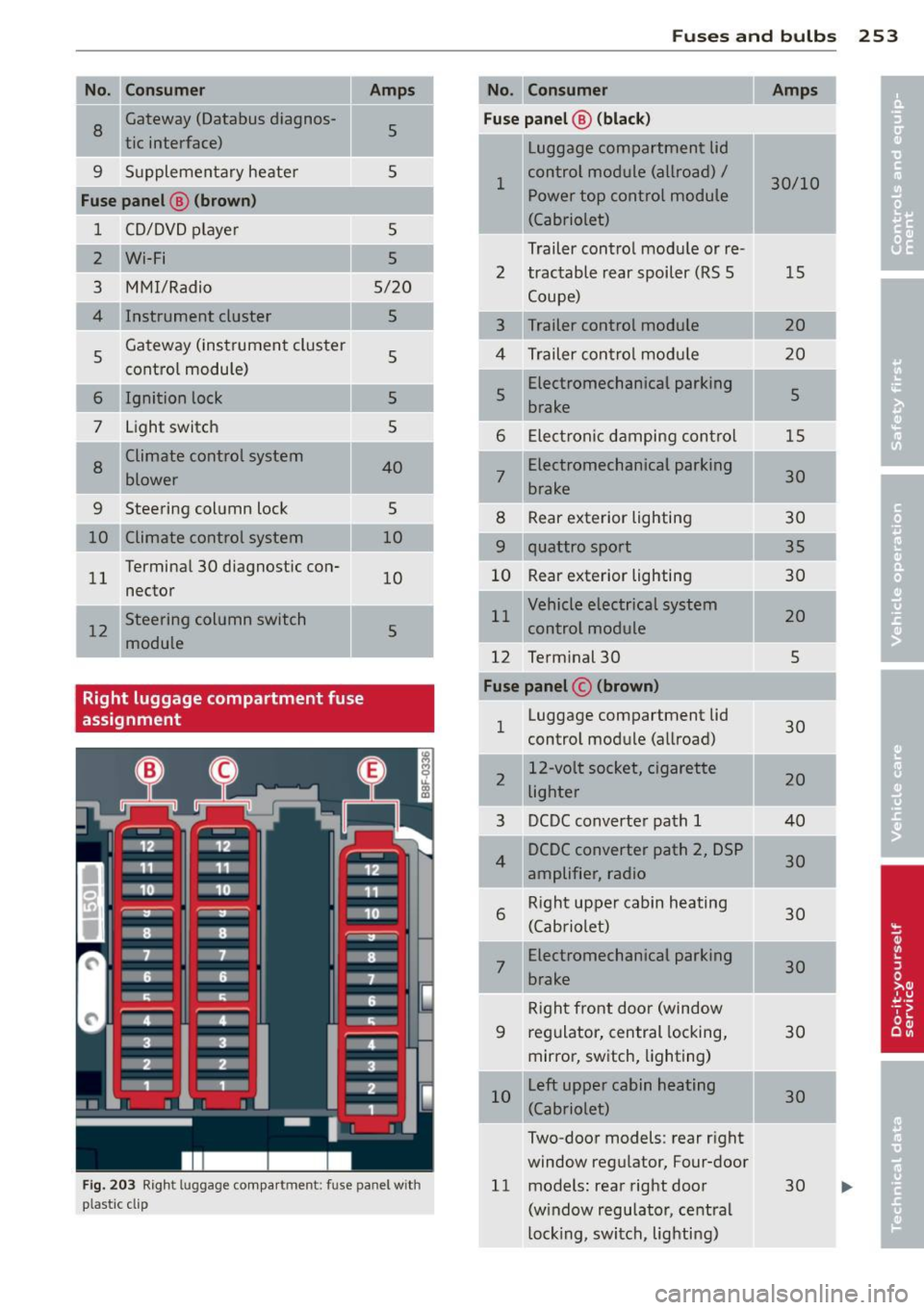
--No. Consumer Amps
I a
Gateway (Databus diagnos-
5 tic interface)
I
9 Supplementary heater
Fuse panel ® (brown )
1 CD/DVD playe r
2
Wi-Fi
3 MMI/Radio
4 Instrument cluster
5 Gateway (instrument cluster
control module)
6 Ignition lock
7 Light switch
8
Climate cont
rol system
blower
9 Steering column lock
10 Climate control system
11 Terminal 30 diagnostic con-
nector
-
12 Steering column switch
module
Right luggage compartment fuse
assignment
5
5
5
5/20
5
5
5
5
40
5
10
10
5
F ig. 203 R igh t lu ggage compar tmen t: fu se pan el w ith
pla stic cl ip
-
Fu se s and bulb s 253
No . Consumer Amps
Fuse panel @ (blac k)
Luggage compartment lid
1 control module (all
road) /
30/10
Power top control module
(Cabriolet)
Trailer con trol modu le or re-
2 tractable rear spoiler (RS 5 15
Coupe)
3 Trailer control module 20
4 Trailer contro l modu le 20
5 Electromechanical parking
5
brake
6 E lectron ic damping con trol 1 5
7
Electromechanical parking
30
brake
8 Rear exterior lighting 30
9 quattro sport
35
10 Rear exterior lighting
30
11 Vehicle electrical system
20
con trol module
12 Term inal 30
5
Fuse panel © (brown )
1 Luggage compartment lid
30
control module (allroad)
-.
2 12-volt
socket, cigarette
20
lighter
3 DCDC converte
r path 1 40
4 DCDC converter path
2, DSP
30
amplifie r, radio
6
Right upper cabin heating
30
(Cabriolet)
7
Electromechanical parking
30
brake
R ig ht front door (window
9 regulator, central locking,
30
mirror, switch, lighting)
10 L
eft upper cabin heating
30
(Cabriole t)
Two-door models : rear r ight
window regu lator, Four-door
11 models : rear right door
30
(w indow regulato r, ce ntra l
l ock ing, switch , lighti ng)
Page 258 of 286
256 Emergency situations
@ Tips
The discharged battery must be properly
connected to the vehicle's electrical sys
tem. When jump starting or charging the
battery, never connect the negative
ground cable to the battery negative post
because the batte ry manager system must
be able to detect the battery 's state of
charge. Always connect the negative
ground cab le to the negative ground post
of the battery manager control unit.
Use of jumper cables
Make sure to connect the jumper cable
clamps in exactly the order described below!
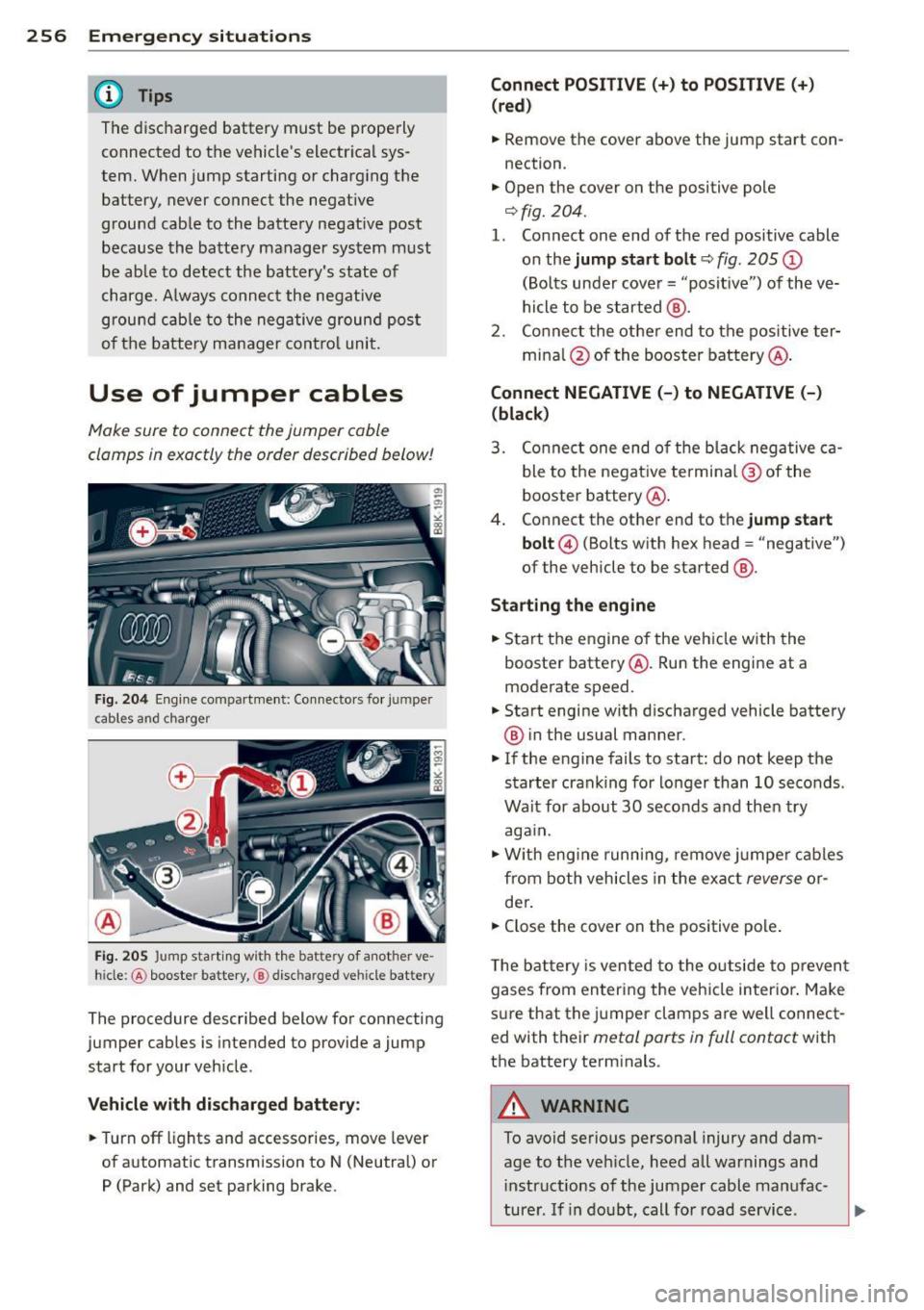
Fig. 204 Engine compartment: Connectors fo r jum per
cables and charger
Fig. 205 Jump sta rting wi th the battery of anot her ve ·
h ide :@ booster battery, @ disc harged vehicle battery
The procedure described below for connecting
jumper cables is intended to provide a jump
start for your vehicle .
Vehicle with discharged battery:
.. Turn off lights and accessories, move lever
of automatic transmission to N (Neutral) or
P (Park) and set parking brake .
Connect POSITIVE(+) to POSITIVE(+)
(red)
.. Remove the cover above the jump start con
nection .
.. Open the cover on the positive pole
¢fig. 204 .
1. Connect one end of the red positive cable
on the
jump start bolt c::> fig. 205 @
(Bolts under cover= "positive") of the ve
hicle to be started @.
2. Connect the other end to the positive ter-
minal @of the booster battery@.
Connect NEGATIVE (-) to NEGATIVE (-)
(black)
3. Connect one end of the b lack negative ca
ble to the negative terminal @of the
booster battery @.
4. Connect the other end to the
jump start
bolt @
(Bolts with hex head= "negative")
of the vehicle to be started @.
Starting the engine
.. Start the engine of the vehicle with the
booster battery@. Run the engine at a
moderate speed.
.. Start engine with discharged vehicle battery
@ in the usual manner .
.. If the engine fails to start: do not keep the
starter cranking for longer than 10 seconds .
Wait for about 30 seconds and then try
again .
.. With eng ine running, remove jumper cables
from both vehicles in the exact
reverse or
der .
.. Close the cover on the positive pole .
T he battery is vented to the outside to prevent
gases from entering the vehicle interior . Make
sure that the jumper clamps are well connect
ed with their
metal parts in full contact with
the battery terminals.
A WARNING
--
To avoid serious personal injury and dam
age to the veh icle, heed all warnings and
instructions of the jumper cable manufac-
turer . If in doubt, call for road service . ..,.