check AUDI RS5 CABRIOLET 2013 Owner's Guide
[x] Cancel search | Manufacturer: AUDI, Model Year: 2013, Model line: RS5 CABRIOLET, Model: AUDI RS5 CABRIOLET 2013Pages: 286, PDF Size: 71 MB
Page 146 of 286

144 Airbag sys tem
-Always move the passenger seat into its
rearmost position in the seat's fore and
aft adjustment range, as far away from
the a irbag as poss ible, before insta lling
the forward-facing child restraint. The backrest must be adjusted to an upr ight
posit io n.
- Make sure that the
PASSENGER AIR BAG
OFF
light comes on and stays on all the
t ime w henever the ignition is switched
on.
Advanced Airbag System components
The fron t passenger sea t in your vehicle h as a
lot of very important par ts of the Advanced
Airbag System in it. These parts include t he
weight -sensing mat, sensors, wiring, brack
ets, and more. The function of the system in
the front passenger seat is checked by the
e lectronic control u nit when the ignit ion is on.
The control unit mo nitors the Advanced Air
bag System and turns the airbag indicator
l ight on when a ma lfunction in t he system
components is detected. The func tion of the
a ir bag ind icator light is described in greater
detai l be low . Because the front passenger
seat contains important parts of the Ad
vanced A irbag System, you m ust take care to
prevent it from be ing damaged. Damage to
the seat may prevent the Advanced Airbag for
the front passenger seat from doing its job in
a crash .
The front Advanced Airb ag Sy stem
consists of the following:
- Crash sensors in the front of the veh icle that
measure veh icle acceleration/deceleration
to provide information to the Advanced Air
bag System abou t the seve rity of the crash.
- An electron ic co ntrol unit, with integ rated
crash sensors for front and side impacts .
T he cont ro l unit "dec ides " w het her to fire
the front airbags based on the information
received from the crash senso rs . The contro l
unit a lso "decides" whethe r the safety be lt
pretensioners should be activated . -
An Advanced A irbag w ith gas generator and
cont ro l valve for the d river inside the steer
ing wheel h ub.
- An Advanced A irbag with gas ge nerator and
contro l valve inside the instrument pane l for
the front passenger.
- A weight-sensing mat under the up ho lstery
pad ding of the front passenger seat cushion
that measures the total weight on the seat.
The informat ion registered is sent continu
ously to the electronic contro l unit to regu
late deployment of the front Advanced Air bag on the passenger side .
- An airbag monitor ing system and i ndicator
light in the i nstr ument cluster ~
page 148 .
-A sensor in each front seat registers the dis
tance between the respective seat a nd the
steer ing whee l o r i ns trument panel. The i n
formation registered is sent cont inuo usly to
t he ele ctr onic cont ro l uni t to regula te de
p loyment o f the front Advance d Airbags .
- The
PASSENGER AIR BAG OFF ligh t comes
on and st ays on in the cen ter o f the instr u
ment panel
~ page 148, fig . 155 and tells
you whe n the front Advanced Airbag on the
passenger side has been tu rned off .
- A sensor below the safety be lt latch for the
front seat passenger to measure the tension on the safety be lt . The tension on the safety
be lt and the weight registered by the
weight-sensing mat he lp the control unit
"decide" whether the front airbag for the
front passenger seat should be turned off or
not
~ pag e 138, Child restraints on the
front seat -some important things to
know.
- A senso r in the safety belt latch fo r th e d riv
er and fo r the front sea t passenger tha t
senses w het he r th at safety bel t is latched or
not and transmi ts this information to the
electronic control unit.
A WARNING
Damage to the front passenger seat can
p revent the front airbag from work ing
properly.
-
Page 151 of 286
If the fron t passenger seat is not occupied,
the front airbag will not deploy, and the
PAS
SENGER AIR BAG OF F
light will stay on. Nev
er in sta ll a rearward-fac ing ch ild restra int on
t he fron t passenger seat, the safest place for
a child in any kind of child restraint is at one
of the seating positions on the rear seat
¢ page 138, Child restraints on the front seat
- some important things to know
and
¢ page 158, Child Safety .
If the PASSENGER AIR BAG OFF light c om es
on
when one of the conditions listed above is
met, be sure to check the light regularly to
make certa in that the
PAS SENGER AIR BAG
O FF
ligh t stays on cont inuous ly whenever the
ignition is on . If the
PASSENGER AIR BAG
OFF
light does not appear and not stay on all
the time, stop as soon as it is safe to do so
and
- reactivate the system by turning the ignition
off and then t urning it on again;
- remove and reinstall the child restraint .
Make sure that the child restraint is properly
installed and that the sa fety be lt for the
front passenger seat has been correct ly
routed around the child restraint a s desc ri
bed in the child restraint manufacturer 's in
structions;
- make sure that the convertible locking fea
ture on the safety be lt for the front passen
ger seat has been activated and that the
safety belt has been pulled tight . The belt
mus t not be loose o r have loops of slack so
that the sensor below the safety be lt latch
on the seat can do its job
¢ page 168 .
-make su re that th ings that may increase the
weight of t he ch ild and child safe ty seat are
not being transported on the front passen
ger seat ;
- make su re that the safety bel t tension sen
sor is not b locked . Shake t he safety belt
l atch on the front passenger seat back and
forth;
- If a strap or tether is being used to tie the
child safety seat to the front passenger
seat, make sure that it is not so tight that it
A irbag system 149
causes the weight -sensing mat to measure
more weight than is act ually on the seat .
If the PASSENGER AIR BAG OFF light still
doe s not come on
and does not stay on con
tin uous ly (when the ignition is switched on) ,
- take the child rest ra int off the front passen-
ge r seat and install it properly a t one of the
rear seat positions. Have the airbag system
inspected by yo ur authorized Audi dealer
immediate ly .
- move the child to a rear seat position and
make sure t hat the c hild is properly restrain
ed in a c hild restra int that is app ropriate for
its size and age.
T he
PASSENGER AIR BAG OFF light sho uld
NOT come on when the ignition is on and an
adult is sitting in a proper seating position on
the front passenger seat. If the
PASSENGER
AIR BAG OFF
ligh t comes on and stays on or
flashes for about 5 seconds wh ile driving, un
der these c ircumstances , make sure that:
- the adult on the front passenger seat is
properly seated on the center of the seat
cushion wi th his or her back up aga inst the
backrest and the backrest is not recl ined
¢ page 119, Proper occupant seating posi
tions,
- the adult is not tak ing weight off the seat by
holding on to the passenger assist handle
above the front passe nger door or support
ing their weight on the armrest ,
- the safety belt is being properly wo rn and
t ha t there is not a lot of s lack in the safety
be lt webbing ,
- ac cesso ry seat covers or cushions o r other
t hings tha t may cause an incorrect reading
or impression on the we ight-sensing mat
under the upho lstery of the seat have been
removed from the front passenger seat,
- a sa fety belt exten der has not been left in
the safety belt latch for the front passenger
seat.
In add it ion to the
PASSENGER AIR BAG OFF
li ght in the cente r of the instrumen t panel,
the message
PASSENGER AIR BAG OFF or
PASSENGER AIR BAG ON wi ll briefly appear ll-
•
•
Page 168 of 286
166 Child Safety
belts, ¢page 137, Airbag system and
c:> page 158, Important things to know.
A WARNING
If exceptional circumstances require the
use of a forward-facing child restraint on
the front passenger's seat, the child's safe
ty and well-being require that the follow ing special precautions be taken :
- Make sure the forward -facing seat has
been designed and certified by its manu
facturer for use on a front seat with a
passenger front and side airbag.
-Always follow the manufacturer's in
structions provided with the child safety
seat or infant carrier.
- Always move the front passenger seat in
to the rearmost position of the passen
ger seat's fore and aft adjustment range,
and as far away from the airbag as possi
ble before installing the child restraint .
- Always make sure that nothing prevents
the front passenger's seat from being
moved to the rearmost position in its
fore and aft adjustment range.
- Always make sure the backrest is in an
upright position.
- Make sure that the
PASSENGER AIR BAG
OFF
light comes on and stays on all the
time whenever the ignition is switched on .
- If the light does not stay on, perform the
checks ¢
page 148, Monitoring the Ad ·
vanced Airbag System.
- Take the child restraint off the front pas
senger seat and install it properly at one
of the rear seat positions if the
PASSEN
GER AIR BAG OFF
light does not stay on
whenever the ignition is switched on .
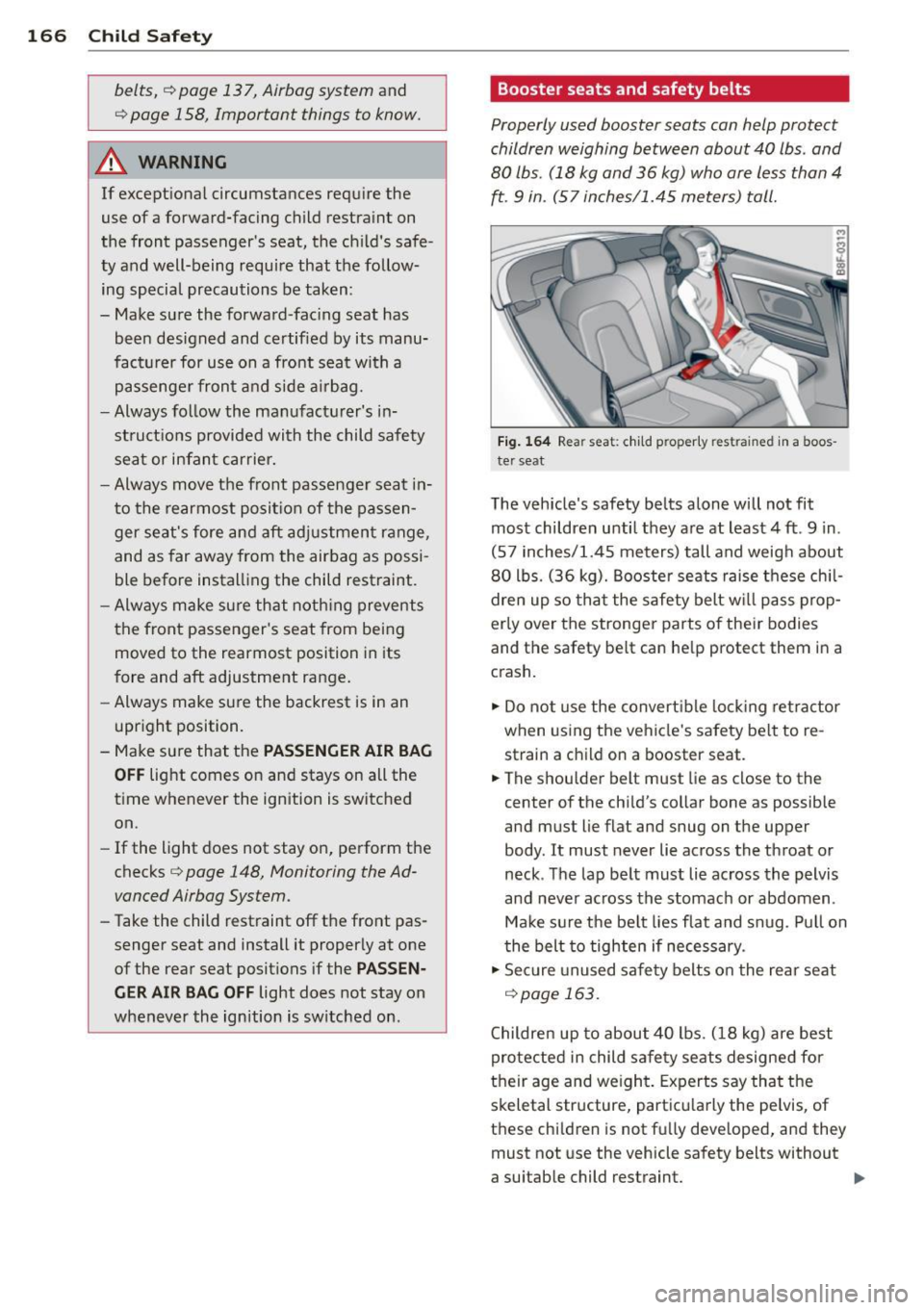
Booster seats and safety belts
Properly used booster seats can help protect
children weighing between about 40 lbs . and
80 lbs . (18 kg and 36 kg) who are
less than 4
ft. 9 in. (57 inches/1.45 meters) tall.
Fig. 164 Rea r seat : child p rop erly r estrained in a boo s
te r se at
The vehicle's safety belts alone will not fit
most children until they are at least 4
ft . 9 in .
(57 inches/1.45 meters) tall and weigh about
80 lbs.
(36 kg). Booster seats raise these chil
dren up so that the safety belt will pass prop
erly over the stronger parts of their bodies
and the safety belt can help protect them in a
crash.
.. Do not use the convertible locking retractor
when using the vehicle's safety belt to re strain a child on a booster seat.
.. The shoulder belt must lie as close to the
center of the child 's collar bone as possible
and mu st lie flat and snug on the upper
body.
It must never lie across the throat or
neck . The lap belt must lie across the pelvis
and never across the stomach or abdomen .
Make sure the belt lies flat and snug . Pull on
the belt to tighten if necessary .
.. Secure unused safety belts on the rear seat
c::>page 163.
Children up to about 40 lbs. (18 kg) are best
protected in child safety seats designed for
their age and weight. Experts say that the
skeletal structure, particularly the pelvis, of
these children is not fully developed, and they must not use the vehicle safety belts without
a suitable child res traint.
...
Page 170 of 286
168 Child Saf ety
- If the PASS ENGER AIR BAG O FF li ght
does not come on and stay on, perform
the checks described
c:> page 148, Moni
toring the Advanced Airbag System .
-Take the child restraint off the front pas
senger seat and install it properly at one
of the rear seat positions if the
PASSEN
GER AIR BAG OFF
light does not stay on
whenever the ignition is switched on.
- Always read and heed all WARNINGS whenever using a child rest rained in ave
hicle is being used
c:> page 129, Safety
belts, c:>page
137, Airbag sy st em and
<:?v page 158, Important things to know.
Installing a child safety
seat
Securing a child safety seat using a
safety belt
Safety belts for the rear seats and the front
pas senger 's seat can be locked with the con
vertible locking retractor to properly secure
child safety seats.
The safe ty belts eme rgency lock ing re tractors
fo r the re ar seats safe ty belts and for the
fro nt passenger's seat safety belt have a con
vertible locking retracto r fo r child restraints.
The safety belt must be locked so that belt
webbing cannot unree l. The retractor can be
activated to lock the safety be lt and prevent
the safety belt webbing from loosening up
during normal driving . A child safety seat can
only be properly installed when the safety belt
i s locked so that the child and child safety
seat will stay in place.
A lways remember: Even thoug h your veh icle is
eq uipped w it h an Advanced A irbag system, all
ch ildren , espec ia lly those 12 yea rs and yo ung
e r, should always ride in the ba ck seat proper
l y res traine d for thei r age and weig ht.
_& WARNING
Imprope rly insta lled child sa fe ty seats in
crease the risk of ser ious personal inju ry
and death in a collision. -
Always make sure that the safety belt re
tractor is locked when insta lling a child
safety seat. An unlocked safety belt re
tractor cannot hold the child safety seat in place dur ing no rma l dr iving o r in a
crash .
- Always buckle the child safety seat firmly in place even if a ch ild is not sitt ing in it .
A loose child safety seat can fly aroun d
du ring a s udden st op or in a colli sion.
- I f the backrest is not securely la tched,
the child and the child restraint will be
throw n forward toge ther with t he ba ck
rest and will strike par ts of the vehicle
interior. The child can be se riously in
jured or killed.
- Never inst all rearward-facing child safety
seats or infant ca rr iers on the front pas
senger seat . A child will be serious ly in
jured and can be killed when the passen
ger airbag i nflates.
- The inflating airbag will h it the ch ild
safety seat or infant carrier with great
force and will smash the child safety seat
and child aga inst the back rest , center
armrest, doo r or roof.
- Always install rearward-facing ch ild safe
ty seats or infa nt carriers on the rea r
seat .
- Forwa rd-facing child safety seats or in
fant car riers installed on the front pas
senger's seat may interfere with t he de
p loyment of t he a irbag and cause serious
i njur y to the child .
-It is safer to ins tall a forward-facing
child safety seat on the rear seat.
- Always read and heed all WAR NIN GS
whe neve r using a child restrai ned in ave
h icle i s being u sed
c:> page 158. Special
p reca utions apply when ins tal ling a child
safety seat on the fron t passenger seat
c:> page 138, Child restraints on the front
seat -some important things to know.
_& WARNING
--
Always take specia l precautions if you
must install a forwa rd or rearward-facing
Page 171 of 286
child restraint on the front passenger's
seat in exceptional situations:
- Whenever a forward or rearward-facing
child restraint is installed on the front
passenger seat, the
PASSENGER AIR
BAG OFF
light must come on and stay on
whenever the ignition is switched on .
-If the PASSENGER AIR BAG OFF light
does not come on and stay on, perform
the checks described
~ page 148, Moni
toring the Advanced Airbag System .
- Take the child restraint off the front pas
senger seat and install it properly at one
of the rear seat positions if the
PASSEN·
GER AIR BAG OFF
light does not stay on
whenever the ignition is switched on.
- Improper installation of child restraints
can reduce their effectiveness or even
prevent them from providing any protec
tion.
- An improperly installed child restraint
can interfere with the airbag as it de
ploys and seriously injure or even kill the
<;hild.
- Always carefully follow the manufactur
er's instructions provided with the child
safety seat or carrier.
- Never place additional items on the seat
that can increase the total weight regis
tered by the weight-sensing mat and can cause injury in a crash.
_&. WARNING
Forward-facing child restraints:
- Always make sure the forward-facing
seat has been designed and certified by
its manufacturer for use on a front seat
with a passenger front and side airbag.
- Never put the forward-facing child re·
straint up, against or very near the in
strument panel.
- Always move the passenger seat into its
rearmost position in the seat's fore and
aft adjustment range, as far away from
the airbag as possible before installing
the forward-facing child restraint. The
Child Safety 169
backrest must be adjusted to an upright
position.
- Make sure that the
PASSENGER AIR BAG
OFF
light comes on and stays on all the
time whenever the ignition is switched
on .
_&. WARNING
"' Rearward-facing child restraints:
-A child in a rearward-facing child safety
seat installed on the front passenger
seat will be seriously injured and can be
killed if the front airbag inflates - even
with an Advanced Airbag System .
- The inflating airbag will hit the child
safety seat or infant carrier with great
force and will smash the child safety seat
and child against the backrest, center
armrest, door or roof.
-Always be especially careful if you must
install a rearward facing child safety seat
on the front passenger seat in exception
al circumstances.
-A tight tether strap on a rearward-facing
child restraint attached to the front pas
senger seat can put too much pressure
on the weight-mat in the seat and regis
ter a heavier weight in the Advanced Air bag System. The heavier weight regis
tered can make the system work as
though an adult were on the seat and de
ploy the Advanced Airbag when it must
be suppressed causing serious or even
fatal injury to the child.
- Make sure that the
PASSENGER AIR BAG
OFF
light comes on and stays on all the
time whenever the ignition is switched
on.
- If the PASSENGER AIR BAG OFF light
does not come on and stay on, immedi
ately install the rearward-facing child
safety seat in a rear seating position and
have the airbag system inspected by your
authorized Audi dealer. •
•
Page 174 of 286

172 Child Saf ety
LATCH Lower
anchorages and tether
for children
Child Restraint System anchors and how
are they related to child safety
To provide a simpler and more practicable way
to attach the ch ild restraint on the vehicle
seat, Federa l regu lations require specia l lower
anchorages in vehicles and dev ices on new
child restraints to attach to the vehicle ancho
rages .
The combination of the tether anchorages and
the lower anchorages is now generally called
the
LAT CH system for " Lower Anchorages and
Tethers for Children ."
F orward-facing child restraints manufactured
after September 1, 1999, are required by U.S.
federal regulations to comply with new child head movement performance requirements .
These new performance requirements make a
tether necessary on most new child seats.
Installing a chi ld restraint that requires a top
tether without one can serious ly impair the
performance of the chi ld restraint and its abi l
ity to protect the ch ild in a collision. Installing
a child restraint that requires a top tether
without the top tether may be a v iolation of
state law .
Ch ild restra int manufacturers offer LATCH
lower anchorages on the ir ch ild seats with
hook -on or push-on connectors attached to
adjustable straps .
In addition to the LATCH lower anchorages,
these child restraint systems usually require
the use of tether straps to help keep the child restra int firmly in place .
Tether ancho rage s
Your Audi Cabriolet is not equipped with a
LATCH system. It is no t equ ipped with top
tether anchorages. It is equipped with lower
anchorages only.
Your Cabriolet is equipped with the Active Rollover Protection System, which is integrat- ed into the backrest o
f the rear seat . The Ac
tive Ro llover Protection System dep loys up
wards to he lp provide addit ional protection in
certain co llisions and crash s ituations. For this
reason, your vehicle is
not equipped with top
tether anchorages for use with forward -facing
child restra ints .
In Canada , provinc ial law requ ires that for
ward-fac ing ch ild restra ints use both top teth
er anchorages and lower anchorages; there
fore, it is
not possible to install a forward-fac
ing ch ild restra int in this vehicle.
In the United States , child restraint installa
t ion must conform w ith the child restraint
manufacture r's instructions . Check the in
structions that come w ith the child restra int
o r contact the manufactu rer to determine if
the ch ild restraint may be insta lled fac ing fo r
ward witho ut securing the top tether s trap .
A WARNING
=
Improper installation of child restraints
will increase the r isk of injury and death in
a crash.
- Always follow the instr uctions provided
by the manufacturer of the child re
straint you intend to install in your vehi
cle.
- Improper use of child restraint LATCH
lower anchorage points can lead to injury
in a collision. The LATC H lower anchorage
points are designed to withstand on ly
those loads imposed by correctly fitted
child restraints.
- Never mount two child restra int systems
on one LATC H lower anchorage point .
- Never secure or attach any luggage or other item to the LATCH lower anchorag
es .
(D Tips
In other countries, the term "ISOFIX" is
used to describe the lower anchorages .
-
Page 181 of 286

You can compensate for th is sligh tly re duced
brak ing power by push ing harder on the brake
pedal. Avoid heavy braking loads d uring the
break-in per iod.
Operating condit ion s and d riv ing hab it s
The brakes on today's automobi les are st ill
subject to wear, depend ing largely on operat
ing conditions and driving habits¢.&. . On
vehicles that are either driven mostly in stop and-go city traffic or are driven hard, the brake pads should be checked by your author
i zed Audi dealer more often than specified i n
the
Warranty & Maint enan ce booklet . Failure
to have your brake pads inspected can result
in reduced b rake performance.
On steep slopes, you should use the brak ing
effect of the engine . Th is way, you prevent un
necessary wea r on the brake system. If you
must use you r brakes, do not hold the brakes
down continuously. P ump the b rakes a t inter
va ls.
Operating noise
Noises may occur when braking depending on
the speed, braki ng force and outside condi
tions such a s tempe ratu re a nd h umidity .
Due to the nature of the materials used i n ce
ramic brake rotors*, nois es may become more
apparent at low speeds.
Effect of w ater and ro ad s alt
In certain situat ions, for example after driving
through water, i n heavy ra in, after over night
condensation or after washing your car, the
b rak ing effect can be reduced by moistu re or
i ce on the bra ke roto rs and b rake pads . The
b ra kes must be dried fi rs t w it h a few caref ul
b ra ke app lications.
At h igher speeds and with the w indshield w ip
e rs turned on, the brake pads p ress against
the brake rotors for a short amount of time.
This occurs a t reg ular in tervals wi tho ut the
d river noticing and provides for better brake
response time un der wet conditions.
The effectiveness of the brakes can be reduced
when the vehi cle is dr iven o n a salt -cove re d
Int ellig ent technolog y 179
road and the b ra kes are no t used. Likewise ,
you clean off acc umulated salt coating from
brake d iscs and pads with a few cautio us ap
plications of the brake
9 ,&. .
Due to the ir sur face character istics, ceramic
brake rotors* absorb moisture i n such condi
tions. T his can cause a tempo rary reduction in
braking force compared to dry brakes. Yo u can
compensate for this by pressing the brake
pedal harder .
Corrosio n
There may be a tendency for dirt to b uild up
on the brake pads and corros ion to form on
the d iscs if the car is not driven regularly or
o nly for short trips w ith litt le use of the
brakes .
If the brakes are not used frequently, or if cor
ros ion has formed on the discs, i t is adv isable
to clean off the pads a nd d iscs by braking
firmly a few times from a moderately high
speed
9 &. .
Fault s in the brake sy stem
If you shou ld notice a sudden increase in
brake pedal travel, then one of the two b rake
c ircui ts may have failed ¢&. .
Lo w brake fluid lev el
Malfunctions can occ ur in the brake system if
the brake fluid level is too low. The brake fluid
level is monitored electronica lly.
Brake booster
T he br ake booster inc reases the pressure tha t
yo u gene rate with t he brake peda l. It works
o nl y when t he engine is running .¢
&
Brake lining wear status
B ra ke lining wear may be checked by visual in
spe ction o f the condition of the bra ke pads
th rough the open ings in the wheel. If neces
sary, the wheel may be removed for t his in
spection ¢
page 245, Changing a wheel.
•
•
Page 187 of 286

A WARNING ,~
After driving through water, mud, slush,
etc., the brakes may be slow to take effect
because of wet brake rotors and pads. Dry
the brakes first by braking carefully to re
store the full brak ing effect.
([) Note
Vehicle components such as the engine,
transmiss ion, suspension or electrical sys
tem can be severely damaged by driving
through wate r.
@ Tips
- Check the depth of the water before dr iv
i ng through it.
- Do not stop the veh icle, dr ive in reverse
or switch the engine off when driving
th rough water.
- Keep in mind that oncoming vehicles may create waves that raise the water
level and make it too deep for you r vehi
cle to drive through safely.
- Avoid dr iving through salt water because
i t can cause corrosion.
Warming up and
cooling down
By carefully warming up and cooling down
your vehicle, you can he lp ensure that it is not
overstressed unnecessarily during sporty driv ing.
When warming up, the vehicle is driven at a maximum engine speed of 6000 RPM in order
to raise the engine oil temperature to a mini mum of 140 °F (60 °C) . The tires also only
reach their full road holding capability once
they have warmed up .
The cooling fan can continue to run in your ve h icle after the engine is switched off. Howev
er, driving the vehicle to cool it down is part ic
ularly important . Du ring sporty driving, the
engine and brakes, the exha ust system, and
the transm ission all become ext remely hot.
Before you park the vehicle, you shou ld drive
Dri vin g and en vironm ent 185
it for a few miles/kilometers at light load in
the low rpm range to allow it to cool down.
Catalytic converter
It is very important that your emission con
trol system (catalytic converter) is function
ing properly to ensure that your vehicle is run
ning in on environmentally sound manner.
"" Always use lead-free gasoline c> page 202,
Fuel supply.
"" Never run the tank down all the way to emp
ty.
"" Never put too much motor o il in your engine
<=> page 212, ~ Adding engine oil .
""Never try to push- or tow-sta rt you r vehicle.
The catalyt ic converter is an efficient "clean
up" device bui lt into the exhaust system of
the ve hicl e. The cata lytic conve rter bu rns
many of t he pollutants in the exha ust gas be
fo re t hey are re leased into the atmosphere.
The exclusive use of unleaded fue l is critically
important for the life of the catalyt ic convert
er and proper funct ion ing of the engine.
A WARNING ~
- The temperature of the exhaust system
is high, both when driving and after stop
ping the engine.
- Never touch the exhaust tail pipes once they have become hot . This could result
in burns .
- Do not park or operate the vehicle in areas where the hot exha ust system may
come in contact with dry grass, brush,
fuel spill or other material wh ich can
cause a fire.
- Do not apply additional undercoating or rustproof ing on or near the exhaust
manifold, exhaust pipes, catalytic con
verter or heat shields . Dur ing driving, the
substanc e used fo r undercoating could
overheat and cause a fire. •
•
Page 189 of 286
Avoid full throttle
Driving at moderate speeds saves fuel and
improves your mileage.
""Try and keep well below your car's maximum
speed.
Accelerating gently reduces fuel consump
tion, engine wear, and does not disturb the
environment.
Fu el consumption, exhaust emissions and en
g ine noise increase disproportionately at high
speeds. If you drive at approximately three
quarters of top speed, fuel consumption will
be reduced by one half. Never drive faster
than the posted speed limit and weather con
ditions permit .
Reducing unnecessary idling
Even when your car is just idling it burns up
fuel.
""Shut the engine off when you are not driving
the vehicle.
"" Do not warm up the vehicle by letting the
engine run at idle .
It makes sense to shut
off the engine in traff ic
jams, when waiting for trains to pass at ra il
road crossings, or at traffic lights that have
l ong wa its on red. Turning the engine
off for
just
30-40 seconds saves more fue l than is
burned starting the engine again .
It takes a long time for the engine to warm up
fully when it is running at idle. However, wear
and noxious emissions are especially high
when the engine is warming up. So you should
drive away as soon as you start the engine and
avoid running at high rpms while the engine is
still warming up.
(D Note
Do not leave engine idling unattended af
ter starting . If warning lights should come
on to indicate improper operation, they
would go unheeded. Extended idling also
produces heat, which cou ld result in over-
Driving and environment 187
'
heating or othe r damage to the vehicle or
other property.
Regular maintenance
A badly tuned engine unnecessarily wastes a
lot of fuel.
""H ave your veh icle serviced at regular inter-
vals.
By having your vehicle regu larly serviced by an
au thorized Aud i dea ler helps to ensure that it
runs properly and economic all y. The condition
of your veh icle not on ly affects its safety and
ability to hold its va lue, it a lso affects
fuel
consumption .
Check your oil each time you fill your tank.
The amount of o il used is related to engine
load and speed.
It is normal for the oil consumption of a new
engine to reach its lowest value after a certain
mileage has been driven.
You must drive your vehicle about 3,000 miles
(5,000 kilometers) before you can properly
assess oil consumpt ion.
This also app lies to fue l consumption and en
gine output.
(U) Note
- Have your vehicle maintained properly
and in accordance with the service rec
ommendations in your Warranty
& Main
tenance booklet. Lack of proper mainte
nance as well as improper use of the ve
hicle will impair the function of the
emission control system and could lead
to damage.
- Do not alter or remove any component of
the Emission Control System unless ap
proved by the manufacturer.
- Do not alter or remove any device, such
as heat shields, switches, ignition wires,
valves, which are designed to protect
your vehicle's Emission Control System
and other important vehicle compo
nents .
•
•
Page 198 of 286
196 Cleaning and protection
Use only special acid -free cleaners form ulated
for a lloy rims. Safe products are available at
your author ized Audi dealer . Never leave the
cleaner on the rims longer than specified on
the label.
If no t rinsed off promptly, the acid
contained in some cleaners can attack the
threads on the wheel bolts .
Never use abras ive or metal polishing clean
ing agents. If the protective coating has been
chipped, e .g . by k icked up road dirt, touch it
up as soon as poss ible.
A WARNING
- Moist ure and ice on brakes may affect
braking efficiency ~
page 178. Test the
br ake s ca refully each time you wash the
vehicle.
- Always read and heed all WARNI NGS and
other informa tion ~
page 189.
Body cavity sealing
-
The body cavity sealing does not need to be
checked.
A ll body cavities wh ich could be affected by
corrosion have been thoroughly protected at
the facto ry.
T his sea ling does not require any inspection or
addit io nal treatment. If any wax should seep
out of the cav ity when the ambient tempera
ture is high, it can be removed w it h a plastic
scrape r and a su itab le so lven t.
A WARNING
So lvents can be dange rous.
- B enzine is flammable and t oxic.
If you
use benzine for removing the w ax, keep
spar ks, flame and lighted cigaret tes
away. Never dump benzine on t he
ground, into open streams or down sew
age drains.
- Be sure to observe all safety and env iron
menta l regulations . Follow all instruc
t ions on the container.
- Always read and heed all WAR NIN GS and
other information
¢ page 189. Chassis
Have the undercoating checked for damage
from time to time.
The lower body shell of your Aud i is also thor
oughly protected against cor ros io n.
Any damage to the unde rcoating ca used by
road ha zards should be repaired prompt ly.
A WARNING ....__
Too much undercoating in the wrong p la
ces can cause a fire.
- Do not app ly additional undercoating or
r u stp roof ing on or near the exhaust
manifold, exhaust pipes, catalytic con
ver ter or heat shields. While driving, the
substance used fo r undercoating could
overhea t and cause a fire.
- Always read and heed all WAR NINGS and
o ther info rmation ¢
page 189.
Exhaust tail pipes
Road salt and o ther co rrosive materials w ill
damage the mate ria l in the e xhaus t ta il pipes
i f they are not cleaned regular ly . Do not clean
the tail pipes with w hee l cleaner, pa int polish,
c h rome polish or other ab rasive cleane rs .
Clean the tail pipes with car care products
t h at are suitable for sta inless steel.
Your a uthorized Audi dea ler can prov ide clean
ing products that have been tested and ap
proved for your vehicle .
Care of interior
Infotainment components
The Rad io/MM !* disp lay may be cleaned w ith
a soft cloth and comme rcially-ava ilable "LCD
cl eaner". The clot h should be coated lightly
whe n the cleaning solution w hen clea ning t he
display.
T he M MI* con trols m ust be clean ed first wi th
a b rush so tha t dirt does not en ter the uni t or
enter between the buttons an d the housing.
The n wiping the controls with a cloth ..,.