lights AUDI RS5 CABRIOLET 2013 Owner's Guide
[x] Cancel search | Manufacturer: AUDI, Model Year: 2013, Model line: RS5 CABRIOLET, Model: AUDI RS5 CABRIOLET 2013Pages: 286, PDF Size: 71 MB
Page 182 of 286

180 Intelligent technology
8_ WARNING
-New brake pads don't have the best stop
ping power and must be "broken -in" dur
ing the initial 100 to 150 miles (150 to
200 kilometers) of normal city driving .
The break-in period can be considerably
longer for vehicles with ceramic brake ro
tors*. You can compensate for this by pressing the brake pedal more firmly.
This also applies later when new pads are
installed.
- You should perform braking maneuvers
for the purpose of cleaning the brake
system only if road conditions permit.
Other road users must not be put at risk -
you may cause an accident!
- Before descending a steep grade, reduce
speed and shift transmission into a lower
gear or lower driving range. Do not ride
the brakes or hold the pedal down too
long or too often. This could cause the
brakes to get hot and diminish braking
efficiency .
- Do not "ride the brakes" by resting your
foot on the pedal when you do not intend
to brake . This may cause the brakes to
overheat, premature wear and increased
stopping distance.
- Under certain climatic and operating
conditions such as passing through wa
ter, driving in heavy rain or after washing
the vehicle, the effectiveness of the
brakes can be reduced. In winter, ice can
accumulate on the brake pads, linings,
discs and drums . Carefully apply brakes
for a test . Brakes will dry and ice coat
ings will be cleaned
off after a few care
ful brake applications.
- Driving for an extended period of time on
salt-covered roads without using your
brakes can also affect braking efficiency.
Clean
off accumulated salt coating from
brake discs and pads with a few careful
brake applications.
- If you damage the front spoiler, or if you
install a different spoiler, be sure the air
flow to the front brakes is not obstruct- ed
. Otherwise the brake system could
overheat reducing the effectiveness of
the entire brake system.
- Failure of one brake circuit will impair
the braking capability resulting in an in
creased stopping distance. Avoid driving
the vehicle and have it towed to the near
est authorized Audi dealer or qualified
workshop.
- Never let the vehicle roll to a stop with
the engine shut off.
- If the brake booster is not working, for
example when towing your vehicle, or
because the brake booster has somehow
been damaged, the brake pedal must be
pressed considerably harder to make up
for the lack of booster assistance.
Electro-mechanical
power assist, dynamic
steering
The electro-mechanical power assist helps
the driver when steering .
Power steering adapts electronically based on
the vehicle speed.
Indicator lights and messages
• Steering defective! Do not drive vehicle!
If this indicator light turns on and stays on
and this message appears, the power steering
may have failed.
Do
not continue driving . See your authorized
Audi dealer or other qualified repair facility
for assistance .
''!'Y Dynamic steering: System fault! You can
continue driving
If the indicator light turns on and the mes
sage appears, the steering may be more diffi
cult to
move or more sensitive than usual. The
steering wheel may also be at an angle when
driving straight .
Drive slowly to your authorized Audi dealer or
qualified workshop to have the malfunction
corrected. .,..
Page 184 of 286
182 Intelligent technology
-On wet road surfaces , be careful not to
dr ive too fast because the front wheels
cou ld beg in to slide on top of the water
(aquaplaning). If this should occur, you
will have no warning from a sudden in
c rease in engine speed as with a front
wheel drive vehicle. A lways d rive at
s peeds w hich a re suited to the road con
di tions -ris k of crash.
Energy management
Starting ability is optimized
Energy management controls the distribution
of electrical energy and thus optimi zes the
availabili ty of elec trical energy for s tarting
t he engine.
If a vehicle with a conventional energy system
is not driven for a long period of time, the bat
te ry is d ischarged by idling current consumers
(e.g . immobilizer) . In certain ci rcumstances it
can result i n there bei ng ins ufficient ene rgy
ava ilab le to start th e engi ne .
Intell igen t energy management in y our veh i
cle hand les the d istribution of electrical ener
gy. Starting ab ility is markedly improved and
the life of the battery is extended .
Basically, energy management consists of
battery diagnos is , idling current manage
ment
and dynamic en ergy management .
Battery diagnosis
Battery d iagnosis continuously determ ines
the state of the battery. Sensors determ ine
battery vo ltage, ba tte ry current and battery
temperature . This dete rm ines the current
state of charge and the powe r of the battery.
Idling current management
Idling current management reduces energy
consumption while the vehicle is stand ing.
W ith the igni tion switched off, it cont ro ls the
energy s upply to the va rious e lectr ica l compo
n ents . Data from battery diagnosis is consid
e red. D
epend ing on the ba tte ry's state o f cha rge ,
indivi dual cons umers a re g radually turned off
to prevent excessive discharge of t he battery
and th us maintain starting capability.
Dynamic energy management
While the vehi cle is being d riven, dynami c en
ergy management distr ibutes the energy gen
erated accord ing to t he needs of the indivi du
al components . It regulates consumption, so
t h at more electrical energy is not being used
t h an is be ing generated and ensures an opti
mal state of charge fo r the battery .
(D Tips
-But even ene rgy management cannot
negate the limits of physics. Consider
t ha t the powe r and life of a battery are
limited.
- If start ing ability is t hreatened , the indi
cator light(•) appears ~
page 17.
What you should know
The highest priority is given to maintaining
starting capability.
The battery is severe ly taxed in short-d istance
driv ing, in city traff ic and during the cold time
of yea r. Ab undant electrical e nergy is re
quired, but on ly a little is generated . It is also
c rit ical if th e engi ne is no t ru nning and e lectri
ca l c ompone nts are t urned on . In this in
sta nce ene rgy is be ing consumed but none i s
being gene ra ted .
It is in prec isely these s ituations that you will
not ice ene rgy management a ct ive ly reg ulat
in g t he di stribu tion of ene rgy.
Vehicle stands for an extended period
If you do not drive your vehicle over a period
of seve ral days or weeks , e lectr ica l compo
n ents a re g radually cut bac k or sw itched off.
T h is reduces energy consump tion and ma in
ta in s start ing c apabili ty over a longer pe riod .
Some of the convenience func tions may not
opera te, such as t he interio r lights or the
power seat adjustme nt. The convenience
ll-
Page 189 of 286
Avoid full throttle
Driving at moderate speeds saves fuel and
improves your mileage.
""Try and keep well below your car's maximum
speed.
Accelerating gently reduces fuel consump
tion, engine wear, and does not disturb the
environment.
Fu el consumption, exhaust emissions and en
g ine noise increase disproportionately at high
speeds. If you drive at approximately three
quarters of top speed, fuel consumption will
be reduced by one half. Never drive faster
than the posted speed limit and weather con
ditions permit .
Reducing unnecessary idling
Even when your car is just idling it burns up
fuel.
""Shut the engine off when you are not driving
the vehicle.
"" Do not warm up the vehicle by letting the
engine run at idle .
It makes sense to shut
off the engine in traff ic
jams, when waiting for trains to pass at ra il
road crossings, or at traffic lights that have
l ong wa its on red. Turning the engine
off for
just
30-40 seconds saves more fue l than is
burned starting the engine again .
It takes a long time for the engine to warm up
fully when it is running at idle. However, wear
and noxious emissions are especially high
when the engine is warming up. So you should
drive away as soon as you start the engine and
avoid running at high rpms while the engine is
still warming up.
(D Note
Do not leave engine idling unattended af
ter starting . If warning lights should come
on to indicate improper operation, they
would go unheeded. Extended idling also
produces heat, which cou ld result in over-
Driving and environment 187
'
heating or othe r damage to the vehicle or
other property.
Regular maintenance
A badly tuned engine unnecessarily wastes a
lot of fuel.
""H ave your veh icle serviced at regular inter-
vals.
By having your vehicle regu larly serviced by an
au thorized Aud i dea ler helps to ensure that it
runs properly and economic all y. The condition
of your veh icle not on ly affects its safety and
ability to hold its va lue, it a lso affects
fuel
consumption .
Check your oil each time you fill your tank.
The amount of o il used is related to engine
load and speed.
It is normal for the oil consumption of a new
engine to reach its lowest value after a certain
mileage has been driven.
You must drive your vehicle about 3,000 miles
(5,000 kilometers) before you can properly
assess oil consumpt ion.
This also app lies to fue l consumption and en
gine output.
(U) Note
- Have your vehicle maintained properly
and in accordance with the service rec
ommendations in your Warranty
& Main
tenance booklet. Lack of proper mainte
nance as well as improper use of the ve
hicle will impair the function of the
emission control system and could lead
to damage.
- Do not alter or remove any component of
the Emission Control System unless ap
proved by the manufacturer.
- Do not alter or remove any device, such
as heat shields, switches, ignition wires,
valves, which are designed to protect
your vehicle's Emission Control System
and other important vehicle compo
nents .
•
•
Page 193 of 286
(D Note
-Never try to remove dirt, mud or dust if
the surface of the vehicle is dry. Never
use a dry cloth or sponge, since this
could scratch your vehicle's pa int or w in
dows .
- Never wash your car in bright sunlight.
Drops of water act as magnifying lenses
and may damage your paint.
- When you wash your car in the w inter: if
you r inse your vehicle w ith a hose, be
careful not to aim the stream of water
direct ly at locks, or at door or hatch
openings - they can free ze shut.
- Never use sponges des igned to remove
i nsects, or any kitchen scouring sponges
or similar products. They can damage
you r paint finish.
- Never use a dry cloth o r sponge to clean
the headligh ts. On ly use we t cloths or
sponges to prevent scratches.
It i s best
to use soapy wate r.
- You sho uld remove debris (su ch as in
sects) from the head ligh t lenses on a
r egular basis, for example when refuel
ing your vehicle . Never use a dry cloth or
sponge to clean the head lights. Only use
wet cloths or sponges to prevent
scratches.
It is best to use soapy water.
@ For the sake of the environment
On ly wash the vehicle in facilit ies specially
designed for that purpose. Th is w ill reduce
the risk of d irty water contaminated with
oil from entering the sewer system. In
some areas, wash ing vehicles outs ide of
these facilit ies is prohib ited.
Washing your vehicle with a power
washer
Cleaning the exterior of your car with a high
pressure power washer is safe as long as you observe a few simple rules .
~ Before us ing the powe r washe r, make sure
yo u have re ad an d u nderstood the WARN-
Cleaning and protec tion 19 1
INGS ¢ A in General information on
page 189 .
~ Always follow the operating instr uctions for
the power washer.
~ Make sure that the jet on the spray hose pro
duces a "fan shaped sp ray" .
~ Do not hold the sp ray nozzle too close to
soft mater ials .
Never use a pow er washer to clean the power
top itself.
Keep a distance from soft materia ls s uch as
rubber hoses or insulating material as well as
sensors and camera lenses.
When cleaning the vehicle with a power was h
er
always follow the operating instructions .
This applies part icu larly to the operating pres
sure and the spraying d istance. Do not point
the spray d irectly at the seals around the s ide
windows, around the doo rs, on the rea r lid or
o n the powe r top. Likewise, do not po int it di
re ct ly at tires, rubbe r hoses, insulat io n ma te
ria l or senso rs
¢ page 193. Hold the spray
nozzle at leas t 1.3 ft (0. 4 m) away from the
vehicle.
Do no t use a high-p ressu re power was her to
remove snow and i ce .
Do not use a jet which sprays water in a d irect
stream o r one that has a rotat ing jet.
Water temperature should not exceed 140 °F (60
°() .
A WARNING
Neve r wash t ires with a jet t hat sprays wa
ter in a direct stream . Thi s could cause in
v isi ble d amage to the t ire s and weaken
them, even if the spr ay is from a re lative ly
l ong dis tance and for a sho rt time. Dam
aged and weakened tires can fail and cause
accidents and personal in jury.
([) Note
- Never use a power washer to clean the
powe r top itse lf .
•
•
Page 194 of 286

192 Cleaning and protection
-To a void damaging yo ur vehicle, always
make sure that there is sufficient dis
tance between the spray head and soft
mater ials like rubber hoses, p lastic parts
and sound-deaden ing mater ials as well
as sensors and camera lenses . Never aim
the spray head at t he same po int for a
l ong time. This also app lies to cleaning
headlights and painted bumpers . Re
member: the cl oser the nozzle is to the
su rface o f the materia l, the greater the
stress on the mate rial.
Caring for vehicles with matte finish
paint
Ap plies to vehicles: with matte finish pa int
Vehicles with matte finish point require spe
cial core due to the characteristics of the
poin t.
Washing by hand
To avoid damag ing the pa int when wash ing,
f irst remove dust and large particles from
your ve hicle . Insects, g rease spots and finger
prints are best removed with a special cleaner
for matte finish paint .
Apply the product using a microfiber cloth. To
avoid damaging the paint surface, do not use
too m uch pressure.
R inse the vehicle t ho roughly with wa ter. Clean
the vehicle sta rting at the top and working to
ward the bottom using a
neutral shampoo
and a soft mi crofiber cloth . Stop frequently to
rinse t he cloth thoroughly.
C lean the w heels and sill panels last. Use a
clean
s ponge on these areas .
R in se the veh icle tho roughly aga in and let i t
a ir dry . If there are any wa ter spots, t hey ca n
be removed using a
leather cloth.
C lean again with t he special cleaner for matte
fini sh paint
if ne cessa ry.
Removing stubborn dirt
Bird dropping s or tree sap
are best removed
with plenty of water a nd a m icrofiber cloth. You should
rinse off
ga soline re sidue immed i
ate ly wit h plenty of water.
A WARNING
-
- Wash your vehicle only when the ign ition
is switched off to reduce the risk of a
crash.
-Always read and heed a ll WAR NINGS and
other information
c';> page 189.
(D Note
- Do not treat veh icle parts pa inted with
matte finish paint using polishing mate
r ia ls or hard wax . These p roducts could
cause damage to the appearance or s ur
face that cannot be repaired.
- Never use protective wax . It can destroy
the matte f inish effect .
- Do not place any stickers or magnetic
signs on vehicle parts painted with
matte finish paint . The paint could be
damaged w hen the stickers or magnets
are removed.
'
- To prevent paint damage, do not wash
the vehicle in d irect sunlight.
- To prevent damage to the pa int surface,
do not use insect remova l sponges ,
rough k itchen spo nges or sim ila r items.
- You should remove deb ris (such as i n
sects) from the headlight lenses o n a
regu lar basis, for example w he n r efuel
ing your vehicle . Only clea n the head
ligh ts u sing a wet cloth or sponge, neve r
a dry one. Clean ing wi th so apy wate r is
recommended .
{D Tips
For more inform ation on special clea ning
p rodu cts designed fo r m att e fin ish pain t,
see your Aud i deale r.
Power top care
The power top requires special care.
K eep ing you r top looking great and mak ing
c e rtain that it lasts a long time depend to a
great ex ten t on prope r use an d ca re. Remove .,.
Page 213 of 286
temperatures stay below freezing point for l ong periods.
Detergent add itives in the o il w il l make fresh
oil look dark after the eng ine has been run
ning fo r a short time . This is norma l and is not
a reason to change the oi l more often than
recommended.
D am ag e or m alfun ction s due to lack of
ma intenanc e
It is essential that you change your oil at the
r ecommended inte rva ls using only engine o il
t hat complies with A udi oi l standard
VW 502 00 . Your Limited New Vehicle War
ranty does not cover damage or malfunctions
due to fa ilure to fo llow recommended mainte
nance and use requ irements as set forth in
the Audi Owner's Manual and Warranty
&
Maintenance book let . Your dealer will have to
deny warranty coverage u nless you present to
the dea ler p roof in the fo rm of Serv ice or Re
pa ir Orde rs that all s chedu led maintenance
was pe rformed in a t imely manner .
Engine oil consumption
The engine in your vehicle depends on an ade
quate amount of oil to lubricate and cool all
of its moving parts.
In o rder to provide effective lubrication and
cool ing of internal engine components, a ll in
ternal combustion eng ines consume a certa in
amo unt of o il. Oil consumption varies from
engine to engine and may change significantly
over the life of the engine. Typ ica lly, engines
with a specified break-in period (see
¢
page 184) consume more oil during the
break-in per iod than they consume after oil
consumption has stabilized .
Under normal conditions, the rate of oil con
sumpt ion depends on the quality and viscosity
of the oil, the RPM (revo lutions per m inute) at
which the engine is operated, the ambient
temperature and road condit ions. Furthe r fac
tors are the amount of o il d ilution from wate r
condensation or fuel residue and the ox ida
tion level of the oil. As any engine is s ubje ct to
Checkin g and fillin g 211
wear as mi leage builds up, the oil consump
tion may increase over time until replacement
of worn components may become necessary.
Wi th a ll these variab les coming into p lay, no
standard rate of oil consumpt ion can be es
tablished or specified. There is no alternative
to regular and frequent check ing of the o il lev
el, see
Note .
If the yellow engine oil leve l warning symbo l
1\1 in the instrument cluster lights up , you
shou ld check the oil leve l as soon as possib le
¢
page 212. Top off the oil at your earliest
convenience
¢ page 212.
A WARNING
Before you check anythi ng i n the engine
compartment, always read a nd heed all
WARNINGS¢ .&.
in Working in the engine
c ompartment on page 207.
(D Note
Driving w ith an insufficient o il level is like
ly to cause severe damage to the engine .
(D Tips
- The oil pressure warning display. is
not an indi cator of the oil le vel. Do not
rely on it . Instead, check the oil level in
your engine at regu lar intervals, pref
erably ea ch time you r efuel, and alway s
before going on a long trip .
-If you have the impression you r engi ne
c ons umes ex cess ive amoun ts of o il, we
recommend that you consul t an a uthor
ized Aud i dea ler to have the cause of
your concern properly diagnosed. Keep in mind that the accurate measurement of
oil consumption requ ires great care and
may take some t ime. An authorized Aud i
dealer has instructions about how to
measu re oil consumption accurately.
-
•
•
Page 220 of 286
218 Check ing and filling
Di sconnect ing the batt ery terminal s
Some vehicle functions (power window regu
l ators, for example) are lost if the battery ter
minals are disconnected . These functions have
to be re learned after the battery terminals are
connected again. To prevent this, the battery
should only be disconnected from the vehicle
electrical system when absolutely necessary
for repairs .
Vehicles not dri ven fo r lo ng period s
If you do not drive your vehicle over a period
of several days or weeks, electrical compo
nents are gradually cut back or switched off.
This reduces energy consumption and main
tains starting capab ility over a longer period
~ page 182.
Some of the conven ience functions may not
operate, such as the inter ior lights or the
power seat adjustment . The conven ience
functions will be ava ilable again when you
turn on the ignition and start the eng ine.
Winter operati on
During the winter months, battery capacity
tends to decrease as temperatures drop . This
is because more power is also consumed while
start ing, and the headlights, rear window de
fogger, etc., are used more often .
Avoid unnecessary power consumption, par
ticularly in c ity traffic or when traveling only
short d istances . Let you r authorized Audi
dealer check the capacity of the vehicle bat
tery before winte r sets in
~ page 219. A well
charged battery w ill not only prevent starting
prob lems when the weather is cold, but wi ll
a lso last longer .
(D Tips
If your vehicle is left standing for severa l
weeks at extremely low temperat ures, the
veh icle battery should be removed and
stored where it will not freeze. This w ill
prevent it from being damaged and hav ing
to be replaced.
Working on the battery
Be especially careful when working on or near
the battery.
The battery is located in the luggage compart ment under the floor. Before you check any
th ing in the luggage compartment,
read and
h ee d all WARNINGS
~ ,&,
Always heed the safet y warnings , when work
ing on the vehicle battery or the vehicle e lec
trical system to prevent injury.
The following WARNINGS are ve ry
i mportant wh en wor king on the battery :
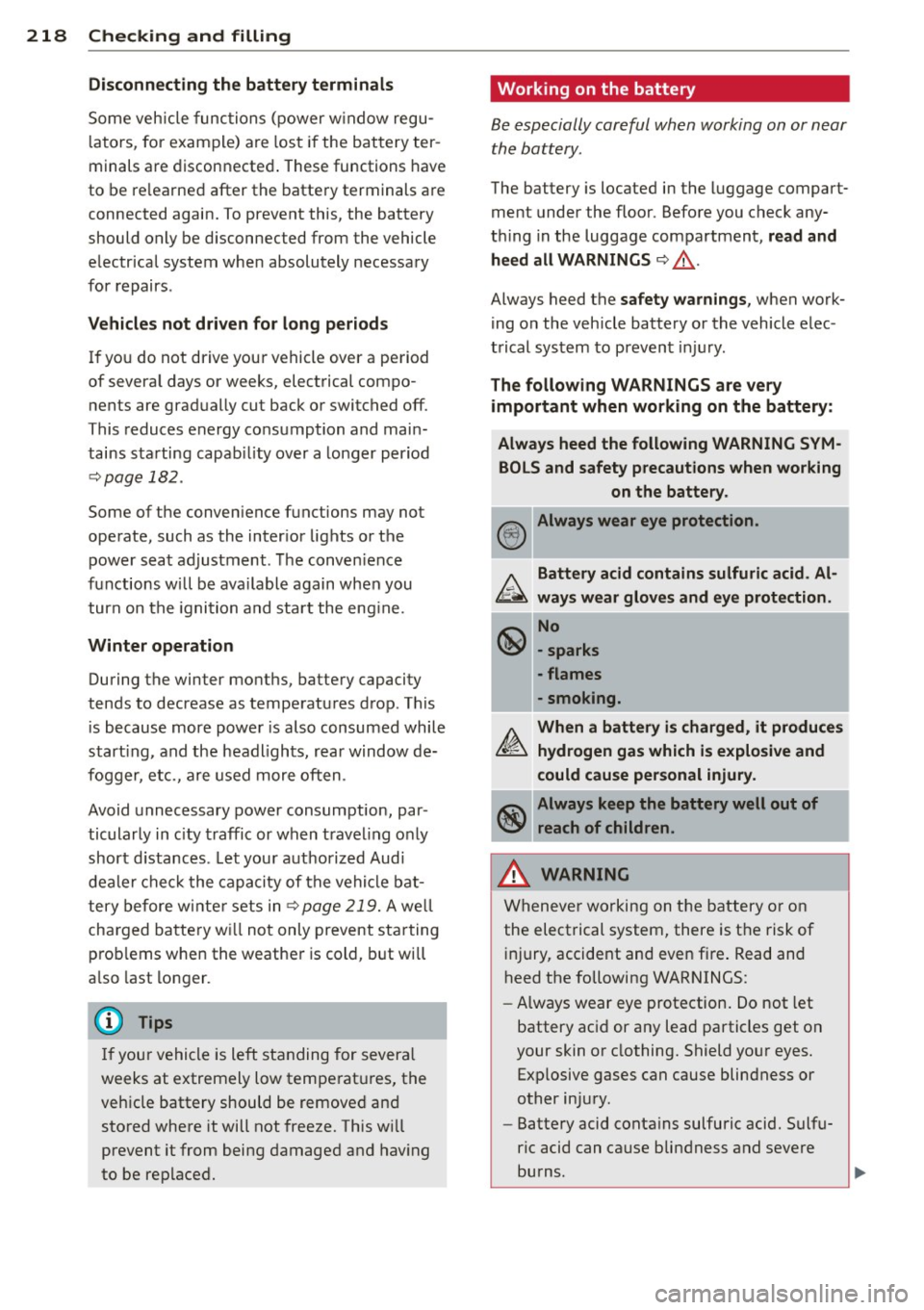
Alway s heed the following WARNING S YM
BOLS and safety prec autions when working
on the battery .
® Always wear eye protection .
b.. Battery acid contains sulfuric acid . Al
~ ways wear gloves and e ye protect ion.
-No
~ -sparks
-flames
--
-smoking.
A When a battery i s charged , it produ ce s
~ hy drogen gas which is e xplosi ve and
could cau se pe rsonal injur y.
--Always keep the battery well out of
® reach of children .
_& WARNING
=
Whenever working on the battery or on
the electrical system, there is the risk of i njury, accident and even fire . Read and
heed the following WARNINGS:
- Always wear eye protection. Do not let
battery acid or any lead particles get on
your skin or clothing. Shield your eyes. Exp losive gases can cause blindness or
other injury . -
-Battery acid conta ins sulfuric acid. Sulfu
ric acid can cause blindness and severe
burns.
Page 221 of 286
-Always wear gloves and eye protection.
Do not tilt the battery because acid
could leak out of the ventilation open
ings .
- If you get battery acid in your eyes or
on your skin, immediately rinse with
cold water for several minutes and get
medical attention.
- If you should ingest any battery acid,
seek medical attention immediately.
- Do not expose the battery to an open
flame, electric sparks or an open light .
- Do not smoke.
- Do not interchange the positive and neg-
ative cables .
- When working on the battery, be sure
not to short-circuit the terminals with
tools or other metal objects. This would cause the battery to heat up very quickly,
which could lead to damage or explosion
and personal injury .
- When a battery is charged, it produces
hydrogen gas which is explosive and
could cause personal injury .
- Always keep the battery well out of the
reach of children .
- Before work is done on the electrical sys
tem, disconnect the negative ground ca
ble.
- Before performing any work on the elec trical system, switch off the engine and
ignition as well as any electrical equip
ment. The negative cable on the battery
must be disconnected.
If you are just go
ing to replace a light bulb, then it is
enough to switch off the lights.
- Before disconnecting the battery , switch
off the anti-theft alarm system! Other
wise you will set off the alarm.
- When disconnecting the battery, first
disconnect the negative cable and then
the positive cable.
- Before reconnecting the battery, make
sure all electrical consumers are switch
ed off. Reconnect the positive cable first
and then the negative cable. Never inter
change the cables - this could start a fire!
Checking and filling 219
- Never charge a frozen or a thawed-out
battery . It could explode! If a battery has
frozen, then it must be replaced. A dis
charged battery can freeze over at 32°F
(ooc).
- Make sure the vent hose is always attach
ed to the opening on the side of the bat
tery .
- Never use batteries which are damaged.
There is the danger of an explosion! Al
ways replace a damaged battery .
A WARNING
California Proposition 65 Warning:
- Battery posts, terminals and related ac
cessories contain lead and lead com
pounds, chemicals known to the State of
California to cause cancer and reproduc
tive problems . Wash hands after han
dling.
(D Note
- Do not disconnect the vehicle battery
when the ignition is switched on or when
the engine is running, otherwise, you will
damage electronic components in the
electrical system.
- If your vehicle is going to stand for a
long period of time without being driven,
protect the battery from "freezing", oth
erwise it will be damaged and will then
have to be replaced.
Battery charging
Start ing the engine requires a well charged
battery.
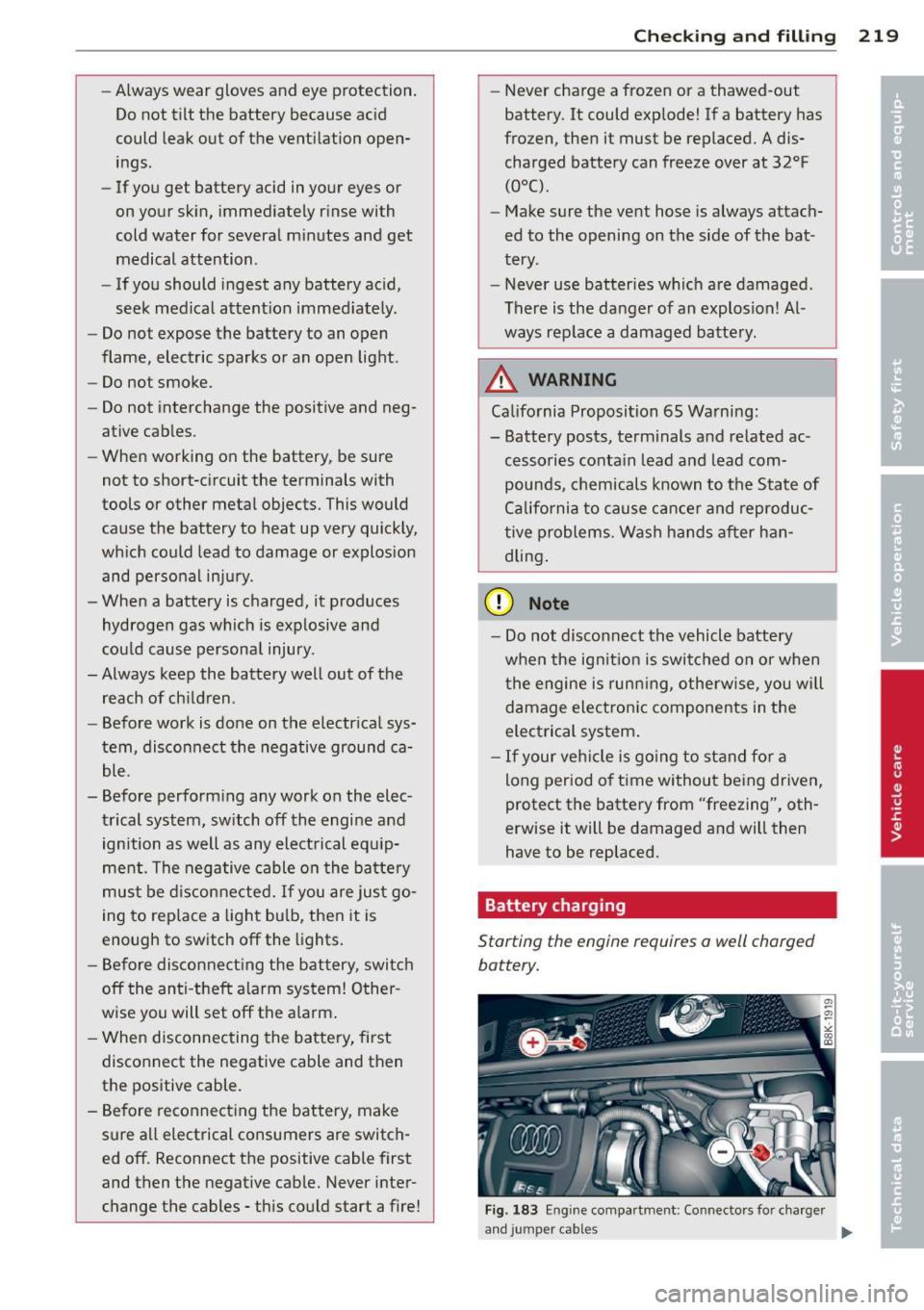
Fig . 183 Eng in e compart ment : Co nnectors fo r charger
and jum per cab les
1111>
Page 256 of 286

254 Fuses and bulbs
--No. Consumer Amps
12 Cell phone prep 5
-
Fuse panel© (black)
1 Right front seat heating 15
4 MMI 7,5
5
Radio 5
6 Rear view camera 5
7
Rear window heater (all·
30 road)
8 Rear Seat Entertainment 5
Bulbs
Replacing bulbs
For your safety, we recommend that you have
your authorized Audi dealer replace any bulbs for you.
It is becoming increasingly more and more
difficult to replace vehicle light bulbs since in many cases, other parts of the car must first
be removed before you are able to get to the
bu lb. Thi s applies especially to the light bu lbs
in the front of your car which you can only
reach through the engine compartment .
Sheet metal and bulb holders can have sharp
edges that can cause ser ious cuts, parts must
be correctly taken apart and then properly put
back together to help prevent breakage of
parts and long term damage from water that
can enter housings that have not been proper·
ly resealed.
F or your safety, we recommend that you have
your author ized Audi dealer replace any bulbs
for you, since your dealer has the proper tools,
the correct bu lbs and the expertise.
Ga s discharge lamps (Xenon lights}*:
Due to the high electrical vo ltage, have the
bu lbs rep laced by a qualified technician.
H eadlights with Xenon l ight are identified by
the high voltage sticker.
A WARNING
Changing Xenon lamps without the neces
sary equipment can cause serious personal
in jury.
- Bulbs are pressurized and can explode
when being changed. Potential risk of in
jury!
- On vehicles equipped with gas discharge
bulbs (Xenon light)* life-threatening in
juries can result from improper handling
of the high-voltage portions of such
lamps!
- Only your authorized Audi dealer or a
qualified workshop should change the
bu lbs in gas discharge lamps. There are
pa rts with sharp edges on the openings
and on the bulb holders that can cause
serious cuts. If you are uncertain about
what to do, have the work performed by
an author ized Audi dealer or other quali
fied workshop. Ser ious personal injury
may result from improperly performed
work.
(D Tips
- If you st ill prefer to replace the light
bulbs yourself, be aware that the engine
compartment is a hazardous area to
work in
9 page 200, Engine compart
ment
9 Lr:,. .
-It is best to ask your authorized Audi
dealer whenever you want to change a
bulb.
Page 258 of 286
256 Emergency situations
@ Tips
The discharged battery must be properly
connected to the vehicle's electrical sys
tem. When jump starting or charging the
battery, never connect the negative
ground cable to the battery negative post
because the batte ry manager system must
be able to detect the battery 's state of
charge. Always connect the negative
ground cab le to the negative ground post
of the battery manager control unit.
Use of jumper cables
Make sure to connect the jumper cable
clamps in exactly the order described below!
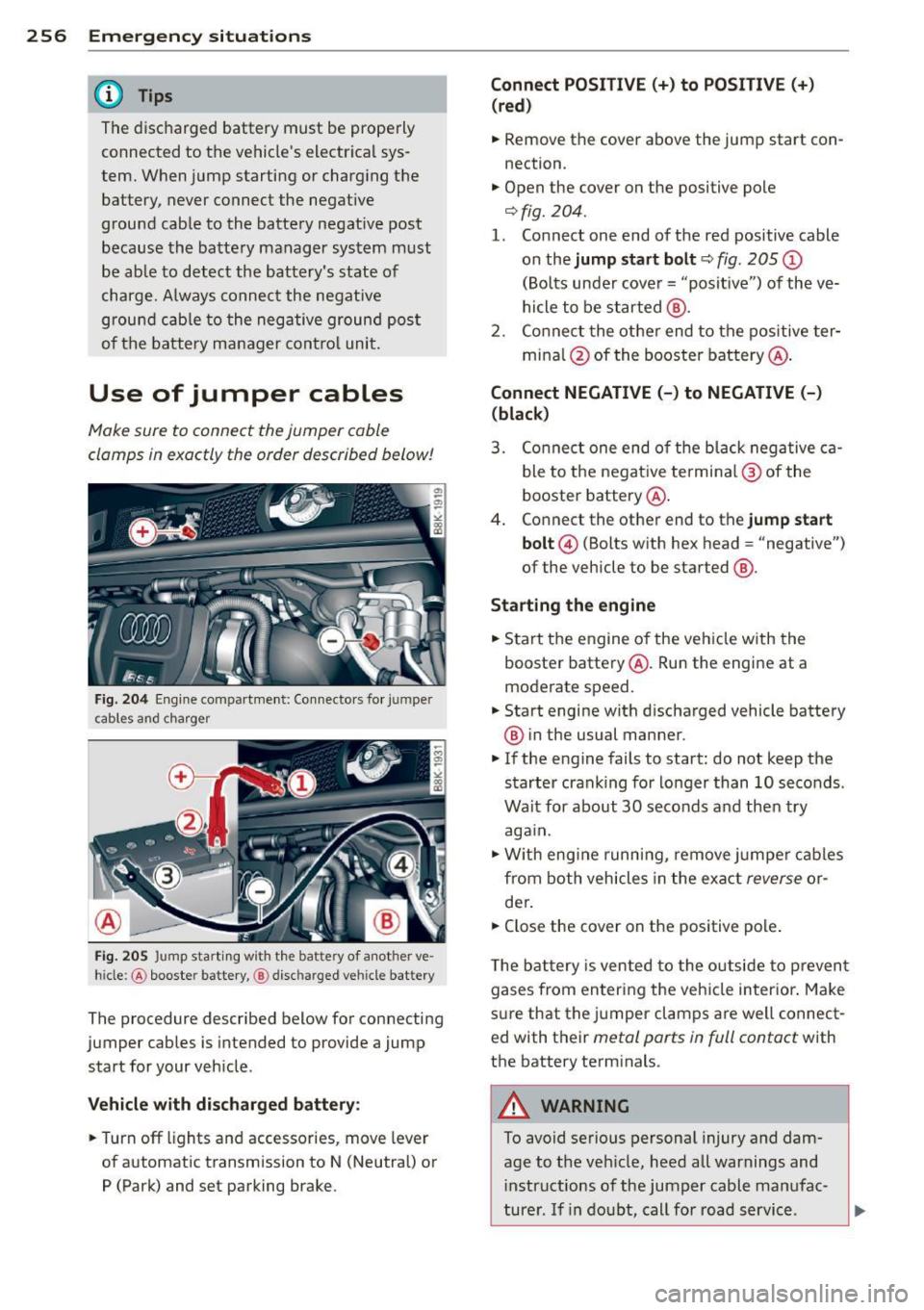
Fig. 204 Engine compartment: Connectors fo r jum per
cables and charger
Fig. 205 Jump sta rting wi th the battery of anot her ve ·
h ide :@ booster battery, @ disc harged vehicle battery
The procedure described below for connecting
jumper cables is intended to provide a jump
start for your vehicle .
Vehicle with discharged battery:
.. Turn off lights and accessories, move lever
of automatic transmission to N (Neutral) or
P (Park) and set parking brake .
Connect POSITIVE(+) to POSITIVE(+)
(red)
.. Remove the cover above the jump start con
nection .
.. Open the cover on the positive pole
¢fig. 204 .
1. Connect one end of the red positive cable
on the
jump start bolt c::> fig. 205 @
(Bolts under cover= "positive") of the ve
hicle to be started @.
2. Connect the other end to the positive ter-
minal @of the booster battery@.
Connect NEGATIVE (-) to NEGATIVE (-)
(black)
3. Connect one end of the b lack negative ca
ble to the negative terminal @of the
booster battery @.
4. Connect the other end to the
jump start
bolt @
(Bolts with hex head= "negative")
of the vehicle to be started @.
Starting the engine
.. Start the engine of the vehicle with the
booster battery@. Run the engine at a
moderate speed.
.. Start engine with discharged vehicle battery
@ in the usual manner .
.. If the engine fails to start: do not keep the
starter cranking for longer than 10 seconds .
Wait for about 30 seconds and then try
again .
.. With eng ine running, remove jumper cables
from both vehicles in the exact
reverse or
der .
.. Close the cover on the positive pole .
T he battery is vented to the outside to prevent
gases from entering the vehicle interior . Make
sure that the jumper clamps are well connect
ed with their
metal parts in full contact with
the battery terminals.
A WARNING
--
To avoid serious personal injury and dam
age to the veh icle, heed all warnings and
instructions of the jumper cable manufac-
turer . If in doubt, call for road service . ..,.