oil pressure AUDI RS5 CABRIOLET 2013 Owners Manual
[x] Cancel search | Manufacturer: AUDI, Model Year: 2013, Model line: RS5 CABRIOLET, Model: AUDI RS5 CABRIOLET 2013Pages: 286, PDF Size: 71 MB
Page 15 of 286
Instrument s and warnin g/indic ator ligh ts 13
(D Note
Never run the tank completely dry! An ir
reg ular supply of fuel can cause eng ine
m isfiring and fuel could enter into the ex
haust system. The catalyt ic converter
could the n overheat and be damaged .
Warning/indicator
Lights
Description
The indicator lights in the instrument cluster
blink or turn on . They indicate functions or
malfunct ions ¢,&. .
Messages may appear with some indicator
lights. A warning signal will sound at the
same time . The messages disappear again af
ter a short t ime . To display a message again ,
pressthelSE T!button
¢ page 11. If severa l
malfunc tions occu r, each of the indica to r/
warn ing lamps will be d isplayed in succession
for abo ut two seconds at a time .
Some ind icators lights in the disp lay can turn
on in several colors.
_& WARNING
- F ailure to heed warning lights and o ther
impor tant vehicle info rmation may result
in serious persona l injury o r vehicle dam
age.
- Whenever sta lled or stopped for repair,
move the vehicle a safe distance off the
road, stop the engine, and turn on the
eme rgency flasher¢
page 54.
-The e ngine compartment of any motor
vehicle is a potentially hazardous area.
Before you check anything in the engine
compartment, stop the engine and let it
cool down. Always exercise extreme cau
t ion when wor king under the hood
¢ page 200, Engine compartment
(D Tips
Ma lfunctions or faults w ill be identified ei
ther with a red symbo l (pr io rity 1 -Dan- ger!) or with a yellow symbol (prio
rit y 2 -
Warning).
' Overview
Some indicator lights t urn on briefly to check
the function of that system when you switch
the ignit ion on . These systems are marked
with a../ in the fo llow ing tables . If one of
these indicator lights does not tu rn on, there
i s a ma lf u nct ion in that system.
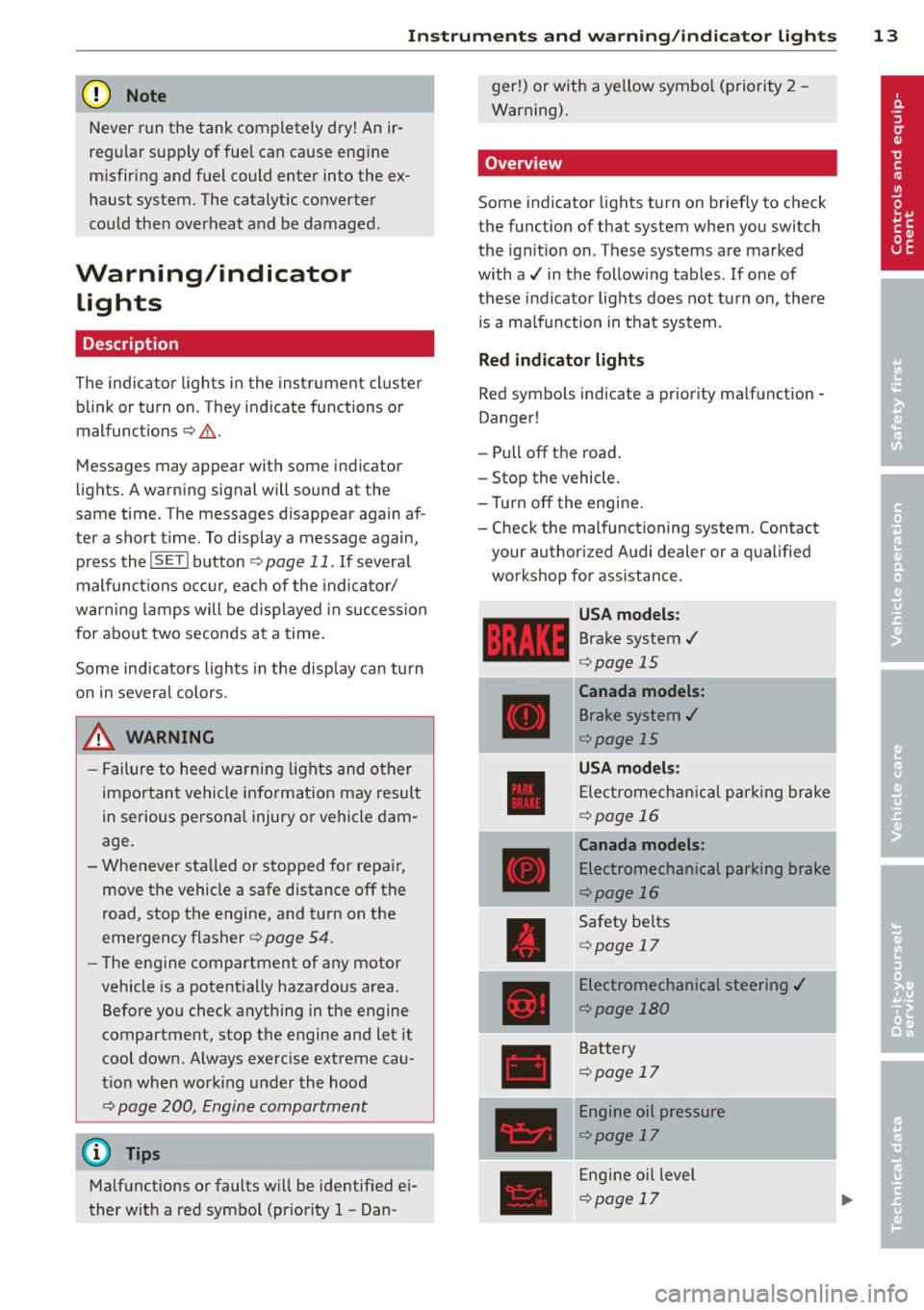
Red indicator lights
Red symbo ls indicate a prior ity ma lfunction -
Danger!
- Pull off the road .
- Stop the vehicle.
- Tur n off the engi ne.
- Check t he malfunc tioning system. Contac t
your author ized A udi dealer or a q ualified
workshop for assistance.
USA models :
Brake system../
¢page 15
----~r~
Canada models:
Brake system ../
¢page 15
USA mod els :
Elec tromech anical parki ng br ake
¢ page 16
Canada models:
Electromechanical parking brake
¢page 16
Safety be lts
¢ page 17
Electromechanical steering ../
¢page 180
Battery
¢page 17
Engine oil pressure
¢page 17
Eng ine oil level
¢page 17
Page 19 of 286
Instrument s and warnin g/indic ator ligh ts 17
dealer or qualified workshop immediately to
have the ma lfunction corrected.
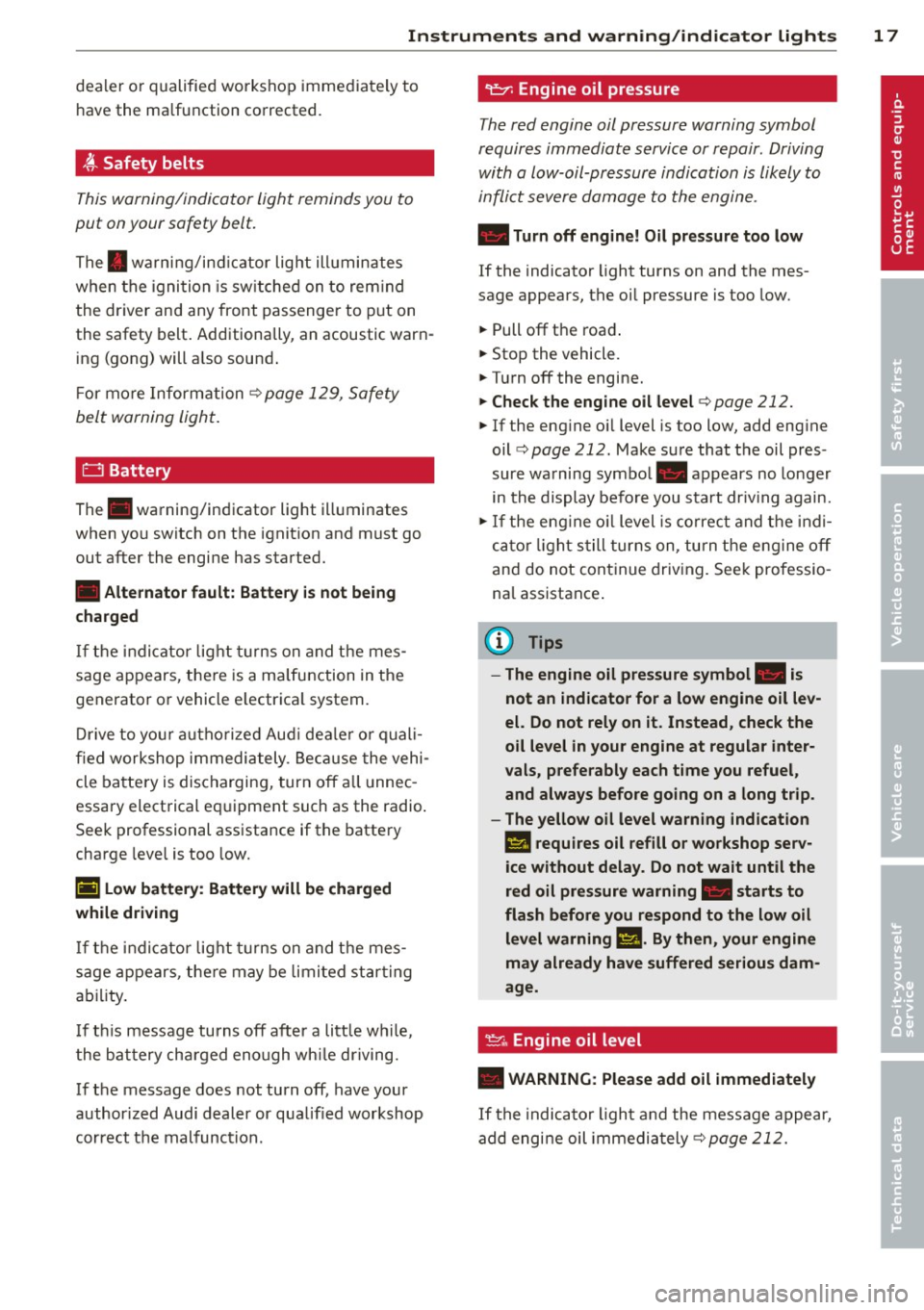
,(,_ Safety belts
This warning/indicator light reminds you to
put on your safety belt.
The . warning/ind icator light illuminates
when the ignition is sw itched on to rem ind
the driver and any front passenger to put on
the safety belt. Additionally, an acoustic warn
i ng (gong) will a lso sound .
F or more Information¢
page 129, Safety
belt warning light .
0 Battery
The. warning/indicator light illuminates
when you switch on the ignition and must go
out after the engine has started.
• Altern ator fault: Batte ry is not being
c ha rged
If the i ndicator light turns on and the mes
sage appears, there is a malfunction in the
generator or vehicle e lectrica l system .
D rive to you r autho rized Aud i dea ler or quali
fied workshop immediately . Bec ause the vehi
cle battery is discharging, turn
off a ll unnec
essary electrical eq uipment such as the radio .
Seek professional assistance if the battery
charge leve l is too low.
(•) Lo w b atter y: B att ery wi ll be charg ed
while dri ving
If the indicator lig ht turns on and the mes
sage appears, the re may be limited start ing
ab ility .
If t his message turns
off after a litt le while,
the battery charged enough wh ile driving.
If the message does not turn
off, have your
author ized Audi dealer or qualified workshop
correct the malfunction .
"l::;r: Engine oil pressure
The red engine oil pressure warning symbol
requires immediate service or repair . Driving
with a low-oil-pressure indication is likely to
inflict severe damage to the engine .
• Turn off eng ine! Oil pressure too l ow
If the indicator light turns on and the mes
sage appears, the oil pressure is too low.
.. Pull
off the road .
.. Stop the vehicle.
.. Turn
off the engine.
.. C heck the engine oil le vel ¢ page 212.
.. If the eng ine o il level is too low, add eng ine
oil
¢ page 212. Make sure that the oil pres
sure warning symbol. appears no longer
in the display befo re you sta rt dr iv ing again.
""I f the eng ine o il level is correct and t he i nd i
ca to r li ght still turns on, turn the eng ine
off
and do not continue driv ing. Seek professio
na l assistance .
(D Tips
- The engine oil pres sure sy mbol. is
not an indicat or for a low engine oil lev
el. Do not rel y on it . Instead, check the
o il level in yo ur engine at regula r inter
v als, p referably each time you refuel ,
and always before going on a long trip .
- The yellow oil level wa rn ing indication
Ill req uires oil refill or wo rkshop serv
ice without delay. Do not wait until th e
red oil p ressur e warning. st a rt s to
fla sh before you respond to the low oil
level warning
111 -By th en, your engin e
may already have suffered seriou s dam
age .
~ .. Engine oil level
• WARN ING: Ple ase add o il immed iatel y
If the indicator ligh t and the message appear,
add engine oil immedia tely
¢ page 212.
Page 26 of 286

24 Drive r in form ation d ispl ay
Driver information
display
Introduction
The Driver information disp lay inside the in
strument cluster provides you, the driver ,
with important information.
Fig . 7 In strum en t cl ust er: center dis pl ay
Fi g. 8 W iper leve r: co ntr ols fo r the menu displa y
Cent er d ispla y
With the ignition on, the display in the Dr iver
I nformation System shows the fol low ing in
format ion :
- CD* inserted or Radio* station set
- Outside temperature* : At temperatures be-
low 41 °F ( +S °C), a snowflake symbol ap
pears in front of the temperature display
c::> .&_ .
- Warning if one of the doors , front lid or en-
gine compartment lid is not closed .
Additional fun cti ons
You can open the following function s in the
Driver Information System display by pressing
the
! R ESE T I button c::> fig. 8 one or more times:
Digital speedometer*
Tire pressure monitoring *
~page240
Trip computer
Service interval display
Speed warning
Gearshift selector positions
Automatic transmission
Adapt ive cruise control*
Lap timer
c::> page25
c::> page 27
c::> page 81
c:> page 92
Eng ine oil temperature indica-c:> page 28
tor
Auto Check Control
Some functions and veh icle components are
scanned for their operating status when you
switch the ignition on and whi le you are driv
i ng . Malfunctions or required service proce
dures are s ignaled audib ly and ind icated by
red and yellow illuminated symbols and re
minders in the disp lay.
A WARNING
- Never rely exclusively on the outside
temperature display to determine if a road surface is icy or not. Keep in m ind
that road surfaces, especially br idges
and overpasses, could be ice covered and
slippery even at an outside temperature
above 4 1 °F (+ S
0
() .
-Always remember , even if the "snow
f lake" symbo l (ice warning) does not ap
pear in the d isp lay, black ice co uld be on
the road .
- Always reduce your speed a nd d rive with
specia l care in cold weathe r cond itions
when the chance of encountering icy
road surfaces increases.
© Tips
If the vehicle is stationa ry, or if you are
driving at a very low speed, the tempera
tu re shown in the display mig ht be s light ly
higher than the actua l outside tempera
ture . This is caused by the heat being radi
ated from the engine.
Page 79 of 286

CD Note
If the engine has been under heavy load
for an extended period, heat builds up in
the engine compartment after the engine
is switched off- there is a risk of damaging
the engine . Allow the engine to run at idle
for about two minutes before switching it off.
Convenience key
Starting the engine
Applies to vehicles: with convenience key
The I START ENGINE S TOPI button switches
the ignition on and starts the engine.
Fig. 91 Ce nter console : S TART ENGINE STOP button
Starting the engine
.. Step on the brake pedal and move the selec
tor lever to P or N
c::> ,&..
.. Press On the ,..,I s=T"" A--=R=T =-= E~N::;:.,=G-;-,I N:-:--;:::E--;:S:-:;T:--;:O:;--;:P::il button
c::>fig. 91 -the engine w ill start.
Switching the ignition on/off
If you would like to switch the ignition on
without starting the engine, follow these
steps:
.. Press the
!S TART ENGINE STOPI button
without pressing the brake pedal.
.. To switch the ignition off, press the button
again.
If the engine should not start immediately,
the starting process is automatically stopped
after a short time . Repeat starting procedure.
When starting the engine, major electrical
loads are switched off temporarily.
On the road 77
After a cold engine is started, there may be a
brief period of increased noise because oil
pressure must first build up in the hydraulic
valve adjusters. This is normal and not a cause
for concern .
A WARNING
-Never allow the engine to run in confined
spaces - danger of asphyxiation.
- Never turn off the engine until the vehi
cle has come to a complete stop.
- Always take the key with you whenever
you leave your vehicle. Otherwise, the
engine could be started or electrical
equipment such as the power windows
could be operated. This can lead to seri
ous injury.
- Never leave children or persons requ iring
assistance unattended in the vehicle. The
doors can be locked using the remote
transmitter, preventing people from es
caping from the veh icle on their own in
the event of an emergency . Depending
on the time of year, people inside the ve
hicle can be exposed to very high or very
low temperatures.
CD Note
- Avoid high engine rpm, full throttle and
heavy engine loads until the eng ine has
reached operating temperature - other
w ise you risk engine damage.
@ For the sake of the environment
Do not let the engine run while parked to
warm up. Begin driving immediately. This
reduces unnecessary emissions .
(!} Tips
-After starting a cold engine, there may
be a brief period of increased noise be
cause the oil pressure must first bu ild up
in the hydraulic valve adjusters. This is
normal and not a cause for concern .
- If you leave the veh icle with the ignition
switched on, the ign it ion w ill switch off
after a certain period of time . Please ..,.
Page 193 of 286
(D Note
-Never try to remove dirt, mud or dust if
the surface of the vehicle is dry. Never
use a dry cloth or sponge, since this
could scratch your vehicle's pa int or w in
dows .
- Never wash your car in bright sunlight.
Drops of water act as magnifying lenses
and may damage your paint.
- When you wash your car in the w inter: if
you r inse your vehicle w ith a hose, be
careful not to aim the stream of water
direct ly at locks, or at door or hatch
openings - they can free ze shut.
- Never use sponges des igned to remove
i nsects, or any kitchen scouring sponges
or similar products. They can damage
you r paint finish.
- Never use a dry cloth o r sponge to clean
the headligh ts. On ly use we t cloths or
sponges to prevent scratches.
It i s best
to use soapy wate r.
- You sho uld remove debris (su ch as in
sects) from the head ligh t lenses on a
r egular basis, for example when refuel
ing your vehicle . Never use a dry cloth or
sponge to clean the head lights. Only use
wet cloths or sponges to prevent
scratches.
It is best to use soapy water.
@ For the sake of the environment
On ly wash the vehicle in facilit ies specially
designed for that purpose. Th is w ill reduce
the risk of d irty water contaminated with
oil from entering the sewer system. In
some areas, wash ing vehicles outs ide of
these facilit ies is prohib ited.
Washing your vehicle with a power
washer
Cleaning the exterior of your car with a high
pressure power washer is safe as long as you observe a few simple rules .
~ Before us ing the powe r washe r, make sure
yo u have re ad an d u nderstood the WARN-
Cleaning and protec tion 19 1
INGS ¢ A in General information on
page 189 .
~ Always follow the operating instr uctions for
the power washer.
~ Make sure that the jet on the spray hose pro
duces a "fan shaped sp ray" .
~ Do not hold the sp ray nozzle too close to
soft mater ials .
Never use a pow er washer to clean the power
top itself.
Keep a distance from soft materia ls s uch as
rubber hoses or insulating material as well as
sensors and camera lenses.
When cleaning the vehicle with a power was h
er
always follow the operating instructions .
This applies part icu larly to the operating pres
sure and the spraying d istance. Do not point
the spray d irectly at the seals around the s ide
windows, around the doo rs, on the rea r lid or
o n the powe r top. Likewise, do not po int it di
re ct ly at tires, rubbe r hoses, insulat io n ma te
ria l or senso rs
¢ page 193. Hold the spray
nozzle at leas t 1.3 ft (0. 4 m) away from the
vehicle.
Do no t use a high-p ressu re power was her to
remove snow and i ce .
Do not use a jet which sprays water in a d irect
stream o r one that has a rotat ing jet.
Water temperature should not exceed 140 °F (60
°() .
A WARNING
Neve r wash t ires with a jet t hat sprays wa
ter in a direct stream . Thi s could cause in
v isi ble d amage to the t ire s and weaken
them, even if the spr ay is from a re lative ly
l ong dis tance and for a sho rt time. Dam
aged and weakened tires can fail and cause
accidents and personal in jury.
([) Note
- Never use a power washer to clean the
powe r top itse lf .
•
•
Page 195 of 286

bird d ropp ings as soon as possib le, since the
corrosive chemica ls in them wi ll cause the
rubber impregnat ion in your top to swell and
possibly allow the fabric to leak.
With
normal soiling , all yo u need to do is
clear the top with a soft brush and clear wa
ter . Always brush in the direction of the fabric
from front to rear.
If the top is
very dirty and has spotted areas
clean it with a brush using a convertible top
cleaner . Always brush in the direction of the
fabric from front to rea r. Rinse w ith plenty of
clear water, and allow the top to air-dry .
Chamo is are not suitable for drying the top .
Never use gasoline, spot remover, benze ne,
pa int thinner or so lvents to remove spo ts. We
recommend that you only use cleaners espe
cially formu lated for use on convertible tops ,
and that you follow the produce use di rections
caref ully. Authori zed A udi deals can p rovide
deta iled information.
A WARNING
Always read and heed all WARNINGS and
the information on ¢
page 189.
Never use a high-pressure power washer to
clean the power top.
Wind deflector
App lies to vehicles: with wind deflector
Clear the wind deflector with water or, if it is
heav ily soiled, a chemically neutra l cleaning
solut io n.
A WARNING
Always read and heed a ll WARNINGS and
t he information on
¢page 189.
Sensors and camera lenses
-Remove snow wi th a hand brush and remove
ice with a de-icing spray that does not con
ta in solvents .
Cleaning and protec tion 193
- Clean the sensors (adap tive c ruise control *,
parking system *) with a cleaning so lution
that does not contain so lvents and a soft
cloth.
@ Note
- If you wash your vehicle with a press ure
washer,
- make sure there is enough d istance to
sensors in the rear bumper.
- do not clean the camera lenses and the area a round them with the p ress ure
washer.
- N ever use warm o r hot wate r to remove
snow or ice from the came ra lens . This
c ou ld cause t he lens to crack.
- N ever clean the camera lens with abra
sive products .
Waxing and Polishing
Waxing
A good wax coating protects the vehicle paint
to a la rge ex ten t agains t the envi ronmental
f a ctors lis ted under ¢
page 189, Washing and
even against s light scratches .
You can use a liquid car wax to protect yo ur
paint as soon as one wee k afte r you r vehicle
has been delivered.
Even if you regularly use a
wa xing process in
a utomat ic car washes, we recommend that
yo u manually a pply a coat o f wax to g ive the
pain t ex tra protection, par ticu larly if water no
longer beads on t he clean paint.
P rotect plast ic body parts w ith car wax in the
same w ay as the veh icle body .
During warm weather dead insects tend to
collect on the front bumper and on the fo r
ward a rea of the hood. They are much easier
to remove from pa int that is waxed
often .
Polishing
Polish your vehicle only if the paint has lost its
shine and the gloss cannot be brought back
with wax . ..., •
•
Page 213 of 286
temperatures stay below freezing point for l ong periods.
Detergent add itives in the o il w il l make fresh
oil look dark after the eng ine has been run
ning fo r a short time . This is norma l and is not
a reason to change the oi l more often than
recommended.
D am ag e or m alfun ction s due to lack of
ma intenanc e
It is essential that you change your oil at the
r ecommended inte rva ls using only engine o il
t hat complies with A udi oi l standard
VW 502 00 . Your Limited New Vehicle War
ranty does not cover damage or malfunctions
due to fa ilure to fo llow recommended mainte
nance and use requ irements as set forth in
the Audi Owner's Manual and Warranty
&
Maintenance book let . Your dealer will have to
deny warranty coverage u nless you present to
the dea ler p roof in the fo rm of Serv ice or Re
pa ir Orde rs that all s chedu led maintenance
was pe rformed in a t imely manner .
Engine oil consumption
The engine in your vehicle depends on an ade
quate amount of oil to lubricate and cool all
of its moving parts.
In o rder to provide effective lubrication and
cool ing of internal engine components, a ll in
ternal combustion eng ines consume a certa in
amo unt of o il. Oil consumption varies from
engine to engine and may change significantly
over the life of the engine. Typ ica lly, engines
with a specified break-in period (see
¢
page 184) consume more oil during the
break-in per iod than they consume after oil
consumption has stabilized .
Under normal conditions, the rate of oil con
sumpt ion depends on the quality and viscosity
of the oil, the RPM (revo lutions per m inute) at
which the engine is operated, the ambient
temperature and road condit ions. Furthe r fac
tors are the amount of o il d ilution from wate r
condensation or fuel residue and the ox ida
tion level of the oil. As any engine is s ubje ct to
Checkin g and fillin g 211
wear as mi leage builds up, the oil consump
tion may increase over time until replacement
of worn components may become necessary.
Wi th a ll these variab les coming into p lay, no
standard rate of oil consumpt ion can be es
tablished or specified. There is no alternative
to regular and frequent check ing of the o il lev
el, see
Note .
If the yellow engine oil leve l warning symbo l
1\1 in the instrument cluster lights up , you
shou ld check the oil leve l as soon as possib le
¢
page 212. Top off the oil at your earliest
convenience
¢ page 212.
A WARNING
Before you check anythi ng i n the engine
compartment, always read a nd heed all
WARNINGS¢ .&.
in Working in the engine
c ompartment on page 207.
(D Note
Driving w ith an insufficient o il level is like
ly to cause severe damage to the engine .
(D Tips
- The oil pressure warning display. is
not an indi cator of the oil le vel. Do not
rely on it . Instead, check the oil level in
your engine at regu lar intervals, pref
erably ea ch time you r efuel, and alway s
before going on a long trip .
-If you have the impression you r engi ne
c ons umes ex cess ive amoun ts of o il, we
recommend that you consul t an a uthor
ized Aud i dea ler to have the cause of
your concern properly diagnosed. Keep in mind that the accurate measurement of
oil consumption requ ires great care and
may take some t ime. An authorized Aud i
dealer has instructions about how to
measu re oil consumption accurately.
-
•
•
Page 217 of 286

Before you check anything in the engine com
partment,
al ways r ead and heed all W ARN
ING S ¢ A in Working in the engine compart
ment on page 207.
The "MIN" und "MAX" markings are found on
the bi-level disc in the interior of the coolant
expansion tank
¢ fig . 181.
.,. Park your vehi cle on a level sur face.
.,. Turn off the ignition .
.,. Let the engine coo l down .
.,. Place a thick rag over the coolant expansion
tank and
c a refully turn the cap counter
clockwise ¢
.&,.
.,. Read the engin e coolant le vel inside the
coolant expans ion tank ¢
fig. 180,
¢ page 209, fig . 177. With a cold engine,
the coolant leve l should be between the
" M IN" and "MAX" mark ings
¢ fig. 181
-arrows- . When the eng ine is warm, the lev
el may be slightly above the "MAX" marking.
.,. The MAX marking may be covered with a
maximum of 1 mm of coolant when yo u
fill
coolant .
.,. Twist the cap on again tightly.
The location of the coolant expansion tank
can be seen in the engine compartment illus
tration
¢ page 209.
To obtain an accurate read ing, the engine
must be switched off .
The expans ion tank in you r vehicle is equipped
with an electric coolant level sensor .
When the coo lant level is too low, the warning
light in the A uto-Check System¢
page 18 wi ll
b lin k until you add coo lant and the level has
been restored to norma l. Even though there is
an electric coolant level sensor, we sti ll rec
ommend you check the coolant leve l from
time to time.
Coolant loss
Coolant loss may indicate a leak in the coo ling
system . In the event of coolant loss, the cool
i n g system should be inspected immediately
by your authorized Audi dealer. It is not
enough merely to add coolant.
Checkin g and fillin g 215
In a sealed system, losses can occur on ly if
the boiling point of the coolant is exceeded as
a resu lt of overheating.
Adding coolant
Rep lacement engine coolant must confo rm to
exact specificat ions¢
page 214, Coolant .
We recommend using only coo lant add itive
Gl2++, Gl3 or i n an emergency Gl 2+ . Do not
use a different add itive. In an emergen cy use
plain water until you can ge t the correct addi
tive and can restore the correct ra tio. This
sho uld be done as soon as possib le .
If you have lost a cons iderab le amount o f
coolant, then you sho uld add cold ant ifreeze
and co ld water on ly when the engine is cold.
A lways use
new engine coo la nt when refilling.
Do not fill coolant above the "MAX" mark. Ex
cess coolant will be fo rced out through the
pressure relief valve in the cap when the en
gine becomes hot.
_& WARNING
- Th e cooling system is un der pressure and
can get very hot. Reduce the risk of
scalding from hot coolant by following
these ste ps.
- Turn off the engine and allow it to coo l
down.
- Protect your face, hands and arms from
escaping fluid and steam by covering
the cap w ith a large, th ic k rag.
- Turn the cap s lowly and very carefully
i n a counter-clockwise direction while
applying light, downward pressure on
the top of the cap.
- To avoid being bu rned, do not spill an
tifree ze or coolant o n the ex haust sys
tem o r hot engine p arts. Under ce rtain
con ditio ns, the ethy lene glycol in en
gine coolant can catch fire.
- Antifreeze i s poisonous. Always s tore an
tifreeze in its original container an d well
out of the reach of children .
Ill-
•
•
Page 241 of 286
Wheel bolts
Wheel bolts must always be tightened to the
correct torque .
The design of wheel bolts is matched to the
factory installed r ims. If differen t rims are fit
ted, the correct wheel bolts with the right l ength and correctly shaped bolt heads must
be used. This ensures that wheels are fitted
securely and that the brake system functions
correctly .
In certain circumstances, you may not use
wheel bo lts from a different vehicle -eve n if it
i s the same model
¢ page 266.
_&. WARNING
Improperly tig htened or maintained whee l
bolts can become loose ca using loss of
contro l, a co llision and serious persona l in
jury.
- Always keep the wheel bolts and the threads in the wheel hubs clean so the
whee l bolts can turn easily and be prop
erly t ightened.
- Never grease or oil the wheel bo lts and
the threads in the wheel hubs. They can become loose wh ile driving if greased or
o iled, even if tightened to the specif ied
torque .
- Only use wheel bolts that belong to the
rim being installed.
- Never use different whee ls bolts on your
vehicle .
-Always maintain the correct tighten ing
torque for the wheel bo lts to reduce the
risk of a wheel loss . If the tightening tor
que of the wheel bolts is too low, they
can loosen and come out when the vehi
cl e is moving.
If the tightening torque is
too high, the whee l bolts and threads
can be damaged and the wheel can be
come loose.
Q;) Note
The spec ified torque fo r the wheel bo lts is
90 ft lbs. (120 Nm) with a tolerance of
± 7,4 ft lbs.(± 10 Nm). Torque wheel bo lts
Tire s an d wheel s 239
diagonally. After changing a wheel, the
torque m ust be checked as soon as possi
ble with a torque wrench -preferably by an
a uthori zed Audi dea ler or qualified work
shop.
Low aspect ratio tires
Your Aud i is factory -equ ipped w ith low aspect
ratio tires . These tires have been tho roughly
tested and been se lected specifically fo r your
model for their superb perfo rmance, road fee l
and hand ling under a var iety o f driving cond i
tions. Ask your authorized Audi dealer for
more details .
T he low aspect ratio of these t ires is ind icated
by a numeral of
55 or l ess in the tire's s ize
designation. The numera l rep resents the ra tio
of the tire's sidewa ll height in relation to its
tread width expressed in percentage . Conven
tiona l tires have a he ight/w idth ratio of 60 or
more.
T he performance of low-a spe ct- ra tio tire s is
p ar tic ul ar ly se nsi tiv e to i mprop er i nfl ation
pre ssure. It is the refo re important that low
a spect ratio t ires are inflated to the specified
pr ess ure and that th e inflation pr essur e is
r e gula rly ch ecked and maintain ed. Tir e pre s
s ure s should b e check ed at l east once a
m onth and alwa ys befo re a long trip
¢ page 228, Checking tire pressure.
What you c an do to avo id tire and rim
damage
Low aspect ratio tires can be damaged mo re
easily by impact w ith potholes, curbs, g ull ies
o r ridges on the road, pa rticularly if the tire is
u nderinflated.
In orde r to minimize the occurrence of impact
damage to the tires of your vehicle, we recom
mend that you observe the following p reca u
tions:
- Always ma inta in recommended inflation
pressu res. Check your tire pressure eve ry
2,000 miles (3,000 km) and add air if neces-
sary . .., •
•
Page 247 of 286
~ Screw the accompanying filling hose com
pletely onto the bottle. This breaks through
the foi l seal automat ically at the connec
t ion.
~ Remove the valve cap from the tire valve and
unsc rew the valve insert us ing the accompa
nying valve insert tool¢
fig. 193 .
~ Lay the valve insert on a clean surface .
~ Remove the sealing plug from the filling
hose and connect the hose to the tire v alve.
~ Hold the bottle with the bottom fac ing up
ward and emp ty the entire contents into the
tire .
~ Then pu ll out the hose and screw the valve
insert tightly back into the tire valve.
Inflating a tir e
~ Screw the filling hose for the electric a ir
pump onto the tire valve and insert the con
nector into the cigarette lighter .
~ Inflate the t ire between 2.0 and 2.5 bar and
read the pressure from the gauge.
~ If this tire pressure is not reached, drive
your vehicle approximate ly 10 meters for
ward or backwa rd so that the sealant can be
redistributed i nside the tire . If at th is time
the req uired air p ressu re still cannot be
reached, the t ire is too badly damaged and
cannot be repa ired with the tire sea lant.
Final check
~ After dr iving for about 10 minutes, stop and
chec k the t ire p ressure.
~ If tire pressure is less than 1.3 bar, the tire
is too seve rely d amaged. Do not contin ue to
dr ive . Seek pro fessional assistance.
& WARNING
- Turn on the emergency flashers and set
up the emergency triangle if you have
flat tire while in mov ing traffic. This is
for your protection and the for the safety
of other drivers.
- Have all passengers leave the vehicle and
stay away from the danger zone (for ex
amp le, beh ind a guard rail) .
What do I do now? 245
-Read and follow the manufacturer's safe
ty precautions on the compressor and in
the instructions on the bottle of sealant!
- If a tire pressure of 2.0 bar cannot
reached after inf lating for six minutes,
then the tire is too severely damaged. Do not continue driving!
- Obta in qua lified help if it is not possible
to pe rform the repair wit h the t ire seal
a nt.
- If the tire pressure is less than 1.3 bar
after 10 m inutes of driv ing, then the the
tire is too seve rely damaged. Do not con
tinue dr iving . Seek profess iona l assis
tance .
(D Note
Particular care is necessary if you are mak
i ng a tire repa ir on a steep incl ine .
(D Tips
-Do not operate the electric air pump for
more than 6 minutes without stopping,
otherwise it can over heat. When the a ir
pump has coo led down, you can continue
t o use it.
- If sea lant has spilled out, let it dry and
then you can remove it by peeling it away
like a foil.
- Remember to obtain a new bott le of
sealant from yo ur autho rized Aud i dea le r
afte r repairing a tire. After this, the func
tionality of the tire repa ir set is restored.
- Obey all laws.
Changing a wheel
Before changing a wheel
Observe the following precautions for your
own and your passenger 's safety when chang
ing a wheel.
~ After you experience a tire failure, pull the
car we ll away from moving traffic and try to
reach
le vel ground before you stop ¢ ,&..
~ All passengers should lea ve the car and
move to a safe location (for instance, behind
the guardrail) ¢
,&.. ..,.
•
•