tires AUDI RS5 CABRIOLET 2013 Owners Manual
[x] Cancel search | Manufacturer: AUDI, Model Year: 2013, Model line: RS5 CABRIOLET, Model: AUDI RS5 CABRIOLET 2013Pages: 286, PDF Size: 71 MB
Page 5 of 286
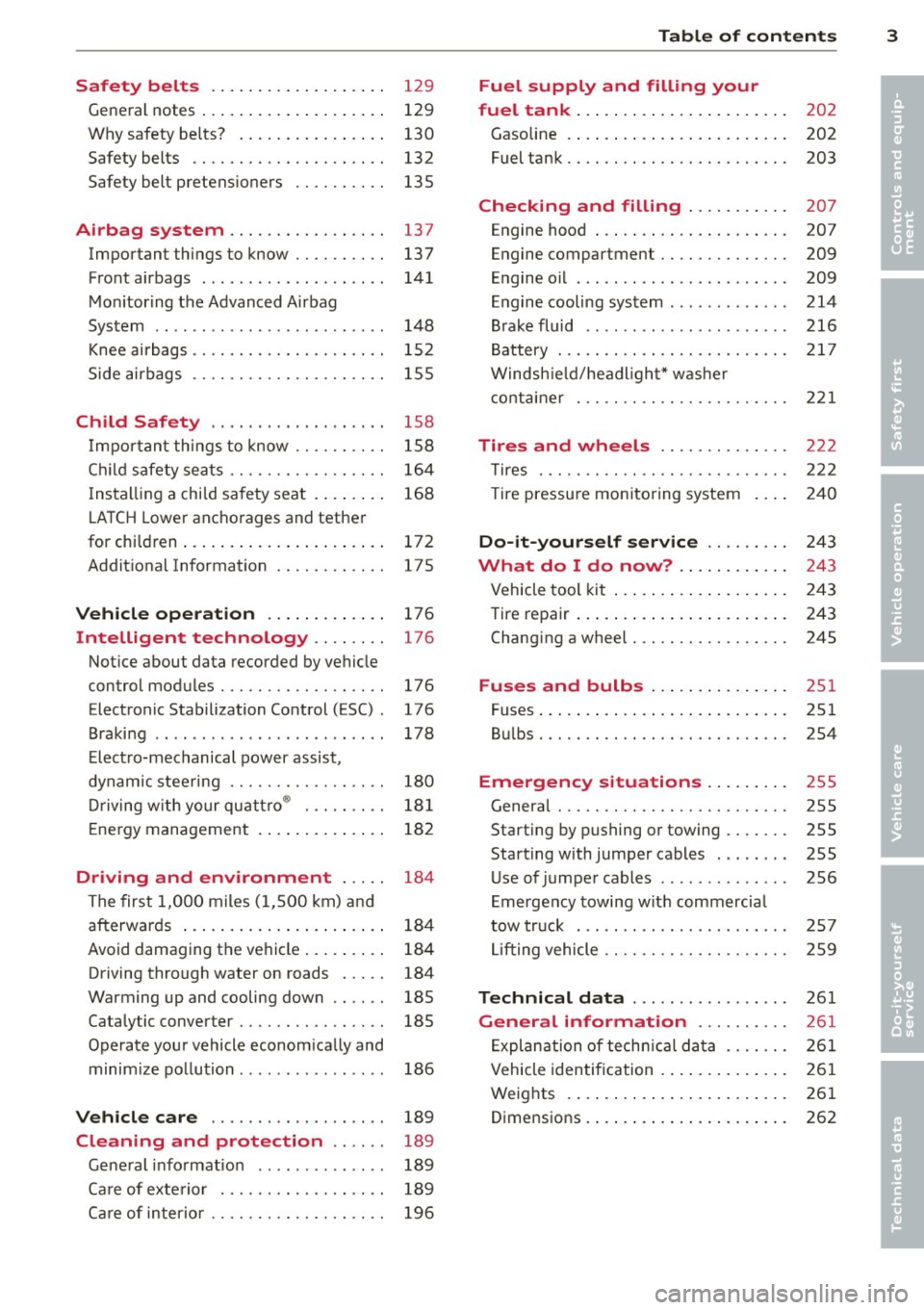
Safety belts . . . . . . . . . . . . . . . . . . . 129
General notes . . . . . . . . . . . . . . . . . . . . 129
Why safety be lts? . . . . . . . . . . . . . . . . 130
Safety belts . . . . . . . . . . . . . . . . . . . . . 132
Safety belt pretens ioners . . . . . . . . . . 13S
Airbag system ............. .. .. 137
Important things to know . . . . . . . . . . 137
Front airbags . . . . . . . . . . . . . . . . . . . . 141
Monitoring the Advanced Airbag
System . . . . . . . . . . . . . . . . . . . . . . . . . 148
Knee airba gs. . . . . . . . . . . . . . . . . . . . . 152
Side airbags . . . . . . . . . . . . . . . . . . . . . 155
Child Safety . . . . . . . . . . . . . . . . . . . 158
Import ant things to know .... .. .. . .
C hild safety sea ts ......... .. .. .. . .
I ns tall ing a chi ld safety seat . ... .. . .
L A T CH Lower anchorages and tether
for chi ldren ... ........... .. .. .. . .
Addit ional Information
Vehicle operation ............ .
Intelligent technology .. .. .. . .
Notice about data recorded by vehicle
control modules .......... .... .. . .
Electronic Stabilization Control (ESC) .
Braking .. ... ...... ......... .... .
E lect ro-mechanical power assist,
dynamic steering ............. .. . .
Driving with your qu attro ® ... .. .. . .
E nergy management ............. .
Driving and environment ... ..
The first 1,000 miles (1,500 km) and
afterwards ... ........... .. .. .. . .
Avoid damaging the vehicle ... .. .. . .
Driving through water on roads ... . .
Warming up and cooling down .. .. . .
Cataly tic converter ........ .... .. . .
Operate your vehicle econom ically and
minim ize pollution ......... ... ... .
Vehicle care .............. .. .. .
158
164
16 8
172
175
176
176
176
176
178
180
18 1
182
184
184
184
184
185
18S
186
189
Cleaning and protection . . . . . . 189
Gene ral i nfo rmation . . . . . . . . . . . . . . 189
Ca re of exte rior . . . . . . . . . . . . . . . . . . 189
Ca re of inter ior . . . . . . . . . . . . . . . . . . . 196
Table of contents 3
Fuel supply and filling your
fuel tank . . . . . . . . . . . . . . . . . . . . . . .
202
Gasoline . . . . . . . . . . . . . . . . . . . . . . . . 202
Fuel tank. . . . . . . . . . . . . . . . . . . . . . . . 203
Checking and filling . . . . . . . . . . . 207
Engine hood . . . . . . . . . . . . . . . . . . . . . 207
Engine compartment . . . . . . . . . . . . . . 209
Engine oil . . . . . . . . . . . . . . . . . . . . . . . 209
Engine cooling system . . . . . . . . . . . . . 214
Brake fluid ....... ............... 216
Battery . . . . . . . . . . . . . . . . . . . . . . . . . 217
Windshield/headlight* washer
container . . . . . . . . . . . . . . . . . . . . . . . 221
Tires and wheels ............. .
T ires ... .. .. .. .. .. . ............ .
T ire pressu re mon itoring system
Do-it-yourself service ........ .
What do I do now? ........... .
Vehicle tool kit ... .. . .. .......... .
Tire repair ... .. .... . ............ .
Chang ing a wheel ..... ........... .
Fuses and bulbs .. .. ... .... ... .
Fuses ..... .. .. .... .. ........... .
Bul bs ....... .. ...... ........... .
Emergency situations ........ .
General ... .. .. .. ............... .
Starting by pushing or towing ...... .
Starting with jumper cables ..... .. .
U se of jumper cables ... .. .. ... ... .
Emergency towing with commercia l
tow truck ... .. .. .. . ............ .
Lift ing vehicle .. .. .... ........... .
Technical data ... . .. .. ..... ... .
General information ......... .
Exp lanation of techn ic al data ...... .
Vehicle identification ........... .. .
Weights .. .. .... ... .. .......... .
Dimensions . ....... . .. .......... . 222
222
240
24
3
243
243
243
245
251
251
2S4
255
255
255
255
256
2 57
259
261
261
26 1
261
261
262
•
•
Page 127 of 286
area because the rear lid cannot be fully
closed.
-If you absolutely must drive with the rear
lid open, observe the following notes to
reduce the risk of poisoning:
- Close all windows,
- Close the power top,
- Open all air outlets in the instrument
panel,
- Switch off the air recirculation,
- Set the fresh air fan to the highest
speed.
A WARNING
Always make sure that the doors, all win
dows, the power top and the rear lid are
securely closed and locked to reduce the
risk of injury when the vehicle is not being
used.
-After closing the rear lid, always make sure that it is properly closed and locked.
- Never leave your vehicle unattended es
pecially with the rear lid left open. A
child could crawl into the vehicle through
the luggage compartment and close the
rear lid becoming trapped and unable to
get out. Being trapped in a vehicle can
lead to serious personal injury.
- Never let children play in or around the
vehicle.
- Never let passengers ride in the luggage
compartment. Vehicle occupants must
always be properly restrained in one of
the vehicle's seating positions.
(D Tips
- Air circulation helps to reduce window
fogging. Stale air escapes to the outside
through vents in the trim panel. Be sure
to keep these slots free and open.
- The tire pressure must correspond to the
load. The tire pressure is shown on the
tire pressure label. The tire pressure la bel is located on the driver's side B-pillar.
The tire pressure label lists the recom mended cold tire inflation pressures for
the vehicle at its maximum capacity
.
Driving Safely 125
weight and the tires that were on your
vehicle at the time it was manufactured.
For recommended tire pressures for nor
mal load conditions, please see chapter
¢page 226.
Tie-downs
App lies to vehicles : wi th t ie-downs
The luggage compartment is equipped with
four tie-downs to secure luggage and other
items.
Use the tie-downs to secure your cargo prop
erly ¢
page 124, Loading the luggage com
partment .
In a collision, the laws of physics mean that
even smaller items that are loose in the vehi
cle will become heavy missiles that can cause
serious injury. Items in the vehicle possess en
ergy which vary with vehicle speed and the
weight of the item. Vehicle speed is the most significant factor.
For example, in a frontal collision at a speed
of 30 mph (48 km/h), the forces acting on a 10-lb (4.5 kg) object are about 20 times the
normal weight of the item . This means that
the weight of the item would suddenly be
about 200 lbs. (90 kg). You can imagine the injuries that a 200 lbs. (90 kg) item flying
freely through the passenger compartment
could cause in a collision like this.
A WARNING
Weak, damaged or improper straps used
to secure items to tie-downs can fail dur ing hard braking or in a collision and cause
serious personal injury.
- Always use suitable mounting straps and
properly secure items to the tie-downs in
the luggage compartment to help pre
vent items from shifting or flying for
ward as dangerous missiles.
- When the rear seat backrest is folded
down, always use suitable mounting
straps and properly secure items to the
tie-downs in the luggage compartment
to help prevent items from flying
•
•
Page 180 of 286

178 Intelligent technolog y
@ Tips
-ABS and ASR on ly work correctly when
a ll four wheels are eq uipped w ith identi
ca l tires . Different tire s iz es can lead to a
r educt io n in engine power .
- You may hear no ises w hen the systems
described are wo rking.
- If the indicato r light
DJ or 11:11 (U SA
models) 1i] (Canada models) appears,
there may be a malf unct io n ¢
page 19,
c> page 19.
Switching on/off
ESC turns on au toma tically when you s tart
the engine.
Fig . 16 9 Ver sio n A : low er c ente r co nso le,~ OFF bu t·
to n
Fig . 17 0 Ve rsio n B: u ppe r ce nter conso le, ~ OFF but
to n
Switching sport mode on
Press the I;; OF F I button ¢ fig. 169 o r
c::> fig. 170 quickly. The act ions taken by the
E SC and ASR stabilize the vehicle a re limited .
T he
IJ ES C in dicator light tu rns on and the
me ssage
Stabilization control (ESC) : Sport .
Warning! Restricted stability
appe ars in the
d river info rmation disp lay
c::> A .
The following e xamp les are unusual situa
t io ns whe re it may ma ke sense to switch s port
mode on in order to allow the wheels to sp in:
- Ro cking the vehicle to free i t when i t is s tuck
- Dr iv ing in deep snow o r on loose g round
- Dr iving with snow chains
Sport mode can be sw itched on at a ny speed .
Switching ESC/ASR off
Press a nd ho ld the I~ OFF I but ton for three
secon ds. The
lfil•)H and fl indicator lights
turn on and the message
Stabilization con
trol (ESC) : off. Warni ng! Restricted stability
appears in the driver information display.
AS R is also switched off when ESC is switched
off . The stabilizat ion function is not ava ilable
c> A .
Switching on
Press the !.i, O FF I button ag ain to sw itch the
ESC back on . The
I indicator lig ht tu rns off
and the message
Stabilization control (ESC ):
On appears in the display.
A WARNING ,-
- Drive whee ls can sp in and you can lose
control of t he vehicle mo re eas ily w hen
ASR and ESC are in sport mode , especial
ly whe n the road is slippe ry .
- Sw itch to sport mode only when your
driving skills, traffic an d weather condi
tions per mit.
@ Tips
You cannot sw itch sport mode on whe n
adaptive c ruise co ntrol* is w ork in g.
Braking
What affects braking efficiency?
New brake pads
D uring the first 250 mi les (400 km), new
brake pad s do not possess the ir full b rak ing
effect, they have to be "broken in" first¢ &.
The break- in period can be considerably lon-
-
ger for ve hicles w ith ceram ic b rake rotors* . ll>
Page 183 of 286

';'ij Dynamic stee ring : initi alizing
If th is driver message appears and the ind ica
tor light is flash ing on the inst rument pane l,
dynamic steering* is be ing reinitialized. Once
you start the engine after this is finished, the
steering whee l wi ll be easy to move. Re-initi
alization m ight be necessary if the steering
wheel was moved hard to the left and r ight
while the veh icle was not moving. The display
goes out as soon as initialization is complete .
A WARNING
Have the dynamic steering* system mal
function repaired as soon as poss ible by an
authori zed Audi dealer or any qualified
workshop -risk of accident!
@ Tips
- If the . or 1~ ij indicator light only stays
on for a short t ime, you may continue
driving.
- The dynamic steering* stability systems
are not available in the event of a system
malfunction.
- For additional informat ion on dynamic
stee ring*, refer to
c::> page 104.
Driving with your
quattro ®
With all-wheel drive, all four wheels are driv
en.
G ene ral inform ation
W ith all -whee l dr ive, power is distributed to
all fo ur wheels. This happens automatica lly
depending on your driving sty le and the road
conditions at the time . See also
c::> page 176.
A center diffe rent ial distr ibutes the dr iv ing
power variably to the front and rear axle.
It
works together with se lective wheel torque
control, which activates when driving through
curves
c::> page 177. W ith the sport d ifferen
tial*, power distribution to the rear wheels is
variable and can be adjusted with drive select
<=:> page 104 .
Intellig ent technolog y 181
The all -whee l drive concept is designed for
high engine power. Your vehicle is exception
ally powerfu l and has excellent driving charac
teristics both under normal driv ing cond itions
and on snow and ice. Always read and follow
safety precaut ions
c::> ,&. .
Winter t ires
When driving in the winter, yo ur vehicle with
a ll-wheel drive has an advantage, even w ith
regular tires. In winter road conditions it may
be advisable to mount winter tires (or all-sea
son tires) for improved driveability and brak
ing: these tires must be mounted on
a ll fou r
wheels. See also c::> page 23 7, Winter tires.
Tire chains
Where tire chains are mandatory on certain
roads, this normally also applies to veh icles
with all -wheel drive
c::> page 238, Snow
chains .
Replacing whee ls / tires
Vehicles with a ll-wheel drive must always
have tires of the same s ize. Also avoid tires
with different tread depths. For deta ils see
page
~ page 233, New tires and replacing
tires and wheels .
Off-Road driving?
Your Audi does not have enough ground clear
ance to be used as an off-road vehicle. It is
therefore best to avoid rough tracks and un
even terrain as much as possible . Also refer to
~ page 184.
A WARNING
Always ad just your dr iv ing to road and t raf
fi c condi tions. Do no t let the extra safety
afforded by all-wheel drive temp t you into
taking extra risks.
- Al tho ugh t he all-wheel drive is very ef
fective, always remember that braking capacity is lim ited by tire traction . You
should therefore not d rive at excessive
speeds on icy or slippery road surfaces.
•
•
Page 186 of 286
184 Driving and environment
Driving and
environment
The first 1,000 miles
(1,500 km) and
afterwards
New engine
The engine needs to be run-in during the first
1,000 miles (1,500 km).
For the fir st 600 miles (1,000
kilometers ):
.,. Do not use full throttle.
... Do not d rive at engine speeds that are more
than 2/3 of the max imum permitted RPM.
From 600 to 1,000 miles (1 ,000 to
1,500 kilomete rs):
.,. Speeds can gradually be increased to the
max imum pe rm iss ible road or eng ine speed .
During and after break-in per iod
... Do not rev the eng ine up to high speeds
when it is cold. Th is app lies whether the
transmission is in N (Neutra l) or in gear.
After the break- in period
... Do not exceed max imum engine speed un
der any circumstances .
... Upshift into the next higher gear before
reaching the red area at the end of the tach
ometer scale¢ page 10.
During the first few hours of driving, the en
g ine's inter na l friction is higher than later
when all the moving parts have been broken
i n. How well this break- in process is done de
pends to a conside rable extent on the way the
ve hicl e is driven du ring the first 1,000 miles
(1, 500 kilome ters).
(D Note
E xtremely high engi ne speeds are auto
mat ica lly r educed. However, t hese rpm
lim its are programme d for a n engine well
r u n- in, not a new eng ine.
{® For the sake of the environment
Do not drive with unnecessarily high en
g ine speeds - upshifting ear ly saves fuel,
reduces no ise and protects the environ
ment.
, New tires
If your vehicle is runni ng on new tires, drive
very carefully for the first 350 miles (500 kilo meters) after fitting.
_& WARNING
N ew tires tend to be slip pery a nd mus t al
so be "b roken -in" . Be s ure to remembe r
this dur ing the fi rst 350 mi les (500 kilo
meters) . Brake gently . Avoid fo llow ing
closely behind other vehicles or other sit
uations that m ight require sudden, hard
braking.
Avoid damaging the
vehicle
When you a re d rivi ng on poo r roads, or over
cu rbs, ste ep ramps, etc., ma ke certai n that
low- ly ing parts s uch as spoile rs and ex ha ust
s ystem parts do not bot tom o ut and get dam
aged.
T his is espec ially true for veh icles with low
s lu ng chassis (s por ts chassis)* and fully load
ed vehicles.
Driving through water
on roads
Note th e following to avoid ve hicle damage
whe n driving through water, for examp le on
flooded roads:
- The wa ter must not be any hig he r th an the
bottom of the vehicle body .
- Do not dr ive faste r than walk ing speed.
Page 187 of 286

A WARNING ,~
After driving through water, mud, slush,
etc., the brakes may be slow to take effect
because of wet brake rotors and pads. Dry
the brakes first by braking carefully to re
store the full brak ing effect.
([) Note
Vehicle components such as the engine,
transmiss ion, suspension or electrical sys
tem can be severely damaged by driving
through wate r.
@ Tips
- Check the depth of the water before dr iv
i ng through it.
- Do not stop the veh icle, dr ive in reverse
or switch the engine off when driving
th rough water.
- Keep in mind that oncoming vehicles may create waves that raise the water
level and make it too deep for you r vehi
cle to drive through safely.
- Avoid dr iving through salt water because
i t can cause corrosion.
Warming up and
cooling down
By carefully warming up and cooling down
your vehicle, you can he lp ensure that it is not
overstressed unnecessarily during sporty driv ing.
When warming up, the vehicle is driven at a maximum engine speed of 6000 RPM in order
to raise the engine oil temperature to a mini mum of 140 °F (60 °C) . The tires also only
reach their full road holding capability once
they have warmed up .
The cooling fan can continue to run in your ve h icle after the engine is switched off. Howev
er, driving the vehicle to cool it down is part ic
ularly important . Du ring sporty driving, the
engine and brakes, the exha ust system, and
the transm ission all become ext remely hot.
Before you park the vehicle, you shou ld drive
Dri vin g and en vironm ent 185
it for a few miles/kilometers at light load in
the low rpm range to allow it to cool down.
Catalytic converter
It is very important that your emission con
trol system (catalytic converter) is function
ing properly to ensure that your vehicle is run
ning in on environmentally sound manner.
"" Always use lead-free gasoline c> page 202,
Fuel supply.
"" Never run the tank down all the way to emp
ty.
"" Never put too much motor o il in your engine
<=> page 212, ~ Adding engine oil .
""Never try to push- or tow-sta rt you r vehicle.
The catalyt ic converter is an efficient "clean
up" device bui lt into the exhaust system of
the ve hicl e. The cata lytic conve rter bu rns
many of t he pollutants in the exha ust gas be
fo re t hey are re leased into the atmosphere.
The exclusive use of unleaded fue l is critically
important for the life of the catalyt ic convert
er and proper funct ion ing of the engine.
A WARNING ~
- The temperature of the exhaust system
is high, both when driving and after stop
ping the engine.
- Never touch the exhaust tail pipes once they have become hot . This could result
in burns .
- Do not park or operate the vehicle in areas where the hot exha ust system may
come in contact with dry grass, brush,
fuel spill or other material wh ich can
cause a fire.
- Do not apply additional undercoating or rustproof ing on or near the exhaust
manifold, exhaust pipes, catalytic con
verter or heat shields . Dur ing driving, the
substanc e used fo r undercoating could
overheat and cause a fire. •
•
Page 188 of 286
186 Driving and en vironm ent
-Be aware that just one tank fi lling with
le a ded fuel will already seriously de
grade the performance of the catalytic
converter.
- Do not exceed the correct engine oil leve l
qpage 212.
-Do not drive until the fuel tank becomes
completely empty. The eng ine could mis
fire. Unburned fuel could also get into
the exhaust system and this could cause
t h e catalyt ic converte r to overheat.
- Do not turn off the ignition while the ve
hicle is moving.
- Do not continue to operate your vehicle
under these conditions, as otherw ise fuel
can reach the catalytic converter. This
could result in overheat ing of the co n
ve rter, req uiring its repla ceme nt.
- To assure efficient operation of the Emis
s ion Control System:
- Have your veh icle maintained properly
and in accordance with the service rec
ommendations in your Warranty
&
Ma intenance booklet.
- Lack o f proper maintenance as well as
improper use of the vehicle will impa ir
the funct ion of the emission control
system and cou ld lead to damage.
@) For the sake of the environment
Even when the Emission Control System is
operati ng properly, the exhaust gas can
have a sulfur-like exhaust gas smell under
some operating sta tes. This depends on
t he s ulfur content of the fue l being used .
Using a differe nt brand of fuel may help,
or filling the t ank w it h lead-free super
grade gaso line .
Operate your vehicle
economically and
minimize pollution
General
Your personal style of driving will determine
the economy of your vehicle, as well as ex
haust and noise levels.
F uel economy, environmenta l impact, and
wear on your engine, brakes and tires largely
depend on three factors:
- your personal driving s tyle
- oper ating conditions
- technical limitat ions
If you ant ic ipate what you need to do next and
drive economica lly, you can easily cut your
fuel consumpt ion by 10-15 percent . This sec
t ion w ill give you some tips on how you can
help the env ironment and your po cketbook.
@ Tips
The consumption estimates as published
by ENVIRON MENTAL PROTEC TION AG ENCY
( EP A) and Transpo rt Canada may no t corre
s pon d to your actual consump tion on the
r oad, which will va ry depending upon vehi
cle load and speed, road and weather con
dit ions, trip length, etc.
Drive smoothly and keep a lookout
ahead
Vehicles use the most fuel when they ore ac
celerating.
.,. Avoid unnecessary accelerating and brak ing.
Vehicles use the mos t fu el when they are ac
ce le rat ing. If yo u ant icipate what is going to
happen next, you will need to brake less and,
t hu s, acce le rate less . Let the vehicle coast
whenever possible -for examp le when you see
t h at the next traff ic light is red.
Page 192 of 286
190 Cleaning and protection
Automatic car wash
Th e ve hicl e can be washed in almost any
modern automatic car wash .
The vehicle paint is so du rable that t he ve hicle
can normally be washed without problems in
an automatic car wash . However, the effect on
the paint depends to a large extent on the de
sig n of the facility, the filte ring of the wash
wate r, the type of wash and care mater ia l, etc.
If th e p aint ha s a dull appearance afte r go ing
through the car wash or is scratched, bring
this to the attention of the operator immedi
ately.
If necessary, use a different car wash.
Th e power top does no t require special pre
cautions be fore passing through a car wash.
However , the car mu st not be treated with
hot wa x after the wash cycle!
The wax could
adversely affect the power top and even dam
age the fabric ove r a period of time.
The power top does not have to be washed ev
e ry time you use a car wash . The power top
can be spared if the car wash facility is equ ip
ped with manually adjustable roof brushes or
rollers.
Before going through a car wash, be sure to
take the usual precaut ions such as clos ing the
windows . Remove antenna if applicable.
I f yo u have installed additional accessories on
the vehicle - such as spoilers, etc. - it is best to
ask the car wash operator i f these should be
removed.
On ly use car washes where the vehi cle re
mains stationary and the cleaning equipment
moves around the vehicle wh ile washing and
drying. It is not recommended to use car
washes where the vehicle is moved forward on
a conveyer.
A WARNING
- Always read and heed all WAR NIN GS and
ot he r i nforma tio n
¢ page 189.
(D Note
- Before wash ing the ve hicle in an auto
matic ca r wash, please make su re to re
tract the exter ior mir rors to prevent
them from be ing damaged .
- Compare the w idth of yo ur vehicle with
the width of the tunne l at the facility.
- Compa re the track of yo ur vehicle with
the distance between the g uide rails of
the facility -there is a risk of damage to
the whee ls and tires.
Washing the vehicle by hand
A lot of water is needed when washing a vehi
cle by hand.
.,. Before yo u start washing, ma ke s ure you
have read a nd understood the WARNINGS
¢ .&, .
.,. First soak all dried d irt unt il it is soft, then
r inse it off .
.,. As you clean yo ur vehicle, start w ith t he roof
and wo rk your way down to t he bo ttom, us
ing a sponge, a s ponge g love or a clean
br ush .
.,. Rinse the s ponge o r th e sponge g love o ften,
flushi ng it clean eac h time .
.,. Use spec ia l car shampoo only for very persis
tent dirt .
.,. Rinse the car t ho roughly with water.
.,. Use a chamo is leather to gently wipe the ex-
t er ior d ry .
U se a separate sponge for cleaning the
whee ls, door s ills and othe r regions exposed
to road dirt . In this way, yo u w ill not scratch
t h e pa int w ith coarse pa rticles imb edded in
t h e sponge the next time you wash t he ca r.
A WARNING
- W ash your vehicl e only when the ign ition
is swi tched o ff to re duce the r isk o f a
crash .
- Always re ad and heed a ll WA RNIN GS and
o ther in fo rm ation
¢ page 1 89 .
Page 193 of 286
(D Note
-Never try to remove dirt, mud or dust if
the surface of the vehicle is dry. Never
use a dry cloth or sponge, since this
could scratch your vehicle's pa int or w in
dows .
- Never wash your car in bright sunlight.
Drops of water act as magnifying lenses
and may damage your paint.
- When you wash your car in the w inter: if
you r inse your vehicle w ith a hose, be
careful not to aim the stream of water
direct ly at locks, or at door or hatch
openings - they can free ze shut.
- Never use sponges des igned to remove
i nsects, or any kitchen scouring sponges
or similar products. They can damage
you r paint finish.
- Never use a dry cloth o r sponge to clean
the headligh ts. On ly use we t cloths or
sponges to prevent scratches.
It i s best
to use soapy wate r.
- You sho uld remove debris (su ch as in
sects) from the head ligh t lenses on a
r egular basis, for example when refuel
ing your vehicle . Never use a dry cloth or
sponge to clean the head lights. Only use
wet cloths or sponges to prevent
scratches.
It is best to use soapy water.
@ For the sake of the environment
On ly wash the vehicle in facilit ies specially
designed for that purpose. Th is w ill reduce
the risk of d irty water contaminated with
oil from entering the sewer system. In
some areas, wash ing vehicles outs ide of
these facilit ies is prohib ited.
Washing your vehicle with a power
washer
Cleaning the exterior of your car with a high
pressure power washer is safe as long as you observe a few simple rules .
~ Before us ing the powe r washe r, make sure
yo u have re ad an d u nderstood the WARN-
Cleaning and protec tion 19 1
INGS ¢ A in General information on
page 189 .
~ Always follow the operating instr uctions for
the power washer.
~ Make sure that the jet on the spray hose pro
duces a "fan shaped sp ray" .
~ Do not hold the sp ray nozzle too close to
soft mater ials .
Never use a pow er washer to clean the power
top itself.
Keep a distance from soft materia ls s uch as
rubber hoses or insulating material as well as
sensors and camera lenses.
When cleaning the vehicle with a power was h
er
always follow the operating instructions .
This applies part icu larly to the operating pres
sure and the spraying d istance. Do not point
the spray d irectly at the seals around the s ide
windows, around the doo rs, on the rea r lid or
o n the powe r top. Likewise, do not po int it di
re ct ly at tires, rubbe r hoses, insulat io n ma te
ria l or senso rs
¢ page 193. Hold the spray
nozzle at leas t 1.3 ft (0. 4 m) away from the
vehicle.
Do no t use a high-p ressu re power was her to
remove snow and i ce .
Do not use a jet which sprays water in a d irect
stream o r one that has a rotat ing jet.
Water temperature should not exceed 140 °F (60
°() .
A WARNING
Neve r wash t ires with a jet t hat sprays wa
ter in a direct stream . Thi s could cause in
v isi ble d amage to the t ire s and weaken
them, even if the spr ay is from a re lative ly
l ong dis tance and for a sho rt time. Dam
aged and weakened tires can fail and cause
accidents and personal in jury.
([) Note
- Never use a power washer to clean the
powe r top itse lf .
•
•
Page 224 of 286
222 Tire s and wheel s
Tires and wheels
Tires
General notes
Tires may be the least appreciated and most
abused parts of a motor vehicle .
Tires may be the least appreciated and most
abused parts of a motor vehicle . Tires are,
however, one of the most important parts of a
vehicle, particularly considering the compara
tive ly small patch of rubber on each tire that
assures that a ll-impo rtant contact between
you, your vehicle and the road.
Maintaining the correct tire pressure, mak ing
sure that your vehicle and its tires do not have
to carry mo re weight than they can safe ly han
d le, avoiding damage from road hazards and
reg ularly inspecting t ires for damage includ
ing cuts, slashes irregu la r wear and ove rall
condition are the most important things that
you can do to he lp avoid sudden tire failure in
cluding tread separat ion and blowouts.
Avoiding damage I f you have to drive over a curb or similar ob
stacle, drive very s low ly and as close as possi
b le at a right angle to the curb.
A lways keep chem ica ls includ ing gre ase, o il,
gasoline and b rake fluid off the ti res .
Inspect the t ires regularly for damage (cuts,
cracks or b listers, etc.). Remove any fo reign
bod ies embedded in the treads.
Storing tires Mark tires when you remove them to indicate
the direction of rotation . Th is ensures you to
be ab le to mount them correctly when you re
install t hem.
When removed, the whee ls or t ires should be
stored in a cool, d ry and preferably dark place .
Store tires in a vertical pos ition if they are not
mounted on r ims, in a horizontal pos it ion if
they are mounted on rims. New tire
s
New t ires have to be broken in¢&,. .
T he tread depth of new t ires may vary, accord
ing to the type a nd make of t ire and the tread
pa tte rn .
Hidden damage
Damage to tires and r ims is ofte n not readily
vis ible . If you notice unusual v ibrat ion or the
vehicle p ulls to one s ide, th is may ind icate
t h at one of the t ires has been damaged . Th e
t ir es m ust be checked immed iate ly by an au
tho rized Aud i dea le r or q uali fied wor ks hop.
Unidirectional t ires
A un idirectional tire can be identified by ar
rows on the s id ewa ll, that po int in the direc
t ion the t ire is desig ned to rotate. You mus t
f ol low the specified d irection of rotation . This
is necessary so that these tires can develop
their optimum characterist ics regarding grip,
road no ise, wear and hyd rop laning resistance.
For more information
¢ page 250.
A WARNING
-New tires or tires that are o ld, worn or
damaged cannot provide maximum con
trol and braking ability .
-
-New tires tend to be slippery and must
also be broken-in. To reduce t he risk of
losing control, a collision and se rious
pe rsonal injuries, drive w it h specia l care
for the first 350 miles (560 km).
- Driving with worn or damaged tires can
le ad to loss of control, sudden tire fail
ure, including a blowou t and sudden de
fl ation, c rashes and seriou s personal in
juries . Have wo rn or damaged t ires re
p laced immediate ly .
- T ires age even if they are not being used
an d can fai l sudden ly, especially at high
speeds. Tires that are more than 6 years
old can only be used in an emergency
and then w ith specia l care and at low
speed.