ABS AUDI RS5 CABRIOLET 2015 User Guide
[x] Cancel search | Manufacturer: AUDI, Model Year: 2015, Model line: RS5 CABRIOLET, Model: AUDI RS5 CABRIOLET 2015Pages: 284, PDF Size: 69.56 MB
Page 139 of 284

M N
er
u..
co ,...., \!) 1.1"1 ,...., 1.1"1 ,....,
-a small child that is heavier than a typical 1
year-o ld child is on the front passenger seat
(regardless of whether the c hild is in one of
t h e chi ld safety seats listed
¢ page 154),
-a chi ld who has outgrown child restraints is
on the front passenger seat.
I f the front passenger airbag is turned off, the
PA SSENGER AIR BAG OF F light in the center
of the instrument pane l w ill come on and stay
on.
The front ai rbag on the passenger side may
not deploy (the PASSENGER AIR BAG OFF
light does not illuminate and stay lit) if:
- a small ad ult or teenager is o n the front pas
senger seat
- a passenger who is not sitt ing upright w ith
their back against a non -reclined backrest
with their feet on the vehicle floo r in front
of the seat is on the front passenger seat .
I f the front passenger airbag deploys, the
F ederal Standard requires the airbag to meet
the " low risk" deployment criteria to help re
d uce the risk of inj ury through interaction
with the airbag. " Low risk" deployment occurs
in those crashes that take place at lower de
celerations as defined in the electronic co ntrol
u ni t.
¢ page 141
Always remember: Even tho ugh you r vehicle
is equipped with Advanced Airbags, the safest
p lace for children is properly restrained on the
back seat . Please be sure to read the impor
tant information i n the sect ions that follow
and be sure to heed a ll of the WARNINGS.
.8, WARNING
To redu ce the risk of injury whe n an airbag
in flates, always wear safety belts prope rly.
- If you are unres trained, lean ing fo rward,
sitting sideways or out of position in any
way, your risk of in jury is much higher.
- You w ill also receive serio us inju ries and
c ou ld even be killed if you are up against
the a irbag or too close to it when it in
fla tes -even with an Advanced Airbag
Q page 131 .
Airbag system 137
.8, WARNING
-
A child in a rearward-fac ing ch ild safety
seat installed on the front passenger seat
will be ser iously injured and can be killed if
the front airbag inflates -even with an Ad
vanced A irbag System .
- Al tho ugh the A dvanced Airbag Sys tem in
your veh icle is designed to tur n off the
fro nt airbag whe n a rea rward-facing
child res tra int has been insta lled on the
front passenger seat, nobody can abso
lutely g uarantee that dep loyment is im
possible in all conceivable situations that
may happen dur ing the usefu l life of your
veh icle.
- The in flating airbag will h it the ch ild
safety seat or infant carrier with great
force and will smash the child safety seat
and chi ld against the backrest , center
armrest, doo r, or roof.
- Always install rearward-facing chi ld re
straints in the back seat .
- If you must install a rearward fac ing
child safety seat on the front passenger
seat because of exceptiona l circumstan
c e s and t he
PASSENGER AIR BAG OFF
lig ht does not come o n and stay on, im
media tely insta ll the rear -fa cing ch ild
safety sea t in a rear seating position and
have the airbag system inspected by your
authorized Audi dealer .
A WARNING
-=
If, in e xceptiona l circumstances, you must
i nstall a forward -facing child restraint on
the front passenger 's seat:
- Always make sure the forward- facing
seat has been designed and certified by its manufacturer for use on a front seat
with a passenger front and s ide a irbag.
- Never put the forward-facing child re
straint up against or very near the instru
ment panel.
- Always move the passenger seat into its
rearmost pos ition in the seat's fore and
aft ad justment range, as fa r away from
the airbag as possible, before install ing •
•
Page 147 of 284
M N
er
u..
co ,...., \!) 1.1'1 ,...., 1.1'1 ,....,
-Never attach any objects such as cu
pholders or telephone mountings to the
surfaces covering the airbag units.
- For cleaning the horn pad or instrument
panel, use only a soft, dry cloth or one
moistened with plain water. Solvents or
cleaners could damage the airbag cover
or change the stiffness or strength of the
material so that the airbag cannot de
ploy and protect properly.
- Never repair, adjust, or change any parts
of the airbag system.
-All work on the steering wheel, instru
ment panel, front seats or electrical sys
tem (including the installation of audio
equipment , cellular telephones and CB
radios, etc.) must be performed by a
qualified technician who has the training
and special equipment necessary.
- For any work on the airbag system, we
strongly recommend that you see your
authorized Audi dealer or qualified work
shop.
- Never modify the front bumper or parts
of the vehicle body .
- Always make sure that the side airbag
can inflate without interference:
- Never install seat covers or replace
ment upholstery over the front seat backs that have not been specifically
approved by Audi.
- Never use additional seat cushions that
cover the areas where the side airbags
inflate.
- Damage to the original seat covers or
to the seam in the area of the side air
bag module must always be repaired
immediately by an authorized Audi
dealer.
- The airbag system can be activated only
once. After an airbag has inflated, it must be replaced by an authorized Audi
dealer or qualified technician who has
the technical information, training and
special equipment necessary.
- The airbag system can be deployed only
once. After an airbag has been deployed,
it must be replaced with new replace-
Airbag system 145
ment parts designed and approved espe
cially for your Audi model version . Re
placement of complete airbag systems
or airbag components must be per
formed by qualified workshops only. Make sure that any airbag service action
is entered in your Audi Warranty
& Main
tenance booklet under
AIRBAG REPLACE
MENT RECORD.
- In accidents when an airbag is deployed,
the vehicle battery separates the alterna
tor and the starter from the vehicle elec
trical system for safety reasons with a pyrotechnic circuit interrupter.
- Work on the pyrotechnic circuit inter
rupter must only be performed by a
qualified dealer -risk of an accident!
- If the vehicle or the circuit interrupter
is scrapped, all applicable safety pre
cautions must be followed.
@ For the sake of the environment
Undeployed airbag modules and preten
sioners might be classified as Perchlorate
Material -special handling may apply, see
www .dtsc.ca.gov/hazardouswaste/per-
ch lorate. When the vehicle or parts of the
restraint system including airbag modules
safety belts with pretensioners are scrap
ped, all applicable laws and regulations
must be observed. Your authorized Audi
dealer is familiar with these requirements
and we recommend that you have your
dealer perform this service for you.
Other things that can affect Advanced
Airbag performance
Changing the vehicle's suspension system can
change the way that the Advanced Airbag Sys
tem performs in a crash. For example, using
tire-rim combinations not approved by Audi ,
lowering the vehicle, changing the stiffness of
the suspension, including the springs, suspen
sion struts, shock absorbers etc. can change
the forces that are measured by the airbag
sensors and sent to the electronic control unit. Some suspension changes can, for
•
•
Page 173 of 284

M N
a! u.. co ,...., \!) ..,.,
,...., ..,., ,....,
@ Tips
Your vehicle may be equipped with Audi
connect. Your use of certain Aud i connect
features req uires wireless serv ices that are
provided by a third party wireless telecom
municat ions provider. For details regard
ing how information obtained through
Aud i connect is collected, processed,
transmitted, used, and shared, please see
your contra ct w ith the wire less telecom
municat ions provider and the "About A udi
connect" tab in your vehicle's MMI*:
!MENU ! button> Audi connect > About
Audi con nect .
Electronic Stabilization
Control (ESC)
Description
ESC helps to improve road holding and vehicle
dynamics to help reduce the probability of
skidd ing and loss of veh icle control. It works
only when the eng ine is running. ESC detects
certain difficult driv ing situations, including
when the vehicle is beginning to spin (yaw) out of cont ro l and he lps you to get the vehicle
back under control by select ively b rak ing the
wheels, and/or red ucing engine power and
p roviding steering assistance to help hold the
ve hicle on the driver's intended course . The in
dicator light
DJ in the instrument cluster
blinks when ESC is taking action to help you
control the vehicle.
ESC has limitations.
It is important to remem
ber that ESC cannot overcome the laws of
phys ics. It will not a lways be able to help out
under all conditions you may come up against.
For example, ESC may not always be able to
help you master situat ions where there is a
sudden change in the coefficient of fr iction of
the road surface. When there is a sect io n of
d ry road that is s udden ly cove red with water,
slush o r snow, ESC canno t perform the same
way it would on the dry su rface.
If the vehicle
hydroplanes (rides on a c ush ion of water in
stead of the road surface), ESC wi ll not be
ab le to he lp you steer the veh icle because con-
Int ellig ent technolog y 171
tact with the pavement has been interrupted
and the vehicle cannot be braked or steered .
D uring fast corner ing, particular ly on wind ing
roads, ESC cannot always deal as effectively
with difficult dr iv ing s ituations than at lower
speeds. When towing a trailer, ESC is not able
to help you regain control as it would if you
were not tow ing a trailer.
Always adjust your speed and driving style to road, traffic and weather conditions . ESC can
not override the vehicle's physical lim its, in
crease the availab le tract ion, or keep a veh icle
o n the road if road departu re is a result of
driver ina ttent io n. Instead , ESC imp roves the
poss ibility of keep ing the vehicle under con
trol and on the road during extreme maneu
vers by using the driver's steering i nputs to
help keep the vehicle go ing in the intended di
rect ion. If you are traveling at a speed that
causes you to run off the road before ESC can
provide any assistance, you may not experi
ence the benefits of ESC.
ESC is switched on all the time. In certain sit
uat ions when you need less traction, you can
switch off ASR by pressing the butto n
[ill
~ page 173, fig. 166 or~ page 173,
fig. 167. Be sure to sw itch ASR on aga in when
you no lo nger need less traction.
The following systems are integrated in the
ESC:
Anti-lock bra king sy stem (ABS )
ABS prevents the whee ls from locking up
when brak ing. T he vehicle can st ill be steered
even dur ing hard braking. App ly steady pres
su re to the brake peda l. Do not pump the ped
al. A pulsing in the brake pedal ind icates that
the system is helping you to brake the veh icle .
Brake assi st system
The brake ass ist system can decrease braking
distance. It increases brak ing power when the
drive r presses the brake peda l quickly in emer
gency s ituations. You must press and hold the
brake pedal unti l the s ituation is over. In
vehicles with adaptive c ruise control*, the
brake assis t system is more sensitive if the
•
•
Page 174 of 284

172 Intelligent technology
distance detected to the vehicle ahead is too
smal l.
Anti-slip regulation (ASR )
ASR reduces eng ine power when the drive
wheels begin to spin and adapts the fo rce to
the road condit ions. This makes it eas ier to
start, accelerate and drive up hills .
Electronic differential lock (EDL )
The EDL brakes wheels that are spinn ing and
transfers the d rive powe r to the other wheels.
This f unct ion is available up to abo ut 60 mph
(100 km/h) .
In extreme cases, ED L automat ica lly switches
off to help keep the brake on the braked whee l
from ove rheating. EDL wi ll switch on aga in a u
tomatically when conditions have returned to
norma l.
Steering recommendation
The ESC helps to stabilize the ve hicle by
changing the steering to rque.
In vehicles with dynam ic steeri ng*, ESC also
helps to stabilize the stee ring in critical s itua
tions.
Select ive wheel torque control
Selective whee l torque control is used when
driving on curves . The front wheel on the in
side of the curve or both wheels on the inside
of the curve are braked selective ly as needed.
This a llows mo re prec ise d riving in curves. The
appl icable system may no t activate when d riv
i ng in wet or snowy condi tions.
A WARNING
- The ESC and its integrated systems can
not overcome the laws of physics. This is especia
lly important on slippery o r wet
roads. If the systems begin acting to sta
bilize your veh icle, you should immedi
ately change your speed to match the
road and traffic cond itions. Do not let
the increased safety provided by these
systems tempt you to take risks. Do ing
so will in crease the r is k of a loss of vehi
cle control, collision and serious person al
in juries.
- Always adap t your speed to road, traffi c
and weather conditions . The risk of los
ing control of the vehicle increases when
driving too fast, especially through
curves and on slippery or wet roads, and
when dr iv ing too close to vehicles up
ahead. The ESC and its integrated sys
tems cannot a lways p revent collisions -
there is still a risk of acc idents!
- Always accelerate with special care on
even, smooth s urfaces such as those that
are wet or covered with ice and snow.
T he drive w heels can spin even w ith
these assistance sys tems that cannot al
ways he lp to re duce the risk of loss of ve
h icle control.
(D Tips
- ABS and ASR o nly wo rk correctly when
a ll four wheels are equipped wi th iden ti
c al tires. D ifferen t tire sizes can lead to a
reduction in engine powe r.
- Yo u may hear noises when the systems
descr ibed are workin g.
-If the ind icator light DJ or Ea (USA
mode ls)/ lCOj
~ page 18,
<=>page 19.
Page 176 of 284

174 Intelligent technology
Braking
What affects braking efficiency?
New brake pad s
Du ring the first 2 50 miles (400 k m), new
b ra ke pads do not possess their fu ll braking
effect , they have to be "broken in" first¢.&. .
The break-in period can be considerably lon
ger for vehicles with ceramic brake rotors*.
You can compensate for this slightly reduced br aking power by push ing harder on the brake
pedal. Avoid heavy braking loads during the
b reak-in per iod.
Operating conditions and d riving h abits
The brakes on today's automobi les are st ill
subject to wear, depend ing largely on operat
ing conditions and dr iv ing habits ¢.&. . On
vehicles that are e ithe r dr iven mostly in stop
and-go city traffic o r are driven ha rd, the
b rake pads should be checked by you r aut hor
iz ed A udi de aler more often than specified in
the
Warrant y & Maintenan ce booklet . Fail ure
to have your b ra ke pads inspected can resu lt
in red uced brake performance.
On steep slopes, yo u sh ou ld use t he b ra ki ng
effect of the eng ine. Th is w ay, you preven t un
necessa ry wear on the brake system . If you
must use yo ur brakes, do not ho ld the brakes
down continuously. P ump the brakes at inter
va ls.
Operating noise
N oises may occur when braking depending on
the speed, braking fo rce and outside condi
tions s uch as temperature a nd h umidity.
Due to the na ture of the mate rials used i n ce
ramic brake rotors*, noises may become more
apparent at low speeds.
Effect of water and road salt
I n ce rtain situat ions, for exampl e after d riving
throug h wate r, in heavy ra in, after overn igh t
conde nsation or afte r washi ng your c ar, the
b ra ki ng effect can be reduced by moisture or
ice on the bra ke rotors and b rake pads. The brakes must be dr
ied first with a few careful
brake applications .
At highe r speeds and with the winds hield wip
ers t urned on, the b ra ke pads press against
the b rake roto rs fo r a short amount o f time .
This occurs at regular intervals without the drive r not icing and p rov ides for better brake
response time under wet conditions.
The effectiveness of the brakes can be red uced
whe n the vehicle is driven on a sa lt -covered
road and the brakes are not used . Likewise,
you clean off accumulated salt coating from brake d iscs and pads with a few cautious ap
plicat ions of the bra ke
¢ .&. .
D ue to the ir s urface characteristics, ceramic
brake rotors* absorb moisture in such condi
tions . T his can cause a temporary reduction in
braking force compared to dry brakes . You can
compensate for th is by pressi ng the brake
p eda l harde r.
Corrosion
There may be a tende ncy for dirt to build up
on the brake pads and corros ion to form on
the d iscs if the car is not driven regu larly or
only for short trips w it h litt le use of the
brakes .
If the brakes are not used frequently, or if cor
ros io n has formed on the discs, it is adv isable
to clean off the pads and discs by braking
firmly a few times from a moderately h igh
speed ¢.&. .
Faults in the brake system
If you shou ld notice a sudden increase in
brake pedal trave l, then one of the two brake
c ir cuits may have fa iled
c::> .&. .
Low brake fluid level
Malfunctions can occur in the brake system if
t h e brake fluid level is too low. The brake flu id
level is monitored electro nically .
Brake boo ster
The brake booster increases the pressure that
yo u generate with the brake peda l. It works
on ly when the engine is running
. ¢ .&. .,.
Page 189 of 284

M N
er
u..
co ,...., \!) ..,.,
,...., ..,., ,....,
Vehicl e ca re a nd cl eanin g 18 7
Component Situ ation Solution
P las tic parts
Dirty Damp cloth
Heavily soiled Mild soap solutional, solvent-free plastic cleaning solu-
t ion, if necessary
Di spl ays Dirty Soft cloth with LCD cleaner
Co nt rols Dirty Soft brus
.h, then a soft cloth with a mild soap solutio nal
S afe ty be lt s Dirty Mild soap solutional, allow to dry before letting them re-
tract
Tex tile s, Stains adhering to
Vacuum cleaner
Vin yl, the surface
Alcantara Water-based stains Absorbent cloth and m ild soap solutional
such as coffee, tea,
blood, etc.
Oil-based stains Apply a mild soap solutional, blot away the dissolved oil
such as oil, make- or dye, treat afterward w ith water, if necessary
up, etc.
Special stains such Special
stain remover, blot with absorbent material,
as ballpoint pen, treat afterward with mild soap solutional, if necessary
nail polish, latex
paint, shoe polish,
etc.
N atur al lea ther Fresh stains Cotton cloth with a mild soap solutiona>
Water-based stains Fresh stains: absorbent cloth
such as coffee, tea, Dried stains: stain remover suitable for leather
blood, etc.
Oi l-based stains Fresh stains: absorbent cloth and stain remover suitable
such as oil, make- for leather
up, etc. dried stains: Oil cleaning spray
Special stains such Sta in remover sui table for leather
as ballpoint pen, nai l polish, latex
pa int, shoe polish,
etc.
Ca re Regularly apply condit ion ing c ream that protects from
light and penetrates into the mater ial. Use specially-col-
ored condit ioning cream, if necessary.
Carb on p art s Dirty Clean the same way as plastic parts
al Mild soap solution: maximum two tablespoons neu tral soap in 1 quart ( 1 lite r) of water
& WARNING
T he windshie ld may not be treated with
wate r-repelling windshie ld coating agents .
Unfavorab le conditions such as wetness,
darkness, or low sun can result in in-
-
creased glare. Wiper b lade chatter is also
possib le.
(D Note
- Hea dlight s/tail ligh ts
•
•
Page 206 of 284

204 Checking and filling
Brake fluid
Checking brake fluid level
The brake fluid level can be checked with a
quick glance .
N N ~ N
" (X) (0
Fig. 179 Engine compartme nt: Cover on the brake flu ·
id reservo ir
Before you check anything in the engine com
partment,
a lwa ys re ad and heed all WARN·
ING S ¢.&._ in Working in the engine compart
ment on page 195 .
.. Read the brake fluid level from the brake
fluid reservoir
¢ fig . 179 , ¢page 197,
fig . 174.
The brake fluid level must be be
tween the "MIN" and
"MAX" markings.
The brake fluid reservoir is located at the rear
partition of the engine compartment on the
left side
¢ page 197.
The fluid level may drop slightly after some
time due to the automatic adjustment of the
brake pads. This is not cause for alarm.
If the brake fluid level falls
considerably be
low the "MIN" mark, the brake warning/indi
cator light (U.S. models:
11111 , Canadian
models :. ) will come on
¢page 15. Do not
continue to operate the vehicle. The complete brake system should be thoroughly checked
by an authorized Audi dealer or qualified
workshop and the cause corrected .
If the
brake fluid level is too low, the brake warn ing/
indicator light w ill illuminate. Contact an au
thorized Audi dealer
immedi atel y.
@ Tips
The brake fluid reservoir is located under
neath the cover.
Changing brake fluid
Have the brake fluid changed by an experi
enced technician .
Brake fluid absorbs moisture from the air. If
the water content in the brake fluid is too
high, corrosion in the brake system may result
after a period of time . The boiling point of the
brake flu id will also decrease conside rably and
decrease braking pe rformance.
Therefore, the brake fluid must be changed
every two year s. Always use new brake flu id
which conforms to Federal Motor Veh icle
Standard "F MVSS 116 DOT 4".
The brake fluid reservoir can be diff icult to
reach, therefore, we recommend that you
have the brake fluid changed by your author
ized
Audi d ealer . Your dealer has the correct
tools, the right brake fl uid and the know -how
to do this for you .
A WARNING
- Brake fluid is poisonous . It must be stor
ed only in the closed original container
out of the reach of children!
- Brake failure can resu lt from o ld or inap
propriate brake flu id. Observe these pre
cautions:
- Use only brake f luid that meets SA E
specifica tion
J 1 7 03 and conforms to
Federa l Moto r Ve hicle Standard 1 16.
Always check with yo ur authorized Aud i
dealer to make sure yo u are using the
correct brake fluid. The correct type of brake f lu id is also indicated on the
brake fluid reservoir.
- The brake fluid must be new. Heavy use
of the brakes can cause a vapor lock if
the brake fluid is left in the system too
l ong. This can seriously affect the effi
c iency of the brakes as well as your
safety. This cou ld resu lt in an accident.
(D Note
Brake fluid will damage the paint of your
vehicle .
Page 207 of 284

M N
er
u..
co ,...., \!) 1.1'1 ,...., 1.1'1 ,....,
@ For the sake of the environment
Because of the pr oblem of proper d isposa l
of brake flu id as we ll as the special tools
requ ired and the necessary expert ise, we
recommend that you have the brake fluid
changed by your author ized Audi dealer .
Battery
General information
Under normal operating conditions, the bat
tery in your Audi does not need any mainte
nance. With
high outside temperatures or
long daily dr ives we recommend that you have
the electro lyte level checked by an authorized
Aud i dealer or qualified workshop . The elec
trolyte leve l should also be checked each time
the battery is charged c>
page 207.
Have the battery checked when you take your
ve hicle in for service . You are well adv ised to
replace a battery that is older than 5 yea rs .
W ith certa in types of a irbag deployment, t he
battery is d isconnected from the vehicle elec
tr ica l system for safety reasons c>
.&. in Re
pair, care and disposal of the airbags on
page 144.
Disconnecting the battery terminals
Some vehicle functions (power w indow regu
lators, for example) are lost if the battery ter
m inals a re d isconnected. These func tions have
to be re lea rned after the batte ry term inals a re
connected agai n. T o prevent this, the bat tery
should only be d isconnec ted from the vehicle
e lec tric al system when absolu tely necessa ry
for repairs .
Vehicles not driven for long periods
If you do not drive you r vehicle over a period
of severa l days or weeks, elec trical compo
nen ts are gr adually cut b ack o r swi tched off .
This redu ces energy cons umption and main
tains starting capab ility over a longer per io d
c> page 177.
Some o f the conven ience f unctions m ay not
ope rate, su ch as the in ter ior lig hts or t he
Checkin g and fillin g 205
power seat adjus tment. The convenience
funct io ns w ill be available again when yo u
turn o n the ign ition and start the engine.
Winter operation
D ur ing the w inte r mon ths, bat tery capa city
tends to dec rease as tempera tures drop . This
is beca use more power is a lso consumed wh ile
starting, and the headlights, rear window de
fogger, etc., are used more often.
Avoid unnecessary powe r consumpt ion, pa r
ticular ly in city traffic or when traveling only
sho rt distances. Let yo ur authorized A udi
dealer check the capacity of the vehicle bat
tery before w inter sets inc>
page 207. A well
charged battery will not on ly prevent starti ng
problems w hen the weather is cold, but w ill
also last longer.
@ Tips
If your vehicle is left standing for seve ral
weeks at extremely low temperatures, the
vehicle battery s hou ld be removed and
stored where it will not freeze . This will
p revent it from be ing damaged and having
to be repla ced.
Working on the battery
Be especially careful when working on or near
the bat tery.
The battery is located in the luggage compar t
ment under the floor . B efo re you che ck any
thi ng in the luggage compartment,
read and
heed all WARNINGS
c> ,&. .
Always heed the safety warnings , when work
i ng on the veh icle batte ry or t he vehicle e lec
t rical sys tem to p reven t inju ry.
The following WARNINGS are very
important when working on the battery:
Always heed the following WARNING SYM· BO LS and safety precautions when working
on the battery .
®
Always wear eye protection.
•
•
Page 242 of 284

24 0 T ire s and wheel s
According ly, when the low tire pressure te ll
tale illuminates, you shou ld stop and check
your tires as soon as possible, and inf late
them to the proper pressure. Driving on a s ig
n ificantly under-inflated tire causes the tire to
overheat and can lead to tire failure. Under-in
flation also reduces fuel efficiency and tire
tread life, and may affect the vehicle's han
dli ng and stopp ing ability.
Please note that the TPMS is not a subst itute
for proper tire maintenance, and it is the driv
e r's responsib ility to ma inta in correct tire
p ressu re, even if under- inflation has not
reached the leve l to trigger ill umination of the
TPMS low tire pressure telltale.
Your veh icle has also been equ ipped with a
TPMS malfunction indicato r to indica te when
the system is not opera ting properly. The
TPMS mal function indicator is combined wi th
the low tire press ure telltale . When the sys
tem detects a malfunction, the te lltale will
f lash fo r approximately one minute and then
remain cont inuous ly illuminated. This se
quence will continue upon subsequen t vehicle
start -ups as long as the ma lfunction ex ists .
When the malfunct ion indicator is ill uminat
ed, the system may not be able to detect or
signal low t ire pressure as intended . TPMS
malfunctions may occur for a variety of rea
sons , includ ing the installat ion of replace
ment or a lternate tires or whee ls on the veh i
cle that prevent the TPMS from funct ioning
p roperly. Always check the TPM S malf unct ion
tellta le after replacing one o r more t ires or
wheels on your veh icle to ensure that the re
p lacement or a lternate tires and wheels allow
the TPMS to continue to function p roperly. Tire pressure indicator appears
Applies to vehicles: wit h tire press ure mo nitor ing system
The tire pressure indicator in the instrument
cluster informs you if the tire pressure is too
low or if there is a system malfunction .
Fig . 1 87 Displa y: un derin flation w arnin g
U sing the ABS sensors, the tire pressure moni
toring system compares the tire tread circum
ference and vib ration characteristics of the in
dividua l tires.
If the pressure decreases in one
or more t ires, this is indicated in the instru
ment cluster with a
RI] war ning symbol and a
message ¢
fig. 187 . The driver message in the
display goes out afte r 5 seconds . The driver
message can b e displayed again by pressing
t h e
ISE TI button. If o nly one t ire is affec ted,
the d isp lay w ill indicate its posi tion.
The tire pressure monitoring system must be reset via rad io or M MI* each time the pres
su res a re adjusted (e.g. when swit ching be
tween partial and f ull load p ress ure) or after
changing or rep lacing a tire on your ve hicle
¢
page 241 . The TPMS indicator only mon i
tors the ti re pressure that yo u have previous ly
stored. You can find the recommended tire
pressures for your vehicle on the label on driv
er 's side 8-pillar ¢
page 217.
Tire tread circumference and vibration charac
teristics can change and cause a ti re pressure
warning if:
- the tire press ure in one or more tires is too
low,
- the t ire has struc tural damage,
- t he t ire p ress ure was c hanged, wheels rota t-
ed or rep laced but the TPMS was not reset
¢ page 241. ..,_
Page 253 of 284
M N
er
u..
co ,...., \!) 1.1'1 ,...., 1.1'1 ,....,
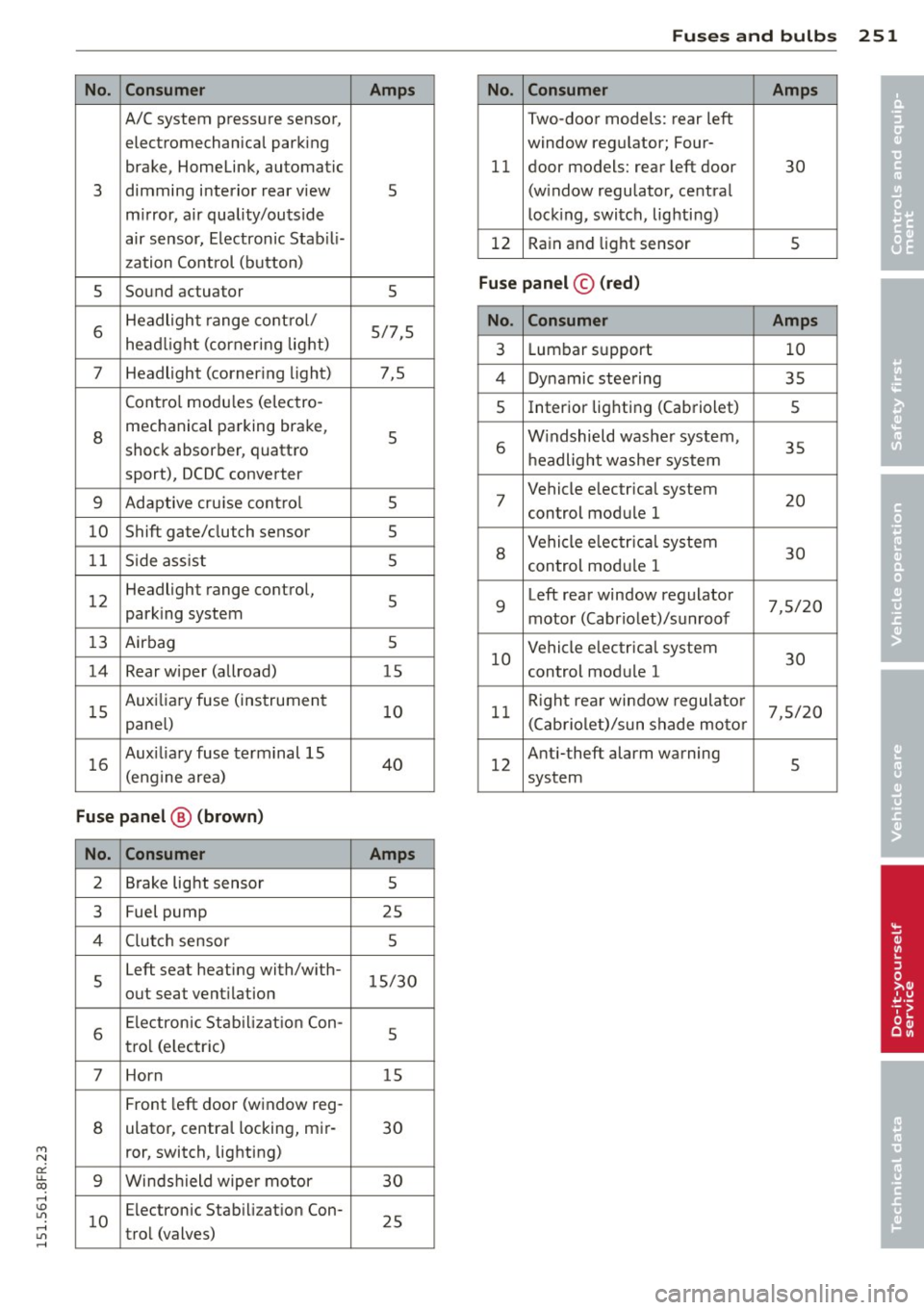
No. Consumer
A/C system pressure sensor,
electromechanical parking
brake, Homelink, automatic
3 dimming interior rear view
m
irror, air quality/outside
air sensor, Electronic Stab ili-
zation Control (button)
5 Sound
actuator
6 Headlight
range cont rol/
head light (cornering light)
7 Headlight (corner
ing light)
Contro l modu les (e lectro-
8 mechanical parking brake,
shock absorber, quattro
sport), DCDC converter
9 Adaptive cru ise contro l
10 Shift gate/clutch
sensor
1 1 Side ass ist
1 2 Headlight range
control,
park ing system
13 Airbag
14 Rear wiper (allroad)
1 5 Auxi
liary fuse (instrument
pane l)
16 Aux
iliary fuse terminal 15
(engine area)
Fuse p anel @ (brown )
No. Con sumer
2 Brake light sensor
3 Fuel
pump
4 Clutc h sensor
5 Left
seat heating with/w ith-
out seat vent ilation
6 Electronic Stab
il iz at ion Con-
tro l (e lectric)
7 Horn
Front left door (window reg-
8 ulator, centra
l locking, mir-
ror, switch, lighting)
9 Winds hield wipe r motor
1 0 Electronic
Stabilizat ion Con-
trol (valves)
Fuses and bulb s 251
Amp s No. Consumer Amps
•
Two-door models: rear left
• window regulator; Four-
11 door models:
rear left door
30
5 (window regulator, central
lock
ing, switch, lighting)
12 Rain and light sensor
5
5
Fuse pan el© (r e d )
5/7,5 No . Consumer Amps
3 Lumbar support 10
7,5 4 Dynamic steering 35
s Interior lighting (Cabriolet)
5
5 6 W
indshield washer system,
35
h eadlight washe r system
5 7 Vehicle electrical
system
20
control module 1
5
5
8
Vehicle e lectr ica l system
30
control module 1
5 9 Left rear window regulator
7,5/20
motor (Cabriolet)/sunroof
5
15 10 Vehicle e
lectrical system
30
control module 1
10 11 R
ight rea r window regulato r
7,5/20
(Cabriolet)/sun shade motor
40 12 Anti-theft
alarm warning
5
system
Amps
5
25 5
15/30
5
15
30
30
25