ABS AUDI RS5 CABRIOLET 2015 Owners Manual
[x] Cancel search | Manufacturer: AUDI, Model Year: 2015, Model line: RS5 CABRIOLET, Model: AUDI RS5 CABRIOLET 2015Pages: 284, PDF Size: 69.56 MB
Page 16 of 284
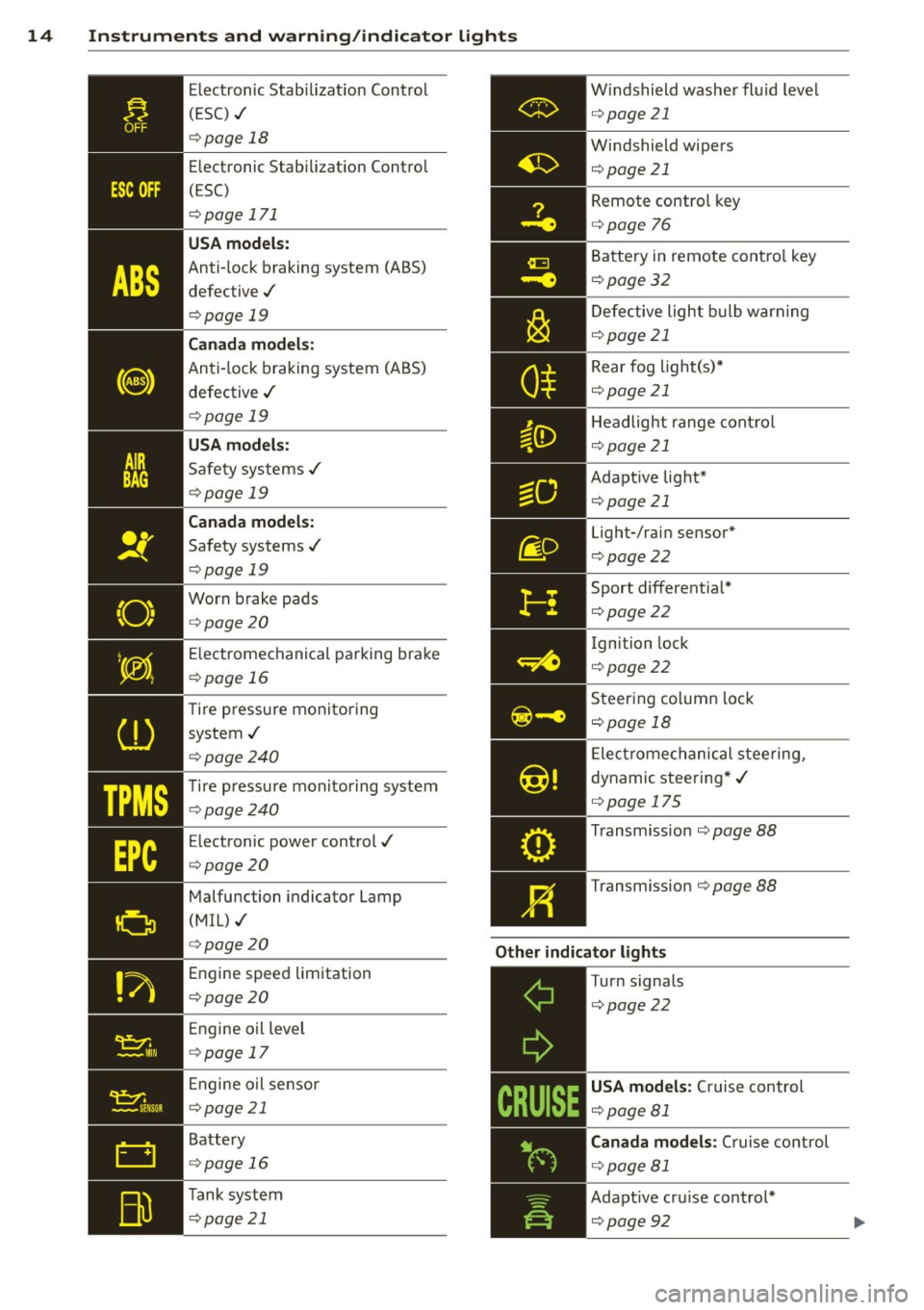
14 Instruments and warning/indicator lights
TPMS
Electronic Stabilization Control
( ES C) ./
¢page 18
Electronic Stabilization Control
(ESC)
¢ page 171
USA models:
Anti-lock braking system (ABS)
defective ./
¢ page 19
Canada models:
Anti-lock braking system (ABS)
defective ./
¢ page 19
USA models:
Safety systems ./
¢page 19
Canada models:
Safety systems ./
¢ page 19
Worn brake pads
¢ page 20
E lectromechanical parking brake
¢ page 16
T ire pressu re monitoring
system ./
¢ page240
Tire pressure mon itoring system
¢page240
Electronic power control./
¢ page20
Malfunction indicator Lamp
(MIL) ./
¢ page 20
Engine speed limitation
¢ page20
Engine oil leve l
¢ page 17
Engine oil sensor
¢page 21
Battery
¢ page 16
Tank system
¢ page 21 Windshield
washer fluid level
¢ page21
Windshield wipers
¢page21 Remote control key
¢page
76
Battery in remote control key
¢page32
Defective light bulb warning
¢page21
Rear fog light(s)*
¢page21
Headlight range control
¢page 21
Adapt ive light*
¢page21
Light-/rain sensor*
¢page22
Sport differentia l*
¢page22
Ignition lock
¢ page22
Steering column lock
¢page 18
Electromechanical steering,
dynamic steering*./
¢ page 175
Transm ission ¢page 88
Transm ission ¢page 88
Other indicator lights
-------------
Turn signals
¢page22
USA models : Cru ise control
¢page 81
Canada models : Cruise control
¢ page81
Adapt ive cru ise control*
¢page92
Page 17 of 284
M N
er
u..
co ,...., \!) 1.1'1 ,...., 1.1'1 ,....,
Instrument s and warnin g/indic ator ligh ts 15
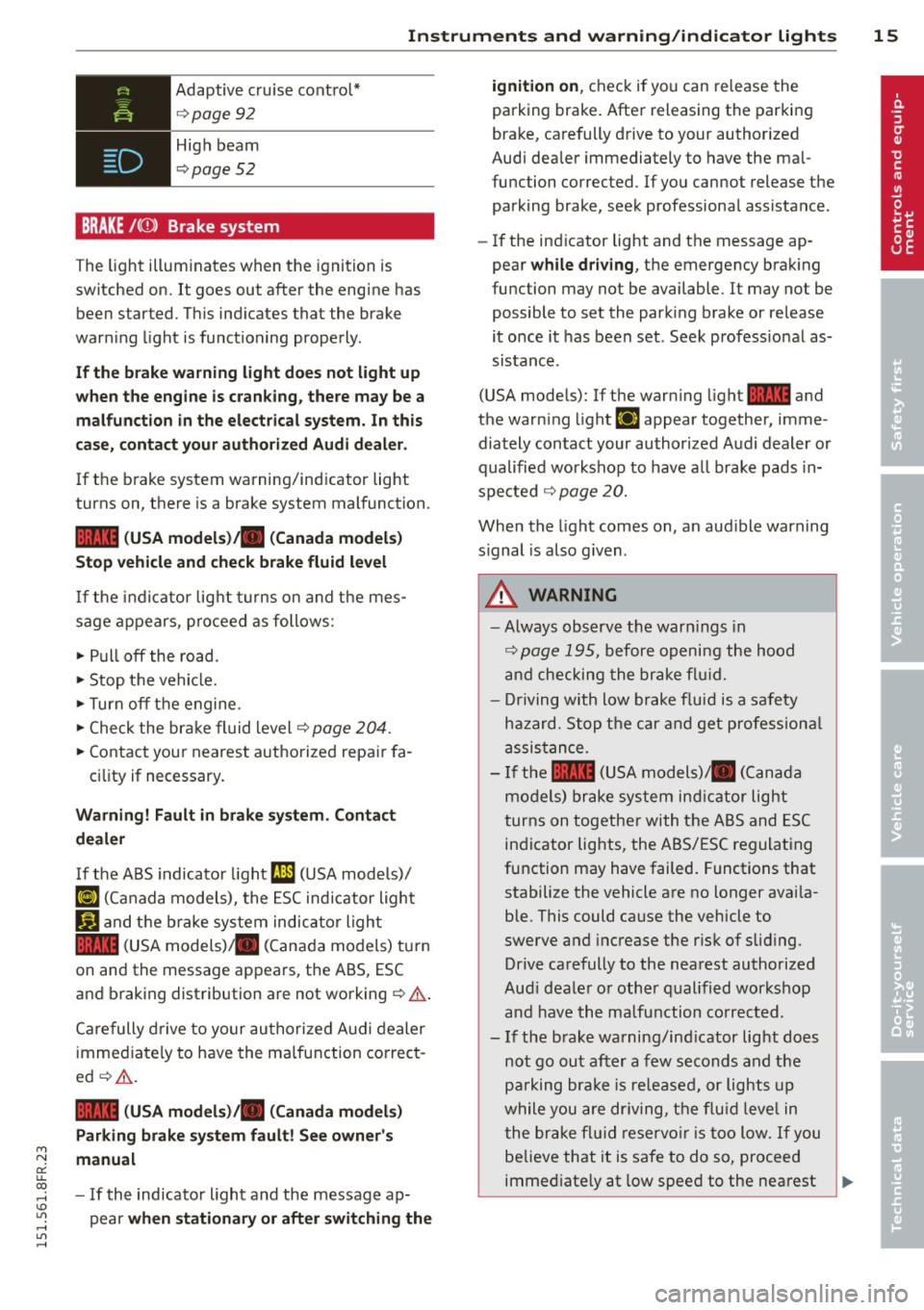
Adaptive cruise contro l*
~ page 92
High beam
~page 52
BRAKE /((J)) Brake system
The light i llum inates when the ignition is
switched on. It goes out after the engine has been started . Th is indicates that the brake
warn ing light is functioning properly .
If the brake wa rning light doe s not light up
w hen t he engine i s cr an ki ng , th ere ma y be a
malf unct ion in the ele ctric a l s ystem. In th is
c as e, c ont act your author ize d Audi dealer .
If the brake system warning/ind icator light
turns on, there is a brake system malfunction.
1111 ( USA mod els)/ . (Canada m odel s)
Stop veh icle and che ck brake f luid le vel
If the indicator light t urns on and the mes
sage appears, proceed as follows :
i.. Pull off the road .
1> Stop the vehicle.
1> Turn off the engine.
1> Check the brake flu id level ~ page 204.
1> Contact your nearest authorized repair fa-
ci lity if necessary.
W arning! Fault in br ake sy ste m . Conta ct
de aler
If the ABS indicator light rJl1 (USA mode ls)/
ii] (Ca nada models), the ESC ind icator light
GJ and the b rake system indicator ligh t
1111 (USA models);II (Canada models) turn
on and the message appears , the ABS, ESC
and braking distribution are not working
~ & .
Ca re fully drive to yo ur au thorized A ud i dealer
immed iately to have the malfunction correct
ed ~& -
1111 (USA m odels)/ . (Canada m odel s)
Parkin g brake sy ste m f ault! See own er' s
ma nual
- If the indicator light and the message ap
pear
when stati onary o r aft er swit ching the ignition on
,
check if you can release the
parking brake. After releasing the parking
brake, carefully drive to your authorized
Audi dea ler immediately to have the ma l
function correc ted. If you cannot release the
parking brake, seek professional assistance.
- If the ind icator light and the message ap
pear
w hile d riving , the emergency brak ing
function may not be available. It may not be
possible to set the park ing b rake or release
it once it has been set . Seek profess ional as
sistance .
(USA models): If the warn ing light
1111 and
the warn ing light
Ei'J appear together, imme
diately contact your authorized Audi dealer or
qualified workshop to have a ll brake pads in
spe cted
~ page 20.
When the light comes on, an aud ible warning
s ignal is also g iven .
A WARNING
-Always observe the warn ings in
Q page 195, before openi ng the hood
and checking the brake flu id.
- Driving with low brake fluid is a safety
ha zard . Stop the car and get professiona l
assis tance.
- I f the
1111 (USA models) ;II (Canada
models) brake system ind icator light
turns on together with the ABS and ESC
indicator lights, the ABS/ESC regulating
function may have failed. Functions that
stabilize the vehicle are no longer avai la
ble. This could cause the vehicle to
swerve and increase the r isk of slid ing .
Drive carefully to the nearest authorized
Aud i deale r or other q ualified workshop
and have the malfunction corrected .
- If the brake warning/ind icator light does
not go out after a few seconds and the
pa rking brake is re leased, or lights up
while you are dr iving, t he f lu id leve l in
the brake fl uid reservo ir is too low. If you
believe that it is safe to do so, proceed
immediate ly at low speed to the nearest
Ill-
Page 20 of 284

18 Instruments and warning/indicator lights
Do not continue driving if the . symbo l
illuminates. There is a malfunct ion in the
engine cooling system -you co uld damage
your eng ine .
@-Steering column lock
• Steering defective! Do not drive vehicle!
If the indicator light turns on and the mes
sage appears, there is an electronic steer ing
column lock malfunction . You ca nnot switch
the ign ition on .
Do
not tow your vehicle because it cannot be
steered. Seek professional assistance.
1!11 Steering lock: Contact dealer!
If the indicator light turns on and t he mes
sage appears, there is an elect ronic steer ing
column lock ma lfunction.
Drive to your authorized Aud i dea ler immedi
ately to have the malfunction corrected.
A WARNING
-
Your vehicle must not be towed in the
event of a malfunction in the electronic
steering column lock because it cannot be
steered due to the locked steering.
If it is
towed with the steering locked, there is
the risk of an accident.
©-Ignition lock
• Ignition lock defective. Contact dealer!
If the indicator light turns on and the mes
sage appears, do
not switch the ignition off
because you may not be able to switch it on
again.
Drive to your authorized Audi dealer immedi
ately to have the malfunction corrected.
On vehicles with convenience key *, the engine
should not be switched
off using the
I START ENGINE STOP ! button because the en
g ine cannot be started again after the ignition
has been switched
off.
(D Tips
The symbol's appearance might be differ ent in some mode ls.
!;.! ~ Electronic Stabilization Control
(ESC)
If the DJ ind icator light blinks while driving,
the ESC or ASR (Anti-Slip Regulation) is active
ly regulat ing.
If the
DJ ind icator light turns on, the system
has switched the ESC
off. In th is case, you can
switch the ign ition
off and then on to switch
the ESC on aga in. The ind icator light turns
off
when the system is fu nctioning fu lly.
If the
II ind icator light turns on, ESC was re
stricted or switched
off using the I.a OFFI but
ton
Q page 171 .
Stabilization control (ESC/ABS): Fault! See
owner's manual
If the indicator light DJ and the ABS indicator
light~ (USA models)
;t!J (Canada models)
turn on and the message appears, the ABS or
electron ic differe ntial lock is malfunctioning.
T his also causes the ESC to malfunction. The
brakes still function with their normal power,
but ABS is not active .
Drive to your author ized Audi dealer immed i
ately to have the malfunction corrected .
For more information about the ESC
Q page 171.
A WARNING
--If the 1111 (USA models)/ . (Canada
models) brake system indicator light turns
on together with the ABS and ESC indic a
tor lights, the ABS/ES( regulat ing function
may have failed. Functions that s tabilize
the vehicle are no longer available. This
could cause the vehicle to swerve and in
crease the risk of sliding. Drive carefully to
the nearest authorized Audi dealer and
have the ma lfunction corrected.
~
Page 21 of 284
M N
er
u..
co ,...., \!) 1.1'1 ,...., 1.1'1 ,....,
Instrument s and warnin g/indic ator ligh ts 19
@ Tips
For additional information on ESC and
ABS, refer to
r=;, page 171.
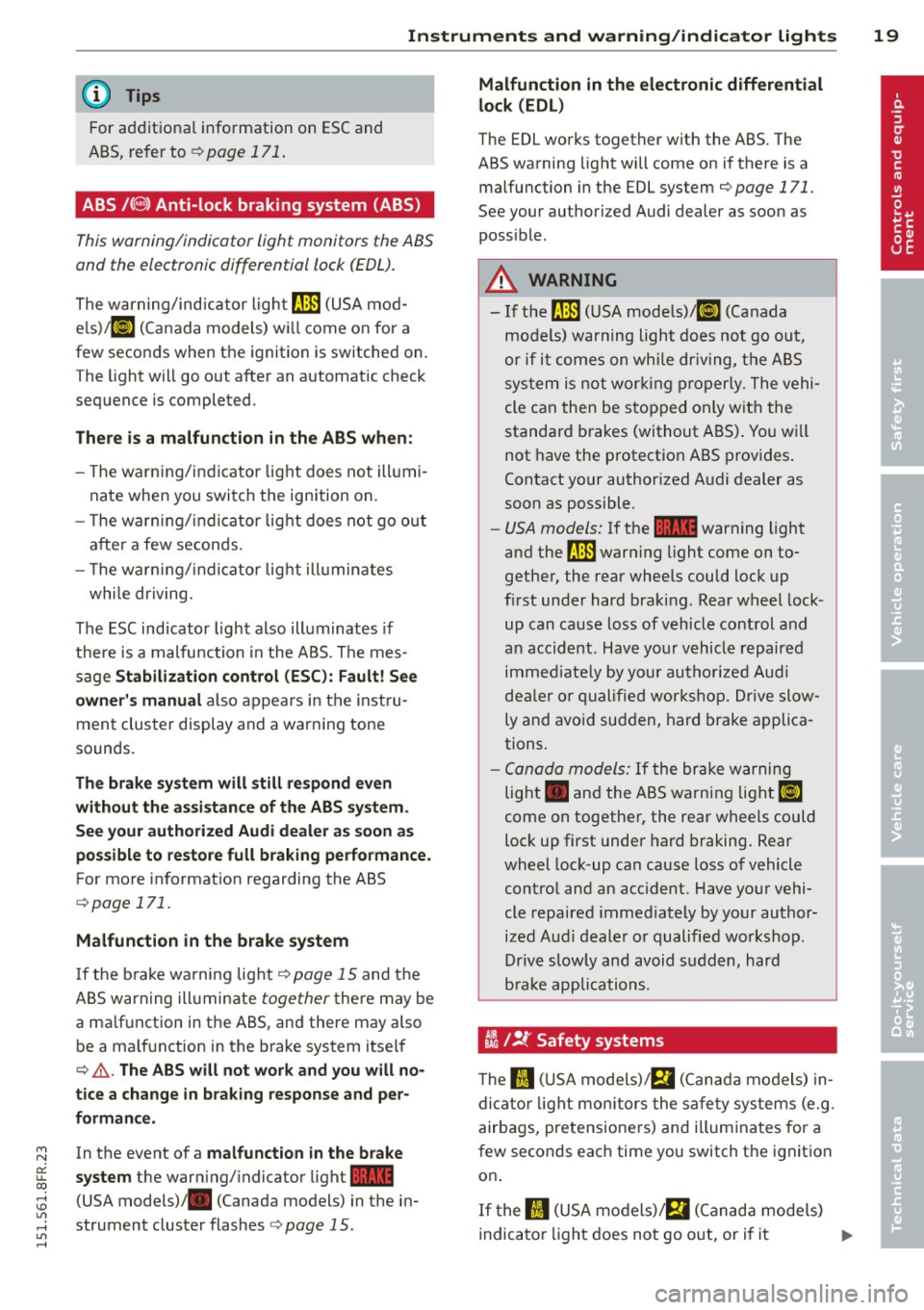
ABS /( 8 ) Anti-lock braking system (ABS)
This warning/indicator light monitors the ABS
and the electronic differential lock (EDL).
The warning/indicator light[!]) (USA mod
els)/ ti] (Canada models) wi ll come on for a
few seconds when the ignition is switched on.
The light will go out after an automatic check
sequence is completed .
There is a malfunction in the ABS wh en :
- T he warning/ indicator light does not illumi
nate when you switch the ignition on.
- T he warn ing/indicator lig ht does not go out
after a few seconds.
- T he warning/indicator lig ht ill uminates
whi le dr iving.
The ESC ind icator light also illuminates if
there is a malfunction in the ABS. T he mes
sage
Sta bilizati on control (E SC) : Faul t! S ee
owner 's manu al
also appears in the inst ru
ment cluster display and a warning tone
sounds.
Th e br ake sy ste m will still re spond eve n
with out the a ssis tan ce of the ABS sy ste m .
See you r a uthorized Audi dealer a s soon a s
po ssible to re store full braking perform ance .
For more informat ion regarding the ABS
r=;,page 171.
Malfunction in the brake sy stem
If the brake warning light¢ page 15 and the
ABS warning ill uminate
together there may be
a ma lfunction in the ABS, and there may also
be a ma lfunction in the brake system itself
¢ ,1. . The ABS w ill not work a nd you will no
tice a change in braking response and per
forma nce.
In the event of a malfu nction in the b rake
s y stem
the warn ing/ indicator light 1111
(USA models) ;II (Canada models) in the in
strument cluster flashes
r=;, page 15 .
Malfunction in the electronic diff erential
l o ck (EDL)
The EDL works together with the ABS. The
ABS warning light will come on if there is a malfunction in the EDL system
¢page 171.
See your author ized Audi dealer as soon as
poss ible.
A WARNING
- If the [!]) (U SA mode ls)/ ti] (Canada
models) warning light does not go out,
-
or if i t comes on while dr iving, the ABS
sys tem is not wor king properly. The vehi
cle can then be stopped only w ith the
standard b rakes (without ABS) . You wi ll
not have the protect ion ABS provides .
Contact your authorized A udi dealer as
soon as possible.
- USA models: If the 1111 warning light
and the[!]) warning light come on to
gether, the rear whee ls could lock up
first under hard braking. Rear wheel lock
up can cause loss of vehicle control and
an accident. Hav e yo ur vehicl e repaired
immed iate ly by yo ur au tho riz ed Aud i
dea le r o r q ualified wor kshop. Drive slow
ly and avo id sud den, hard brake appli ca
tions .
-Canada models: If the brake warning
light . and the ABS warning light
£iJ
come on togethe r, the rear wheels could
lock up first under hard braking . Rear
wheel lock-up can cause loss of vehicle
contro l and an accident. Have yo ur vehi
cle repaired immed iately by your author
ized Audi dealer or qualified wo rkshop.
Drive slow ly and avoid sudden, hard
b ra ke applications.
tli I !f Safety systems
T he II (USA models) ;EI (Canada models) in
d icator light mon itors the safe ty systems (e.g.
airbags, pretensione rs) and illum inates for a
few seconds each time you switch the ignition
on .
If the II (USA models)/ E,I (Canada mode ls)
indica tor ligh t does not go o ut, or i f it
Page 67 of 284

"' N
a: LL co
rl I.O
"' rl
"' rl
.. To install the insert , press it down into the
mount.
A WARNING
Never put waste paper in the ashtray. Hot
ashes or other hot objects in the ashtray
could set waste paper on fire.
Cigarette Lighter
Fig. 75 Fron t ce n ter conso le: cigarett e lig hter
.. Press the cigarette lighter in .
.. Remove the cigarette l ighter when it pops
out.
The c igarette lighter shou ld only be used as a
power source for the tire repair kit when abso
l utely necessary.
A WARNING
The cigarette lighter only works when the
ign ition is switched on . Incorrect usage
can lead to serious injuries or burns. For
this reason, children should never be left
unattended in the vehicle because this in
creases the risk of injury.
Storage
General overview
A WARNING
- Always remove objects from the instru
ment panel. Any items not put away
could slide around inside the vehicle
wh ile driving or when accelerating or
when applying the brakes or when driv
ing around a corner.
Seats and storage 65
-When you are driving make sure that
anyth ing you may have placed in the cen
ter console or other storage locations
cannot fall out into the footwells . In case
of sudden braking you would not be able
to brake or accelerate .
Cupholder
Fig. 76 Center console: fro nt cupho lde r
Fig. 77 (up holder* in the rea r
Front beverage holders
.. You can accommodate two beverages in this
storage
Q fig. 76.
A maximum of two beverages can be placed in
the rear beverage holders*.
A WARNING
Spilled hot liquid can cause an accident
and personal injury.
- Never carry any beverage containers with
hot liquids, such as hot coffee or hot tea,
in the vehicle while it is moving. In case
of an accident, sudden braking or other
veh icle movement, hot liquid could spill,
causing scalding burns. Spilled hot liquid
can also cause an acc ident and personal
injury.
Page 82 of 284
80 On the road
soon as the switch @is released, or the accel
erator pedal is depressed, emergency braking
stops .
.&_ WARNING
Emergency braking should only be used in
an emergency, when the normal foot brake
has failed or the brake pedal is obst ructed.
Using the parking brake to perform emer
gency braking will slow yo ur vehicle down
a s if you had made a full brake application.
The laws of physics cannot be s uspended
even w ith ESC and its associated compo
nents (ABS, ASR, EDS). In corners and
when road or weather conditions are bad,
a full brake application can cause the vehi
cle to skid or the rear end to break away -
r isking an accident.
Speed warning system
Overview
The speed warning system helps you to keep
your driving speed below a set speed limit.
The speed warning system warns if the driver
exceeds a prev iously stored maximum speed.
A warning ton e will sound as soon as the vehi
cle speed exceeds the set speed by about
3 mph (3 km/h). At the same time, a warning
symbol appears in the d isplay . The symbol's
appearance might be d ifferent in some mod
e ls.
The speed warning sys tem has two warn ing
thresholds that function independently of
each other and that have somewhat different
purposes:
Speed warning 1
You can use speed warning 1 to set the maxi
m um speed whil e you are dr iv ing . This setting
will remain in effect until you turn off the igni
tion, assuming that you have not changed or reset the setting .
The. (USA models)/ . (Canada models)
speed warning symbol in the warning 1 dis
play appears when you exceed the maximum speed
. It goes out when the speed falls be low
the stored maximum speed.
T he speed warning symbol will also go out if
the speed
exceeds the stored maximum speed
by more than about 25 mph (40 km/h) for at
least 10 seconds . The stored maximum speed
is de leted .
Speed warning 2
Storing warning 2 is recommended if you al
ways
want to be rem inded of a ce rtain speed,
f or example when you are traveling in a coun
try that has a general maximum speed limit,
or if you do not want to exceed a specified
speed for winter tires.
The. (USA models)/ . (Canada models)
speed warning 2 symbol appears in the dis
play when you exceed the stored speed Limit.
Unlike warning 1, it will not go out until the
vehicle speed drops below the stored speed
limit .
Setting speed warning 2
c> page 81 .
(D Tips
Even though your vehicle is eq uipped with
a speed warning system, you should still
watch the speedometer to make sure you
are not driv ing faster than the speed limit.
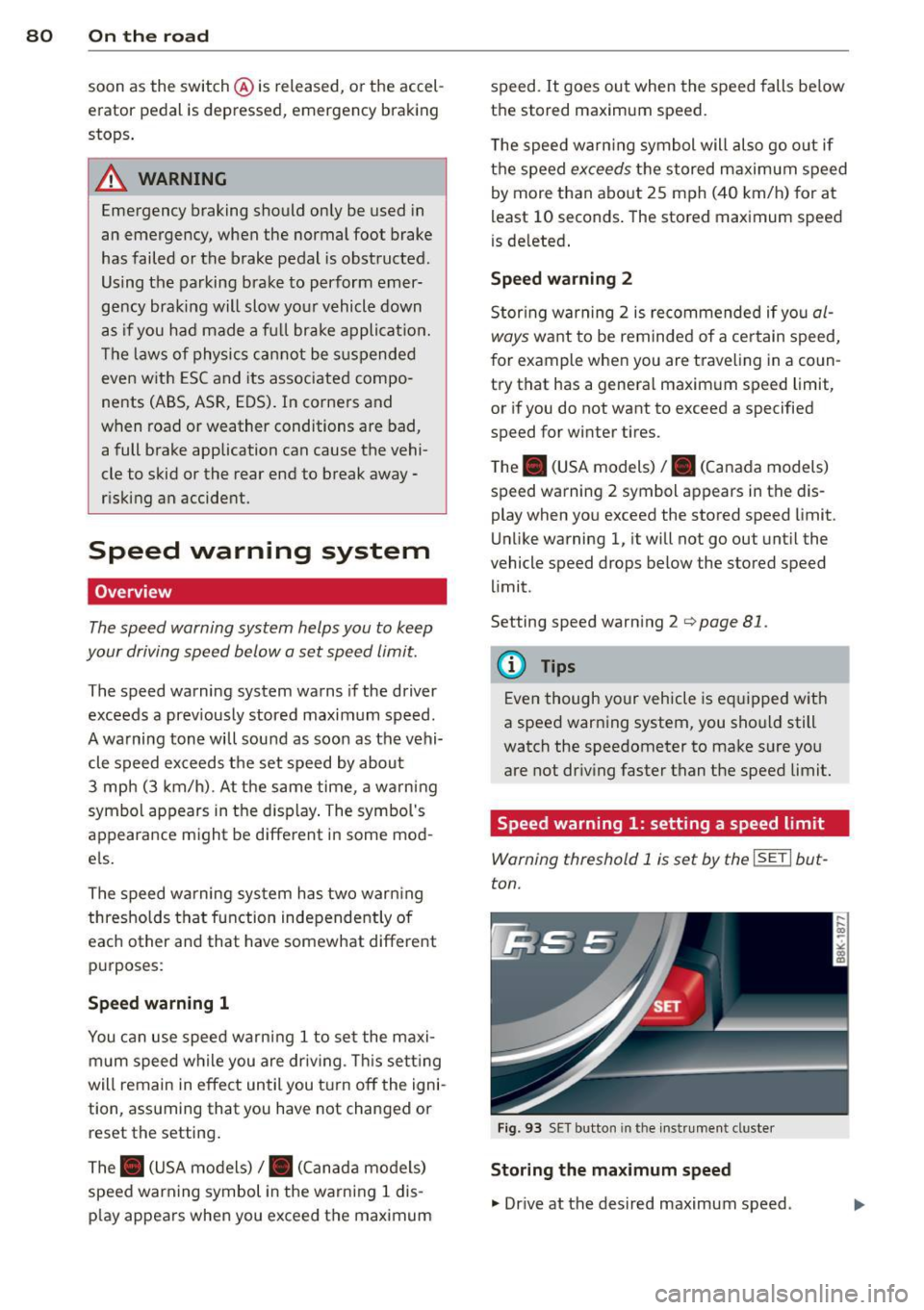
Speed warning 1: setting a speed limit
Warning threshold 1 is set by the ISETI but
ton.
Fig . 93 SET button in the instr umen t cluste r
Storing the maximum speed
., Dr ive at the desired maximum speed .
Page 121 of 284

M N
er
u..
co ,...., \!) ..,.,
,...., ..,., ,....,
area because the rear lid cannot be fully
closed.
-If you absolutely must drive with the rear
lid open, observe the following notes to
reduce the risk of poisoning:
- Close all windows,
- Close the power top,
- Open all air outlets in the instrument
panel,
- Switch off the air recirculation,
- Set the fresh air fan to the highest
speed.
A WARNING
Always make sure that the doors, all win
dows, the power top and the rear lid are
securely closed and locked to reduce the
risk of injury when the vehicle is not being
used.
-After closing the rear lid, always make sure that it is properly closed and locked.
- Never leave your vehicle unattended es
pecially with the rear lid left open. A
child could crawl into the vehicle through
the luggage compartment and close the
rear lid becoming trapped and unable to
get out. Being trapped in a vehicle can
lead to serious personal injury.
- Never let children play in or around the
vehicle.
- Never let passengers ride in the luggage
compartment. Vehicle occupants must
always be properly restrained in one of
the vehicle's seating positions.
(D Tips
- Air circulation helps to reduce window
fogging. Stale air escapes to the outside
through vents in the trim panel. Be sure
to keep these slots free and open.
- The tire pressure must correspond to the
load. The tire pressure is shown on the
tire pressure label. The tire pressure la bel is located on the driver's side B-pillar.
The tire pressure label lists the recom mended cold tire inflation pressures for
the vehicle at its maximum capacity
.
Driving Safely 119
weight and the tires that were on your
vehicle at the time it was manufactured.
For recommended tire pressures for nor
mal load conditions, please see chapter
¢page 217.
Tie-downs
Applies to vehicles : wi th t ie-downs
The luggage compartment is equipped with
four tie-downs to secure luggage and other
items.
Use the tie-downs to secure your cargo prop
erly
¢ page 118, Loading the luggage com
partment .
In a collision, the laws of physics mean that
even smaller items that are loose in the vehi
cle will become heavy missiles that can cause
serious injury. Items in the vehicle possess en
ergy which vary with vehicle speed and the
weight of the item. Vehicle speed is the most significant factor.
For example, in a frontal collision at a speed
of 30 mph (48 km/h), the forces acting on a 10-lb (4.5 kg) object are about 20 times the
normal weight of the item . This means that
the weight of the item would suddenly be
about 200 lbs. (90 kg). You can imagine the injuries that a 200 lbs. (90 kg) item flying
freely through the passenger compartment
could cause in a collision like this.
A WARNING
Weak, damaged or improper straps used
to secure items to tie-downs can fail dur ing hard braking or in a collision and cause
serious personal injury.
- Always use suitable mounting straps and
properly secure items to the tie-downs in
the luggage compartment to help pre
vent items from shifting or flying for
ward as dangerous missiles.
- When the rear seat backrest is folded
down, always use suitable mounting
straps and properly secure items to the
tie-downs in the luggage compartment
to help prevent items from flying
•
•
Page 126 of 284

124 Safet y belt s
Why safety belts?
Frontal collisions and the law of physics
Frontal crashes create very strong forces for
people riding in vehicles .
Fig. 139 Unbelted occupants in a ve hicle heading for a
wall
Fig . 140 The vehicle c ras hes into the wall
The physical principles are simple. Both the
vehicle and the passengers possess energy
which varies with vehicle speed and body
weight . Engineers call this energy ''kinetic en
ergy ."
The higher the speed of the vehicle and the
greater the vehicle's weight, the more energy
that has to be "absorbed" in the crash .
Vehicle speed is the most significant factor . If
the speed doubles from 15 to 30 mph (25 to
50 km/h), the energy increases 4 times!
Because the passengers of this vehicle are not
using safety belts
c::> fig. 139, they will keep
moving at the same speed the vehicle was
moving just before the crash, until something
stops them -here, the wall
c::> fig . 140 .
The same principles apply to people sitting in
a vehicle that is involved in a frontal collision .
Even at city speeds of 20 to 30 mph (30 to
50 km/h), the forces acting on the body can reach
one ton (2,000 lbs. or 1,000 kg) or
more. At greater speeds, these forces are
even
higher.
People who do not use safety belts are also
not attached to their vehicle. In a frontal colli
sion they wi ll also keep moving forward at the
speed their vehicle was travell ing just before
the crash. Of course, the laws of physics don't
just apply to frontal collisions, they determine what happens in all kinds of accidents and col
lis ions .
What happens to occupants not wearing
safety belts?
In crashes unbelted occupants cannot stop
themselves from flying forward and being in
jured or killed . Always wear your safety belts!
Fig. 141 A d river not wea ring a safety belt is violen tly
th rown fo rwa rd
Fig . 142 A rear passenger not wearing a safety belt
will
fl y fo rwa rd and strike the drive r
Unbelted occupants are not able to resist the
tremendous forces of impact by holding tight
or bracing themselves. Without the benefit of
safety restraint systems, the unrestrained oc
cupant will slam violently into the steering
wheel , instrument panel, windshield, or what
ever else is in the way c::> fig. 141. This impact .,..
Page 127 of 284

"' N
a: LL co
rl I.O
"' rl
"' rl
with the vehicle interior has all the energy
they had just before the crash.
Never rely on airbags alone for protection.
Even when they deploy, airbags provide only
additional protection. Airbags are not sup posed to deploy in all kinds of accidents. Al
though your Audi is equipped with airbags, all
vehicle occupants, including the driver , must
wear safety belts correctly in order to mini mize the risk of severe injury or death in a
crash.
Remember too, that airbags will deploy only
once and that your safety belts are always
there to offer protection in those accidents in
which airbags are not supposed to deploy or
when they have already deployed . Unbelted
occupants can also be thrown out of the vehi
cle where even more severe or fatal injuries
can occur.
It is also important for the rear passengers to
wear safety belts correctly. Unbelted passen
gers in the rear seats endanger not only them
selves but also the driver and other passen
gers
¢ fig. 142. In a frontal collision they will
be thrown forward violently, where they can
hit and injure the driver and/or front seat pas
senger .
Safety belts protect
People think it's possible to use the hands to
brace the body in a minor collision. It 's simply
not true!
Fig. 143 Driver is correctly restrained in a sudden bral<·
ing maneuve r
Safety belts used properly can make a big dif
ference . Safety belts help to keep passengers
in their seats, gradually reduce energy levels
Safety belts 125
applied to the body in an accident, and help
prevent the uncontrolled movement that can
cause serious injuries. In addition, safety be lts
reduce the danger of being thrown out of the
vehicle.
Safety belts attach passengers to the car and
give them the benefit of being slowed down
more gently or "softly" through the "give" in
the safety belts, crush zones and other safety
features engineered into today's vehicles. By
"absorbing" the kinetic energy over a longer
period of time, the safety belts make the
forces on the body more "tolerable" and less
likely to cause injury.
Although these examples are based on a fron
ta l collision, safety belts can also substantial
ly reduce the risk of injury in other kinds of
crashes. So, whether you're on a long trip or
just going to the corner store, always buckle
up and make sure others do, too. Accident sta
tistics show that vehicle occupants properly
wearing safety belts have a lower risk of being
injured and a much better chance of surviving
an accident. Properly using safety belts also
greatly increases the ability of the supplemen
tal airbags to do their job in a collision . For
this reason, wearing a safety belt is legally re
quired in most countries including much of
the United States and Canada.
Although your Audi is equipped with a irbags,
you still have to wear the safety belts provid
ed . Front airbags, for example, a re activated
only in some frontal collisions. The front air
bags are not activated in all frontal collisions,
in side and rear collisions, in roll overs or in
cases where there is not enough deceleration
through impact to the front of the vehicle.
The same goes for the other airbag systems in
your Audi . So, always wear your safety belt
and make sure everybody in your vehicle is
properly restrained!
Page 137 of 284

"' N
a: LL co
rl I.O
"' rl
"' rl
-Never place additional items on the seat
that can increase the total weight regis
tered by the weight-sensing mat and can
cause injury in a crash.
Front airbags
Description of front airbags
The airbag system can provide supplemental
protection to properly restrained front seat
o ccupan ts.
F ig . 149 Location of driver airbag: in steering wheel
Fig. 150 Location of front passenger's airbag: in the in
st rument panel
Your veh icle is equipped w ith an "Advanced
Ai rbag System" in compliance with United
States Federal Motor Vehicle Safety Standard (F MVSS) 208 as app licab le at the time your
ve hicle w as manufac tured. The safety be lts
for the seats have "pretensione rs" that help
to take slack out of the belt system . The pre
tensioners are a lso activated by the electronic
contro l unit for the airbag system.
The front safety belts a lso have load limiters
to help reduce the forces applied to the body
in a crash.
The airbag fo r the driver is in the s teer ing
wheel hub
~ fig. 149 and the airbag for the
A irba g sy stem 135
front passenger is in the instr ument panel
~ fig. 150 . The general location of the airbags
is marked "AIRBAG".
T he re is a lot you need to know about t he a ir
bags in your vehicle . We urge you to read the
detailed information about airbags, safety
belts and child safety in this and the other
chapters that make up the owner's literature.
Please be sure to heed the WARNINGS - they
are extremely important for your safety and
the safety o f your passengers, especially in
fants and small children .
.&_ WARNING
Neve r rely on airbags alone for p rotec tion.
- Even w hen they deploy, airbags provide
only suppleme nta l protect ion.
- Airbag work most effectively w hen used
with p roperly worn safety belts.
- Therefore, always wear your safety belts and make sure that eve rybody in your ve
hicle is p rope rly r est rained .
.&_ WARNING
A person on the front passenger seat, es
pe cially infants and sma ll children, w ill re
ceive ser io us i njuries and can even be kil
led by being too close to the airbag when it inflates .
- Altho ugh the Advan ced A irbag Sys tem in
your veh icle is designed to turn off the
fro nt passenge r airbag if a n infant or a
sma ll child is on the front passenger
seat , nobody can absolutely gua rantee
that deployment under these special conditions is impossible i n all conceiva
ble sit uat ions that may happen during
the useful life of your vehicl e.
- The Advanced Airbag System can dep loy
in acco rdance with the "low risk" option
un der the U.S . Fede ral S tanda rd if a child
that is heavie r th an the typical one-yea r
old child is on the front passenge r seat
a nd the ot her condit ions for a irbag de
ployment are met .
-