door lock AUDI RS5 CABRIOLET 2015 Owner's Manual
[x] Cancel search | Manufacturer: AUDI, Model Year: 2015, Model line: RS5 CABRIOLET, Model: AUDI RS5 CABRIOLET 2015Pages: 284, PDF Size: 69.56 MB
Page 78 of 284

76 On the road
(D Note
If the engine has been under heavy load
for an extended period, heat builds up in
the engine compartment after the engine
is switched off -there is a risk of damaging
the engine. Allow the engine to run at idle
for about two minutes before switching it
off.
Convenience key
Starting the engine
Appl ies to vehicles: w it h co nve nience key
The I STAR T ENGINE S TOP! button switches
the ignition on and starts the engine .
Fig. 91 Center conso le: S TART ENGINE STOP butto n
Starting the engine
.. Step on the brake pedal and move the selec
tor lever to P or N
q &, .
.. Press On the ,.., I s=T=-= A--=R =T '""' E::;,N C7":=G-;"CI N;-;--;:::: E--=s:-:;T =::O :;-;: P:;-, 1 button
q fig . 91 -the engine w ill start .
Switching the ignition on /off
If yo u wou ld like to switch the ignition on
without starting the engine, follow these
steps:
.. Press the
I STAR T ENGINE STOP! button
without pressing the brake peda l.
.. To switch the ignition off, press the button
again.
If the engine should not start immediately,
the starting process is automatically stopped
after a short time . Repeat starting procedure.
When starting the engine, major e lectr ica l
loads are switched off temporarily. After a
cold engine is started, there may be a
brief period of increased noise because oil
pressure must first build up in the hydrau lic
valve adjusters. This is normal and not a cause
for concern.
A WARNING
=
- Never allow the engine to run in confined
spaces -danger of asphyx iat ion.
- Never turn off the engine until the vehi
cle has come to a complete stop.
- Always take the key with you whenever
you leave your veh icle . Otherw ise, the
engine could be started or electrical
equ ipment such as the power windows
could be ope rated. Th is can lead to seri
ous injury.
- Never leave children or persons req uiring
a ssis tance unattended in the vehi cle. The
doors can be locked usi ng the remote
transmitter, preventing people from es
caping from the veh icle on the ir own in
the event of an emergency . Depending
on the time of year, peop le inside the ve
hicle can be exposed to very high or very
low temperatures.
(D Note
- Avoid high engine rpm, full thrott le and
heavy eng ine loads unt il the eng ine has
reached operating temperature -other
w ise you risk engine damage.
® For the sake of the environment
Do not let the engine run wh ile parked to
warm up. Begin dr iving immediately. This
reduces unnecessary emissions .
¢j) Tips
- After starting a co ld engine, there may
be a brief period of increased noise be
cause the oil pressure must first bu ild up
in the hydraulic valve adjusters. This is
normal and not a cause for concern.
- If you leave the veh icle with the ignition
switched on, the ignit ion w ill switch off
afte r a certain per iod of t ime . Please
1JJ1,
Page 79 of 284

M N
er
u..
co ,...., \!) 1.1'1 ,...., 1.1'1 ,....,
note that electrica l equipment such as
exterior lights wi ll switch off as well
when that happens.
Switching engine off
App lies to vehicles: with conve nien ce key
.,. Bring your vehicle to a complete stop.
.,. Move the selector lever to the P or N pos i
t ion.
... Press the
I START ENGINE STOPI button
~ page 76, fig. 91 .
Steering lock
The steering locks when you turn the engine
off us ing the
I STAR T ENGINE STOP I button
and open the dr iver's door. The locked steer
ing helps prevent vehicle theft.
E mergenc y off
If necessary, the eng ine can be sw itched off
with the selector lever in the R or D/S pos i
tions. To do so, step on the brake pedal and
press and hold the
I STAR T ENGINE STOP I but
ton vehicle speed must be less than 6 mph (10 km/h).
.&, WARNING
- Never t urn off the eng ine be fore the ve
hicle has come to a complete stop . The
f ull function of the brake booster and the
power steering is not guaranteed . You
must use more force to turn or brake if
necessary. Because you cannot steer and
brake as you usually would, this could
lead to c rashes and serious injur ies.
- For safety reasons, you should always
park your vehicle with the se lector lever
in P. Otherwise, the veh icle could inad
vertent ly roll away.
- The rad iator fan can continue to run for
up to 10 minutes eve n afte r you have
tu rned off the eng ine and removed the
ignition key. The radiator fan can also
turn on again if the eng ine coolant hea ts
up because of intense sunlight or hea t
build -up in the engine compartment.
On th e ro ad 77
-Always take the key with you whenever
you leave your ve hicle. Otherw ise, the
e ngine could be started or electrical
equipment such as the power windows
could be operated. This can lead to seri
ous injury.
(D Note
If the engine has been under heavy load
for an extended period, heat bu ilds up in
the eng ine compartment after the engine
i s sw itched off - there is a r is k of damag ing
the e ngine. A llow the eng ine to run at id le
for abo ut two minutes before switching it
off.
Driver messages
I g nition i s on
This message appears and a warning tone
sounds if you open the d river's door when the
ignition is sw itched on.
No key ident ified
This message appears when the
I START ENGINE STOP I button is pressed if
there is no master key ins ide the ve hicle or if
the system does not recognize it . For exam
ple, the master key cannot be recognized if it
i s covered by an object (e .g . aluminum brief
case) which
screens the radio s ignal. Electron
ic dev ices such as cell p hones can also inte r
f ere with the radio s ignal.
Pr ess brake p edal to start engine
This message appears if you do not press the
brake pedal to start the eng ine .
Shift to N or P to start eng ine
T his message appears w hen attempt ing to
star t the eng ine if the selecto r lever for the
automatic transmiss ion is not in the P or N
pos ition . The engine can only be started with
the se lector in these positions.
!I I s the ke y in the vehicle?
Page 80 of 284

78 On the road
This message appears if the master key is re
moved from the vehicle with the engine run
n ing.
If the master key is no longer in the ve
h icle, you cannot switch on the ignition after
stopping the engine and you also cannot start
the eng ine again . Moreover, you can not lock
the veh icle from the outside w ith the key.
Shift to P otherwise vehicle can roll away .
Doors do not lock if lever is not in
P.
This message appears for safety reasons
a long w ith a warning signa l. It appears if the
selector lever for the automat ic transm iss ion
is not in the P position when sw itch ing off the
ignition . Move the selector lever to the P pos i
tion, othe rwise the ve hicle is not secured
against rolling away . You also cannot lock the
vehi cle using the locking bu tton* on the door
han dle or using the remote key.
Convenience key defective! Use ignition lock
This message appears if the eng ine must be
started or stopped using the ignition key and
not the
I STAR T ENGIN E ST OP ! button .
Electromechanical
parking brake
Operation
The electromechanical parking brake replaces
the hand brake.
F ig. 92 Cen te r console: Parking brake
.., Pull on the switch @ c.> fig. 92 to apply the
parking brake. The indicator lights in the
switch and. (USA models)/. (Cana-
da models) in the instrument cluste r ill umi
nate. ..,
With the ignition switched on, step on the
brake peda l or the accelerator pedal and
press the switch @ at the same time to re
lease the parking brake . The indicator lights
in the switch and. (USA mode ls)/ . (Can
ada models) in the instrument cluster go
out.
Your vehicle is equipped with an electrome chanical parking brake. The parking brake is
designed to prevent the veh icle from rolling
u nintentionally and replaces the hand brake.
In add ition to the normal functions of a tradi
t ional hand brake, the electromechanical
parking brake provides various convenience
and safe ty funct ions .
When starting from rest
-The integral start ing ass ist helps you when
driving by automatically releasing the park
ing brake
c> page 79, Starting from rest .
- When start ing o n inclines, the starting as
sist prevents the vehicle from unintentional
ly rolling back. The braking force of the
pa rking brake is not released until suffic ient
driving force has been bui lt up at the
wheels.
Emergency brake function
An emergency brake ensures that the veh icle
can be slowed down even i f the normal brakes
fail ¢ page 79, Emergency braking.
A WARNING
If a drive rang e is engaged with the vehicle
stationary and the engine running, yo u
must in no instance accelerate carelessly.
Otherwise the vehi cle wi ll start to move
immediately -risk of an accident.
(0 Tips
-If the parking brake is applied with the
ign ition switched off, the ind icator lights
in the switch and - (USA models) .
(Canada mode ls) in the instrument clus
ter will go out after a certain period of
time.
Page 81 of 284

M N
er
u..
co ,...., \!) ..,.,
,...., ..,., ,....,
-Occasiona l noises when the parking
brake is applied and re leased are norma l
and are not a ca use for concern .
- When the vehicle is parked, the parking
brake goes through a se lf-test cycle at
regular intervals. Any associated noises
are norma l.
Parking
.,. Press the brake pedal to stop the vehicle .
.. Pull the switch@¢
page 78, fig . 92 to set
the parking brake .
.,. Move the selecto r leve r to P .
.. Turn the eng ine off ¢,& .
.. When on incl ines or decli nes, tu rn the steer
ing wheel so that the vehicle w ill roll into
the cu rb if it begins to move .
_& WARNING
--When you leave your veh icle -even if on
ly briefly -always remove the ign ition
key . This applies part icularly when chil
dre n remain in the vehicle. Otherw ise the
children cou ld start the engine, release
the parking bra ke or operate electrical
equipment (e .g. power wi ndows). There
is the r is k of an accident .
- Whe n the vehicle is loc ked, no one -par
t ic ularly not c hild ren sho uld remain in
the vehicle . Locked doors make it more
difficult for emergency workers to get in
to the vehicle -putting lives at risk .
Starting from rest
The starting assist function ensures that the
parking brake is released automatically upon
starting.
Stopping and applying parking brake
.,. Pull the switch @ ~ page 78, fig. 92 to ap
ply the pa rk ing brake.
On th e ro ad 79
Starting and automatically relea sing the
parking brak e
.. When you sta rt to drive as usual, the park
ing brake is autom atically released and your
veh icle begins to move.
When stopping at a traffic signa l or stopping
in c ity traffic on v ehicl es with an automatic
tran smission, the pa rking b rake can be ap
plied . The vehicle does not have to be held
with the footbrake . The parking brake elimi
nates the tendency to creep w ith a dr ive range
engaged . As soon as you d rive
off as usual ,
t h e pa rking bra ke is re leased automat ically
and t he veh icle s tarts to move .
Starting on slopes
When sta rting on inclines, the sta rting assist
prevents the vehicle from un intent ionally roll
ing back . The braking force of the parking
brake is not re leased unti l su ff ici ent d riving
f orce has been built up at the wheels .
(D Tips
For safety reaso ns, the pa rking brake is re
l eased automatically o nly when the d riv
e r's safety belt is engaged in the buckle.
Emergency braking
In the event that the conventional brake sys
tem fails or locks .
.. In an emergency , pull the switch @
¢
page 78, fig . 92 and continue to pull it to
slow you r vehicle down with the parking
br ak e.
.. As soon as you re lease the swi tch @ or ac-
celerate, the braking process stops.
If you p ull the swi tch@ and hold it above a
speed o f abo ut 5 mph (8 km/h), the eme rgen
cy bra king f unct ion is initiated. The ve hicle is
braked at all four whee ls by activating the hy
draulic b rake system. The brake pe rformance
is sim ilar to making an emergency stop¢
A.
In orde r not to act ivate the eme rgency brak -
ing by mistake, an audib le wa rning tone (bu z
zer) so unds when the switch @ is pulled. As
ll>
Page 87 of 284
"' N
a: LL co
rl I.O
"' rl
"' rl
lever is left in N (Neutral) for more t han ap
prox imately 2 seconds, without the b rake ped
a l being pressed .
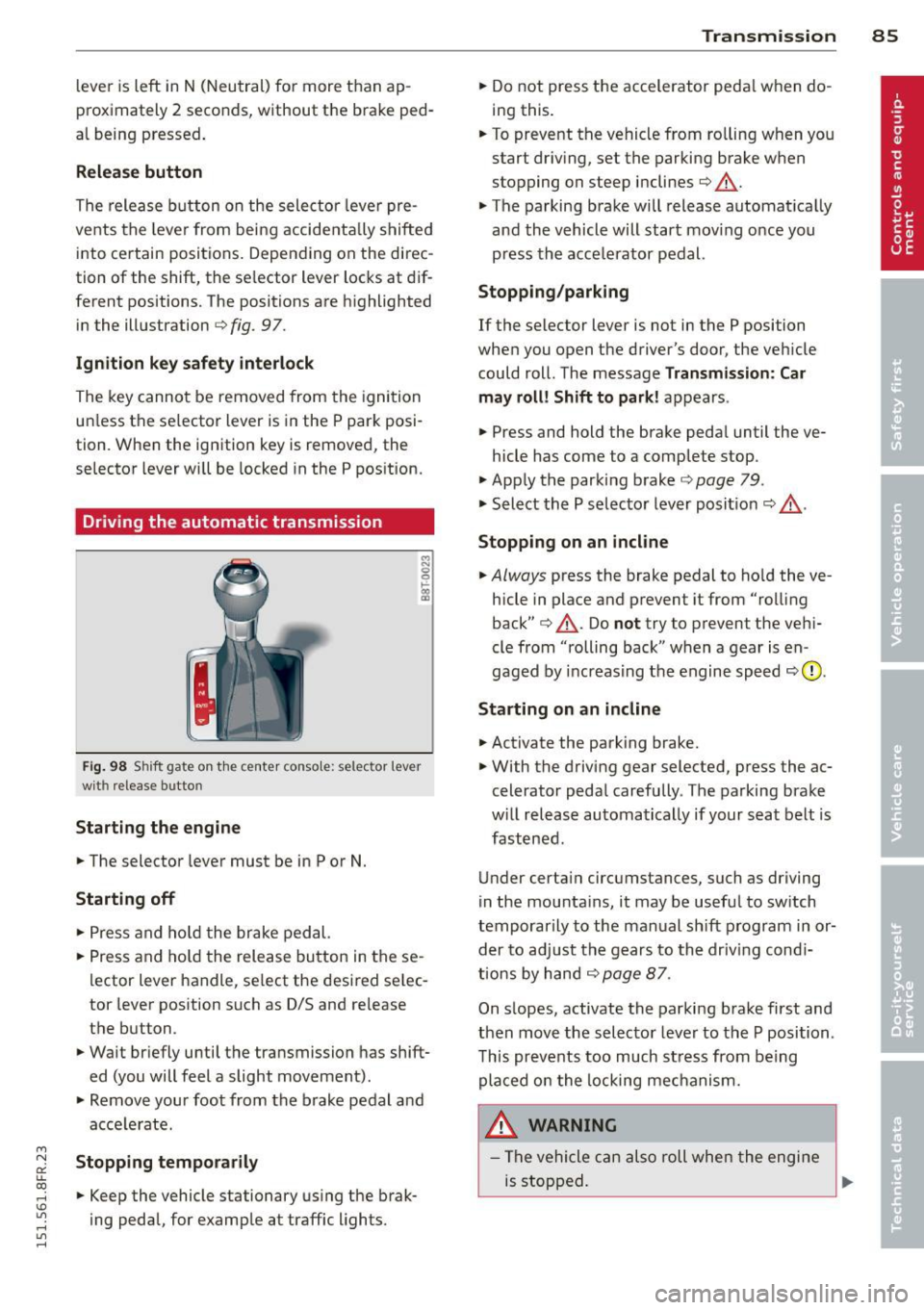
Release button
The release b utton on the selec tor leve r pre
ve nts the leve r from bei ng accide ntally s hifte d
i n to ce rtain positions. Depen ding on the direc
tion of the shift, the se lector lever locks at d if
ferent positions. The positions are h ighlighted
in the ill ustration
c!> fig . 97.
Ignition key safety interlock
The key canno t be removed from the igni tion
un less the se lector lever is in the P park posi
tion . When the ignition key is remove d, the
se lecto r lever wi ll be locked in the P pos ition.
Driving the automatic transmission
F ig. 98 S hift gate o n th e ce nte r conso le: selector lever
wit h release bu tton
Starting the engine
.. The selector leve r must be in P or N.
Starting off
.. Press a nd ho ld t he brake ped al.
.. Press and ho ld the release bu tton in these
l ector lever handle, se lect the desi red se lec
tor leve r pos ition such as D/S and re lease
t h e b utton.
.. Wait br iefly u ntil t he transmission has shift
ed (you will feel a slight movement).
.. Remove your foot from the b rake pedal a nd
acce le rate.
Stopping temporarily
.. Keep the vehicle stationary us ing the brak
ing peda l, for e xamp le at traffic lights.
Transm ission 85
.. Do not press the accelerator peda l w hen do
ing this .
.. To preve nt t he vehicle from ro lling when yo u
start dr iv ing, set the parking b rake w hen
stopping on steep inclines
c!> _&. .
.. The parking brake will release automat ica lly
an d the vehicle will start mov ing o nce you
p ress th e acce lerator pedal.
Stopping/parking
If the selector lever is not in the P position
whe n you open the driver's door , the veh icle
could roll . The message
Transmission: Car
may roll! Shift to park! ap pears .
.. Press and hold the brake peda l until the ve-
hicle has come to a comp lete stop .
.. App ly t he park ing brake
co page 79 .
.. Select the P selec to r lever posit io n
co _&. .
Stopping on an incline
.. Always press the brake pedal to ho ld the ve
hicle in place and prevent it from "ro lling
back"
co _&. . Do not try to p revent the ve hi
cle from "rolling back" when a gear is en
gaged by increas ing t he engine spee d co (!).
Starting on an incline
.. Activate the parking brake .
.. With t he driving gear selected, p ress the ac
celerato r peda l carefully . The parking brake
w ill rel ease au toma tically if your sea t belt is
fast ene d .
U nder certa in circumstances, such as driving
in the mounta ins, i t may be usefu l to sw itch
t emporar ily to the man ual sh ift program in or
d er to adju st the gears to th e d riv in g con di
ti ons by ha nd
co page 87 .
On s lopes, activate the parki ng b rake first and
t hen move the s electo r leve r to the P posi tion .
T his pr eve nts t oo much st ress from be ing
p la ced o n the locking me chani sm .
&_ WARNING
- Th e vehicle c an als o roll whe n the engi ne
is s topped .
~
Page 103 of 284

"' N
a: LL co
rl I.O
"' rl
"' rl
Have your authorized Audi dealer or au
thorized Audi Service Facility check their
function.
@ Tips
- If the window glass in the driver's door
or front passenger's door has been tint
ed, the display in the exterior mirror may be misinterpreted .
- For Declaration of Compliance to United
States FCC and Industry Canada regula
tions
¢ page 267.
Activating and deactivating
Applies to vehicles: with Audi side assist
Fig. 118 Drive r's d oor : Sid e ass ist bu tton
.. Press the button ¢.&. in General informa
tion on page 100
to switch the system on/
off . The LED in the button turns on when
side assist is switched on.
Adjusting the display brightness
Applies to vehicles: with Audi side assist
The signal brightness can be set in the radio
orMMI* .
.. Select : ICARI function button> Audi side as
sist.
.. Select : I CARI function button > Car systems*
control button > Driver assist > Audi side
assist.
The display brightness adjusts automatically
to the brightness of the surroundings, both in
the information and in the warning stage. In
very dark or very bright surroundings, the dis play is already set to the minimum or maxi
mum level by the automatic adjustment. In
Audi side assist 101
such cases, you may notice no change when
adjusting the br ightness, or the change may
only be noticeable once the surroundings
change.
Adjust the brightness to a level where the dis
play in the information stage will not disrupt
your view forward. If you change the bright
ness, the display in the exterior mirror will
briefly show the brightness level in the infor
mation stage. The brightness of the warning
stage is linked to the brightness in the infor
mation stage and is adjusted along with the
information stage adjustment.
(D Tips
- Side assist is not active while you are
making the adjustment.
- Your settings are automatically stored
and assigned to the remote control key
being used.
Driver messages
Applies to vehicles: wit h Aud i side ass ist
If side assist switches off by itself, the LED in
the button turns off and a message will ap
pear in the instrument cluster display:
Audi side assist unavailable: Sensors blocked
The radar sensors' vision is affected . Do not
cover the area in front of the sensors with bike
wheels, stickers, dirt or other objects. Clean
the area in front of the sensors, if necessary
¢ page 99, fig. 117 .
Audi side assist: Currently unavailable
Side assist cannot be switched on temporarily
because there is a malfunction (for example,
the battery charge level may be too low) .
Audi side assist: System fault!
The system cannot guarantee that it will de
tect vehicles correctly and it is switched off.
The sensors have been displaced or are faulty.
Have the system checked by an authorized
Audi dealer or authorized Audi Service Facility
soon.
Page 121 of 284

M N
er
u..
co ,...., \!) ..,.,
,...., ..,., ,....,
area because the rear lid cannot be fully
closed.
-If you absolutely must drive with the rear
lid open, observe the following notes to
reduce the risk of poisoning:
- Close all windows,
- Close the power top,
- Open all air outlets in the instrument
panel,
- Switch off the air recirculation,
- Set the fresh air fan to the highest
speed.
A WARNING
Always make sure that the doors, all win
dows, the power top and the rear lid are
securely closed and locked to reduce the
risk of injury when the vehicle is not being
used.
-After closing the rear lid, always make sure that it is properly closed and locked.
- Never leave your vehicle unattended es
pecially with the rear lid left open. A
child could crawl into the vehicle through
the luggage compartment and close the
rear lid becoming trapped and unable to
get out. Being trapped in a vehicle can
lead to serious personal injury.
- Never let children play in or around the
vehicle.
- Never let passengers ride in the luggage
compartment. Vehicle occupants must
always be properly restrained in one of
the vehicle's seating positions.
(D Tips
- Air circulation helps to reduce window
fogging. Stale air escapes to the outside
through vents in the trim panel. Be sure
to keep these slots free and open.
- The tire pressure must correspond to the
load. The tire pressure is shown on the
tire pressure label. The tire pressure la bel is located on the driver's side B-pillar.
The tire pressure label lists the recom mended cold tire inflation pressures for
the vehicle at its maximum capacity
.
Driving Safely 119
weight and the tires that were on your
vehicle at the time it was manufactured.
For recommended tire pressures for nor
mal load conditions, please see chapter
¢page 217.
Tie-downs
Applies to vehicles : wi th t ie-downs
The luggage compartment is equipped with
four tie-downs to secure luggage and other
items.
Use the tie-downs to secure your cargo prop
erly
¢ page 118, Loading the luggage com
partment .
In a collision, the laws of physics mean that
even smaller items that are loose in the vehi
cle will become heavy missiles that can cause
serious injury. Items in the vehicle possess en
ergy which vary with vehicle speed and the
weight of the item. Vehicle speed is the most significant factor.
For example, in a frontal collision at a speed
of 30 mph (48 km/h), the forces acting on a 10-lb (4.5 kg) object are about 20 times the
normal weight of the item . This means that
the weight of the item would suddenly be
about 200 lbs. (90 kg). You can imagine the injuries that a 200 lbs. (90 kg) item flying
freely through the passenger compartment
could cause in a collision like this.
A WARNING
Weak, damaged or improper straps used
to secure items to tie-downs can fail dur ing hard braking or in a collision and cause
serious personal injury.
- Always use suitable mounting straps and
properly secure items to the tie-downs in
the luggage compartment to help pre
vent items from shifting or flying for
ward as dangerous missiles.
- When the rear seat backrest is folded
down, always use suitable mounting
straps and properly secure items to the
tie-downs in the luggage compartment
to help prevent items from flying
•
•
Page 129 of 284

The front seats are equipped with belt posi
tioners so it is easier to fasten the safety be lts . T he belt positioners automatically ex
tend when the door closes and the ignition
sw itches on ¢
fig. 144.
The belt positioner retur ns to its starting posi
tion again when
- th e tongue in the bel t latc h engages o r the
belt was not fastened within 60 seconds .
- yo u sw itch the igni tion off.
- you ope n the doo r.
_& WARNING
- O nly y our auth orize d Au di de aler s hou ld
wor k on the sys tem or remove and in stal
ling system com ponents when perform
ing other work .
- T he be lt positioners could cause in jury or
damage if they pi nc h peop le or objects
when extendi ng or retracting .
Fastening safety belts
Safety first -everybody buckle up!
Fig. 145 Be lt buckle an d to ngue o n th e dr iver's seat
T o provide maxim um protection, sa fety belts
must always be posit ioned correctly on the
wearer's body .
~ Adjust the front seat and head restraint
properly ¢
page 60, Seats and storage .
~ Make sure the seatback of the rear seat
bench is in an upright pos ition and securely
latched i n place before using the belt¢ ..
&.
~ ~ Hold the belt by the tongue and pull it even-
~ Ly across the ch est and pelvis ¢ ,&. .
rl I.O
"' rl
"' rl
Safety belts 12 7
~ Insert the tongue into the correct buck le o f
your seat unti l you hear it latch securely
¢ fig. 145.
~ Pull on the belt to make sure that it is se-
curely latched in the buck le.
Automatic safety belt ret ractors
Eve ry safety bel t is equipped with an a utomat
ic be lt ret ractor on the shoulder belt. This fea
ture locks the belt when the be lt is pu lled out
fast, during hard brak ing and in an accide nt.
The belt may a ls o l ock when you drive up or
down a steep h ill or t hrough a sha rp cu rve.
D uring normal driv ing the be lt lets you move
freely .
Safety belt pretensioners
The safety belts are equipped with a belt pre
tensioner that he lps to tighten the safety belt
and remove slack when the p retensioner is ac
t ivated. The function of the pretensione r is
monito red by a warn ing light ¢
page 19.
Convertible locking retractor
Every safety belt except the one on t he d river
seat is equipped with a convert ible locking re
tractor tha t
must be used when t he safety
belt is used to attach a ch ild safety seat . Be
su re to read t he importa nt infor mation about
t h is feature ¢
page 162.
_& WARNING
Im properly posit io ned s afe ty be lts c an
cause serious injury in an accident
¢ page 128, Safety belt position .
- Safety belts offer opt imum protec tion
only when the seatba ck is upr ight a nd
be lts a re p ro perly posit io ned on the
body.
-
- Never attach t he safety be lt to the buck
le for another seat. Attac hing t he belt to
the wrong buckle will reduce safety be lt
effectiveness and can cause ser ious per
sonal injury .
- A passenge r who is not properly restrai n-
ed can be seriously injured by t he safety .,.
Page 145 of 284

M N
er
u..
co ,...., \!) 1.1'1 ,...., 1.1'1 ,....,
make certain that the PASSENGER AIR BAG
OFF
light stays on continuous ly whenever the
i gnit ion is on. If the
PASSENGER AIR BAG
OF F
light does not appear and not stay on all
the t ime, stop as soon as it is safe to do so
and
- react ivate the system by turning the ignition
off and then turning it on again;
- remove and reinstall the child restraint .
Make sure that the child restraint is properly
installed and that the safety belt for the
front passenger seat has been correct ly
routed around the child restraint as descr i
bed in the child restraint manufacturer's in
structions;
- make sure that the convertible locking re
tractor on the safety belt for the front pas
senger seat has been act ivated and that the
safety belt has been pulled tight. The belt
must not be loose o r have loops of slack so
that the sensor below the safety belt latch on the seat can do its job
¢ page 162 .
-make sure that things that may increase the
weight of the chi ld and child safety seat are
not being transported on the front passen
ger seat;
- make sure that the safety belt tension sen
sor is not b locked. Shake the safety belt
latch on the front passenger seat back and
forth;
- If a strap or tether is being used to tie the child safety seat to the front passenger
seat, make sure that it is not so tight that it
causes the we ight-sensing mat to measure
more we ight than is actually on the seat.
If the PA SSEN GER AIR B AG OFF light st ill
do es not come o n
and does not stay on con
tinuously (when the ignition is switched on),
- take the chi ld restraint off the front passen-
ger seat and install it properly at one of the
rear seat pos itions. Have the a irbag system
inspected by your author ized Audi dealer
i mmediately .
- move the ch ild to a rear seat posit io n and
make sure that the child is properly restrain
ed in a child restraint that is appropriate for
its size and age.
A irbag system 143
The PAS SENGER AIR BAG OFF light should
NOT come on when the ignitio n is on and an
adult is s itting in a proper seating position on
the front passenger seat. If the
PAS SENGER
AIR BAG OFF
light comes on and stays on or
flashes for about 5 seconds wh ile driving, un
der these c ircumstances, make sure that:
- the adult on the front passenger seat is properly seated on the center of the seat
cushion with his or her back up aga inst the
backrest and the backrest is not recl ined
¢ page 113, Proper occupant seating posi
tions,
- the adult is not tak ing weight off the seat by
holding on to the passenger assist handle
above the front passenger door o r support
ing thei r weight on the armrest,
- the safety belt is being properly wo rn and
tha t the re is not a lot of s lack in the safety
be lt webbing,
- accesso ry sea t covers or cushions o r other
things that may cause an incorrect reading
or imp ression on the weight-sensing mat
under the upho lstery of the seat have been
removed from the front passenger seat,
- a safety belt extender has not been left in the safety be lt latch for the front passenger
seat.
In add ition to the
PA SSENGER AIR BAG O FF
light in the center of the instrument panel,
the message
PASSENGER A IR BAG OFF or
PASSENGER AIR BAG ON will briefly appear
in the instrument cluster disp lay. This is to in
form the dr iver of the current front passenger
airbag status.
Important safety instructions on
monitoring the Advanced Airbag System
A WARNING
An airbag system that is not functioning
properly cannot provide supplemental pro
tection in a frontal crash.
- If the airbag ind icator light
¢ page 19
comes when the veh icle is being used,
have the system inspected immediately
by your authorized Audi dealer.
It i s
-
•
•
Page 160 of 284

158 Child S afet y
Child safety seats
Infant seats
Babies and infants up to about one year old
and 20 lbs. or 9 kg need special rearward-fac
ing child restraints that support the back,
neck and head in a crash.
-- /
Fig . 158 Sche matic overview: rearward- facing infant
seat, properly installed o n the rear seat
> When using the vehicle safety belt to install
a ch ild safety seat, you must first activate
the convertible locking retractor on the
safety belt to prevent the child safety seat
from moving ¢
page 162 or install the seat
using the LATCH attachments.
> Push the child safety seat down with your
full weight to get the safety belt rea lly tight
so that the seat cannot move forward or
sideways more than one inch (2.5 cm).
> Secure unused safety belts on the rear seat
¢page 157.
Infants up to about one year (20 lbs. or 9 kg)
are best protected in special infant carriers
and child safety seats designed for their age
group . Many experts believe that infants and
small children should ride only in spec ial re
straints in which the chi ld faces the back of
the vehicle . These infant seats support the ba
by's back, neck and head in a crash ¢
fig. 158.
The airbag on the passenger side makes the
fro nt seat a potentially dangerous place for a
child to r ide . The front seat is not the safest
p lace for a child in a forwa rd-facing child seat.
I t is a very dangerous p lace for an infant or a
larger child in a rearward-facing seat.
A WARNING
-Not using a child safety seat, using the
wrong child safety seat or improperly in
stalling a ch ild restra int increases the risk
of ser ious personal in ju ry and death in a
crash.
- Never install rearwa rd-facing child safety
seats or infant ca rr ie rs on the front pas
senger sea t -even with an Advanced Air
bag Sys tem. A c hild will be ser iously in
jured and can be killed whe n the inflat
ing ai rbag hits the child safety seat or in
fant carrier with great force and smashes the child safety seat and child against
the backrest, center armrest, door or
roof
c:> page 132, Child restraints on the
front seat -some important things to
know.
- Always install rearward-facing ch ild safe
ty seats or infant carriers on the rear seat .
- Never install a rearward-facing ch ild re
straint in t he forward-facing direction .
Such rest ra ints are des igned for the spe
cial needs of infan ts and very sma ll chil
d ren and cannot protect them p roperly if
the seat is forward -facing.
- If you m ust ins ta ll a rearwa rd fac ing
chi ld safety seat on the front passenger
seat because of exceptiona l circumstan
ces and the
PASSENGER AIR BAG OFF
light does not come on and stay on, im
mediately install t he rearward-fac ing
child safety seat in a rear seating posi
tion and have the airbag system inspect
ed by your authorized Aud i dealer .
- Always read and heed all WARNINGS
whenever us ing a child restrained in ave
h icle is being used
¢ page 123, Safety
belts, ¢ page 131, Airbag system
and
c> page 152, Importan t things to know.