seats AUDI RS5 CABRIOLET 2015 Owner's Manual
[x] Cancel search | Manufacturer: AUDI, Model Year: 2015, Model line: RS5 CABRIOLET, Model: AUDI RS5 CABRIOLET 2015Pages: 284, PDF Size: 69.56 MB
Page 130 of 284
128 Safet y belt s
belt itself when it moves from the stron
ger parts of the body into critical areas
like the abdomen.
- Always lock the convertible locking re
tractor when you are secur ing a child
safety seat in the vehicle
c::> page 164.
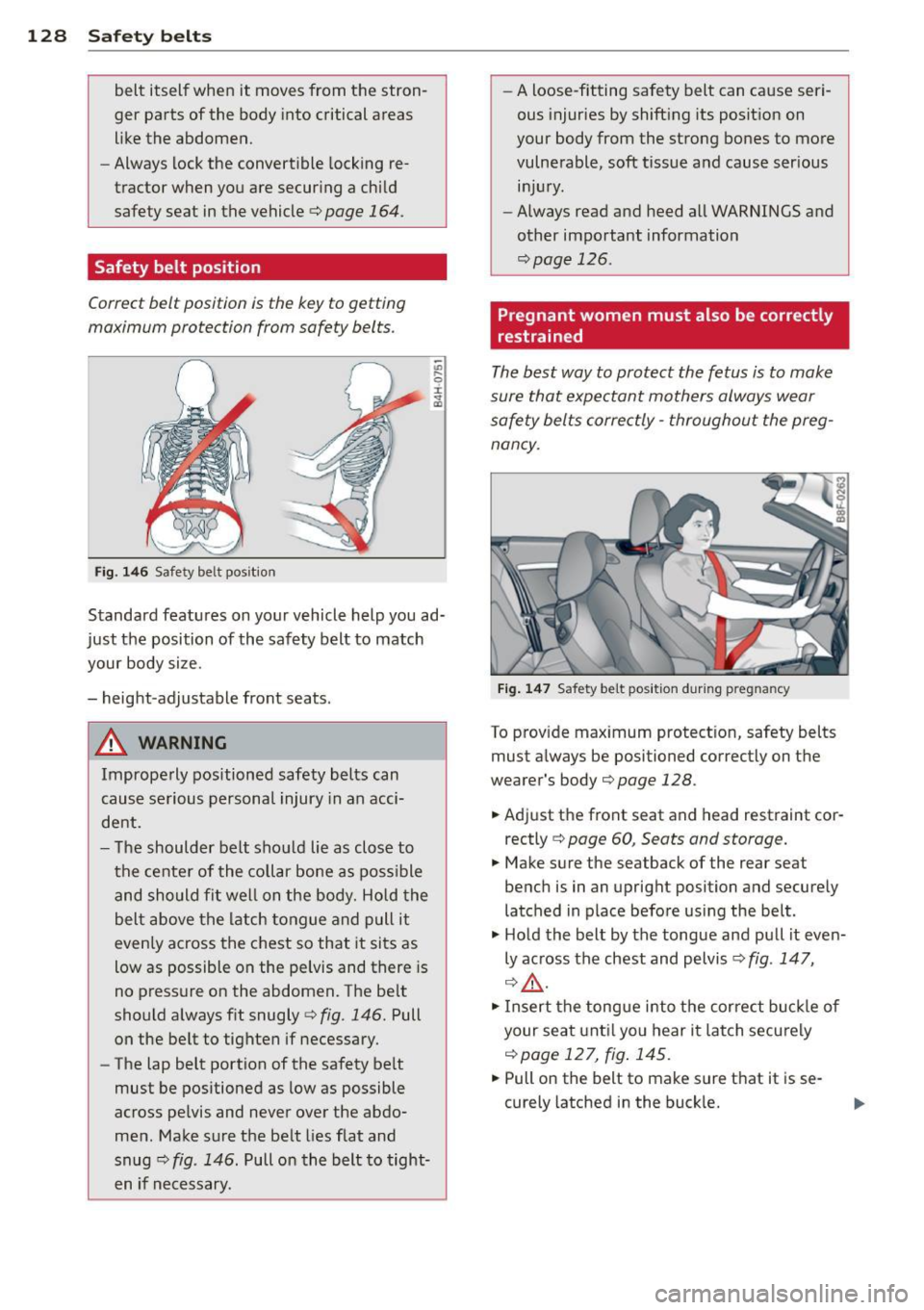
Safety belt position
Correct belt position is th e key to getting
maximum protection from safety belts .
Fig. 14 6 Safety belt pos it io n
;;; r-0 ± .., CD
Standard features on your vehicle help you ad
just the position of the safety belt to match your body size .
- height -adjustable front seats .
A WARNING
Improperly positioned safety belts can
cause se rious personal injury in an acci
de nt.
- T he shoulder belt sho uld lie as close to
the cente r of the collar bone as poss ible
and should fit we ll on the body. Ho ld the
bel t above the latch tongue and pull it
even ly across the chest so that it sits as
low as possible on the pelvis and there is
no p ress ure on the abdomen. The be lt
should a lways fit snugly
c:> fig . 146. Pull
on the be lt to tighten if necessary.
- The lap belt portion of the safety be lt
must be positioned as low as possible
across pe lvis and never over the abdo
men . Make s ure the be lt lies flat and
snug
c::> fig . 146. Pull o n the belt to tight
en if necessary. -
A loose-fitting safety belt can cause seri
ous injuries by shift ing its posit ion on
your body from the strong bones to more
vulnerable, soft tissue and cause ser ious
in ju ry.
- Always read and heed all WARNINGS a nd
other important information
c::> page 126 .
Pregnant women must also be correctly
restrained
The best way to protect the fetus is to make
sure that expe ctan t mothers always wear
safety belts corre ctly -throughout the preg
nan cy.
Fi g. 147 Saf ety belt pos it ion dur ing p re gnan cy
To prov ide max imum protect ion, safety belts
must a lway s be positioned correctly on the
wearer's body
<=:>page 128.
.,. Adjust the front seat and head restraint cor
rectly
c::> page 60 , Seats and storage .
.,. Make sure the seatback of the rear seat
benc h is in an upright position and secure ly
latched in place before using the belt .
"' Ho ld the belt by the tongue and pull it even
ly ac ross the chest and pelvis
c:> fig . 147,
c::> &_ .
"' In sert the tong ue i nto the correct buckl e of
your seat unt il yo u hear i t latch secu re ly
c;, page 12 7, fig . 145 .
.,. Pull on the belt to make sure t hat it is se
curely latched in the buck le.
Page 134 of 284

132 Airbag sys te m
angle of im pact that will always trig ger the
airbags, since the circumstances wi ll vary con
siderably between one collision and another.
Important factors include, for example, the
nature (hard or s oft) of the object which the
car h its, the angle of impact, vehicle speed,
etc. The front airbags will also not inflate in
side or re ar collisions, or in roll-overs .
Always remember : Airbags will deploy only
once, and only in certa in kinds of collisions .
Your safety belts are always there to offe r pro
tection in those s ituations in which airbags
a re not supposed to deploy , or when they have
a lready deployed; for example , when yo ur ve
h icle strikes or is st ruck by another after the
first collision .
This is just one of the reaso ns why an a irbag is
a supplementary restra int and is not a s ubst i
tute for a safety be lt. The airbag system
works most effective ly when used with the
safety be lts. Therefore, always properly wear
you r safety belts ¢
page 123 .
A WARNING
Sitting too close to the steer ing wheel or
instrument panel will decrease the effec
tiveness of the airbags and will increase
the risk of pe rsonal injury in a collision .
- Never sit closer than 10 inches (25 cm)
to the stee ring wheel or instr ument pan
el.
- If you cannot sit more than 10 inches
(25 cm) from t he steer ing wheel, investi
gate whethe r adaptive equipment may
be available to help you reach the pedals
and incre ase your sea ting dis tance from
the steering wheel.
- If you are unrestr ained, lean ing fo rward,
s itting sideways or out of posi tion in any
way, your risk of injury is much higher.
- Yo u w il l a lso receive serio us in juries and
co uld even be killed if you are up against
the airbag or too close to it when it in
flates -even with an Advanced Airbag.
- To reduce the r is k of i njury when an air
bag inf lates, a lways wear safety belts
properly
c::> page 126, Safety belts .
-Always make certain that ch ild ren age 12
or younger always ride in the rear seat. If
children are not properly restrained, they
may be severe ly injured or killed when an
airbag inflates .
- Never let c hildren ride unrestrained or
improperly restrained in the vehicle . Ad
just the front seats prope rly .
- Never ride with the back rest reclined.
- Always sit as far as possible from the
steer ing whee l or the instrument pane l
¢page 113.
-Always sit upright with your back against
the backrest of your seat.
- Never p lace your feet on the instrument
panel or on the seat. Always keep both
feet on the floor in front of the seat to
he lp prevent serious in ju ries to the legs
and h ips if the airbag inflates .
- Never recline the front passenger 's seat
to transport objects . Items can a lso
move i nto the a rea of the s ide airbag or
the front a irbag d uring br akin g or in a
sudden maneuve r. Obje cts ne ar the air
bags can become projec tiles and cause
inj ury when an airbag inflates.
.&, WARNING
A irbags that have deployed in a crash must
be replaced.
- Use on ly original eq uipment airbags ap
proved by Audi and installed by a trained
technician who has the necessary too ls
and d iagnost ic equipment to properly re
p lace any airbag in your vehicle and as
sure system effectiveness i n a crash .
- Never permit salvaged or recycled air
bags to be installed in your vehicle .
Child restraints on the front seat - some
important things to know
.,. Be s ure to read the importa nt information
and head the WAR NINGS for important de
t ails about children and Advanced A irbags
c::> page 152. ..,.
Page 135 of 284

M N
er
u..
co ,...., \!) 1.1'1 ,...., 1.1'1 ,....,
Even though your vehicle is equipped with an
Advanced Airbag System, make certain that
all ch ildren, especially those 12 years and
younger, a lways ride in the back seat properly
restrained for their age and size. The airbag
on the passenger side makes the front seat a potentially dangerous place for a child to r ide.
The front seat is not the safest place for a
child in a fo rward-facing child safety seat.
It
can be a very dangerous place for an infant or
a child in a rearward-facing seat.
The Advanced Airbag System in your veh icle
h as been certified to comp ly w ith the Requ ire
ments of United States Federa l Moto r Veh icle
Safety Standard 208 as applicable at the time
your vehicle was manufactured.
The Standard requires the front a irbag on the
passenger side to be t urned off ("sup
p ressed") if a ch ild up to about one year of
age restrained in one of the rear -facing or for
ward -facing infant restraints listed in Federal
Motor Vehicle Safety Standard 208 with wh ich
the Advanced Airbag System in your vehicle
was certified has been installed on the front passenger seat . For a listing of the child re
straints that were used to certify compliance
with the US Safety Standard
Q page 154.
The PASSENGER AIR BAG OFF light in the in
strument panel tells you when the front Ad
vanced A irbag on the passenger side has bee n
turned off by the e lectronic control unit.
Each t ime you turn on the ignition, the
PAS
SENGER AIR BA G OFF
light w ill come on for a
few seco nds and :
- will stay on if the front passenger seat is not
occupied,
- will stay on if there is a small child or child restraint on the front passenger seat,
- will go off if the front passenger seat is oc
cupied by an adult as registered by the
weight-sensing mat
Q page 141, Monitor
ing the Advanced Airbag System .
The PASSENGER AIR BAG OFF light comes on
when the control un it detects a total weight
on the front passenger seat that requires the
fro nt airbag to be turned off.
A irbag system 133
If the total weight on the front passenger
seat is more than that of a typical 1 year-o ld
c hi ld but less than the weight of a small
adult, the front airbag on the passenger side
can deploy (the
PASSENGER AIR BAG OFF
light does not come on). If the PASSENG ER
AIR BAG OFF
light does not come on, the
front a irbag on the passenger side has not
been tu rned off by the elect ronic con trol unit
and can deploy if the co ntrol unit senses an
impact that meets the cond itions stored in its
memory .
For exampl e, the air ba g may deplo y if:
-a small ch ild that is heav ie r than a typical 1
year-old ch ild is o n the front passenger seat
( r egard less of whether the child is in one of
the child safety seats listed
Q page 154), or
- a child who has outgrown child restraints is
on the front passenger seat.
If the front passenger airbag is turned off, the
PASSENGER AIR BAG OFF light comes on in
the instrument cluster and stays on.
The front airbag on the passenger side may
not deploy (the P A SSENGER AIR B AG OFF
light does not illum inate and stay lit) even if a
small adult o r teenager, or a passenger who is
not sitting uprig ht with their back against a
non- re cli ned back rest w it h thei r feet on the
vehicle floor in front of the sea t is on t he front
passenger seat
~ page 113, Proper seating
position for the driver.
If the fron t passenger a irbag dep loy s, the
Federa l Standard req uires the airbag to meet
the "low risk" dep loyment criteria to reduce
the risk of injury thro ugh interact ion w it h the
airbag . "Low risk" dep loyment occ urs in those
crashes that take place at lower dece lerat ions
as defined in the electronic control unit
Q page 142, PASSENGER AIR BAG OFF light .
Always remember, a child safety seat or infant
carr ier installed on the front seat may be
struck and knocked out of posit ion by the rap
idly inflat ing passenger's airbag in a frontal
collision . T he ai rbag could greatly reduce the
effectiveness of the ch ild restraint and even
seriously inj ure the child dur ing inflation. •
•
Page 136 of 284

134 Airbag sys te m
For this reason, a nd because t he bac k seat is
the safest place for children - when prop erly
restra ined according to their age and size - we
strongly recommend that children always sit in the back seat
Q page 152, Child Safety.
A WARNING
-
A c hild in a rearward-facing child safety
seat installed on the front passenger seat
w ill be seriously injured and can be k illed if
t he front a irbag inflates - even wit h an Ad
v a nced Airb ag System.
- T he inflating a irbag will hit the child
safety seat or infant carrier with g reat
force and w ill smash the ch ild safety sea t
and child against the backrest, center
armrest, door or roof .
- Always install rear-facing child safety
seats on the rear seat .
-If you mus t inst all a rearwar d fa cing
child safety seat on the front passenger
seat because of exceptional circ umstan
ces and the
PASSENGER AIR BAG OFF
light does not come on and stay on , im
med iately install the rear-facing child
safety seat in a rear seating position and
have the a irbag system inspected by you r
au thorized Audi dealer .
- Forward-fac ing ch ild safety seats instal
led on the front passenger's seat may in
terfer e wi th the deployment of the air
bag and cause se rious personal injury to
the ch ild.
A WARNING
If, in exceptional c ircumstances, you mus t
install a forwa rd-facing child restra int on
the front passenger's seat:
- Always m ake su re the forw ard-fa cing
sea t has been des igned and certified by
its manufact urer for use on a front seat
with a passenger front and side airbag.
- Never put the forward -facing child re
st raint up aga inst or very near the inst ru
ment pane l.
- Always move the passenger seat into its
rearmost position in the seat's fore and aft ad
justment range, as fa r away from
the airbag as possible before installing
the forward-fac ing ch ild restra int. The
backrest must be ad justed to an upright
position .
- Make sure that the
PASSENGER AIR BAG
OFF
li ght comes on and stays on all the
time wheneve r the ignit ion is switched
on.
A WARNING
To reduce the risk of serious inju ry, ma ke
sure that the
PASSENGER AIR BAG OFF
lig ht w ill be displayed whenever a child re
straint is insta lled on the front passenger
seat and the ignition is switched on .
- If the
PASSENGER AIR BAG OFF light
does not stay on, per form the checks de
scribed ¢
page 141, Monitoring the Ad
vanced Airbag System.
- Take the chi ld restraint off the front pas
senger seat and install it properly at one
of the rear seat positions if the
PASSEN
GER AIR BAG OFF light does not stay on.
-Have the airbag system inspected by
your author ized Audi dealer immed iate
ly.
- Always carefully follow instr uctions from
child restraint manufacture rs when in
stalling ch ild restra ints.
A WARNING
-If, in except iona l circumstances, you must
i nstall a forward or rearwa rd -facing child
r estra int on t he front passenger's seat :
- Improper installation of ch ild restra ints
can reduce their effectiveness o r even
p revent them from providing any protec
tion.
- An improperly installed ch il d restra int
can inter fere with the airbag as it de
p loys and seriously injure o r even kill the
child -even with an Advance d Airbag
System.
- Always caref ully follow the m anu factur
er 's ins truc tio ns p rov ided with the ch ild
safety sea t or carrier .
Page 137 of 284

"' N
a: LL co
rl I.O
"' rl
"' rl
-Never place additional items on the seat
that can increase the total weight regis
tered by the weight-sensing mat and can
cause injury in a crash.
Front airbags
Description of front airbags
The airbag system can provide supplemental
protection to properly restrained front seat
o ccupan ts.
F ig . 149 Location of driver airbag: in steering wheel
Fig. 150 Location of front passenger's airbag: in the in
st rument panel
Your veh icle is equipped w ith an "Advanced
Ai rbag System" in compliance with United
States Federal Motor Vehicle Safety Standard (F MVSS) 208 as app licab le at the time your
ve hicle w as manufac tured. The safety be lts
for the seats have "pretensione rs" that help
to take slack out of the belt system . The pre
tensioners are a lso activated by the electronic
contro l unit for the airbag system.
The front safety belts a lso have load limiters
to help reduce the forces applied to the body
in a crash.
The airbag fo r the driver is in the s teer ing
wheel hub
~ fig. 149 and the airbag for the
A irba g sy stem 135
front passenger is in the instr ument panel
~ fig. 150 . The general location of the airbags
is marked "AIRBAG".
T he re is a lot you need to know about t he a ir
bags in your vehicle . We urge you to read the
detailed information about airbags, safety
belts and child safety in this and the other
chapters that make up the owner's literature.
Please be sure to heed the WARNINGS - they
are extremely important for your safety and
the safety o f your passengers, especially in
fants and small children .
.&_ WARNING
Neve r rely on airbags alone for p rotec tion.
- Even w hen they deploy, airbags provide
only suppleme nta l protect ion.
- Airbag work most effectively w hen used
with p roperly worn safety belts.
- Therefore, always wear your safety belts and make sure that eve rybody in your ve
hicle is p rope rly r est rained .
.&_ WARNING
A person on the front passenger seat, es
pe cially infants and sma ll children, w ill re
ceive ser io us i njuries and can even be kil
led by being too close to the airbag when it inflates .
- Altho ugh the Advan ced A irbag Sys tem in
your veh icle is designed to turn off the
fro nt passenge r airbag if a n infant or a
sma ll child is on the front passenger
seat , nobody can absolutely gua rantee
that deployment under these special conditions is impossible i n all conceiva
ble sit uat ions that may happen during
the useful life of your vehicl e.
- The Advanced Airbag System can dep loy
in acco rdance with the "low risk" option
un der the U.S . Fede ral S tanda rd if a child
that is heavie r th an the typical one-yea r
old child is on the front passenge r seat
a nd the ot her condit ions for a irbag de
ployment are met .
-
Page 139 of 284

M N
er
u..
co ,...., \!) 1.1"1 ,...., 1.1"1 ,....,
-a small child that is heavier than a typical 1
year-o ld child is on the front passenger seat
(regardless of whether the c hild is in one of
t h e chi ld safety seats listed
¢ page 154),
-a chi ld who has outgrown child restraints is
on the front passenger seat.
I f the front passenger airbag is turned off, the
PA SSENGER AIR BAG OF F light in the center
of the instrument pane l w ill come on and stay
on.
The front ai rbag on the passenger side may
not deploy (the PASSENGER AIR BAG OFF
light does not illuminate and stay lit) if:
- a small ad ult or teenager is o n the front pas
senger seat
- a passenger who is not sitt ing upright w ith
their back against a non -reclined backrest
with their feet on the vehicle floo r in front
of the seat is on the front passenger seat .
I f the front passenger airbag deploys, the
F ederal Standard requires the airbag to meet
the " low risk" deployment criteria to help re
d uce the risk of inj ury through interaction
with the airbag. " Low risk" deployment occurs
in those crashes that take place at lower de
celerations as defined in the electronic co ntrol
u ni t.
¢ page 141
Always remember: Even tho ugh you r vehicle
is equipped with Advanced Airbags, the safest
p lace for children is properly restrained on the
back seat . Please be sure to read the impor
tant information i n the sect ions that follow
and be sure to heed a ll of the WARNINGS.
.8, WARNING
To redu ce the risk of injury whe n an airbag
in flates, always wear safety belts prope rly.
- If you are unres trained, lean ing fo rward,
sitting sideways or out of position in any
way, your risk of in jury is much higher.
- You w ill also receive serio us inju ries and
c ou ld even be killed if you are up against
the a irbag or too close to it when it in
fla tes -even with an Advanced Airbag
Q page 131 .
Airbag system 137
.8, WARNING
-
A child in a rearward-fac ing ch ild safety
seat installed on the front passenger seat
will be ser iously injured and can be killed if
the front airbag inflates -even with an Ad
vanced A irbag System .
- Al tho ugh the A dvanced Airbag Sys tem in
your veh icle is designed to tur n off the
fro nt airbag whe n a rea rward-facing
child res tra int has been insta lled on the
front passenger seat, nobody can abso
lutely g uarantee that dep loyment is im
possible in all conceivable situations that
may happen dur ing the usefu l life of your
veh icle.
- The in flating airbag will h it the ch ild
safety seat or infant carrier with great
force and will smash the child safety seat
and chi ld against the backrest , center
armrest, doo r, or roof.
- Always install rearward-facing chi ld re
straints in the back seat .
- If you must install a rearward fac ing
child safety seat on the front passenger
seat because of exceptiona l circumstan
c e s and t he
PASSENGER AIR BAG OFF
lig ht does not come o n and stay on, im
media tely insta ll the rear -fa cing ch ild
safety sea t in a rear seating position and
have the airbag system inspected by your
authorized Audi dealer .
A WARNING
-=
If, in e xceptiona l circumstances, you must
i nstall a forward -facing child restraint on
the front passenger 's seat:
- Always make sure the forward- facing
seat has been designed and certified by its manufacturer for use on a front seat
with a passenger front and s ide a irbag.
- Never put the forward-facing child re
straint up against or very near the instru
ment panel.
- Always move the passenger seat into its
rearmost pos ition in the seat's fore and
aft ad justment range, as fa r away from
the airbag as possible, before install ing •
•
Page 141 of 284
M N
er
u..
co ,...., \!) 1.1'1 ,...., 1.1'1 ,....,
-Repairs to the front passenger seat must
be performed by qualified and properly
trained workshop personnel.
- Never remove the front passenger or
driver seat from the vehicle.
- Never remove the upholstery from the
front passenger seat.
- Never disassemble or remove parts from
the seat or disconnect wires from it.
- Never carry sharp objects in your pockets
or place them on the seat. If the weight
sensing mat in the passenger seat is
punctured it cannot work properly.
- Never carry things on your lap or carry
objects on the passenger seat. Such
items can increase the weight registered
by the weight-sensing mat and send the
wrong information to the airbag control
unit.
- Never store items under the front pas
senger seat. Parts of the Advanced Air bag System under the passenger seat
could be damaged, preventing them and
the airbag system from working proper
ly.
- Never place seat covers or replacement
upholstery that have not been specifical
ly approved by Audi on the front seats.
- Seat covers can prevent the Advanced
Airbag System from recognizing child re
straints or occupants on the front pas
senger seat and prevent the side airbag
in the seat backrest from deploying prop
erly.
- Never use cushions, pillows, blankets or
similar items on the front passenger
seat. The additional padding will prevent
the weight-sensing mat in the seat from
accurately registering the child restraint
or person on the seat and prevent the
Advanced Airbag System from function
ing properly.
- If you must use a child restraint on the
front passenger seat and the child re
straint manufacturer's instructions re
quire the use of a towel, foam cushion or
something else to properly position the
child restraint, make certain that the
Airbag system 139
PASSENGER AIR BAG OFF light comes
on and stays on whenever the child re
straint is installed on the front passen
ger seat.
- If the
PASSENGER AIR BAG OFF light
does not come on and stay on, immedi
ately install child restraint in a rear seat
ing position and have the airbag system
inspected by your authorized Audi dealer.
How the Advanced Airbag System
components work together
The front Advanced Airbag System and the
side airbags supplement the protection of
fered by the front three-point safety belts
with pretensioners and load limiters and the
adjustable head restraints to help reduce the
risk of injury in a wide range of accident and
crash situations. Be sure to read the impor
tant information about safety and heed the
WARNINGS in this chapter.
Deployment of the Adva need Airbag System
and the activation of the safety belt preten sioners depend on the deceleration measured
by the crash sensors and registered by the
electronic control unit. Crash severity depends
on speed and deceleration as well as the mass
and stiffness of the vehicle or object involved
in the crash.
On the passenger side, regardless of safety
belt use, the airbag will be turned off if the
weight on the passenger seat is less than the
amount programmed in the electronic control
un it. The front airbag on the passenger side
will also be turned off if one of the child safe
ty seats that has been certified under Federal
Motor Vehicle Safety Standard 208 has been
recogni zed on the seat . The
PASSENGER AIR
BAG OFF
light comes on and stays on to tell
you when the front Advanced Airbag on the passenger side has been turned off
~ page 132, Child restraints on the front seat
- some important things to know. .,.
•
•
Page 142 of 284

140 Airbag system
& WARNING
To reduce the risk of injury when an airbag
inf lates, a lways wear safety belts properly.
- If you are unrestrained, lean ing forward,
sitting sideways or out of position in any
way, your risk of injury is much hig her .
- You w ill also receive serio us in juries and
cou ld even be killed if you are up against
the a irbag or too close to it when it in
fla tes -even with an Advanced Airbag
~ page 131.
More important things to know about
front airbags
F ig . 1 51 Inflated front a irbags
Safety belts are impo rtant to help keep front
seat occupants in the proper seated pos ition
so that airbags can unfo ld prope rly and pro
vide supp lement al protection in a front al col
lision.
Th e front a irbags are designed to provide ad
d itiona l prote ct io n for the chest a nd face of
the dr iver and the fr ont seat passenge r whe n:
- safety belts are worn properly,
- the seats have been posit ioned so that the
occupant is properly seated as far as possi
ble from t he a irbag,
- and the head rest raints have been properly
adjusted .
Because airbags inflate in the blink of an eye
with great force, things you have on your lap
or have placed on the seat could become dan
ge ro us projectiles, an d be pushed into yo u if
the airbag inflates.
When an a irbag deploys, fine dust is released.
This is normal and is not caused by a fire in the vehicle
. This dust is made up mostly of a
powde r used to lubricate the airbags as they
deploy.
It could irr itate sk in.
It is impo rtant to remember th at w hile the
s u pplementa l airbag system is designed to re
duce the like lihood of serious injuries, other
i njur ies, for examp le swelling, br uis ing and
minor abrasions, can a lso happen when air
bags inflate. A irbags do not protect the arms
o r the lowe r parts of the body . Front a irbags
o nly supp lement the three point safe ty belts
in some fronta l collisions in wh ich the vehicle
deceleration is h igh enough to deploy the air
bags.
Front airbags will not deploy:
- if the ignition is sw itched off whe n a crash
occ urs,
- in side co llisions,
- in rear-end co llisions,
- in rollovers,
- when t he crash decelerat ion meas ured by
the airbag system is less than the min imum
threshold needed for a irbag deployment as
reg istered by the electronic contro l unit .
The front passenger airbag will also not
deploy:
- when the front passenger seat is not occ u
pied,
- when the weight on the front passenger
seat as sensed by the Advanced Airbag Sys
tem indicates that the fr ont a irbag on the
passe nger side has to be turned off by the
elect ronic control un it (the
PA SSENGER AIR
BAG OFF
li ght comes on and stays o n).
& WARNING
-
Sitting in the wrong pos ition can incr ease
t he r isk of se rio us i njury in crashes.
- To r educe t he risk of inju ry w he n the air
bags i nflate, the drive r and passenge rs
m ust alw ays sit in an upr igh t position,
m ust not lea n aga ins t or place any part
of their body too close to the area whe re
the airbags a re located .
II>
Page 143 of 284

M N
er
u..
co ,...., \!) 1.1'1 ,...., 1.1'1 ,....,
-Occ upants who are unbelted, out of posi
t ion or too close to the airbag can be
seriously injured by an airbag as it un
folds with great force in the blink of an
eye
¢ page 132.
A WARNING
-
A child in a rearward-facing child safety
seat insta lled on the front passenger seat
w ill be seriously injured and can be k illed if
the front a irbag in flates - even with an Ad
vanced Airbag System .
- The inflating a irbag w il l hit the child
sa fety sea t or infant carrier w ith g reat
f orce and w ill smash the ch ild safety seat
and child against the backrest , cente r
armrest, door or roof .
- Always install rear -facing child sa fety
seats on the rear seat .
- If you mus t install a rearward facing
child safety seat on the front passenger
seat because of exceptional circ umstan
ces and the
PASSENGER AIR BAG OFF
light does not come on and stay on, im
med iately install the rear-facing child
safety seat in a rear seating position a nd
have the a irbag system inspected by you r
authori zed Au di dealer .
A WARNING
Objects betwee n you and t he a irbag will
increase the risk of in jury in a crash by in
t erfering wi th the way the air bag un folds
or by being pushed into you as the a irbag
inflates.
- Never hold th ings in your hands or on
yo ur lap when the vehicle is in use.
- Never transport i tems on or in the area
of the front passenge r seat . Objects
cou ld move into the area of the front air
bags dur ing braking or other s udden ma
neuver and become dangerous projec
t il es that can cause serious personal in
jury if the airbags inflate .
- Never place or attach accessories or oth
er objects (such as cupholders, te le
phone brackets, large, heavy or b ulky ob -
-
Airbag system 141
jects) on the doors, ove r o r near the area
marked "AIRBAG" on the steering wheel,
instrument panel, seat backrests or be
tween those areas and yourself . These
objects could cause in ju ry in a c rash , es
pecia lly when the airbags infla te .
- Never recline the front passenger 's sea t
to transport objects. Items can a lso
move into the area of the s ide a irbag or
the front a irbag du ring bra king or in a
sudden maneuve r. O bje cts ne ar the air
bags can become projec tiles and cause
in jur y, partic ula rly when the seat is re
clined .
A WARNING
The fine dust create d when air bags deploy
can cause breathing prob lems for people
with a history of asthma or other breath ing cond itions .
- To reduce the risk of breath ing problems,
those with asthma or other respiratory conditions shou ld get fresh air r ight
away by getting o ut o f the veh icle or
open ing windows or doors.
- If you are in a collision in which airbags
deploy, was h your hands and face with
mild soap and wate r before ea ting.
- Be ca reful not to get the dust into your
eyes, o r into any c uts or sc ratches .
- If the resid ue should get into your eyes,
f lush them w ith wate r.
Monitoring the
Advanced Airbag
System
Airbag monitoring indicator light
T wo separate indicators monitor the function
of the Advanced Airbag System: the airbag
monitoring indicator light and the
PASSEN·
GER AIR BAG OFF
light.
T he Advanced A irbag System ( incl uding the
electron ic co ntro l unit , se nsor circu its and sys
tem wir ing) is mo nitore d continuously to
m ake su re that it i s fu nc tioni ng properly •
•
Page 146 of 284

144 Airbag sys tem
possible that the airba g will inf late when
it is not supposed to, or will not inflate
when it should.
A WARNING
If t he front airbag inflates, a ch ild without
a child restra int, in a rearward-facing child
safety seat or in a forward-facing child re
straint that has not been properly insta lled
w ill be seriously injured and can be k illed.
- Even though your veh icle is equipped
with an Advanced Airbag System, make c ertain that a ll children, especially 12
years and younger, a lways ride on the
back seat properly restrained for their
age and size.
- Always instal l forwa rd or rear-facing
child safety seats on the rear seat -even
with an Advanced Airbag System.
- If you must install a rearward -fac ing
child safety seat on the front passenger
seat because of exceptional circ umstan
ces and the
PASS ENG ER AIR BAG OFF
light does not appear and stay on, imme
diately install the rear-fac ing ch ild safety
seat in a rear seating position and have
the a irbag system inspected by you r au
tho riz ed Aud i deale r.
- A tight tether or other strap on a rear
wa rd-facing child restra int attached to
the front passenger seat can put too much pressure on the weight-sens ing
mat in the seat and register mo re weight
than is ac tually on the seat. The heavier
weight registe red can make the system
work as though an adu lt were on the seat
and dep loy the Advanced Airbag when it
must be suppressed caus ing serious or
even fatal injury to the child.
- If, in exceptional circumstances, you
must install a forward-facing child re
st raint on the front passe nger seat, a l
ways move the seat into its rearmost po
sit io n in the seat's fo re and aft adjust
me nt range, as f ar away from the airbag
as possib le. The b ackrest m ust be adjus t
ed to an upr ight position. Make sure that the
PA
SSEN GER AIR BAG OFF light
comes on and stays on all the time when
ever the ignition is switched on.
A WARNING
-
- If the PASSENGER AIR BAG OFF light
does not go out when an adult is sitting
on the front passenger seat after taking
the ste ps described above, make su re the
adu lt is prope rly seated and restra ined at
one o f the rea r sea ting pos itions.
- Have the airbag system inspected by
your author ized Audi dealer befo re trans
port ing anyone on the front p assenger
se at.
(D Tips
If the weig ht-sensing mat in the front pas
senger seat de te cts an empty seat, the
front air b ag on the p assenger side wi ll be
turned off, and
PASSENGER AIR BAG OFF
will stay on .
Repair, care and disposal of the airbags
Parts of the airbag system are installed at
many different places o n your Aud i. Insta lling,
removing, servicing or repa iring a part in an
area of the veh icle can damage a part of an
airbag system and p revent that system from
working p roperly in a coll is io n.
There are some important t hings you have to
know to make sure that the effectiveness of
the system w ill not be impaired and that dis
ca rded components do not cause inju ry or pol
lute the environmen t.
A WARNING
Imprope r care, serv ic ing and repair p roce
dur es can increase the risk of personal in
ju ry and death by prevent ing an a irbag
from deploying when needed or dep loying
an a irbag unexpectedly:
- Never cover, obstruct , or change the
steer ing whee l horn pad or airbag cover
or the instrument panel or mod ify them
in any way .