rims AUDI RS5 CABRIOLET 2015 Owners Manual
[x] Cancel search | Manufacturer: AUDI, Model Year: 2015, Model line: RS5 CABRIOLET, Model: AUDI RS5 CABRIOLET 2015Pages: 284, PDF Size: 69.56 MB
Page 113 of 284
M N
er
u..
co ,...., \!) ..,.,
,...., ..,., ,....,
(D Note
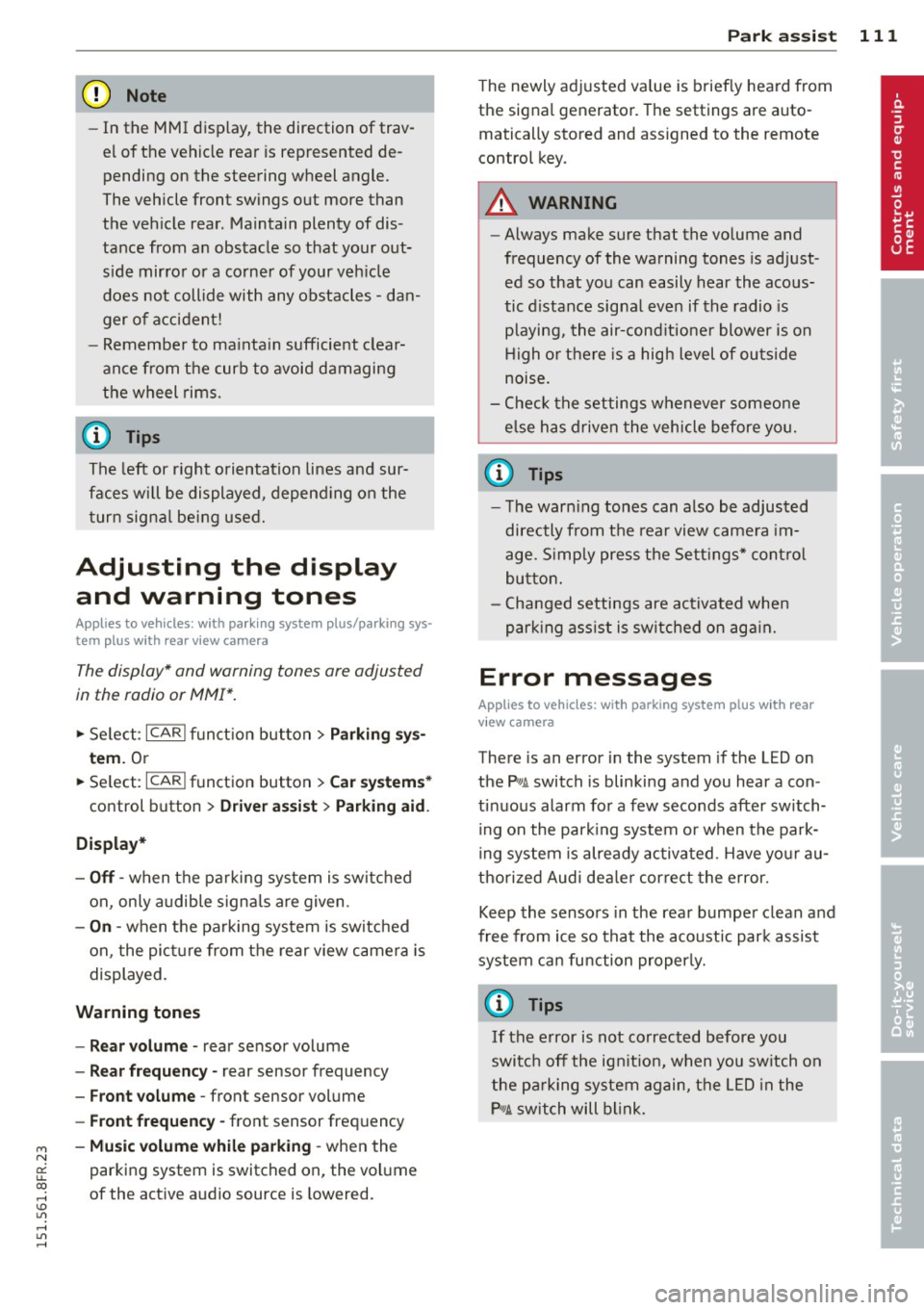
-In the MMI display, the directio n of trav
el of the vehicle rear is represented de
pending on the steering wheel angle.
The vehicle front swings out more than
the veh icle rear . Maintain plenty of dis
tance from an obstacle so that your out
s ide mirro r or a corner of your veh icle
does not collide with any obstacles -dan
ger o f accident!
- Remember to ma inta in sufficie nt clear
ance from the curb to avoid damaging
the wheel rims.
(j) Tips
The left or right orientation lines and sur
faces will be di splayed, depend ing on the
t ur n signa l being use d.
Adjusting the display
and warning tones
Applies to vehicles: with parking system plus/ parking sys
tem plus with rear view camera
The display* and warning tones are adjusted
in the radio or MMI*.
,.. Se lect : I CARI fu nct ion button > Parking sy s
tem.
Or
,.. Se lect : ~ I C~ A,..., R,..., I function button > Car system s*
control button > Drive r assist > Parking aid .
Display*
-Off -when t he parking system is sw itch ed
on, only a udib le signa ls are given .
-On -when the parking sys tem is switched
on, the pict ure from the rear view camera is
displayed.
Warning tones
- Rear volume -
rear sensor volume
-Rear frequency -rear sensor frequency
-Front volume -front sensor volume
-Front frequency -front sensor freq uency
- Mu sic volume while pa rking -when the
parking system is switched on, the vol ume
of the activ e audio source is lowered.
P ark a ssis t 11 1
The newly adj usted va lue is briefly hea rd from
the sig na l generato r. Th e settings are auto
matically stored and assigned to the remote
control key.
A WARNING
- Always make sure that the vo lume and
frequency of the warning tones is ad just
ed so that yo u can easily hear the acous
tic d istance signa l even if the radio is
p laying, the air-cond itio ne r blower is on
High or there is a high level of ou ts ide
noise.
- Chec k the settings whenever someone
e lse has drive n the vehicle before yo u.
(D Tips
- The warn ing tones can also be adjus ted
directly from t he rear view came ra im
age. S imp ly press the Sett ings* cont ro l
bu tton.
- Cha nged settings are ac tiva ted whe n
park ing ass ist is swi tc hed on aga in.
Error messages
Applies to vehicles: with parking system plus with rear
view camera
There is an error in the system if the LED on
the
p, ,; A switch is blinki ng and you hear a con
tinuous alarm fo r a few seconds after switch
ing on the park ing system or when the park
ing system is already activated . Have yo ur au
t h orized Aud i dea le r cor re ct the e rror.
Keep th e senso rs in the rea r bumpe r clean and
free from ice so that the acoust ic par k assist
system can fu nction properly.
@ Tips
If the error is not corrected before you
switc h off the ig nitio n, when you sw itch on
the p arking system again, the LED in the
P" JA switch will b link.
Page 190 of 284

188 Vehicle care and cleaning
- Never clean headlights or tail lights
with a dry cloth or sponge.
- Do not use any cleaning product that
contains alcohol, because they could
cause cracks to form.
-Wheels
- Never use any paint polish or other
abrasive materials.
- Damage to the protective layer on the
rims such as stone chips or scratches
must be repaired immediately .
-Sensors/camera lenses
- Never use warm or hot water to re-
move snow or ice from the camera
lens. This could cause the lens to crack.
- Never use abrasive cleaning materials
or alcohol to clean the camera lens.
This could cause scratches and cracks.
- Power top
- Remove bird droppings immediately.
- Never use gasoline, stain remover, ben-
zene, paint thinner or other solvents to
remove stains.
- Windows
- Remove snow and ice on windows and
exterior mirrors with a plastic scraper.
To avoid scratches, move the scraper
only in one direction and not back and
forth.
- Never remove snow or ice from win
dows and mirrors using warm or hot
water because this could cause cracks
to form.
- To avoid damage to the rear window
defogger, do not apply any stickers on
the heating wires on the inside of the
window.
- Decorative parts/trim
- Never use chrome care or cleaning
products.
-Paint
- To reduce the risk of scratches, the ve-
hicle must be free of dirt and dust be
fore polishing or waxing.
- To prevent paint damage, do not polish
or wax the vehicle in direct sunlight. - To reduce the risk of paint damage, do
not polish away rust film.
- Remove cosmetics and sunblock imme
diately. Otherwise, the paint could be
damaged.
- Displays
-To avoid scratches, do not use dry
cleaning methods on displays .
-Controls
- Make sure that no fluids enter the con-
trols, because this could cause dam
age.
- Safety belts
- Do not remove the safety belts to clean
them.
- Never clean safety belts or their com
ponents chemically or with corrosive
fluids or solvents and never allow sharp objects to come into contact
with the safety belts . This could cause
damage to the belt webbing.
- If there is damage to the webbing, the
connections, the retractors or the buck
les, have them replaced by an author
ized Audi dealer or qualified workshop.
-Textiles/Vinyl/ Alcantara
- Never treat Vinyl/Alcantara with leath-
er care products, solvents, floor polish,
shoe polish, stain remover or similar products.
- To avoid damage, have stubborn stains
removed by an authorized Audi dealer
or qualified workshop.
- Never use steam cleaners, brushes,
hard sponges, etc. when cleaning.
- Do not turn on the seat heating* to dry
the seat.
- Objects with sharp edges such as zip pers, rivets on clothing or belts can
cause damage to the surface.
- Open hook and loop fasteners, for ex ample on clothing, can damage seat
covers. Make sure hook and loop fas
teners are closed .
-Natural leather
Page 212 of 284

210 Tires an d whee ls
Tires and wheels
Tires
General notes
Tires may be the least appreci
ated and most abused parts of
a motor vehicle.
Ti res may be the least appreci
ated and most abused parts of
a motor vehicle. Tires are, how
ever, one of the most important
parts of a vehicle, particularly
considering the comparatively
small patch of r ubber on each
tire that assures that all-impor
tant contact between you, your
vehicle and the road.
Maintaining the co rrect tire
p ressure, making sure that your
vehicle and its tires do not have
to carry more we ight than they
can safe ly handle, avoiding
damage from road hazards and
regularly inspecting tires for
damage including cuts, s lashes
irregular wear and overall con
d ition are the most important
things that you can do to help
avoid sudden tire failure inc lud
ing tread separation and blow
outs.
Avoiding damage
If you have to drive over a curb
or similar obstacle, drive very
slowly and as close as possible
at a right angle to the curb.
Always keep chemicals includ
ing grease, oil, gasoline and
brake fluid off the tires.
Inspect the tires regularly for
damage (cuts, cracks or blis
ters, etc.). Remove any foreign
bodies embedded in the treads.
Storing tires
Mark tires when you remove
them to indicate the direction
of rotation. This ensures you to be able to mount them correct
ly when you reinstall them.
When removed, the wheels or
tires should be stored in a cool,
dry and preferably dark p lace.
Store tires in a vertical position if they are not mounted on
rims, in a horizontal position if
they are mounted on rims.
New tires
New tires have to be broken in
¢ &.
The tread depth of new tires
may vary, according to the type .,.
Page 213 of 284
Tires and wheels 211
and make of tire and the tread -New tires tend to be slip-•
pattern.
pery and must also be bro-• '
Hidden damage ken-in. To reduce the risk of
Damage to tires and rims is of -losing control, a collision
and serious personal inju-
ten not readily visible. If you ries, drive with special care
notice unusual vibration or the for the first 350 miles
vehicle pulls to one side, this (560 km).
may indicate that one of the -Driving with worn or dam-
tires has been damaged . The
aged tires can lead to loss of
tires must be checked immedi-
ately by an authorized Audi control
, sudden tire failure,
including a blowout and
dealer or qualified workshop.
sudden deflation, crashes
Unidirectional tires and serious personal inju-
A unidirectional tire can be ries. Have worn or damaged
identified by arrows on the tires replaced immediately.
sidewall, that point in the di rec- -Tires age even if they are
tion the tire is designed to ro- not being used and can fail
tate. You must follow the speci- suddenly, especially at high
fied direction of rotation. This is speeds. Tires that are more
necessary so that these tires than 6 years old can only be
can develop their optimum used in an emergency and
characteristics regarding grip, then with special care and
road noise, wear and hydro- at low speed.
planing resistance. For more in- -Never mount used tires on
formation
¢ page 249. your vehicle if you are not sure of their "previous histo-
A WARNING
ry." Old used tires may have -
New tires or tires that are been damaged even though
old, worn or damaged cannot the damage cannot be seen
provide maximum control that can lead to sudden tire
M
and braking ability. N
er failure and loss of vehicle u.. co ,...., \!) control. 1.1'1 ,...., 1.1'1 ,....,
Page 214 of 284
212 Tires and wheels
-If you notice unusual vibra
tion or if the vehicle pulls to
one side when driving, al
ways stop as soon as it is
safe to do so and check the
wheels and tires for dam
age.
0 Note
-Please note that summer and winter tires are de
signed for the conditions
that are typical in those sea
sons. Audi recommends us
ing winter tires during the
winter months. Low tem peratures significantly de
crease the elasticity of
summer tires, which affects
traction and braking ability. If summer tires are used
in
very cold temperatures, cracks can form on the tread
bars, resulting in perma
nent tire damage that can
cause loud driving noise and
unbalanced tires. Audi is not
responsible for this type of
damage.
-Burnished, polished or chromed rims must not be used in winter road condi
tions. The surface of the
rims does not have suffi
cient corrosion protection
for this and could be perma
nently damaged by road salt
or similar substances.
Glossary of tire and loading terminology
Accessory weight
means the combined weight (in
excess of those standard items
which may be replaced) of auto matic transmission, power
steering, power brakes, power
windows, power seats , radio,
and heater, to the extent that
these items are available as fac
tory-installed equipment (whether installed or not).
Aspect ratio
means the ratio of the height to
the width of the tire in percent.
Numbers of 55 or lower indi
cate a low sidewall for im
proved steering response and
better overall handling on dry
pavement.
...
Page 222 of 284

220 Tires and wheels
Because technical changes may
be made to vehicle equipment
during the model year, always
compare the tire size designa
tion on the tire pressure label
on your vehicle with the tires on
your vehicle. Make sure that the
tire size information on the ve hicle label is the same as the
size of the tires on the vehicle.
This is especially important if
the vehicle belongs to someone else or you bought the vehicle
with different rims/tires or you
bought the vehicle as a previ
ously owned vehicle.
Remember, your safety and
that of your passengers also de pends on making sure that load
limits are not exceeded . Vehicle
load includes everybody and ev
erything in and on the vehicle.
These load limits are technical
ly referred to as the vehicle's
Gross Vehicle Weight Rating
("GVWR"). The Gross Axle
Weight Rating ("GAWR") is the
maximum load that can be ap
plied at each of the vehicle's
two axles . The Gross Vehicle
Weight Rating and the Gross
Axle Weight Rating are listed on the safety compliance stick- er label located on the driver's
side B-pillar.
The tire pressure
label on your Audi lists the
maximum combined weight of
all of the occupants and lug
gage or other cargo that the ve
hicle can carry. For the location
of the tire pressure label
¢fig. 182.
&_ WARNING
-
Overloading a vehicle can
cause loss of vehicle control,
a crash or other accident, se rious personal injury, and
even death .
-Carrying more weight than
your vehicle was designed to carry will prevent the ve
hicle from handling properly
and increase the risk of a
loss of vehicle control.
-The brakes on a vehicle that has been overloaded may
not be able to stop the vehi
cle within a safe distance.
-Tires on a vehicle that has
been overloaded can fail
suddenly causing loss of
control and a crash.
-Always make sure that the
total load being transported
- including the weight of a
Page 232 of 284
230 Tires and wheels
New tires and replacing
tires and wheels
New tires and wheels have to
be broken in.
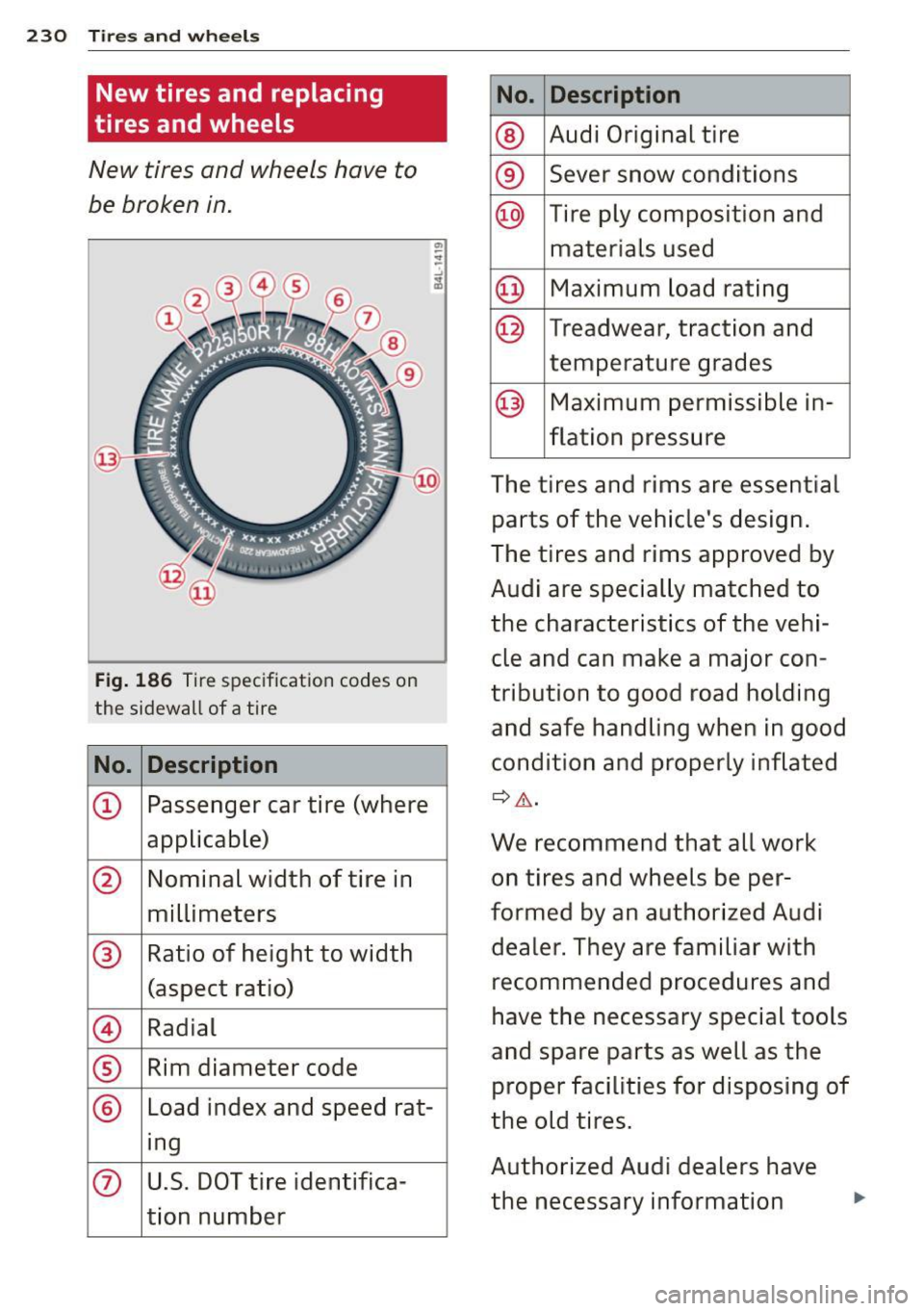
Fig. 186 Tire specification codes on
the sidewall of a tire
No. Description
CD Passenger car tire (where
applicable)
@ Nominal width of tire in
millimeters
@ Ratio of height to width
(aspect ratio)
© Radial
® Rim diameter code
® Load index and speed rat-
1ng
(j) U.S. DOT tire identifica -
tion number
No. Description
® Audi Original tire
® Sever snow conditions
@ Tire ply composition and
materials used
@ Maximum load rating
@ Treadwear, traction and
temperature grades
@ Maximum permissible in-
flation pressure
The tires and rims are essential
parts of the vehicle's design.
The tires and rims approved by
Audi are specially matched to
the characteristics of the vehi
cle and can make a major con
tribution to good road holding and safe handling when in good
condition and properly inflated
¢ A .
We recommend that all work
on tires and wheels be per
formed by an authorized Audi
dealer. They are familiar with recommended procedures and
have the necessary special tools
and spare parts as well as the
proper facilities for disposing of
the old tires.
Authorized Audi dealers have
the necessary information
Page 233 of 284

M N
er
u..
co ,...., \!) 1.1'1 ,...., 1.1'1 ,....,
about technical requirements
for installing or changing tires and rims.
Replacing tires and wheels
Tires should be replaced at least in pairs and not individu
ally (for example both front
tires or both rear tires togeth er) .
Be sure to read and heed the in
formation to the tire pressure monitoring system*
¢page 239.
Always buy replacement radial
tires that have the same specifi
cations as the tires approved
for your vehicle by Audi. Re
placement tires must always
have the same load rating spec
ification as the original equip
ment or approved optional tires
listed in the table
¢ page 217.
Audi-approved specification
tires are specially matched to
your vehicle and its load limits and can contribute to the im
portant roadholding, driving
characteristics, and safety of
the vehicle. The table ( ¢
page 217) lists specifica
tions of the tires approved for
I
Tires and wheels 231
the Audi models covered by
your Owner's Literature.
The tire pressure label located on driver's side B-pillar
(r=>page 217, fig. 183) lists the
specifications of the original
equipment tires installed on
your vehicle at the time it was
manufactured.
Federal law requires tire manu
facturers to place standardized information on the sidewall of
all tires¢
fig. 186. This infor
mation identifies and describes
the fundamental characteris
tics, the quality grade of the
tire and also provides a tire identification number for safety
standard certification and in
case of a recall.
Tire specifications
Knowledge of tire specifications
makes it easier to choose the
correct tires. Radial tires have
the tire specifications marked on the sidewall , for example:
P265 / 35 R19 98V XL
This contains the following in-
formation: ..,..
•
•
'
Page 236 of 284

234 Tires and wheels
Maximum Permissible
Inflation Pressure
This number is the greatest
amount of air pressure that
should ever be put in the tire
under normal driving condi
tions.
.&_ WARNING
-Using incorrect or unmatch ed tires and/ or wheels or improper tire and wheel
combinations can lead to loss of control, collision and
serious personal injury.
-Always use tires, rims and wheel bolts that meet the
specifications of original
factory-installed tires or
other combinations that have been specifically ap
proved by the vehicle manu
facturer.
-Tires age even if they are
not being used and can fail
suddenly, especially at high
speeds. Tires that are more
than 6 years old can only be used in an emergency and
then with special care and
at lower speeds.
-Never mount used tires on your vehicle if you are not sure of their "previous
histo
ry." Old used tires may have
been damaged even though
the damage cannot be seen
that can lead to sudden tire
failure and loss of vehicle
control.
-All four wheels must be fit ted with radial tires of the
same type, size (rolling cir
cumference) and the same
tread pattern. Driving with different tires reduces vehi
cle handling and can lead to
a loss of control.
-If the replacement tire is
not the same as the tires
that are mounted on the ve
hicle -for example with win
ter tires - only use the re
placement tire for a short
period of time and drive
with extra care. Refit the normal road wheel as soon
as safely possible.
-Never drive faster than the maximum speed for which
the tires on your vehicle are
rated because tires that are
driven faster than their rat-
ed speed can fail suddenly. ...
Page 237 of 284

Tires and wheels 235
-Overloading tires cause heat Incorrect use of run flat •
build-up, sudden tire fail- tires can lead to vehicle • '
ure, including a blowout damage or accidents. Check
and sudden deflation and with an authorized Audi loss of control. dealer or tire specialist to
-Temperature grades apply see if your vehicle
can be
to tires that are properly in- equipped with run flat tires.
flated and not over or un- If run flat tires are used,
derinflated. they must be installed on all
-For technical reasons it is four wheels. Mixing tire
not always possible to use types is not permitted.
wheels from other vehicles -
(D Note
in some cases not even -For technical reasons, it is
wheels from the same vehi-
not generally possible to
cle model.
use the wheel rims from
-If you install wheel trim
other vehicles. This can hold
discs on the vehicle wheels, true for wheels of the same
make sure that the air flow vehicle type.
to the brakes is not blocked. -If a replacement tire is dif-
Reduced airflow to the
ferent from the tires that
brakes can them to over-
you have mounted on your
heat, increasing stopping
vehicle (for example winter
distances and causing a col-
tires or wide profile tires),
lision.
-Run flat tires may only be then use the replacement
tire for a short period of
used on vehicles that were time only and drive with ex-
equipped with them at the tra care. Replace the flat
factory. The vehicle must
tire with the tire matching
have a chassis designed for
the others on your vehicle
run flat tires and a factory-
as soon as possible.
installed tire pressure moni-
M
-Never drive without the N
er toring system* that indi-u.. co
valve stem cap. The valves ,....,
cates a loss of tire pressure. \!) 1.1'1 ,...., could get damaged. 1.1'1 ,....,