flat tire AUDI RS5 COUPE 2015 User Guide
[x] Cancel search | Manufacturer: AUDI, Model Year: 2015, Model line: RS5 COUPE, Model: AUDI RS5 COUPE 2015Pages: 254, PDF Size: 64.12 MB
Page 219 of 254
"' N
0:: loo
rl I.O
"' N
"' rl
TMS can be used at temperatures down to -4 °F
(- 20 °C).
A WARNING
Take the following precautions after repairing
the tire:
- Do not drive faster than 50 mph (80 km/ h)!
- Avoid full -throttle acceleration, heavy brak -
ing and fast corner ing.
- T he ve hicle's road behavior can be affec ted.
- T ir es sealed w ith
TMS a re intended only for
temporary , short-t erm use. Damaged t ires
must be replaced. D rive carefully to the nex t
professional repair facility .
- After using the tire sea lant the tire pressure
monitoring system may no longer work
properly . Drive ca refully to the next profes
sional repair facility.
- TMS must NOT be used,
- for cuts or punctures in the tire which a re
larger than 0.16 inch (4 mm)
- for damage to the rim
- if you have been driv ing with very low tire
pressures or tires with no air
- Seek profess ional assistance if it is not pos
sible to repair the tire with the tire sealant.
- The tire sealant must not come into contact
with skin, eyes or clothing.
- If you get any tire sealant in your eyes or
come into contact with it, rinse the affected
area thoroughly with clean water. F ind a
physician immediately!
- Change any cloth ing contaminated with t ire
sealant immediately.
- Do not inhale the vapor!
- If you have swallowed tire sealant, rinse
yo ur mouth thorough ly right away and drink
plenty of water.
- Do not induce vomiting! F ind a phys ic ian
immed iate ly!
- If you have allergic reactions, find a physi
cian immediately.
- Keep the t ire sealant away from chi ldren.
(D Note
Do not use commerc ia lly available tire sea l
ants. The electrical components of the tire
Em erg en cy ass is tan ce
press ure monitoring system w ill no longe r
work properly .
@ For the sake of the environment
Used sealant bottles ca n be dropped off a t a
recycling fac ility.
© Tips
- If sea la nt has run o ut, allow i t to d ry. Then
yo u ca n pee l it off.
- Have the tire sea lant rep laced eve ry 4 years
at a de alership.
Making a tire repair
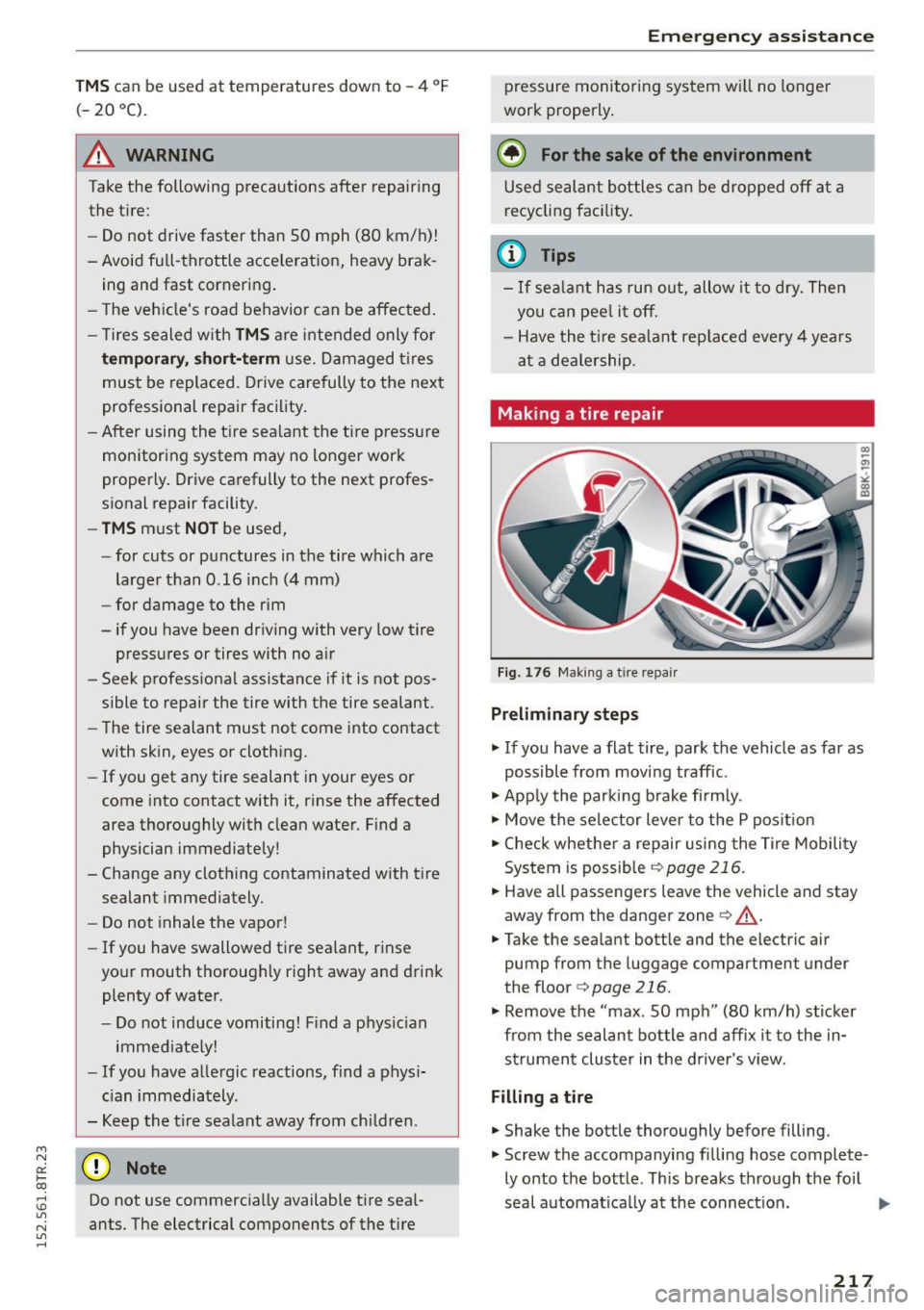
Fig. 176 Maki ng a t ire repair
Pr eliminary steps
"' If you have a flat tire, park the vehicle as far as
possible from moving traffic .
"' App ly the parking b rake firmly.
"' Move the selector lever to the P pos ition
"' Check whether a repair using the Tire Mobility
System is possib le
~ page 216.
"' Have all passengers leave the vehicle and stay
away from the danger zone
Q _A .
"'Take the sea lant bottle and the electric air
pump from the luggage compartment under
the floor <=>
page 216.
"' Remove the "max . 50 mph" (80 km/h) sticker
from the sealant bottle and aff ix it to the in
s trument cluster in the driver 's view.
Filling a tire
"' Shake the bott le thoroughly before filling.
"' Screw the accompanying fi lling hose complete-
ly onto the bottle . This breaks through the foil
s e al automat ica lly a t the connect ion.
217
Page 220 of 254
Emerg enc y ass is tance
"' Remove the valve cap from the tire valve and
unscrew the valve insert using the accompany
ing valve insert tool¢
fig. 176.
"'Lay the valve insert on a clean surface.
"' Remove the sealing plug from the filling hose
and connect the hose to the tire valve .
"' Hold the bottle w ith the bottom facing upward
and empty the ent ire contents into the tire .
"'T hen pull out the hose and screw the valve in
sert t ight ly back into the tire va lve.
Inflating a ti re
"' Screw the filling hose for the electric air pump
onto the tire valve and insert the connector into
the cigarette lighter .
"' Inflate the tire between 2.0 and 2.5 ba r and
read the pressure from the ga uge .
"' If this tire pressu re is not reached, drive your
vehicle approximate ly 10 meters forward or
backward so that the sea lant can be redistribut
ed inside the tire. If at this time the required air
pressure st ill cannot be reached, the tire is too
badly damaged and cannot be repa ired with the
ti re sealant.
F in al ch eck
"' After driving for about 10 minutes, stop and
check the tire press ure.
"' If tire pressure is less than 1.3 bar, the tire is
too severely damaged . Do not cont inue to
drive. Seek professional assistance .
A WARNING
- Turn on the eme rgency flashers and set up
the emergen cy tr iangle if you have flat tire
wh ile in moving traffic. Th is is for yo ur pro
tection and the for the safety o f other driv
ers.
- Have all passengers leave the vehi cle and
stay away from the danger zone (for exam
ple, behind a guard rail).
- Read and fo llow the manufacturer's safety
precautions on the compressor and in the
instructions on the bottle of sealant!
- If a t ire pressure of 2.0 bar cannot reached
after inflating for six minutes, then the tire is too severe ly damaged . Do not contin ue
dr iv ing !
218
-Obtain qua lified help i f it is not possible to
perform the repair w ith the t ire sea lant.
- If the tire pressure is less than 1 .3 bar after
10 minutes of driving, then the the t ire is
too severe ly damaged. Do not continue driv
ing. Seek professional assistance.
(D Note
Partic ular care is necessary if you are mak ing
a tire repa ir on a steep incl ine.
(D Tips
- Do not operate the electric air pump for
more than 6 minutes witho ut stopp ing, oth
erwise it can overheat. When the air pump
has cooled down, you can continue to use it.
- If sea lant has spilled out, let it dry and then
you can remove it by peeling it away like a
foil.
- Remember to obtain a new bott le of sealant
from your authorized Audi dealer after re pairing a tire. After this, the functionality of
the tire repair set is restored .
- Obey all laws.
Replacing wheels
Before changing a wheel
Observe the following precautions for your own
and your passenger's safety when changing a
wheel.
"' After you experience a t ire failure, pull the ca r
well away from mov ing traffic and t ry to reac h
l e vel ground before you stop
~ ,&.
"' All passengers should leave the car and move
to a safe location ( for ins tance , behind the
guardrail) ¢,& .
"' Engage the parking brake to prevent your ve hi
cle from ro lling unintent iona lly ¢ ,& .
"' Move the selector le ver to the P position .
"' Take the jack
¢page 216 out of the luggage
compartment .
Page 221 of 254
M N
0:: loo ,...., \!) 1.1'1
N 1.1'1 ,....,
A WARNING 1=
You or your passengers cou ld be injured while
chang ing a wheel if you do not follow these
safety precautions:
- If you have a flat t ire, move a safe distance
off the road . Turn off the engine, turn the
emergency flashers on and use other warn
ing devices to alert other motorists.
- Make sure that passengers wait in a safe
place away from the vehicle and well away
from the road and traff ic.
- To help prevent the veh icle from mov ing
sudden ly and possibly slipping off the jac k,
always fully set the pa rking brake and block
the whee l diagona lly opposite the w heel be
ing changed with the folding chocks or oth
er objects. When one front wheel is lifted
off the ground, placing the Automatic Trans
mission in "P" (Park) will
not prevent the ve
hicle from moving.
- Before you change a wheel, be sure the
ground is level and firm. If necessary, use a
sturdy board under the jack.
- Always store the vehicle tool kit, the jack *
and the replaced tire in the luggage com
partment
c> page 117.
(D Note
If you are changing the wheel on a steep in
cline, use a rock or sim ilar object to block the
opposite whee l to prevent the vehicle from
mov ing.
{!) Tips
Obey a ll laws.
Changing a wheel
When you change o wheel, follow the sequence
described below step-by-step and in exactly that
order.
1. Remove the wheel bolt caps*. F or more de
tails see also ¢
page 220 , Wheels with
wheel bolt caps .
2. Loosen the wheel bolts¢ page 220.
Emerge ncy ass is tanc e
3. Locate the proper mounting point for the
jack and alig n the jack below that point
¢ page 221 .
4. Lift the car with the jack¢ page 221.
5. Remove the wheel with th e fla t tire and then
install the other wheel¢
page 222 .
6. Tighten all whee l bolts lightly.
7 .
Lower the vehicle with the jack .
8. Use the wheel bolt wrench and
firmly t ighten
all wheel bo lts in a crisscross pattern
¢page 220.
9. Replace the wheel bolt cap s* .
A WARNING
A lways read and fo llow all WARNINGS and in
formation
¢ &. in Raising the vehicle on
page221
and ¢page 223.
After changing a wheel
A wheel chonge is not complete without the do
ing the following.
.. Always store the vehicle tool kit, the jack*, and
the replaced tire in the luggage compartment
¢ page 117.
.. As soon as possib le, have the t ightening tor
ques
on all wheel bolts checked with a torque
wrench . The correct t ightening to rque is 90 ft
lbs. (120 Nm) .
.. Have the flat tire
replaced as soon as possible .
(D Tips
-If you not ice that the wheel bo lts a re cor
roded and difficult to tur n while changing a
tire, they should be replaced before you
check the tigh tening torque.
- Dr ive at reduced speed until you have the
tightening to rques che cked.
219
Page 225 of 254
M N
0:: loo ,...., \!) 1.1"1
N 1.1"1 ,....,
Tires with unidirectional tread design
Tires with unidirectional tread design must be
mounted with their tread pattern pointed in the
right direction.
Using a replacement tire with a tread pattern
intended for use in a specific direction
When using a replacement tire with a tread pat·
tern intended for use in a specific direction,
please note the following:
- The direction of rotation is marked by an
arrow
on the side of the tire .
-If the replacement tire has to be installed i n
the inco rrect direction, use the tire only tempo·
rarily since the tire will not be able to achieve
its optimum performance characteristics with
regard to aquaplaning, noise and wear.
- We recommend that you pay particular atten·
tion to this fact during wet weather and that
you adjust your speed to match road condi
tions .
- Replace the flat tire with a new one and have it
installed on your vehicle as soon as possible to
restore the handling advantages of a unidirec
t ional tire.
Notes on wheel changing
Please read the information ¢ page 203, New
tires or wheels
if you are going to use a replace
ment tire which is different from the t ires on your
vehicle.
After you change a tire:
- Check the tire pressure on the replacement
tire immediately after installation.
- Have the wheel bolt tightening torque
checked with a torque wrench as soon as pos
sible by your authorized Audi dealer or quali
fied workshop.
- With steel and alloy wheel rims, the wheel
bolts are correctly tightened at a torque of 90
ft lbs . (120 Nm).
- If you notice that the wheel bolts are corroded
and difficult to turn while changing a tire,
they should be replaced before you check the
tightening torque.
Emergency assistance
- Replace the flat tire with a new one and have
it installed on your vehicle as soon as possi
ble. Remount the wheel cover.
Until then, drive with extra care and at reduced
speeds.
_& WARNING
- If you are going to equip your vehicle with
tires or rims which differ from those which
were factory installed, then be sure to read
the information¢
page 203, New tires or
wheels.
- Always make sure the damaged wheel or
even a flat tire and the jack and tool kit are properly secured in the luggage com part·
ment and are not loose in the passenger
compartment.
- In an accident or sudden maneuver they
could fly forward, injuring anyone in the ve·
hide.
-Always store damaged wheel, jack and tools
securely in the luggage compartment. 0th·
erwise, in an accident or sudden maneuver
they could fly forward, causing injury to pas
sengers in the vehicle.
(D Note
Do not use commercially available tire seal·
ants. Otherwise, the electrical components of
the tire pressure monitoring system* will no
longer work properly and the sensor for the
tire pressure monitoring system* will have to b e replaced by qualified workshop.
.
223
Page 247 of 254
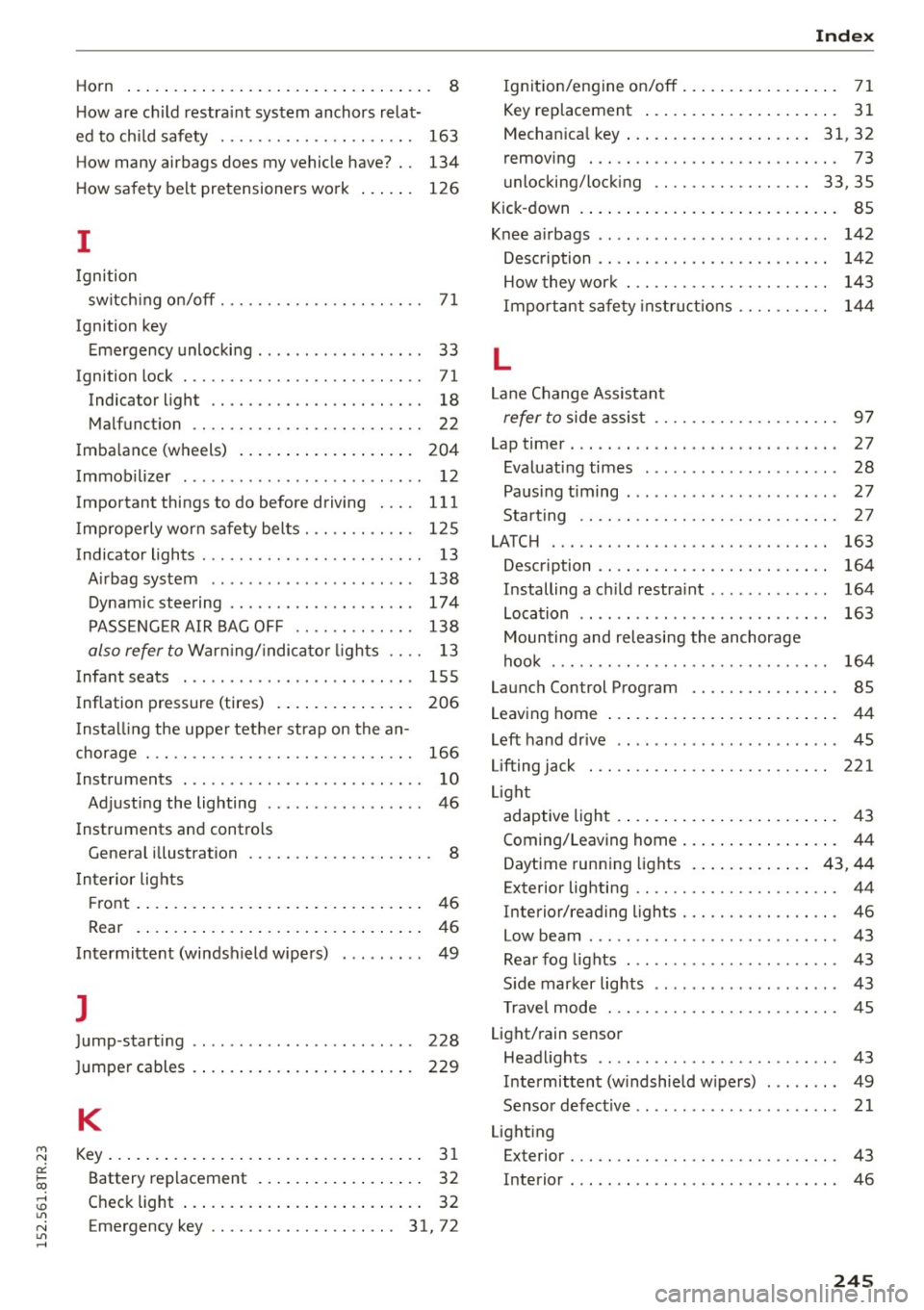
M N
0:: loo ,...., \!) ..,.,
N ..,., ,....,
Horn . . . . . . . . . . . . . . . . . . . . . . . . . . . . . . . . . 8
H ow are child restra int system anchors rela t-
ed to ch ild safety . . . . . . . . . . . . . . . . . . . . .
163
How many airbags does my vehicle have? . . 134
H ow sa fety be lt pretensioners work 12 6
I
Ignition
switch ing on/o ff.......... .... .. ......
7 1
Ignition key
Emergency unlocki ng . . . . . . . . . . . . . . . . . . 33
Ignition lock . . . . . . . . . . . . . . . . . . . . . . . . . .
71
Indicator light . . . . . . . . . . . . . . . . . . . . . . . 18
Malfunct ion . . . . . . . . . . . . . . . . . . . . . . . . . 22
Imba lance (w heels) . . . . . . . . . . . . . . . . . . . 204
Immobilizer . . . . . . . . . . . . . . . . . . . . . . . . . . 12
Important things to do before driving . . . . 111
Imp roperly wor n sa fety be lts. . . . . . . . . . . . 125
Indicator lights . . . . . . . . . . . . . . . . . . . . . . . . 13
A' b 1r ag system . . . . . . . . . . . . . . . . . . . . . . 138
Dynamic stee ring . . . . . . . . . . . . . . . . . . . . 17 4
P ASSENG ER AIR BAG OFF . . . . . . . . . . . . .
138
al so refer to War ning/ indica to r lig hts . . . . 1 3
Infant seats . . . . . . . . . . . . . . . . . . . . . . . . . 155
Inflation pressure (tires) . . . . . . . . . . . . . . . 206
Instal ling the uppe r tethe r st rap on the an-
chor age . .. .. .... ............. .. .. .. .
166
10
Instruments ..... .... ... .. .. .. .. .. ... .
Adjust ing the lighting . . . . . . . . . . . . . . . . . 46
Instruments an d contro ls
General i llustration . . . . . . . . . . . . . . . . . . . . 8
I n ter ior lights
Fr ont . . . . . . . . . . . . . . . . . . . . . . . . . . . . . . .
4 6
Rear . . . . . . . . . . . . . . . . . . . . . . . . . . . . . . . 46
Intermittent (windsh ield wipe rs) . . . . . . . . . 49
]
Jump -starting 228
J umpe r cables . . . . . . . . . . . . . . . . . . . . . . . . 229
K
Key ... .. .. .. .. .... .. .... ... .. .. .... .. 3 1
Battery rep lacement . . . . . . . . . . . . . . . . . . 32
C heck light . . . . . . . . . . . . . . . . . . . . . . . . . . 32
Emergency key . . . . . . . . . . . . . . . . . . . . 31, 72
Index
Ignit ion/engine on/off . . . . . . . . . . . . . . . . . 71
Key rep lacement . . . . . . . . . . . . . . . . . . . . . 31
Mechan ica l key ... ... .. ..... ... .. .. 31 , 32
removing . . . . . . . . . . . . . . . . . . . . . . . . . . . 73
unlocking/lock ing . . . . . . . . . . . . . . . . .
33, 35
Ki ck -down . . . . . . . . . . . . . . . . . . . . . . . . . . . . 85
K . b nee air ags . . . . . . . . . . . . . . . . . . . . . . . . . 142
D .. escriptron .. .. .. ... .......... .. .. . .
How they wor k ... ............. ..... . 142
143
Important sa fe ty instru ctions . . . . . . . . . . 144
L
Lane Change Assista nt
refer to side assis t . . . . . . . . . . . . . . . . . . . . 97
Lap timer. . . . . . . . . . . . . . . . . . . . . . . . . . . . . 27
Evaluating times . . . . . . . . . . . . . . . . . . . . .
28
p .
t· . ausrng ,ming . . . . . . . . . . . . . . . . . . . . . . . 27
Sta rt ing . . . . . . . . . . . . . . . . . . . . . . . . . . . . 27
LATCH . . . . . . . . . . . . . . . . . . . . . . . . . . . . . .
163
Description . . . . . . . . . . . . . . . . . . . . . . . . . 164
In stalling a c hild restra int . . . . . . . . . . . . . 164
Location . . . . . . . . . . . . . . . . . . . . . . . . . . . 163
Mounting and releasing the anchorage
hoo k . . . . . . . . . . . . . . . . . . . . . . . . . . . . . .
164
Launc h Control Program . . . . . . . . . . . . . . . . 85
Leaving home
Left hand drive 44
45
Lifting jack .
. . . . . . . . . . . . . . . . . . . . . . . . . 221
Li ght
adaptive light . . . . . . . . . . . . . . . . . . . . . . . .
43
Coming/Leaving home . . . . . . . . . . . . . . . . . 44
Daytime runn ing lights . . . . . . . . . . . . .
43, 44
Exterior lighting . . . . . . . . . . . . . . . . . . . . . . 44
Interior/reading lights . . . . . . . . . . . . . . . . . 46
Low beam ... .. .. .. ... .. ... ..... .. .. . 43
Rea r fog lights . . . . . . . . . . . . . . . . . . . . . . . 43
Side marker lights . . . . . . . . . . . . . . . . . . . . 43
Trave l mode . . . . . . . . . . . . . . . . . . . . . . . . . 45
Light/rain sensor
Head lights . . . . . . . . . . . . . . . . . . . . . . . . . .
43
In termittent (w indshield w ipers) . . . . . . . . 49
Senso r defective . . . . . . . . . . . . . . . . . . . . . .
21
Light ing
Exterior . . . . . . . . . . . . . . . . . . . . . . . . . . . . .
43
In terior . . . . . . . . . . . . . . . . . . . . . . . . . . . . . 46
245