seats AUDI RS5 COUPE 2015 User Guide
[x] Cancel search | Manufacturer: AUDI, Model Year: 2015, Model line: RS5 COUPE, Model: AUDI RS5 COUPE 2015Pages: 254, PDF Size: 64.12 MB
Page 63 of 254
"' N
0:: loo
rl I.O
"' N
"' rl
-Always keep the compartment above the
rearview mirror closed while driving to re
duce the risk of injury in the event of sudden
braking maneuvers or a collision .
CJ) Note
Objects located on the rear shelf that rub
against the rear window could damage the
heating wires for the rear window defogger.
@ Tips
-A vent slot is located between the shelf and
the rear window. Do not block the vent with
any items you may place on the rear window
shelf.
- Do not place bulky items on the rear window
shelf as they could restrict or block the driv
er's vision in the rear view mirror .
Roof rack
Description and mounting locations
Additional cargo can be carried with a roof lug
gage rock .
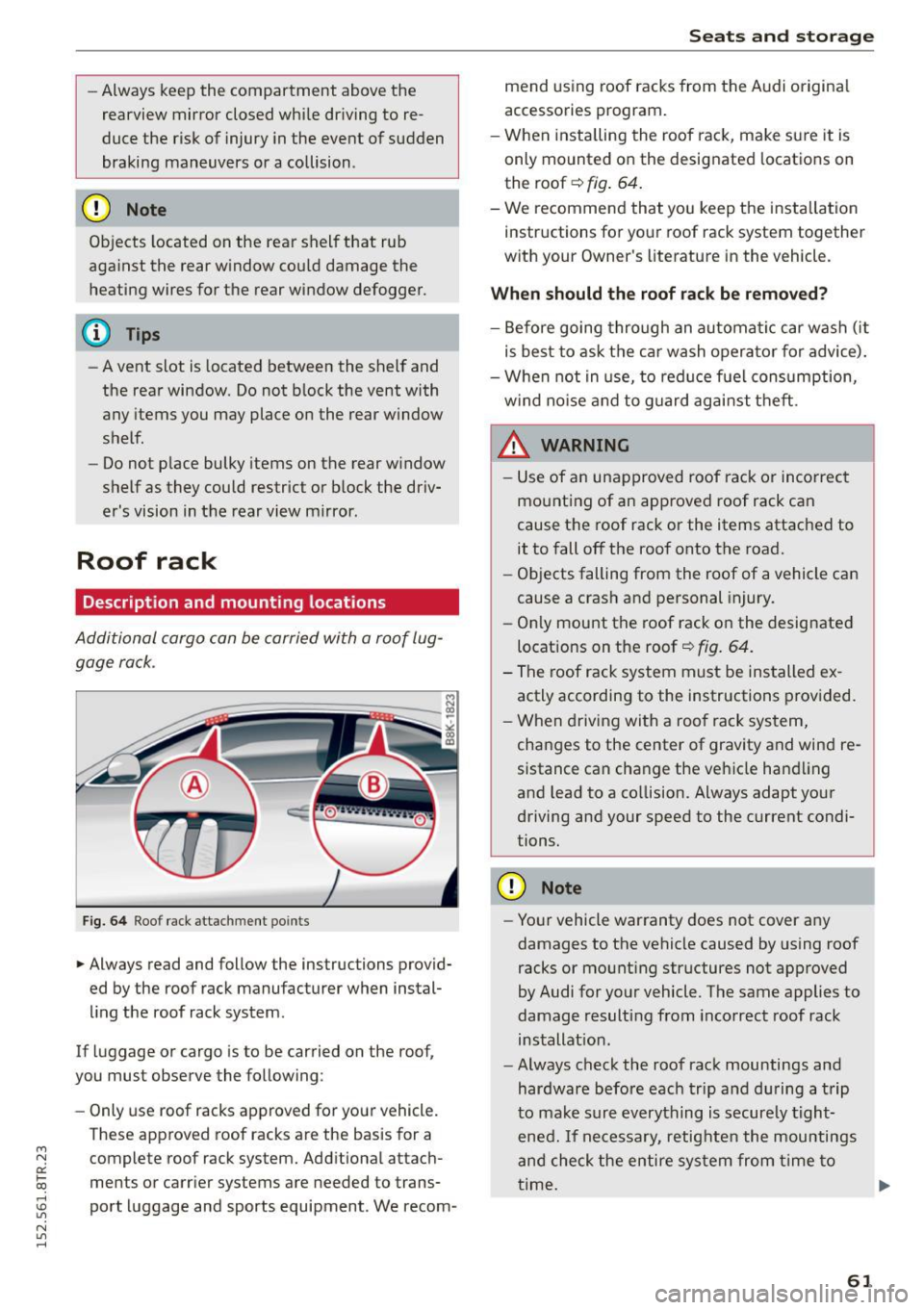
Fig. 64 Roof rack attachment points
• Always read and follow the instructions provid
ed by the roof rack manufacturer when instal
ling the roof rack system .
If luggage or cargo is to be carried on the roof,
you must observe the following :
- Only use roof racks approved for your vehicle.
These approved roof racks are the basis for a complete roof rack system. Additional attach
ments or carrier systems are needed to trans
port luggage and sports equipment . We recom-
Seats and storage
mend using roof racks from the Audi original
accessories program.
- When installing the roof rack, make sure it is
only mounted on the designated locations on
the roof
c::> fig. 64.
- We recommend that you keep the installation
instructions for your roof rack system together
with your Owner's literature in the vehicle.
When should the roof rack be removed?
-Before going through an automatic car wash (it
is best to ask the car wash operator for advice).
- When not in use, to reduce fuel consumption,
wind noise and to guard against theft .
_& WARNING ,_____ -
- Use of an unapproved roof rack or incorrect
mounting of an approved roof rack can
cause the roof rack or the items attached to it to fall off the roof onto the road.
- Objects falling from the roof of a vehicle can
cause a crash and personal injury.
- Only mount the roof rack on the designated
locations on the roof
c::> fig . 64.
- The roof rack system must be installed ex
actly according to the instructions provided.
- When driving with a roof rack system,
changes to the center of gravity and wind re
sistance can change the vehicle handling
and lead to a co llision. Always adapt your
driving and your speed to the current condi
tions.
(D Note
- Your vehicle warranty does not cover any
damages to the vehicle caused by using roof
racks or mounting structures not approved
by Audi for your vehicle. The same applies to
damage resulting from incorrect roof rack
installation.
- Always check the roof rack mountings and
hardware before each trip and during a trip
to make sure everything is securely tight
ened. If necessary, retighten the mountings
and check the entire system from time to
time. ..,.
61
Page 65 of 254
"'
Enlarging the luggage compartment
Applies to vehicles: with fold ing rear seatback
The backrests can be folded forward separately
or together using the two release levers.
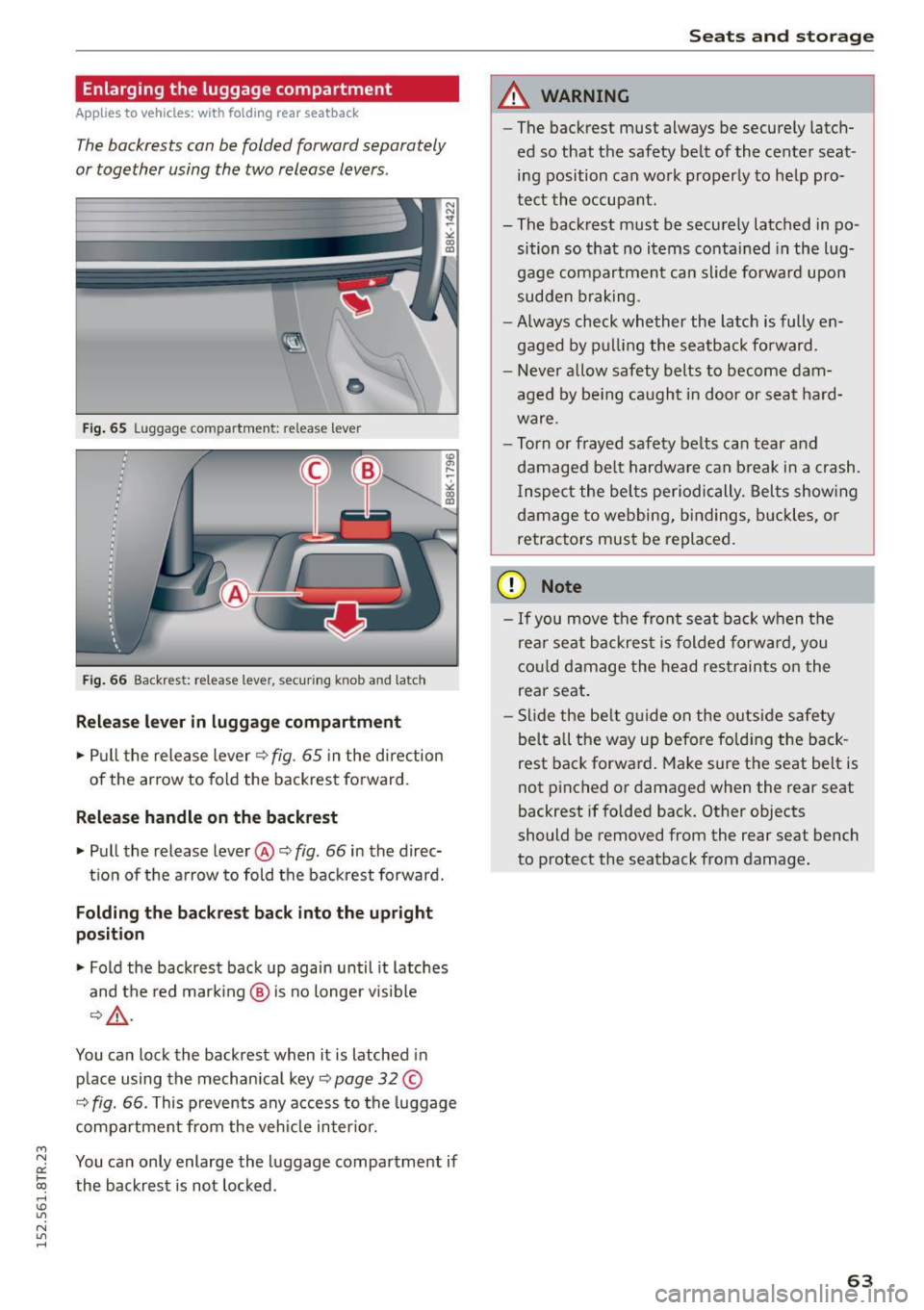
Fi g. 65 Luggage compartment: release lever
F ig. 66 Backrest: release lever, sec uring knob and latch
Release lever in luggage compartment
• Pull the release lever Q fig. 65 in the direction
of the arrow to fold the backrest forward.
Release handle on the backrest
• Pull the release lever@~ fig. 66 in the direc-
t io n of the arrow to fold the back rest forward.
Folding the backres t back into the upright
position
• Fold the backrest back up again until it latches
and the red mar king @ is no longer v isible
Q ,&. .
You can lock the backrest when it is latched in
p lace using the mechan ica l key
~page 32 ©
Q fig. 66. This prevents any acces s to the luggage
compartment from the veh icle in ter ior.
~ You can only enlarge the luggage compartment if
txi the backrest is not locked. rl I.O
"' N
"' rl
Seats and storage
A WARNING
-
-The backrest must always be secure ly latch-
ed so that the safety be lt of the center seat
ing position can wo rk properly to help pro
t e ct the occupant.
- The backrest must be securely latched in po
sition so that no items conta ined in the Lug
gage compartment can slide forward upon
sudden b rak ing.
- Always check whether the latch is fully en
gaged by p ulling the seatback fo rward.
- Never allow safety b elts to become dam
aged by be ing caught in door or seat ha rd
ware.
- Torn or frayed safety belts ca n tear qnd
damaged be lt hardware can b reak i n a crash.
I nspect the bel ts periodically. Belts show ing
damage to webbing, bind ings, b uckles, or
retractors mus t be replaced.
(D Note
- If you move the front seat back when t he
rea r seat b ackres t is folded forwa rd, you
co uld damage the head restraints on the
rear seat.
- Slide the be lt g uide on the o utside safety
bel t all the way up befo re fo ld ing the back
rest bac k forwa rd . Make sure the seat belt is
not pinched or damaged when the rear seat
backrest if folded back. Other objects
should be removed from the rear seat bench
to protect the seatback from damage.
63
Page 66 of 254

Seats and storag e
Tie-downs and cargo net
Applies to vehicles: with cargo net
The cargo net prevents small objects from slid
ing.
F ig . 67 Luggage compartment: cargo net stretc hed out
Fig . 68 Luggage compartment: cargo net at the top of the
luggage compar tment
Net stretched out
.,. To secure objects with the cargo net, hang the
front hooks on the net in the t ie-downs first
and then hang the rear hooks¢
fig. 67 .
.,. Read and heed all WARNINGS ¢page 117,
Storing cargo correctly.
Net at the top of the lug gage comp artm ent
.,. Hang the hooks on the cargo net in the tie
downs on the floor at the rear of the luggage
compartment ¢
fig. 68.
.,. Fold down the hooks at the upper area of the
luggage compar tment down, pull the net up
and hang the eyelets on the net on the hooks .
.,. Read and heed all WARNINGS
¢page 117,
Storing cargo correctly.
You can also use the hooks ¢ fig. 68 to hang bags
and other objects. If nothing is hung on the
hooks, they will fo ld back in by themselves.
64
A WARNING
Weak, damaged or improper straps used to
secure items to tie-downs can fail during hard
braking or in a coll is ion and cause serious per
sona l injury.
-Always use su itable retain ing straps and
prope rly secure items to the tie-downs in
the luggage compa rtment to help prevent
items from shifting o r flying forward.
- Never attach a child seat tether strap to a
tie-down.
- For strength-related reasons, the mounting
hooks can only be used to secure objects
weighi ng up to 10 lb. (5 kg). Heav ier obje cts
w ill not be adequa tely secured -there i s a
ris k of injury.
Ski sack
Applies to vehicles: with ski sack
Long objects such as skis or snowboards can be
transported in the ski sack.
Fig . 69 Backrest: pass-t hro ug h cover
.,. To load the ski sack in the vehicle, fold the rear
center armrest down .
.,. Fold the pass-through cover down¢
fig. 69.
.,. Slide the ski sack from the luggage compart
ment through the opening w ith the zipper at
the rear.
.,. Sec ure the ski sack¢
page 65.
A WARNING
Objects m ust only be transported in the ski
sack since the ski sack can be secured . Individ
ua l objects cannot be secured . There is a risk
of injury.
-
Page 68 of 254
Seats and storage
CJ) Note
Please ma ke s ure that the heat ing wires for
the rear window defog ger are not damage by
abras ive objects.
@ Tips
To ensure problem-free vent ilation, t he vent i
lat io n slo ts between t he rear win dow and t he
parcel she lf m ust not be covered.
66
Page 72 of 254

Warm and cold
th e risk of injury , these individua ls sho uld
not use seat heating.
(D Note
To avo id damage to the heating elemen ts in
the seats, do not kneel on the seats or place
heavy loads on a small a rea of the seat .
Setup
The basic climate control settings can be adjust
ed in the radio or MMI* .
... Se lect : I CAR I f u n ct ion bu tton > A/C con trol b ut
ton. Or
... Se lect : ICAR I f u nction button>
Car sy stems*
control b utton > AC.
Automatic recirculation*
When swi tched o n, a utom atic rec ircula tion con
t rols the recircu lation mode au toma tica lly.
If the
windows fog up, press the
l..i> F RONT I button .
Synchronization*
When sync hron ization is sw itched on, t he same
settings a re applied to bo th t he d river a nd front
p a ssenger, ex cep t fo r the se at hea ting/vent ila
tion *. Synchronization switches off when you ad
just the settings on the front passenger's side.
You ca n also switc h synch ron izat io n on by press
i n g and hold ing the knob on the dr iver' s side.
70
Page 113 of 254
M N
0:: loo ,...., \!) ..,.,
N ..,., ,....,
Driving safety
Basics
Safe driving habits
Please remember -safety first!
This chapter contains important information,
tips, instructions and warnings that you need to
read and observe for your own safety, the safety
of your passengers and others . We have summar
ized here what you need to know about safety
belts, airbags , chi ld restraints as well as child
safety. Your safety is for us
priority number 1. Al
ways observe the informat ion and warn ings in
this section - for your own safety as well as that
of your passengers .
The information in this section app lies to all
model ve rsions of your vehicle . Some of the fea
tures described in this sections may be standard
equipment on some models, or may be optional
eq uipment on others .
If you are not sure, ask
your authorized Audi dealer.
A WARNING
- Always make sure that you follow the in
struct ions and heed the WARNINGS in this
Manual. It is in your interest and in the in
terest of your passengers.
- Always keep the complete Owne r's Litera
ture in your Aud i when you lend or sell your
vehicle so that this important info rmation
will always be ava ilable to the driver and
passenge rs.
-
- Always keep the Owner's literature handy so
that you can find it easily if you have ques
tions.
Safety equipment
The safety features are part of the occupant re
straint system and work together to help reduce
the risk of injury in a wide variety of accident sit
uations.
Your safety and the safety of your passenge rs
should not be left to chance. Advances in tec h
nology have made a var iety of fea tures available
to help reduce the r isk o f injury in an accident.
Dr ivin g sa fet y
The following is a list of just a few of the sa fety
features in your A udi:
- sophisticated s afety be lts fo r drive r and a ll pas-
senger seat ing pos itions,
- be lt fo rce limi ters for the front seats,
- belt pretensioners for the seats,
- head restra ints for each seating posit ion,
- front airbags,
- side airbags in the front seats,
- side curtain a irbags,
- specia l LATCH anchorages for child rest raints,
- adjustab le steering colum n.
These ind iv idual safety features, can work to
gether as a system to help protect you and your
passengers in a w ide range of accidents . T hese
features cannot wo rk as a system if they are not
always cor rect ly adjusted and co rrectly used.
Saf ety is ev erybody' s re sponsibility!
Important th ings to do before driving
Safety is everybody 's job! Vehicle and occupant
safety always depends on the informed and care
ful driver .
For your safety and the safety of your passen
gers,
befor e driv ing alway s:
.. Make sure that all lights and signals are operat
ing correctly.
.. Make sure that the tire pressure is correct.
.. Make sure that all w indows are clean and afford
good vis ibility to the outs ide .
.. Secure all luggage and other items carefully
Q page59.
.. Ma ke s ure that nothing can interfere with the
pedals .
.. Adjust front seat, head restraint and mirrors
correctly for your height.
.. Instruct rear seat passengers to adjust the
head restra ints according to their he ight.
.. Make sure to use the r ight child restraint cor
rectly to protect ch ildren
Q page 150, Child
safety .
.. Sit p rope rly in your seat and make su re that
your passengers do the same
Q page 53, Seats
and storage. .,.
111
Page 115 of 254

M N
0:: loo ,...., \!) ..,.,
N ..,., ,....,
For detailed information on how to adjust the
driver's seat, see ¢
page 54.
A WARNING
Drivers who are unbelted, out of position or
too close to the airbag can be seriously in
jured by an airbag as it unfolds. To help re
duce the risk of serious personal injury:
- Always adjust the driver's seat and the
steering wheel so that there are at least
10 inches (25 cm) between your breastbone
and the steering wheel.
- Always hold the steering wheel on the out
side of the steering wheel rim with your
hands at the 9 o'clock and 3 o'clock posi
tions to help reduce the risk of personal in
jury if the driver's airbag inflates.
- Never hold the steering wheel at the
12 o'clock position or with your hands at
other positions inside the steering wheel
rim or on the steering wheel hub. Holding
the steering wheel the wrong way can cause
serious injuries to the hands, arms and head
if the driver's airbag deploys.
- Pointing the steering wheel toward your
face decreases the ability of the supplemen
tal driver's airbag to protect you in a colli
sion.
- Always sit in an upright position and never lean against or place any part of your body
too close to the area where the airbags are located .
- Before driving, always adjust the front seats
and head restraints properly and make sure
that all passengers are properly restrained.
- Never adjust the seats while the vehicle is
moving . Your seat may move unexpectedly
and you could lose control of the vehicle.
- Never drive with the backrest reclined or
tilted far back! The farther the backrests are
tilted back, the greater the risk of injury due
to incorrect positioning of the safety belt
and improper seating position.
- Children must always ride in child safety
seats¢
page 150 . Special precautions ap
ply when installing a child safety seat on the
front passenger seat¢
page 128.
Driving safety
Proper seating position for the front
passenger
The proper front passenger seating position is
important for safe, relaxed driving.
For your own safety and to reduce the risk of in
jury in the event of an accident, we recommend
that you adjust the seat for the front passenger
to the following position:
"' Move the front passenger seat back as far as
possible . There must be a minimum of 10 in
ches (25 cm) between the breastbone and the
instrument panel¢.&, .
"'Adjust the angle of the seatback so that it is in
an upright position and your back comes in full
contact with it whenever the vehicle is moving.
"'Applies to vehicles with adjustable head re
straints: Adjust the head restraint so the upper
edge is as even as possible with the top of your
head . If that is not possible, try to adjust the
head restraint so that it is as close to this posi
tion as possible .
"' Keep both feet flat on the floor in front of the
front passenger seat.
.,. Fasten and wear safety belts correctly
c:> page 123.
For detailed information on how to adjust the
front passenger's seat, see ¢
page 53.
A WARNING ~
Front seat passengers who are unbelted, out
of position or too close to the airbag can be
seriously injured or killed by the airbag as it unfolds. To help reduce the risk of serious per
sonal injury:
- Passengers must always sit in an upright po
sition and never lean against or place any
part of their body too close to the area
where the airbags are located.
- Passengers who are unbelted, out of posi
tion or too close to the airbag can be seri
ously injured by an airbag as it unfolds with
great force in the blink of an eye.
- Always make sure that there are at least 10 inches (25 cm) between the front passen
ger's breastbone and the instrument panel.
113
Page 116 of 254

Driving safety
-Each passenger must always sit on a seat of
their own and properly fasten and wear the
safety belt belonging to that seat.
- Before driving, always adjust the front pas
senger seat and head restraint properly.
- Always keep your feet on the floor in front
of the seat. Never rest them on the seat, in
strument panel, out of the window, etc. The
airbag system and safety belt will not be
able to protect you properly and can even in
crease the risk of injury in a crash.
- Never drive with the backrest reclined or
tilted far back! The farther the backrests are
tilted back, the greater the risk of injury due
to incorrect positioning of the safety belt
and improper seating position.
- Children must always ride in child safety
seats
r:=;, page 150. Special precautions ap
ply when installing a child safety seat on the
front passenger seat
r:=;, page 128.
Proper seating positions for passengers in
rear seats
Rear seat passengers must sit upright with both
feet on the floor consistent with their physical
size and be properly restrained whenever the ve hicle is in use.
To reduce the risk of injury caused by an incorrect
seating position in the event of a sudden braking maneuver or an accident, your passengers on the
rear bench seat must always observe the follow
ing:
.. Make sure that the seatback is securely latched
in the upright position
r:=;, page 63.
.. Keep both feet flat in the footwell in front of
the rear seat.
.. Fasten and wear safety belts properly
¢ page 123.
.. Make sure that children are always properly re
strained in a child restraint that is appropriate
for their size and ager:=;,
page 150.
A WARNING
Passengers who are improperly seated on the
rear seat can be seriously injured in a crash.
114
- Each passenger must always sit on a seat of
their own and properly fasten and wear the safety belt belonging to that seat.
- Safety belts only offer maximum protection
when the seatback is securely latched in the
upright position and the safety belts are properly positioned on the body. By not sit
ting upright, a rear seat passenger increases
the risk of personal injury from improperly
positioned safety belts!
-Always adjust the head restraint properly so
that it can give maximum protection.
Proper adjustment of head restraints
App lies to vehicles : wit h adjusta ble h ead r estra ints
Correctly adjusted head restraints are an impor
tant part of your vehicle's occupant restraint sys
tem and can help to reduce the risk of injuries in
accident situations.
Fig. 119 Head restra int: v iewed from the front
The head restraints must be correctly adjusted to
achieve the best protection.
.. Adjust the head restraints so the upper edge is
as even as possible with the top of your head.
If
that is not possible, try to adjust the head re
straint so that it is as close to this position as
possible
¢ fig. 119 .
Adjusting head restraints¢ page 56 .
A WARNING -
All seats are equipped with head restraints.
Driving without head restraints or with head
restraints that are not properly adjusted in
creases the risk of serious or fatal neck injury
dramatically. To help reduce the risk of injury:
Iii>
Page 117 of 254

M N
0:: loo ,...., \!) 1.1"1
N 1.1"1 ,....,
-Always drive with the head restraints in
place and properly adjusted.
- Every person in the vehicle must have a
properly ad justed head restraint.
- Always make sure each person in the vehicle
properly adjusts their head restraint. Adjust
the head restraints so the upper edge is as even as possib le w ith the top of your head.
If that is not possib le, try to adjust the head
restraint so that it is as close to this position
as possib le.
- Never attempt to adjust head restraint
wh ile driving. If you have driven off and
must adjust the dr iver headrest for any rea
son, fi rst stop the veh icle safely before at
tempting to ad just the head restraint.
- Children must always be properly restrai ned
in a ch ild restraint that is appropria te fo r
their age and si ze
q page 150.
Examples of improper seating positions
The occupant restraint system con only reduce
the risk of injury if vehicle occupants ore properly
seated.
I mproper seat ing posit ions can ca use serious in
jury o r death . Safety be lts ca n only work when
they are prope rly positioned on t he body. Im
proper sea ting pos it ions reduce the effect iveness
of safety belts and wi ll even increase the risk of
in ju ry and death by moving the safety belt to cr it
i cal areas of the body. Improper seating positions
also increase the risk of serious injury and death
when an airbag deploys a nd strikes an occupant
who is not i n the proper seating position . A driver
i s responsible for the safety of all vehicle occu
pants and especia lly for children . Therefo re :
.. Never allow anyone to assume an incorrect
seat ing pos ition when the veh icle is being used
¢ ,&. .
The follow ing bulletins list only some sample po
sitions that will increase the risk of ser ious injury
and death. Our hope is that these examples will
make you more aware of seat ing pos itions that
are dangerous.
Dr ivin g s afet y
Therefore , whenever the vehicle is moving :
-never stand up in the vehicle
- never stand on the seats
- never kneel on the seats
- never ride w ith the seatback reclined
- never lie down on the rear seat
- never lean up against the instrument panel
- never sit on the edge of the seat
- neve r sit sideways
- neve r lean out t he window
- neve r put your feet out the window
- never put your feet on the instrument panel
- never rest your feet on the seat cushion or back
of the seat
- never ride in the footwell
- never ride in the ca rgo a rea
A WARNING
Imp roper seating posit ions increase the risk
of ser ious personal in jury and death whenever
a veh icle is being used.
-Always make sure that all vehicle occupants stay in a proper seating position and are
properly restrained whenever the vehicle is
be ing used.
Driver's and front
passenger's footwell
Important safety instructions
App lies to vehicles : wit h knee airbags
A WARNING
Always make sure that the knee airbag ca n in
flate w ithout interference. Objec ts between
yourself and the airbag can in crease t he risk
of inju ry in an accident by inter fering with the
way the airbag deploys or by being pushed in
to you as the airbag dep loys .
- No persons (children) or animals shou ld ride
in the footwell in front of the passenger
seat. If the airbag deploys, th is can result in
serio us or fatal injur ies.
- No objects of any kind should be carried in
the footwell area in front of the driver's or passenger's seat. Bulk y objects (shopping
bags, for example) can hamper or prevent
115
Page 122 of 254
Safety belt s
Safety belts
General information
Always wear safety belts!
Wearing safety belts correctly saves lives!
This chapter explain s why safety be lts are neces
sary, how they work and how to adjust and wear
them correctly.
.. Read all the information that fo llows and heed
all of the instructions and WARNINGS.
&_ WARNING
Not wearing safety belts or wearing them im
properly increases the risk of serious personal
injury and death.
- Safety belts are the single most effective
means available to reduce the risk of serious
injury and death in automobile accidents.
For your protection and that of your passen
gers, always correct ly wear safety belts
when the vehicle is moving.
- Pregnant women, injured, or physically im
paired persons must also use safety belts.
L ik e all veh icle occupants, they are more
likely to be seriously injured if they do not
wear safety be lts . The best way to protect a
fetus is to protect the mother - throughout
the ent ire pregnancy.
Number of seats
Your Audi has a total of four seating positions:
two in the front and two in the rear. Each seating
position has a safety belt .
&_ WARNING
Not wearing safety belts or wearing them im
properly increases the risk of serious personal
injury and death.
- Never strap more than one person, includ
ing small ch ildren, into any belt. It is espe
cially dangerous to place a safety belt over a
child sitting on your lap.
- Never let more people ride in the vehicle
than there are safety belts available.
120
-Be sure everyone riding in the vehicle is
properly restrained with a separate safety
belt or child restraint.
Safety belt warning light
Your vehicle has a warning system for the driver
and (on USA models only) front seat passenger
to remind you about the importance of buckling
up .
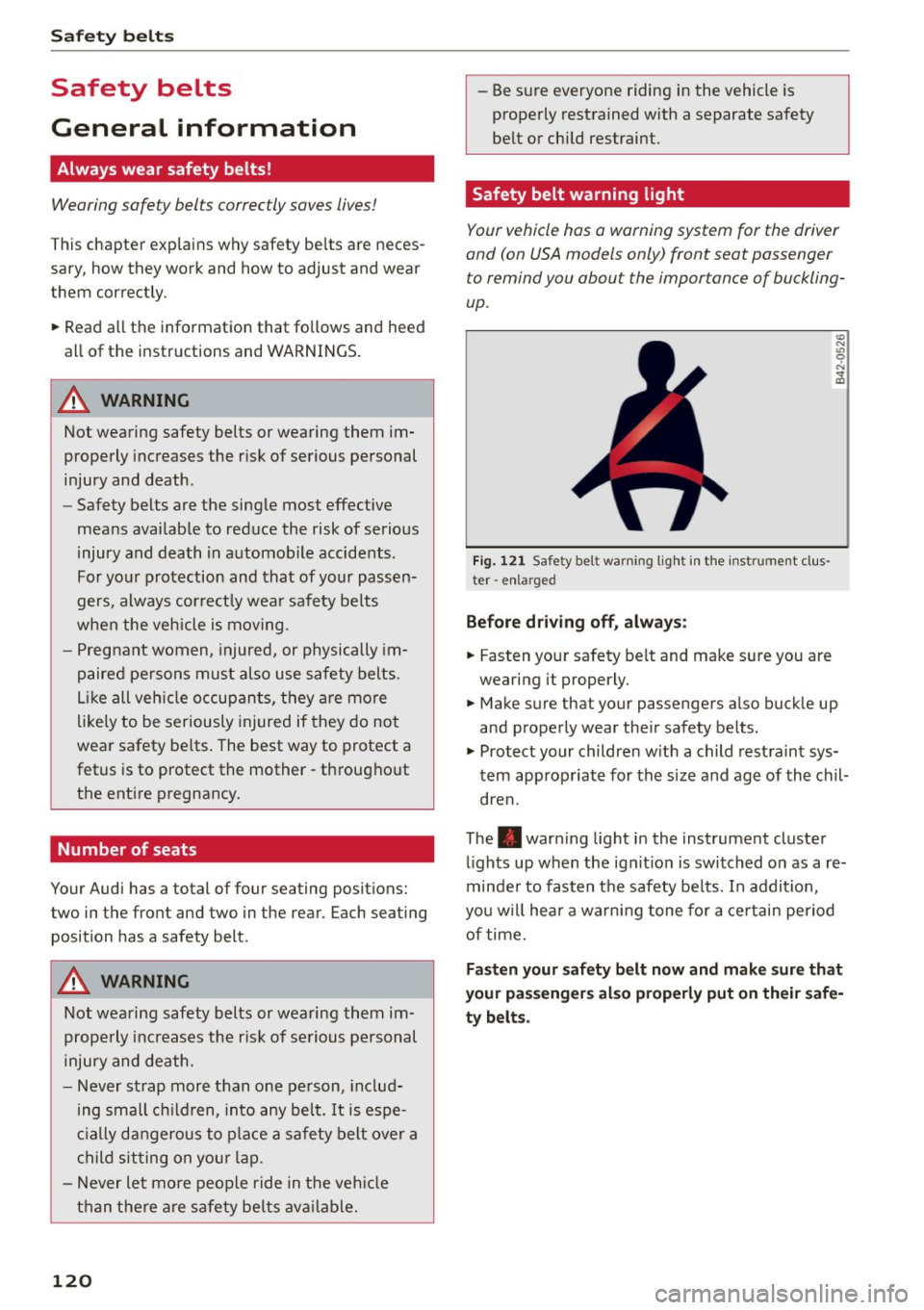
Fig. 121 Safety belt warning light in the instrument cl us
ter -enlarged
Before driving off, always:
.. Fas ten your safety belt and make sure you are
wearing it properly.
(0
"'
"' 0 N
and properly wear the ir safety belts .
.. Protect your children w ith a child restraint sys
tem appropriate for the siz e and age of the chil
dren.
The . warn ing light in the instrument cluster
lights up when the ign it ion is switched on as a re
minder to fasten the safety be lts. In addit io n,
you w ill hear a warning tone for a certain period
of time.
Fasten your safety belt now and make sure that
your passengers also properly put on their safe
ty belts.