fuel AUDI RS5 COUPE 2015 Owner's Manual
[x] Cancel search | Manufacturer: AUDI, Model Year: 2015, Model line: RS5 COUPE, Model: AUDI RS5 COUPE 2015Pages: 254, PDF Size: 64.12 MB
Page 192 of 254
Checking and F ill in g
Using the proper engine o il is important for the
functionality and service life of the engine. Your
engine was factory-fi lled w ith a high-quality o il
which can usually be used throughout the ent ire
year.
@) Note
Your L imited New Vehicle Warranty does not
cover damage or malfunctions due to failure
to follow recommended ma intenance and use
requ irements as set forth in the Audi Ow ne r's
Manual and Wa rranty
& Ma intenance booklet .
- Use only a high quality eng ine oil t hat ex-
pressly comp lies w ith the Audi o il quality
standard specified for your vehicle's e ngine .
Using a ny other oil can cause se rious engine
damage.
- Do not mix any lubricants o r othe r addit ives
i nto the engine oil. Doing so can cause en
g ine damage.
(D Tips
If you need to add oil and there is none availa
ble that meets the Audi o il quality standard
y o ur eng ine requires, you m ay add a total of
no more than 0.5 quart/li ter o f a h igh-quali ty
"synthet ic"oil that meets the fo llowing speci
fications .
- V ehicles wi th gasoline engine: AC EA A3 o r
API SM with a viscosity grade of SAE 0W- 30,
SAE SW -30 or SAE SW-40 .
- Fo r more informa tion abo ut engine oi l that
has been approved for your vehicle, please
contact either you r a uthorized Aud i dea ler
or Audi Customer Relations at
1 (800) 822-2834 or visit o ur web site at
www .aud iusa.com or www .aud icanada .ca .
Engine oil consumption
The engine in your vehicle depends on an ade
quate amount of oil to lubricate and cool all of
its moving parts .
In order to provide effective lubrication and cool
i n g of in ternal engine components, all interna l
combustion engines consume a certai n amount
of oil. O il consumption var ies from engine to en
g ine and may change significant ly ove r the life of
190
the engine. Typically, eng ines with a specif ied
break-in period (see
¢ page 177) consume mo re
o il dur ing the b reak -in per iod than they consume
after oil consumption has stabili zed.
U nder normal cond itions , the rate of oi l con
s u mption depends on t he qu ality and viscosity of
the oil, the RPM (revolutions per minute) at
which the engine is operated, the ambient tem
perature and road condit ions. Further factors are
the amount of o il di lution from water condensa
tion or fuel residue and the ox idat ion level of the
o il. As any engine is s ubject to wear as mileage
builds up, t he oil consump tion may inc rease ove r
t ime unt il rep lacement of wo rn component s may
become necessary.
With a ll these va riab les coming into p lay, no
sta ndard ra te of oil consumpt ion can be estab
li shed or spe cified . There i s no altern ative to reg
u la r and freq uent checking o f the oil leve l, see
Note .
If the yellow e ngine oi l leve l wa rning symbo l El
in the instr ument cluster lights up, yo u should
chec k the o il level as soon as possible
¢ page 191 . Top off the oil at your ear liest con
venience ¢page 191.
A WARNING
Before you chec k anything in the eng ine com
partment, always read and heed a ll WARN
INGS¢ .&. in Working in the engine compart
ment on page 187 .
@ Note
Driving with an insufficient oi l level is likely to
cause severe damage to the engine.
(D Tips
- The oil pressu re warning display. is not
an indicator of the oil level. Do not rely on
it . Instead, check the oil level in your en
gine at regular intervals, preferably each
time you refuel, and always before going on a long trip.
- If you have the impression yo ur engine con
sumes excessive amounts of oil, we r ecom-
mend that yo u consult an au tho rized Audi .,.
Page 203 of 254
Wheels
Wheels and Tires
General information
.,.Che ck your tires regularly for
damage (punctures, cuts, cracks
and bulges). Remove foreign ob
jects from the tire tread.
.,. If driving over curbs or similar
obstacles, drive slowly and ap
proach the curb at an angle.
.,.Have faulty tires or rims re
placed immediately.
"'Protec t your tires from oil,
grease and fuel.
.,.Ma rk tires before removing
them so that the same running direction can be maintained if
they are reinstalled .
.,.Lay tires flat when storing and
store them in a cool, dry location
with as little exposure to light as
possible.
(D Note
-Please note that summer and
winter tires are designed for
the conditions that are typical
in those seasons. Audi recom
mends using winter tires dur
ing the winter months. Low
temperatures significantly de crease the elasticity of summ
er tires, which affects traction
Wheels
and braking ability. If summer
tires are used in very cold tem
peratures, cracks can form on
the tread bars, resulting in
permanent tire damage that
can cause loud driving noise
and unbalanced tires.
-Burnished, polished or
chromed rims must not be
used in winter driving condi
tions. The surface of the rims
does not have sufficient corro
sion protection for this and
could be permanently dam
aged by road salt or similar
substances.
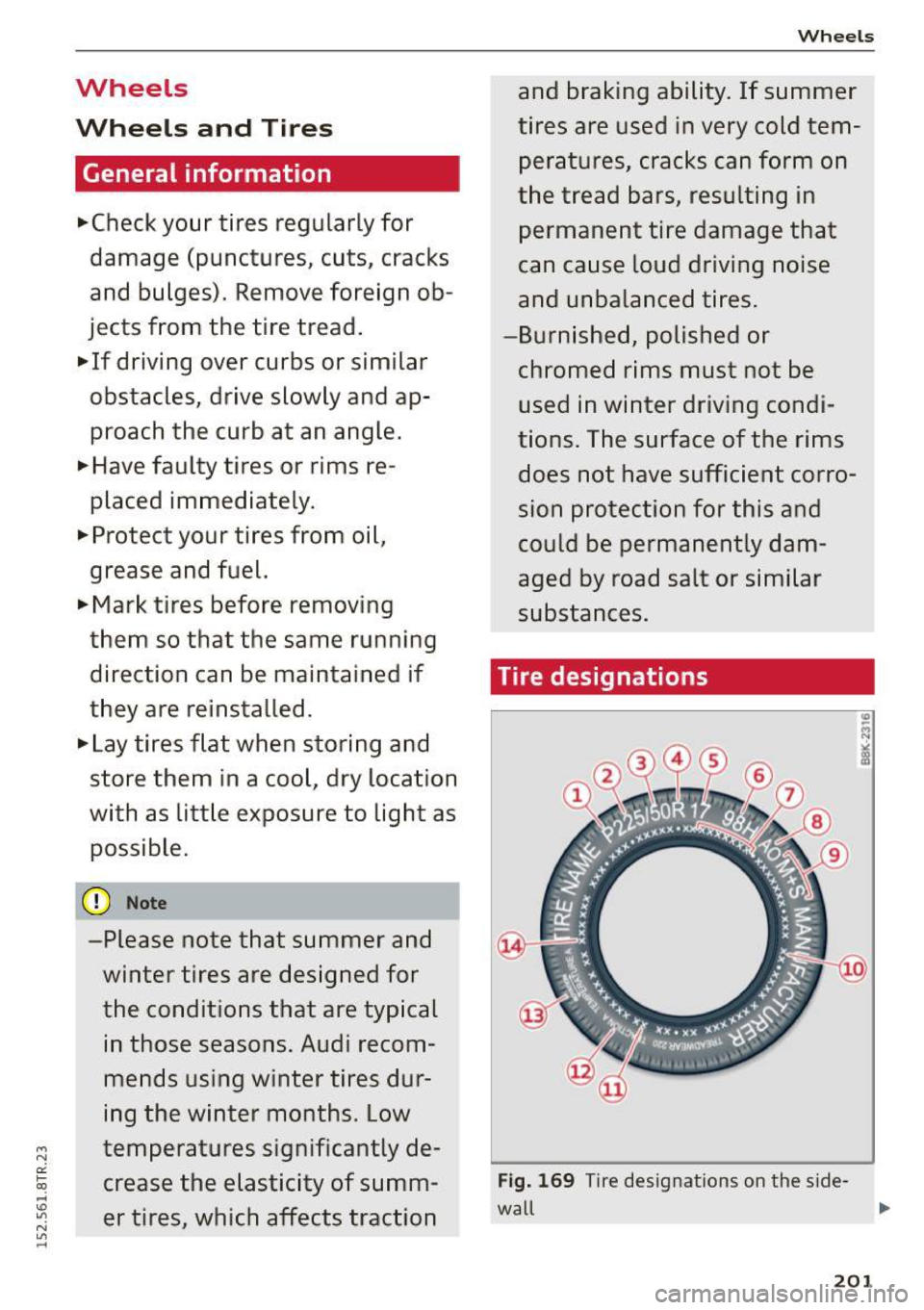
Tire designations
Fig. 169 T ir e designations on the sid e-
wall ,..
201
Page 209 of 254
A WARNING
Always adapt the tire pressure
to your driving style and vehicle load.
-Overloading can lead to loss of
vehicle control and increase the risk of an accident. Read
and follow the important
safety precautions in
¢ page 208, Tires and vehicle
load limits.
-The tire must flex more if the tire pressure is too low or if the vehicle speed or load are
too high. This heats the tire up too much. This increases the
risk of an accident because it
can cause the tire to burst and result in loss of vehicle con
trol.
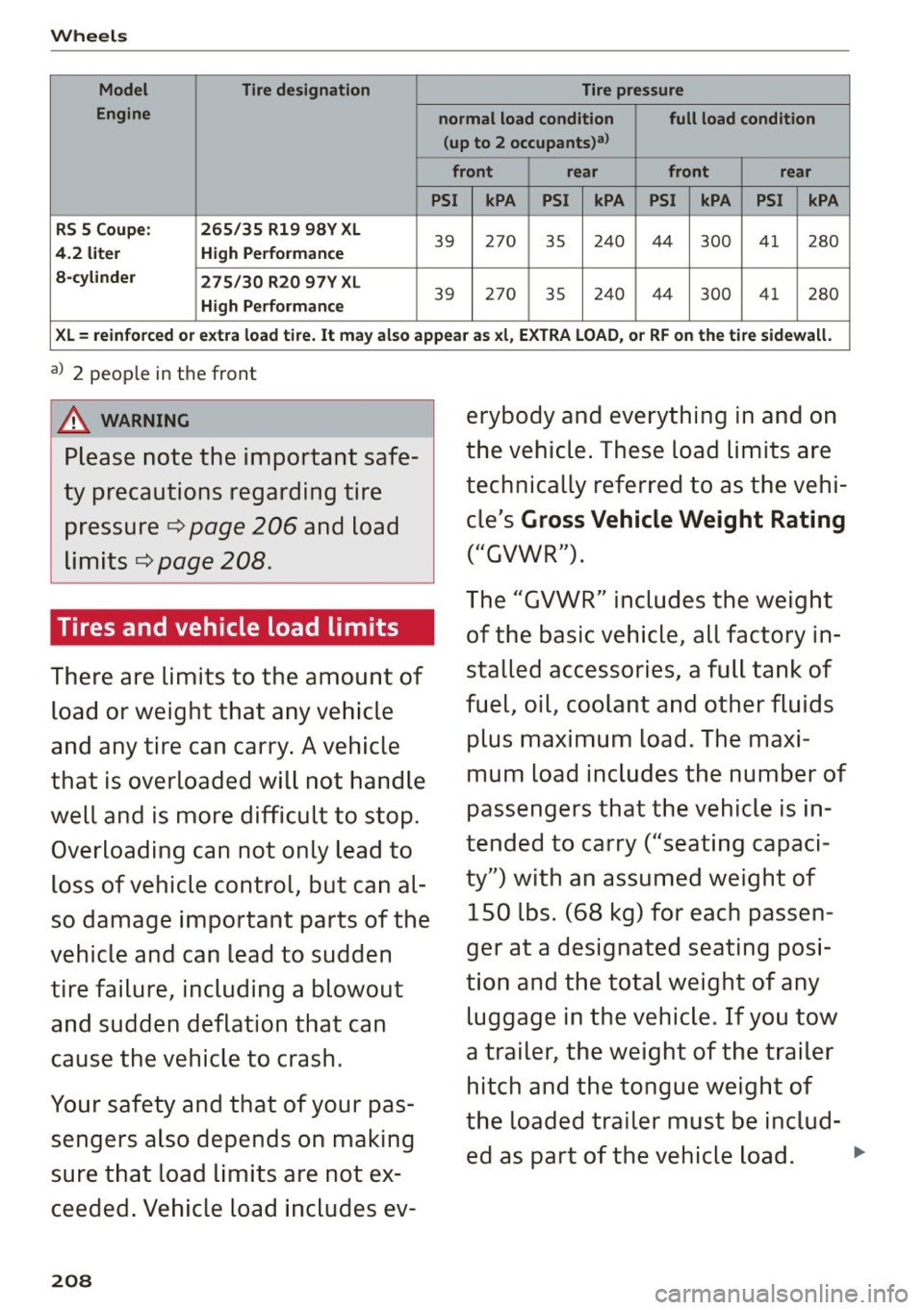
Tire pressure table
Please note that the information
contained in the following table
was correct at the time of print
ing, and the information is sub
ject to change. If there are differ
ences between this information
and the tire pressures specified
on the label on the driver's side B
pillar, always follow the specifica
tion on the B-pillar label
¢ page 206, fig . 171 .
Wheels
-Incorrect tire pressure increas
es tire wear and has a negative
effect on driving and braking behavior, which increases the
risk of an accident.
(D Note
Replace lost valve caps to re
duce the risk of damage to the
tire valves.
@ For the sake of the environment
Tire pressure that is too low in
creases fuel consumption.
(D Tips
Audi recommends using the
tire pressure specified for a nor
mal load¢
page 207 or for a
full load when the vehicle is
partially loaded.
Make sure that the tire designa
tion on your tire matches the des
ignation on the tire pressure label
and the tire pressure table.
The following table lists recom
mended tire pressures in cold
tires according to the load and
the size of the tires installed.
207
Page 210 of 254
Wheels
Model Tire designation Tire pressure
Engine normal load condition full load condition
(up to 2 occupants)a l
front rear front rear
PSI kPA PSI kPA PSI kPA
PSI kPA
RS 5 Coupe: 265/35 Rl9 98V XL
4.2 liter High Performance
39 27
0
35 2
40 44
300 41
280
8-cylinder
275/30 R20 97V XL
High Performance
39 270 35 240
44 300 41 280
XL= reinforced or extra load tire. It may also appear as xl, EXTRA LOAD, or RF on the tire sidewall.
a) 2 people in the front
_& WARNING
Please note the important safe
ty precautions regarding tire pressure ¢
page 206 and load
limits ¢
page 208.
Tires and vehicle load limits
There are limits to the amount of
load or weight that any vehicle
and any tire can carry. A vehicle
that is overloaded will not handle
well and is more difficult to stop. Overloading can not only lead to
loss of vehicle control, but can al
so damage important parts of the
vehicle and can lead to sudden
tire failure, including a blowout and sudden deflation that can
cause the vehicle to crash .
Your safety and that of your pas sengers also depends on making
sure that load limits are not ex
ceeded. Vehicle load includes ev-
208
erybody and everything in and on
the vehicle. These load limits are
technically referred to as the vehi cle's
Gross Vehicle Weight Rating
("GVWR").
The "GVWR" includes the weight of the basic vehicle , all factory in
stalled accessories, a full tank of
fuel, oil, coolant and other fluids plus maximum load . The maxi
mum load includes the number of
passengers that the vehicle is in
tended to carry ("seating capaci
ty") with an assumed weight of
150 lbs. (68 kg) for each passen
ger at a designated seating posi
tion and the total weight of any luggage in the vehicle . If you tow
a trailer, the weight of the trailer hitch and the tongue weight of
the loaded trailer must be includ- ed as part of the vehicle load. ..,.
Page 213 of 254
M N
0:: loo ,...., \!) ..,.,
N ..,., ,....,
yourself, because this increases the risk of
an acc ident.
Winter tires
W inter tires sign ificantly improve t he vehicle's
h andling when drivi ng in winter condit ions. Be
cause of the ir construction (width, compound,
tread pattern), summer t ires p rov ide less t ract ion
on ice and snow.
.. Use w in ter t ires on all four wheels.
.. Only use winter tires that are approved for your
vehicle .
" Please note that the maximum permitted
speed may be lower w it h w inter tir es ~,&. .
You r authorized Audi dea le r or a uthorized re
pair facility can in form you about the maximum
permitted speed fo r yo ur tires.
.. Check the tire pressure after insta lling wheels
~ page 206.
The effectiveness of winte r tires is reduced great
l y when the tread is worn dow n to a depth of
0 .157 inch (4 mm). The characteristics of w inter
tires also decrease greatly as the tire ages, re
gardless of the remai ning tread .
A WARNING
-Never drive faster than the maximum per
mitted speed for your t ires. This could cause
the tires to heat up too much . This increases
the risk of an ac cident be cause it can cause
the tire to b urst.
- Always adapt you r driv ing to the road and
t raff ic conditions. Dr ive ca refully and re duce
yo ur speed on icy or slippery roads. Even
w inter tires can lose tract ion on black ice.
@ For the sake of the environment
Reinstall summer tires at the approp riate
t ime, because they prov ide be tter h and ling
when roads a re free of snow and ice. S ummer
tires ca use less road no ise, tire wea r and fuel
consumption.
Wheels
{!) Tips
You can also use a ll season tires instead of
winter tires. P lease note that in some coun
tries where w inter tires are required, only win
ter tires w ith the
& symbol may be permit
ted.
Snow chains
Snow chains improve traction in the snow .
.. On ly install snow chains on the front wheels .
T his applies a lso to vehicles with a ll whee l
drive .
.. Check and correct the seating of the snow
chains if necessary after driving a few feet . Fol
low the instructions from the manufactu rer .
.. Note the maximum permitted speed when dr iv
ing wit h snow chains . Do not exceed 30 mph
(SO km/h).
Snow c ha ins not only improve the
driving in w in
te r road cond itions , but also the
braking .
Use of snow chains is only permitted with certain
rim/tire combinations due to technical reasons .
Check with an authorized Audi dea ler or author
ized repa ir fac ility to see if you may use snow
chains.
Use
fine-mesh snow chains. They must not add
more than 0 .41 inch (10 .5 mm) in he ight, includ
i ng the cha in lock.
You must remove the chains when driving on roads that are
free of snow . When roads are free
of snow, snow cha ins can impair handl ing and
damage the tires, and the chains wi ll quickly be
dest royed.
A WARNING
Using incor re ct snow chains o r insta lli ng snow
cha ins incorrect ly can result in loss of ve hicle
control, which increases the risk of an acci
dent .
(D Note
Snow ch ains can damage the rims/wheel cov
ers * if the chains come into direct contact
211
Page 215 of 254

M N
0:: loo ,...., \!) ..,.,
N ..,., ,....,
under controlled conditions on a specified gov
ernment test course.
For example, a tire graded 150 would wear one
and one ha lf (11/2) times as well on the govern
ment course as a tire graded 100.
The relative performance of tires depends upon
the actual conditions of their use, however, and
may depart significantly from the norm due to
variations in driving habits, service practices and
differences in road characteristics and climate.
Traction
The traction grades, from highest to lowest, are
AA, A, Band
C. Those grades represent the tire's
ability to stop on wet pavement as measured un
der controlled conditions on specified govern ment test surfaces of asphalt and concrete . A tire
marked C may have poor traction performance
¢ .&. .
Temperature
The temperature grades are A (the highest), B,
and C, representing the tire's resistance to the
generation of heat and its ability to dissipate heat when tested under controlled conditions on
a specified indoor laboratory test wheel.
Sustained high temperature can cause the mate rial of the tire to degenerate and reduce tire life,
and excessive temperature can lead to sudden
tire failure
¢ .&. .
The grade C corresponds to a level of perform
ance which all passenger car tires must meet un
der the Federal Motor Vehicle Safety Standard No. 109. Grades Band A represent higher levels
of performance on the laboratory test wheel than
the minimum required by law .
A WARNING
-
The traction grade assigned to this tire is
based on stra ight-ahead braking traction
tests, and does not include acceleration, cor
nering, hydroplan ing or peak traction charac
teristics.
Wheels
A WARNING
The temperature grade for this tire is estab lished for a tire that is properly inflated and
not overloaded. Excessive speed, underinfla
tion, or excessive loading, either separately or
in comb ination , can cause heat buildup and
possible tire failure.
A WARNING
-
-
Temperature grades apply to tir es that are
properly inflated and not over or underinflat
ed.
Tire pressure monitoring system
ill General notes
Applies to vehicles: with tire pressure monitoring system
Each tire, including the spare (if provided),
should be checked monthly when cold and inflat
ed to the inflation pressure recommended by the
vehicle manufacturer on the vehicle placard or
tire inflation pressure label. (If your vehicle has
tires of a different size than the size indicated on
the vehicle placard or tire inflation pressure la
bel, you should determine the proper tire infla
tion pressure for those tires) .
As an added safety feature, your vehicle has been equipped with a tire pressure monitoring system
(TPMS) that illuminates a low tire pressure tell
tale when one or more of your tires is significant
ly under-inflated. Accordingly, when the low tire
pressure telltale illuminates, you shou ld stop and
check your tires as soon as possible, and inflate
them to the proper pressure . Driving on a signifi
cant ly under-inflated tire causes the tire to over
heat and can lead to tire failure. Under-inflation
also reduces fuel efficiency and tire tread life,
and may affect the vehicle's handling and stop
ping ability .
Please note that the TPMS is not a substitute for
proper tire maintenance, and it is the driver's re
sponsibility to maintain correct tire pressure, even if under-inflation has not reached the level
to trigger illumination of the TPMS low tire pres-
sure telltale. .,.
213
Page 227 of 254
"' N
0:: loo
rl I.O
"' N
"' rl
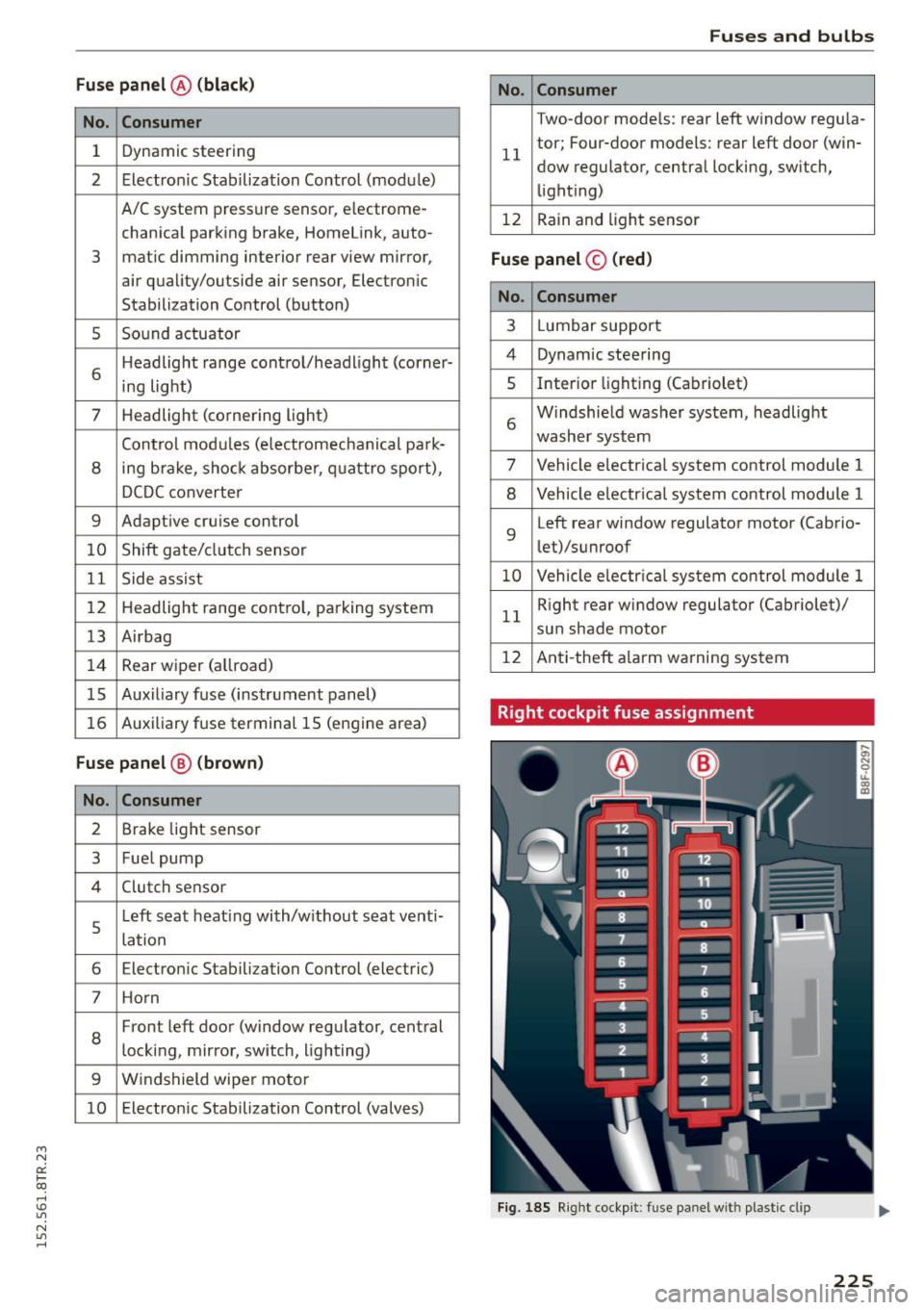
Fu se pa nel @ (black )
No. Consumer
1 Dynamic steering
2 Electron ic Stabilization Control (module)
A/C system pressure sensor, electrome-
chanical parking brake, HomeLink, auto-
3 mat
ic dimming interior rear view mirror,
air quality/outside air sensor, Electron ic
Stabilization Control (button)
s Sound actuator
6 Headlight range control/headl
ight (corner-
ing light)
7 Headlight (cornering light)
Control modu les (electromechanical park-
8 ing brake, shock absorber, q uattro sport),
DCDC converte r
9 Adaptive
cruise control
10 Shift gate/clutch sensor
11 Side assist
1 2 Headlight range cont ro l, parking system
13 Airbag
14 Rear
wiper (a llroad)
15 Auxiliary fuse (instrument panel)
16 Auxiliary
fuse termina l 15 (engine area)
Fuse p anel @ (brown )
No. C onsumer
2 Brake light sensor
3 Fuel pump
4 Clutch sensor
5
Left seat heating with/without seat venti-
lation
6 Electronic Stabilization Control (electric)
7 Ho rn
8
Front left door (window regulator, central
locking, mirror, switch, lighting)
9 Windshield wiper motor
10 Electronic Stabilization Control (valves) Fu
ses a nd bulb s
No. Consumer
Two-door mode ls: rear left window regula-
11 tor; Four-door
models: rear left door (win-
dow regulator, central locking, switch,
light ing)
12 Rain and l
ight sensor
Fuse panel © (r e d )
No . Con sumer
3 Lumbar support
4 Dynamic steering
5 Inter
ior l ight ing (Cabriolet)
6 Windshie
ld washer system, headlight
washer system
7 Vehicle electrica l system control module 1
8 Vehicle electr ica l system control module 1
9 Left rear
window regulator motor (Ca brio-
let)/su nroof
10 Vehicle electr ica l system co ntrol module 1
11 Right rear
window regulator (Cabriolet)/
sun shade motor
12 Anti-theft
alarm warning system
Right cockpit fuse assignment
Fig. 185 Right cockpit: fu se panel with plastic cl ip
225
Page 235 of 254
"' N
0:: loo
rl I.O
"' N
"' rl
Technical data
Vehicle identification
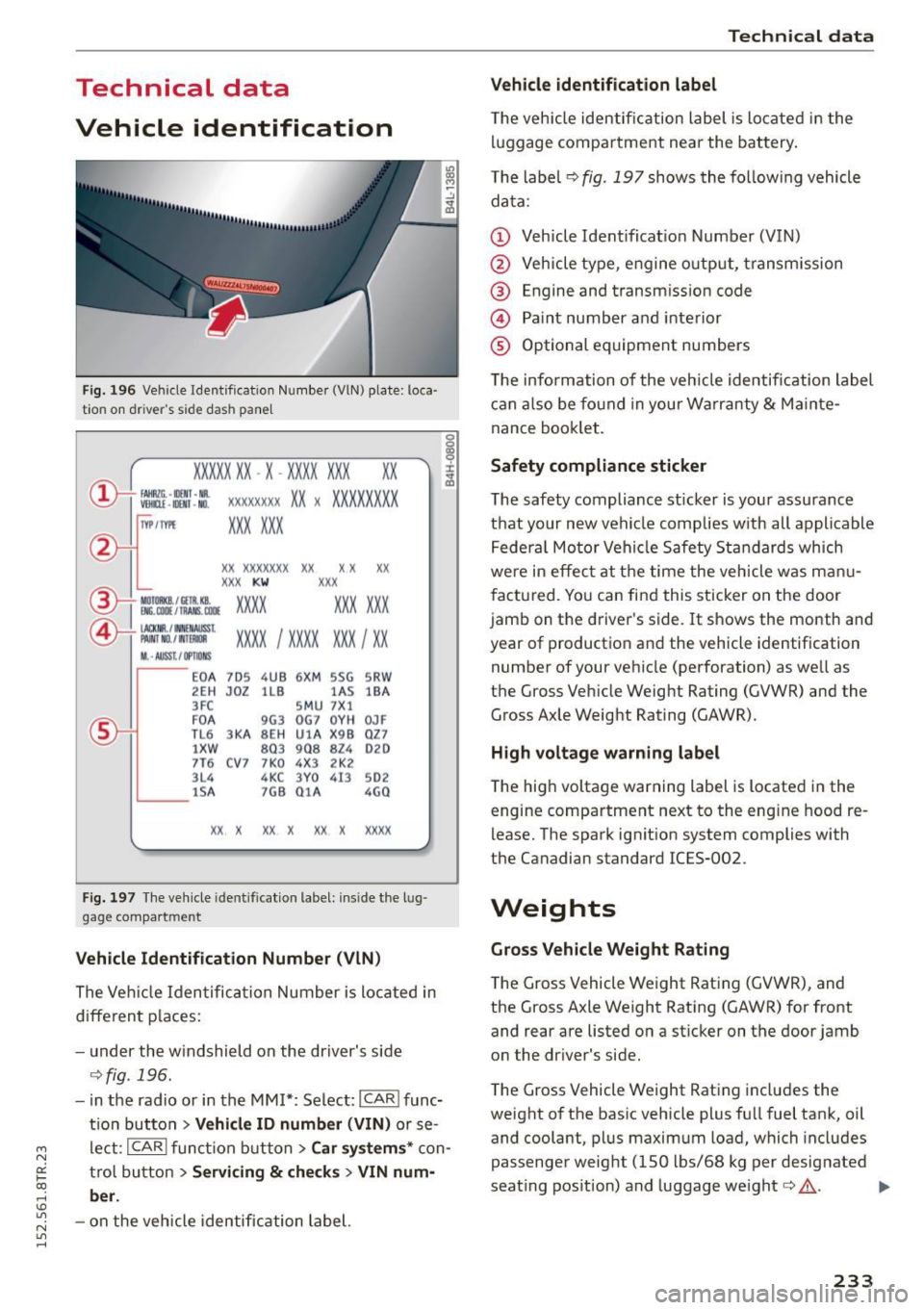
F ig. 196 Ve hicle Identificat io n Number (VlN) plate: loca·
t io n on d river 's s id e dash pane l
XXXXX XX -X -XXXX XXX XX
CD+ ~t :1:: xxxxxxxx xx x xx xxx xxx
T VP /fffl XXX XXX
XX XXXXXXX XX X X xx
XXX KW XXX
®i ~:J·f lfils~~ XXXX XXX XXX
®-+ ~N:a=i~ l xxxx ; xxxx xxx ; xx
II.· AUSS, I OPTIONS
,__ __
EO A 7D5
2EH JOZ
3FC
FOA
TL6 3KA
lX W
7T6 CV 7
3L4 lSA
4UB 6XM 5SG
llB l AS
S MU 7Xl
9G3 0G7 0YH
8EH Ul A X 98
803 908 824
7K0 4X3
2 K2
4KC 3Y0 413
7GB
01 A
5R W
18A
OJF
QZ7
020
502
4G0
XX . X XX X XX X XXXX
Fig. 197 T he veh icle identi fica tion label: ins ide the l ug·
ga ge compart men t
Vehicle Identification Number (VlN )
The Veh icle Iden tifica tion Number is located in
d iffe rent p laces:
- under the w indshield on the dr iver's side
c> fig . 196.
-in the radio or in the MM I*: Select : I CARI func
t ion button
> V ehicle ID numb er (VIN ) or se·
Leet :
I CARI funct ion button > Car sy stem s* con
tro l bu tton >
Servicing & checks > VIN num
ber .
-on the vehicle identification la bel.
Technical d ata
Vehicle id entification label
T he veh icle identification label is lo cated in the
lu ggage compartment near the battery.
T he labe l c>
fig. 197 shows the fo llowing vehicle
da ta:
(D Vehicle Ident ificat ion Number (VIN)
@ Vehicle type, engine o utp ut, transmission
® Engine and transm iss ion code
@ Pa int number and interior
® Optional equipment numbers
T he information of the veh icle identification label
c a n a lso be fo und in you r W arranty
& Mai nte
nance booklet.
Safety compliance sticker
T he safety compliance sticker is you r assurance
that your new vehi cle complies w ith all applicable
Federa l Mo tor Vehi cle Safety Sta ndards which
were in effec t at the time the vehicle w as m anu
fac tured. Yo u can find this sticker on the door
jamb on the driver 's side. It shows the month and
year of production and the vehicle identification number of your vehicle (perforation) as we ll as
the Gross Veh icle Weight Rating (GVWR) and the
Gross Axle Weight Rating (GAWR).
H igh vo ltage warning lab el
T he hig h voltage warning label is located in the
engine compartment ne xt to the eng ine hood re
lease. The spark ign ition system complies with
the Canadian standard ICES-002 .
Weights
Gross Vehicle Weight Rating
The Gross Vehicle Weight Rat ing (GVWR), and
the Gross Axle Weight Rating (GAWR) for front
and rear are listed on a st icker on the door jamb
on the dr iver's side.
T he Gross Vehicle Weight Rat ing includes the
weight of the basic vehicle plus fu ll fuel tank, oil
and coolant, p lus maxim um load, which includes
passenger weigh t (150 lbs/68 kg per designated
seat ing pos ition) and luggage we ight
c> .&, . ..,,.
233
Page 236 of 254
Technical data
Gross Axle Weight Rating
The Gross Axle Weight Rating is the maximum load that can be appli ed at each axle of the vehi
cle ¢& .
Vehicle capacity weight The vehicle capacity we ight (max. load) is listed
on the driver's side 8 -p ill ar.
_& WARNING
- T he actual Gross Axle Weight Rating at the
front and rear axles should not exceed the
permissible weights, and their combination
must not exceed the Gross Vehicle Weight
Rating .
Dimensions
length
Width
Width (across mirrors) He ight (unloaded) al -
Exceeding permissible weight ratings can
result in veh icle damage, acc idents and per
sonal injury.
(D Note
- The vehicle capacity weight figures apply
when the load is distributed evenly in the
vehicle (passengers and luggage). When
transporting a heavy load in the luggage
compartment, carry the load as near to the
rear axle as possible so that the vehicle 's
hand ling is not impaired .
- Do not exceed the maximum permissible
axle loads or the maximum gross vehicle
we ight. Always remember that the vehicle's
hand ling will be affected by the extra load.
T herefore, adjust your speed accordingly.
- Always observe local regulations .
in (mm)
183 .0 (4649)
in (mm) 73 .2 (1860)
in (mm) 79 .5 (2020)
in (mm) 53 .8 (1366)
aJ The height of the vehicle depe nd s on the tires and t he su spen sion.
When driving up steep ramps, on rough roads,
over curbs, etc. it is important to remember that
some parts of your vehicle, such as spoilers or ex-
Capacities
Fuel tank: total capacity
Windshield and headlight* washer fluid container
234
haust system components, may be close to the
ground. Be carefu l not to damage them.
gal (liters)
16 .1 (61.0)
quarts (liters) 4.8 (4 .5)
Page 237 of 254
M N
0:: loo ,...., \!) 1.1'1
N 1.1'1 ,....,
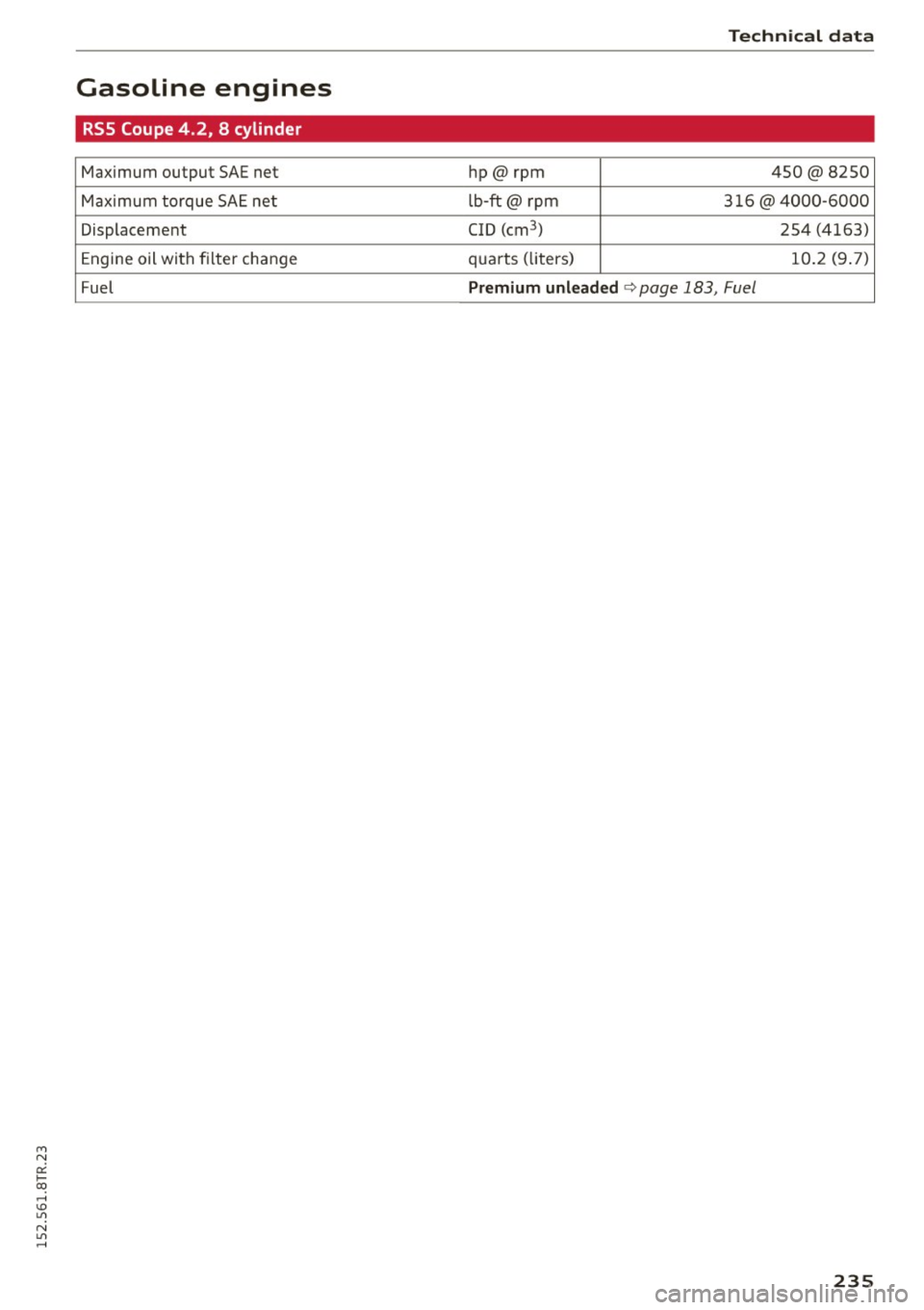
Gasoline engines
RSS Coupe 4.2, 8 cylinder
Maximum output SAE net
Maximum torque SAE net
Displacement
Engine oil with filter change
Fuel
Techni cal d at a
hp@ rpm 450@8250
l b-ft@ rpm 316
@4000-6000
CID (cm
3
) 254 (4163)
quarts (liters) 10.2 (9.7)
Premium u nlea ded c> page 183, Fuel
2 35