fuel AUDI RS5 COUPE 2015 User Guide
[x] Cancel search | Manufacturer: AUDI, Model Year: 2015, Model line: RS5 COUPE, Model: AUDI RS5 COUPE 2015Pages: 254, PDF Size: 64.12 MB
Page 83 of 254
M N
0:: loo ,...., \!) 1.1"1
N 1.1"1 ,....,
Automatic transmission
S tronic
Introduction
The automatic transmission is controlled elec
tronically. The transmission upshifts or down
shifts automatically depending on which drive
program is selected.
When a
moderate driving style is used, the
transmission selects the most economical driving
mode.
It will then change up early and delay the
downshifts to give better fuel economy.
The transmission switches to a sporty mode after
a kick-down or when the driver uses a
sporty driv
ing style
characterized by quick accelerator pedal
movements, heavy acceleration, frequent
changes in speed and traveling at the maximum
speed.
If desired, the driver can also select the gears
manually (tiptronic mode) ~ page 85.
The S tronic is a dual-clutch transmission . Power
is transferred using two clutches that work inde
pendently from one another. They replace the
torque converter used in conventional automatic
transmissions and allow the vehicle to accelerate
without a noticeable interruption in traction.
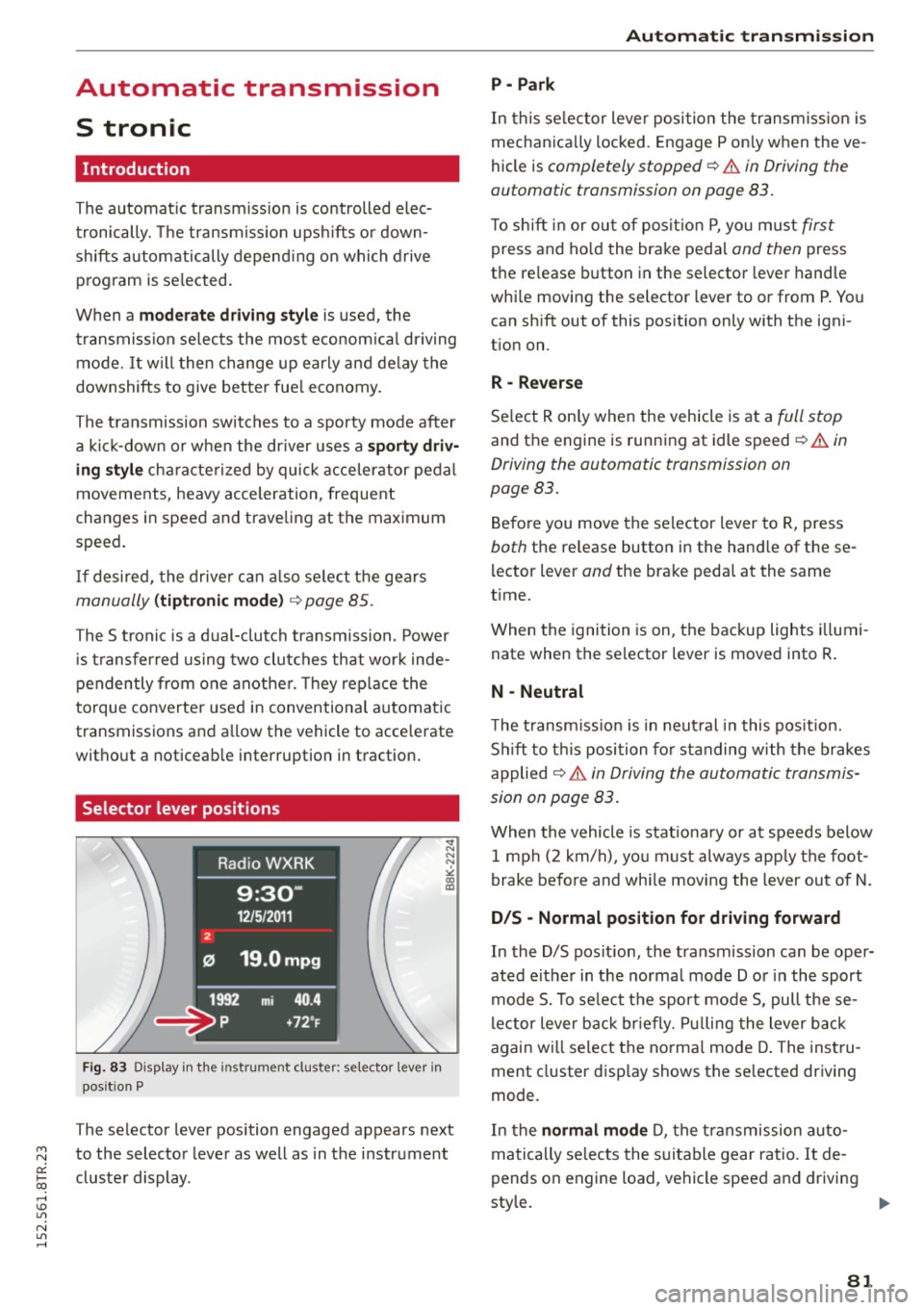
Selector lever positions
Fig. 83 Display in the instru ment cluster: selector lever in
pos it ion P
The selector lever position engaged appears next
to the selector lever as well as in the instrument
cluster display .
Automatic transmission
P - Park
In this selector lever position the transmission is
mechanically locked. Engage P only when the ve
hicle is
completely stopped¢.& in Driving the
automatic transmission on page 83.
To shift in or out of position P, you must first
press and hold the brake pedal and then press
the release button in the selector lever handle
while moving the selector lever to or from P. You
can shift out of this position only with the igni
tion on.
R- Reverse
Select R only when the vehicle is at a full stop
and the engine is running at idle speed¢.& in
Driving the automatic transmission on
page 83.
Before you move the selector lever to R, press
both the release button in the hand le of the se
lector lever
and the brake pedal at the same
time .
When the ignition is on, the backup lights illumi
nate when the selector lever is moved into R.
N - Neutral
The transmission is in neutral in this position.
Shift to this position for standing with the brakes
applied
~ .& in Driving the automatic transmis
sion on page 83.
When the vehicle is stationary or at speeds below
1 mph (2 km/h), you must always apply the foot
brake before and while moving the lever out of N.
D/S - Normal position for driving forward
In the D/S position, the transmission can be oper
ated either in the normal mode Dor in the sport
mode S. To select the sport mode S, pull these
lector lever back briefly. Pulling the lever back
again will select the normal mode D. The instru
ment cluster display shows the selected driving
mode.
In the
normal mode D, the transmission auto
matically selects the suitable gear ratio. It de
pends on engine load , vehicle speed and driving
style.
11o-
81
Page 179 of 254

M N
0:: loo ,...., \!) 1.1"1
N 1.1"1 ,....,
Driving and the
environment
Breaking in
New engine
The engine needs to be run-in during the first
1,000 miles (1,500 km).
For the first 600 miles (1,000 kilometers ):
"' Do not use full throttle .
"' Do not drive at engine speeds that are more
than
2/3 of the max imum permitted RPM .
From 600 to 1,000 miles (1,000 to 1,500
kilometers):
"' Speeds can gradually be increased to the maxi
mum perm issible road or engine speed.
During and after break-in period
"'Do not rev the engine up to high speeds when it
is cold. This applies whether the transmission is
in N (Neutral) or in gear .
After the break-in period
"'Do not exceed maximum engine speed under
any circumstances.
"'U pshift into the next higher gear
before reach
ing the red area at the end of the tachometer
scale
c=> page 10.
During the first few hours of driving, the engine's
internal friction is higher than later when all the
moving parts have been broken in. How well this
break-in process is done depends to a considera
ble extent on the way the vehicle is driven during
the first 1,000 miles (1,500 kilometers).
(D Note
Extremely high engine speeds are automati
cally reduced. However, these rpm limits are
p rog rammed for an engine wel l run- in, not a
new engine.
@) For the sake of the environment
Do not dr ive with unnecessarily high eng ine
speeds -upshifting early saves fuel, reduces
noise and protects the environment.
Driving and the environment
New tires
If your vehicle is running on new tires, drive very
carefully for the fi rst 350 m iles (500 kilometers)
after fitting .
New tires tend to be slippery and must also
be "broken-in". Be sure to remember this dur
ing the first
350 miles (500 kilometers).
Brake gently. Avoid following closely behind
other vehicles or other situations that might
require sudden, hard brak ing .
Avoid damaging the
vehicle
When you are d riving on poor roads, or over
curbs, steep ramps, etc., ma ke certain that low
lying parts such as spoilers and exhaust system
parts do not bottom out and get damaged.
T his is espec ially true for veh icles with low-s lung
chassis (sports chassis)* and fully loaded
vehicles.
Driving through water on
roads
Note the following to avoid vehicle damage when
driving through water, for example on f looded
roads:
- The water must not be any higher than the bot
tom of the vehicle body.
- Do not drive faster than walking speed.
A WARNING
= -
After driving through water, mud, slush, etc.,
the brakes may be s low to take effect because
of wet brake rotors and pads. Dry the brakes
first by braking carefully to restore the full braking effect.
(D Note
Vehicle components such as the engine,
transmission, suspension or electrical system
can be severely damaged by driving through
water . ""
177
Page 180 of 254
Driving and th e environment
(D Tips
-Check the depth of the water before driving
through it.
- Do not stop the veh icle, drive in reverse or
switch the engine
off when driving through
water.
- Keep in mind that oncoming vehicles may
create waves that raise the water level and
make it too deep for your vehicle to dr ive
through safely.
- Avoid driving through sa lt water because it
can cause corrosion.
Warming up and cooling down
By carefully warming up and cooling down your
veh icle, you can help ensure that it is not over
stressed unnecessar ily du ring sporty dr iv ing.
When warming up, the vehicle is driven at a max imum engine speed of 6000 RPM in order to ra ise
the engine oil temperature to a m inimum of
140 °F (60 °C). T he tires also only reach their full
road holding capab ility once they have wa rmed
up.
The cooling fan can continue to run in your vehi
cle after the eng ine is switched
off. However,
d riving the vehicle to cool it dow n is part icu larly
important. During sporty d riving, the engine and
brakes , the exhaust system, and the transmission
all become extremely hot. Before you park the
vehicle, you should drive it for a few mi les/kilo
meters at light load in the low rpm range to al
low it to cool down.
Catalytic converter
It is very important that your emission control
system (catalytic converter) is functioning prop erly to ensure that your vehicle is running in on
environmentally sound manner .
.. Always use lead -free gasoline c::> page 183,
Fuel supply.
.. Never ru n the tank down a ll the way to empty.
.. Neve r pu t too m uch motor oil in your engine
c::> page 191, 't:::?: Adding engine oil .
178
.. Never try to push -or tow-start your vehicle .
The catalytic converte r is an effi cient "clean-up"
device b uilt into the exha ust system of the veh i
cle. The cata lytic conve rter burns many o f the
po llutants in the exhaust gas before they are re
l eased into the atmosphere.
The exclusive use of unleaded fue l is c ritically im
po rtant for the life of the catalytic conver ter and
proper functioning of the engine .
A WARNING
-The temperature of the exhaust system is
high, both when driving and after stopping
the engine.
- Never touch the exhaust tail pipes once they
have become hot. Th is could resu lt in burns.
- Do not park or operate the vehicle in areas
where the hot exha ust system may come in
contact with dry grass, brush, fuel spill or
other material which can cause a fire.
- Do not apply additional undercoating or rustproof ing on or near the exhaust mani
fold, exhaust pipes, catalytic converter or
heat shields. During dr iving, the substance
used for unde rcoat ing could overheat and
cau se a fire.
@ Note
- Be aware that just one tank fill ing with lead
ed
fuel w ill al ready ser iously degrade the
performance of the catalytic converter.
- Do not exceed the correct engine oil level
c::>poge 191.
-Do not drive until the fue l tank becomes
completely empty . T he engine cou ld m isfire .
Unburned fu el could also get into the ex
haus t sys tem a nd this could cause the cata
lyt ic converte r to overheat.
- Do not turn
off the ignition while the vehicle
is
moving.
- Do not continue to operate your veh icle un
der these condi tions, as otherwise f uel can
re ach the cat aly tic converter. This could re
s u lt in ove rheat ing of the c onve rter, requ ir
ing its replacement .
- T o assure efficient oper ation of the Emission
~
Cont ro l System: ..,_
Page 181 of 254

M N
0:: loo ,...., \!) ..,.,
N ..,., ,....,
-Have your veh icle maintained properly and
in accordance with the service recommen
dations in your Warranty
& Maintenance
book let.
- Lack of proper maintenance as well as im
proper use of the vehicle will impair the
function of the emission control system and could lead to damage.
@ For the sake of the environment
Even when the Emission Control System is op
erating properly, the exhaust gas can have a
sulfur-like exhaust gas smell under some op
erating states. This depends on the sulfur
content of the fuel being used . Using a differ
ent brand of fuel may help, or filling the tank
w ith lead-free super grade gasoline.
Shutting down vehicle
If you wou ld like your vehicle to remain inopera
tive for a longer period of time, contact an Audi
or other specialized dealer. T hey can advise you
on necessary precautions e.g. corrosion preven
tion, maintenance and storage. Pay attention to
additional information concerning the battery. Refer to
c:;, page 196.
Economical and environ
mentally-friendly driving
General
Your personal style of driving will determine the
economy of your vehicle, as well as exhaust and
noise levels.
Fu el economy, environmental impact , and wear
on your engine, brakes and tires largely depend
on three factors:
- your personal driving style
- operating conditions
- technical limitations
If you anticipate what you need to do next and
drive economically, you can easily cut your fue l
consumption by 10-15 percent. This sect ion will
give you some tips on how you can help the envi
ronment and your pocketbook .
Driving and the environment
(D Tips
The consumption estimates as published by
ENVIRONMENTAL PROTECTION AGENCY (EPA)
and Transport Canada may not correspond to
your actual consumption on the road, which
will vary depending upon vehicle load and
speed, road and weather conditions, tr ip
l ength, etc.
Drive smoothly and keep a lookout ahead
Vehicles use the most fuel when they are acceler
ating .
.. Avoid unnecessary accelerating and braking .
Vehicles use the most fuel when they are acceler
ating. If you anticipate what is going to happen next, you will need to brake less and , thus, accel
erate less. Let the veh icle coast whenever possi
ble -for example when you see that the next traf
fic light is red.
Avoid full throttle
Driving at moderate speeds saves fuel and im
proves your mileage .
.. Try and keep well below your car's maximum
speed.
Acce lerating gently reduces fue l consumption,
engine wear, and does not disturb the environ
ment .
Fuel consumpt ion, exhaust emiss ions and engine
noise increase disproportionately at high speeds.
If you drive at approximate ly three quarters of
top speed, fue l consump tion will be reduced by
one half. Never drive faster than the posted
speed l imit and weather cond itions permit .
Reducing unnecessary idling
Even when your car is just idling it burns up fuel.
.. Shut the eng ine off when you are not driving
the vehicle.
.. Do not warm up the vehicle by letting the en-
gine run at idle .
ll>
179
Page 182 of 254
Driving and th e environment
It makes sense to shut off the engine in traffic
jams, when waiting for trains to pass at rai lroad
crossings, or at traff ic lights that have long waits
on red. Turning the eng ine off for just 30-40 sec
onds saves more fuel than is burned starting the
engine again .
It takes a long time for the engine to warm up
fully when it is running at idle. However, wear
and nox ious em issions are especially h igh when
the engine is warm ing up. So you should dr ive
away as soon as you start the engine and avoid running at high rpms while the engine is still
warming up.
{[) Note
Do not leave engine idling unattended after
starting. If warning lights should come on to
indicate improper operation, they would go
unheeded. Extended id ling a lso produces
heat, wh ich co uld resu lt in overheating or ot h
er damage to the vehicle or other property .
Regular maintenance
A badly tuned engine unnecessarily wastes a lot
of fuel.
~ Have you r vehicle se rv iced at regular i nte rva ls.
By having your vehicle regularly serviced by an
author ized Audi dealer helps to ensure that it
r u ns p roperly and economically. The condition of
your veh icle not only affe cts its safety and ability
to hold its va lue, i t also affects
fue l con sump
tion.
Ch eck your oil each tim e you fill your tank .
The amount of oil used is related to engine load
and speed .
It is normal for the oil consumption of a new en
g ine to reach its lowest value after a certain mile
age has been driven.
You must drive yo ur vehicle about 3,000 miles
(5,000 ki lometers) before you can properly as
sess o il consumption .
This a lso applies to fuel consumption and engine
output .
180
(D Note
-Have your veh icle ma intained properly and
in accordance with the service recommenda
tions in your Warranty
& Maintenance book
let. Lack of proper maintenance as well as
improper use of the vehicle will impair the
function of the emission control system and cou ld lead to damage .
- Do not alter or remove any component of the Emission Control System unless ap
proved by the manufacturer.
- Do not alter or remove any device, such as
heat shields, sw itches, ignit ion wires,
valves, which a re des igned to p rotect your
vehicle's Emission Control System and other
impo rtant vehicle components.
Fewer short trips
Fuel consumption will always be relatively high
on short trips.
~ Tr y to avoid dr iv ing sho rt distances w ith a co ld
eng ine .
The eng ine and cata lytic converter have to reach
their opt imal
op erat ing temperature to reduce
fuel consumpt io n and noxious em issions effec
tive ly.
Just after starting, a co ld eng ine in a mid -s ize car
o nly achieves a fuel economy of 6-8 m iles per
gallon (30-40 l/100 km). After about a half a
mile, fuel economy climbs to 12 mpg ( 20 l/100
k m). After about
2.5 mi les ( 4 km) , the eng ine is
at i ts p roper operating tempera ture and fuel
economy has reached a normal level. So you can
see that yo u should avo id short trips whenever
poss ib le.
The
outside temperature is also cr itical in th is re
gard. Your car cons umes more fuel in the winter
than in the summer.
Page 185 of 254

Fuel and Refueling
Fuel
Fuel supply
Using the right fuel helps keep the environment
clean and prevents engine damage.
Fuel recommendation
The fuel recomme nded for yo ur vehicle is unlead
ed premium
grade gaso line. A udi recommends
usi ng TOP TIER Detergent Gasoline w ith a min i
mum octane rating of 91 AKI (95 RON). For more
i nformation on TOP TIER Detergent Gaso line,
p lease go to the official website
(www.toptiergas.com).
The recommended gasoline octane rating for
your e ng ine can a lso be found o n a label located
on the inside of the fue l filler flap. This rating
may be specified as AKI or RON.
Your veh icle may also be operated using unlead
ed regular gaso line with a minimum octane rat
in g of 87 AKl/9 1 RON . Howeve r, using 87 AKI/91
RON octane fue l will s ligh tly reduce eng ine per
fo rma nce.
Use unleaded gasoline only . Unleaded gasoline
i s availabl e thr oughout the USA, Canada, and in
most European cou ntries. We recommend t hat
you do not t ake yo ur vehicle t o areas or countr ies
w here unle ade d gaso line may no t be availabl e.
For mo re info rmat io n on r efueling your ve hicle ,
see
r=;, page 184 .
Octane rating
Octane rating ind icates a gaso line's ability to re
sist engine damaging "knock" caused by prema
ture ign ition and detona tion. The refor e, buying
the co rrect g rade of gasoli ne is very important to
h e lp p reven t possib le eng ine damage an d a loss
of eng ine perfo rm anc e.
Gasoline mos t commonly used i n the Uni ted
S tates a nd Canada has the following octane rat-
"' ings that ca n usually be fo und o n the filler pu mp:
N
0::
~ -Prem ium Grade: 91- 96 AKI
,...., \!) 1.1'1 -Regular G rade: 87 -90 AKI N 1.1'1 ,....,
Fuel and Refueling
Explanation of the abb revia tions :
A KI=
A nti Knock Index= ( R+ M )/2 = (RO N+M ON)/
2
RON = Research Octane Number
MON = Motor Octane Number.
(D Note
- Do not use a ny f ue l w ith octane rat ings low
er than 87 AKI or 9 1 RO N othe rwise e xpe n
sive engine damage w ill occur .
- Do
not use leaded gasoline . The use of lead
ed gas oline will severely damage your veh i
cle 's catalytic converter and its ab ility to
cont rol exha ust em issions.
Blended gasoline
Use of gasoline containing alcohol or MTBE
(methyl tertiary butyl ether)
You may us e unleaded gasoline bl ended with a l
coho l o r MTBE (c om monly referred to a s oxygen
ates) if the b lended mixtu re mee ts the following
c rit e ria:
Blend of ga soline methanol (wood alcohol or
methyl alcohol)
- Anti-knock index must be 87 AKI or higher.
- Blend must contain no more t han 3% metha-
nol.
- Blend must contain more than 2% co-solvents.
Blend of gasoline and ethanol (grain alcohol or
ethyl alcohol )
-Anti -kno ck index mus t be 87 A KI or higher.
- Blend must not co nta in mo re than 10% etha-
nol.
Blend of gasoline and MTBE
- Anti -knoc k index must be 87 AKI or higher.
- Blend must contain not mo re than 1S% MTBE.
Seasonally adjusted gasoline
Many gasoline grades are blended to perform es
p ecially well for winter o r su mmer dr iv ing . D ur
i ng seasonal cha nge-ove r, we s uggest that you
fill up at busy gas s tat io ns w here t he se asona l
adjus tme nt is mo re lik ely to be made i n time. .,..
183
Page 186 of 254

Fuel and Refu elin g
CJ) Note
-Methanol fuels which do not meet these re
quirements may cause corros ion and dam
age to plastic and rubber components in the
fuel system.
- Do not use fuels that fail to meet the speci fied criteria in this chapter .
- If you are unable to determine whether or
not a particular fuel blend meets the speci
fications, ask your service station or its fuel supplier.
- Do not use fuel for which the contents can
not be identified.
- Fuel system damage and performance prob lems resulting from the use of fuels differ
ent from those specified are not the respon
s ibility of Audi and are not covered under
the New Vehicle or the Emission Contro l
System Warranties.
- If you experience a loss of fuel economy or
driveability and performance problems due
to the use of one of these fuel b lends, we
recommend that you sw itch to unb lended
fuel.
Gasoline additives
A major concern among many auto manufactur
ers is carbon deposit build-up caused by the type
of gasoline you use .
A lthough gasoline grades differ from one manu
facturer to another, they have certain things in
common. All gasoline grades contain substances
that can cause deposits to collect on vita l engine
parts, such as fuel injectors and intake valves. Al
though most gasoline brands include additives to
keep eng ine and fuel systems clean, they are not
equally effect ive .
Audi recommends using TOP TIER Detergent Gas
oline . For more information on TOP TIER Deter
gent Gasoline, please go to the official webs ite
(www .toptiergas .com).
After an extended period of using inadequate
fuels, built-up carbon deposits can rob your en
g ine of peak performance .
184
(D Note
Damage or malfunction due to poor fuel qual
ity is not covered by the Audi New Vehicle
Limited Warranty.
Refueling
Fuel filler neck
The fuel filler neck is located on the right rear
side panel behind the fuel filler flap .
If the power lock ing system should fail, you can
still open the flap manually - for detailed instruc
tions see
9 page 186.
You can find the fuel tank capacity of your vehicle
in 9 page234.
The label on the inside of the fuel filler flap tells
you the correct fuel for your vehicle . For more in
format ion about fuel specifications, see
9 page 183.
Your vehicle fuel tank has an on-board refuelling
vapor recovery system. This feature helps to pre
vent fuel vapors from escap ing from the tank and
po lluting the environment while you refuel your
vehicle. In order to fi ll the tank properly while
protecting the environment , p lease follow this
r efueling procedure carefully .
_& WARNING
Under normal operating conditions, never car
ry additional fuel containers in your car . Gas
can isters and other containers used to trans
port fuel can be dangerous . Such containers,
full or empty, may leak and could cause a fire in a co llision .
If you must transport fuel to
use for your lawn mower, snow blower, etc .,
be ve ry careful and always observe local and
state laws regarding the use, transportation
and storage of such fue l conta iners . Make cer
tain the container meets industry standa rds
(ANSI/ASTM F8S2 - 86).
@ Note
Neve r drive your veh icle until the fuel tank is
complete ly empty. The ir regular supply of
f u el can cause misfiring. Gasoline could enter ..,.
Page 187 of 254

"' N
0:: loo
rl I.O
"' N
"' rl
the exhaust system and damage the catalytic
converter.
Refuelling
Fig . 155 Rig ht re ar v ehicl e sid e: Op enin g the fuel fille r flap
Fig. 156 Fuel f ill er fla p with atta ched fuel cap
When activating the central locking, the fuel fi ll
er flap is automatically un locked or locked . Re
fuel the veh icle with the ignition turned
off.
Taking the fuel cap off
~T urnoff the ignition.
~ Press the left side of the fue l filler flap to open
it
q fig. 155 -arrow -.
~ Unscrew fuel cap count er-clockw ise and hang it
on the fuel filler flap~
fig. 156.
Refuelling procedure
~ Insert the fuel nozzle from the gasol ine pump
into the fuel filler neck as far as it will go.
~ Select a medium refuelling rate so that the
nozzle switches off automat ica lly when the
tank is full.
Putting the fuel cap back on
~ After filling your tank, tw ist the f uel cap clock
wise as far as it wi ll go.
~ Close the fuel filler flap.
Fuel and Refueling
To avoid fuel spilling or evaporating from the fuel
tank always close fue l cap proper ly and com
pletely .
A WARNING
--
Improper refueling or handling of fuel can
cause fire, explosion and severe burns.
- Fuel is highly flammable and can cause se
vere burns and other injuries.
- Failure to shut the engine off while refuel
ing and/or to insert the pump noz zle fully
into the fue l filler neck could cause fuel to
spray out of filler neck or to overflow . Fuel
spray and overflowing fuel can cause a fire.
- Never use a cellular telephone while refuel
ing. The electromagnetic radiation can
cause sparks that can ignite fuel vapors and
cause a fire .
- Never get back into your vehicle while refu
eling. If in exceptional circumstances you
must get back in your vehicle whi le refuel
ing, make certain that you close the door
and touch metal to discharge static electric
ity before touching the filler nozzle again.
Static electricity can cause sparks that can ignite fue l vapors re leased during refueling.
- Never smoke or have an open f lame any
where in or near your vehicle when refueling
or filling a portable fue l conta iner .
- For your safety, we strongly recommend
that you do not travel with a portable f uel
container in your vehicle. The container, full
or empty may leak and cou ld cause a fire,
especially in a crash.
- If, under exceptional circumstances, you
must transport a portable fuel container,
ple ase observe the following:
- Never fill a portable fuel container while it
is anywhere in or on the veh icle (for exam
ple, in the luggage compartment, or on
the trunk). Static e lectricity can build up
while filling and can ignite fuel vapors
causing a f ire.
- Always place a portab le fue l container on
the ground before filling .
185
Page 188 of 254

Fuel and Refueling
-Always keep the fi ller nozzle completely
inside the portable container before and
during filling.
- If filling a portable container made of
metal, the filler nozzle must always be in
contact with the container. This will help
prevent static electricity from discharging
and cause a fire .
-Never sp ill fuel inside the vehicle or lug
gage compartment. Fuel vapors are highly
flammab le.
-Always observe local and state/provincia l
laws regarding the use, storage and trans
portat ion of fuel containers.
- Make certain the fuel container meets in
dustry standards (ANSI/ ASTM F852 -86) .
(D Note
If any fuel has spilled onto the car, it should
be removed immediately to prevent damage
to the paint .
@ For the sake of the environment
As soon as the correctly operated nozzle
switches off automatically for the first time,
the tank is full. Do not try to add more fuel
because fuel may spill out . In addition, the
expansion space in the fuel tank will be filled·
causing the fuel to overflow when it becomes
warm and pollute the environment.
(j) Tips
- Running your engine while refuelling may
cause vapors to escape or even cause fuel to
sp il l out of the tank . This wo uld then shut
off the fuel nozzle before the tank is full.
- Do not refuel your veh icle with the ignition
turned on. The fuel gauge may otherwise
not indicate the correct fuel level after refu
elling.
- The fuel filler flap of your vehicle is not
l ocked when you lock the vehicle from the
inside .
186
Unlocking the fuel filler flap by hand
You can open the fuel filler flap by hand if the
power locking system should fail .
Fig. 157 Luggage compartme nt: ope ning the side trim
Fig. 158 Luggage compartment: Emer gency open ing of
fuel fil ler flap
The emergency opening mechanism is located
behind the right side trim panel in the luggage
compartment.
Opening the side trim
.. Insert a tool such as a screwdriver ¢page 216
or the emergency key into the right side of the
upper gap¢
fig. 157.
.. Pry upward to release the trim .
Fuel filler door emergency release
.. Loosen the strap from its bracket and pull on it
¢ fig. 158. You can now open the fuel filler flap
as usual
¢page 185.
Page 190 of 254
Checking and Filling
compartment. Wait until no steam or cool
ant can be seen or heard before carefully
opening the hood.
- Keep children away from the engine com
partment.
- Never spill fluids on hot engine compo
nents. They can cause a fire.
- Never touch the radiator fan. The auxiliary
electric fan is temperature controlled and
can switch on suddenly.
- Never open the coolant reservoir cap when
the engine is still warm . The coolant system
is pressurized and hot coolant could spray
out .
- Protect your face, hands and arm from
steam or hot engine coolant by placing a
thick rag over the cap when you open the coolant reservoir .
- Do not remove the engine cover under any
circumstances . This increases the risk of
burns .
- If work on the fuel system or the electrical
system is necessary :
= Always disconnect the battery.
- Never smoke or work near heaters or open
flames. Fluids in the engine compartment
could start a fire.
- Keep an approved fire extinguisher imme
diately available.
- To avoid electrical shock and personal injury
while the engine is running or being started,
never touch:
- Ignition cables
- Other components of the high voltage
electronic ignition system.
- If you must perform a check or repair with
the engine running:
- First, fully apply the parking brake, move
selector lever of automatic transmission
to "P" (Park) .
- Always use extreme caution to prevent
clothing, jewelry, or long hair from getting
188
caught in the radiator fan, V-belts or other
moving parts, or from contacting hot
parts. Tie back hair before starting, and do
not wear clothing that will hang or droop
into the engine.
- Minimize exposure to emission and chemi
cal hazards
¢ A .
A WARNING
California Proposition 65 Warning:
- Engine exhaust, some of its constituents,
and certain vehicle components contain or
emit chemicals known to the State of Cali
fornia to cause cancer and birth defects and
reproductive harm. In addition, certain flu
ids contained in vehicles and certain prod
ucts of component wear contain or emit
chemicals known to the State of California
to cause cancer and birth defects or other
reproductive harm.
- Battery posts, terminals and related acces
sories contain lead and lead compounds,
chemicals known to the State of California
to cause cancer and reproductive harms.
Wash hands after handling.
([) Note
When adding fluids, always make sure that
they are poured into the proper container or
filler opening, otherwise serious damage to
vehicle systems will occur.
@ For the sake of the environment
To detect leaks in time, inspect the vehicle
floor pan from underneath regularly. If you
see spots from oil or other vehicle fluids, have
your vehicle inspected by an authorized Audi dealer .