tow AUDI RS5 COUPE 2015 Owner's Manual
[x] Cancel search | Manufacturer: AUDI, Model Year: 2015, Model line: RS5 COUPE, Model: AUDI RS5 COUPE 2015Pages: 254, PDF Size: 64.12 MB
Page 171 of 254

M N
0:: loo ,...., \!) 1.1"1
N 1.1"1 ,....,
shared, please see your contract with the
wireless telecommunications provider and the
"About Aud i connect" tab in your vehicle's
MMI*:
IMENU I button> Audi connect > About
Audi connect .
Electronic Stabilization
Control (ESC)
Description
ESC helps to improve road holding and vehicle
dynamics to help reduce the probability of skid
ding and loss of vehicle control. It works only
when the engine is running. ESC detects certain
d ifficu lt driving situations, including when the ve
hicle is beginn ing to spin (yaw) out of control and
helps you to get the vehicle back under control by
selectively braking the whee ls, and/or reducing
engine power and prov iding steer ing ass istance
to help hold the vehicle on the driver's intended
course. The indicator light
Bl in the instrument
cluster blinks when ESC is taking action to help
you control the veh icle.
ESC has limitations.
It is important to remember
that ESC cannot overcome the laws of physics. It
will not always be able to help out under all con
ditions you may come up against. For example, ESC may not always be able to help you master
situations where there is a sudden change in the
coefficient of frict ion of the road surface . Whe n
there is a section of dry road that is suddenly cov
ered with water, slush or snow, ESC cannot per
form the same way it wou ld on the dry surface. If
the vehicle hydroplanes (rides on a cushion of wa
ter instead of the road surface), ESC will not be
ab le to he lp you steer the vehicle because contact
with the pavement has been interrupted and the
vehicle cannot be braked or steered . During fast
cornering, particularly on winding roads, ESC
cannot always deal as effectively with difficult
driving situations than at lower speeds. Whe n
tow ing a trailer, ESC is not able to help you regain
con trol as it wou ld if you were no t towing a trail
er .
A lways adjust your speed and dr iving sty le to
road, traffic and weather conditions. ESC cannot
override the vehicle's physical limits, increase the
Smart Technology
available traction, or keep a vehicle on the road i f
road departure is a result of driver inattention.
Instead, ESC improves the possibility of keeping
the vehicle under control and on the road dur ing
extreme maneuvers by using the driver's steering
inputs to help keep the vehicle go ing in the in
tended direction. If you are traveling at a speed
that causes you to run off the road before ESC
can prov ide any assistance, you may not expe ri
ence the benefits of ESC.
ESC is switched on all the time . In certain situa
t ions when you need less traction, you can switch
off ASR by pressing the button
[ru ~ page 170,
fig. 152 or ~page 170, fig . 153. Be sure to
switch ASR on again when you no longer need
less traction.
T he following systems are integrated in the ESC:
Anti-lock braking system (ABS)
ABS prevents the wheels from locking up when braking. The vehicle can still be steered even dur
i ng hard braki ng. Apply steady pressure to the
brake pedal. Do not pump the pedal. A pulsing in
the brake pedal indicates that the system is he lp
ing you to brake the vehicle.
Brake assist system
The brake ass ist system can decrease braking dis
tance . It increases braking power when the driver
presses the brake peda l quickly in emergency sit
u at ions. You must press and hold the brake pedal
until t he situat ion is over. In vehicles with adap
tive cruise control*, the brake assist system is
more sensitive if the distance detected to the ve
hicle ahead is too sma ll.
Anti-slip regulation (ASR)
ASR red uces eng ine power when the drive wheels
begin to spin and adapts the force to the road
conditions. This makes it easier to start, acce le r
ate and drive up hills.
Electronic differential lock (EDL)
T he EDL brakes whee ls that are spinning and
transfers the drive power to the other wheels.
T his function is available up to about 60 mph
(100 km/h).
169
Page 176 of 254
Smart Technolog y
-If y ou dama ge the front spo iler, or if you in
sta ll a di fferent spoile r, be sure the air flow
to the front brakes is not obstructed . Other
wise the brake system co uld overheat reduc
ing the effectiveness o f the enti re brake sys
tem .
- Failure of one brake c ircuit will impair the
braking capab ility r esult ing in a n increased
stopp ing distance. Avoid driving the veh icle
and have it towed to the nearest au thorized
Audi de aler or qualified workshop.
- Never let the vehicle ro ll to a stop with the
engine shut off .
-If the brake booster is not work ing, the
brake pedal must be pressed considerably
harder to make up for the lack of booste r as
sistance .
Electro-mechanical
power assist, dynamic
steering
The electro-mechanical power assist helps the
driver when steering .
Power steering adapts electronically based on
the vehicle speed .
Indicator lights and me ss a ges
• Steering defe cti ve! Do not dri ve vehicle!
If th is indicator light tu rns on and stays on and
this message appears, the power steering may
have fa iled .
D o
n ot co ntinue driving. See yo ur authorized
Audi dealer or a qua lified repair fac ility for assis
tance.
l;r-ij Dynamic steering : System fault! You can
c on tinu e drivin g
If the indicator light tu rns on and the message
appears, the steer ing may be more difficult to
move or mo re sensitive than usual. The steer ing
wheel may a lso be at an ang le when dr iv ing
straight.
Drive s low ly to your author ized Audi dealer or
qua lified wor kshop to have the malfunction cor
rected.
174
':r-ij Dynamic stee ring: initializing
If this drive r message appears and the indicator
li gh t is flashing on the instr ument pane l, dynam
i c s teer ing* is being rein itia lized. After sta rting
the engine, the steering wheel w ill move slightly.
Re-initialization might be necessary if the steer
i ng whee l was moved hard to the left and right
while the vehicle was not moving. The display goes out as soon as initialization is comp lete.
A WARNING
H ave the dynamic steering* system malfunc
tion repaired as soon as possible by an author ized A udi dealer or qualified wo rkshop -risk
of accident!
@ Tips
- If the . or ':rfl indicator light only stays on
for a sho rt time, you may cont inue driving.
- The dynamic steering* stab ility systems are
not availab le in the event of a system mal
function.
- For add itiona l information on dynamic
steering*, refer to~ page 101.
Driving with your quattro
With all-wheel drive, all four wheels are driven .
General information
With all-wheel drive, power is distributed to all
four wheels . This happens automatically depend
i ng on your driving style and the road conditions
at the t ime . See also ~ page 169.
A center d ifferential distributes the driving power
variably to the front and rear axle. It works to
gether w ith select ive whee l torque control, which
activates w hen d rivi ng throug h curves
~ page 170 . With the spo rt diffe rential*, power
dist ribution to the rear wheels is variab le and can
be adjusted with drive select~ page 101.
The all-whee l dr ive concept is des igned for hig h
engine power . Yo ur vehicle is exceptiona lly pow
e rfu l and has excellen t drivi ng cha racte rist ics
both unde r normal d riving condi tions and o n
snow and ice . Always read and follow sa fe ty pre-
ca utions ~& .
1111>
Page 180 of 254
Driving and th e environment
(D Tips
-Check the depth of the water before driving
through it.
- Do not stop the veh icle, drive in reverse or
switch the engine
off when driving through
water.
- Keep in mind that oncoming vehicles may
create waves that raise the water level and
make it too deep for your vehicle to dr ive
through safely.
- Avoid driving through sa lt water because it
can cause corrosion.
Warming up and cooling down
By carefully warming up and cooling down your
veh icle, you can help ensure that it is not over
stressed unnecessar ily du ring sporty dr iv ing.
When warming up, the vehicle is driven at a max imum engine speed of 6000 RPM in order to ra ise
the engine oil temperature to a m inimum of
140 °F (60 °C). T he tires also only reach their full
road holding capab ility once they have wa rmed
up.
The cooling fan can continue to run in your vehi
cle after the eng ine is switched
off. However,
d riving the vehicle to cool it dow n is part icu larly
important. During sporty d riving, the engine and
brakes , the exhaust system, and the transmission
all become extremely hot. Before you park the
vehicle, you should drive it for a few mi les/kilo
meters at light load in the low rpm range to al
low it to cool down.
Catalytic converter
It is very important that your emission control
system (catalytic converter) is functioning prop erly to ensure that your vehicle is running in on
environmentally sound manner .
.. Always use lead -free gasoline c::> page 183,
Fuel supply.
.. Never ru n the tank down a ll the way to empty.
.. Neve r pu t too m uch motor oil in your engine
c::> page 191, 't:::?: Adding engine oil .
178
.. Never try to push -or tow-start your vehicle .
The catalytic converte r is an effi cient "clean-up"
device b uilt into the exha ust system of the veh i
cle. The cata lytic conve rter burns many o f the
po llutants in the exhaust gas before they are re
l eased into the atmosphere.
The exclusive use of unleaded fue l is c ritically im
po rtant for the life of the catalytic conver ter and
proper functioning of the engine .
A WARNING
-The temperature of the exhaust system is
high, both when driving and after stopping
the engine.
- Never touch the exhaust tail pipes once they
have become hot. Th is could resu lt in burns.
- Do not park or operate the vehicle in areas
where the hot exha ust system may come in
contact with dry grass, brush, fuel spill or
other material which can cause a fire.
- Do not apply additional undercoating or rustproof ing on or near the exhaust mani
fold, exhaust pipes, catalytic converter or
heat shields. During dr iving, the substance
used for unde rcoat ing could overheat and
cau se a fire.
@ Note
- Be aware that just one tank fill ing with lead
ed
fuel w ill al ready ser iously degrade the
performance of the catalytic converter.
- Do not exceed the correct engine oil level
c::>poge 191.
-Do not drive until the fue l tank becomes
completely empty . T he engine cou ld m isfire .
Unburned fu el could also get into the ex
haus t sys tem a nd this could cause the cata
lyt ic converte r to overheat.
- Do not turn
off the ignition while the vehicle
is
moving.
- Do not continue to operate your veh icle un
der these condi tions, as otherwise f uel can
re ach the cat aly tic converter. This could re
s u lt in ove rheat ing of the c onve rter, requ ir
ing its replacement .
- T o assure efficient oper ation of the Emission
~
Cont ro l System: ..,_
Page 210 of 254
Wheels
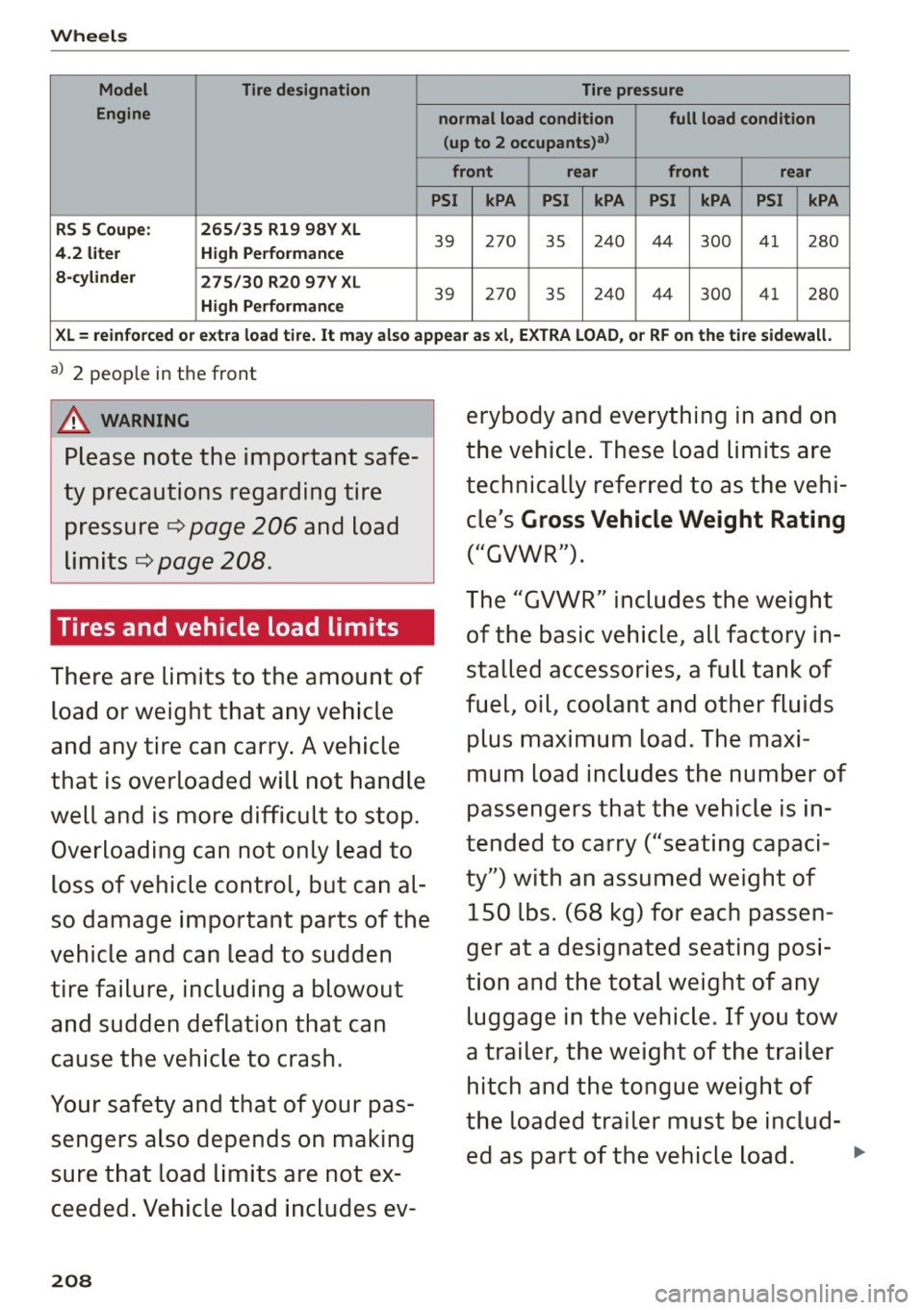
Model Tire designation Tire pressure
Engine normal load condition full load condition
(up to 2 occupants)a l
front rear front rear
PSI kPA PSI kPA PSI kPA
PSI kPA
RS 5 Coupe: 265/35 Rl9 98V XL
4.2 liter High Performance
39 27
0
35 2
40 44
300 41
280
8-cylinder
275/30 R20 97V XL
High Performance
39 270 35 240
44 300 41 280
XL= reinforced or extra load tire. It may also appear as xl, EXTRA LOAD, or RF on the tire sidewall.
a) 2 people in the front
_& WARNING
Please note the important safe
ty precautions regarding tire pressure ¢
page 206 and load
limits ¢
page 208.
Tires and vehicle load limits
There are limits to the amount of
load or weight that any vehicle
and any tire can carry. A vehicle
that is overloaded will not handle
well and is more difficult to stop. Overloading can not only lead to
loss of vehicle control, but can al
so damage important parts of the
vehicle and can lead to sudden
tire failure, including a blowout and sudden deflation that can
cause the vehicle to crash .
Your safety and that of your pas sengers also depends on making
sure that load limits are not ex
ceeded. Vehicle load includes ev-
208
erybody and everything in and on
the vehicle. These load limits are
technically referred to as the vehi cle's
Gross Vehicle Weight Rating
("GVWR").
The "GVWR" includes the weight of the basic vehicle , all factory in
stalled accessories, a full tank of
fuel, oil, coolant and other fluids plus maximum load . The maxi
mum load includes the number of
passengers that the vehicle is in
tended to carry ("seating capaci
ty") with an assumed weight of
150 lbs. (68 kg) for each passen
ger at a designated seating posi
tion and the total weight of any luggage in the vehicle . If you tow
a trailer, the weight of the trailer hitch and the tongue weight of
the loaded trailer must be includ- ed as part of the vehicle load. ..,.
Page 212 of 254
Wheels
Steps for Determining Correct Load Limit
1. Locate the statement "THE
COMBINED WEIGHT OF OCCU PANTS AND CARGO SHOULD
NEVER EXCEED XXX KG OR XXX
LBS"on your vehicle 's placard
(tire inflation pressure label)
¢ page 206 , fig. 171 .
2. Determine the combined
weight of the driver and pas
sengers that will be riding in
your vehicle.
3 . Subtract the combined weight
of the driver and passengers
from
"XXX " kilograms or "XXX"
pounds shown on the sticker
¢ page 206, fig. 171.
4 . The resulting figure equals the
available amount of cargo and
luggage load capacity. For ex
ample, if the
" XXX" amount
equals 1400 lbs. and there will be five 150 lbs. passengers in
your vehicle, the amount of available cargo and luggage load capacity is 650 lbs.
(1400-750 (5 X 150) = 650
lbs.)
5. Determine the combined weight of luggage and cargo
being loaded on the vehicle.
That weight may not safely ex-
210
c eed the available ca rgo and
luggage load capa city calculat
ed in Step 4 .
6. If your vehicle will be towing a
trailer, load from your trailer
will be transferred to your vehic le . Consult thi s manual to de
termine how this reduce s the
available cargo and luggage load capacity of your vehicle .
~check the tire sidewall
(¢ page 201 , fig. 169) to deter
mine the designated load rating
for a spe cific tire.
· Wheel bolts and rims
Wheel bolts
W heel bolts must be clean and loosen/ tighten
e asi ly.
Rims
Rims with a bo lted rim ring* or with bo lted whee l
cove rs* cons ist of mult iple p iec es. T hese com po
nen ts wer e bolte d together using specia l bo lts
a nd a s pe ci al procedu re . Yo u m us t n ot rep air or
d is as semb le th em ¢
&.
_&. WARNING
Wh eel bo lts tha t are ti ghtene d or r epa ired i n
cor rectly ca n be come lo o se and res ult in loss
of vehicle control , wh ic h increases the risk of
an accident. For t he cor rect tightenin g specif i
cati on, refer to¢
page 219 , A~er changing a
wheel.
- Always keep the wheel bolts and the threa ds
in the wh eel hub clean and free of grease.
- On ly us e whee l bolts that f it t he rim .
- Always have damaged rim s repaire d by an
auth orized Audi dealer or auth orized re p air
facility. Neve r repa ir or disassemble r ims
Page 218 of 254

Emergency assistance
Emergency assistance
Vehicle tool kit
The tools ore stored underneath the floor panel
in the luggage comportment.
Fig . 174 Luggage compartme nt: too l kit
W hen you need access to the veh icle tool k it or
jack*, you will need to ta ke o ut the cover.
The vehicle tool kit includes :
- Tire repa ir kit (Tire Mobility System)
- Plastic clip for removing wheel bolt caps*
- Alignment pi n for cha nging the whee l
- Screwdr iver w ith reve rsible blade
- Too l for chang ing light bu lbs
- Reversible bit (reversible Torx bit for changing
light bu lbs)
- Rod for jack
- Jack*
- Lug wrench
-Towing eye
Some of the ve hicle items listed above are p rovid
ed on ce rtai n models only or a re optional extras.
Before return ing the jack * to its place, retract the
jack arm fully.
_& WARNING
-
- Never use t he screw d river hex head to
t ig ht en whee l bol ts, s in ce the bolts c annot
atta in the necessary tightening tor que if you
use the hex head, potentia lly ca us ing an ac
c ident.
- The factory -supp lied jac k is intended only
for yo ur vehicle model. Under no c ircum
stances should it be used to lift heavy
216
veh icles o r othe r loads; you risk i njuring
yourse lf.
- Never start the engine when the vehicle is
raised, which could cause an accident.
- Support the vehicle securely w ith appropri
ate stands if work is to be performed under
neath the vehicle; otherwise, there is a po
tential risk for injury.
Tire repair set
General and safety pointers
Tire repair is intended only for temporary, short
term use .
Fig . 1 75 Tire damage for which the Tire Mobility System is
not su ited
Your vehicle is equipped with a tire repa ir kit, the
Tire Mobility System (TMS) .
In the event of a tire fail ure, the TMS is in the
l uggage compartment under the floor. It consists
of the t ire sealant and an electric air pump.
Using
TMS , tire damage caused by foreign bodies
u p to abo ut
0.16 inch (4 mm ) in diameter can be
sealed reliably .
The foreign object must stay in the tire.
The tire sealant must not be used:
- for cu ts or pu nctures in the tire w hich a re larger
than 0 .16 inch (4 mm)
r=;,fig.175 @
-for d amage to the rim @
- if yo u h ave been drivi ng with very low t ire pres-
sures o r ti res wit h no air @
Using the
TMS is descr ibed in the section
¢page 217.
Page 230 of 254
Emerg enc y s it uat ion s
Emergency situations
General
T his c hapt er is inte nded fo r tra ined e merg ency
c rews a nd worki ng p ers onn el w ho h ave the nec
e ssa ry tool s and equipm ent t o perf orm the se
op era tion s.
Starting by pushing or
towing
CD Note
Vehicl es with an automa tic tra nsmission
c annot be st arted by pushing or towing .
Starting with jumper
cables
If necessary, the engine con be started by con
necting it to the battery of another vehicle .
If the engine should fail to start because of a d is
charged or weak battery, the battery can be con
nected to the battery of
another vehicle, us ing a
p air of j umpe r cables to start the engine.
Jump er c abl es
Use only jumper cab les of sufficiently largec ross
sec tion
to carry the starter current safely. Refer
to the manufacturer's specifications.
Use on ly jumper cables with
insulated term inal
clamps which are d istinctly mar ked:
plus (+ ) cabl e in most cases co lored re d
minu s(-) cable
in most cases colored black .
A WARNING
Batteries contain electricity, ac id, and gas.
Any of these can cause very ser ious or fatal in
jury . Fo llow the inst ruct ions be low for safe
hand Ling of your veh icle's battery.
- Always shield your eyes and avoid leaning
over the battery whenever possible.
- A discharged battery can freeze at tempera
tures just below 32 °F (0 °C). Before con
nect ing a jumper cab le, you must thaw the
228
frozen battery completely, otherwise it
could explode.
- Do not allow battery acid to contact eyes or
skin. Flush any contacted area with water immed iately.
- Improper use of a booster battery to start a
veh icle may cause an explosion.
- Vehicle batteries generate explosive gases .
Keep sparks, flame and lighted cigarettes
away from batteries.
- Do not try to jump start any vehicle with a
low acid level in the battery.
- The voltage of the booster battery must al
so have a 12-Volt rat ing . The capacity (Ah)
of the booster battery should not be lower
than that of the discharged battery. Use of batter ies of different voltage or substantial
ly different "Ah" rating may cause an explo
sion and personal injury .
- Never charge a frozen battery . Gas trapped
in the ice may cause an explosion .
- Never charge or use a battery that has been
frozen . The battery case may have be weak
ened .
- Use of batter ies of different voltage or sub
stantially d ifferent capacity (Ah) rating may
cause an explosion and injury. The capacity
(Ah) of the booster battery sho uld not be
lowe r than that of the discharged battery.
- Before you check anything in the engine
compartment, always read and heed a ll
WARNINGS
qpoge 187.
CD Note
-App lying a higher voltage booster battery
wi ll cause expensive damage to sensitive
elec tronic components, such as control
units, re lays, radio, etc.
- T here must be no electrical contact between
the vehicles as otherwise cu rrent cou ld al
ready start to flow as soon as the positive
(+) termina ls are connected.
@ Tips
The discharged battery must be properly con-
nected to the vehicle's electrical system. .,.
Page 232 of 254

Emergency situation s
-The ba ttery ce ll lockin g screws must be
t ightened securely .
- Before you check anyt hing in the engine
compartment, always read and heed all
WARNINGS
c> page 187.
(D Note
Improper hook -u p of jumper cables can r uin
the generator .
- A lways connect POS ITIV E(+ ) to POS ITIV E
( + ), and NEGATIVE( -) to NEGATIVE( -)
gro und post of the battery manager control
unit .
- Check that a ll screw plugs o n the batte ry
ce lls are screwed in firmly . If not, tighten
pl ugs prior to connect ing clamp on negat ive
battery te rminal.
- Please note that the procedure for connect
i ng a jumper cable as desc ribed above ap
plies specifica lly to the case of yo ur vehicle
being jump started . W hen you a re g iving a
j u mp sta rt to another vehicl e, do
not co n
ne ct the negative ( -) cab le to the negative
( -) t erminal o n the di scharged battery @
c> fig. 18 8 . In stea d, secure ly co nn ect the
nega tive ( -) cab le to either a solid me tal
com ponent that is f irm ly bolted to the en
gine block o r to t he engine bloc k itself. I f
the battery that is being charged does not
vent to the outside , escap ing battery gas
could ignite and exp lode!
Towing with a tow truck
General hints
Y o ur Audi requires special handling for towing.
The fo llow ing information is to be used by com
mercia l tow truck operato rs who know how to op
erate their eq uipment safe ly .
- Never tow your Audi, towing will cause dam
age to the engine and transmiss ion.
- Never wrap the safety chains or winch cables
around the brake lines .
- To pre vent unnecessary damage, your Audi
must be transported with a flat bed truck.
230
- To load the vehicle on to the flat bed , use the
towing loop found in the vehicle tools and at·
tach to the front or rear anchorage
c> page 230 and c:>page 231.
A WARNING
A veh icle being towed is not safe f or passe n
gers . Never a llow anyone to ride in a ve hicle
be ing towed, fo r any reason .
Front towing loop
Do not install the front towing loop until it is
needed .
Fig. 18 9 Fro nt b um per: remov ing t he cove r cap
Fig. 190 Front b umper: sc rew ing in t he tow ing loop
The towing loo p fits in to the threade d hole locat
ed on the right side o f the front bum per and cov
e red by a small cover when not in use .
.,. Remove the tow ing loop fr om the vehicle tool
ki t
c> page 216.
... Take ho ld of the bot tom edge o f the cover cap
and pull it out of the bumpe r
9fig . 189 .
... Sc rew the tow ing loop t ightly into the threaded
hole as far as it will go
c> fig. 190 and t ighten it
with the wheel wrench . ..,.
Page 233 of 254

"' N
0:: loo
rl I.O
"' N
"' rl
When it is no longer needed, unscrew the towing
loop and put it back into the vehicle toolkit. Be
sure to have the towing loop stored in the vehicle
at all times .
A WARNING
If the towing loop is not screwed in as far as it
w ill go, the thread can pull out when the vehi
cle is towed -potential risk of an accident .
Rear towing loop
Do not install the rear towing loop until it is
needed.
0
0
Fig. 191 Rear bumper: cover
Fig. 192 Rear bumpe r: Screw ing in towing loop
.,.
-0
0
I-'-0) Ill
On the r ight side of the rear bumper there is a
threaded hole for the towing loop. The threaded
hole is protected by a cover.
• Remove the towing loop from the vehicle too l
kit
r::!;>page 216.
• Press the cover in by applying short strong
pressure to the bottom part to re lease it from
the bumper
r::!;> fig . 191.
• Screw the towing loop tight ly into the threaded
hole as far as it will go
r::!;> fig. 192 and tighten it
with the wheel wrench .
Emergency situations
Unscrew the towing loop again afte r use and in
stall the cover in the bumper. Install the cover in
the bumper . Return the tow ing loop to the tool
k it. Be sure to have the towing loop stored in the
vehicle at all times.
A WARNING
-If the tow ing loo p is not screwed in as far as it
will go, the thread can pull out when the vehi
cle is towed - potential risk of an accident.
Loading the vehicle onto a flat bed truck
Fig . 193 Vehicle on flat bed t ruck
Front hook up
.... 0) II> -' lit
l8
• Align the vehicle with the centerline of the car
carrier ramp.
"' Attach the winch hook to the front towline eye
prev ious ly installed .
Rear hook up
"'Align the vehicle with the centerline of the car
carrier ramp.
"' Attach the winch hook to the rear towline eye
previously installed .
@ Tips
Check carefully to make sure the hook-up is
secure before moving the car up the flatbed
truck ramp.
231
Page 238 of 254

Consumer information
Consumer information
Warranty coverages
Your Audi is covered by the following warran
ties:
- New Vehicle Limited Warranty
- Limited Warranty Against Corrosion Perfora-
tion
- Emissions Control System Warranty
- Emissions Performance Warranty
- California Emissions Control Warranty (USA
vehicles only)
- California Emissions Performance Warranty
(USA vehicles only)
Detailed information regarding your warranties
can be found in your
Warranty & Maintenance
booklet .
Operating your vehicle
outside the U.S.A. or
Canada
Government regulations in the United States and
Canada require that automobiles meet specific
emission regulations and safety standards.
Therefore, vehicles built for the U.S.A. and Cana
da differ from vehicles sold in other countr ies.
If you plan to take your veh icle outside the conti
nenta l limits of the United States or Canada,
there is the possibility that:
- unleaded fuels for vehicles with catalytic con
verter may not be available;
- fuel may have a considerably lower octane rat
ing . Improper fuel may cause engine damage;
- serv ice may be inadequate due to lack of proper
serv ice facilities , tools or testing equipment;
- r eplacement parts may not be readily available .
- Nav igat ion systems for vehicles built for the
U.S.A. and Canada will not necessar ily work in
Europe, and may not work in othe r countries
outside of North America.
236
(D Note
Aud i cannot be responsib le for mechanical
damage that could result from inadequate
fuel, service or parts availability.
Audi Service Repair
Manuals and Literature
Audi Offic ial Factory Service Manuals and Litera
ture are published as soon as possible after mod
el introduction. Service manuals and literature
are available to order from the Audi Technical Lit
erature Ordering Center at:
www.audi.techliterature .com
Maintenance
General '
Your vehicle has been designed to help keep
maintenance requirements to a minimum. How
ever, a certain amount of regular maintenance is
still necessary to assure your veh icle's safety,
economy and reliability. For deta iled vehicle
maintenance consult your Warranty & Mainte
nance booklet .
Under difficult operating conditions, for exam
ple at extremely low outs ide temperatures, in
very dusty regions, when towing a trailer very fre
quently , etc., some service work should be per
formed between the intervals specified. This ap
plies particularly to:
- oil changes, and
- cleaning or replacing the air filter .
'
@) For the sake of the environment
By regularly maintaining your vehicle, you
help make sure that emission standards are
maintained, thus minimizing adverse effects
on the environment.
Important considerations for you and your
vehicle
The increasing use of electronics, sophisticated
fuel injection and emission control systems , and
the generally increasing technical comp lexity of
llJJ,