tow AUDI RS5 COUPE 2015 User Guide
[x] Cancel search | Manufacturer: AUDI, Model Year: 2015, Model line: RS5 COUPE, Model: AUDI RS5 COUPE 2015Pages: 254, PDF Size: 64.12 MB
Page 89 of 254
"' N
0:: loo
rl I.O
"' N
"' rl
Selector lever emergency release
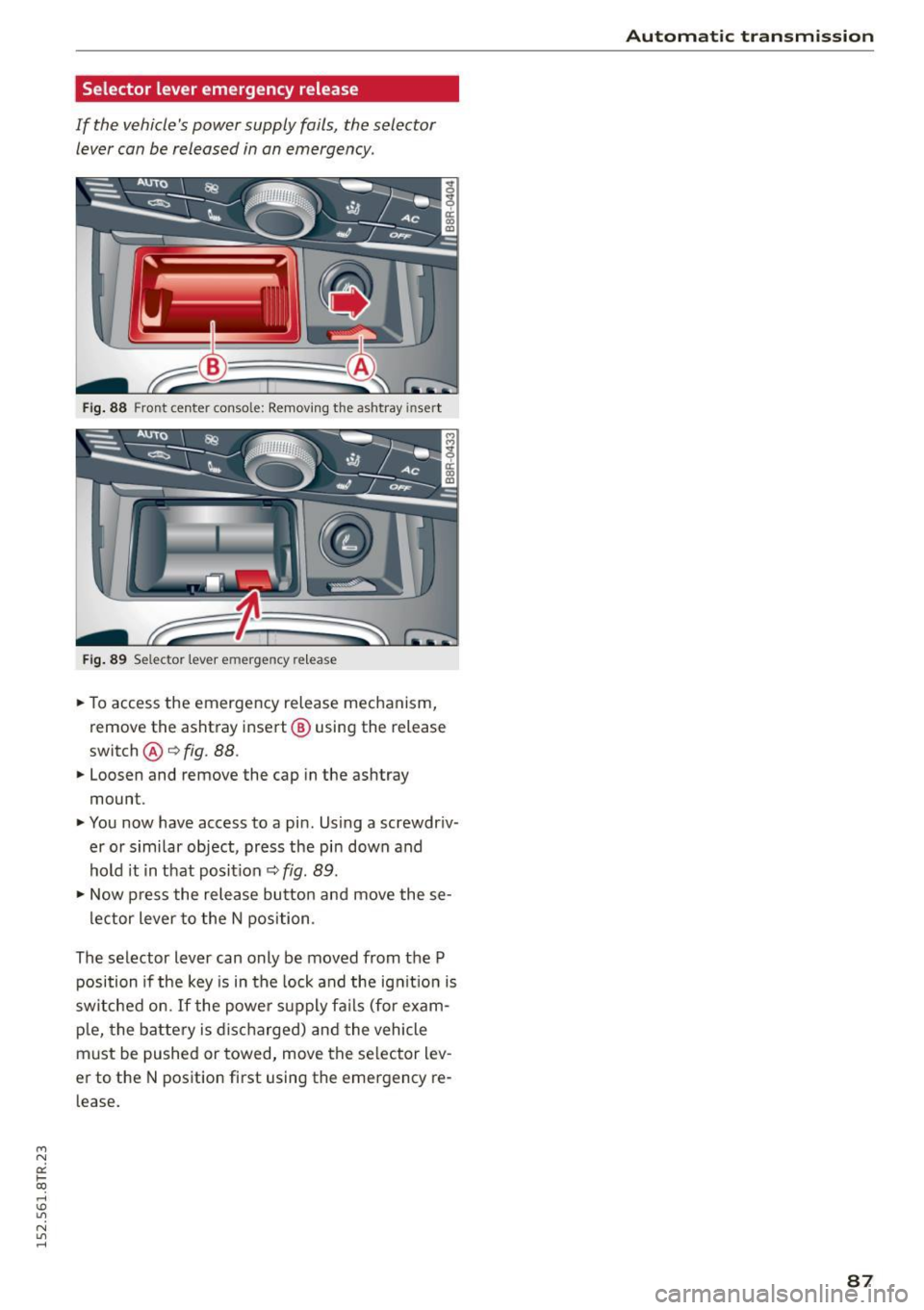
If the vehicle's power supply fails, the selector lever can be released in an emergency.
Fi g. 88 Front center console: Remov ing the ashtray insert
Fig. 89 Selector lever emergency release
.. To access the emergency release mechanism,
remove the ashtray insert @ using the release
switch @c::>
fig. 88 .
.. Loosen and remove the cap in the ashtray
mount.
.. You now have access to a pin. Using a screwdr iv
er or simi lar object, press the pi n down and
hold it in t hat posit ion
c::> fig . 89 .
.. Now p ress the release bu tto n and move the se -
lector lever to the N position.
The selector lever can only be moved from the P
posi tion if the key is in the lock and the ig nitio n is
sw itched on. If the p owe r su pply fa ils (for e xam
p le, the batte ry is disch arged) and the vehicle
must be pushed or towed, move the se lector lev
er to the N pos ition first using the emergency re
lease.
Automatic transmission
87
Page 90 of 254

Audi adapt ive cru ise control and brak ing gu ard
Audi adaptive cruise
control and braking
guard
Introduction
App lies to veh icles: w ith Audi adaptive cruise co ntrol
The adaptive cruise control system assists the
d river by regu lating veh icle speed and he lp ing to
maintain a set distance to the vehicle ahead ,
within the limits of the system. If the system de
tects a moving vehicle up ahead, adaptive cruise control can brake and then accelerate your vehi
cle. This he lps to make driving more comfortable
on long highway stretches.
The braking guard system can warn you about an impending collision and initiate brak ing maneu
vers
c> page 94.
Adapt ive cruise control and braking guard have
technical limitations that you must know, so p lease read this section carefully, understand
how the system works and use them properly at
all times.
General information
General information
A pp lies to veh icles: w ith Audi adaptive cruise control
Fig. 90 F ront of the ve hicle: Posit ion of rada r se nsor
The area that contains the radar sensor c::> fig . 90
must neve r be covered by stickers or other ob
jects or obstructed with dirt, insects, snow or ice
that will inte rfe re wi th the adapt ive cru ise con
trol system and brak ing guard. For information
on cleaning, refer to
c> page 181 . The same ap
plies for any modifications made in the front
area.
88
The function of the adaptive cruise contro l sys
tem and braking guard is limited under some
condit ions:
- Objects can on ly be de tected when they are
within sensor range
c> page 90, fig. 93.
- The system has a l imi ted ability to detect ob
jects that are a short d istance ahead, off to the
side of your vehicle or moving into your lane.
- Some k inds of veh icles are hard to detect ; fo r
example motorcycles, vehicles with high
ground clearance or overhanging toads may be
detected when it is too late or they may not be
detected at all .
- When driving through curves
c::> page 89 .
- Stationary objects c::> page 89.
& WARNING
-Always pay attention to traffic when adaptive
cruise control is switched on and braking
guard is active . As the driver, you are still re
sponsible for starting and for maintaining
speed and distance to other objects . Braking
guard is used to assist you . The driver must
a lways take action to avo id a collis ion. The
driver is always responsible for braking at the
cor rect t ime.
- I mproper use of adaptive cru ise con tro l can
cause collisions, other accidents and serious
personal inju ry.
- Never let the comfort and conven ien ce that
adapt ive cru ise control and brak ing guard
offer distrac t you from the need to be alert
to traffic cond itions and the need to remain
in full control of your vehicle at all times,
- Always remember t hat the adaptive cruise
contro l and brak ing guard have limits - they
will not slow the vehicle down or maintain
the set distance when you dr ive towards an
obstacle or something on or near the road
that is not moving, such as vehicles stopped in a traff ic jam, a stalled or disabled vehicle.
If registered by t he radar sensor, vehicles or
obstacles that are not moving can t rigge r a
co llision warning and if confirmed by the
video camera, a n acu te collision warning.
IJI,-
Page 92 of 254

Audi adaptive cruise control and braking guard
Audi adaptive cruise
control
De script ion
Applies to veh icles: with Audi adaptive cruise co ntrol
F ig. 93 Det ect ion range
What can Audi adaptive cruise control do?
The adaptive cruise control works in conjunction
with a radar sensor insta lled in the front of the
vehicle
¢ page 88, fig. 90, which is subject to
designated system limits
c:;;> page 90. Stationary
objects are disregarded.
On open roads w ith no traff ic, adaptive cruise
control works like a regula r cruise control system.
The stored speed is mainta ined . When approach
ing a moving vehicle detected up ahead, the
adaptive cruise control system automatically
slows down to match that vehicle's speed and
then maintains the distance that the driver previ
ously stored. As soon as the system does not de
t ect a vehicle up ahead, adap tive cruise control
accelerates back up to the stored speed .
Which functions can be controlled?
When you switch adaptive cruise control on, you
can set the current speed as the "control speed"
¢ page 90, Switching on and off.
When driving, you can stop cruise control
c;;> page 92 or change the speed c:;;> page 91 at
any time.
You can also set the distance to the object ahead
and set the adaptive cr uise control driving pro
gram
c;;> page 92.
90
Switch ing on and off
Applies to vehicles: with A udi adapt ive cruise contro l
Fig. 94 Selector lever : sw itc hin g on /off
Fig. 95 Ins trumen t cl ust er: Audi adaptive crui se control
You can set any speed between 20 mph and 95
mph (30 and 150 km/h).
Indicator lamps and messages in the instrument cluster display inform you about the current sys
tem status and settings.
Switching Audi adaptive cruise control on
.. Pull the lever toward you into position (D
c;;> fig. 94 . ACC standby appears in the instru
ment cluster display .
Setting the speed and activating regulation
.. To set the current speed, press the ISET I button
¢ page 11, fig. 4. The set speed is shown in the ..,.
Page 99 of 254

"' N
0:: loo
rl I.O
"' N
"' rl
Audi side assist Side assist
Description
Applies to vehicles: with Audi side assist
Fig. 101 Se nsor detection range
Fig. 1 02 Display o n the exterio r m irro r
Side assist helps you monitor your blind spot and
traffic behind your veh icle . With in the limits of
the system, it wa rns you about vehicles that are
coming closer or that are traveling w ith you with
i n sensor range
(D c::, fig. 101 : if a lane change is
classified as crit ical , the disp lay @ in the exter io r
mirror
¢ fig. 102 tu rns on.
The display i n the left exterior mirror provides as
sistance when making a lane cha nge to the left,
while the d isp lay in the right exterio r mir ror pro
vides assistance whe n mak ing a lane change to
the r ight .
Information stag e
As long as you do not activate the turn signal,
side assist
informs you about ve hicl es that a re
detected and class ified as crit ica l. The display in
the respective mirror tu rns on, but is dim.
Aud i side assist
The display remains d im intentionally in the in
formation stage so that your view toward the
front is not d isturbed .
Warning sta ge
If you activ ate the turn s ignal, s ide ass ist warns
you about vehicles that are detected a nd classi
fied as critica l. The d isplay in the respective mir
ror blinks brightly . If this happens, check traffic
by g lancing in the rearview mirror and over your
shoulder
c::, .&. in General information on
page 98.
{!) Tips
- Yo u can adjust the brightness of the display
@ c:;, page 99 .
97
Page 108 of 254

Parking Sy stem
General Information
App lies to veh icles: w ith pa rk in g system (rear, w ith rear v iew
camera)
F ig . 112 Covered area(!) and uncovered a rea @ of the rear
v iew came ra
• 0
F ig. 1 13 Tru nk lid: Locat io n of the rear v iew camera
Sens ors i n the bumper
Sensors are located in the front and rear bump
ers . If these detect an obstacle, aud ible and v isu
al signals warn you. The range at which the sen
sors beg in to measure is approximate ly:
side 3 ft (0.90 m)
front center 4 ft (1.20 m)
side 2 ft (0.60 m)
rear center 5.2 ft (1.60 m)
Distance warning when reversing starts when an
obstacle is detected in the range of the parking
assist sys tem. As the d istance decreases, the
time interva l between the audib le tones becomes
shorter.
When the d istance is less than 1 ft (0 .30 m), the
tone becomes contin uous . At th is point you
should stop backing up.
If the d istance to an obstacle stays the same , the
volume of the d istance signa l chime is gradua lly
red uced after about 4 se conds (does no t affect
106
the continuous signal tone) . Approach ing anoth
er obstacle wi ll ca use the distance signal to
sound again at the norma l volume .
Rear view cam era coverage area
The M MI display shows the area covered by the
rear view camera
r=> fig. 112 @ . Objects that are
not in the a rea covered @are not shown on the
MMI display .
We recommend tha t you pract ice pa rking with
the rear view came ra in a traffic-free location or
parking lot to become familiar with the system,
the or ientation lines , and their function. When
doing this, there sho uld be good light and weath
er condit ions.
In the MMI display, objects or vehicles appear
closer or further away if:
- you are driving i n reverse gear from a level sur
face on to an incline, or a downwa rd s lope,
- you a re driving i n reverse gear towa rd p rotr ud
ing objects ,
- the vehicle is carrying too mu ch load in the
rea r.
The acc uracy of the o rientation l ines and blue
su rfaces dim inishes if:
- the rear view camera does not provide a reliable
image, for example, in poor visib ility condit ions
or if the lens is dirty,
- the image on the screen is not visib le due to
sun glare and reflection .
Caring for the rear v iew camera lens
The rear view camera is located above the rear li
cense p late bracket. For the parking assist to op
erate, the lens
r=> fig . 113 must be kept clean :
- Dampen t he lens with a household a lcohol-
based g lass cleaner, and clean the lens with a
dry cloth
<=> @) .
-Remove snow with a hand brus h and ice pref
erab ly w ith a de-icing spray
q Q) _
A WARNING
-The parking aid cannot replace the driver's
attention. The driver alone is respons ible for
parking and simi lar driving maneuvers .
~
Page 115 of 254

M N
0:: loo ,...., \!) ..,.,
N ..,., ,....,
For detailed information on how to adjust the
driver's seat, see ¢
page 54.
A WARNING
Drivers who are unbelted, out of position or
too close to the airbag can be seriously in
jured by an airbag as it unfolds. To help re
duce the risk of serious personal injury:
- Always adjust the driver's seat and the
steering wheel so that there are at least
10 inches (25 cm) between your breastbone
and the steering wheel.
- Always hold the steering wheel on the out
side of the steering wheel rim with your
hands at the 9 o'clock and 3 o'clock posi
tions to help reduce the risk of personal in
jury if the driver's airbag inflates.
- Never hold the steering wheel at the
12 o'clock position or with your hands at
other positions inside the steering wheel
rim or on the steering wheel hub. Holding
the steering wheel the wrong way can cause
serious injuries to the hands, arms and head
if the driver's airbag deploys.
- Pointing the steering wheel toward your
face decreases the ability of the supplemen
tal driver's airbag to protect you in a colli
sion.
- Always sit in an upright position and never lean against or place any part of your body
too close to the area where the airbags are located .
- Before driving, always adjust the front seats
and head restraints properly and make sure
that all passengers are properly restrained.
- Never adjust the seats while the vehicle is
moving . Your seat may move unexpectedly
and you could lose control of the vehicle.
- Never drive with the backrest reclined or
tilted far back! The farther the backrests are
tilted back, the greater the risk of injury due
to incorrect positioning of the safety belt
and improper seating position.
- Children must always ride in child safety
seats¢
page 150 . Special precautions ap
ply when installing a child safety seat on the
front passenger seat¢
page 128.
Driving safety
Proper seating position for the front
passenger
The proper front passenger seating position is
important for safe, relaxed driving.
For your own safety and to reduce the risk of in
jury in the event of an accident, we recommend
that you adjust the seat for the front passenger
to the following position:
"' Move the front passenger seat back as far as
possible . There must be a minimum of 10 in
ches (25 cm) between the breastbone and the
instrument panel¢.&, .
"'Adjust the angle of the seatback so that it is in
an upright position and your back comes in full
contact with it whenever the vehicle is moving.
"'Applies to vehicles with adjustable head re
straints: Adjust the head restraint so the upper
edge is as even as possible with the top of your
head . If that is not possible, try to adjust the
head restraint so that it is as close to this posi
tion as possible .
"' Keep both feet flat on the floor in front of the
front passenger seat.
.,. Fasten and wear safety belts correctly
c:> page 123.
For detailed information on how to adjust the
front passenger's seat, see ¢
page 53.
A WARNING ~
Front seat passengers who are unbelted, out
of position or too close to the airbag can be
seriously injured or killed by the airbag as it unfolds. To help reduce the risk of serious per
sonal injury:
- Passengers must always sit in an upright po
sition and never lean against or place any
part of their body too close to the area
where the airbags are located.
- Passengers who are unbelted, out of posi
tion or too close to the airbag can be seri
ously injured by an airbag as it unfolds with
great force in the blink of an eye.
- Always make sure that there are at least 10 inches (25 cm) between the front passen
ger's breastbone and the instrument panel.
113
Page 119 of 254

"' N
0:: loo
rl I.O
"' N
"' rl
Storing cargo correctly
Loading the luggage compartment
All luggage and other objects must be properly
stowed and secured in the luggage compart
ment.
Fig . 120 Safe load position ing: place heavy objects as low
and as far forwa rd as poss ible.
"' N .,. ~ ,,: CX) ID
Loose items in the luggage compartment can
shift suddenly, changing vehicle handling charac
teristics. Loose items can also increase the risk of
serious personal injury in a sudden veh icle ma
neuver or in a coll is ion.
,.. Distribute the load evenly in the luggage com
partment.
,.. Always place and p roperly secure heavy items in
the luggage compartment as low and as far for
ward as possible
¢ fig . 120.
,.. Secure the load with the cargo net* or with
non-elastic straps secured to the tie-downs
Qpage 64.
,.. Make sure that the rear seatback is securely
latched in place.
A WARNING
Improperly stored luggage or other items can
fly through the veh icle causing serious per
sonal injury in the event of ha rd braking or an
accident. To help reduce the r isk of serious
personal injury:
- Always put objects, for examp le, luggage or
other heavy items in the luggage compart
ment.
- Always secure objects in the luggage com
partment us ing the tie-down eye lets and
suitable straps.
Dri vin g s afe ty
A WARNING
-Heavy loads wi ll influence the way your vehi-
cle handles . To help reduce the risk of a loss
of control leading to serious personal injury:
- Always keep in mind when transporting
heavy objects, that a change in the center of
grav ity can also cause changes in vehicle
handling:
- Always distribute the load as evenly as
possible .
- Place heavy objects as far forward in the
luggage compartment as possib le .
- Never exceed the Gross Axle We ight Rating
or the Gross Vehicle Weight Rating specified
on the safety compliance s ticker on the left
door jamb. Exceeding permissib le weight
standards can cause the vehicle to slide and
handle differently .
- Please observe information on safe dr iving
¢page 111 .
A WARNING
-To help prevent poisonous exhaust gas from
being drawn into the vehicle, always keep the
rear lid closed wh ile driving.
- Never transport objects la rger than those
fitting completely into the luggage area be
cause the rear lid cannot be fully closed .
- If you absolutely must dr ive with the rear lid
open, observe the following notes to reduce
the risk of poisoning:
- Close all windows,
- Close the s unroof,
- Open all a ir outlets in the ins trumen t pan-
el,
- Switch off the air recirculat ion,
- Set the fresh air fan to the highest speed.
A WARNING
-A lways make sure that the doors , all windows,
the sunroof and the rear lid are securely
closed and locked to reduce the risk of injury
when the vehicle is not being used.
- After closing the rear lid, always make sure that it is properly closed and locked.
~
117
Page 127 of 254

"' N
0:: loo
rl I.O
"' N
"' rl
Pregnant women must also be correctly
restrained
The best way to protect the fetus is to make sure
that expectant mothers always wear safety belts
correctly -throughout the pregnancy.
Fig. 129 Safety belt pos it io n during p regnancy
To provide maximum protection, safety belts
must always be positioned correctly on the wear
er's body
c:> poge 124.
.. Adjust the front seat and head restraint correct
ly
c> page 53, Seats and storage .
.. Make sure the seatback of the rear seat bench is
in an upright position and securely latched in
place before using the belt .
.. Hold the belt by the tongue and pull it evenly
across the chest and pelvis
c:>fig . 129, c:> &_.
.. Insert the tongue into the correct buckle of
your seat until you hear it latch securely
c:>poge 123, fig . 127 .
.. Pull on the belt to make sure that it is securely
latched in the buckle.
_& WARNING
Improperly positioned safety belts can cause
serious personal injury in an accident.
- Expectant mothers must always wear the
lap portion of the safety belt as low as pos
sible across the pelvis and below the round
ing of the abdomen .
- Always read and heed all WARNINGS and
other important information
~.& in Fasten
ing safety belts on page 124.
Safety belts
Unfastening safety belts
Unbuckle the safety belt with the red release
button only o~er the vehicle hos stopped .
J-L
Fig. 130 Releasing the tongue from the buck le
.. Push the red release button on the buckle
c:> fig. 130. The belt tongue will spring out of
the buckle
c> &_ .
.,. Let the belt wind up on the retractor as you
guide the belt tongue to its stowed position .
_& WARNING ,-
Never unfasten safety belt while the vehicle is
moving . Doing so will increase your risk of be
ing injured or killed.
Improperly worn safety belts
0 ..... N 0 :i:
"' CD
Incorrectly positioned safety belts con cause se
vere injuries .
Wearing safety belts improperly can cause seri
ous injury or death . Safety belts can only work
when they are correctly positioned on the body.
Improper seating positions reduce the effective
ness of safety belts and w ill even increase the risk
of injury and death by moving the safety belt to
critical areas of the body. Improper seating posi
tions also increase the risk of serious injury and
death when an airbag dep loys and strikes an oc
cupant who is not in the correct seating position.
A driver is responsible for the safety of all vehicle occupants and especially for children . Therefore:
.. Never permit anyone to assume an incorrect sit-
ting position in the vehicle while traveling
c> &_ . ~
125
Page 138 of 254

Airbag system
restraints or occupants on the front passen
ger seat and prevent the side airbag in the
seat backrest from deploying properly.
- Never use cushions, pillows, blankets or
similar items on the front passenger seat.
The additional padding will prevent the
weight-sensing mat in the seat from accu rately registering the child restraint or per
son on the seat and prevent the Advanced
Airbag System from functioning properly.
- If you must use a child restraint on the front
passenger seat and the child restraint man
ufacturer's instructions require the use of a
towel, foam cushion or something else to
properly position the child restraint, make
certain that the
PASSENGER AIR BAG OFF
light comes on and stays on whenever the
child restraint is installed on the front pas
senger seat.
- If the
PASSENGER AIR BAG OFF light does
not come on and stay on, immediately in
stall child restraint in a rear seating position
and have the airbag system inspected by
your authorized Audi dealer.
How the Advanced Airbag System
components work together
The front Advanced Airbag System and the side
airbags supplement the protection offered by the
front three-point safety belts with pretensioners and load limiters and the adjustable head re
straints to help reduce the risk of injury in a wide
range of accident and crash situations. Be sure to
read the important information about safety and
heed the WARNINGS in this chapter.
Deployment of the Advanced Airbag System and
the activation of the safety belt pretensioners de
pend on the deceleration measured by the crash
sensors and registered by the electronic control
unit . Crash severity depends on speed and decel
eration as well as the mass and stiffness of the
vehicle or object involved in the crash.
On the passenger side, regardless of safety belt
use, the airbag will be turned off if the weight on
the passenger seat is less than the amount pro
grammed in the electronic control unit . The front
136
airbag on the passenger side will also be turned
off if one of the child safety seats that has been
certified under Federal Motor Vehicle Safety
Standard 208 has been recognized on the seat.
The
PASSENGER AIR BAG OFF light comes on
and stays on to tell you when the front Advanced
Airbag on the passenger side has been turned off
¢ page 129, Child restraints on the front seat
some important things to know .
.&_ WARNING
To reduce the risk of injury when an airbag in
flates, always wear safety belts properly.
- If you are unrestrained, leaning forward, sit
ting sideways or out of position in any way,
your risk of injury is much higher.
- You
will also receive serious injuries and
could even be killed if you are up against the
airbag or too close to it when it inflates -
even with an Advanced Airbag
r::!;>page 128.
More important things to know about front
airbags
Fig. 133 Inflated front airbags
-,... N 0 :i: ;;i;
Safety belts are important to help keep front seat
occupants in the proper seated position so that
airbags can unfold properly and provide supple
mental protection in a frontal collision.
The front airbags are designed to provide addi
tiona l protection for the chest and face of the
driver and the front seat passenger when:
- safety belts are worn properly,
- the seats have been positioned so that the oc-
cupant is properly seated as far as possible
from the airbag, .,._
Page 164 of 254
Child safety
-Always make sure the seat backrest to which
the child restraint is installed is in an up
right position and securely latched into
place and cannot fold forward. Otherwise,
the seatback with the child safety seat at
tached to it could fly forward in the event of
an accident or other emergency situation.
- Always read and heed all WARNINGS when
ever using a child restrained in a vehicle is
being used¢
page 150 . Special precautions
apply when installing a child safety seat on
the front passenger seat¢
page 129, Child
restraints on the front seat -some impor
tant things to know.
Deactivating the convertible locking
retractor
The convertible locking retractor for child re
straints will be deactivated automatically when
the belt is wound all the way back into the re
tractor .
~ Press the red button on the safety belt buckle.
Th@ belt tongue will pop out of the buckle.
~ Guide the safety belt all the way back into its
stowed position .
Always let the safety belt retract completely into its stowed position . The safety belt can now be
used as an ordinary safety belt without the con
vertible locking retractor for child restraints.
If the convertible locking retractor should be ac
tivated inadvertently, the safety belt must be un
fastened and guided completely back into its
stowed position to deactivate this feature .
If the
convertible locking retractor is not deactivated,
the safety belt will gradually become tighter and
uncomfortable to wear.
_& WARNING
Improperly installed child safety seats in
crease the risk of serious personal injury and
death in a collision.
-
- Never unfasten the safety belt to deactivate
the convertible locking retractor for child re
straints while the vehicle is moving. You
162
would not be restrained and could be seri ously injured in an accident.
- Always read and heed all WARNINGS when
ever using a child restrained in a vehicle is
being used¢
page 150. Special precautions
apply when installing a child safety seat on
the front passenger seat
c> page 129, Child
restraints on the front seat -some impor
tant things to know.