body AUDI RS5 COUPE 2015 Owner's Guide
[x] Cancel search | Manufacturer: AUDI, Model Year: 2015, Model line: RS5 COUPE, Model: AUDI RS5 COUPE 2015Pages: 254, PDF Size: 64.12 MB
Page 183 of 254
Care and cleaning
General information
Regular, proper care helps to maintain your vehi
cle's value. It can a lso be a req uirement when
submitting warranty claims for corrosion damage
and paint defects on the body.
The necessary care products can be obtained
from your a uthorized Audi dea ler . Read and fol
l ow the instructions for use on the packaging .
A WARNING
- Using cleaning and care products incorrectly
can be dangerous to your health.
- Always store cleaning and care products out of reach of children to reduce the r isk of po i
soning .
@) For the sake of the environment
-Preferably use environmentally-friendly
products when b uying cleaning agents.
- Do not dispose of leftover cleaning and care
products with h ousehold tras h.
Car washes
The longer that deposits remain on the vehicle ,
the more the s urface may be damaged . H igh
temperatures s uch as those caused by s unlight
increase the damaging effect.
Before washing, rinse off heavy deposits with
p lenty of water.
S tu bbor n depos its s uch a s bird dropp ings o r tree
sap are best removed w ith plenty of wa ter and a
microfiber cloth .
A lso, was h the unde rs ide of your vehi cle once
ro ad salt s tops be ing use d fo r t he season .
Pressure washers
When washing your ve hicles w ith a pressure
washer, always follow the operating instructions p rov ided with t he p ress ure washer. This is espe-
"' "' cially importan t in reg ard to the p ress ure and 0::
~ sp ray ing dist ance. Do not aim the spray direc tly
~ at seals on side windows, doors, the hood, the 1.1"1
~ rear lid or the sunroof * or at tires, rubber hoses, ,....,
Care and cleaning
insulat ing mater ia l, sensors * or camera lenses *.
Keep a distance of at least 16 inches (40 cm) .
D o no t remove snow and ice with a pressu re
washe r.
Never use rotary nozzles or high pressure noz
zles.
The water temperature must not be above 140 °F
(60 °C) .
Automat ic car washes
Sp ray off the ve hicle before washing .
Make sure tha t the w indows and roo f* are close d
and the windshield wipers are off . Follow inst ruc
tions from the car wash operator, especially if
there are accessor ies attached to your vehicle.
If possible, use car washes th at do not h ave
brushes.
Only use car washes whe re the vehicle rem ains
stationa ry and the w ashing eq uipmen t moves
aro und the veh icle when w ash ing and dry ing . Car
washes that move the vehicle thro ugh the car
wash using a c hain are n ot recommende d.
Washing by hand
Clean the ve hicl e s tarting fro m the top and work
i ng down using a soft sponge or cleaning b rush .
U se solven t-free cleani ng p ro du cts .
Washing vehicles with matte finish paint by
hand
To avoid d amaging the paint whe n was hing, first
r emove dus t and la rge particles from yo ur vehi
cle . Insects, g rease s pots and finge rprints are
best removed with a spec ial cleaner for matte
finish paint.
Apply t he p rod uct us ing a micro fiber cloth . To
avoi d damaging the paint surface, do not use too
much pressure.
Rinse the ve hicl e thoro ughly with water. Then
clean usi ng a neutra l shampoo and a soft mic ro
fi ber cloth .
Rinse the ve hicle thoro ughly again and le t it air
dry. Remove any wate r residue using a s ham my. .,.
181
Page 184 of 254

Care and cleaning
A WARNING
- Only wash the vehicle when the ignition is
off and follow the instructions from the car
wash operator to reduce the risk of acci
dents.
- To reduce the risk of cuts, protect yourse lf
from sharp metal components when wash
ing the underbody or the inside of the wheel
housings.
- After washing the vehicle, the braking effect may be delayed due to moisture on the
brake rotors or ice in the winter . The brakes
must be dried first w ith a few careful brake
applications.
@ Note
- If you wash the vehicle in an automatic car
wash, you must fold the exterior mirrors in
to reduce the risk of damage to the mirrors.
Power folding exterior mirrors* must only
be fo lded in and out us ing the power folding
funct ion.
- To prevent pa int damage, do not wash the
vehicle in direct sunlight .
- To reduce the risk of damage to the surface,
do not use insect removing sponges, kitchen
sponges or similar items.
- Matte finish painted vehicle components:
- To reduce the risk of damage to the sur-
face, do not use polishing agents or hard
wax.
- Never use protective wax. It can destroy
the matte finish effect.
- Do not place any stickers or magnetic
signs on vehicle parts painted with matte
finish paint. The paint could be damaged
when the stickers or magnets are re moved.
@ For the sake of the environment
On ly wash the vehicle in facilities specially de
signed for that purpose. This will reduce the
risk of dirty water contaminated with oil from
entering the sewer system.
182
-
Placing your vehicle out
of service
If you would like to take your vehicle out of serv
ice for a longer time, contact your authorized
Audi dealer or qualified repair facility. They will
advise you of important measures, such as corro
s ion protec tion , maintenance and storage proce
dures. Also follow the information about the bat
tery
~ page 196.
Page 189 of 254
"' N
0:: loo
rl I.O
"' N
"' rl
Checking and Filling Hood
Releasing and opening the engine hood
The engine hood is released from inside the vehi
cle.
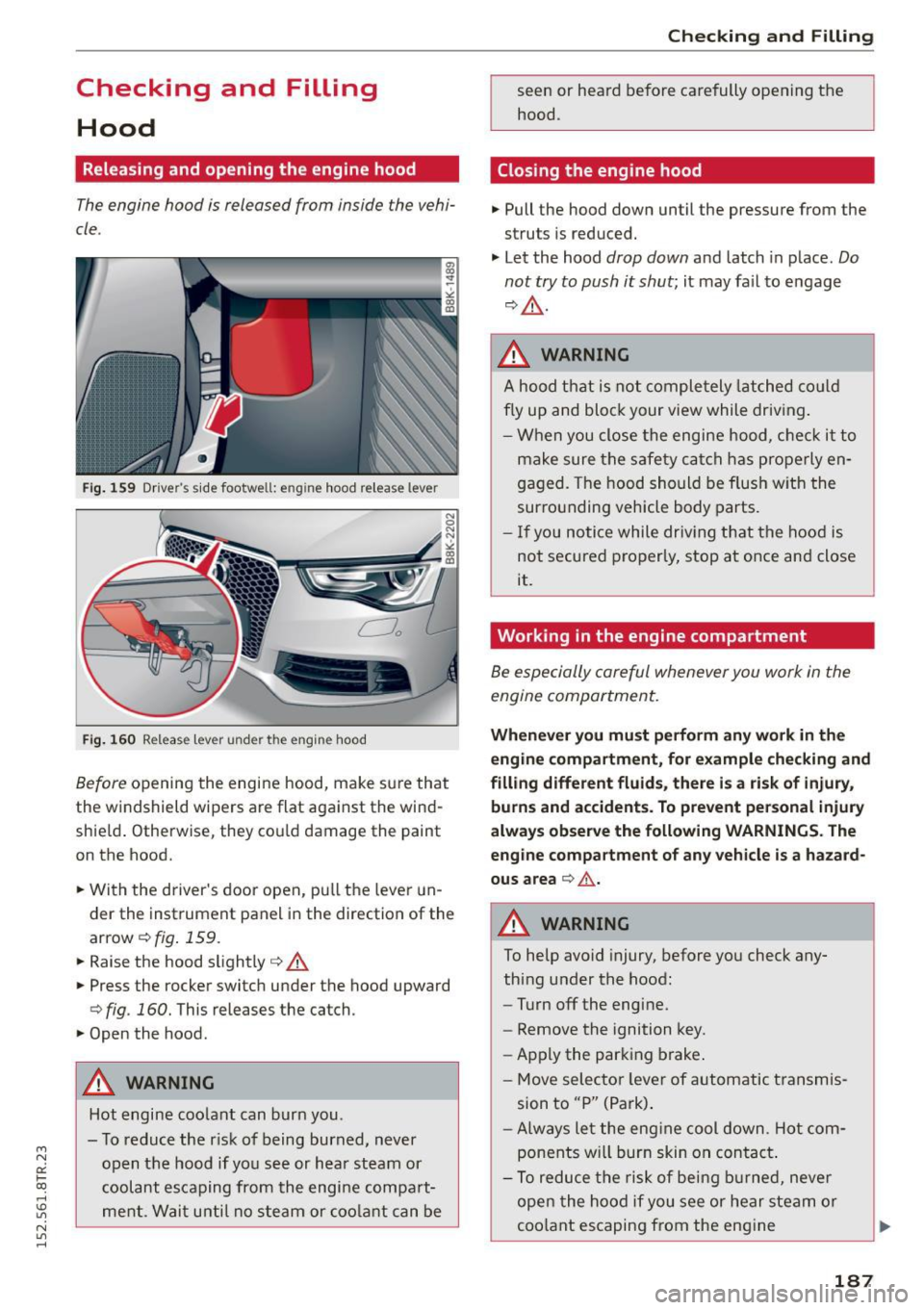
Fig. 159 Driver's side footwell: e ng in e hood release lever
Fig. 160 Releas e lev er un der t he e ngin e hood
Before opening the engine hood, make sure that
the windshield wipers are flat against the wind
shield . Otherwise, they could damage the paint
on the hood.
.. With the driver's door open, pu ll the lever un
der the instrument panel in the direction of the
arrow
c::> fig . 159.
.. Ra ise the hood slightly c::> &.
.. Press the rocker switch under the hood upward
c::> fig . 160. This releases the catch .
.. Open the hood.
A WARNING
Hot engine coolant can burn you.
- To reduce the r isk of being burned, never
open the hood if you see or hear steam or
coolant escaping from the engine compa rt
ment. Wait until no steam or coolant can be
Checking and Filling
seen or heard before carefully opening the
hood .
Closing the engine hood
.. Pull the hood down until the pressure from the
struts is reduced.
"' Let the hood
drop down and latch in place. Do
not try to push it shut;
it may fa il to engage
c::> &. -
A WARNING
A hood that is not comp letely latched could
fly up and block your view while driving.
- When you close the engine hood, check it to
make sure the safety catch has properly en
gaged . The hood should be flush with the
surrounding vehicle body parts.
- If you notice while driv ing that the hood is
not secured properly, stop at once and close
it.
Working in the engine compartment
Be especially careful whenever you work in the
engine compartment.
-
Whenever you must perform any work in the
engine compartment, for example checking and
filling different fluids , there i s a risk of injury ,
burns and accidents. To prevent personal injury
always observe the following WARNINGS . The
engine compartment of any vehicle is a hazard
ous area
c:> .&. .
A WARNING
-
To help avoid injury, before you check any-
thing under the hood:
- Turn off the engine.
- Remove the ignition key .
- Apply the parking brake.
- Move selector lever of automatic transmis-
sion to "P" (Park) .
-Always let the engine cool down. Hot com
ponents wi ll burn skin on contact .
- To reduce the risk of being burned, never
open the hood if you see or hear steam o r
coo lant escaping from the engine
187
Page 210 of 254
Wheels
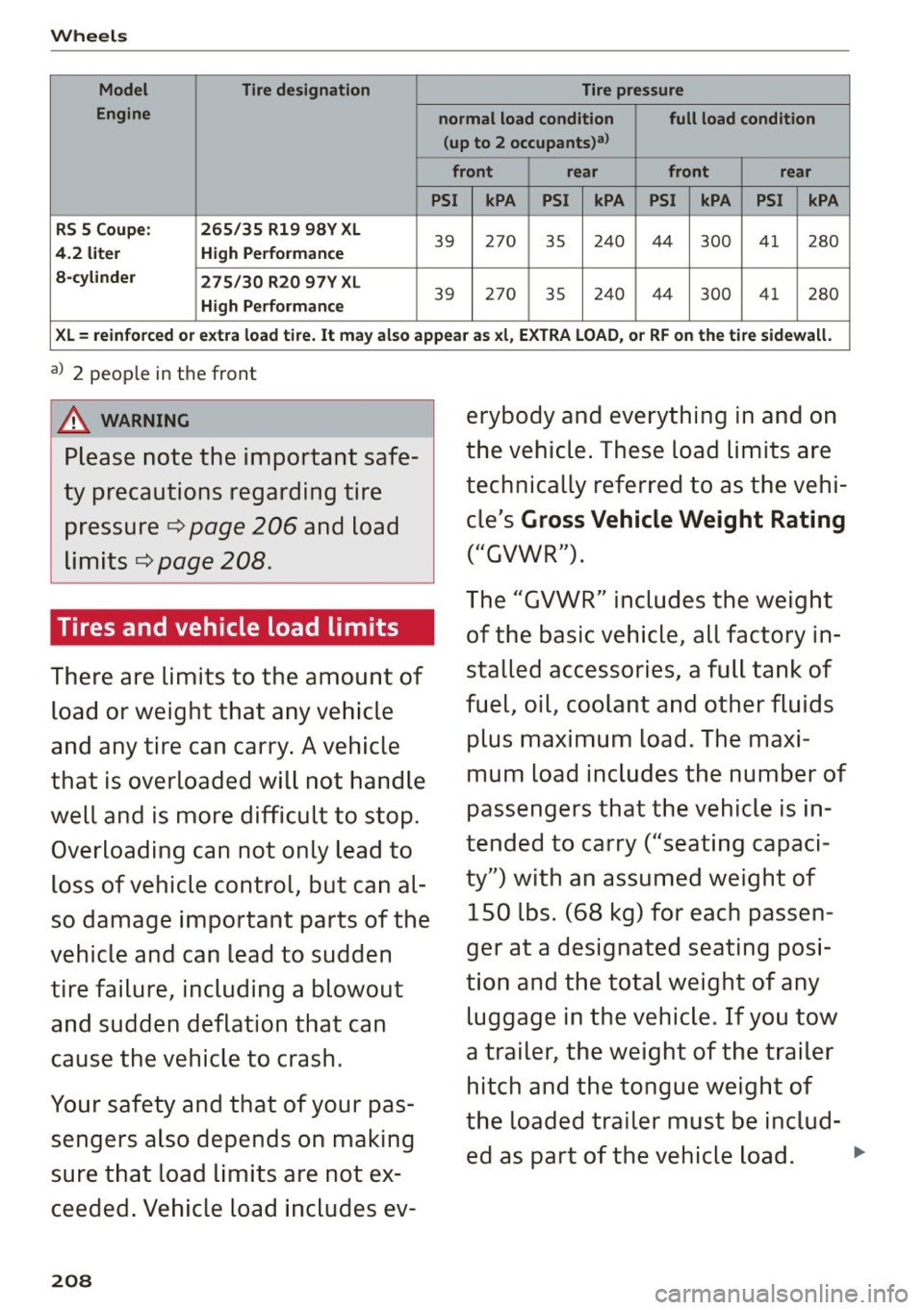
Model Tire designation Tire pressure
Engine normal load condition full load condition
(up to 2 occupants)a l
front rear front rear
PSI kPA PSI kPA PSI kPA
PSI kPA
RS 5 Coupe: 265/35 Rl9 98V XL
4.2 liter High Performance
39 27
0
35 2
40 44
300 41
280
8-cylinder
275/30 R20 97V XL
High Performance
39 270 35 240
44 300 41 280
XL= reinforced or extra load tire. It may also appear as xl, EXTRA LOAD, or RF on the tire sidewall.
a) 2 people in the front
_& WARNING
Please note the important safe
ty precautions regarding tire pressure ¢
page 206 and load
limits ¢
page 208.
Tires and vehicle load limits
There are limits to the amount of
load or weight that any vehicle
and any tire can carry. A vehicle
that is overloaded will not handle
well and is more difficult to stop. Overloading can not only lead to
loss of vehicle control, but can al
so damage important parts of the
vehicle and can lead to sudden
tire failure, including a blowout and sudden deflation that can
cause the vehicle to crash .
Your safety and that of your pas sengers also depends on making
sure that load limits are not ex
ceeded. Vehicle load includes ev-
208
erybody and everything in and on
the vehicle. These load limits are
technically referred to as the vehi cle's
Gross Vehicle Weight Rating
("GVWR").
The "GVWR" includes the weight of the basic vehicle , all factory in
stalled accessories, a full tank of
fuel, oil, coolant and other fluids plus maximum load . The maxi
mum load includes the number of
passengers that the vehicle is in
tended to carry ("seating capaci
ty") with an assumed weight of
150 lbs. (68 kg) for each passen
ger at a designated seating posi
tion and the total weight of any luggage in the vehicle . If you tow
a trailer, the weight of the trailer hitch and the tongue weight of
the loaded trailer must be includ- ed as part of the vehicle load. ..,.
Page 234 of 254
Emergency situation s
Raising the vehicle
Lifting with workshop hoist and with floor
jack
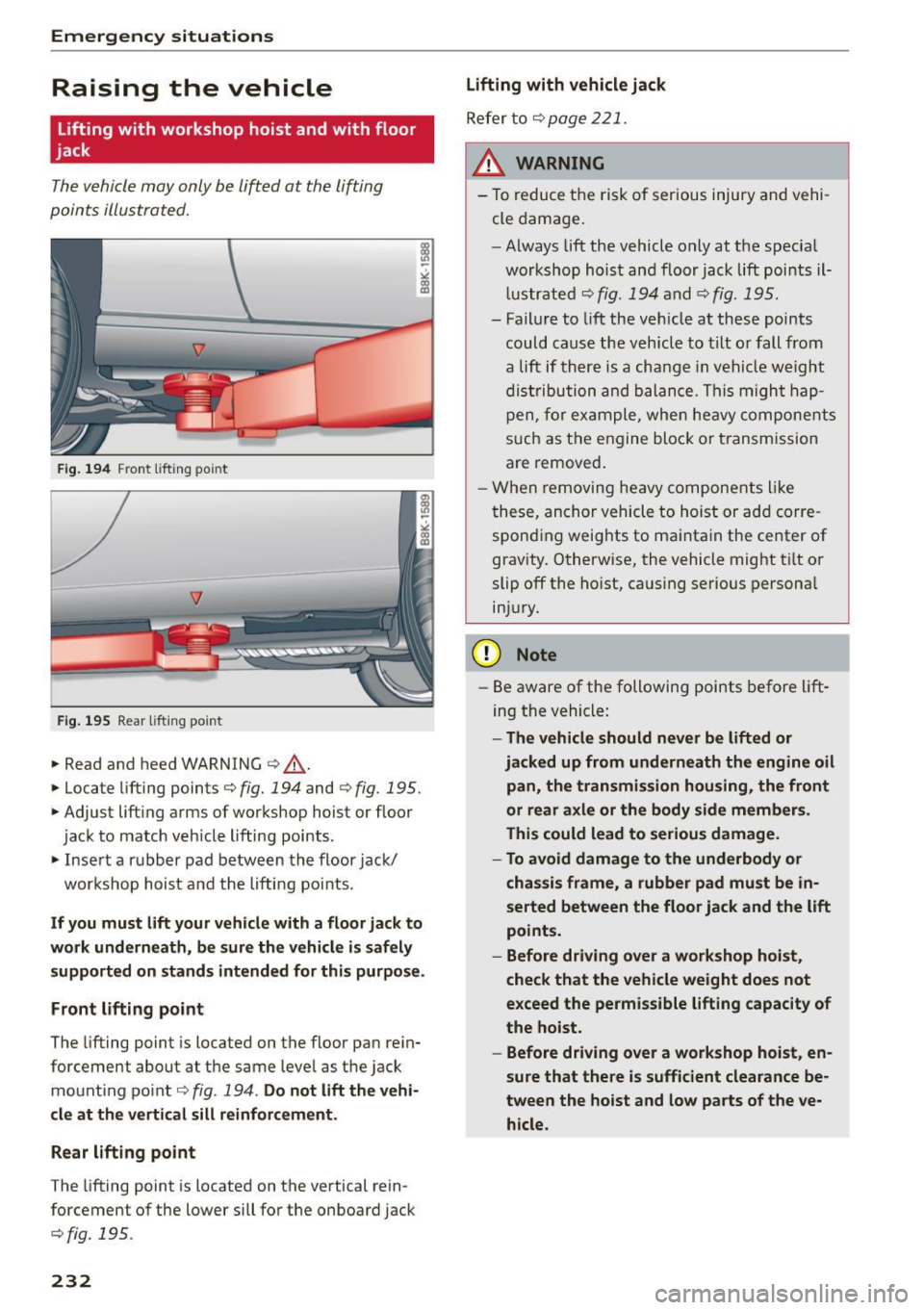
The v ehicle may only be lifted at the lifting
points illustrated.
F ig . 1 94 Front lift in g po int
F ig . 1 95 Rear l ift ing po int
... Read and heed WARNING c> &_ .
... Locate lifting points c> fig. 194 and c> fig . 195.
... Adjust lift ing arms of workshop hoist or floor
jack to match veh icle lifting points.
... Inse rt a r ubber pad between the floor jack/
workshop hoist and the lifting points .
If you must lift your vehicle with a floor jack to
work underneath, be sure th e vehicle is safely
supported on stands intended for this purpo se.
F ront l ifting point
The lifting point is located on the floor pan rein
forcement about at the same leve l as the jack
mount ing po int
c> fig . 194 . Do not lift the vehi
cle at the vertical sill reinforcement .
Rear lift ing point
The lifting point is located on the vertical rein
forcement of the lower sill fo r the on board jack
c>fig. 195.
232
Lifting with vehicle jack
Refer to c::> page 221.
A WARNING
- To reduce t he risk of serious injury and vehi
cle damage .
- Always lift the vehicle only at the specia l
workshop hoist and f loor jack lift points il
l ustrat ed
c::> fig . 194 and c> fig. 195.
-Failure to lift the veh icle a t these points
could cause the veh icle to tilt o r fall from
a lift if th ere is a cha nge in vehi cle we ight
dis tribu tio n and balance. T his m ight hap
p en, for example, whe n he avy compone nts
s uch as the en gine block or tran smission
are removed .
- W hen removing he avy componen ts like
these, anchor vehicle to hoist or ad d corre
spond ing weights to ma intain the center of
grav ity . Otherwise, the vehicle might ti lt o r
slip off the ho ist , causing se rious persona l
in jury .
(D Note
-Be aware of the following points before lift
ing the vehicle:
- The veh icle should never be lifted or
jacked up from underneath the engine oil pan, the transmis sion housing, the front
or rear axle or the body side members .
This could lead to serious damage .
- To avoid damage to the underbody or
chas sis frame , a rubber pad must be in
serted between the floor ja ck and the lift
points.
- Before driving over a workshop hoist,
check that the vehicle weight doe s not
exceed the permissible lifting capacity of
the hoist.
- Before driving over a work shop hoist , en
sure that the re is sufficient clearance be
tween the hoist and low parts of the ve
h icle.