airbag off AUDI RS5 COUPE 2015 Owners Manual
[x] Cancel search | Manufacturer: AUDI, Model Year: 2015, Model line: RS5 COUPE, Model: AUDI RS5 COUPE 2015Pages: 254, PDF Size: 64.12 MB
Page 32 of 254
Open in g and cl osin g
Opening and closing
Central locking
General description
The power locking system locks or unlocks all
doors and the rear lid simultaneously.
You can lock and unlock the vehicle centrally. You have the following choices:
- Remote master key
r:!> page 33,
-Door handles with convenience key*
r:!> page 3 3,
-Lock cylinder at the dr iver's door q page 35,
or
- Power locking switch inside
q page 34.
Autom atic locking
The automatic locking feature locks all the vehi
cle doors and the rear lid when you drive faster
than 9 mph (15 km/h) .
The car is unlocked again once the ignition key is removed . In addition, the vehicle can be unlocked
if the opening function in the power locking sys
tem sw itch or at one of the door levers is actuat
ed. The Auto Lock function can be turned on and
off in the rad io or MMI*
q page 35.
Addit ionally, in the event of a crash with a irbag
deployment the doors are automatically un locked to allow access to the vehicle .
Selective unlo cking
When you lock the vehicle, the power locking sys
tem w ill lock the doors and the rear lid. When un
lock ing, you can set in the radio or MMI* whether
only the d river 's door or t he entire veh icle should
be unlocked
q page 35.
Ant i-th eft ala rm warn ing sys tem
If the anti-theft alarm warning system detects a
break-in into the vehicle, acoust ic and visual
warn ing s ignals are tr iggered.
The anti-theft warning system is activated auto mat ically when you lock the vehicle. It is deact i
vated when unlocking using the remote key, w ith
the mechanical key, and when you switch on the ignit ion.
3 0
The alarm also tu rns off when the alarm cycle has
expired.
Turn signals
When you u nlock the veh icle, the turn signals
flash twice, when you lock it once. If they do not
flash , one of the doors, the luggage compart
ment lid or the hood is not locked or the ignition
is still switched on.
Unint entionall y lo cking yourself out
In the follow ing cases there safegua rds to pre
vent you locking your remote master key in the
vehicle:
- T he veh icle does not lock w ith the power lock
ing sw itch
q page 34 if the driver 's door is
open.
- On veh icles with convenience key*, if the most
recently used master key is in the luggage com
partment, the rear lid is automatically unlocked
again after it is closed .
Do not lock your veh icle w ith the remote master
key or convenience key* unt il all doors and the
rear lid are closed. In this way you avoid locking
yourself out acc identally.
A WARNING
- When you leave the vehicle, always remove
the ignition key and take it with you. This
w ill prevent passengers (children, for exam
ple) from accidentally being locked in the
vehicle should they accidentally press the
power locking sw itch in the front doors .
- Do not leave ch ildren inside the vehicle un
supervised . In an emergency it would be im
possible to open the doors from the outs ide
w it h out the key.
(D Tips
- In the event of a crash with airbag deploy
ment all locked doors w ill be automatically
unlocked to give access to the veh icle occu
pants from the outside.
- If the power locking system should mal
function, you can lock the driver's door us ing the mechanica l key
q page 35.
Page 36 of 254
Open ing a nd clos ing
¢ .&. in General description on page 30. Do not
reach inside the door handle.
The vehicle can be locked and unlocked at any door. The remote control key cannot be more
than 1.5 m away from the door hand le . It makes
no difference whether the master key is in your
jacket pocket or in your brief case .
I f you grip the door handle while locking, this can
adversely affect the locking function.
It is not possible to re-open the door for a brief
period directly after closi ng it . This allows you to
ensure that the doors are properly locked.
It depends on the sett ings i n the radio or MM !*
whether the entire vehicle is unlocked or one of
the doors ¢
page 35.
A WARNING
Read and follow all WARNINGS ¢.& in Gener
al description on page 30.
(D Tips
I f your vehicle has been stand ing fo r an ex
tended period, please note the fol low ing :
- The proxim ity sensors are deactivated after
a few days to save power. You then have to p ull on the door handle once to unlock the
vehicle and a second time to open t he vehi
cle.
- To prevent the battery from being dis
charged and to preserve your vehicle's abili
ty to start for as long as possible, the ener
gy management system gradually switches
off unnecessary convenience functions.
It is
possib le that you will not be able to unlock
your vehicle using these convenience func
tions .
- For Declaration of Compliance to United
States FCC and Industry Canada regulations
¢ page 239.
34
Locking and unlocking the vehicle from
inside
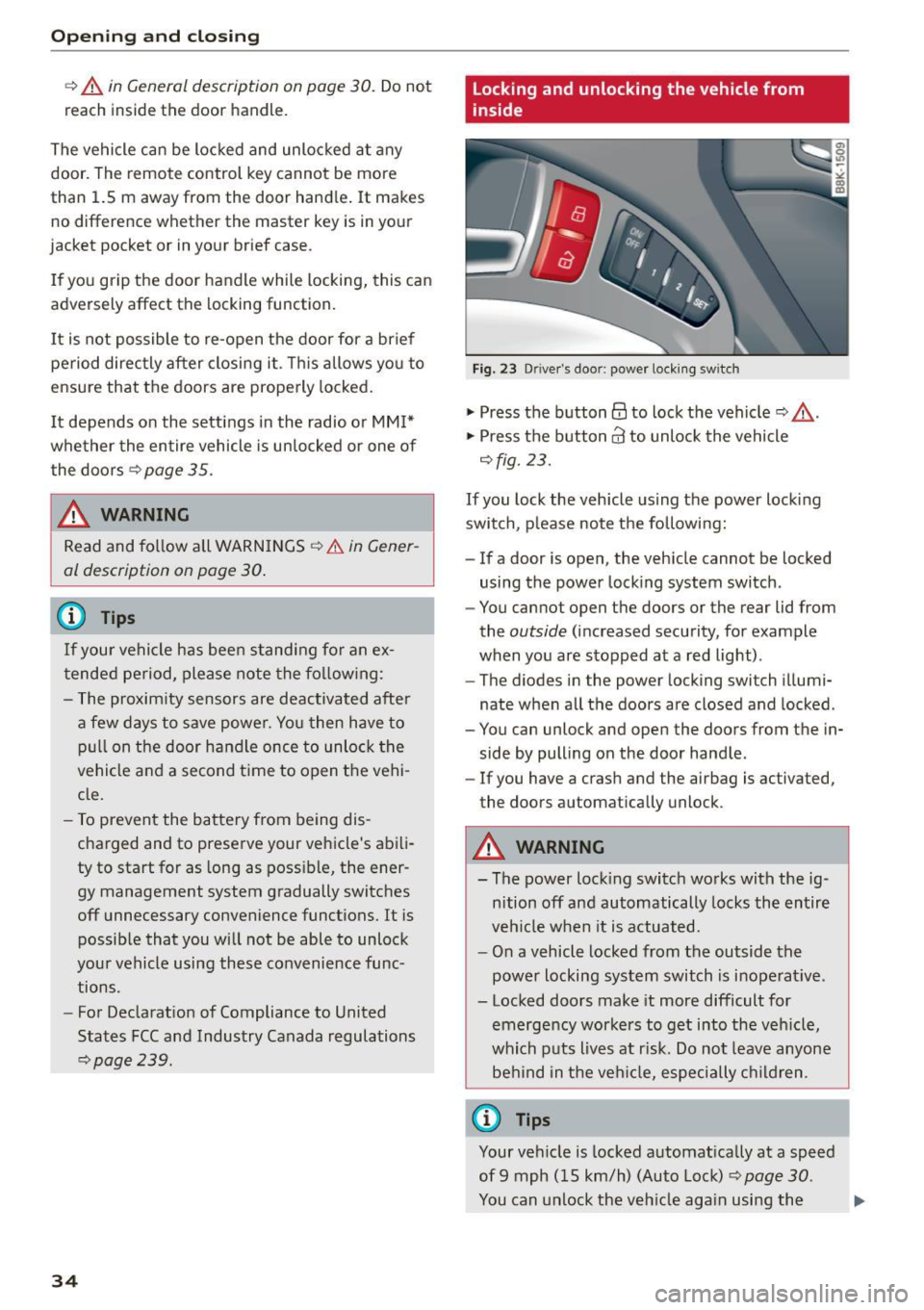
Fig. 23 Driver's doo r: power lock ing sw itch
.,. Press the button@ to lock the vehicle¢_&. .
.,. Press the button@ to unlock the vehicle
¢fig. 23 .
If you lock the veh icle using the power locking
switch , please note the following:
- If a door is open, the veh icle cannot be locked
using the power lock ing system switch.
- You cannot open the doors or the rear lid from
the
outside (increased security, for example
when you are stopped at a red light) .
- The d iodes in the power locking switch illumi
nate when all the doors are closed and locked .
- You can unlock and open the doors from the in
side by pulling on the doo r handle .
-If you have a crash and the airbag is activated,
the doors automatically unlock .
A WARNING
- The power locking switch works with the ig
nition off and automatically locks the entire
vehicle when it is actuated.
- On a vehicle locked from the outside the
power locking system switch is inoperat ive .
- Locked doors make it more difficult for
emergency workers to get into the veh icle,
which puts lives at r isk. Do not leave anyone
be hind in the veh icle, especially children .
('O Tips
Your vehicle is locked automatically at a speed
of 9 mph (15 km/h) (Auto Lock) ¢
page 30.
You can unlock the veh icle aga in using the ..,.
Page 47 of 254
"' N
0:: loo
rl I.O
"' N
"' rl
The coming home and leaving home functions
only operate when it is dark and the light switch
is in the AUTO position ¢
page 43, fig. 36.
Auto headlights*
When the light switch is in the AUTO¢ page 43
position, the switch-on point of the lights can be
changed in the automatic driving light function.
Daytime running lights
USA models: You can switch the daytime running
lights
on and off.
Canada models: The function cannot be turned
off. It is activated automatically each time the ig nition is switched on.
Travel mode*
The headlight beam is asymmetrical. This pro
vides stronger illum ination on the s ide of the
road on which you are driving. If you are driving
in a country that drives on the opposite side of
the road from your own country, this will cause
glare for oncoming drivers. To prevent glare:
- Travel mode must be selected in vehicles with
Xenon headlights*.
- In vehicles with halogen headlights, certain
areas of the headlight lenses must be covered
with waterproof adhesive covers that prevent light from passing through . For more informa
tion, please see your authorized Audi dealer or authorized repair facility.
(0 Tips
When travel mode is activated, a display in
the driver information system indicates this
each time you switch the ignition on.
Lights and Vision
Emergency flashers
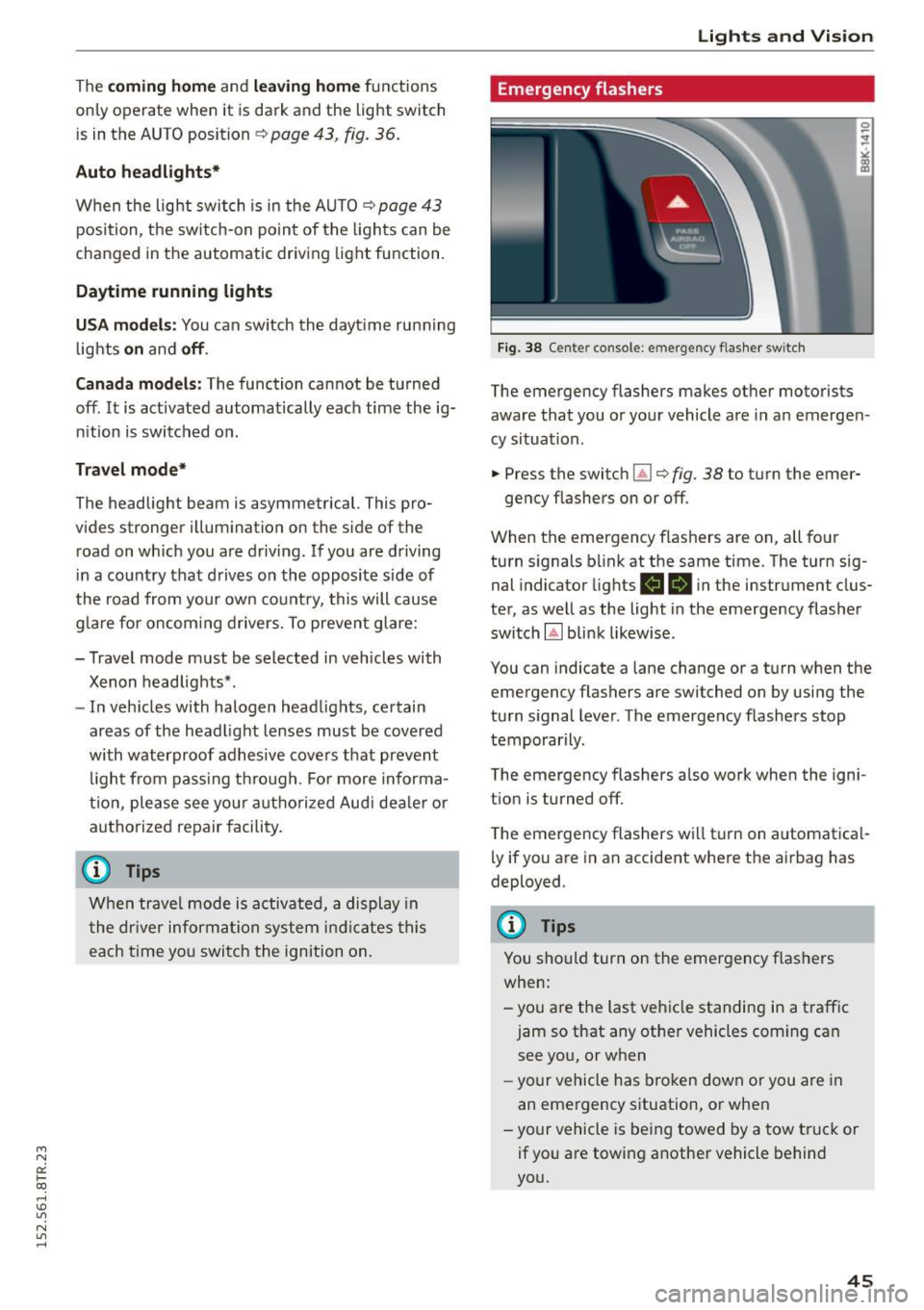
Fig. 38 Center console: emergency flasher switch
The emergency flashers makes other motorists
aware that you or your vehicle are in an emergen
cy situation .
.. Press the switch~ ¢
fig. 38 to turn the emer-
gency flashe rs on or off.
When the emergency flashers are on, all four
turn signals blink at the same time. The turn sig
nal indicator lights
R 1B in the instr ument clus
ter, as well as the light in the emergency flasher
switch
Gil blink likewise .
You can indicate a lane change or a turn when the emergency flashers are switched on by using the
turn signal lever. The emergency flashers stop
temporarily.
The emergency flashers also work when the igni
t ion is turned off.
The emergency flashers will turn on automatical
ly if you are in an accident where the airbag has
deployed .
(D Tips
You should turn on the emergency flashers
when:
- you are the last vehicle standing in a traffic
jam so that any other vehicles coming can see you, or when
- your vehicle has broken down or you are in
an emergency situation, or when
- your vehicle is being towed by a tow truck or
if you are towing another vehicle behind
you.
45
Page 55 of 254
M N
0:: loo ,...., \!) 1.1'1
N 1.1'1 ,....,
Seats and storage
General information
Why is your seat adjustment so important?
The safety belts and the airbag system can only
provide maximum protection if the front seats are correctly adjusted.
There are various ways of adjusting the front
seats to provide safe and comfortable support
for the driver and the front passenger. Adjust
your seat properly so that:
- you can easily and quickly reach all the switches
and controls in the instrument panel
- your body is properly supported thus reducing
physical stress and fatigue
- the safety belts and a irbag system can offer
maximum protection ¢
page 128.
In the following sections, you will see exactly
how you can best adjust your seats.
There are special regulations and instructions for installing a child safety seat on the front pas
senger's seat. Always follow the information re
garding child safety provided in¢
page 150,
Child safety.
A WARNING -
Refer to¢ page 111, Driving safety for im
portant information, t ips, suggestions and
warnings that you should read and follow for
your own safety and the safety of your pas senge rs.
A WARNING
Incorrect seating position of the dr iver and all
other passengers can resu lt in serious person
al injury.
- Always keep your feet on the floor when the
vehicle is in motion -never put your feet on
top of the instrument pane l, out of the win
dow or on top of the seat cushion. This ap
plies especially to the passengers . If your
seating pos it ion is incorrect, you increase
the risk of injury in the case of sudden brak
ing or an accident. If the airbag inflates and
Seat s and stor age
the seating position is incorrect, this cou ld
result in personal injury or even death.
- It is important for both the driver and front
passenger to keep a distance of at least
10 inches (25 cm) between themselves and
the steering wheel and/or instrument panel.
If you're sitting any closer than this, the air
bag system cannot protect you properly. In
addition, the front seats and head restraints must be adjusted to your body height so
that they can give you max imum protect ion.
- Always try to keep as much distance as pos
sible between yourself and the steer ing
wheel or instrument pane l.
- Do not adjust the driver's o r front passeng
er 's seat while the veh icle is moving. Your
seat may move unexpectedly, causing sud
den loss of vehicle control and persona l in
jury.
If you adjust your seat whi le the vehicle
is moving, you are out of position.
Driver's seat
The correct seat position is important for safe
and relaxed driving.
We recommend that you adjust the dr iver's seat
in the following manner:
"' Adjust the seat in fore and aft direction so that
you can eas ily push the pedals to the floor
while keeping your knees slightly bent¢.&,
in
Why is your seat adjustment so important? on
page 53.
"' Adjust the seatback so that when you sit with
your back against the seatback, you can still
grasp the top of the steering wheel.
"' App lies to veh icles w ith adjustable head re
straints: Adjust the head restraint so the upper
edge is as even as possible with the top of your
head.
If that is not possible, try to adjust the
head restra int so that it is as close to th is posi
t ion as possible ¢
page 56.
A WARNING
Never place any objects in the driver's foot
well. An object could get into the pedal area
and interfere with pedal funct ion. In case of
-
53
Page 56 of 254
Seats and storag e
sudden braking or an accident, yo u wo uld not
be able to brake or accelerate.
Front passenger's seat
Always move the front passenger seat into the rearmost position.
To avo id contact w it h the airbag wh ile i t is de
p loying, do not sit any closer to the inst rument
panel than necessary and always wear the three
point safety belt provided adjusted correctly. We
recommend that you adjust the passenger's seat in the following manner:
.,. Bring the backrest up to an (a lmost) upright
position .
Do not ride with the seat reclined .
.,. Applies to vehicles with adjustable head re
straints: Adjust the head restra int so the upper
edge is as even as poss ible with the top of your
head. If that is not possib le, try to adjust the
head restraint so that it is as close to this posi
tion as possible ¢
page 56.
.,. Place your feet on the floor in fron t of the pas
senger 's seat.
Front seats
Power seat adjustment
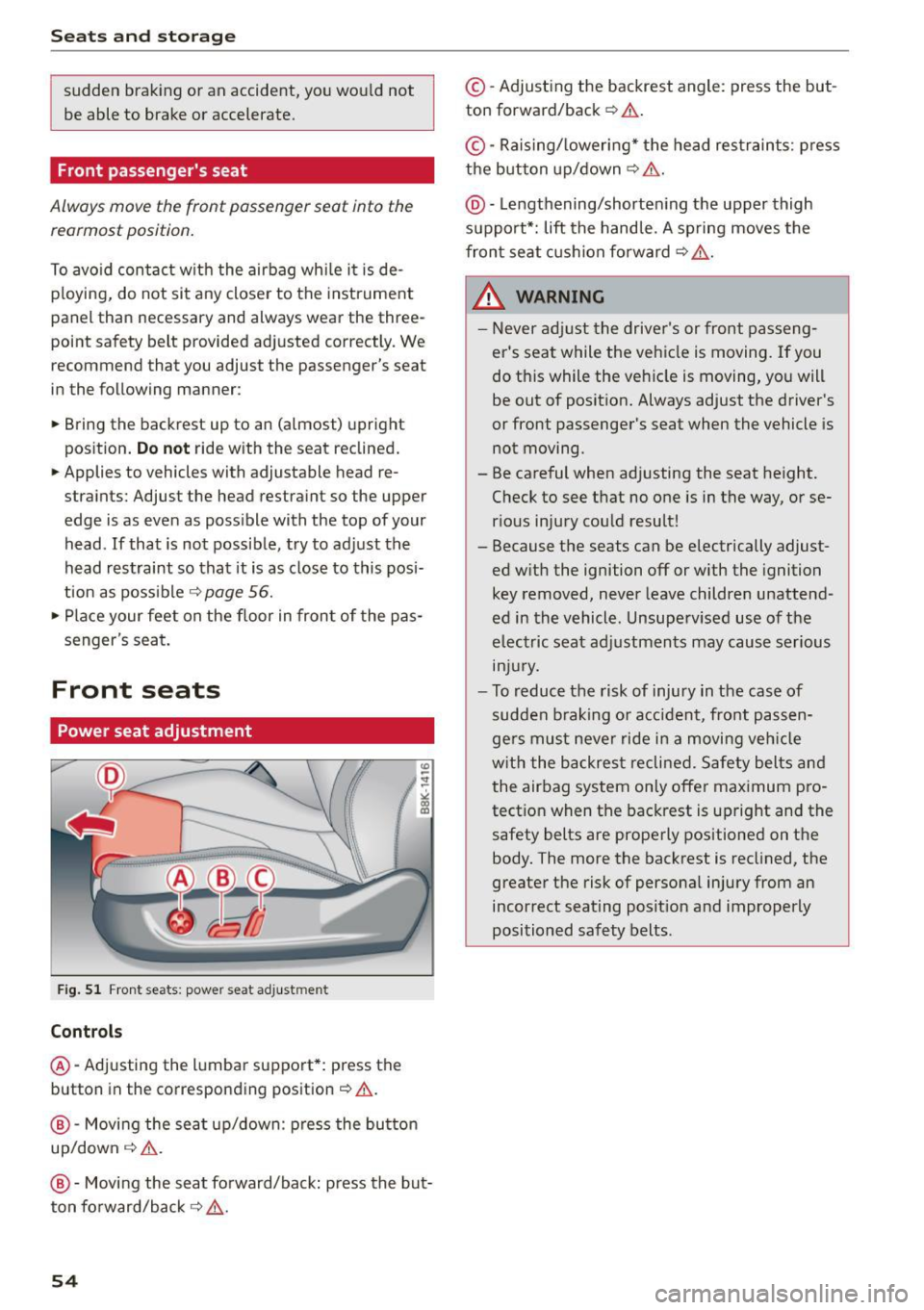
F ig . 5 1 Front seats : power seat ad justm ent
Controls
@ -Adjusting the l umbar support*: press the
button in the corresponding position~.& .
@-Movi ng the sea t up/down : press the bu tton
up/down
~ & .
@ -Movi ng the seat fo rward/back: press the but
ton fo rward/back
~ ,1,. .
54
©-Adjusting the backrest angle: press the but
ton forward/back ¢.& .
©-Raising/ lowering* the head res traints: p ress
the button up/down~ &.
@ -Lengthening/shorte ning the upper thigh
support*: lift the hand le. A sp ring moves the
fron t seat c ushion fo rward ¢
,&..
& WARNING -
-Never ad just the driver's or front passeng
er's seat while the vehicle is moving. If you
do this while the veh icle is moving, yo u will
be out of posit ion. Always adjust the driver 's
or front passenger's seat when the vehicle is
not moving .
- Be careful when adjusting the seat height. Check to see that no one is in the way, or se
r ious injury cou ld result!
- Because the seats can be electrically adjust ed w ith the ignition off or with the ignition
key removed, never leave children unattend
ed in the vehicle. Unsuperv ise d use of the
electric seat adj ustments may cause serious
m Ju ry.
- To reduce the risk of injury in the case of
sudden b raking or accident, fro nt passen
ge rs must neve r ride in a moving veh icle
w ith the backres t reclined. Safety belts and
the air bag system on ly offer ma ximum pro
tect ion when the bac krest is upright and the
safety belts are properly positioned on t he
body. The more the backrest is recl ined, the
greater the risk of persona l injury from an
incorrect seating posit ion and improperly
positioned safety belts.
Page 61 of 254
"' N
0:: loo
rl I.O
"' N
"' rl
_& WARNING
The cigarette lighter only works when the ignition is switched on. Incorrect usage can lead
to serious injuries or burns . For this reason,
children should never be left unattended in
the vehicle because this increases the risk of
injury .
Storing
General overview
_& WARNING
-Always remove objects from the instrument
panel. Any items not put away could slide
around inside the vehicle while driving or
when accelerating or when applying the
brakes or when driving around a corner .
- When you are driving make sure that any
thing you may have placed in the center con
sole or other storage locations cannot fall
out into the footwells. In case of sudden
braking you would not be able to brake or
accelerate.
-Any pieces of clothing that you have hung up must not interfere with the driver's view.
The coat hooks are designed only for light
weight clothing . Never hang any clothing
with hard, pointed or heavy objects in the pockets on the coat hooks. During sudden
braking or in an accident - especially if the
airbag is deployed - these objects could in
jure any passengers inside the vehicle.
Cupholder
Fig. 61 Cen te r con sole: fron t cupho ld er
Seats and storage
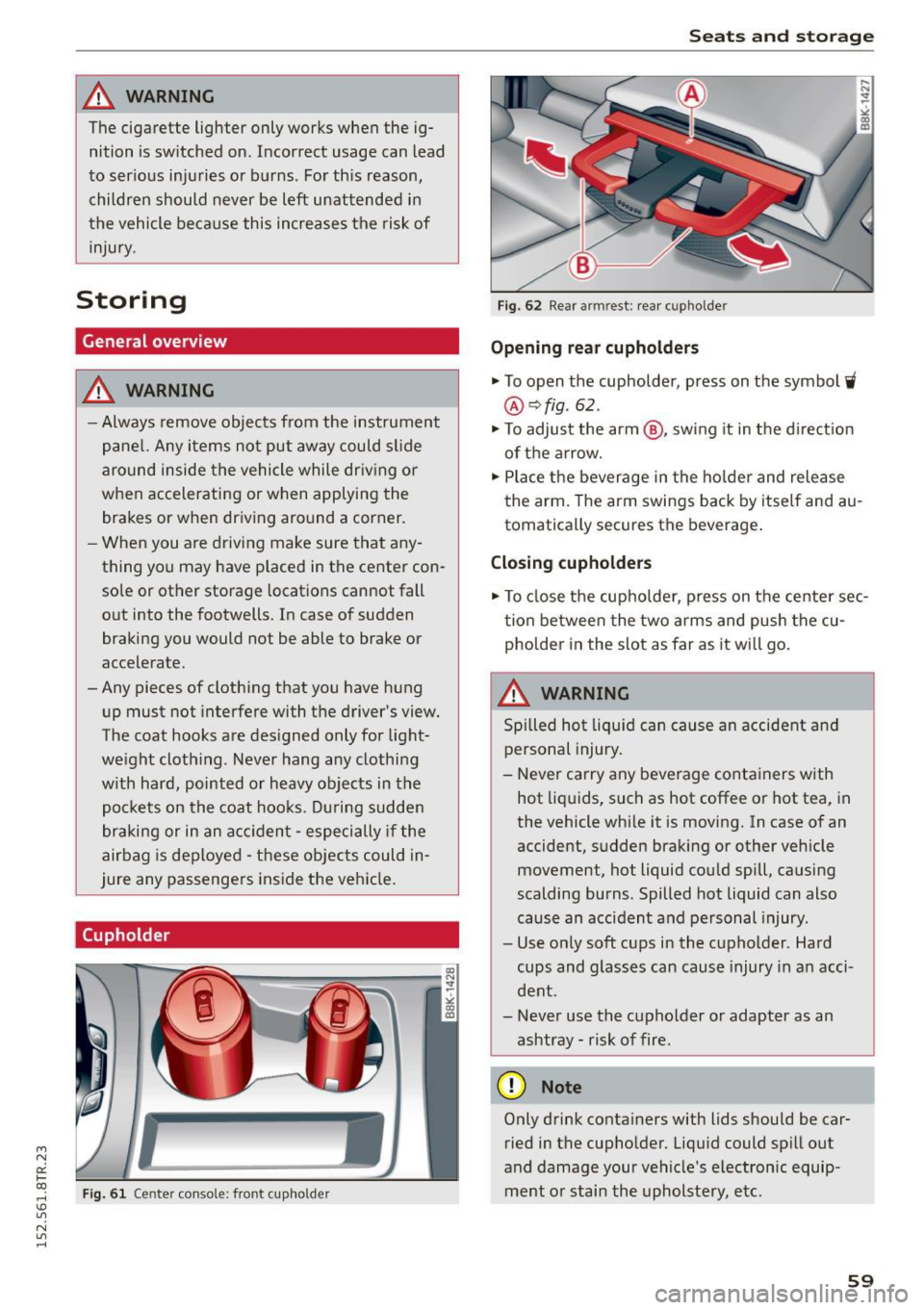
Fig. 62 Rear armrest: rear cup hol der
Opening rear cupholders
.,. To open the cupholder, press on the symbol W
@ ¢fig . 62 .
.,. To adjust the arm @, swing it in the direction
of the arrow.
.,. Place the beverage in the holder and release
the arm. The arm swings back by itself and au
tomatically secures th e be verage .
Closing cupholders
.,. To close the cupholder , press on the center sec
tion between the two arms and push the cu
pholder in the slot as far as it wi ll go.
A WARNING
Spilled hot liquid can cause an accident and
personal injury.
- Never carry any beverage containers with
hot liquids, such as hot coffee or hot tea, in
the vehicle while it is moving. In case of an
accident, sudden braking or other vehicle movement, hot Liquid could spill, causing
scalding burns. Spilled hot Liquid can also
cause an accident and personal injury.
- Use only soft cups in the cupholder . Hard
cups and glasses can cause injury in an acci
dent .
- Never use the cupholder or adapter as an
ashtray- risk of fire .
(D Note
Only drink containers with lids should be car
ried in the cupholder . Liquid could spill out
and damage your vehicle's electronic equip
ment or stain the upholstery, etc.
-
59
Page 116 of 254

Driving safety
-Each passenger must always sit on a seat of
their own and properly fasten and wear the
safety belt belonging to that seat.
- Before driving, always adjust the front pas
senger seat and head restraint properly.
- Always keep your feet on the floor in front
of the seat. Never rest them on the seat, in
strument panel, out of the window, etc. The
airbag system and safety belt will not be
able to protect you properly and can even in
crease the risk of injury in a crash.
- Never drive with the backrest reclined or
tilted far back! The farther the backrests are
tilted back, the greater the risk of injury due
to incorrect positioning of the safety belt
and improper seating position.
- Children must always ride in child safety
seats
r:=;, page 150. Special precautions ap
ply when installing a child safety seat on the
front passenger seat
r:=;, page 128.
Proper seating positions for passengers in
rear seats
Rear seat passengers must sit upright with both
feet on the floor consistent with their physical
size and be properly restrained whenever the ve hicle is in use.
To reduce the risk of injury caused by an incorrect
seating position in the event of a sudden braking maneuver or an accident, your passengers on the
rear bench seat must always observe the follow
ing:
.. Make sure that the seatback is securely latched
in the upright position
r:=;, page 63.
.. Keep both feet flat in the footwell in front of
the rear seat.
.. Fasten and wear safety belts properly
¢ page 123.
.. Make sure that children are always properly re
strained in a child restraint that is appropriate
for their size and ager:=;,
page 150.
A WARNING
Passengers who are improperly seated on the
rear seat can be seriously injured in a crash.
114
- Each passenger must always sit on a seat of
their own and properly fasten and wear the safety belt belonging to that seat.
- Safety belts only offer maximum protection
when the seatback is securely latched in the
upright position and the safety belts are properly positioned on the body. By not sit
ting upright, a rear seat passenger increases
the risk of personal injury from improperly
positioned safety belts!
-Always adjust the head restraint properly so
that it can give maximum protection.
Proper adjustment of head restraints
App lies to vehicles : wit h adjusta ble h ead r estra ints
Correctly adjusted head restraints are an impor
tant part of your vehicle's occupant restraint sys
tem and can help to reduce the risk of injuries in
accident situations.
Fig. 119 Head restra int: v iewed from the front
The head restraints must be correctly adjusted to
achieve the best protection.
.. Adjust the head restraints so the upper edge is
as even as possible with the top of your head.
If
that is not possible, try to adjust the head re
straint so that it is as close to this position as
possible
¢ fig. 119 .
Adjusting head restraints¢ page 56 .
A WARNING -
All seats are equipped with head restraints.
Driving without head restraints or with head
restraints that are not properly adjusted in
creases the risk of serious or fatal neck injury
dramatically. To help reduce the risk of injury:
Iii>
Page 117 of 254

M N
0:: loo ,...., \!) 1.1"1
N 1.1"1 ,....,
-Always drive with the head restraints in
place and properly adjusted.
- Every person in the vehicle must have a
properly ad justed head restraint.
- Always make sure each person in the vehicle
properly adjusts their head restraint. Adjust
the head restraints so the upper edge is as even as possib le w ith the top of your head.
If that is not possib le, try to adjust the head
restraint so that it is as close to this position
as possib le.
- Never attempt to adjust head restraint
wh ile driving. If you have driven off and
must adjust the dr iver headrest for any rea
son, fi rst stop the veh icle safely before at
tempting to ad just the head restraint.
- Children must always be properly restrai ned
in a ch ild restraint that is appropria te fo r
their age and si ze
q page 150.
Examples of improper seating positions
The occupant restraint system con only reduce
the risk of injury if vehicle occupants ore properly
seated.
I mproper seat ing posit ions can ca use serious in
jury o r death . Safety be lts ca n only work when
they are prope rly positioned on t he body. Im
proper sea ting pos it ions reduce the effect iveness
of safety belts and wi ll even increase the risk of
in ju ry and death by moving the safety belt to cr it
i cal areas of the body. Improper seating positions
also increase the risk of serious injury and death
when an airbag deploys a nd strikes an occupant
who is not i n the proper seating position . A driver
i s responsible for the safety of all vehicle occu
pants and especia lly for children . Therefo re :
.. Never allow anyone to assume an incorrect
seat ing pos ition when the veh icle is being used
¢ ,&. .
The follow ing bulletins list only some sample po
sitions that will increase the risk of ser ious injury
and death. Our hope is that these examples will
make you more aware of seat ing pos itions that
are dangerous.
Dr ivin g s afet y
Therefore , whenever the vehicle is moving :
-never stand up in the vehicle
- never stand on the seats
- never kneel on the seats
- never ride w ith the seatback reclined
- never lie down on the rear seat
- never lean up against the instrument panel
- never sit on the edge of the seat
- neve r sit sideways
- neve r lean out t he window
- neve r put your feet out the window
- never put your feet on the instrument panel
- never rest your feet on the seat cushion or back
of the seat
- never ride in the footwell
- never ride in the ca rgo a rea
A WARNING
Imp roper seating posit ions increase the risk
of ser ious personal in jury and death whenever
a veh icle is being used.
-Always make sure that all vehicle occupants stay in a proper seating position and are
properly restrained whenever the vehicle is
be ing used.
Driver's and front
passenger's footwell
Important safety instructions
App lies to vehicles : wit h knee airbags
A WARNING
Always make sure that the knee airbag ca n in
flate w ithout interference. Objec ts between
yourself and the airbag can in crease t he risk
of inju ry in an accident by inter fering with the
way the airbag deploys or by being pushed in
to you as the airbag dep loys .
- No persons (children) or animals shou ld ride
in the footwell in front of the passenger
seat. If the airbag deploys, th is can result in
serio us or fatal injur ies.
- No objects of any kind should be carried in
the footwell area in front of the driver's or passenger's seat. Bulk y objects (shopping
bags, for example) can hamper or prevent
115
Page 130 of 254

Airbag system
Airbag system
Important information
Importance of wearing safety belts and
sitting properly
Airbags are only supplemental restraints . For
airbags to do their job, occupants must always
properly wear their safety belts and be in a prop er seating position.
For your safety and the safety of your passen
gers, befo re driving off, always:
"' Adjust the driver's seat and steering wheel
properly
Q page 112,
"'Adjust the front passenger's seat properly
Qpage 54,
"'Wear safety be lts properly C? page 122,
"'Always properly use the proper child restraint
to protect children
Qpage 150.
In a coll is ion airbags must inflate within the blink
of an eye and with considerab le force. The sup
p lemental airbags can cause injuries if the driver
or the front seat passenger is not seated proper•
Ly. Therefore in order to help the airbag to do its
job, it is important, both as a driver and as a pas
senger to sit properly at all times.
By keeping room between your body and the
steering whee l and the front of the passenger
compartment, the airbag can inflate fully and
completely and provide supplemental protection
in certain frontal collisions
c> page 112, Correct
passenger seating positions.
Fo r details on the
operation of the seat adjustment controls
c>page54.
It's especially important that children are proper
ly restrained
Qpage 150.
There is a lot that the driver and the passengers
can and must do to help the individual safety fea
tures installed in your Audi work together as a
system .
Proper seat ing position is important so that the
front airbag on the driver side can do its job. If
you have a phys ical impairment or condition that
prevents you from sitt ing properly on the dr iver
seat with the safety be lt properly fastened and
128
reaching the pedals, specia l modifications to your
vehicle may be necessary.
Contact your authorized Audi deale r, or call Audi
Customer Relat ions at 1-800-822-2834.
When the airbag system dep loys , a gas generator
will fill the airbags, break open the padded cov
ers, and inflate between the steering wheel and
the driver and between the instrument panel and
the front passenger. The airbags wi ll deflate im
mediate ly after deployment so that the front oc
cupants can see through the w indshield again
without interruption.
All o f this takes place in the blink o f an eye, so
fast that many people don't even realize that the
airbags have dep loyed . The airbags also inflate
with a great deal of force and nothing should be
in the ir way when they deploy. Front a irbags in
combination with properly worn safety belts slow
down and lim it the occupant's forwa rd move
ment . Together they he lp to prevent the driver
and front seat passenge r from hitting parts of
the insid e the veh icle wh ile red ucing the forces
acting on the occupant dur ing the crash. In this
way they help to reduce the risk o f injury to the
head and upper body in the crash. Airbags do not
protect the arms or the lower parts of the body.
Both front airbags will not inflate in all fronta l
collisions . The triggering of the airbag system de
pends on the vehicle deceleration rate caused by
the collis ion and registered by the electronic con
trol unit. If this rate is below the reference value
programmed into the control unit, the airbags
will not be triggered, even though the car may be
badly damaged as a result of the coll is ion . Vehi
cle damage, repair costs or even the lack of vehi
cle damage is not necessar ily an indication of
whether an airbag should inflate or not.
It is not possible to define a range of vehicle
speeds that w ill cover every possible kind and an
gle of impact that will always trigger the air bags,
since the circumstances will vary considerably be
tween one collision and another. Impo rtant fac
tors include, for example, the nature (hard or
soft) of the object which the car hits, the angle of
impact, vehicle speed, etc . The front airbags will
IJ>-
Page 131 of 254

M N
0:: loo ,...., \!) 1.1'1
N 1.1'1 ,....,
also not inflate in side or rear co llisions, or in roll
overs .
Alwa ys rememb er: Airbag s wi ll deploy on ly once,
and on ly in cer tain kinds of collisions. Your safety
b e lts a re a lways there to offer protection in those
situations in which airbags are not supposed to
deploy, or when they have already deployed; for
examp le, when your vehicle str ikes or is struck by
another after the first collision .
This is just one of the reasons why an airbag is a
supp lementary restraint and is not a substitute
for a safety belt. The airbag system works most
effectively when used w ith the safety belts.
Therefore, always properly wear your safety belts
c::>page 120.
A WARNING
Sitting too close to the steer ing whee l o r in
strument panel will decrease the effect ive
ness of the airbags and will increase the risk
o f persona l injury in a coll is ion .
- Never sit closer than 10 inches (25 cm) to
the steering wheel or instrument panel.
- If you cannot sit more than 10 inches
(25 cm) from the steer ing whee l, investi
gate whethe r adaptive equipment may be
available to help yo u reach the peda ls and
increase your seating distance from the
steering wheel.
- If you are unrestrained, lean ing forward, sit
ting s ideways or out of position in any way,
your risk of in jury is much higher.
- You will also receive serio us injuries and
cou ld even be killed if you are up against the
airbag or too close to it when it inflates -
even with an Advanced Airbag.
- To reduce the r isk of injury when an airbag
inflates, always wear safety belts properly
¢ page 123, Safety belts .
- Always make certain that children age 12 or
younger always r ide in the rear seat. If chil
dren are not properly restrained, they may
be severely injured or killed when an airbag
inflates .
- Never let children ride unrestrained or im
properly restrained in the veh icle. Adjust the
front seats properly.
-
Airbag syste m
- Never ride with the back rest reclined .
- Always sit as far as possible from the steer -
ing wheel o r the instrument panel
c::> page 112.
- Always sit up right with your back against
the backrest of your seat.
- Never p lace your feet on the instrument
panel or on the seat. Always keep both feet
on the floor in front of the seat to help pre
vent serious injur ies to the legs and hips if
the airbag inflates.
- Never recline the front passenger's seat to transport objects. Items can also move into
the area of the side airbag or the front air
bag d uring braking or in a sudden maneu
ver. Objects near the airbags can become
p rojectiles and ca use in jury when an airbag
inflates.
A WARNING
A irbags tha t have deployed i n a crash mus t be
r eplaced.
- Use o nly orig inal equipment airbags ap
p rove d by Aud i an d in stalled by a trained
technici an who has the ne cessary too ls and
diagnostic equipment to properly rep lace
any airbag in yo ur vehicle and assu re system
effectiveness in a crash.
- Never permit salvaged or recycled airbags to
be installed in you r vehicle .
Child restraints on the front seat - some
important things to know
.,. Be su re to read the important information and
head the WARNI NGS for important details
about ch ild ren and Advanced Airbags
c::> page 150.
Even though your veh icle is equipped wit h an Ad
vanced Airbag System, make certain that a ll chil
dren, especially those 12 years a nd you nger, a l
ways ride in the bac k seat properly restrained fo r
the ir age and size. The airbag on the passenger
s ide makes the front seat a potent ia lly dangerous
place for a child to ride. The front seat is not the
sa fest p lace for a child in a forward-facing ch ild ..,.
129