open hood AUDI RS7 SPORTBACK 2014 User Guide
[x] Cancel search | Manufacturer: AUDI, Model Year: 2014, Model line: RS7 SPORTBACK, Model: AUDI RS7 SPORTBACK 2014Pages: 292, PDF Size: 73.56 MB
Page 215 of 292
Checking and filling Engine hood
Releasing the engine hood
The engine hood is released from inside the
vehicle .
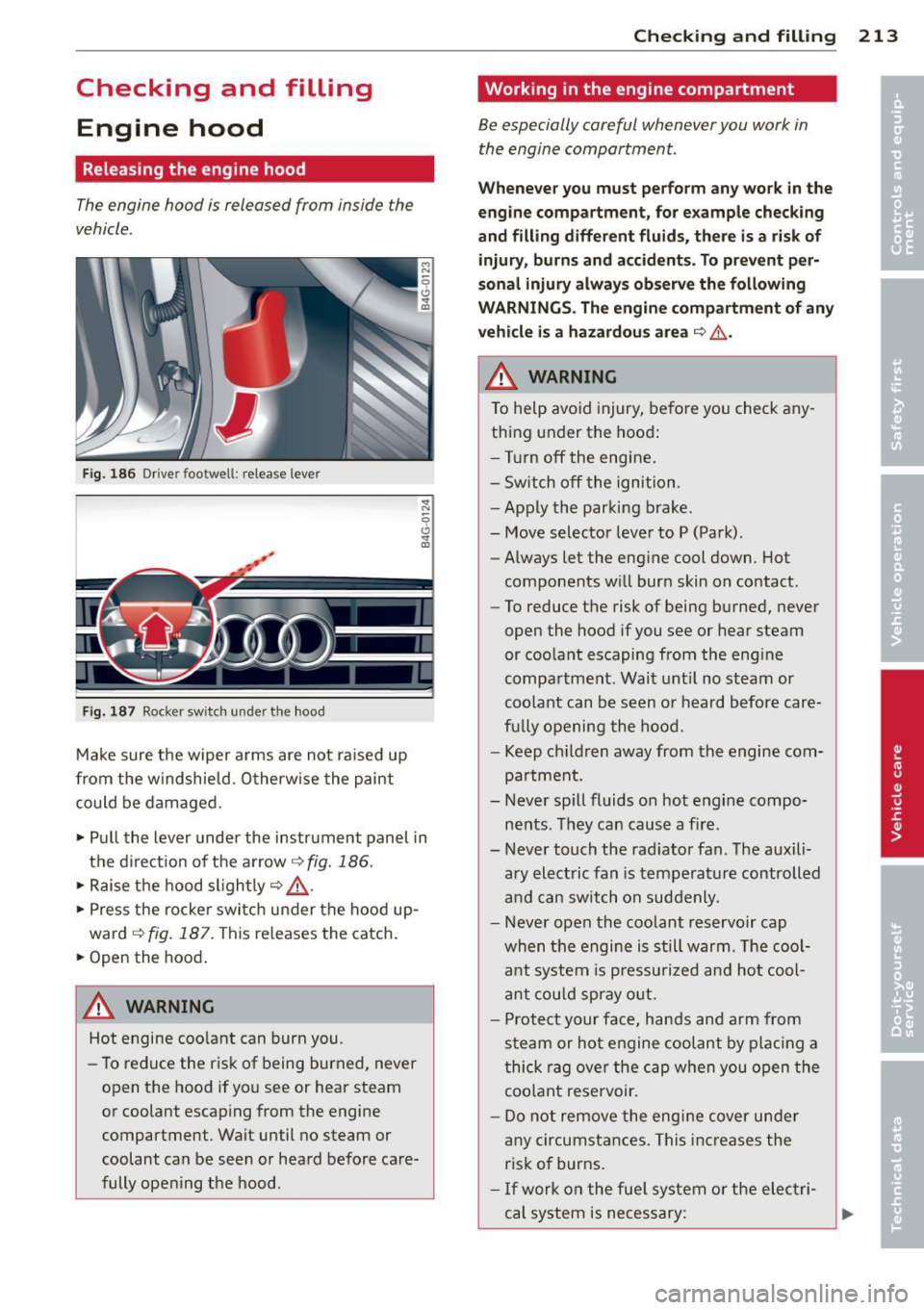
Fig. 186 Dr iver footwell: release lever
Fig. 187 Rocker switch under the hood
Make sure the wiper arms are not raised up
from the w indshield. Otherw ise the paint
could be damaged.
.. Pull the lever under the instrument panel in
the d irect ion of the arrow~
fig. 186.
.. Raise the hood slightly~ &-
.. Press the rocker switch under the hood up
ward
~ fig. 187. This re leases the catch .
.. Open the hood .
A WARNING
Hot engine coo lant can burn you.
- To reduce the r isk of being burned, never
open the hood if you see or hear steam
or coolant escaping from the engine
compartment . Wait until no steam or
coolant can be seen or heard before care
fully opening the hood.
Checkin g and fillin g 213
Working in the engine compartment
Be especially careful whenever you work in
the engine compartment.
W hen ev er y ou must p erform an y wor k in the
en gine com pa rtm ent , for e xample checking
a nd filling diff ere nt fluid s, th ere is a risk of
inju ry, burn s and accid ents. To pr eve nt p er
so nal inju ry always observ e the foll owing
W ARNING S. The engin e compartm ent of any
v e hicle i s a haza rdou s area
~ ,& .
h WARNING
To help avoid injury, before yo u check any
thing under the hood:
- Turn off the engine.
- Sw itch off the ignition.
- Apply the parking brake.
- Move selector leve r to P (Park).
- Always let the engine cool down. Hot
components w ill burn skin on contact .
- To reduce the risk of being burned, never
open the hood if you see or hear steam
or coo lant escaping from the engine
compa rtment. Wait unt il no steam or
coolant can be seen or heard before care
fu lly opening the hood.
- Keep ch ildren away from the engine com
pa rtment.
- Never sp ill fluids on hot engine compo
nents . They can cause a fire .
- Never touch the rad iator fan. The auxili
ary electric fan is temperat ure controlled
and can switch on suddenly .
- Never open the coolant reservoir cap
when the engine is still warm. The cool
ant system is p ressu rized and hot cool
a nt cou ld spray o ut.
- Protect your face, hands and arm from
steam or hot engine coolant by plac ing a
thick rag ove r the cap when you open the
coo lant rese rvoir.
- Do not remove the engine cover under
any circumstances. This inc reases the
ris k of burns.
- If work on the fue l system o r the elec tri
cal system is necessary:
Page 216 of 292
214 Check ing and filling
- Always disconnect the battery.
- Never smoke or work near heaters or open flames . Fluids in the engine com
partment could start a fire.
- Keep an approved fire extinguisher im
mediately available.
- To avoid electrical shock and persona l in
jury while the engine is running or being started, never touch:
- Ignition cables
- Other components of the high voltage
electronic ignition system.
- If you must perform a check or repa ir
with the engine running:
- Fi rst, fully apply the parking bra ke,
move se lec to r lever to P (Pa rk) .
- Always use extreme caution to preven t
clot hing, jewe lry, or long h air from ge t
ting caught in the radiator fan, V -belts
or other moving parts, or from contact ing hot parts. Tie back hair before
start ing, and do not wear cloth ing that
will hang or droop into the eng ine.
- Min imize exposure to emission and
chemica l hazards¢ ,&..
A WARNING
California Propos ition 65 Warning:
- Engine exhaust, some of its constituents,
and certa in veh icle components conta in
or emit chemicals known to the State of
Califor nia to cause cancer and b irth de
fec ts a nd reproduct ive ha rm. In addition,
certain fluids conta ined in vehicles and
certa in prod ucts of co mponent wear co n
ta in o r emi t chemicals known to the
State o f Ca lifornia to cause can cer and
birth defects or ot her reproductive harm. -
Battery posts, terminals and re lated ac
cessories conta in lead and lead com
pounds, chemicals known to the State of
California to cause cance r and reproduc
tive harms. Wash hands after handling .
(D Note
When adding flu ids, always make sure that
they are poured into the proper conta iner
or f iller opening, otherwise serious dam
age to vehicle systems w ill occur.
® For the sake of the environment
To detect leaks in time, inspect the vehicle
floor pan from underneath regularly. If
you see spots from oil or other ve hicle flu
i ds, have yo ur vehicle inspected by a n au
thori zed Audi dea le r.
Closing the engine hood
.,. Pull the hood down un til the pressure from
t he struts is reduced.
.,. Let the hood drop down and latch in p lace .
Do not try to push it shut; it may fail to en
gage ¢&_ .
A WARNING
-
A hood that is not completely latched
could fly up and b lock your view while dr iv
ing.
- When you close the engine hood, check it
to make sure the safety catch has p roper
ly engaged. The hood sho uld be flush
with the surrou nding vehicle body pa rts.
- If you notice while driv ing t hat the hood
is not s ecured prope rly, stop at onc e and
close it.
Page 220 of 292
218 Check ing and filling
Checking the engine oil level
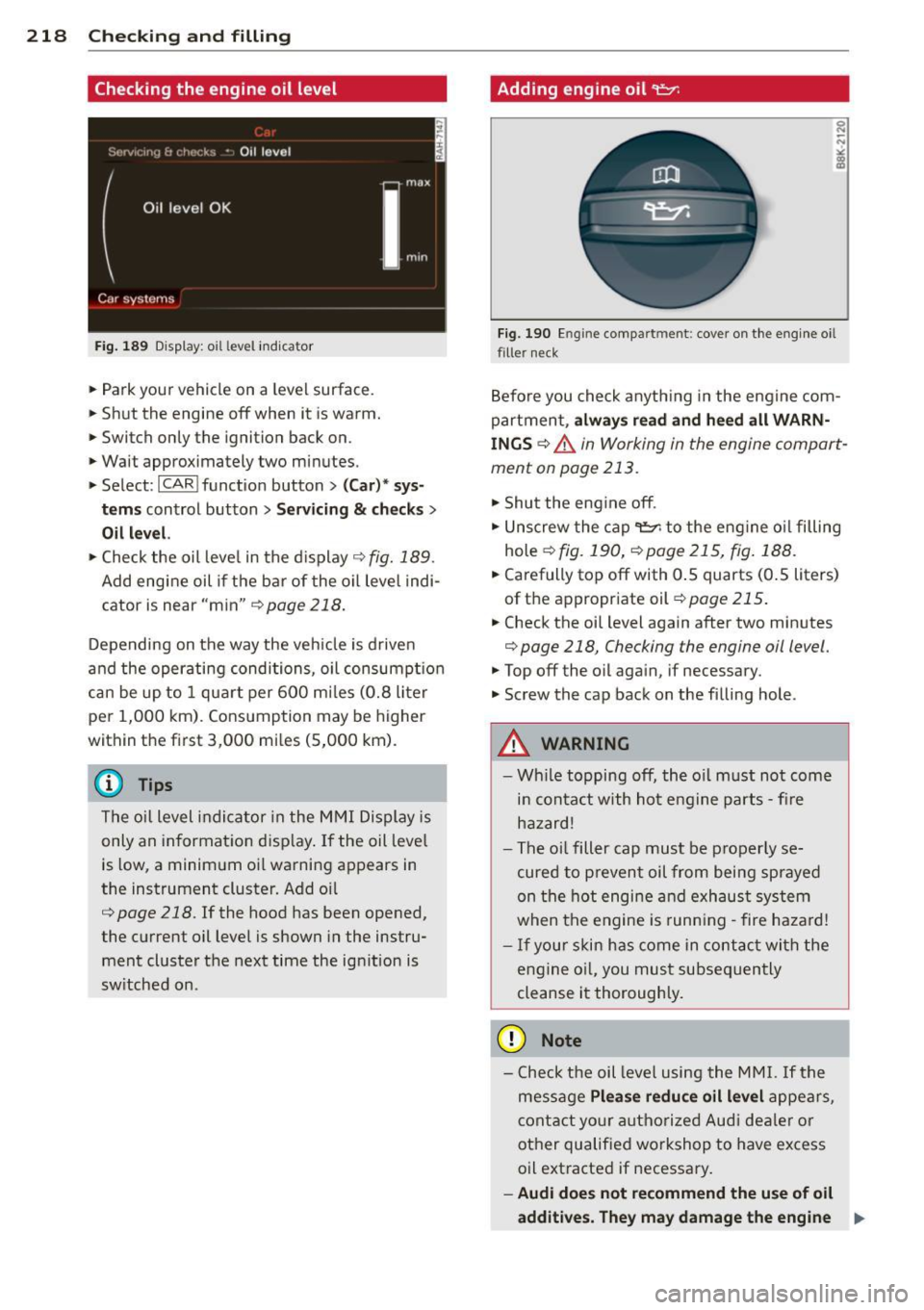
Fig. 189 Disp lay: oil level indica tor
• Park your vehicle on a level surface .
• Shut the engine off when it is warm.
• Switch only the ignition back on .
• Wait approximately two minutes.
• Select :
I CAR I function button> (Ca r)* sys
t e m s
control button > Se rv ici ng & ch ecks >
Oil l evel.
• Check the oil leve l in the d isplay r::;, fig. 189.
Add engine oil if the bar of the oil leve l indi
cator is near "min"
¢page 218.
Depending on the way the veh icle is driven
and the operating condi tions, oil consumpt ion
can be up to 1 qua rt per 600 m iles (0.8 liter
per 1,000 km) . Consumption may be higher
within the first 3 ,000 mi les (5,000 km).
@ Tips
The oil level indicator in the MMI Display is
only an information disp lay . If the oil leve l
is low, a minim um oil warning appears in
the instrument cluster. Add oil
r:::;, page 218. If the hood has been opened,
the current oil level is shown in the instru ment cluster the next time the ignition is
sw itched on .
Adding engin e oil 't:::r.
Fig. 190 Engin e compart men t: cover on the engine oi l
fille r neck
Befo re you check anyth ing in the engine com
partment,
a lw ay s re ad and h eed all WARN
IN GS
r::;, .&. in Working in the engine compart
ment on page 213.
• Shut the eng ine off .
• Unscrew the cap
't=;rl to the eng ine oi l filling
hole
¢ fig. 190, r:=:,page 215, fig. 188 .
• Carefully top off with 0 .5 quarts (0 .5 liters)
of the appropr iate oil¢
page 215.
• Check the oil level again after two minutes
r:::;, page 218, Checking the engine oil level.
• Top off the oil again, if necessary.
• Screw the cap back on the filling hole .
.&_ WARNING
--Wh ile topping off, the o il m ust not come
in conta ct with hot engine parts - fire
hazard!
- The oi l filler cap must be properly se
cured to prevent oil from being sprayed
on the hot engine and exhaust system
when the engine is runn ing -fire haza rd!
- If you r skin has come in contact with the
engine o il, you must subsequen tly
cleanse it thoroughly.
(D Note
- Check the oil level using the MMI. If the
message
Ple ase redu ce oil l evel appears,
contact you r authorized Aud i deale r or
other qualified workshop to have excess
oil extracted if necessary.
- Audi d oes n ot r ecommend the u se of o il
a dd iti ve s. The y may dama ge the en gine
II>-
Page 228 of 292
226 Checking and filling
Battery charging
Starting the engine requires a well charged
battery.
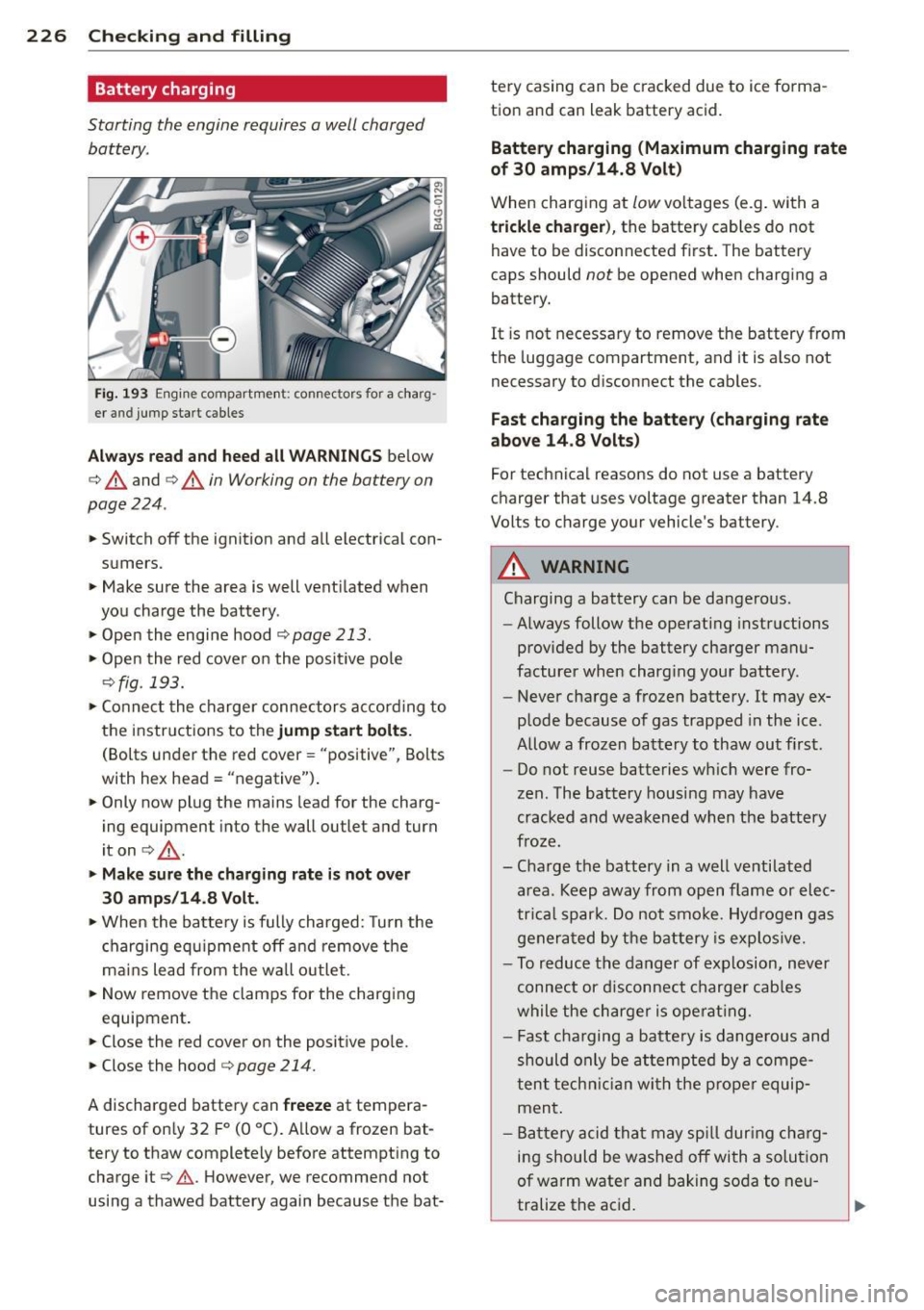
Fig . 193 Engine compartme nt: connecto rs for a charg
er and jump start cables
Always read and heed all WARNINGS below
c:> A and c:> A in Working on the battery on
page 224 .
.,. Switch off the ignition and all electrical con
sumers.
> Make sure the area is well vent ilated when
you charge the battery .
> Open the engine hood c:> page 213 .
> Open the red cover on the posit ive pole
c:>fig. 193.
> Connect the charger connectors according to
the instructions to the
jump start bolts.
(Bolts under the red cover = "positive", Bolts
with hex head= "negative") .
> Only now plug the mains lead for the charg
ing equipment into the wall outlet and turn
iton
c:> &_ .
.,. Make sure the charging rate is not over
30 amps/14.8 Volt.
> When the batte ry is fully charged: Turn the
charging equipment off and remove the
ma ins lead from the wall outlet.
> Now remove the clamps for the charging
equipment.
.. Close the red cover on the positive pole.
> Close the hood c:> page 214.
A discharged battery can freeze at tempera
tures of on ly 32 F
0 (0 °C). Allow a frozen bat
tery to thaw completely before attempting to charge it
c:> .&. However, we recommend not
using a thawed battery again because the bat- tery casing can
be cracked due to ice forma
tion and can leak battery acid.
Battery charging (Maximum charging rate
of 30 amps/14.8 Volt)
When charging at low voltages (e.g. with a
trickle charger), the battery cables do not
have to be disconnected f irst. The battery
caps should
not be opened when charging a
battery.
It i s not necessary to remove the battery from
the luggage compartment, and it is also not
necessary to disconnect the cables.
Fast charging the battery (charging rate
above 14 .8 Volts)
For technical reasons do not use a battery
charger that uses voltage greater than 14.8
Volts to charge your vehicle's battery .
A WARNING
Charging a battery can be dangerous.
- Always follow the operating instructions
provided by the battery charger manu
facturer when charg ing your battery.
- Never charge a frozen battery. It may ex
plode because of gas trapped in the ice .
Allow a frozen battery to thaw out first.
- Do not reuse batteries wh ich were fro
zen. The battery housing may have
cracked and weakened when the battery
froze.
- Charge the battery in a well ventilated area. Keep away from open flame or elec
tr ica l spar k. Do not smoke. Hydrogen gas
generated by the battery is explos ive.
- To reduce the danger of explosion, never
connect or disconnect charger cables
while the charger is operating .
- Fast charging a battery is dangerous and
should only be attempted by a compe
tent technician with the proper equip
ment .
- Battery acid that may spill dur ing charg
ing should be washed off with a solution
of warm water and baking soda to neu
tralize the acid.
Page 282 of 292
280 Index
Defrosting (windows)
automatic climate control . ... ... ... .. 71
Determining correct load limit ... .... . 236
Dimensions ................. .. .... . 271
Dimming the rearview mirror . ..... .. .. 51
Displays Cleaning . .. .......... ...... ... .. . 205
Distance . . . . . . . . . . . . . . . . . . . . . . . . . . . 24
Door/rear lid warning . . . . . . . . . . . . . . . . . 23
Doors Power child safety lock ........ .. .... 40
Driver information system Boost ... .. ............. .. .. .. ... . 28
CD/radio display . . . . . . . . . . . . . . . . . . . . 23
Door/rear lid warning . . . . . . . . . . . . . . . 23
Efficiency program . ........... .. .. .. 25
En gin e oi l tempe rature display .. .. .. . . 28
E xterior tempe rature display . .. .. .. . . 23
On -board computer . . . . . . . . . . . . . . . . . 24
Shifting indicator . . . . . . . . . . . . . . . . . . . 28
Driver seating position . . . . . . . . . . . . . . . 124
drive select ................. .. .... .. 96
adaptive air suspension/sport ... ...... 96
Adaptive dampers . . . . . . . . . . . . . . . . . . 96
Curve light . . . . . . . . . . . . . . . . . . . . . . . . 96
Engine sound .. .... ...... .. .. .. .. .. 96
Safety belt tensioner . . . . . . . . . . . . . . . . 96
Sport different ial . . . . . . . . . . . . . . . . . . . 96
Driving safely . . . . . . . . . . . . . . . . . . . . . . 123
Driving through water .......... .. ... 199
Driving time ............... ... .. .. .. 24
Duplicate key ............... .. .... .. 32
Dust filter
r e fer to Pollutant filter . . . . . . . . . . . . . . 69
Dynamic steering .......... .. .. .. .. . 194
E
Easy entry feature . . . . . . . . . . . . . . . . . . . . 7 4
Efficiency program . . . . . . . . . . . . . . . . . . . 25
Fu el economy messages . . . . . . . . . . . . . 25
Other equipment . . . . . . . . . . . . . . . . . . . 25
E lectrical accessories (sockets) . . . . . . . . . 60
Electro-mechanical power assist .. .. .. . 194
Electromechanical parking brake
Emergency braking . . . . . . . . . . . . . . . . . 78
Operation . . . . . . . . . . . . . . . . . . . . . . . . . 77 Parking ...
.... .. ............. ..... 78
Releasing and closing ............... 77
Starting assist . . . . . . . . . . . . . . . . . . . . . 78
Starting from rest . . . . . . . . . . . . . . . . . . 78
Warning/indicator lights ........ .... . 15
Electronic differential lock
Warning/indicator lights ............ . 18
Electronic differential lock (ED L) . . . . . . . 189
Warning/indicator lights ............ . 19
Elec tronic immobilizer . . . . . . . . . . . . 26, 33
E lectronic power control (EPC)
warning/indicator light .............. 20
Electronic Stabilization Control (ESC) . .. 189
Warning/indicator lights .......... .. . 18
Emergency actuation Doors ...... .. .. .. ...... ..... .. .. . 38
Power sunroof . .. ................ .. 43
Rear lid ....... .. ............. .... . 40
Emergency braking .............. .... . 78
Emergency flasher . . . . . . . . . . . . . . . . . . . 45
Warning/indicator lights ............. 22
Emergency release
Selector lever .... ............. .... 109
Emergency starting ............. ....
264
Emergency towing ................. . 266
Emergency warning triangle .......... 250
Energy management ............ .... 195
Engine Compartment .... ............. .... 215
Coolant ....... .. .. ............ ... 220
starting ....... .. .. .............. .. 74
Starting with jumper cables ....... .. 264
Stopping .. .... .. ............. .... . 75
Engine compartment ................ 215 Closing the hood .............. .... 214
Opening the hood ................ . 213
Safety instructions ............. .... 213
Working in the engine compartment .. 213
Engine coolant .... ................ . 220
Adding coolant ... ................ . 221
Checking the engine coo lant level ..... 220
Expansion tank ... ............. .. .. 220
Malfunction symbol . . . . . . . . . . . . . . . . . 15
Radiator fan ...... .............. .. 222
Temperature gauge ......... ...... .. 10
Page 285 of 292
-----------------------------~I~n~d~e~x 283
Lane Change Assistant
refer to side assist .................. 93
Lap timer
Evaluating times . . . . . . . . . . . . . . . . . . .
30
Pausing timing ........... .. .. .. .... 29
Starting ... ................ ... .... 29
LATCH .. ' .. ... ..... ........... ... '
D . t' escnp 10n . ............. .... .. .. .
Installing a child restraint .. .. .. .. .. .
L ocation
. .. ............. .. .. .. .. .
Mounting and releasing the anchorage
hook
. ... .. .................. ....
182
183
184
183
184
L eather cleaning/protection . .. .. .. .. . 206
Leaving home .. ........... .. .. .. .... 46
Lifting jack .. ................ ... ...
256
Lifting vehicle ..... .. ...... .. .. .. .. . 268
Light
Ambience lighting ........ .. .. .. .. ..
47
Coming/Leaving home ....... .. .. .. .. 46
Daytime running lights ........ ... ... 44
Emergency flashers ........ ... ... ...
45
Exterior lighting ............. ... ... . 44
Headlight range control ... .. .. .. .. .. 44
High beam . .. ........... .. .. .. .... 46
L ow beam .. ............. .... .. ....
44
Rear fog lights .............. .... ... 44
Side marker lights .................. 44
T urn signals .. ........... .. .. .. .. .. 46
L ight/rain sensor
Headlights .............. .. .. .. .. ..
44
Intermittent (windshield wipers) .. .. .. 48
Sensor defective . . . . . . . . . . . . . . . . . . . . 22
Loading the roof rack . . . . . . . . . . . . . . . . . 63
Locking Power locking swi tch . . . . . . . . . . . . . . . . 3 7
Remote control ............... .... .
35
Using the key .... ... ... .. .. .. .. .. .. 37
Low beams .. ............. .... .. .. .. 44
Lower universal anchorages (Canada) .. . 182
Luggage compartment
Bag hooks .................. .... ... 67
Cargo net .................. .... ... 66
carpeting . . . . . . . . . . . . . . . . . . . . . . . . . 67
Cover .. .. .. .... ............. .. .. .. 64
Enlarging ................... .... ..
65
Loading .... ................ ... .... 64
Movement-activated opening ... .. .. ..
40
Ski sack .......................... . 67
Stowing luggage ... .............. .
129
Tie-downs . . . . . . . . . . . . . . . . . . . . . . . . . 66
Trunk pa ss-through ... .... ......... .
68
Lumbar support
Front seats . . . . . . . . . . . . . . . . . . . . . . . . 55
M
M . t am enance .. .. .. .... .. .. ... .... .. 273
Malfunction Indicator Lamp (MIL) . . 20, 30
Manual shift program ............... . 108
Massage function
Front seats . . . . . . . . . . . . . . . . . . . . . . . . 55
Matte finish paint cleaning ......... ..
203
Mechanical key .. .. .. .............. .. 33
Mirrors
Adjust ing the exterior m irrors .... .. .. . SO
d. . 1mmmg .... .. .. .... ............. . 51
Vanity mirrors . .. .. . ... .. ..... .... . 48
Monitoring the Advanced Airbag System 154
Multifunction steering wheel ......... .. 24
N
Natural leather
Cleaning
New tires and wheels
NHTSA Con tac ting
Night vision assistant ............... .
Cleaning camera lenses ............ .
206
239
131
100
204
Number of seats . .. .... ... ... ... .. .. 133
0
Occupant seating positions
Octane rating 124
208
Odometer . . . . . . . . . . . . . . . . . . . . . . . . . . 26
OFF (automatic climate control) . . . . . . . . 70
Oil
re fer to Engine oil 215
On-board computer .... ...... ... .. .. . 24
On-Board Dia gnostic Sy stem (OBD)
Data Link Connector (DLC) . ...... .... .
30
Malfunction Indicator Lamp (MIL) ..... 30
Open door/hood/rea r lid warning .... .. . 23
•
•
Page 286 of 292
284 Index
Opening Hood .. .... ................ ..... . 213
Power windows .................... 41
Rear lid . . . . . . . . . . . . . . . . . . . . . . . . . . . 38
Sliding/tilting sunroof ..... .. .. .... .. 42
Operate your vehicle economica lly and
minimize po llution .......... ... .... . 200
Other equipment (effic iency program) ... 25
Outlet .. .. .. ............. .. .. .. ... . 59
p
Paint damage
205
Paint No . .. .... ........... .. .. .... . 270
Parking . .. .... ........... .... .... .. 78
Automatic transmission ....... .. ... 106
Valet park ing .. ... ... .... .. .. .. .. .. 42
Parking brake ............. .. .. .. ... . 77
also refer to Electromechanical parking
br ake .. .. ................. .. .. .. .. 77
Parking system Adjusting the disp lay/warning tone . .. 120
C leaning sensors/came ra lenses . .... . 204
Cleaning the rear view camera .. .. .. .
Malfunc tion ......... ...... .. .. .. .
Parking system plus ........ ... .. .. . 112
120
111
Peripheral cameras ........ ... .. ... 115
Rear view camera ............. .. ... 11 2
o/sorefertoPark ingsystems . .. 111 ,112
Pa rking systems .. ......... .. .. .. .. . 110
Parts replacement .......... ... .... . 275
Pass-through with sk i sack ... .. .. .. .. . . 67
PASS ENG ER A IR BAG OF F light . . . . . . . . 155
Passenger protection ....... .. .. .. .. . 187
Passive safety system . . . . . . . . . . . . . . . . 123
Pedals .... .. ............... .. .... . 128
Physical principles of a frontal coll is ion 134
Plas tic parts
Cleaning . ...... .. ..... .... .. .. .. . 205
Polishing .... ................ ..... . 205
Pollen filter
refer to Pollutant filter . . . . . . . . . . . . . . 69
Pollutan t filter ............ .. .. .. .. .. 69
Power locking system . . . . . . . . . . . . . . . . . 34
Locking/unlocking the vehicle from in-
side ... .... ................ ..... .. 37
Selective unlock feature ... .. .. .... .. 35 Settings .
..... .. ............. ..... 35
Unlocking and locking vehicle ..... ... . 35
Power seat ad justment
Front seats . . . . . . . . . . . . . . . . . . . . . . . . 54
Power steer ing
refer to Electro -mechanical power as -
sist ......... ... .. ............... 194
Power windows .. ........ ....... .... . 41
malfunction . .. .. .... ... .. .. .. .. .. . 41
Pregnant women Special considerations when wearing a
safety belt .... .. ................ . 138
pre sense . .. .. .. . .. ... ..... ... ... .. 187
Preventative passenger pro tec tion . .. .. 187
Programming the Homelink universal re -
mote control . ..... ................. 121
Proper occupant seating positions . .. .. 124
Proper safe ty belt position .. .... .. .... 13 7
Proper seating position Front passenger .. ............. .... 125
Occupants ..... .. ................. 124
Rear passengers . . . . . . . . . . . . . . . . . . . 126
Protecting
Q
quattro
refer to All-wheel drive
Question What happens to unbelted occupants?
Why safety belts? ................ .
R
205
195
1 34
133
Radia tor fan .. .. .. ...... ..... .. .... 222
Radio clock . . . . . . . . . . . . . . . . . . . . . . . . . 26
Rain/light sensor Headlights .. .. .. ....... ..... ..... . 44
Inte rmittent (w indshield w ipers) . .... . 48
Sensor defective . . . . . . . . . . . . . . . . . . . . 22
Range (fuel level) . . . . . . . . . . . . . . . . . . . . 24
Reading lights ..... ............. ..... 47
Rear fog lights .. .. ... .. .. .. .. .. .. .. . 44
Rear lid
Automatic operation . . . . . . . . . . . . . . . . 38
Emergency release .................. 40