seats AUDI RS7 SPORTBACK 2014 Owner's Manual
[x] Cancel search | Manufacturer: AUDI, Model Year: 2014, Model line: RS7 SPORTBACK, Model: AUDI RS7 SPORTBACK 2014Pages: 292, PDF Size: 73.56 MB
Page 127 of 292
~ Fasten and wear safety belts correctly
¢page 136.
~ Always keep both feet in the footwell so
that you are in control of the vehicle at all
times.
For detailed information on how to adjust the
driver's seat, see
¢ page 54 .
A WARNING
Drivers who are unbelted, out of position
or too close to the airbag can be seriously
injured by an airbag as it unfolds. To help
reduce the risk of serious personal injury:
- Always adjust the driver's seat and the
steering wheel so that there are at least
10 inches (25 cm) between your breast
bone and the steering wheel.
- Always adjust the driver's seat and the
steering wheel so that there are at least
4 inches (10 cm) between the knees and
the lower part of the instrument panel.
- Always hold the steering wheel on the
outside of the steering wheel rim with
your hands at the 9 o'clock and 3 o'clock
positions to help reduce the risk of per
sonal injury if the driver's airbag inflates.
- Never hold the steering wheel at the
12 o'clock position or with your hands at
other positions inside the steering wheel
rim or on the steering wheel hub . Hold
ing the steering wheel the wrong way
can cause serious injuries to the hands, arms and head if the driver's airbag in
flates.
- Pointing the steering wheel toward your
face decreases the ability of the supple
mental driver's airbag to protect you in a
collision .
- Always sit in an upright position and nev
er lean against or place any part of your
body too close to the area where the air
bags are located.
- Before driving, always adjust the front
seats properly and make sure that all
passengers are properly restrained.
Driving Safely 125
-For adjustable head restraints: before
driving, always also adjust the head re
straints properly.
- Never adjust the seats while the vehicle
is moving. Your seat may move unexpect
edly and you could lose control of the ve hicle .
- Never drive with the backrest reclined or
tilted far back! The farther the backrests are tilted back, the greater the risk of in
jury due to incorrect positioning of the safety belt and improper seating posi
tion .
- Children must always ride in child seats
¢ page 168. Special precautions apply
when installing a child seat on the front
passenger seat ¢
page 142.
Proper seating position for the front
passenger
The proper front passenger seating position
is important for safe, relaxed driving.
For your own safety and to reduce the risk of
injury in the event of an accident, we recom
mend that you adjust the seat for the front
passenger to the following position :
~ Adjust the angle of the seatback so that it is
in an upright position and your back comes
in full contact with it whenever the vehicle is
moving.
~ For adjustable head restraints: adjust the
head restraint so the upper edge is as even
as possible with the top of your head. If that
is not possible, try to adjust the head re
straint so that it is as close to this position
as possible
¢ page 127. Move the head re
straint so that it is as close to the back of
the head as possible.
~ Keep both feet flat on the floor in front of
the front passenger seat.
~ Fasten and wear safety belts correctly
¢ page 136.
For detailed information on how to adjust the
front passenger's seat, see
¢ page 53. .,..
•
•
Page 128 of 292
126 Driving Saf ely
A WARNING
Front seat passengers who are unbelted,
out of position or too close to the airbag
can be seriously injured or k illed by the air
bag as it unfolds . To help reduce the r isk of
ser ious personal injury:
- Passengers must always s it in an upr ight
posit ion and never lean against or place
any part of their body too close to the
area where the airbags are located.
- Passengers who are unbelted, out of po
sit ion or too close to the airbag can be
seriously injured by an airbag as it un
folds with great force in the blink of an eye.
- Always make sure that there are at least
10 inches (25 cm) between the front
passenger's breastbone and the instru
ment pane l.
- Always make sure that there are at least
4 inches (10 cm) between the front pas
senger's knees and the lower part of the
instrument panel.
- Each passenger must always sit on a seat of the ir own and properly fasten and
wear the safety belt be longing to that
seat.
- Before driving, always adjust the front
passenger seat properly .
- For adjustable head restraints: before
dr iv ing, always also adjust the head re
straints properly .
- Always keep your feet on the floor in
front of the seat. Never rest them on the
seat, instrument panel, out of the win
dow, etc. The airbag system and safety
belt w ill not be able to protec t you prop
erly and can even increase the risk of in
jury in a crash.
- Never drive with the backrest recl ined or
t ilted far bac k! The farther the back rests
are t ilted back, the greater the risk of in
jury d ue to incorrect positioning of the
safety belt and improper seating posi
t ion.
- Children must always ride in child seats
¢
page 168. Specia l precautions apply
-
when instal ling a child seat on the front
passenger seat¢
page 142.
Proper seating positions for passengers
in rear seats
Rear seat passengers must sit upright with
both feet on the floor consistent with their
physical size and be properly restrained whenever the vehicle is in use .
To reduce the risk of in jury caused by an incor
rect seating position in the event of a sudden
braking maneuver or an accident, your pas
sengers on the rear bench seat must always
observe the following:
.,. For adjustab le head restra ints: adjust the
head restra int so the upper edge is as even
as poss ible with the top of your head. If that
is not possible, try to adjust the head re
straint so that it is as close to this position
as poss ible
c;, page 127.
.,. Keep both feet flat in the footwell in front of
the rear seat .
.,. Fasten and wear safety belts proper ly
c;, page 136.
.,. Make sure that children are always properly
restrained in a child restraint that is appro
priate fo r the ir s ize and age
c::;, page 168 .
A WARNING
-Passengers who are imp roperly seated on
the rea r seat can be se riously in jured in a
crash.
- Each passenge r must always sit on a seat
of their own and p roperly fasten and
wear the safety belt belonging to that
seat.
- Safety belts only offer maximum pro te c
tion when the safety belts are properly
positioned on the body and securely
latched. By not sitting upright, a rear
seat passenger increases the r isk o f per
sonal injury from improperly pos itioned
safety belts!
- For ad justab le head restra ints: always
adjust the head restraint properly so that it can g ive maximum protect ion.
Page 129 of 292
Proper adjustment of head restraints
Applies to vehicles: with adj ustable head restraints
Correctly adjusted head restraints ore on im
portant port of your vehicle's occupant re
straint system and con help to reduce the risk of injuries in occident situations.
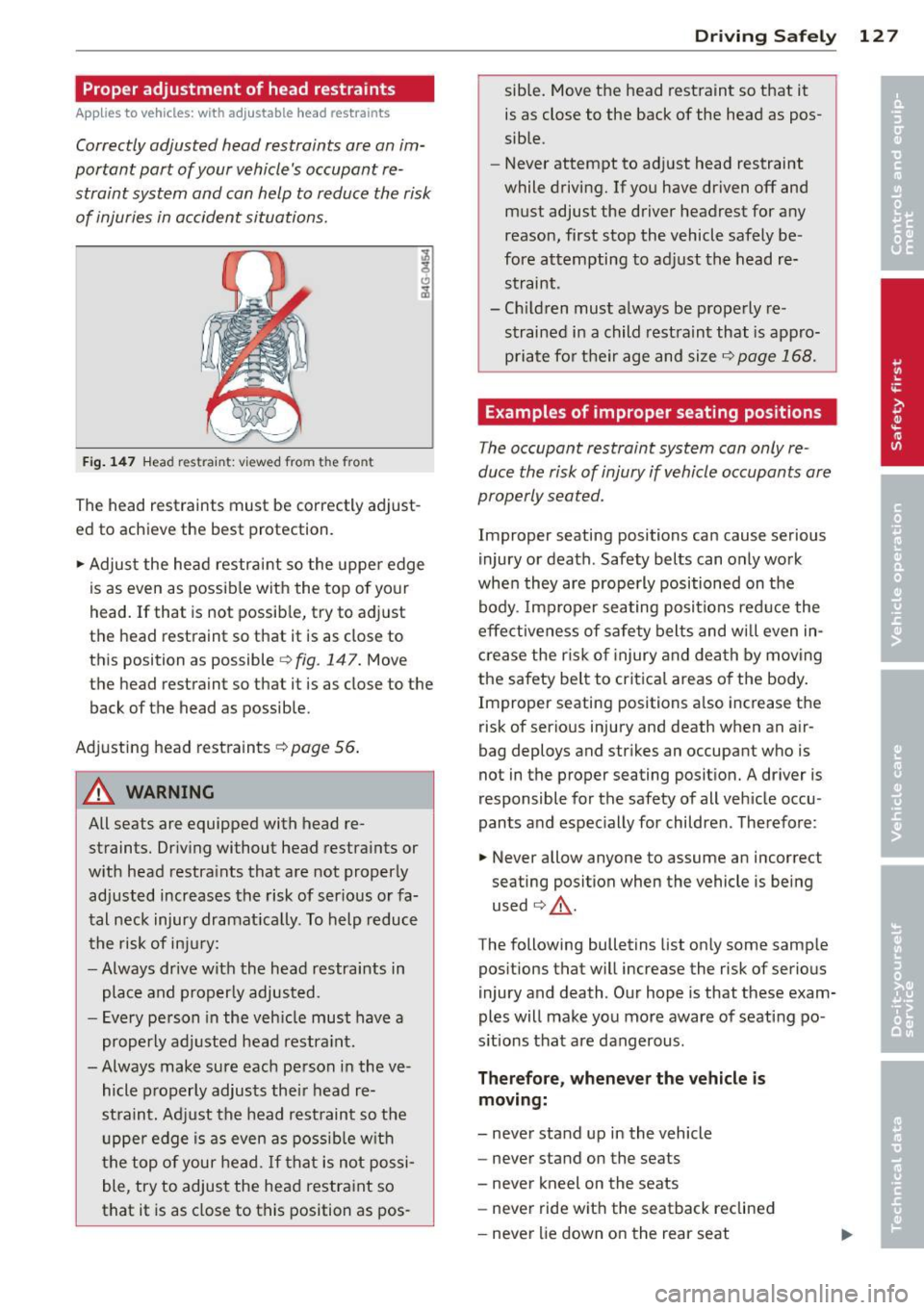
F ig . 147 H ead r estr ain t: v ie w ed fro m the front
The head restraints must be correctly adjust
ed to achieve the best protection .
.,. Adjust the head restraint so the uppe r edge
is as even as possib le with the top of your
head. If that is not possib le, try to adjust
the head restraint so that it is as close to
this position as possible
q fig . 147. Move
the head restraint so that it is as close to the back of the head as possible.
Adjusting head restraints
¢ page 56.
_&. WARNING
All seats are equipped with head re
straints. Driving without head restraints or
w ith head restraints that are not properly
adjusted increases the risk of ser ious or fa
tal neck injury dramat ica lly. To help reduce
the risk of inju ry:
- Always drive with the head restraints in
place and properly adjusted.
- Every pe rson in the veh icle must have a
properly adjusted head restra int .
-Always make sure each person in the ve hicle properly adjusts their head re
straint. Adjust the head restraint so the upper edge is as even as possib le w ith
the top of your head .
If that is not possi
ble, try to adjust the head restraint so
that it is as close to this position as pos-
Dr ivin g Sa fely 12 7
sible. Move the head restraint so that it
is as close to the back of the head as pos
sible.
- Never attempt to adjust head restraint
while driving. If you have driven off and must adjust the driver headrest for any
reason, first stop the vehicle safely be
fore attempting to adjust the head re
s traint .
- Ch ildren must always be prope rly re
strained in a child restraint that is appro
pria te fo r their age and size
¢ page 168.
Examples of improper seating positions
The occupant restraint system con only re
duce the risk of injury if vehicle occupants ore
properly seated .
Improper seating positions can cause serious
injury or death . Safety belts can only work
when they are properly positioned on the
body . Improper seating positions reduce the
effectiveness of safe ty belts and will even in
c rease the r isk o f injury and dea th by moving
the safety belt to critica l areas o f the body .
Improper seating positions a lso increase the
risk of serious injury and death when an air
bag deploys and str ikes an occupant who is
not in the proper seating position. A driver is
responsible for the safety of all veh icle occu
pants and espec ially for children . The refore :
.,. Never allow anyone to assume an incorrect
seating position when the vehicle is being
used
q _& .
The following bulletins list only some samp le
pos itions that will increase the risk of serio us
injury and death. Our hope is that these exam
ples will make you more aware of seating po
s itions that are dangerous.
Th erefore , whenever the vehicle is
moving:
- never stand up in the vehicle
- never stand on the seats
- never kneel on the seats
- never ride wit h the seatback reclined
- neve r lie down on the rear seat
Page 135 of 292
Safety belts
General notes
Always wear safety belts!
Wearing safety belts correctly saves lives!
This chapter explains why safety belts are nec
essary, how they work and how to adjust and
wear them correctly.
~ Read all the information that follows and
heed all of the instructions and WARNINGS.
A WARNING
Not wearing safety belts or wearing them
improperly increases the risk of serious
personal injury and death.
- Safety belts are the single most effective
means available to reduce the risk of se
rious injury and death in automobile acci
dents. For your protection and that of
your passengers, always correctly wear
safety belts when the vehicle is moving.
- Pregnant women, injured, or physically
impaired persons must also use safety
belts. Like all vehicle occupants, they are
more likely to be seriously injured if they
do not wear safety belts. The best way to
protect a fetus is to protect the mother -
throughout the entire pregnancy.
Number of seats
Your Audi has a total of four seating positions:
two in the front and two in the rear. Each seat ing position has a safety belt.
A WARNING
Not wearing safety belts or wearing them
improperly increases the risk of serious
personal injury and death.
- Never strap more than one person, in
cluding small children, into any belt. It is
especially dangerous to place a safety
belt over a child sitting on your lap.
- Never let more people ride in the vehicle
than there are safety belts available.
Safety belts 13 3
-Be sure everyone riding in the vehicle is
properly restrained with a separate safe
ty belt or child restraint.
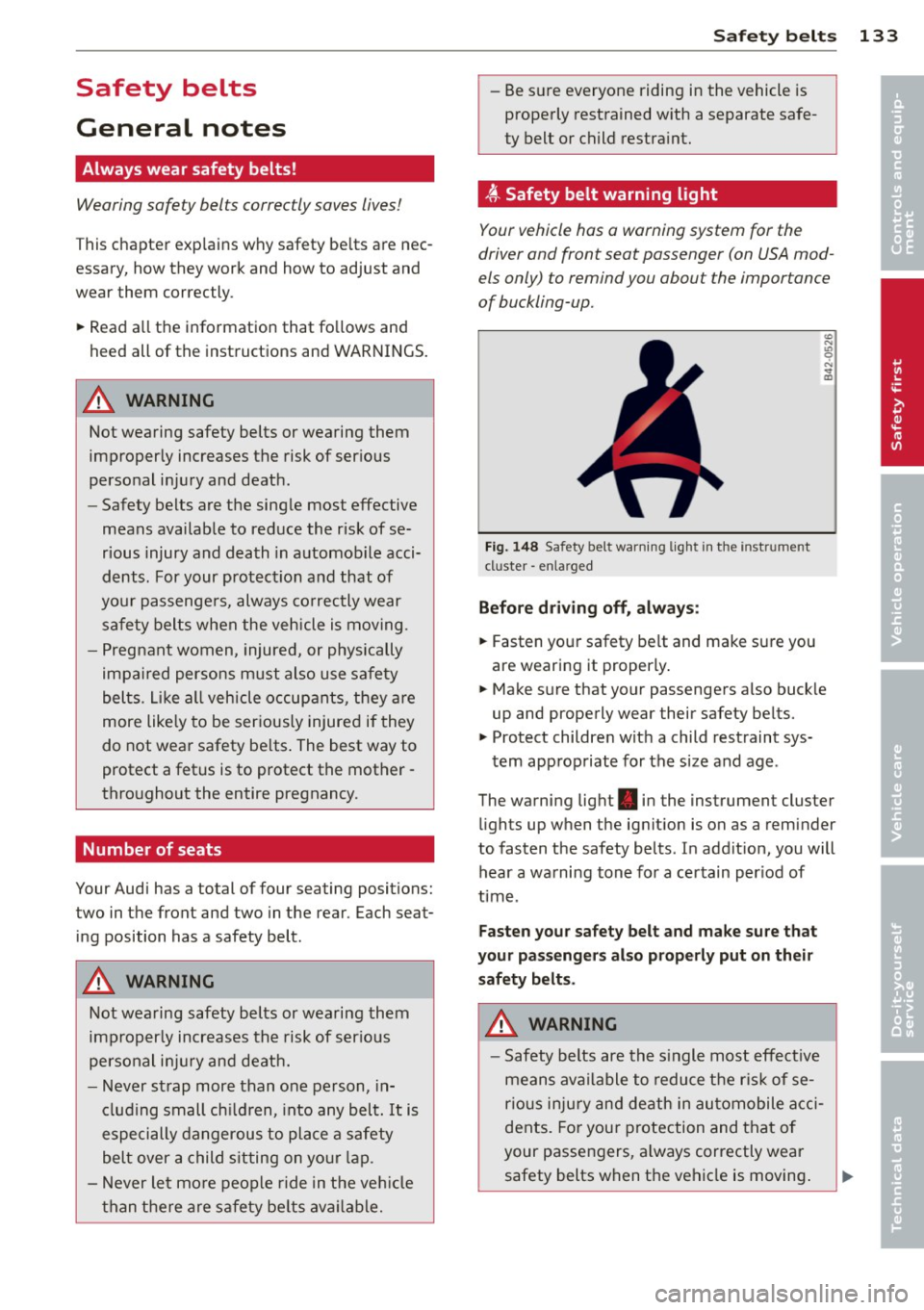
~ Safety belt warning light
Your vehicle has a warning system for the
driver and front seat passenger (on USA mod
els only) to remind you about the importance
of buckling-up.
Fig. 148 Safety belt warning light in the instr ument
cl uster -enla rged
Before driving off, always:
~ Fasten your safety belt and make sure you
are wearing it properly.
~ Make sure that your passengers also buckle
up and properly wear their safety belts.
~ Protect children with a child restraint sys-
tem appropriate for the size and age .
The warning light . in the instrument cluster
lights up when the ignition is on as a reminder
to fasten the safety belts. In addition, you will
hear a warning tone for a certain period of
time .
Fasten your safety belt and make sure that
your passengers also properly put on their
safety belts.
A WARNING
- Safety belts are the single most effective
means available to reduce the risk of se
rious injury and death in automobile acci
dents. For your protection and that of
your passengers, always correctly wear
safety belts when the vehicle is moving.
•
•
Page 137 of 292
occupant will slam violently into the steering
wheel, instrument panel, windshield, or what
ever else is in the way
r::;; fig. 151. This impact
with the vehicle interior has all the energy
they had just before the crash.
Never rely on airbags alone for protection.
Even when they deploy, airbags provide only
additional protection. Airbags are not sup
posed to deploy in all kinds of accidents. Al
though your Audi is equipped with airbags, all
vehicle occupants, including the driver, must
wear safety belts correctly in order to mini
mize the risk of severe injury or death in a
crash.
Remember too, that airbags will deploy only
once and that your safety belts are always
there to offer protection in those accidents in
which airbags are not supposed to deploy or
when they have already deployed. Unbelted
occupants can also be thrown out of the vehi
cle where even more severe or fatal injuries
can occur.
It is also important for the rear passengers to
wear safety belts correctly. Unbelted passen
gers in the rear seats endanger not only them
selves but also the driver and other passen
gers
r::;; fig. 152. In a frontal collision they will
be thrown forward violently, where they can
hit and injure the driver and/or front seat pas
senger.
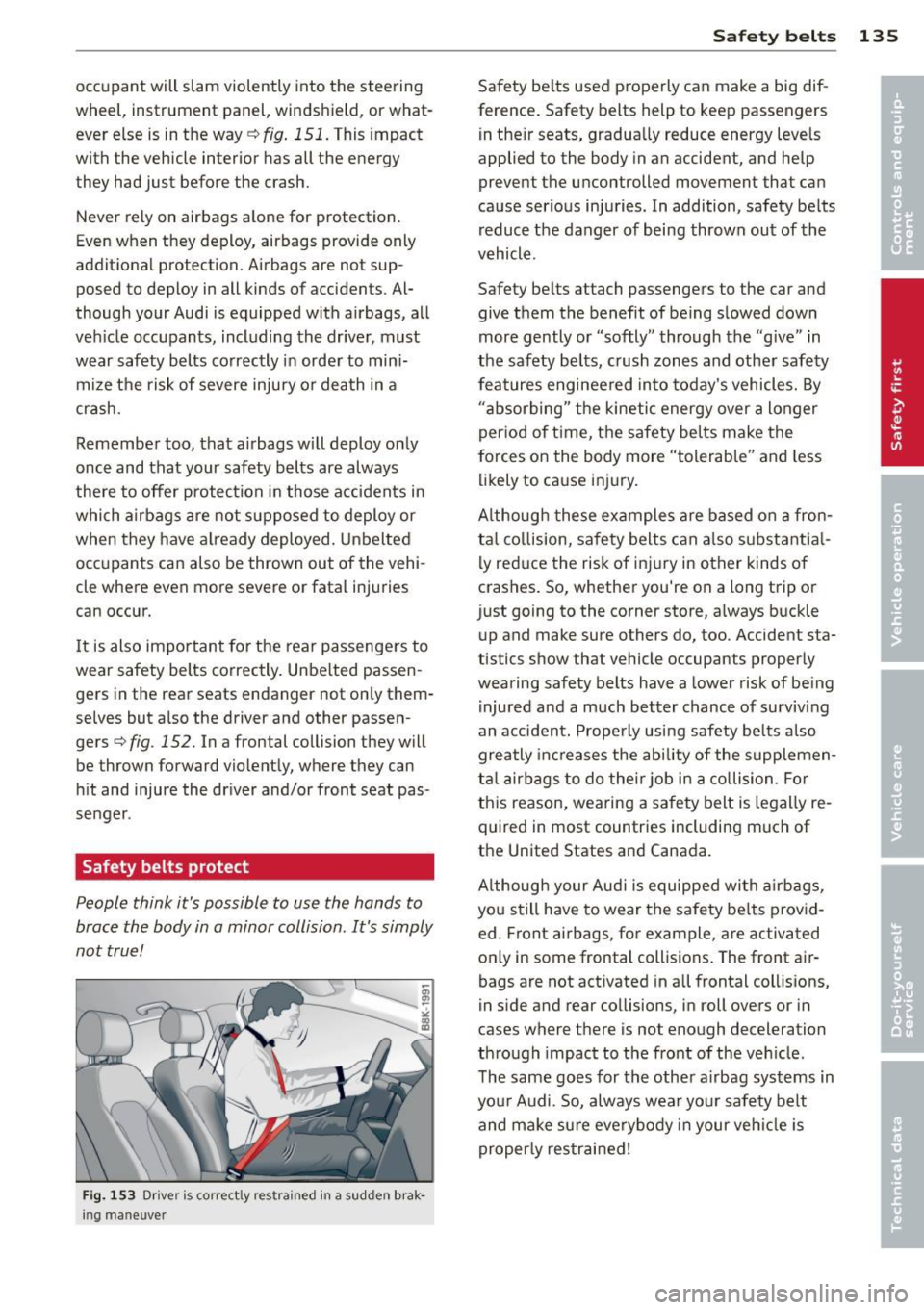
Safety belts protect
People think it's possible to use the hands to
brace the body in a minor collision. It's simply
not true!
Fig. 153 Driver is correctly restra ined in a sudden brak
ing maneuver
Safety belts 135
Safety belts used properly can make a big dif
ference. Safety belts help to keep passengers
in their seats, gradually reduce energy levels
applied to the body in an accident, and help
prevent the uncontrolled movement that can
cause serious injuries. In addition, safety belts
reduce the danger of being thrown out of the
vehicle.
Safety belts attach passengers to the car and
give them the benefit of being slowed down
more gently or "softly" through the "give" in
the safety belts, crush zones and other safety
features engineered into today's vehicles. By
"absorbing" the kinetic energy over a longer
period of time, the safety belts make the
forces on the body more "tolerable" and less
likely to cause injury.
Although these examples are based on a fron
tal collision, safety belts can also su bsta ntia l
ly reduce the risk of injury in other kinds of
crashes. So, whether you're on a long trip or
just going to the corner store, always buckle
up and make sure others do, too. Accident sta
tistics show that vehicle occupants properly
wearing safety belts have a lower risk of being
injured and a much better chance of surviving
an accident. Properly using safety belts also
greatly increases the ability of the supplemen
tal airbags to do their job in a collision . For
this reason, wearing a safety belt is legally re
quired in most countries including much of
the United States and Canada.
Although your Audi is equipped with airbags,
you still have to wear the safety belts provid
ed. Front airbags, for example, are activated
only in some frontal collisions. The front air
bags are not activated in all frontal collisions,
in side and rear collisions, in roll overs or in
cases where there is not enough deceleration
through impact to the front of the vehicle.
The same goes for the other airbag systems in
your Audi. So, always wear your safety belt
and make sure everybody in your vehicle is
properly restrained!
Page 141 of 292
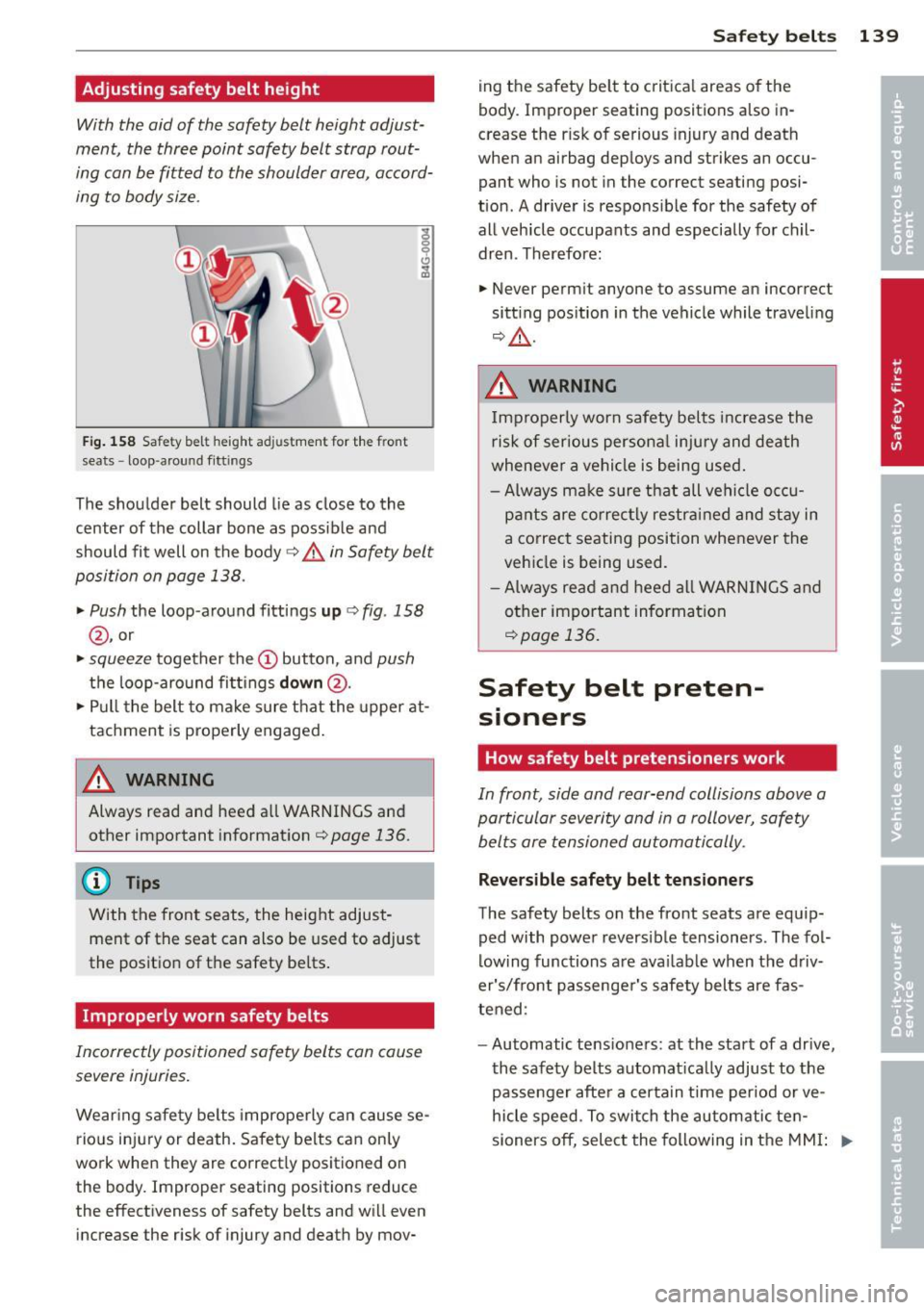
Adjusting safety belt height
With the aid of the safety belt height adjust
ment, the three point safety belt strap rout
ing can be fitted to the shoulder area, accord
ing to body size .
Fig . 158 Saf ety belt he ight ad justment for the front
seats -loop -aro und f itt ings
The shoulder belt should lie as close to the
center of the collar bone as possib le and
should fit well on the body¢,&.
in Safety belt
position on page 138 .
.,. Push
the loop -a round fittings up c> fig . 158
@ , or
.,. squeeze together the@button, and push
the loop-around fi ttings down @.
.,. Pull the belt to make sure t hat the upper at
tachment is properly engaged .
A WARNING
Always read and heed all WARNINGS and
other important informat ion
c> page 136 .
@ Tips
With the front seats, the height adjust
ment of the seat can also be used to adjust
the posit ion of the safety be lts .
Improperly worn safety belts
Incorrectly positioned safety belts can cause
severe injuries.
Wear ing safety be lts improperly can cause se
rio us in jury or death. Safety belts ca n only
work when they are correct ly positioned on
the body. Improper seating positions reduce the effectiveness of safety belts and wi ll even
increase the r isk of injury and death by mov-
Safety belts 139
ing the safety be lt to critica l areas of the
body. Improper seat ing positions also in
crease the r isk of serious injury and death
when an airbag dep loys and strikes an occu
pant who is not in the correct seating posi
tion . A driver is respons ible for the safety of
all vehicle occupants and especially for ch il
dren . Therefore:
.,. Never perm it anyone to assume an incorrect
sitt ing pos ition in the vehicle while trave ling
~ .&. -
A WARNING
Imp roperly worn safety belts increase the
risk of serious persona l injury and death
whenever a vehicle is being used.
- Always ma ke s ure that all vehi cle occu
pa nts are co rrec tly restra ined and stay in
a correct seating position whenever the
veh icle is being used .
- Always read and heed al l WARNI NGS a nd
other important informat ion
r:::> page 136 .
Safety belt preten
sioners
How safety belt pretensioners work
In front, side and rear-end collis ions above a
particular severity and in a rollover, safety
belts are tensioned automati cally .
Reve rsible s afety belt tensioners
The safety belts on the front seats are equ ip
ped with powe r reversible tensioners . The fol
low ing functions a re ava ilab le when the driv
er's/front passenge r's safety belts are fas
tened :
- Automatic tens ioners : at the start of a drive,
the saf ety belts automat ica lly adjust to the
passe nger afte r a certa in time per iod or ve
hicle speed . To switch the automatic ten
sioners off, select the following in the MMI: .,..
Page 142 of 292
140 Safety belts
ICAR !function button> (Car )* sys tem s> Ve
hicle setting s > Seats > Driver 's seat or Pas
senger 's se at > Automatic belt ten sioner
>
Off .
-In certain driving situations, the safety be lts
may tighten with a reversib le tensioning
function
c:> page 187.
- The safety belts may also tighten with this
revers ible tensioning f unction in m inor colli
s ions.
Pyrotechnic safety belt preten sioner s
The sa fety belts are equipped with safety be lt
pretensioners. The system is activated by sen
sors in front, side and rear-end collisions of
great severity and in a rollover. Th is tightens
the belt and takes up be lt slack
c:> &. in Service
and disposal of safety belt pretensioner on
page 140 .
Taking up the slack helps to reduce
forward occupant movement during a co lli
sion.
,& WARNING
- It is possib le for the pre tensioners to de
ploy incorrect ly .
- T he py rotechnic system can only pr ovide
pro te ction for one co llision.
If t he pyro
techni c pretensioners dep loy, the p reten
sioning system must be replaced .
@ Tips
The pyrotechnic safety belt p retens ioners
can only deploy once .
- The safety belt pretens ione rs do no t de
ploy in mi no r frontal an d side col lisions,
i n rear -end collisions, in rollove rs and in
collisions invo lving very litt le impact
fo rce.
- A f ine d ust is released when the pyro
technic safety belt pretensioners deploy.
This is normal and is not caused by a fire
i n the veh icle.
- The relevant safety requirements must
be observed when the vehicle or compo
nents of the system are scrapped. A
qualified dea lership is familiar with
these regulations and w ill be pleased to
pass on the informat io n to you . - Be sure to observe all safety, env
iron
menta l and other regu lations if the ve hi
cle or individual parts of the system, par
ticu larly the safety belt or airbag, are to
be disposed. We recommend you have
your authorized Audi dealer perform this service fo r you.
Service and disposal of safety belt
pretensioner
T he safety belt pretens ioners are parts o f the
safety belts on your Audi . Insta lling, remov
ing, servicing or repairing of be lt pretension
ers can damage the safety belt system and
prevent it from working correctly in a co lli
s ion.
There are some important t hings you have to
know to make sure that the effectiveness of
the system w ill not be impaired and that dis
carded components do no t cause injury or pol
l u te the environment .
A WARNING
-Improper care, serv ic ing and repair p roce-
d ur es can increase the risk of pe rsonal in
j u ry and death by prevent ing a safety belt
p retensioner from activ ating w hen neede d
or activa ting it unexpectedly:
- T he belt pretensione r system can be a ct i
vated only once. If be lt pretensioners
have been activated , the system m ust be
replaced .
- Never repair, adjus t, or change any parts
of the safety be lt system .
- Safety belt systems incl uding safety belt
pretensioners cannot be repaired. Spe
cial procedures are required for removal,
installation and disposa l of th is system.
- For any wo rk on the safety belt system,
we strongly recommend t hat you see
your author ized Audi dealer or qualif ied
technician who has an Audi approved re pa ir manua l, train ing and special equ ip
ment necessary.
Page 145 of 292
Since the circumstances will vary considerably
between one collision and another , it is not
possible to define a range of veh icle speeds
that will cover every possible k ind and angle
of impact that will always trigger the airbags .
Important factors include, for example, the nature (hard or soft) of the object which the
car h its, the ang le of impact, vehicle speed ,
etc. The front airbags will a lso not inflate in
side or rear collisions, or in ro ll-overs .
Alw ays rememb er: Airbags will deploy only
once, and only in certa in kinds of collisions.
Your safety belts are always there to offe r pro
tect ion in those s ituations in which airbags
are not supposed to deploy , or when they have
a lready deployed ; for example , when your ve
hicle strikes or is struck by another vehicle af
ter the first co llision .
This is just one of the reasons why an a irbag is
a supp lementary restraint and is not a s ubsti
tute for a safety belt . The airbag system
works most effectively when used with the
safety belts. Therefore, always properly wear
your safety belts ¢
page 133.
A WARNING
Sitting too close to the steer ing whee l or
instrument panel will decrease the effec
tiveness of the airbags and will inc rease
the risk of pe rsonal injury in a co llision .
- Never sit closer than 10 inches (2S cm)
to the stee ring wheel or instr ument pan
el.
- If you cannot sit more than 10 inches
( 2 5 cm) from the steer ing whee l, investi
ga te whethe r adaptive equipment may
be available to help you reach the pedals
and increase your seating distance from
the steering wheel.
- If you are unrestrained, lean ing forward,
sitting sideways or out of position in any
way, yo ur risk of inj ury is much higher.
- You w ill also receive serio us injuries and
cou ld even be killed if you are up against
the a irbag or too close to it when it in
flates -even with an Advanced Airbag.
A irbag system 143
-To reduce the risk of injury when an air
bag inflates, always wear safety belts
properly ¢
page 136, Safety belts.
-Always make certain that ch ild ren age 12
or younger a lways ride in the rear seat. If
children are not properly restrained, they may be severe ly injured or killed when an
airbag inf lates .
- Never let ch ildren ride unrestra ined or
improperly restrained in the vehicle. Ad
just the front seats prope rly .
- Never ride with the backrest reclined .
- Always sit as far as possible from the
steer ing whee l or the instrument pane l
¢page 124.
-Always sit upright with your back against
the backrest of your seat .
- Never p lace your feet on the instrument
panel or on the seat. Always keep both
feet on the f loor in front of the seat to
he lp preven t serio us in ju ries to the legs
and h ips if the airbag infla tes.
- Never recline the front passenger 's seat
to transport objects . Items can a lso
move into the area of the s ide a irbag or
the front a irbag du ring bra king or in a
sudden maneuve r. Obje cts near the air
bags can become projectiles and cause
in ju ry when an airbag inflates.
A WARNING
Airbags that have deployed in a crash must
be replaced.
- Use on ly original equipment airbags ap
proved by Aud i and installed by a trained
technician who has the necessary too ls
and d iagnost ic equipment to properly re
place any airbag in your vehicle and as
sure system effectiveness in a crash .
- Never perm it salvaged or recycled air
bags to be installed in your vehicle . •
•
Page 146 of 292
144 Airbag sys tem
Child restraints on the front seat - some
important things to know
• Be sure to read the important information
and heed the WARNINGS for important de
ta ils about ch ildren and Advanced Airbags
i=> page 168.
Even though your vehicle is equipped with an
Advanced Airbag System, make certain that
all children, especially those 12 years and
younger, always ride in the back seat properly
restra ined for their age and size. The airbag
on the passenger side makes the front seat a potentially dangerous place for a child to r ide .
The front seat is not the safest place fo r a
chi ld in a fo rward-facing chi ld seat.
It can be a
ve ry dangerous p lace for an infant or a c hild in
a rearward -facing seat.
The Advanced Airbag System i n your veh icle
has been certified to comply with the require
men ts of United States Federa l Mo to r Veh icle
Safety Standard 208 as applicable at the time
your ve hicle was manufact ured.
The Standa rd requires the fron t air bag on t he
passenger side to be turned off ("sup
p ressed") if a child up to about one yea r of
age restrained in one of the rear-facing or for
ward-facing infant restraints listed in Federal
Motor Vehicle Safety Standard 208 with which
the Advanced A irbag System in your vehicle
was certified has been installed on the front
passenger seat. For a listing of the child re
straints that we re used to certify compliance
with the US Safety Sta ndard
c> page 170.
The PASSENGER AIR BAG OFF light in the in
strument panel tells you when the front Ad
vanced A irbag on the passenger side has been
turned off by t he e lectronic control unit.
Each time you sw itch on the ignit ion, the
PAS
SENGER AIR BAG OFF
l ight will come on for a
few seconds a nd:
- will stay on if the front passenger seat is not
occupied,
- will stay on if the electrical capacitance
measured by the capacitive passenger de
tection system for the fro nt passenger seat equa
ls the combined capacitance of an in
fant up to about one year of age and one of
the rearwa rd-facing or forward-fac ing ch ild
restraints listed in Federal Motor Vehicle
Safety Standard 208 with which the Ad
vanced Airbag System in your vehicle was
cert ified. For a listing of the ch ild restraints
that w ere used to certify you r vehicle 's com
plia nce w it h the U.S. Safety Standard
i=>page 170.
- w ill stay on i f the re is a small c hild or child
restrai nt on the front passenge r seat,
- w ill go off if the front passenger seat is oc
cupied by an adult as registered by the ca pacitive passenge r de tection system
c> page 154, Monitoring the Advanced Air
bag System.
T he PASSENGER AIR BAG OFF light comes on
whe n electr ica l capacitance regis tered on the
front passenger seat is eq ua l to or less than
t h e comb ined capacitance of a typical 1 year
o ld infant and one of the rearward-facing or
forward-facing child restraints listed in Feder
al Motor Vehicle Safety Standard 208 with
which the Advanced Airbag System i n your ve
hicle was cert ified .
If the total e lectr ica l capacitance registered
on the front passenger seat is more than that
of a typical 1 year-old child but less than the
we ight of a small adu lt, the front airbag on
the passenger side can deploy (the
PASSEN
GER AIR BAG OFF
light does not come on).
If the
PASSENGER AIR BAG OFF light does
not come on, the front airbag on the passen
ger side has not been turned off by the e lec
t ron ic cont ro l unit and can deploy if the con
t ro l u nit se nses an impa ct that mee ts the con
di tions s to red in its memory.
For example, the airbag may deploy if:
- a small ch ild that is heav ier th an a typical 1
year-old child is on the front passenger seat
(regard less of whether the child is in one of
the ch ild seats listed
c::;, page 170), o r
- a child who has outgrown child restraints is
on the front passenger seat. ..,.
Page 147 of 292
If the fron t passenger airbag is turned off, the
PA SSENGER AIR BA G OF F light comes on in
the instrument cluster and stays on.
If the front passenger airbag deploys, the
F ederal Standard requires the airbag to meet
the " low risk" deployment criteria to reduce
the r isk of injury through interaction with the
airbag. "Low r isk" deployment occurs in those
crashes that take place at lower decelerations
as defined in the electronic control un it
c::> page 155, PASSENGER AIR BAG OFF light.
Always remember, a child seat or infant carri
er installed on the front seat may be struck
and knocked out of position by the rap idly in
flating passenger's a irbag i n a frontal colli
sion . The airbag could greatly reduce the ef
fectiveness of t he ch ild restraint and even se
r io usly inju re the child d uring inflat io n.
For this reason, and because the back seat is
the safest place for chi ldren - when properly
restra ined accord ing to their age and size - we
strongly recommend that children always sit in the back seat
c::> page 168, Child Safety.
A WARNING
-
A child in a rearward -facing child seat in
stalled on the front passenger seat will be
ser iously injured and can be killed if the
front airbag inflates - even with an Ad
vanced Airbag System.
- The inflating airbag w ill hit the child seat
or infant carrier w ith great force and w ill
smash the ch ild seat and child against
the backrest, center armrest, door or roof.
- Always install rear-facing child seats on the rear seat.
- If you must install a rearward facing
child seat on the front passenge r seat
because of exceptiona l circumstances
and the
PASSENGER AIR BAG OFF light
does not come on and stay on, immedi
a tely ins tall the rea r-facing chi ld seat in a
rear seating position and have the airbag
system inspected by your Audi dealer.
A irbag system 145
-Forwa rd-facing child seats installed on
the front passenger's seat may interfere
with the dep loyment of the airbag and
cause serious persona l injury to the
child.
A WARNING
If, in except ional circumstances, you must
install a forward-facing child restraint on
the front passenge r's seat:
- Always ma ke sure the forward-facing
seat has been designed and certified by its manufacture r for use on a front seat
with a passenger fron t and s ide a irbag.
- Never put the fo rward-facing child re
s tra int up against or ve ry near the instru
men t panel.
- Always move the passenge r seat into its
rea rmost pos ition in the se at's fore and
aft ad justment range, as fa r away from
the airbag as possible before installing
the forward-fac ing ch ild restra int . The
backrest must be adj usted to an upright
position.
- Make sure that the
PASSENGER AIR BAG
OFF
li ght comes on and stays on all the
time whenever the ignition is switched on .
A WARNING
To reduce the risk of ser ious injury, make
sure that the
PASSENGER AIR BAG OFF
light w ill be displayed whenever a child re
straint is insta lled on the front passenge r
se at and the ignition is sw itched on.
- If the
PASSENGER AIR BAG OFF light
does not s tay on, perform the checks de
scribed
c::> page 154, Monitoring the Ad
vanced Airbag System.
- T ake the chi ld restraint off t he front pas
senger seat and install it prope rly at one
of the rear seat positions i f the
PASSEN
GER AIR BAG OFF
light does not stay on.
- Have the airbag system inspected by
your Aud i dea ler immediately.
•
•