ESP AUDI RS7 SPORTBACK 2014 Service Manual
[x] Cancel search | Manufacturer: AUDI, Model Year: 2014, Model line: RS7 SPORTBACK, Model: AUDI RS7 SPORTBACK 2014Pages: 292, PDF Size: 73.56 MB
Page 148 of 292
146 Airbag system
-Always carefully follow instructions from
child restraint manufacturers when in
stalling child restraints.
_& WARNING
If, in exceptional circumstances, you must
install a forward or rearward -facing child
restraint on the front passenger's seat:
- Improper installation of child restraints
can reduce their effectiveness or even
prevent them from providing any protec
tion.
- An improperly installed child restraint
can interfere with the airbag as it de
ploys and seriously injure or even kill the
child -even with an Advanced Airbag
System.
- Always carefully follow the manufactur
er's instructions provided with the child
seat or carrier .
- Always make sure that there is nothing
on the front passenger seat that will
cause the capacitive passenger detection
system in the seat to signal to the Airbag
System that the seat is occupied by a person when it is not, or to signal that it
is occupied by someone who is heavier
than the person actually sitting on the
seat . The presence of additional objects
could cause the passenger front airbag
to be turned on when it should be off, or
could cause the airbag to work in a way
that is different from the way it wou ld
have worked without the object on the
seat.
Front airbags
Description of front airbags
The airbag system can provide supplemental
protection to properly restrained front seat occupants .
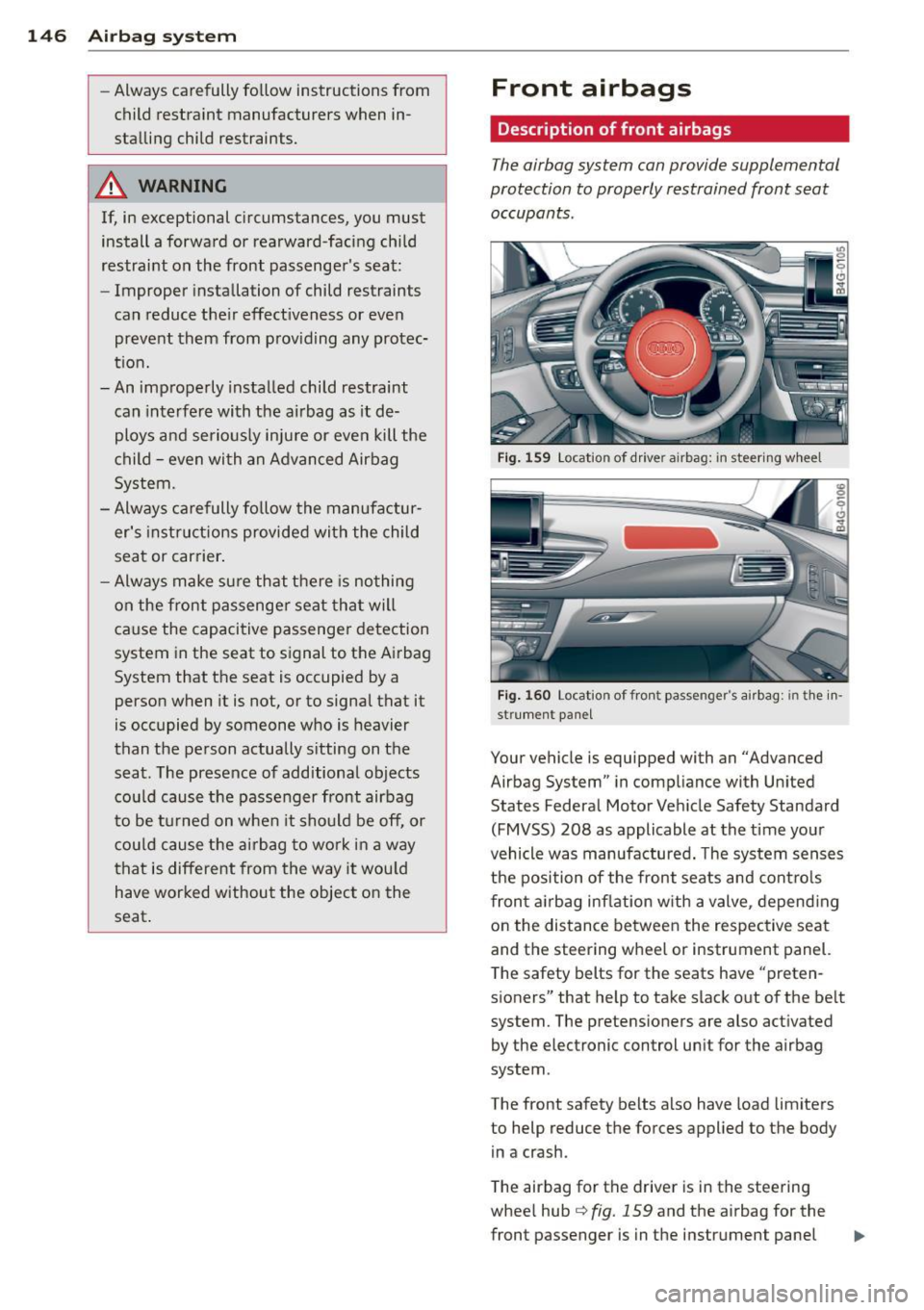
Fig. 159 Locat io n of drive r ai rbag: in steering wh eel
Fig. 160 Locat io n of fron t passenger' s air bag: in the in·
st rument panel
Your vehicle is equipped with an "Advanced
Airbag System" in compliance with United
States Federal Motor Vehicle Safety Standard
(FMVSS) 208 as applicable at the time your
vehicle was manufactured. The system senses
the position of the front seats and controls
front airbag inflation with a valve , depending
on the distance between the respective seat
and the steering wheel or instrument panel.
The safety belts for the seats have "preten
sioners" that help to take slack out of the belt
system. The pretensioners are also activated by the electronic control uni t for the airbag
system .
The front safety belts also have load limiters
to help reduce the forces applied to the body in a crash.
The airbag for the driver is in the steering
wheel hub¢
fig. 159 and the airbag for the
front passenger is in the instrument panel
Page 149 of 292
q fig. 160. The general location of the airbags
is marked "AIRBAG".
There is a lot you need to know about the air bags in your vehicle. We urge you to read the
detailed information about airbags, safety
belts and child safety in this and the other
chapters that make up the owner's literature.
Please be sure to heed the WARNINGS -they
are extremely important for your safety and
the safety of your passengers, especially in
fants and small children .
A WARNING
Never rely on airbags alone for protection.
- Even when they deploy, airbags provide only supplemental protection .
- Airbag work most effectively when used
with properly worn safety belts .
- Therefore, always wear your safety belts
and make sure that everybody in your ve
hicle is properly restrained .
- Always hold the steering wheel with both
hands on the outside of the steering
wheel rim at the 9:00 o'clock and 3:00 o'clock positions to help reduce the risk
of personal injury if the driver's airbag in
flates.
- Never hold the steering wheel at the 12
o'clock position or with your hands any
where inside the steering wheel or on the
steering wheel hub. Holding the steering
wheel the wrong way increases the risk
of severe injury to the arms, hands, and
head if the driver airbag deploys .
A WARNING
Objects between you and the airbag will
increase the risk of injury in a crash by in
terfering with the way the airbag unfolds
and/or by being pushed into you as the air
bag inflates.
- Always make sure nothing is in the front
airbag deployment zone that could be
struck by the airbag when it inflates.
- Objects in the zone of a deploying airbag
can become projectiles when the airbag
Airbag system 147
deploys and cause serious personal in
Jury.
- Never hold things in your hands or on
your lap when the vehicle is in use.
- Never place accessories or other objects
(such as cup holders, telephone brackets,
note pads, navigation systems, or things
that are large, heavy, or bulky) on the
doors; never attach then to the doors or
the windshield; never place them over or
near or attach them to the area marked
,,AIRBAG" on the steering wheel, instru
ment panel or the seat backrests; never
place them between these areas and you
or any other person in the vehicle.
- Never attach objects to the windshield
above the passenger front airbag, such
as accessory GPS navigation units or mu
sic players. Such objects could cause seri
ous injury in a collision, especially when
the airbags inflate.
- Never recline the front passenger seat to
transport objects. Items can also move
into the deployment area of the side air
bags or the front airbag during breaking
or in a sudden maneuver. Objects near
the airbags can fly dangerously through
the passenger compartment and cause injury, particularly when the seat is re
clined and the airbags inflate.
WARNING
A person on the front passenger seat, es
pecially infants and small children, will re
ceive serious injuries and can even be kil
led by being too close to the airbag when
it inflates.
- Although the Advanced Airbag System in
your vehicle is designed to turn off the
front passenger airbag if an infant or a
small child is on the front passenger
seat, nobody can absolutely guarantee
that deployment under these special conditions is impossible in all conceiva
ble situations that may happen during
the useful life of your vehicle . .,.
•
•
Page 150 of 292
148 Airbag system
-The Advanced Airbag System can deploy
in accordance with the .,low risk" option
for 3- and 6-year-old children under the U.S . Federal Standard if a child with elec
trical capacitance greater than the com bined capacitance of a typical one-year
old infant restrained in one of the for
ward facing or rearward-facing child
seats with which your vehicle was certi
fied is on the front passenger seat and
the other conditions for airbag deploy ment are met.
- Accident statistics have shown that chil
dren are generally safer in the rear seat
area than in the front seating position.
- For their own safety, all children, espe
cially 12 years and younger, should al
ways ride in the back properly restrained
for their age and size.
Advanced front airbag system
Your vehicle is equipped with a front Advanced
Airbag System in compliance with United
States Federal Motor Vehicle Safety Standard
208 as applicable at the time your vehicle was manufactured.
The front Advanced Airbag System supple
ments the safety belts to provide additional
protection for the driver's and front passeng
er's heads and upper bodies in frontal crashes .
The airbags inflate only in frontal impacts
when the vehicle deceleration is high enough.
The front Advanced Airbag System for the
front seat occupants is not a substitute for
your safety belts. Rather, it is part of the over all occupant restraint system in your vehicle.
Always remember that the airbag system can
only help to protect you, if you are sitting up
right, wearing your safety belt and wearing it
properly . This is why you and your passengers
must always be properly restrained, not just
because the law requires you to be.
The Advanced Airbag System in your vehicle has been certified to meet the "low risk" re
quirements for 3 and 6 year-old children on
the passenger side and very small adults on the driver side. The low risk deployment crite
ria are intended to help reduce the risk of in
jury through interaction with the front airbag
that can occur, for example, by being too close to the steering wheel and instrument
panel when the airbag inflates.
In addition, the system has been certified to
comply with the "suppression" requirements
of the Safety Standard, to turn off the front
airbag for infants 12 months old and younger
who are restrained on the front passenger
seat in child restraints that are listed in the
Standard
c::> page 170, Child restraints and
Advanced front airbag system.
"Suppression" requires the front airbag on the
passenger side to be turned off if:
- a child up to about one year of age is re
strained on the front passenger seat in one
of the rear-facing or forward-facing infant
restraints listed in Federal Motor Vehicle
Safety Standard 208 with which the Ad
vanced Airbag System in your vehicle was
certified. For a listing of the child restraints
that were used to certify your vehicle's com
pliance with the US Safety Standard
i=>page 170,
-When a person is detected on the front pas
senger seat that has an electrical capaci
tance that is more than the total electrical
capacitance of a child that is about 1 year
old restrained in one of the rear-facing or
forward -facing infant restraints (listed in
Federal Motor Vehicle Safety Standard 208
with which the Advanced Airbag System in
your vehicle was certified) , the front airbag
on the passenger side may or may not de
ploy.
The
PASSENGER AIR BAG OFF light comes on
when the electronic control unit detects a to
tal electrical capacitance on the front passen ger seat that requires the front airbag to be
turned off. If the
PASSENGER AIR BAG OFF
light does not come on, the front airbag on
the passenger side has not been turned off by
the control unit and can deploy if the control unit senses an impact that meets the condi -
tions stored in its memory. ..,_
Page 152 of 292
150 Airbag sys te m
backrest must be adjusted to an uprigh t
posit ion.
- Always make sure that there is nothing
on the front passenger seat that will
cause the capacitive passenger detection
system in the seat to s ignal to the A irbag
System that the seat is occupied by a
person when it is not, or to signal that it
is occupied by someone who is heavier
than the pe rson actually s itting on t he
seat. The presence of additiona l objects
cou ld cause the passenger front airbag
to be t urned on w hen it sho uld be off, or
cou ld cause the airbag to work in a way
that is different from the way it wou ld
have worked without the object on the
seat.
- Make sure that the
PASSENGER AIR BA G
OFF
light comes on and stays on all the
t ime w henever the ignition is switched
on.
Advanced Airbag System components
The front passenger seat in you r veh icle has a
l ot of very important pa rts of the Advanced
A irbag System in it . These parts include the
capacitive passenge r de tect ion sys tem, wir
ing, brac kets, and more . The cont ro l uni t
monitors the system on the front passenger
seat when the ignition is switc hed on and
turns the airbag indicato r light on when a
malfunction in the one of the system compo
nents is detected
c::;, page 155 . Because the
fro nt passenge r seat contains important pa rts
of the Advanced Airbag System , you must
take ca re to p revent it from being damaged.
Da mage to the seat may preven t the Ad
vanced A irb ag System for the fron t passenger
seat from doing i ts job in a c rash .
The front Advanced Airbag System
consists of the following:
-Crash sensors in the front o f the veh icle tha t
measure veh icle acceleration/dece le ration
to provide information to the Advanced Air bag System about the severity of the crash. -
An elect ronic contro l unit, with integrated
crash sensors for front and sid e impacts .
T he control un it "decides" whether to fire
the front a irbags based on the inform at ion
received from the crash sensors. The control
unit also "decides" whether the safety belt prete nsioners shou ld be act ivated .
- An Advanced A irbag w ith gas generator and
contro l valve for the driver inside the steer
ing wheel hub .
- An Advanced A irbag w ith gas generator and
contro l valve inside the inst rument panel for
the front passenger .
- A capacit ive passenger detection system u n
de rneath the front passenger seat cover .
This system measures the elec trical capac i
t ance of the perso n in t he seat. The informa
t ion regis tered is se nt cont inuo usly to the
electronic con trol un it to regu late deploy
ment of the front Advanced Airbag on the
passenger side.
- An airbag monitoring system and indicator
light in the instr ument cluster
c::;, page 154.
- A senso r in each front seat regis ters the dis
tance between the respective seat and the
steering whee l or instrument panel. The in
formation registered is sent cont inuo usly to
the electron ic contro l uni t to regulate de
ployment of the front Adv a need A irbags .
- The
PASSENGER AIR BAG OFF light comes
on and stays on in the center of the instr u
ment panel
c::;, page 155, fig . 162 and tells
you when the front Advanced Airbag on the
passenger side has been t urned off.
- A sensor in the safety belt latch for the driv
er and fo r the front seat passenger that
senses w hether t hat safety belt is latched or
no t and transmi ts this information to t he
elec tronic con trol un it.
A WARNING
D amage to the fron t passenger seat can
prevent the front airbag from working
p roperly.
- Imp roper repai r or disassembly of the
front passenge r and dr iver seat will pre
vent the Advanced Airbag System from
functioning properly .
-
Page 154 of 292
152 Airbag system
things on the sea t cushion can have the
same effect. If the front passenger fron tal airbag is turned on, the
PASSENGER
AIR BAG OFF
light light will go out .
How the Advanced Airbag System
components work together
The front Advanced Airbag System and the
side airbags supplement the protection of
fered by the front three -point safety be lts
with pretensioners and load limiters and the
adj ustab le head restraints* to help reduce the
risk of inju ry in a wide range of accident and
crash situa tions. Be sure to re ad the impor
tan t information abou t safe ty and heed the
WARNINGS in this chapter .
Dep loyment of the Advanced Airbag System
and the activat ion of the safety bel t preten
sioners depend on the decelera tion measured
by the crash sensors and registered by the
e lectronic control un it . The amount of i nfla
tion of the front airbags can also be adapted to the front sea t position , depend ing on the
d istance between t he respective front seat
and the steering wheel o r instrument pa nel as
registered by sensors in the seats. Crash se
ver ity depends on speed and dec elerat ion as
well as the mass and st iffness of the vehicle
or objec t invo lved in the crash .
On the passenge r side, regard less of safety
be lt use, the front passenger fronta l a irbag
will be turned off if the e lectrical capacitance
measured by the capac itive passenger de tec
tion system on the front passenger seat is less
than the amount programmed in the electron
i c co ntrol unit . The front passenger frontal air
bag will a lso be turned off if the capa cita nce
measured by the system for the front passen
ge r seat eq ua ls tha t of an infant of abo ut one
yea r of age in one o f the child sea ts that was
used to cert ify the Advanced Airbag System
under Federal Motor Vehicle Safety Standard
208. The
PASSENGER AIR BAG OFF li ght
comes on and stays on to tell you when the
front Advanced A irbag System on the passen
ge r side has been turned off~
page 155 .
A WARNING
-To reduce the risk of injury w hen an a irbag
in flates, always wear safety be lts p roperly.
- If you are unrestra ined, leaning fo rward,
sitt ing s ideways or out of pos ition in any
way, your risk of injury is much h igher .
- You will a lso receive se rious injuries and
could even be killed if you a re up aga inst
the airbag o r too close to it when it in
flates - even w ith an Advanced A irb ag
r:::> page 1 4 2 .
More important things to know about
front airbags
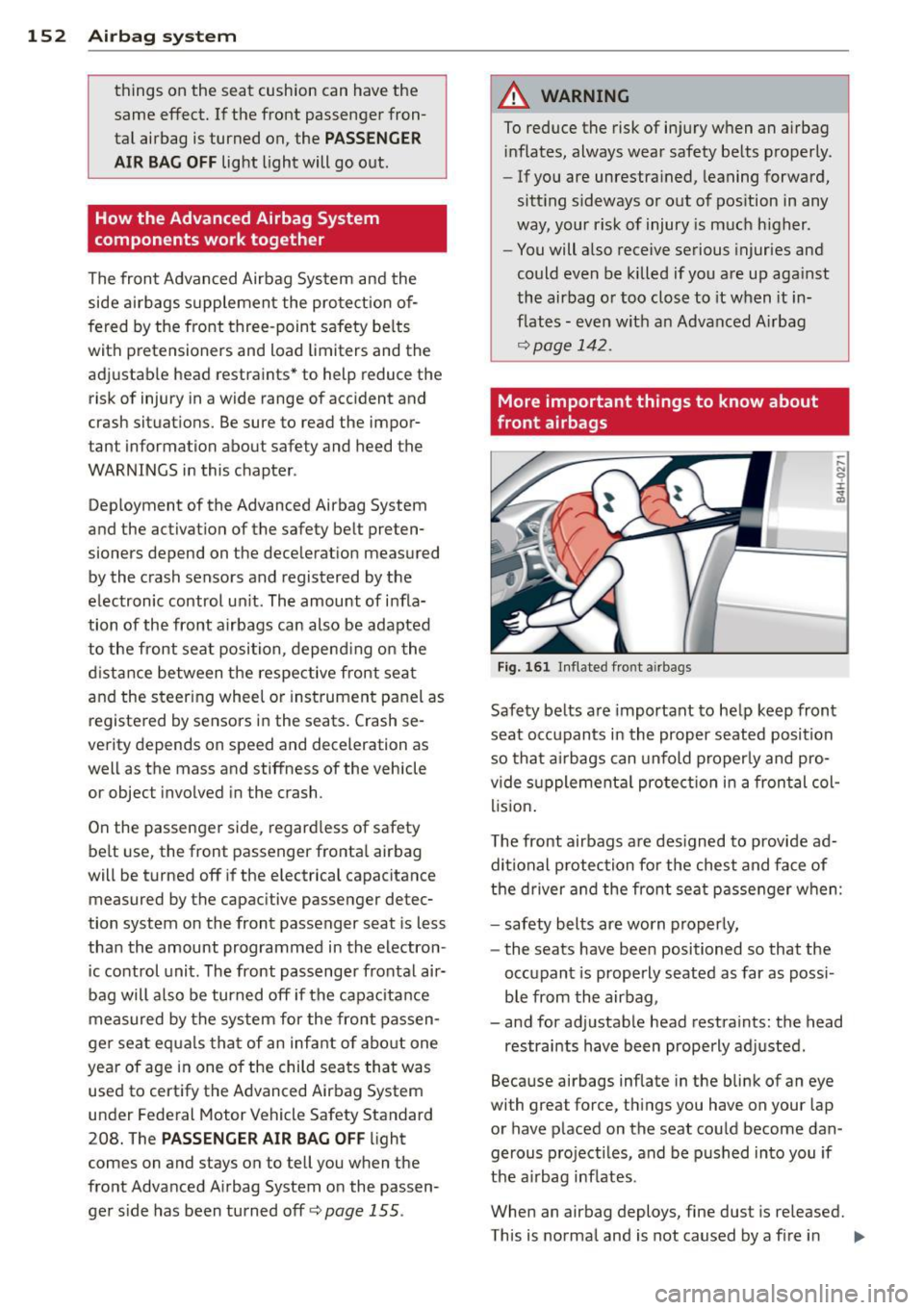
Fig . 1 61 In flated fro nt a irbags
Safety belts a re important to he lp keep front
seat o ccupants in the proper seated position
so that a irbags can unfold properly and pro
v ide s upplementa l pro te cti on in a fron tal col
li sion .
T he front airbags are des igned to provide ad
di tional p rotection fo r the ches t and face of
the driver a nd the front seat passenger w hen:
- safety belts are worn properly,
- the seats have bee n positioned so that the
occupant is properly seated as far as poss i
b le from the airbag ,
- and for ad justab le head restra ints: the head
restrai nts have been properly ad justed.
Beca use airbags inflate in the blink of an eye
with great force, th ings you have on your lap
or have p laced on the seat cou ld become dan
gerous projecti les, and be p ushed in to you if
t h e a irbag inflates .
When an airbag deploy s, fine dust is re leased.
This is norma l and is not caused by a f ire in ..,.
Page 156 of 292
154 Airbag sys te m
- Never place or attach accessories or o th
er objects (such as cup holders, tele
phone brackets, large, heavy or bulky ob
jects) on the doors, over or near the area marked "AIRBAG" on the stee ring wheel,
instrument panel, seat backrests or be
tween those a reas and yourself. These
objects co uld cause injury in a crash, es
pecially when the airbags inflate .
- Never recline the front passenger's seat
to transport objec ts. Items can also
move into the area o f the side airbag or
the front airbag during braking or in a sudden maneuver . Objects near the air
bags can become project iles and cause
injury, part icularly when the seat is re
cl ined .
- Never place or transport ob jects on the
front passenger seat. Objects on the
front passenger seat could cause the ca pacitive senso r in the seat to s ignal to
airbag system that the seat is occupied
by a person whe n it in fa ct is not, o r that
the person on the se at is heavie r than he
or she actually is. The change in electric
capacitance because of such objects can
cause the passenger front airbag to be
t u rned on when it sho uld be
off, or can
cause the airbag to work in a way that is
different from the way it wou ld have
wor ked w ithout ob jects on the seat .
- Always make sure that there is nothing
on the front passenger seat that will
cause the capacitive passenge r detection
system in the s eat to s ignal to the A irbag
System that the seat is occupied by a
person when it is not, or to signa l th at it
is occupied by someone who is heavier
than the pe rson actually s itting on the
seat . The prese nce of an object co uld
cause the passenger front a irbag to be
t ur ned on when it sho uld be
off, or co uld
cause the airbag to work in a way t hat is
different from the way it wou ld have
worked w ithout the object on the seat.
A WARNING
The fine dust created when airbags deploy
ca n cause breathing p rob lems for people
with a history of asthma or ot her breath
i ng cond itions .
- To reduce the risk of breath ing problems ,
those wi th asthma o r othe r respiratory
conditions s hou ld get fresh air right
away by getting o ut of th e veh icle or
open ing windows or do ors .
- If you are i n a collision in which airbags
de ploy, was h your h ands and face wi th
mild soap and wate r before eating.
- Be ca reful not to get the dust into your
eyes, o r into any c uts or sc ratches.
- If the res id ue should get into your eyes,
fl ush them w ith wate r.
Monitoring the
Advanced Airbag System
t~i Airbag monitoring indicator light
Two separate indicators monitor the function
of the Advan ced Airbag Sy stem: the airbag
moni toring indicator light and the
PASSEN
GER AIR BAG O FF
light.
The Adva nced A irbag Sys tem ( incl uding the
ele ct ron ic cont ro l u nit , sensor circu its and sys
tem wir ing) is monitored con tinuously to
make sure that it is functioning properly
whenever the ignition is on. Eac h time you
switch on the ignition, the airbag monitor ing
indicator light
fl w ill come on fo r a few sec
onds (self diagnostics) .
The sy stem mu st be in spected when the
indicator light
I :
- does not come on when the ignition is
sw itched on,
- does not go out a few seconds after you
have switched on the ignit ion, or
- comes on while driv ing .
If an airbag system malfunction is detected,
the i ndicator lig ht w ill first sta rt flashing to
catch the drive r's attention and then stay on .,..
Page 159 of 292

cushion with his or her back up against the
backrest and the backrest is not reclined,
- the adult is not taking weight off the seat by
holding on to the passenger assist handle
above the front passenger door or support
ing their we ight on the armrest,
- the safety be lt is being properly worn and
that there is not a lot of slack in the safety
belt webbing,
- there are no aftermarket seat covers or
cushions or other things (such as blankets)
on the front passenger seat that might
cause the capacitive passenger detection
system to miscalculate electrical capac i
tance.
Important safety instructions on
monitoring the Advanced Airbag System
A WARNING
- If the status of the Adva need A irbag Sys
tem has changed wh ile the vehicle is
moving, the
PASSENGER AIR BAG OFF
light b links for about 5 seconds to catch
the driver's attent ion. If this happens, al
ways stop as soon as it is safe to do so
and check the steps described above.
- If the PASSENGER AIR BAG OFF light
does not go off when an adu lt who is not
very small is sitting on the front passen
ger seat after taking the steps described
above, make sure the adult is properly
seated and restrained at one of the rear
seating pos it ions. Have the airbag sys
tem inspected by your authorized Audi
dealer before transpo rting anyone on the
front passenger seat.
A WARNING
An airbag system that is not funct ioning
prope rly cannot provide supplemental p ro
t e ction in a fron tal crash.
- If the airbag indicato r light ~page 18
comes when the vehicle is be ing used,
h ave the system inspected immedi ately
by you r autho rized Aud i dea ler . It is pos
sible that the airba g will inflate when it
A irbag system 157
is not supposed to, or will not inflate
when it should.
A WARNING
If the front airbag inflates, a child without
a child restraint, or in a rearward-facing
chi ld safety seat, or in a forward-facing
chi ld restraint that has not been proper ly
install ed w ill be seriou sly injur ed and can
be killed.
- Even tho ugh yo ur vehicle is equipped
wit h an Advanced A irbag System, make
certain that all children, espec ial ly 12
ye ars and younger, always ride on the
back seat properly rest rained for their
age an d size .
- Always install forward o r rear-facing
child seats on the rear sea t - even with
an Advanced Ai rba g System.
- If you must install a rearwa rd -fa cing
child seat on the front passenger seat because of exceptional circumstances
and the
PASSENGER AIR BAG OFF light
does not appear and stay on, immediate
ly install the rear-facing child seat in a
rear seat ing pos itio n and have the airbag
system inspected by you r Audi dealer.
- If, in exceptiona l circumstances, you
must ins tall a forward-fac ing ch ild re
s traint on the front passenger seat, al
ways move the sea t into its rearmos t po
sition in the seat 's fore and aft adjust
men t range, as fa r away from the a irbag
as possi ble . The backrest must be adjust
ed to an upright pos ition. Make su re that
the
PASSENGER AIR BAG OFF light
comes on and stays on all the time when
ever the ignit ion is switched on.
A WARNING
-
- If the PASSENGER AIR BAG OFF light
does not go out w hen an ad ult is sitting
on the front passenger seat after taking
the steps described above, make su re the
adu lt is prope rly seated and restra ined at
one o f the rea r seat ing pos itions. .,.
•
•
Page 163 of 292
How knee airbags work
Applies to vehicles: with knee airb ags
The risk of injury to the leg area can be re
duced by fully inflated knee airbags.
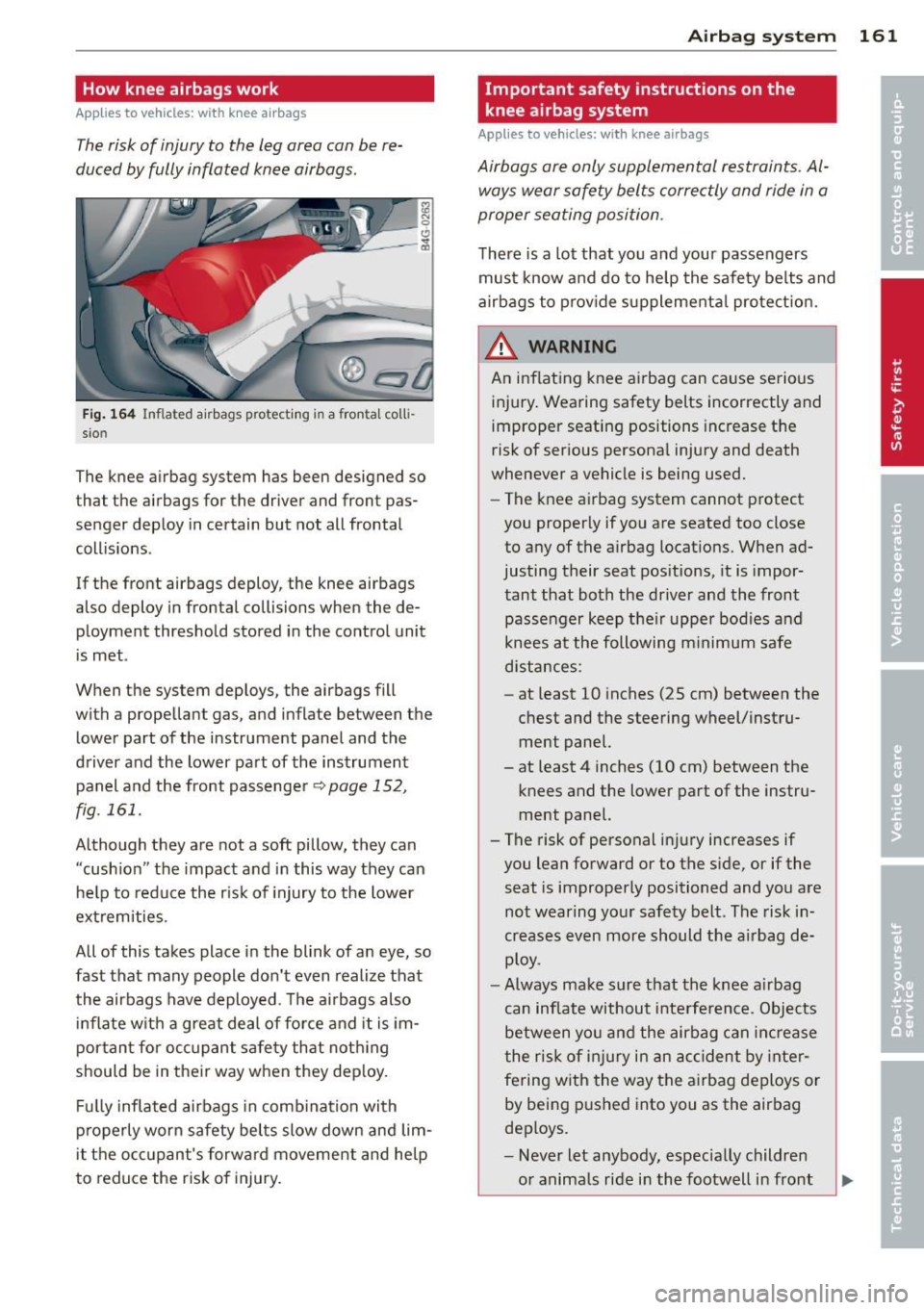
Fig. 164 Inflated airbags protecting in a frontal coll i
sio n
The knee airbag system has been designed so
that the airbags for the driver and front pas
senger deploy in certain but not all frontal
collisions .
If the front airbags deploy, the knee airbags
also deploy in frontal collisions when the de ployment threshold stored in the control unit
is met .
When the system deploys, the airbags fill
with a propellant gas, and inflate between the lower part of the instrument panel and the
driver and the lower part of the instrument panel and the front passenger¢
page 152,
fig. 161.
Although they are not a soft pillow, they can
"cush ion" the impact and in this way they can
help to reduce the risk of injury to the lower
extremities.
All of this takes place in the blink of an eye, so
fast that many people don't even realize that
the airbags have deployed . The airbags also
inflate with a great deal of force and it is im
portant for occupant safety that nothing
should be in their way when they deploy.
Fully inflated airbags in combination with
properly worn safety belts slow down and lim
it the occupant's forward movement and help
to reduce the risk of injury.
Airbag system 161
Important safety instructions on the
knee airbag system
Applies to vehicles: wit h knee airbags
Airbags are only supplemental restraints . Al
ways wear safety belts correctly and ride in a
proper seating position.
There is a lot that you and your passengers
must know and do to help the safety belts and
airbags to provide supplemental protection.
_&. WARNING .. -
An inflating knee airbag can cause serious injury. Wearing safety belts incorrectly and
imprope r seating positions increase the
risk of serious personal injury and death
whenever a vehicle is being used.
- The knee airbag system cannot protect
you properly if you a re seated too close
to any of the airbag locations. When ad
justing their seat positions, it is impor
tant that both the driver and the front passenger keep their upper bodies and
knees at the following minimum safe
distances:
- at least 10 inches (25 cm) between the
chest and the steering wheel/instru
ment panel.
- at least 4 inches (10 cm) between the
knees and the lower part of the instru
ment panel.
- The risk of personal injury increases if
you lean forward or to the side, or if the seat is improperly positioned and you are
not wearing your safety belt . The risk in
creases even more should the airbag de
ploy.
- Always make sure that the knee airbag
can inflate without interference. Objects
between you and the airbag can increase
the risk of injury in an accident by inter
fering with the way the airbag deploys or
by being pushed into you as the airbag
deploys.
- Never let anybody, especially children
or animals ride in the footwell in front
Page 165 of 292
Always remember that the side airbag system
can only help to protect you if you are wearing
your safety belt and wear ing it properly. This
is another reason why you should always wear
your safety belts, not just because the law re
qu ires you to do soc>
page 133, General
notes.
It is important to remember that while the
supp lemental s ide airbag system is designed
to reduce the like lihood of serious injur ies,
other i njuries, for example, swel ling, b ruising,
frict ion bu rns and minor ab rasions can also be
assoc ia ted with deployed side airbags. Re
member too, side airbags will deploy only
once and only in certain kinds of accidents -
your safety belts are always there to offer pro
tection.
Vehicle damage, repa ir costs or even the lack
of vehicle damage are not necessar ily an indi
cation of over-sensitive or failed airbag activa
tion. In some co llisions, both front and side
airbags may inflate. Remember too, that air
bags will dep loy only once and only in certain
kinds of collisions -your safety belts are al
ways there to offer protection in those acci dents in wh ic h airbags are not supposed to
deploy or when they have already deployed.
The side airbag sy stem will not deploy :
-when the ign ition is switched off
- in s ide collisions when the acceleration
measured by the sensor is too low
- in front-end collisions
- in rear -end collisions
- in ro llovers.
In some types of acc idents the front airbags,
side curta in a irbags and side airbags may b e
tr iggered toge ther.
_& WARNING
- Saf ety belts and the a irbag system will
only prov ide protection when occ upan ts
are in the proper seating posit ion
c>page 164.
- If the airbag indicator light c> page 18
comes when the vehicle is being used,
-
Airba g sy stem 163
have the system inspected immediately
by your authorized Audi dealer.
It i s pos
sible that the airbag will inflate when it
is not supposed to, or will not inflate
when it should.
How supplemental s ide airbags work
Side airbags deploy instantly and can help re
duce the risk of upper torso injuries for occu
pants who are properly restrained .
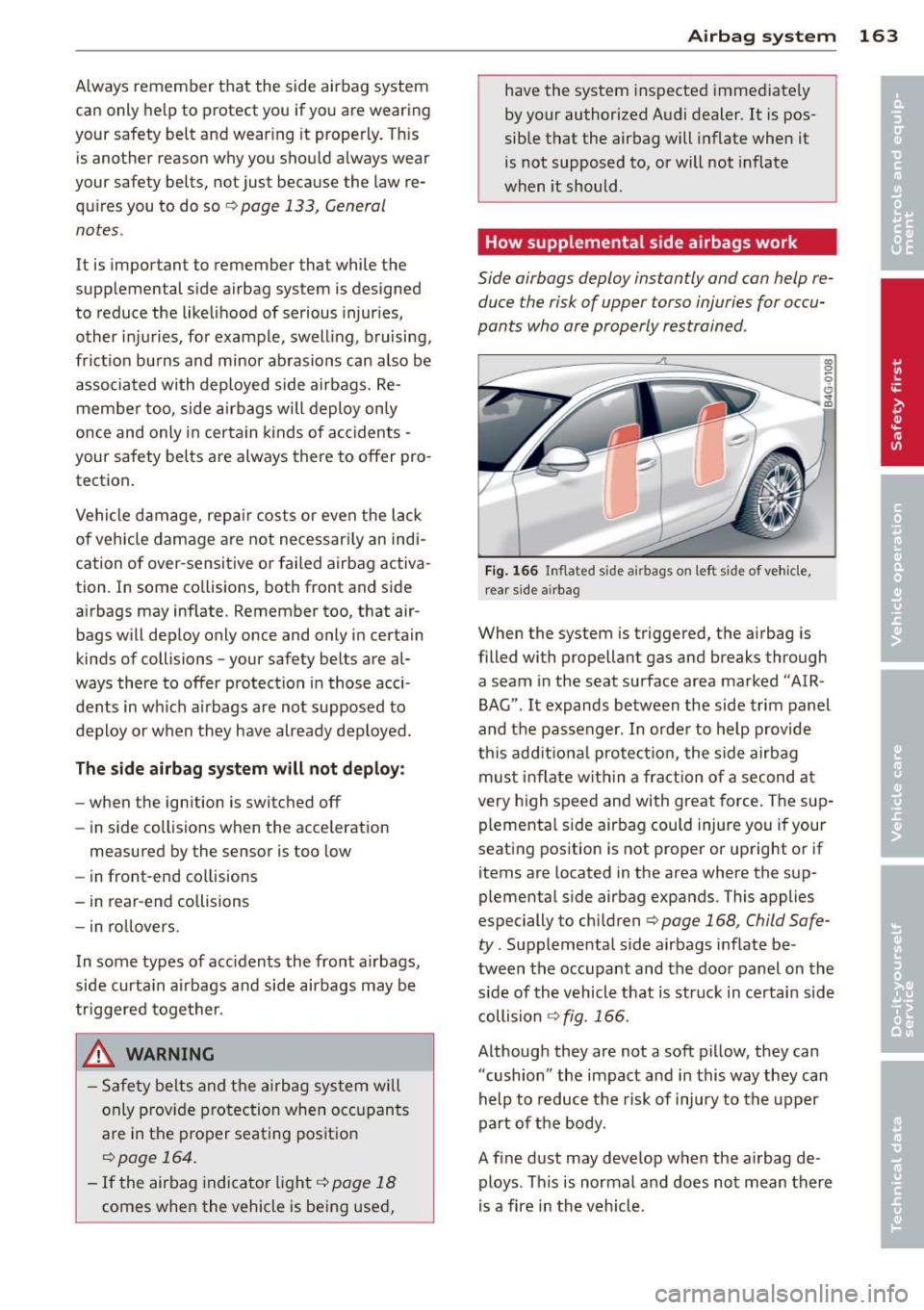
Fig. 16 6 In flated side airbags on left side of vehicle,
rear side airbag
When the system is triggered, the airbag is
filled with propellant gas and breaks through
a seam in the seat surface area ma rked "AIR
BAG". It expands between the side trim panel
and the passenger. In orde r to help provide
th is add it io na l prote ction, the side airbag
mus t inflate within a fraction of a second a t
very h igh speed and with great force. The sup
plementa l side air bag could injure you if your
seating pos ition is not proper or up right o r if
items are located in the area where the sup
plemental side airbag expands. This applies
especially to children
c> page 168, Child Safe
ty .
Supplementa l side airbags i nflate be
tween the occupant and the door panel on the
s id e of th e vehicle th at is str uck in certain side
collision
c> fig. 166.
Although they are not a soft pillow, they can
"cushion" the impact and in this way they can
h elp to reduc e the risk of injury to the upper
part o f the body.
A f ine dust may develop w hen the airbag de
ploys . This is normal and does not mean there
is a fire in th e vehicle.
Page 168 of 292
166 Airbag system
-The side curtain ai rbags above the front and
rear side windows
- The airbag indicator light in the instrument
panel
The airbag system is monitored electron ica lly
to make certain it is f unct io ning properly at a ll
times. Each time you switch on the ignition,
the airbag system indicator light will come on
for a few seconds (self diagnostics).
The side curtain airbag is not activated:
- if the ignit io n is switched off,
- in s ide coll isions when the accelerat ion
measured by the sensor is too low,
- in rear-end collisions.
A WARNING
- Safety belts and the a irbag system w ill
only p rov ide protection whe n oc cupants
are in t he p roper sea ting posit ion
¢ page 53, General recommendations.
- If the airbag indica tor ligh t¢ page 18
comes when the vehicle is be ing used,
have t he system inspected immediate ly
by you r aut horized Audi dea ler . It is pos
sible that the airbag will inf late when it
is not supposed to, or w ill not inflate
when it should.
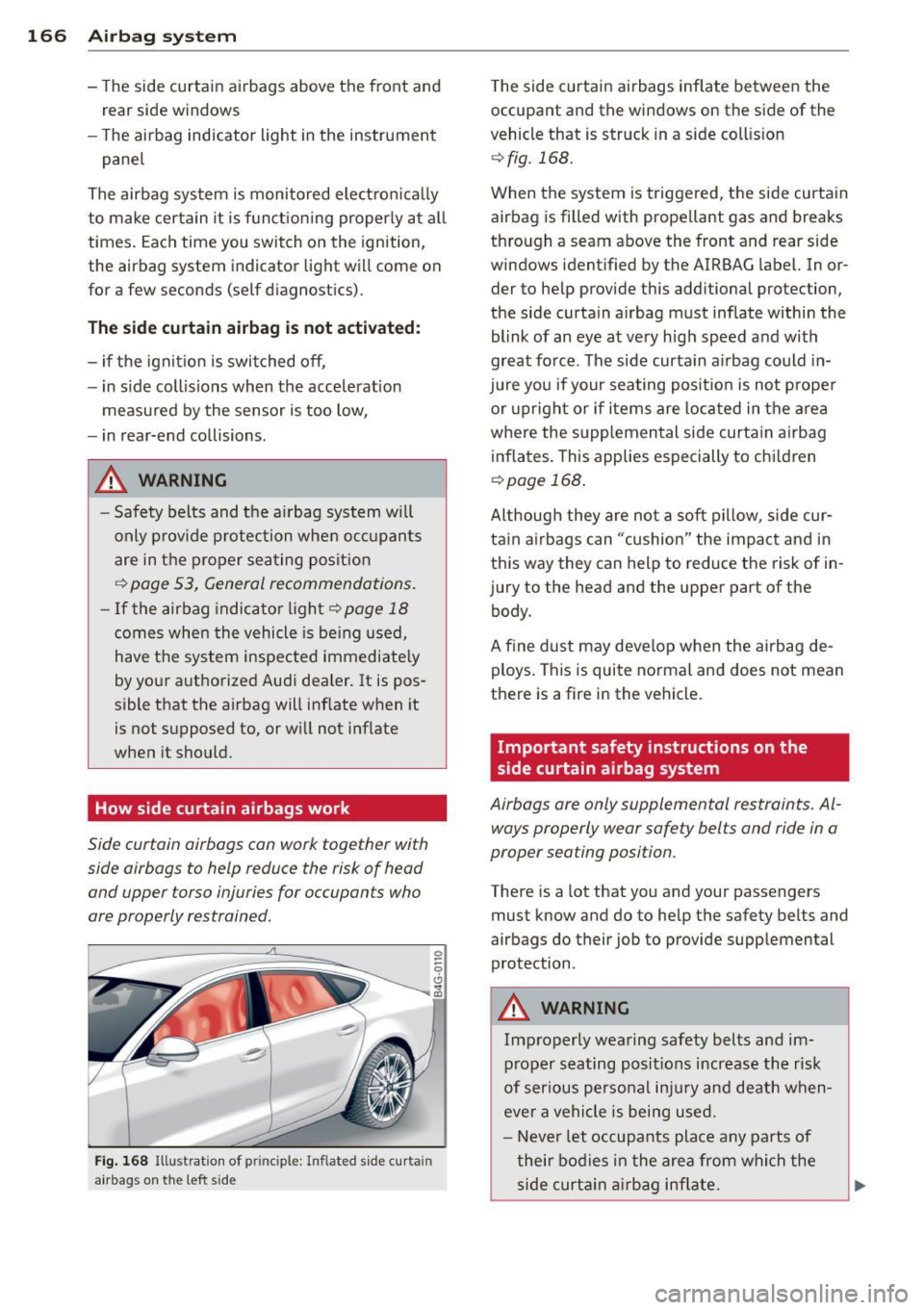
How side curtain airbags work
Side curtain airbags can work together with
side airbags to help reduce the risk of head
and upper torso injuries for occupants who
are properly restrained.
Fi g. 168 Ill ustrat io n of p rincipl e: Inflated side curtain
airbags on t he left s ide
T he side curtain airbags inf late between the
occupant and the windows on the side of the
vehicle that is struck in a side coll is ion
¢ fig . 168.
When the system is triggered, the side curtain
airbag is filled with prope llant gas and breaks
through a seam above the front and rear side
windows identified by the AIRBAG label. In or
der to he lp provide this additional protection,
the side curta in a irbag must inflate within the
blink of an eye at ve ry high speed and with
great fo rce . The side curta in a irbag could in
jure you if your seating posit ion is not prope r
o r u pright or if items are located in t he area
where the supplemen tal side curta in airbag
inflates . This applies especially to chi ldren
c> page 168.
Althoug h they are not a so ft pillow, side cur
ta in airbags can "cushion" the impact and in
th is way they can help to reduce the risk of in
j u ry to the head and the upper part of the
body .
A f ine d ust may deve lop when the airbag de
ploys . This is qui te normal and does not mean
there is a fire in the vehicle .
Important safety instructions on the
side curtain airbag system
Airbags are only supplemental restraints . Al
ways properly wear safety belts and ride in a
proper seating position.
There is a lot that yo u and your passengers
must know and do to he lp the safety belts and
airbags do their job to provide supp lemental
protection .
A WARNING
'"' Improperly wea ring safety belts and im
p roper seating pos it ions increase the risk
of ser ious personal in ju ry and death when
ever a vehicle is being use d.
- Never let occupants place any pa rts of
t heir bod ies in the area from whi ch the
-
side curta in a irbag inf la te. .,..