esp AUDI RS7 SPORTBACK 2014 Workshop Manual
[x] Cancel search | Manufacturer: AUDI, Model Year: 2014, Model line: RS7 SPORTBACK, Model: AUDI RS7 SPORTBACK 2014Pages: 292, PDF Size: 73.56 MB
Page 170 of 292
168 Child Saf ety
Child Safety
Important things to
know
Introduction
The rear seat is generally the safest place in a
collision.
The physical principles of what happens when
your veh icle is in a crash app ly also to chi ldren
~ page 134, What happens to occupants not
wearing safety belts?.
But unlike adults and
teenagers, their muscles and bones are not
fu lly developed. In many respects children are
at greater risk of serious injury in crashes than
adults.
Because children's bodies are not fully deve l
oped, they require restraint systems especial
ly designed for their size, weight, and body
structure. Many countries and all states of the
United States and provinces of Canada have
laws requiring the use of approved child re
straint systems for infants and small ch ildren.
In a fronta l crash at a speed of 20 -35 mph
(30-56 km/h) the forces acting on a 13-pound
(6 kg) infant w ill be more than 20 t imes the
weight of the child. This means the weight of
the child would suddenly be more than 260 pounds (120 kg). Under these conditions,
only an appropriate ch ild restraint properly
used can reduce the risk of ser ious injury.
Child restraints, like adult safety belts, must
be used properly to be effective. Used improp
erly, they can increase the risk of serious in
jury in an accident.
Consult the child safety seat manufacturer's instructions in order to be sure the seat is
right for your ch ild's size ~
page 172, Impor
tant safety instructions for using child safety
seats.
Please be sure to read and heed all of
the important information and WARNINGS
about child safety, Advanced A irbags, and the
installation of child restraints in this chapter .
There is a lot you need to know about the Ad
vanced Airbags in your vehicle and how they
work when infants and children in child re- straints are on the front passenger seat
. Be
cause of the large amount of important infor
mation, we cannot repeat it all here . We urge
you to read the detailed information in th is
owner's manual about airbags and the Ad
vanced Airbag System in your vehicle and the
very important information about transport
ing children on the front passenger seat.
Please be sure to heed the WARNINGS -they
are extremely important for your safety and
the safety of your passengers, especially in
fants and small children.
A WARNING
-Accident statistics have shown that chil
dren are generally safer in the rear seat
area than in the front seating position.
Always restrain any child age 12 and un
der in the rear.
- All vehicle occupants and especially chil
dren must be restrained properly when
ever riding in a vehicle. An unrestrained
or improperly restrained chi ld could be
injured by str iking the i nterior or by be
ing ejected from the vehicle during a
sudden maneuver or impact. An unre
strained or improperly restrained chi ld is
also at greater risk of injury or death
through contact with an inflating airbag.
- A suitable chi ld restraint properly instal
led and used at one of the rear seating positions provides the highest degree of
protection for infants and small children
in most accident situations.
A WARNING ,_
Children on the front seat of any car even
with Advanced Airbags can be ser iously in
jured or even killed when an airbag in
flates. A child in a rearward-facing child
safety seat installed on the front passen
ger seat will be seriously injured and can
be killed if the front airbag inflates.
- The inflating airbag will hit the child
safety seat or infant carrier with great
force and will smash the child safety seat and child against the backrest, center
armrest, or door.
II>-
Page 172 of 292
1 70 Child Safety
-Always read and heed all WARNINGS
whenever using a child restraint in ave
hicle
q page 133, Safety belts,
q page 142, Airbag system and
q page 168, Important things to
know.
(D Tips
Always replace child restraints that were
installed in a vehicle during a crash. Dam
age to a child restraint that is not visible
could cause it to fail in another collision
situation.
Advanced front airbag system and children
Your vehicle is equipped with a front "Ad
vanced Airbag System" in compliance with United States Federal Motor Vehicle Safety
Standard (FMVSS) 208 as applicable at the
time your vehicle was manufactured.
The Advanced Airbag system in your vehicle
has been certified to meet the "low-risk" re
quirements for 3- and 6-year old children on
the passenger side and small adults on the
driver side. The low risk deployment criteria
are intended to reduce the risk of injury
through interaction with the airbag that can
occur, for example, by being too close to the
steering wheel and instrument panel when
the airbag inflates . In addition, the system
has been certified to comply with the "sup
pression" requirements of the Safety Stand
ard, to turn
off the front airbag for infants up
to 12 months who are restrained on the front
passenger seat in child restraints that are list
ed in the Standard .
Even though your vehicle is equipped with an
Advanced Airbag system, all children, espe
cially those 12 years and younger, should al
ways ride in the back seat properly restrained
for their age and size. The airbag on the pas
senger side makes the front seat a potentially
dangerous place for a child to ride. The front
seat is not the safest place for a child in a for
ward -facing child safety seat. It can be a very dangerous place
for an infant or a larger child
in a rearward-facing seat.
The vehicle's Advanced Airbag System has a
capacitive passenger detection system in the
front passenger seat cushion that can detect
the presence of a baby or a child in a child re
straint system on this seat.
The capacitive passenger detection system
registers the changes that result in an electri
cal field when a child, a child restraint, and a
baby blanket are on the front passenger seat .
The change in the measured capacitance due
to the presence of a child, a child restraint,
and a baby blanket on the front passenger
seat is related to the child restraint system
resting on the seat. The measured capacitance
of a child restraint system varies depending
on the type of system and specific make and
model.
The electrical capacitance of the various
types, makes, and models of child restraints
specified by the U.S.National Highway Traffic
Safety Administration (NH TSA) in the relevant
safety standard are stored in the Advanced
Airbag System control unit together with the capacitances typical of infants and a 1-year
old child. When a child restraint is used on the
front passenger seat with a typical 1 year-old infant, the Advanced Airbag System compares
the capacitance measured by the capacitive passenger detection system with the data
stored in the electronic control unit. Child restraints and Advanced front
airbag system
Regardless of the child restraint that you use,
make sure that it has been certified to meet
United States Federal Motor Vehicle Safety
Standards and has been certified by its manu
facturer for use with an airbag. Always be sure
that the child restraint is properly installed at
one of the rear seating positions. If in excep
tional circumstances you must use it on the
front passenger seat, carefully read all of the
information on child safety and Advanced Air-
bags and heed all of the applicable .,..
Page 174 of 292
172 Child Safety
-Have the airbag system inspected by
your authorized Audi dealer immediate
ly.
The child seats listed in categories A to C have been statically tested by Audi only for
the Advanced Airbag function.
Important safety instructions for using
child safety seats
Correc t use of child safety seats substantially
reduces the risk of injury in an accident!
As the driver, you are responsible for the safe
ty of everybody in the vehicle, especially chil
dren :
• Always use the right child safety seat for
each child and always use it properly
r:::;, page 174.
• Always carefully follow the child safety seat
manufacturer's instructions on how to route
the safety belt properly through the child
safety seat.
• When using the vehicle safety belt to install
a child safety seat, you must first activate
the convertible locking retractor on the
safety belt to prevent the child safety seat
from moving
r:;, page 179.
• Push the child safety seat down with your
full weight to get the safety belt really tight so that the seat cannot move forward or
sideways more than one inch (2.5 cm) .
• Secure unused safety belts on the rear seat
r:;,page 174.
Always remember: Even though your vehicle is
equipped with an Advanced Airbag system, all
children , especially those 12 years and young
er, should always ride in the back seat proper
ly restrained for their age and size.
.&_ WARNING
Not using a child safety seat, using the
wrong child safety seat or improperly in stalling a child restraint increases the risk
of serious personal injury and death .
-
-All vehicle occupants and especially chil
dren must always be restrained properly
whenever riding in a vehicle.
- An unrestrained or improperly restrain
ed child can be injured or killed by be
ing thrown against the inside of the ve
hicle or by being ejected from it during
a sudden maneuver or impact.
- An unrestrained or improperly restrain
ed child is at much greater risk of injury
or death by being struck by an inflating
airbag.
- Commercially available child safety seats
are required to comply with U.S. Federal
Motor Vehicle Safety Standard (FMVSS)
213 (in Canada CMVSS 213).
- When buying a child restraint, select
one that fits your child and the vehicle.
- Only use child restraint systems that
fully contact the flat portion of the
seat cushion . The child restraint must
not tip or lean to either side. Audi does
not recommend using child safety
seats that rest on legs or tube -like
frames. They do not provide adequate
contact with the seat.
- Always heed all legal requirements per
taining to the installation and use of
child safety seats and carefully follow
the instructions provided by the manu
facturer of the seat you are using .
- Never allow children under 57 inches
(1.45 meters) to wear a normal safety
belt . They must always be restrained by a
proper child restraint system. Otherwise,
they could sustain injuries to the abdo
men and neck areas during sudden brak
ing maneuvers or accidents.
- Never let more than one child occupy a
child safety seat.
- Never let babies or older children ride in
a vehicle while sitting on the lap of an
other passenger.
- Holding a child in your arms is never a
substitute for a child restraint system .
- The strongest person could not hold
the child with the forces that exist in
Page 176 of 292
17 4 Child Safety
Secure unused safety belts on the rear
seat
F ig. 169 Schematic overview: keep unused safety belts
away from children in child safety seats.@-outer rear
safety belt
If a ch ild safety seat is used on the rear bench,
espec ially w ith LATCH unive rsal lower ancho
rages, the unused safety belts
mu st be se
cured so that the ch ild in the child restra in t
cannot reach them
r::;, ,&. .
-Gui de the safety belt webbing @behind the
head restraint of the seat where the child re
stra in t is ins talled
r::;, fig. 169 . When do ing
so, do not engage the switchable locking re
t ractor! You should not hear a "clicking"
sound when winding up the safety be lt.
- Let the belt re tracto r wind up the safety be lt
webbing .
~ WARNING
A child in a child safety seat installed with
the LATCH lower anchorages or w ith the
standard safety belt or a child in a booster
seat on the rear seat could play with un
used rear seat safety belts and become en
tangled . This could cause the child se rious
personal in jury and even deat h.
-Always secure unused rear seat safety belts out of reach of ch ildren in ch ild
seats such as by prope rly routing them
around the head res traint of the seat
where the child res traint is installed.
- N ever activate the sw itchab le lo cking re
tr actor when ro uting the safety belts
around the head rest raints.
Child safety seats
Infant seats
Babies and infants up to about one year old
and 20 lbs . or
9 kg need special rearward-fac
ing child restraints that support the back,
neck and head in a crash.
Fig . 1 70 Schem atic overview: rearward-fac ing infant
seat, properly installed on th e rear seat
.,. When using the vehicle safety belt to install
a child safety seat, you must first activate
the convertib le locking retractor on the
safety belt to p revent the child safety seat
from mov ing
c:;,page 179 or install the seat
using the LATCH attachmen ts .
.,.. Push the chi ld safety seat down with yo ur
full weight to get the safety belt really tight
so that the seat cannot move forward or
sideways more than one inch (2.5 cm).
.,. Secure unused safety belts on the rear seat
c:;,page 174.
Infants up to about one yea r (20 lbs. or 9 kg)
are best protected in spec ial infant carriers
and child safety seats designed for their age
group . Many experts be lieve that infants and
small ch ild ren shou ld ride on ly in sp ecial re
stra ints in wh ich the child faces the back of
t h e ve hicle. These infa nt sea ts sup port the ba
by 's back, ne ck and head in a c rash
r::;, fig. 1 70 .
The airbag on the passenger side makes the
fron t seat a pote ntia lly dange ro us place for a
c hi ld to ride. The fron t se at i s not the safest
place for a child in a forward-facing child sea t.
It is a very dange rous place fo r an infant or a
larger child in a rearward-fac ing seat .
llll>-
Page 180 of 292
178 Child Saf ety
• Secure unused safety belts on the rear seat
r::!;> page 174 .
Children up to at least 8 years old (over 40 lbs
or 18 kg) are best protected in chi ld safety
seats designed for their age and weight . Ex
perts say that the ske leta l structure, particu
larly the pelvis, of these chi ldren is not fully
developed, and they must not use the vehicle
safety belts w ithout a su itab le child restraint .
It is us ually best to put these children in ap
propriate booster seats. Be sure the booster
seat meets all applicab le safety standards.
Booster seats raise the seating position of the
child and reposition bot h the lap and sho ulder
parts of the safety belt so that they pass
across the child 's body in the right places. The
routing of the belt over the chi ld 's body is very
important for the ch ild's protection, whethe r
or not a booster seat is used . Children age 12
and under must always ride in the rear seat.
Ch ildren who are at least 4
ft . 9 in. (S7 in
ches/1.4S meters) tall can generally use the
vehicle's three po int lap and shoulder be lts .
Neve r use the lap belt portion of the veh icle's
safety be lt alone to restrain any child, rega rd
l ess of how b ig the child is. Always remembe r
that c hildren do not have the pronounced pe l
vic st ructure required for the proper function
of lap belt portion of the vehicle's three point lap and shoulder be lts. The child's safety ab
solutely requires that a lap be lt portion of the
safety belt be fastened snugly and as low as
possib le around the pelvis . Never let the lap
be lt po rtion of the safety belt pass over the
chi ld's stomach or abdomen.
In a crash, airbags must inflate within a blink
of an eye and with cons iderab le force . In order
to do its job, the airbag needs room to inflate
so t hat it will be there to p rotect the occupant
as the occupa nt moves forw ard into the air
bag.
A vehicle occupant who is out of position and
too close to the airbag gets in the way of an
i n flat ing a irb ag. When an occupant is too
close, he or she w ill be str uck violen tly and will
receive se rious or possib ly even fatal in
jury .
In orde r fo r the ai rb ag to offer protect ion, i t is
i mpor tan t t hat a ll vehicle occup ants, espe cial
ly any children, who m ust be in the front seat
because of exceptiona l circumstances , be
proper ly restrained and as fa r away from the
airbag as possible . By keeping room between
the child's body and the front of the passen
ger compartment, the airbag can inflate com
pletely and prov ide supplemental protection
in ce rtain frontal coll isions .
.8. WARNING
Not using a booste r seat, using the boos
ter seat imp roperly, in co rrectly installing a
b oos ter seat or using the vehicle sa fe ty
belt imp roperly increases the risk of seri
ous persona l injury and death in a collision
or other emergency situat ion. To he lp re
d uce the risk of serio us personal injury
and/or death:
- The shou lder belt must lie as close to the
center of the ch ild's collar bone as possi
b le and must lie flat and snug on the up
per body . It must neve r lie across the
throat or neck . The lap belt must lie
across the pe lvis and neve r acr oss t he
s tomach o r abdomen.
M ake sure t hat the
be lt lies flat and snug. P ull on the bel t to
tighten if necessary.
- Failure to p roperly ro ute s afe ty belts
over a child's body wi ll ca use seve re inj u
ries in an accident o r other emergency
situation
¢ page 133 .
-The rear side o f the child sa fety seat
should be pos itioned as close as possib le
to the backrest on the vehicle seat.
- For ad justab le head restraints: adjust or
remove the rea r seat head restra int if it
is difficult to install the child seat with
the head restraint in place
c:> page 57. In
stall the head restraint again immed iate
ly once the child seat is removed . Dr iv ing
without head restraints o r with head re-
.
straints that are not p roperly adjus ted Ii),
Page 181 of 292
increases the risk of serious or fatal neck
injury dramatically.
- Children on the front seat of any car,
even with Advanced Airbags, can be seri
ously injured or even killed when an a ir
bag inf lates.
- Never let a child stand or knee l on any
seat, for examp le the front seat.
- Never let a child ride in the cargo area of
yo ur vehicle.
- Always remember that a ch ild lean ing
forward, sitt ing s ideways or out of posi
t ion in any way during an acc ident can be
struck by a deploying airbag. This will re
sult in se rious personal injury or death .
- If you must install a booster seat on the
front passenger seat because of excep
t ional circumstances the
PASSENGER
A IR BAG OFF
light must come on and
stay on, whe never the ignition is switch
ed on.
- If the PASS ENGER AIR BAG OFF light
does not come on and stay on, perform
the checks described¢
page 154, Moni
toring the Advanced Airbag System.
- T ake the child rest rain t off the fron t pas
senger seat and install it proper ly at one
of the rear seat positions if the
PASSEN
GER AIR BAG OFF
light does not stay on
whenever the ignition is switched on.
- Always read and heed all WARNINGS
whenever using a child restrained in ave
hicle is being used¢
page 133, Safety
belts,¢ page 142, Airbag system
and
¢page 168, Important things to know.
Installing a child safety
seat
Securing a child safety seat using a
safety belt
Safety belts for the rear seats and the front
passenger can be locked with the convertible
locking retractor to properly secure child
safety seats.
The safety belts emergency lock ing retractors
for the rear seats safety belts and for the
Child Sa fet y 1 79
front passenger's seat safety be lt have a con
vertib le locking retractor for child restraints .
The safety belt m ust be locked so that be lt
webb ing cannot unreel. The retractor can be
activated to lock the safety belt and prevent
the safety belt webbing from looseni ng up
dur ing normal dr iv ing . A child safety seat can
on ly be properly insta lled when the safety belt
is locked so that the chi ld and child safety
seat w il l stay in place .
Always remember : Even though your vehicle is
equipped with an Advanced Airbag system, all
c hi ldren, especially those 12 years and young
er, shou ld always r ide in the back seat prope r
ly restrained for the ir age and size.
A WARNING r----------
1 mp rope rly installed chi ld safety seats in-
crease the risk of serious personal injury
and death in a co llision.
- Always make s ure that the safety belt re
tractor is locked when insta lling a child
safety seat. An unlocked safety belt re
tractor cannot hold the child safety seat
in place dur ing norma l dr iving or in a
crash .
- Always buckle the child safety seat firmly
in place even if a ch ild is not sitt ing in it .
A loose child safety seat can fly around
during a sudden stop or in a collision.
- If the rea r set backrest is not secure ly
latched, the child and the child restra int
w ill be thrown forwa rd togethe r with the
backrest and will str ike parts of t he vehi
cle interior. The ch ild can be ser iously in
jured or killed.
- Never install rear-facing child s afety
seats or in fant carrie rs on the front pas
senger seat . A child will be serio usly in
jured and can be killed when the passen ger airbag inflates.
- The inflating airbag will hit the child
safety seat or infant carrier with great
force and will smash the child safety seat
and child against the backrest, center
armrest, door or roof . •
•
Page 182 of 292
180 Child Safety
-Always install rear-facing child safety
seats or infant carriers on the rear seat.
- Forward-facing child safety seats or in
fant carriers installed on the front pas
senger's seat may interfere with the de ployment of the airbag and cause serious
injury to the child.
- It is safer to install a forward-facing
child safety seat on the rear seat .
- Always read and heed all WARNINGS
whenever using a child restrained in ave
hicle is being used
c::;, page 168 . Special
precautions apply when installing a child
safety seat on the front passenger seat
c::;, page 144, Child restraints on the front
seat -some important things to know.
A WARNING
-
Always take special precautions if you
must install a forward or rearward-facing
child restraint on the front passenger's
seat in exceptional situations:
- Whenever a forward or rearward-facing
child restraint is installed on the front
passenger seat, the
PASSENGER AIR
BAG OFF
light must come on and stay on
whenever the ignition is switched on.
- If the
PASSENGER AIR BAG OFF light
does not come on and stay on, perform
the checks described
c::;, page 154, Moni
toring the Advanced Airbag System .
-Take the child restraint off the front pas
senger seat and install it properly at one
of the rear seat positions if the
PASSEN
GER AIR BAG OFF
light does not stay on
whenever the ignition is switched on.
- Improper installation of child restraints
can reduce their effectiveness or even
prevent them from providing any protec
tion.
- An improperly installed child restraint
can interfere with the airbag as it de
ploys and seriously injure or even kill the
child.
- Always carefully follow the manufactur
er's instructions provided with the child
safety seat or carrier. -
After checking to make sure that the
child restraint is properly installed, make
certain that the child restraint is correct ly recognized by the capacitive passenger
detection system in the front passenger
seat and that the
PASSENGER AIR BAG
OFF
light signals the correct front pas
senger frontal airbag status.
A WARNING
Forward-facing child restraints:
- Always make sure the forward-facing
seat has been designed and certified by
its manufacturer for use on a front seat
with a passenger front and side airbag.
- Never put the forward-facing child re
straint up, against or very near the in
strument panel.
- Always move the passenger seat into its
rearmost position in the seat's fore and
aft adjustment range, as far away from
the airbag as possible before installing
the forward-facing child restraint. The
backrest must be adjusted to an upright position .
- Make sure that the
PASSENGER AIR BAG
OFF
light comes on and stays on all the
time whenever the ignition is switched
on .
A WARNING "---
Rearward-facing child restraints:
- A child in a rearward-facing child safety
seat installed on the front passenger
seat will be seriously injured and can be
killed if the front airbag inflates -even
with an Advanced Airbag System.
- The inflating airbag will hit the child
safety seat or infant carrier with great
force and will smash the child safety seat
and child against the backrest, center
armrest, door or roof.
- Always be especially careful if you must
install a rearward facing child safety seat
on the front passenger seat in exception
al circumstances.
Page 188 of 292
186 Child Saf ety
Re le asin g th e tethe r str ap
.. Loosen the tension following the child re
stra int manufacturer's instructions .
.. Depress the spring catch on the hook and re
lease it from the anchorage .
([) Note
If you leave the child restraint with the
tether strap firmly insta lled for several
days, this cou ld leave a mark on the up
holstery on the seat cushion and backrest
in the area where the tether strap was in
stalled . The upholstery wou ld a lso be per
manently stretched around the tethe r
strap. Th is applies especially to leather
seats.
Using tether straps on rearward-facing
child restraints
Currently, few rear-facing child restraint sys
tems come with a tether. P lease read and
heed the child restraint system manufactur
er's instructions carefully to determine how to
properly install the tether.
A WARNING
-
A child in a rearward-facing child safety
seat insta lled on the front passenger seat
w ill be seriously injured and can be k illed if
the fron t airbag inflates -even with an Ad
vanced Airbag System.
- T he inflating a irbag wi ll hit the child
sa fety seat or infant carrier with g reat
force and w ill smash the ch ild safety seat
and child against the backrest, center
armrest, or door.
- If you must install a rearward facing
child safety seat on the front passenger
seat because of exceptional circ umstan
ces and the
PASSENGER AIR BAG OFF
light does not come on and stay on, im
med iately install the rear-facing child
safety seat in a rear seating posit ion and
have t he a irbag system inspected by you r
Audi dealer.
Additional Information
Sources of information about child
restraints and their use
T he re a re a number o f sources of add itiona l
information about child rest raint selection, in
sta llation and use:
N HT SA advises that the best ch ild safety seat
is the one that fits your chi ld and fits in you r
vehicle, and that yo u will use correct ly and
consistently .
T ry before yo u buy!
U.S Nationa l Highw ay Traffic Safet y Admin
i s tration
T el.: 1-888-3 27-4236 (TIY: 1-800-424-91S3)
www.nhtsa.gov
National SAFE KIDS Campa ign
T el.: (202) 662-0600
www.safe kids.o rg
Saf ety Belt Saf e U.S .A
Tel.: (800) 745-SAFE (English)
T el.: (800) 747-SANO (Span ish)
www.carseat .org
Transport Canad a In formation C entre
Tel.: 1-800-333-0371 or call
1-613-998-86 16 if you are in the Ottawa area
http://www.tc.gc.ca/eng/ roadsafety/
men u.h tm
Audi Cu stom er R elation s
Tel.: (800) 822-2834
Page 192 of 292
190 Intelligent technology
differential lock (EDL), dynamic steering* and
selective whee l torque control. ESC is switch
ed on all the t ime. In certa in situations when
you need less traction, you can switch off ASR
by pressing the button
[ill c> page 191,
fig. 180. Be sure to switch ASR on again when
you no longe r need less traction .
Anti-loc k br ak ing system (ABS)
ABS prevents the wheels from locking up
when braking. The vehicle can still be steered
even during hard brak ing. Apply steady pres
sure to the brake pedal. Do not pump the ped
al. A puls ing in the brake pedal ind icates that
the system is he lp ing you to b rake the vehicle.
B rake as sist sys tem
The brake assist system can decrease braking
d istance. It increases braking power when the
driver presses the brake pedal quick ly in emer
gency situations. You must p ress and hold the
b rake pedal until the situation is over. I n
vehicles w ith adaptive cru ise cont rol*, the
b rake assist system is more sens it ive if the
d istance detected to the vehicle ahead is too
smal l.
Anti-slip regulation (ASR)
ASR reduces engi ne power when the d rive
wheels begin to spin and ad apts the fo rce to
the road condit ions. This makes i t easier to
start, accelerate and drive up hills .
Electronic differential lock (EDL)
The EDL brakes wheels that are spinning and
transfers the d rive powe r to the other d rive
wheel o r whee ls if the vehi cle is equipped wi th
a ll-w hee l drive* . This function is available up
to about 75 mph (120 km/h).
I n extreme cases, ED L automat ica lly swit ches
off to help keep the brake o n the braked whee l
from overheating . EDL wi ll switch on again au
tomatically when conditions have returned to
norma l.
Dynamic steering*
On vehi cles w ith dy namic stee ring*, ESC helps
stabilize the steering i n critical s ituations.
Selective wheel torque control
T he sele ctive whee l torq ue con trol ope rates
when driving through c urves . The front whee l
on the inside of th e curve o r both wheels on
the inside of the curve are braked selectively
as needed. This minimizes sliding in the front
whee ls and allows for more precise driving
t hr ough curves. The appl icable system may
not act ivate when dr iv ing in wet or snowy con
ditions .
,&. WARNING
-ESC, ABS, ASR, EDL, dy namic steeri ng*
and the select ive wheel torq ue con trol
c a nnot ove rcome the laws of physics.
T his is especially important on slippery
or wet roads.
If the systems begin acting
to stabilize your veh icle, yo u should im
mediately change your speed to match
the road and traffic conditions. Do not
let the increased safety provided by
these systems tempt you to take r isks.
Doing so will increase the risk of a loss of
veh icle cont ro l, collision and ser ious per
sonal injur ies.
- Always adapt your speed to road, traffic
and wea ther conditions. The risk of los
ing con trol of t he vehicle increases when
d riving too fast, espec ially through
curves and on slippery or wet roads, and
when dr iving too close to vehicles up
ahead. ESC, ABS, the brake assist sys
tem, ASR, EDL, dynam ic steering* and
the selective wheel torque contro l can
not prevent collisions .
- Always accelerate with special care on
even, smooth su rfaces such as those that
are wet or covered with ice and snow .
The drive wheels can spin eve n w ith
these assistan ce systems that cannot al
ways he lp to re duce the risk of loss of ve
h icle control.
(D Tips
- ABS and ASR o nly wo rk correctly when
all four wheels are equipped with identi
cal tires. D iffe ren t tire si zes can lead to a
reduction in engine power.
-
...
Page 193 of 292
-You may hear noises when the systems
described are working.
- If the indicator ligh t
DJ or flB (USA
models) @ (Canada models) appears,
Switching on and off
Intelligen t technolog y 191
there may be a malfunc tion c> page 19,
c> page 18 .
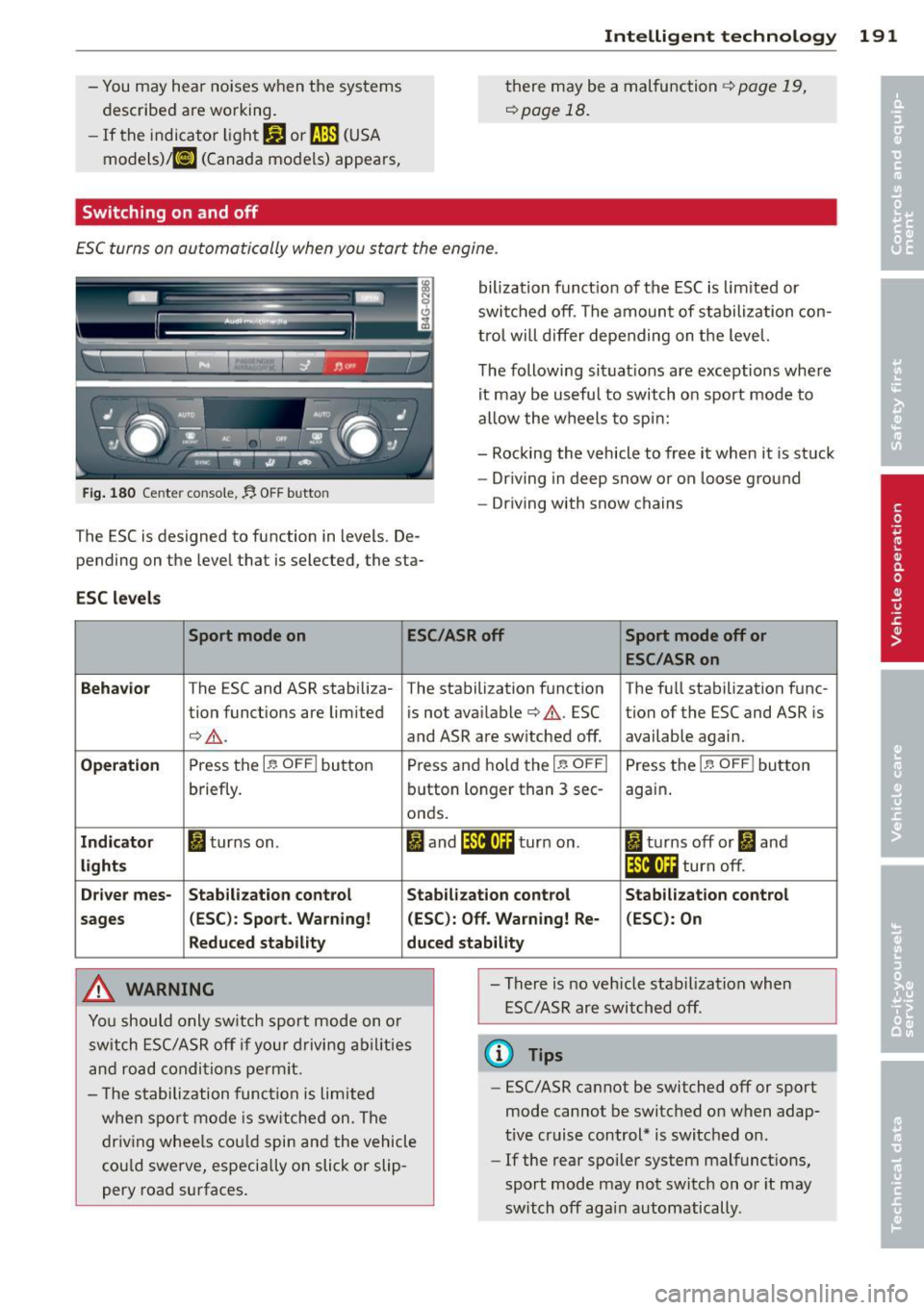
ESC turns on automatically when you s tart the engine .
Fig. 180 Cente r con sole,.$ OFF b utto n
The ESC is des igned to function in levels . De
pend ing on the leve l that is selected, the sta-
ESC l evels
bilization funct ion of the ESC is lim ited or
swi tched off . The amoun t of s tabilization con
tro l will d iffer depending on the level.
T he following situat ions are exceptions where
it may be usefu l to switch on sport mode to
allow the w heels to spi n:
- Rocking the vehicle to free it when it is stuck
- Dr iving in deep snow or on loose ground
- Driving with snow chains
Sport mode on ESC/ASR off Sport mode off or
ESC/ASRon
Behavior
T he ESC and ASR stabili za- The stabili zation function The fu ll stabili zation f unc -
tion funct ions are lim ited is not ava ilable
c> & . ESC tion of the ESC and ASR is
¢ & . and ASR are sw itched off. available agai n.
Operati on Press the I~ O FF I button Press and hold the 1-~ O FFI Press the 1-~ O FF I button
briefly. button longer than 3 sec-again .
o nds.
Ind ic a to r I turns on . I and ifil•)H turn on . II turns off or II and
light s If i4•)ii turn off.
Dr iver mes- Stab ilization control Stabilization control Stabilization control
s ages (
ESC ): Spo rt. Warning! (ESC ): Off. Warning! Re· (ESC) : On
Reduced stabil ity duc ed stab ility
A WARNING
.
You should only sw itch sport mode on o r
switch ESC/ASR off if your drivi ng ab il ities
and road condi tions perm it. -
There is no vehicle stabilization when
ESC/ASR are switched off .
@ Tips
-The s tabilization func tion is limited
w he n spor t mode is sw itched on . The
dr iv ing whee ls cou ld spin and the vehicle
cou ld swe rve, especially on slick or slip
pery road surfaces. -
ESC/ASR cannot be switched off or sport
mode cannot be switched on when adap·
tive cruise control* is switched on .
-If the rear spoiler system malfunctions,
sport mode may not switch on o r it may
switch off again automatically .