warning AUDI RS7 SPORTBACK 2015 Owners Manual
[x] Cancel search | Manufacturer: AUDI, Model Year: 2015, Model line: RS7 SPORTBACK, Model: AUDI RS7 SPORTBACK 2015Pages: 302, PDF Size: 74.76 MB
Page 239 of 302
heavier than the vehicle's
Gross Vehicle Weight Rat
ing.
& WARNING
-Incorrect tire pressures and/or underinflation can lead to a serious or fatal ac
cident.
-Incorrect tire pressures and/or underinflation cause increased tire wear and can
affect the handling of the
vehicle.
-Incorrect tire pressures and/or underinflation can
also lead to sudden tire fail
ure, including a blowout
and sudden deflation, caus ing loss of vehicle control.
Checking tire pressure
The correct tire pressure for the
tires originally installed on
your vehicle is listed on the tire
pressure label located on driver's side 8-pillar.
The recommended tire pressures are on the tire pressure
label and in the table
¢ page 233, Cold tire inflation
pressure .
This means that the
pressure must be checked and
Tires and wheels 237
adjusted when the tire has not been driven for more than a
couple of miles (kilometers) at low speeds during the previous
three hours. Air in the tires ex pands when the tire heats up as
a result of internal friction as it
flexes in use. The tire pressure
is higher when the tire has
warmed up than when it is "cold."
It is the inflation pressure in a
"cold" tire that counts. There
fore, you should never let air out of a warm tire to match
"Cold tire inflation pressure"
recommendations ¢
page 233.
The tires would then be under
inflated and could fail sudden
ly.
The tire pressure label on your
Audi lists the recommended cold tire inflation pressures at maximum capacity for the new,
original equipment tires that
were on your vehicle at the time
it was manufactured . For the
location of the label
¢ page 233, fig . 195.
Most tires lose air naturally
over time. They can also lose
some air if you drive over a
•
•
'
Page 241 of 302
Tires and wheels 239
-The tire pressures should only sudden tire failure, loss of •
be checked and adjusted when control, collision, serious per-• '
the tires are cold. The slightly
sonal injury or even death.
raised pressures of warm tires -When the warning symbol
must not be reduced.
[I] appears in the instru-
-Adjust the tire pressure to the ment cluster, stop and in-
load you are carrying. spect the tires.
-Reinstall the valve stem cap -Incorrect tire pressure and/
on the valve. or underinflation can cause
When should I check the tire increased tire wear and can
pressure? affect the handling of the
vehicle and stopping ability.
The correct tire pressure is es -
-Incorrect tire pressures
pecially important at high
and/or underinflation can
speeds. The pressure should
also lead to sudden tire fail-
therefore be checked at least
ure, including a blowout
once a month and always be-
and sudden deflation, caus-
fore start ing a journey.
ing loss of vehicle control.
When should I adjust the -The driver is responsible for
ti re pressures?
the correct tire pressures for
Adjust the tire pressure to the all tires on the vehicle. The
load you are carrying. After applicable pressure values
changing a wheel
or replacing are located on a sticker on
wheels you have to adjust the the driver's side B-pillar.
tire pressures on all wheels. In -Only when all tires on the
addition, you must then store vehicle are filled to the cor-
the new tire pressures in the rect pressure, the tire pres-
tire pressure monitoring sys- sure monitoring system can
tern¢
page 255. work correctly.
A WARNING -The use of incorrect tire
pressure values can lead to
M
Incorrect tire pressures and/ N
0::
accidents or other damage. <.J
or underinflation can lead 'SI: ....
Therefore it is essential that ~ \!) 1.1'1
.... 1.1'1 ....
Page 243 of 302
Tires and wheels 241
not exceeded. Vehicle load in- rear for total seating capacity •
eludes everybody and every- of 4. Each seating position has • '
thing in and on the vehicle. a safety belt¢ page 130, Safe-
These load limits are technical-ty belts.
ly referred to as the vehicle's
The fact that there is an upper
Gross Vehicle Weight Rating limit to your vehicle's Gross Ve-
("GVWR"). hicle Weight Rating means that
The "GVWR" includes the the total weight of whatever is
weight of the basic vehicle, all being carried in the vehicle is
factory installed accessories, a limited. The more passengers
full tank of fuel, oil, coolant in the vehicle or passengers and other fluids plus maximum who are heavier than the stand-
load . The maximum load in- ard weights assumed mean
eludes the number of passen- that less weight can be carried
gers that the vehicle is intend-as luggage.
ed to carry ("seating capacity") The tire pressure label on your
with an assumed weight of
Audi also lists the maximum
150 lbs (68 kg) for each pas- combined weight of all of the
senger at a designated seating occupants and luggage or other
position and the total weight of cargo that the vehicle can carry.
any luggage in the vehicle. For the location of the label
The
Gross Axle Weight Rating ¢ page 233, fig. 195.
("GAWR") is the maximum load
_& WARNING
that can be applied at each of ~ -
Overloading a vehicle can
the vehicle's two axles.
cause loss of vehicle control,
The Gross Vehicle Weight Rat- a crash or other accident, se-
ing and the Gross Axle Weight rious personal injury, and
Rating are listed on the safety even death.
compliance sticker label locat-
-Carrying more weight than
ed on the driver's side B-pillar. your vehicle was designed
M N
Your Audi has 4 seating posi- to carry will prevent the ve-0:: <.J 'SI:
tions, 2 in the front and 2 in the hicle from handling properly ~ .... \!) 1.1'1
.... 1.1'1 ....
Page 247 of 302
"' N
a:: I.J "". rl I.O
"' rl
"' rl
_&. WARNING
Sudden tire failure can lead
to loss of control, a crash and serious personal injury!
-Never drive a vehicle when the tread on any tire is worn down to the wear indica
tors.
-
-Worn tires are a safety haz ard, they do not grip well on
wet roads and increase your risk of "hydroplaning" and
loss of control.
-Always keep chemicals that can cause tire damage, such
as grease, oil, gasoline and brake fluid away from tires.
-Tires age even if they are not being used and can fail
suddenly, especially at high
speeds. Tires that are more
than 6 years old can only be used in an emergency and
then with special care and at lower speeds.
-Never mount used tires on your vehicle if you are not sure of their "previous history." Old used tires may have
been damaged even though
the damage cannot be seen
that can lead to sudden tire
Tires and wheels 245
failure and loss of vehicle control.
New tires and replacing
tires and wheels
New tires and wheels hove to
be broken in.
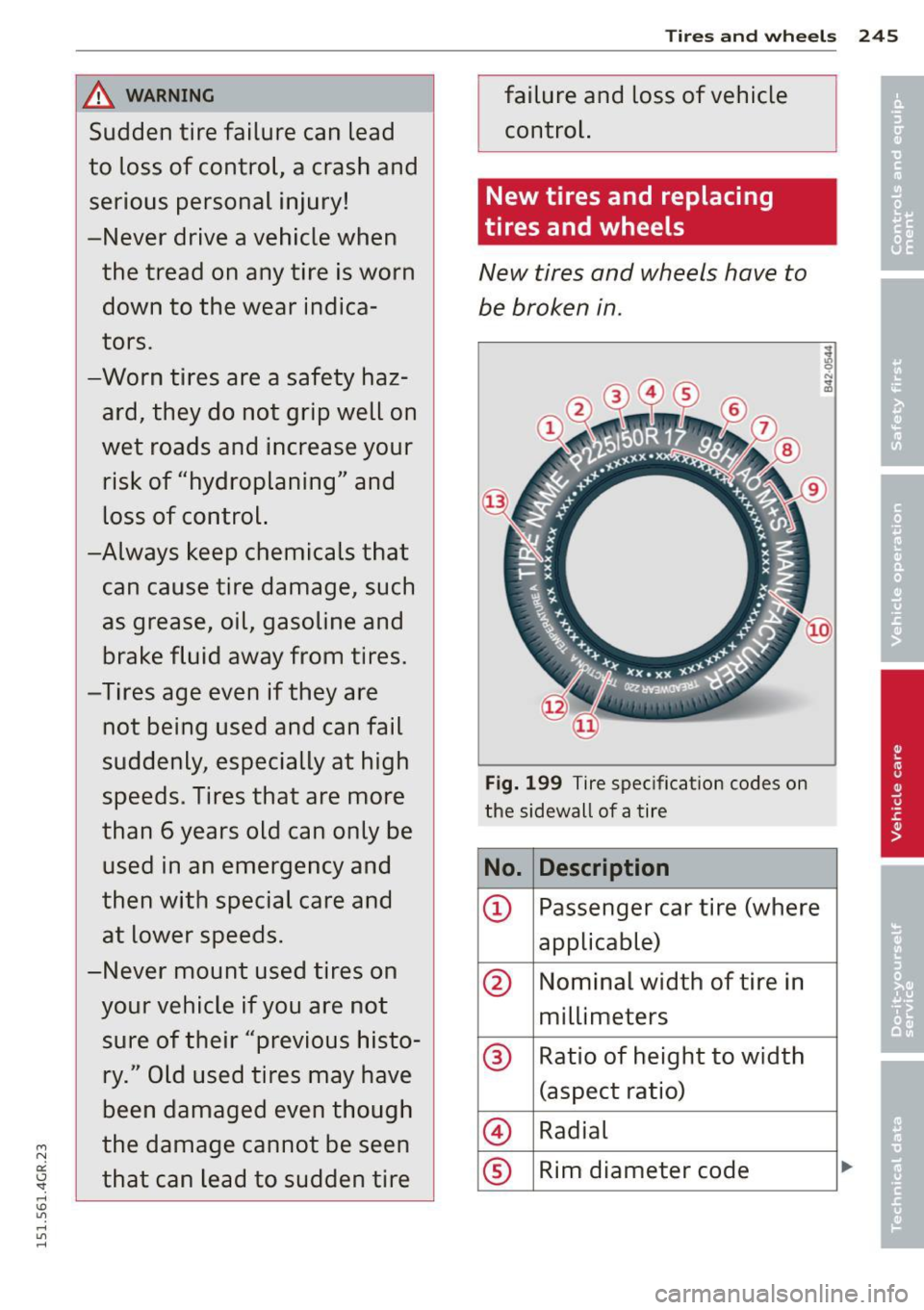
Fig. 199 Tire specification codes on
the sidewall of a tire
No. Description
CD Passenger car tire (where
applicable)
0 Nominal width of tire in
millimeters
® Ratio of height to width
(aspect ratio)
© Radial
® Rim diameter code
Page 251 of 302
Tires and wheels 249
safety and driving characteris- should ever be put in the tire •
tics when used correctly. Your under normal driving condi-• '
authorized Audi dealer will tions.
gladly provide you with more
A WARNING
information.
-Using incorrect or unmatch-
Tire ply composition and ed tires and / or wheels or
materials used improper tire and wheel
The number of plies indicates combinations can lead to
the number of layers of rubber- loss of control, collision and coated fabric in the tire. In gen- serious personal injury.
eral, the greater the number of -Always use tires, rims and
plies, the more weight a tire wheel bolts that meet the
can support. Tire manufactur- specifications of original
ers also must indicate the ma-
factory-installed tires or
terials in the tire, which include other combinations that
steel, nylon, polyester, and oth- have been specifically ap-
ers. proved by the vehicle manu-
Maximum Load Rating
facturer.
-Tires age even if they are
This number indicates the max- not being used and can fail
imum load in kilograms and suddenly, especially at high
pounds that can be carried by speeds. Tires that are more
the tire. than 6 years old can only be
Tire quality grading for used in an emergency and
treadwear, traction, and then with special care and
temperature resistance at lower speeds.
Tread wear, traction and tern- -Never mount used tires on
perature grades¢
page 251. your vehicle if you are not
Maximum Permissible
sure of their "previous histo-
Inflation Pressure ry." Old used tires may have
M been damaged even though N
0:: This number is the greatest <.J
the damage cannot be seen .... 'SI: ,....,
amount of air pressure that \!) 1.1'1 ,...., 1.1'1 ,....,
Page 254 of 302
252 Tire s and wheel s
Sustained high temperature can cause the
materia l of the tire to degenerate and reduce
tire life, and excessive temperature can lead
to sudden tire failure<=>,& .
The grade C corresponds to a level of perform
ance which a ll passenger car tires must meet
under the Federa l Motor Veh icle Safety Stand
ard No.
109. Grades Band A represent higher
levels of performance on the laboratory test
wheel than the m inimum required by law .
A WARNING
The traction grade assigned to this t ire is
based on stra ight-ahead braking traction
tests, and does not include acceleration,
corne ring, hydrop lan ing o r peak traction
character istics .
A WARNING ,.,._____
The temperature grade for this tire is es
tablished for a tire that is p roperly inflated
and not overloaded. Excessive speed, un
derinflation, or excessive loading, either
separate ly or in combination, can cause
heat buildup and possible tire fa ilure.
Winter tires
Winter tires can improve vehicle handling on
snow and ice. At temperatures below 45 °F
(7 °C) we recommend changing to winter
tires .
In some heavy snow areas, loca l governments
may require true winter or "snow" tires, those
with very deeply cut tread. These t ires should
only be used in pairs and be installed on all
four wheels. Make sure yo u purchase snow
tires that are the same size and const ruct ion
type as t he other tires on your ve hicle.
Your veh icle is equipped wit h all -wheel drive,
this will improve tract ion during w inter driv
i ng, even with the standa rd tires. Howeve r, we
strongly recommend that you a lways equ ip a ll
four whee ls o n your ve hicle w ith correctly fit
ted winte r ti res or all -season tires, when win
ter road conditions are expected. This a lso im- proves the vehicle's b
raking performance and
reduces stopping distances.
Summe r tires p rovide less gr ip on ice and
snow.
Winter tires (snow tires) must always be fitted on all four wheels .
Ask your authorized Audi dealer or qualified
workshop for perm itted
winter tire si zes. Use
o n ly rad ial winter t ires .
Winter tires lose their effectiveness when the
tread is worn down to a depth of
0 .157 inch
(4 mm).
Only drive w ith w inter t ires under winter con
ditions. Summer t ires handle better when
there is no snow or ice on the roads and the
temperature is above 45 °F (7 °() .
If you have a flat tire, see notes on replace
ment wheel <=>
page 245.
Please a lways remember that winter tires may
have a lower speed rating than the tires origi
nally installed on your vehicle at the time it
was manufactured. Please see<=>
page 248,
Speed rating (letter code)
fo r a listing of the
speed rating lette r codes and the max imum
speed at which the tires can be d riven .
The speed rating letter code (<=>
page 231) is
on the side wall of the t ire
c> page 245.
A WARNING ,.___
W inter t ires have maximum speed lim its
that may be lower than yo ur vehicle's max
i mum speed. Always know the max imum
speed before dr iv ing off. Never dr ive faster
than the speed permitted for yo ur specific
winter tires . This wi ll ca use damage to the
tires leading to an accident and ser ious
personal injury to you and your passen
gers.
A WARNING
'----
Driving faster than the maximum speed
for which the winter tires on your vehicle were designed can cause t ire failure in
cluding a blowout and sudden deflation,
Page 255 of 302
M N
0:: <.J 'SI: ,...., \!) ..,.,
,...., ..,., ,....,
loss of control, crashes and serious per
sonal injuries . Have worn or damaged tires
replaced immediate ly.
- Winter tires have maximum speed rating
that may be lower than your vehicle's
maximum speed.
- Never drive faster than the speed for
which the winter or other tires installed
on your vehicle are rated.
A WARNING
Always adjust your driving to the road and
traffic conditions. Never let the good ac
celeration of the winter tires and all-wheel
drive tempt you into taking extra risks. Al
ways remember:
- When braking, an all-wheel drive vehicle
handles in the same way as a front drive
vehicle.
- Drive carefully and reduce your speed on
icy and slippery roads, even winter tires
cannot help under black ice conditions.
@) For the sake of the environment
Use summer tires when weather condi
tions permit. They are quieter, do not wear
as quickly and reduce fuel consumption.
Snow chains
Snow chains may be fitted only to the front
wheels, and only to certain tire sizes. Ask your
authorized Audi dealer on which tire sizes
snow chains can be used.
If you are going to use snow chains, then you
must install them on the front wheels at
least.
The snow chains must have low-profile links
and must not be thicker than 0.4 inch (10,5 mm), including the lock.
Remove wheel center covers and trim discs
before putting snow chains on your vehicle
q(D _ For safety reasons cover caps must then
be fitted over the wheel bolts. These are avail
able from authorized Audi dealers.
Tires and wheels 253
A WARNING
Using the wrong snow chains for your vehi
cle or installing them incorrectly can in
crease the risk of loss of control leading to
serious personal injury.
- Snow chains are available in different sizes . Always make sure to follow the in
structions provided by the snow chain
manufacturer.
- When driving with snow chains never
drive faster than the speed permitted for
your specific snow chains.
- Always observe local regulations.
([) Note
-Remove snow chains before driving on
roads not covered with snow to avoid
damaging tires and wearing the snow
chains down unnecessarily.
- Snow chains, which come into direct con
tact with the wheel rim, can scratch or
damage it. Therefore, make sure that the
snow chains are suitably covered. Check
the position of the snow chains after
driving a few yards and correct if neces
sary. Follow the instructions from the
snow chain manufacturer when doing so.
- If the Adaptive Air Suspension* should
malfunction, do not mount or use snow
chains because the vehicle will be ex
tremely low. If you do drive with snow
chains on while the vehicle is at this lev
el, the snow chains might severely dam
age the wheelhouse and other parts of
the vehicle.
(D Tips
Where snow chains are mandatory oncer
tain roads, this normally also applies to
vehicles with all-wheel drive.
•
•
Page 256 of 302
254 Tire s and wheel s
Wheel bolts
Wheel bolts must always be tightened to the
correct torque .
The design of wheel bolts is matched to the
factory installed rims. If different rims are fit
ted, the correct wheel bolts with the r ight
length and correctly shaped bolt heads must
be used. This ensures that wheels are fitted
secure ly and that the brake system funct ions
correctly .
In ce rtain circumstances, you may not use
wheel bolts from a different vehicle -even if it
i s the same mode l
~page 284.
_& WARNING
Improperly tig htened o r maintained whee l
bolts can become loose ca using loss of
contro l, a co llision and serious persona l in
jury.
- Always keep the wheel bolts and the
threads in the wheel hubs clean so the
wheel bolts can turn easily and be prop
erly t ightened.
- Never grease or oil the wheel bo lts and
the threads in the wheel hubs. They can
become loose while driving if greased or
oiled, even if tightened to the specif ied
torque.
- Only use wheel bolts that belong to the
rim being installed.
- Never use different wheels bolts on your
vehicle.
-Always maintain the correct tighten ing
torque for the wheel bo lts to reduce the
risk of a wheel loss. If the tightening tor
que of the wheel bolts is too low, they
can loosen and come out when the veh i
cle is moving. If the tightening torque is
too high, the whee l bolts and threads
can be damaged and the wheel can be
come loose.
@ Note
The spec ified torque fo r the wheel bo lts is
90 ft lb (120 Nm) w ith a tolerance of± 7,4
ft lb(± 10 Nm). Torque wheel bo lts diago- nally
. After changing a whee l, the torque
must be checked as soon as possible with a
torque wrench -preferably by an author
i zed Audi dealer or qualified workshop.
Low aspect ratio tires
Your Audi is factory-equ ipped w ith low aspect
ratio tires . These tires have been thoroughly
tested and been selected specifically fo r your
model for their superb perfo rmance, road fee l
and hand ling under a variety of d riving cond i
tions . As k your au thor ized A udi dealer for
more details .
T he low aspect ratio of these tires is ind icated
by a numera l of
55 or less in the tire's s ize
designation. The numera l represen ts the ratio
of the tire's sidewall height in relation to its
tread width expressed in percentage . Conven
tiona l tires have a height/width ratio of 60 or
more.
The perf orm ance of low- aspect-r atio tire s is
p ar ticu larly s ensitive to improper infl ati on
press ure . It is t here fore im portant that low
as pect rat io tires are infl ated to the spe cified
pre ssure and that the infl ation pressu re is
r e gularl y che ck e d and mainta in ed. Tire pre s
su res should b e check ed at least onc e a
month and alwa ys bef ore a long trip
~page 237, Checking tire pressure.
What you can do to a void tire and rim
damage
Low aspect ratio tires can be damaged more
easily by impact w it h potholes, curbs, gull ies
o r r idges on the road, pa rticularly if the tire is
u nderinfla ted .
In order to minimize the occurrence of impact
damage to the tires of you r vehicle, we recom
mend that you observe the follow ing p recau
tions:
- Always ma inta in recommended inflation
pressures. Check your tire pressure eve ry
2,000 miles (3,000 km) and add air if neces
sary .
- Dr ive carefully on roads with potholes, deep
gullies o r ridges. The impact from dr iv ing ..,.
Page 258 of 302
256 Tire s and wheel s
Description
The tire pressure monitoring system monitors
th e pressure in the four tir es when driving .
The system uses sensors that measure the
temperature and pressure in the tires. Theda
ta is sent from these sensors to the control
module by rad io frequency .
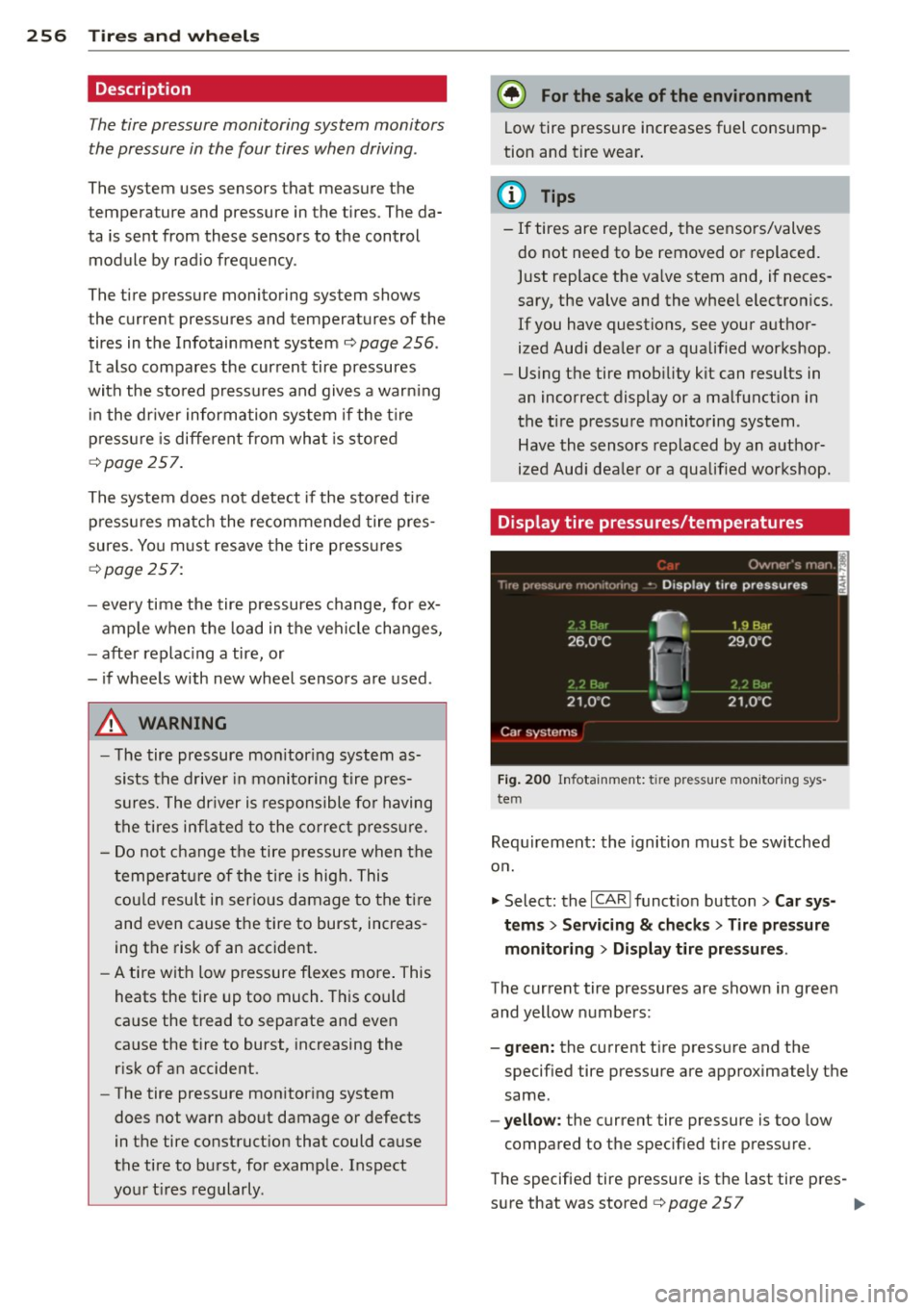
The tire pressure monitoring system shows
the current pressures and temperatures
of the
tires in the Infotainment system
c:> page 256 .
It also compares the current tire pressures
with the sto red press ures and gives a warn ing
in the dr iver information system if the t ire
p ressu re is different from what is sto red
<=:> page 257.
The system does not detect if the sto red ti re
p ressu res matc h the recommended tire pres
sures . Yo u must resave the tire p ress ures
<=:> page 257:
- every time the tire pressures change, for ex
amp le when the load in the veh icle changes,
- after replac ing a tire, or
- i f wheels with new wheel sensors are used .
.,&. WARNING
- The tire pressure mo nitor ing system as
sists t he d rive r in monito ring t ire pres
s ur es. The dr iver is responsible fo r having
the tires in flated t o the co rrec t press ure.
- Do not change t he tire pressu re when the
t empe rat ure of the ti re is high. This
cou ld resul t in ser io us damage to the ti re
and even cause t he tire to burst, increas
ing th e risk of an accident.
- A tire with low pressure flexes more . This
heats the tire up too much. This could
cause the tread to separate and even
cause the tire to burst, increasing the
risk
of a n accident.
- The tire pressure mon itor ing system
does not warn about damage or defects
in the tire construct ion that could ca use
the tire to b urst, for examp le . Inspect
yo ur t ires regularly .
{® For the sake of the environment
Low tire pressure increases fuel consump
tion and tire wear .
(D Tips
- If tires are replaced, the senso rs/valves
do not need to be removed o r replaced.
Just replace the va lve stem and, if neces
sary, the valve and the whee l electronics .
If you have questions, see your a uthor
ized Aud i dea ler o r a qualified workshop .
- Us ing the tire mob ility kit can results in
an incorrect display or a ma lfunction in
t he tire pressure monito ring system .
Have the sensors replaced by an a uthor
ized Aud i dea le r o r a qua lified workshop.
Display tire pressures/temperatures
Fi g. 2 00 In fotainme nt: t ire press ure moni tor ing sys
tem
Requ irement : the ignition must be sw itched
o n .
.,. Select: the
I CAR I funct io n button > Car sy s
tem s
> Servicing & ch eck s > Tire pressure
monitoring
> Disp lay tire pr essures .
The current tire pressures are shown in green
and yellow numbers:
- green: the current tire press ure and the
specified tire pressure are approximately the
same .
-yellow : the current tire pressure is too low
compared to the specified tire pressu re.
The specified tire pressure is th e last tire pres -
s u re that was stored
c:> page 2 5 7 ..,
Page 259 of 302
"' N
a:: I.J "". rl I.O
"' rl
"' rl
Note that the tire pressure also depends on
the tempe rature of the tire . Every 50 °F
(10 °C) increase in tire temperature results in
the tire pressure increasing by approximately
0 .1 bar. The tire pressure increases as the en
g ine becomes warmer while drivi ng .
A WARNING
Read and follow the impo rtant informa
tion and notes
c::> page 2 56.
(D Tips
The tire pressure or temperature are not disp layed i n adaptation mode . Dashes --,-
are show n in p lace o f the pressure and
t em peratur e.
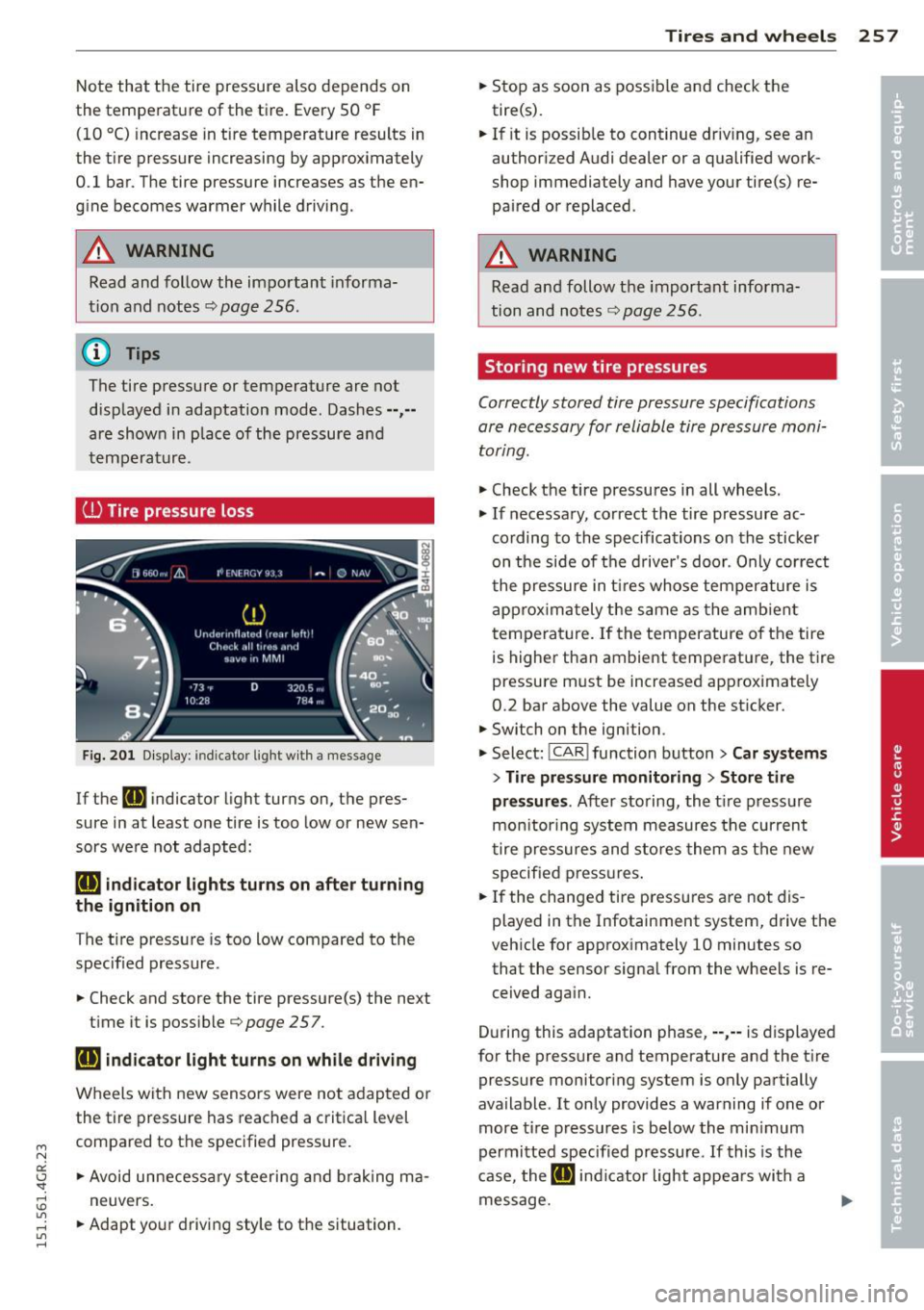
(J) Tire pressure loss
Fig. 201 D isp lay : in dicato r light w it h a message
If the [I] indicator light turns on, t he pres
sure in at least one tire is too low or new sen
sors were not adapted:
[I] indicator lights turns on after turning
the ignition on
The ti re pressu re is too low compared to the
specified pressure .
.. Check and store t he tire pressure(s) the next
time it is poss ible
c::> page 257.
[I] indicator light turns on while driving
Wheels with new senso rs were no t adap ted o r
the tire pressure has reached a critica l level
compared to the specified pressure.
.. Avoid unne cess ary steeri ng and braking m a
neuvers.
.. Adapt yo ur driving style to the s ituation.
Tires and wheels 25 7
.. Stop as soon as poss ible and check the
tire(s) .
.. If it is possib le to continue driv ing, see an
author iz ed Audi dealer or a qualified work
shop immediately and have your tire(s) re
paired or replaced .
A WARNING
Read and follow t he important informa
tion and notes
c::> page 256 .
Storing new tire pressures
-
Correctly stored tire pressure specifications
are necessary for reliable tire pressure moni
toring .
.. Check t he tire pressures in all wheels.
.,. If necessary, correct the tire pressure ac
cording to the specifications on the sticker
on t he side of the d rive r's door . Only correct
t he pressure in t ires whose temperature is
app rox im ately the s ame as th e amb ient
t emperat ure. If the temperature o f the tire
is highe r than ambient tempe rat ure, the t ire
pressure m ust be increased approximately
0.2 bar above the value on the st icker .
.. Switch on the ignition .
.,. Select:
!CAR ! function butt on> Car systems
> Tire pressure mon itoring > Store tire
pressures .
After storing, th e tir e p ress ure
m oni tor ing system measures the cur ren t
t ire pre ssures and st ores them a s the new
specified press ures .
.. If the changed ti re pressu res a re not dis
played in the Infotainment system, drive t he
veh icle for approximately 10 minutes so
that the sensor signa l from the wheels is re
ceived aga in .
D uring this adaptation phase, ··,·· is displayed
for the pressure and temperature and the t ire
pressure monitoring system is only partially
available . It only provides a warning if one or
more t ire press ures is be low the min imum
permi tted specified pr essure . If this is the
case, the
[I] ind ic a tor light appea rs with a
message.